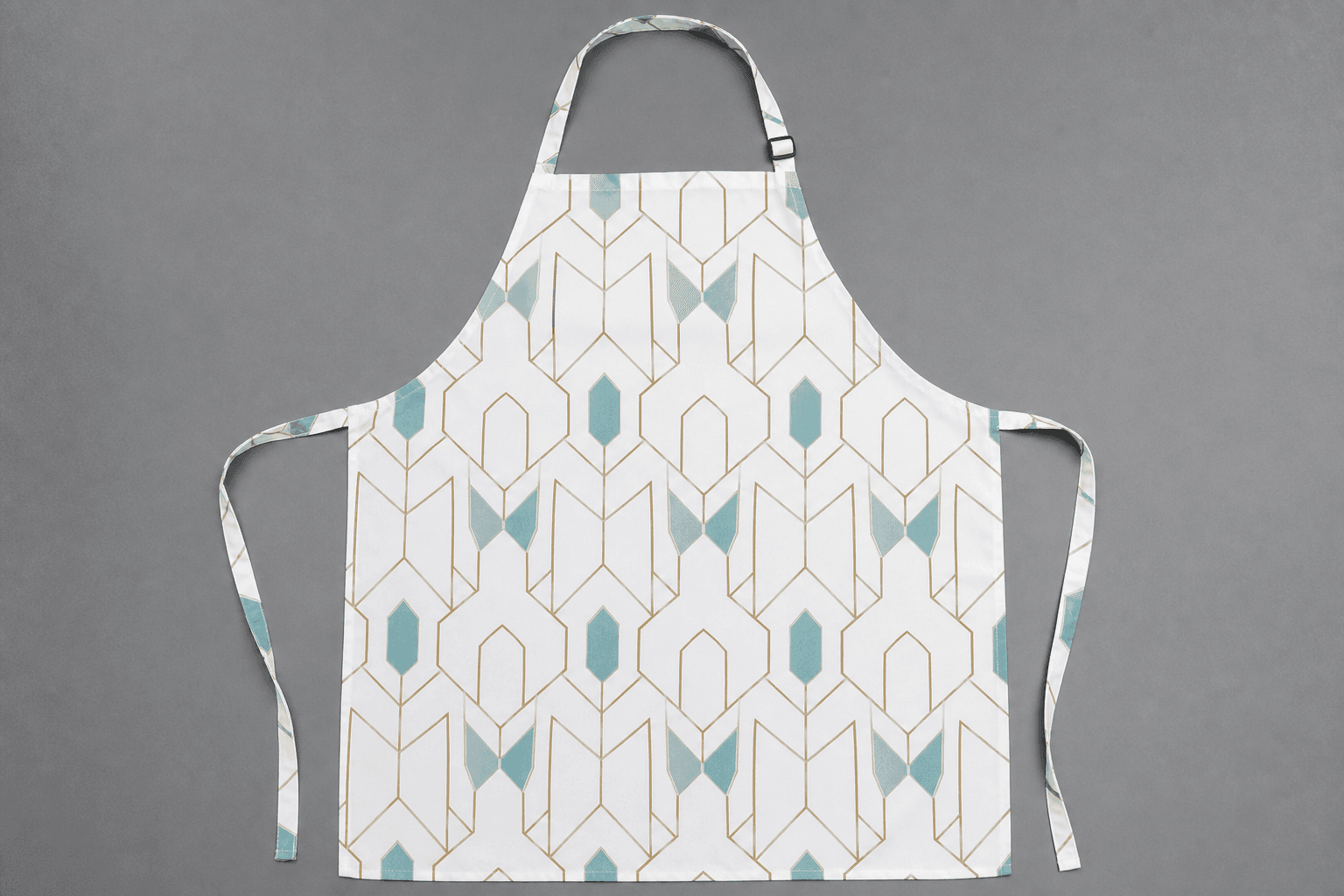
For apron programs, sublimation is often requested when a buyer wants edge-to-edge artwork, photo-style graphics, bright seasonal patterns or many colorways without paying screen charges for each color. In factory terms, a sublimation apron is not simply a normal cotton apron with a printed logo. It is a polyester-based product where the print is transferred into the fiber under heat, usually before cutting and sewing.
This method can be very efficient for an all over print apron, especially when the order needs repeated artwork across bib aprons, waist aprons, cross-back aprons, kids' aprons or promotional cooking aprons. However, it also has firm limitations. Sublimation does not work well on cotton, dark fabric, heavy textured canvas or every style of pocket and binding construction. The buyer needs to decide early whether the artwork should drive the fabric choice, or whether the target handfeel, durability and brand positioning should drive the print method.
Below is a practical supplier-side guide to when dye sublimation apron production is a good choice, when it creates problems, and what details should be confirmed before sampling, quotation and bulk approval.
- Sublimation works best on white or very light polyester, normally 150-260 GSM depending on apron style and price level.
- It is ideal for full-surface artwork, repeat patterns, gradients, photo prints and multiple colorways with the same apron construction.
- It is not suitable for cotton canvas, denim, dark base fabric or high-heat-sensitive trims without changing the product specification.
- Pre-cut sublimation gives better placement control, while roll-to-roll sublimation is more efficient for repeat patterns and larger orders.
- MOQ and lead time depend more on fabric printing setup than sewing, with typical bulk lead time around 25-40 days after sample approval.
- Color approval must be managed by printed fabric swatches, not only by digital artwork viewed on screen.
What a sublimation apron is in factory production
A sublimation apron is made from polyester or a polyester-rich fabric where the artwork is printed on transfer paper and then pressed into the fabric using heat and pressure. In our apron production, the heat press or calendar machine usually runs around 190-205 degrees Celsius, depending on the fabric and paper. The dye turns into gas and bonds with the polyester fiber. This is different from screen printing, pigment printing or heat transfer vinyl, where the print sits more on the surface.
Because the dye becomes part of the polyester, the printed surface keeps a soft handfeel. There is no thick ink layer, no rubbery print edge and no color-count screen charge. This is why buyers often choose sublimation for custom printed apron programs with watercolor artwork, food illustrations, brand patterns, holiday graphics, restaurant uniforms with full-panel designs, or retail kitchen apron collections.
In quotation discussions, the factory normally separates three cost blocks: fabric base, printing process and sewing construction. A basic 180 GSM polyester twill sublimation apron may be much cheaper than a 240 GSM polyester canvas apron with cotton-like texture. A simple neck strap and waist tie construction is faster than cross-back straps with metal buckles. The print itself is only one part of the final $/pc.
- Common fabric weights for promotional sublimation aprons are 150-180 GSM polyester twill or pongee.
- Common fabric weights for retail or workwear-style aprons are 200-260 GSM polyester twill, oxford or polyester canvas.
- Typical heat press settings are around 190-205 degrees Celsius, but exact settings depend on fabric, paper and machine speed.
- The print is usually durable to normal washing because the dye bonds with polyester fiber rather than forming a surface layer.
When a sublimation apron is the right sourcing choice
Sublimation is strongest when the buyer needs visual complexity at controlled cost. A screen-printed apron with one chest logo may be cheaper, but a full floral print, marble texture, photo-style food image or multi-color brand pattern is usually more practical with sublimation. There is no need to open one screen per color, and gradients are easier to reproduce.
For an all over print apron, sublimation also gives better consistency across repeated orders if the fabric, transfer paper, machine profile and artwork file remain the same. This matters for chain restaurants, cooking schools, meal kit brands and retail buyers who reorder the same design by season. If the buyer approves a 200 GSM polyester twill with a defined Pantone target and we keep the same material lot standard, repeat production can be stable enough for commercial programs.
Sublimation is also useful when a buyer wants many SKUs but moderate quantity per SKU. For example, one apron body can be produced in 6 designs for a holiday retail collection. If the order is 600 pcs per design, 3,600 pcs total, sublimation allows the factory to run different prints without changing the sewing line. The cutting and sewing team handles the same construction; only the printed fabric changes.
- Use sublimation for full-panel or edge-to-edge apron artwork rather than a small single-color logo.
- Use sublimation when the design includes more than 4-5 print colors, gradients, shadows or photographic details.
- Use sublimation when multiple colorways share the same apron pattern and fabric quality.
- Use sublimation for lightweight retail, promotional, hospitality, cooking class and seasonal apron programs where polyester is acceptable.
When sublimation does not work well on aprons
The most common misunderstanding is asking for sublimation on cotton canvas. Standard sublimation dye does not bond properly with cotton fiber. A 100% cotton apron can be pigment printed, reactive printed, digitally printed with suitable pretreatment or screen printed, but it is not a normal dye sublimation apron. Some suppliers may offer sublimation coating on cotton, but for bulk apron sourcing we do not recommend it for serious retail or workwear use because wash durability and handfeel can be unstable.
Dark base fabric is another limitation. Sublimation ink is transparent. It does not print white ink, and it does not cover a dark ground. If the base fabric is black, navy, charcoal or burgundy, sublimation colors will disappear or shift heavily. The correct base is white, off-white or very light polyester. If the final design has a black background, the practical method is to print black onto white polyester, not to print colors onto black fabric.
Heavy textured apron fabrics can also create issues. A rough 320 GSM canvas-like polyester may not receive fine detail evenly, especially along slub texture or thick yarns. Thick seams, large pockets and folded bindings are difficult to sublimate after sewing because the heat plate cannot apply uniform pressure across uneven layers. This is why most apron sublimation is done on fabric before sewing, or on cut panels before assembly.
- Avoid sublimation if the required apron must be 100% cotton, cotton denim, linen or cotton-rich canvas.
- Avoid sublimation if the buyer needs a dark dyed base fabric with a light print on top.
- Avoid sublimation for very heavy, rough or uneven fabrics where fine artwork clarity is important.
- Avoid sublimating finished aprons with bulky pockets, metal parts, thick seams or uneven layers.
- Avoid high-temperature sublimation if trims, elastic, PU patches or coated components cannot tolerate around 200 degrees Celsius.
Fabric choices for polyester apron print programs
The fabric selection has a large effect on both cost and customer perception. A 150 GSM polyester pongee apron can be suitable for giveaways, painting events or short-term promotions, but it will not feel like a serious kitchen or bar apron. A 200-220 GSM polyester twill is a common middle point for custom printed apron orders because it gives better drape, opacity and durability while keeping the print surface smooth.
For buyers who dislike the shiny look of cheap polyester, the factory can offer matte polyester twill, peach-finished polyester, polyester-cotton-look canvas or cationic polyester options. These fabrics cost more, but they make a sublimation apron look less like a disposable promotion item. A 240 GSM matte polyester canvas can be suitable for retail kitchen aprons if the design is strong and the buyer accepts synthetic fiber content.
Fabric width also affects consumption. Many printed polyester fabrics are 150 cm wide before finishing. A standard adult bib apron around 70 x 80 cm can usually be nested efficiently, but large cross-back aprons, wrap aprons or styles with wide waist ties may increase wastage. For all over print apron projects, artwork repeat and marker planning should be checked together, because a beautiful pattern can become expensive if the repeat forces inefficient cutting.
- 150-180 GSM polyester is usually used for budget promotional aprons and event aprons.
- 190-220 GSM polyester twill is often used for mid-range retail, cooking class and hospitality aprons.
- 230-260 GSM matte polyester canvas or oxford is used when the buyer wants a stronger handfeel and better opacity.
- White and light ivory bases give the cleanest sublimation color result, while colored polyester bases reduce color accuracy.
- Fabric with a smooth surface gives sharper detail than heavy slub, raised texture or brushed surfaces.
Artwork placement: roll printing, panel printing and all over print apron control
There are two main production routes for apron sublimation. The first is roll-to-roll fabric printing, where the artwork repeat is printed continuously on fabric, then the apron pieces are cut and sewn. This is efficient for repeat patterns such as stripes, fruits, florals, coffee icons, abstract textures and brand motifs. It is also practical for higher-volume orders because printing speed and fabric handling are efficient.
The second route is cut-panel or piece sublimation, where each apron front panel is printed with controlled placement. This is better when the design has a centered logo, a chest graphic, a border, a faux pocket print or artwork that must align with the neckline and hem. It gives better visual control but increases labor, setup and rejection risk. If the buyer requires exact placement within plus or minus 5 mm, panel printing is normally safer than roll printing, but the unit cost is higher.
Pocket handling needs early decision. If the pocket should disappear into the pattern, it can be cut from the same printed fabric, but perfect pattern matching is not guaranteed unless the pocket is panel printed or manually cut with extra wastage. If the pocket carries separate artwork, the pocket panel should be printed separately before sewing. Trying to print over a sewn pocket after assembly often causes pale areas around pocket edges and seam shadows.
- Choose roll-to-roll sublimation for repeat patterns where exact placement is not critical.
- Choose panel sublimation for centered artwork, borders, large logos or designs that must align with apron shape.
- Allow normal cutting and sewing tolerance of around plus or minus 5-10 mm unless a stricter tolerance is costed and approved.
- Confirm whether neck straps, waist ties, pockets and binding use printed fabric, plain matching fabric or contrast fabric.
- Do not assume pattern matching across pockets and apron body unless the quotation includes extra fabric consumption and manual alignment.
Cost, MOQ and lead time for dye sublimation apron orders
For a simple adult bib sublimation apron in 180-200 GSM polyester twill, bulk pricing from a China apron factory may often sit around USD 1.80-3.20 per piece for medium quantities, depending on size, pocket, strap type, packing and fabric market price. A heavier 240 GSM matte polyester canvas apron with cross-back straps, metal hardware and individual retail packing can move into the USD 3.80-6.50 per piece range. These are not fixed offers, but they show the cost gap between promotional and retail construction.
MOQ is usually controlled by print setup and fabric procurement. For digital sublimation, a practical MOQ can start around 300-500 pcs per design for simple styles if fabric is in stock. For better fabric qualities or custom base fabric, the factory may request 1,000-2,000 pcs per color or design. Small orders are possible, but the unit cost rises because sampling, artwork checking, transfer paper waste, cutting setup and QC time do not reduce proportionally.
Lead time should be counted from final artwork, sample approval and deposit, not from the first inquiry. A realistic timeline is 5-7 days for digital mockup and material confirmation, 7-10 days for printed sample making, 3-5 days for buyer review if courier transit is required, and 25-40 days for bulk production after approval. During peak season before Christmas, Mother's Day, summer barbecue programs or large hospitality launches, buyers should add at least 7-14 days of buffer.
- Sample lead time is commonly 7-10 days after artwork and fabric are confirmed.
- Bulk lead time is commonly 25-40 days after sample approval for normal quantities.
- Practical MOQ is often 300-500 pcs per design for stock polyester fabrics and simple apron styles.
- Custom fabric quality, special GSM or many separated prints can push MOQ to 1,000-2,000 pcs per design.
- Retail packing, barcode labels, hang tags and carton marking should be confirmed before final quotation, not after bulk sewing starts.
Color, testing and quality control for a sublimation apron
Color control is one of the most important areas for sublimation sourcing. The color seen on a laptop screen is not a production standard. The buyer should provide Pantone references where possible, but even Pantone matching has limits because sublimation is affected by fabric whiteness, polyester yarn, transfer paper, humidity, heat setting and machine profile. For serious programs, the approval should be based on printed fabric strike-offs or a full apron sample.
A normal acceptable color tolerance for commercial apron orders is often around 80-90% visual match to the approved sample, unless the buyer has a formal lab dip or spectrophotometer requirement. Very bright neon orange, deep black, saturated red and certain blues need special attention. Black backgrounds can print well on white polyester, but if the fabric is thin, the reverse side may remain white and show at strap edges or seam turnings.
Quality control should check both print and sewing. For print, inspectors look for banding, ghosting, paper marks, color shift, white spots, stains and repeat direction errors. For sewing, they check size tolerance, strap length, pocket placement, seam strength, loose threads and carton assortment. A sublimation apron with beautiful artwork but weak stitching will still fail in restaurant, cooking school or retail use.
- Approve color using a printed strike-off or pre-production sample, not only a JPG or PDF.
- Check artwork at actual size, especially small text, fine lines and logos near pocket seams.
- Use washable care labels and confirm whether the apron is machine washable at 30 or 40 degrees Celsius.
- Request color fastness to washing and rubbing tests when the apron is for retail or uniform use.
- Keep one approved sample at the factory and one with the buyer to reduce disputes during final inspection.
How to specify a custom printed apron before asking for quotation
The fastest way to receive an accurate quotation is to provide a complete apron specification. If the buyer only says "polyester apron print" or sends artwork without size, GSM or packing details, the factory must make assumptions. Those assumptions can make the first price look attractive but unreliable. A serious RFQ should define apron style, finished size, fabric weight, pocket design, strap construction, artwork method, quantity per design, packing and testing requirements.
For sublimation, artwork files should be supplied in AI, PDF, PSD or high-resolution TIFF format, with embedded or outlined fonts. For all over print apron programs, the artwork repeat should be confirmed and the factory should check whether it works with the cutting marker. For panel printing, the buyer should provide a placement drawing showing key distances from neckline, side seam, pocket edge and bottom hem.
It is also useful to state the commercial purpose. A 10,000 pc supermarket promotion, a 1,200 pc boutique kitchenware program and a 500 pc restaurant uniform order may all use sublimation, but they should not use the same fabric, QC level or packing. When the buyer gives the sales channel and target retail price, the factory can recommend a more realistic specification instead of quoting the cheapest possible apron.
- Provide finished apron size, such as 70 x 80 cm for adult bib apron or the exact buyer pattern.
- State fabric requirement by composition and GSM, for example 100% polyester twill, 200 GSM.
- Confirm quantity per design, total quantity and expected repeat order volume.
- Send artwork at actual scale with Pantone targets or approved color references.
- Specify pocket size, strap length, buckle type, label position, packing method and carton requirements.
- Confirm any testing standards, such as REACH, AZO-free dye, color fastness, needle detection or customer-specific inspection rules.