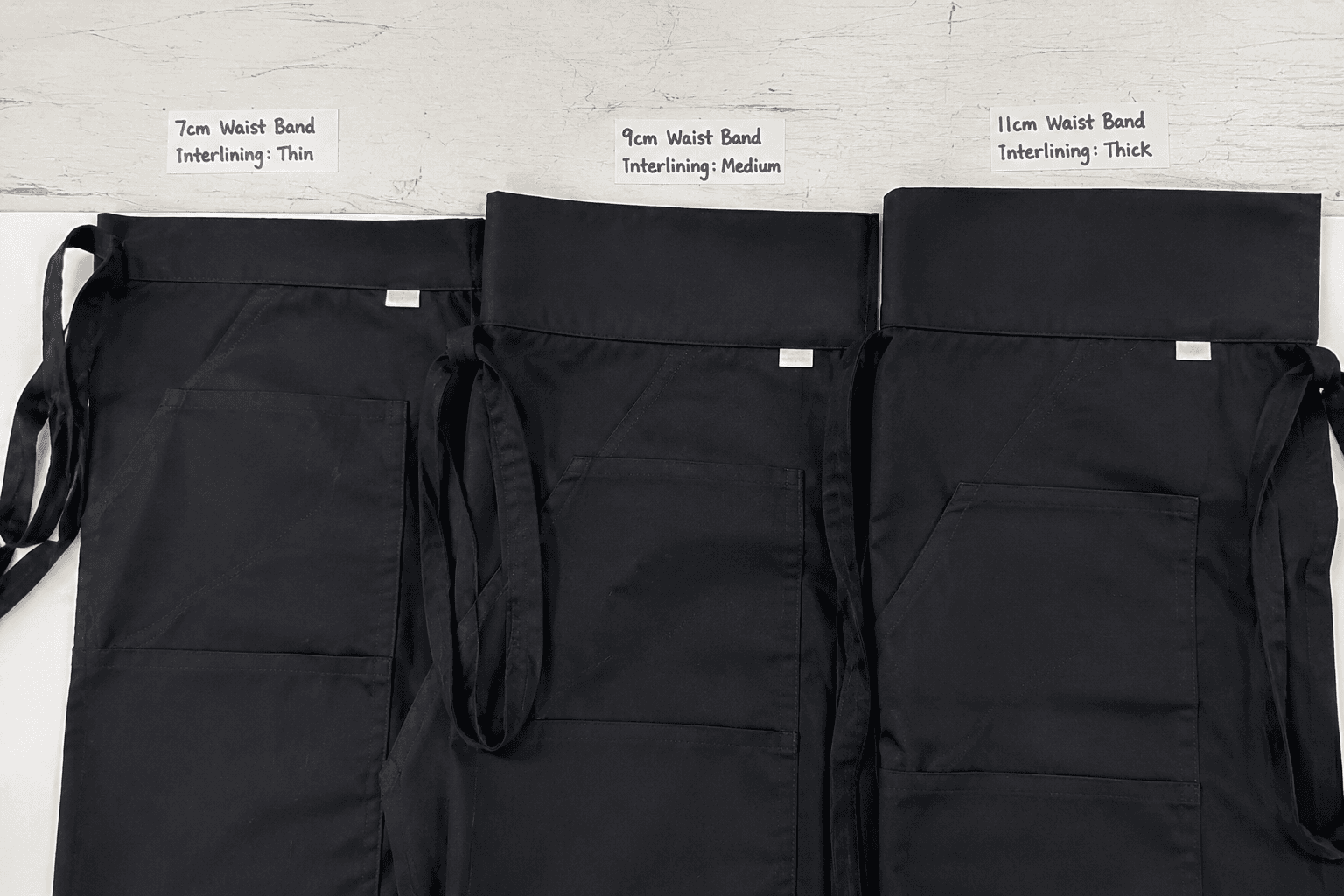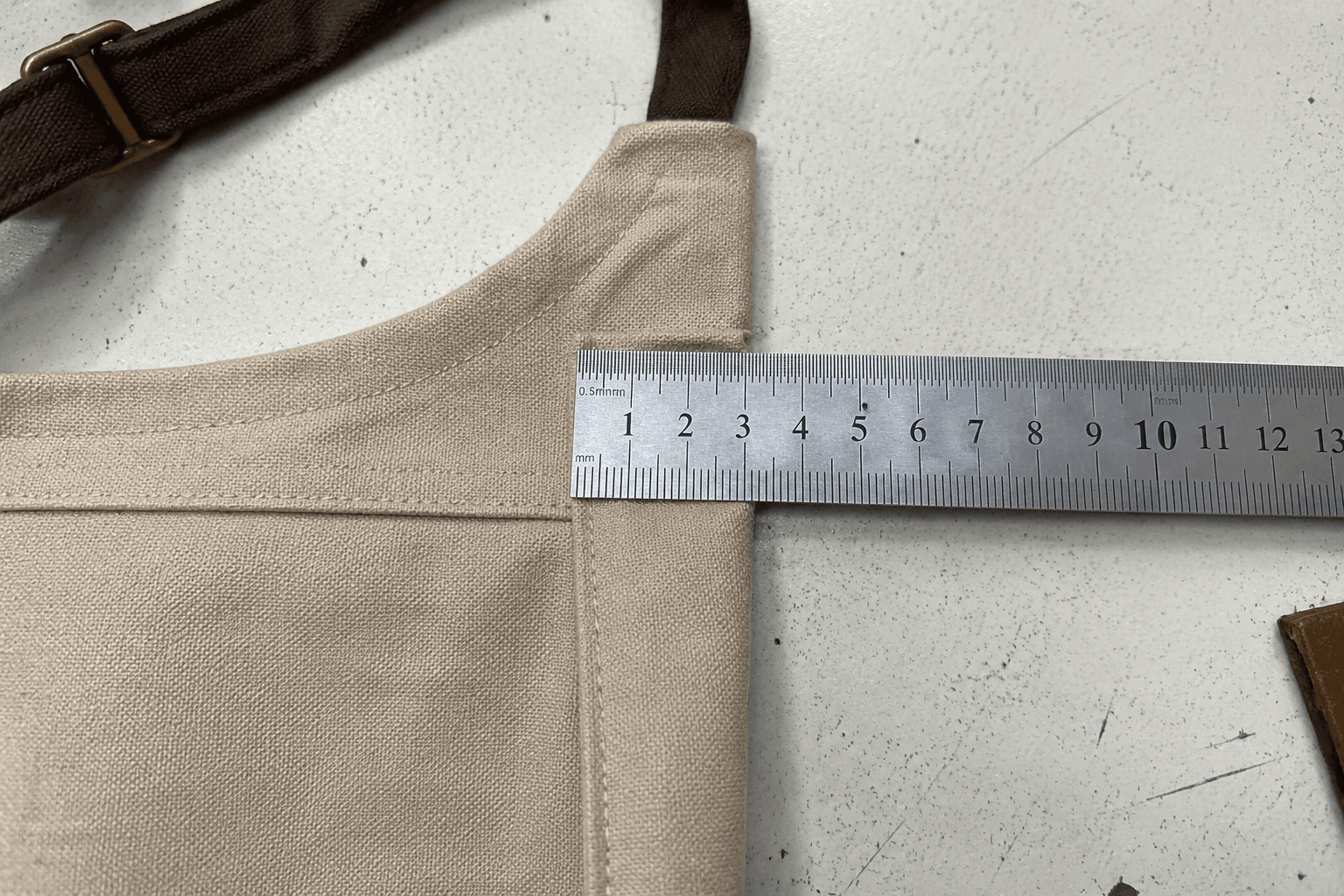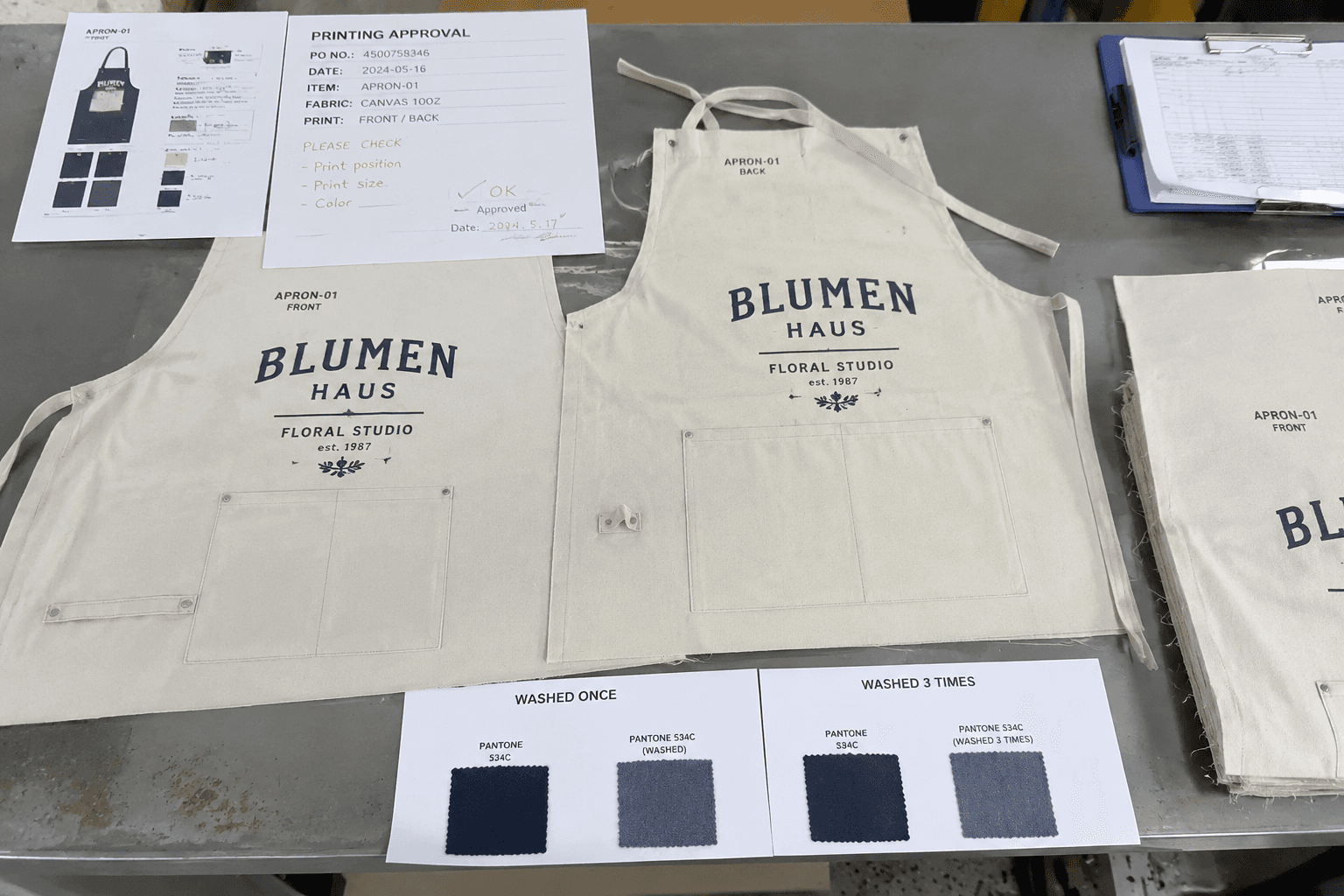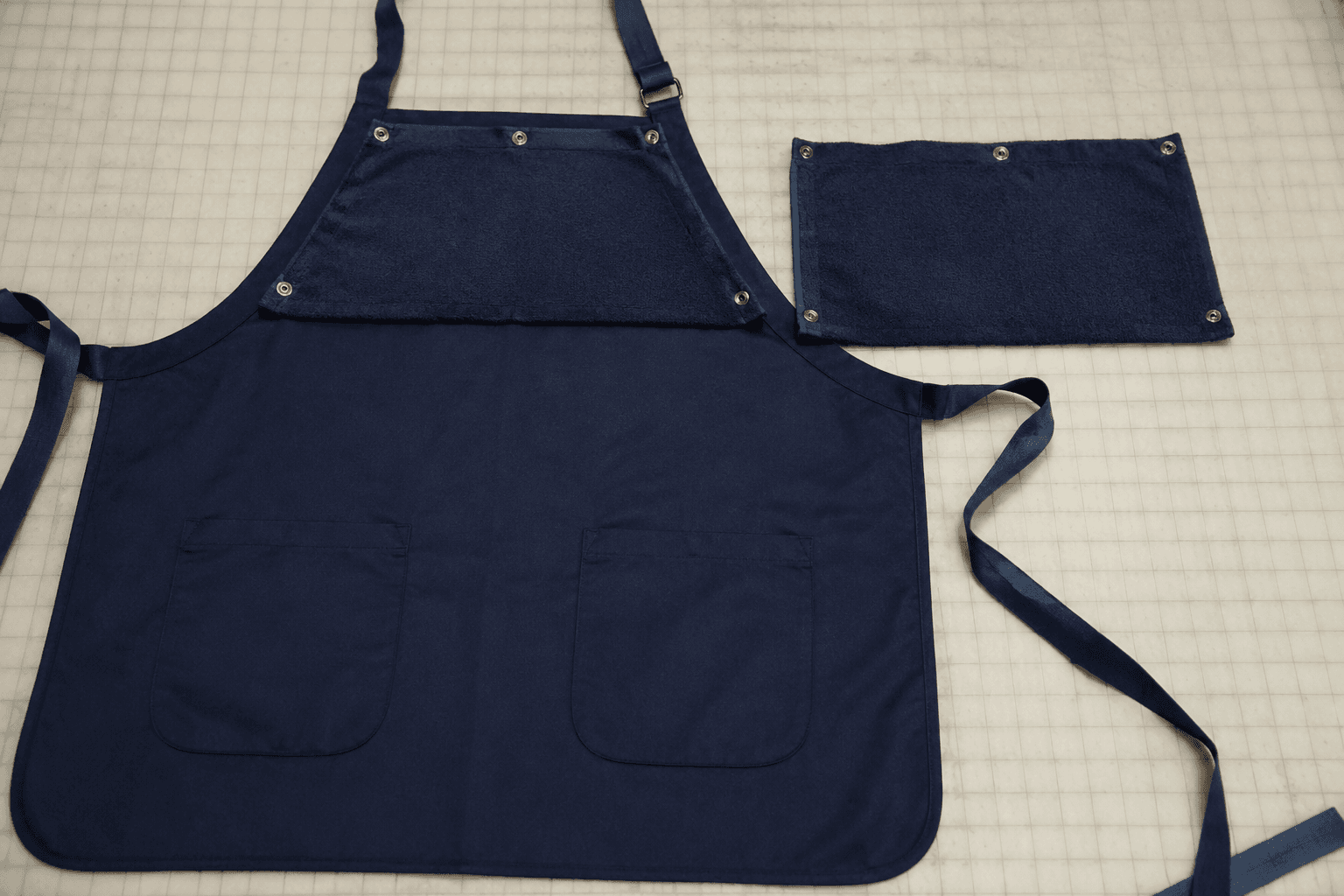
In cafés, bakeries, bars, hotel kitchens and catering operations, the towel usually reaches its soil limit before the apron body. A snap off towel apron separates those wear cycles: the apron maintains coverage and brand presentation for a 6-8 hour shift, while the removable towel handles hand drying, flour wiping, glass polishing, tray handling or minor spill control.
For B2B buyers, the detachable towel is not a decorative trim. Two samples can look identical in a sales photo but behave differently after 20-50 commercial wash cycles if towel GSM, snap plating, reinforcement, shrinkage control and laundry conditions are not defined in the tech pack. A towel that twists, sheds lint, rusts at the snaps or no longer aligns with the apron body becomes a replacement-cost problem and a store-level complaint.
This guide focuses on practical OEM specifications for apron sourcing teams: fabric weights, towel dimensions, snap construction, hygiene controls, spare towel planning, AQL inspection points, FOB China price ranges, MOQ and realistic lead times.
- A snap off towel apron should be sourced as a system: apron body, removable towel, snaps, reinforcement, care label, spare towel ratio and replacement SKU.
- Commercial wash testing should run at least 20 cycles for light-duty programs and 50 cycles for restaurant, hotel or uniform-rental programs exposed to daily laundering.
- Cotton terry at 300-450 GSM is absorbent but bulky; cotton waffle at 220-300 GSM dries faster and is usually cleaner for front-of-house presentation.
- Most foodservice operators need 2-4 towels per apron body, not one towel per apron.
- Nickel-free brass or stainless steel snaps reduce corrosion risk compared with low-cost iron snaps in frequent-wash environments.
- Typical FOB China pricing for a custom apron with one detachable towel ranges from USD 5.20 to USD 9.50 per piece; spare towels usually range from USD 0.60 to USD 1.80 each.
- For inspection, use AQL 2.5 for major defects and AQL 4.0 for minor defects, with sharp hardware, rust, missing snaps, non-functional snaps and severe dye bleeding treated as zero-tolerance defects.
When a snap off towel apron reduces full-apron changes
The strongest use case for a snap off towel apron is uneven soil exposure. At a bakery counter, espresso bar, kitchen pass or cocktail station, the apron body may remain presentable for a full 6-8 hour shift while the towel becomes wet, flour-coated or visibly stained within 1-3 hours. If the towel is fixed, the full apron must be replaced or laundered. If the towel detaches, staff can exchange only the high-soil component.
This matters when the buyer is trying to control both hygiene and uniform appearance. A black 10 oz cotton canvas bib apron can still look serviceable at midday, but a light grey towel may show milk, sanitizer, oil or sauce after the morning rush. Separating the towel reduces unnecessary full-apron changes and lets uniform managers replenish the part that wears fastest.
The system is not suitable for every account. It requires spare towel inventory, compatible snaps across repeat orders, clear laundry sorting and department-level issue control. If the operator cannot track replacement towels, detachable parts may become mismatched, lost or unavailable during service. Buyers should define the towel ratio, spare packing and reorder SKU during development, not after the first shipment reaches stores.
- Use this construction when towel soil exposure is heavier than apron-body soil exposure.
- Avoid it when the end user cannot manage spare towel inventory or snap compatibility.
- Specify snap position before pattern approval because reinforcement changes cutting and sewing.
- Plan spare towels in the first purchase order instead of treating them as a later accessory reorder.
- Use separate SKUs for apron bodies and replacement towels when towels will be replenished more frequently.
Snap off towel apron fabric specs: GSM, towel size and drying speed
The towel fabric should be selected by function, not by hand feel alone. Bar programs need low lint and glass-polishing performance. Bakeries need flour release and frequent shaking. Kitchens need absorbency, heat tolerance and quick replacement. Coffee chains need a towel that dries quickly and does not look dirty after one hour on the line.
Cotton terry at 300-450 GSM offers strong absorbency and a familiar towel texture, but it becomes heavy when wet and increases carton volume. Cotton waffle at 220-300 GSM dries faster, looks cleaner on premium hospitality aprons and normally shrinks less when properly finished, but it holds less liquid than terry. Herringbone cotton at 220-280 GSM gives a flatter, more tailored appearance for polishing and light hand drying. Microfiber terry at 200-280 GSM can work for glassware, although some buyers avoid it near heat or where the brand requires natural fibers.
For most OEM apron programs, practical finished towel sizes range from 25 x 35 cm to 35 x 50 cm. A 25 x 35 cm towel keeps cost and movement low for servers and baristas. A 30 x 45 cm towel is a balanced first sample for cafés, bakeries and casual dining. A 35 x 50 cm towel gives chefs more usable surface but normally needs three snap points and stronger reinforcement.
Shrinkage must be reviewed with the apron body. A 280 GSM cotton twill apron body may shrink 2-3 percent after approved washing, while untreated cotton waffle can shrink 5-8 percent. If shrinkage is not stabilized before bulk production, the towel may twist, curl at the edges or no longer align with snap positions after laundering.
- 300-450 GSM cotton terry: best for high absorbency, with longer drying time and higher carton volume.
- 220-300 GSM cotton waffle: suitable for front-of-house use where drying speed and appearance matter.
- 220-280 GSM herringbone cotton: suitable for polishing and lighter towel functions.
- 200-280 GSM microfiber: useful for glass polishing, subject to heat exposure and brand requirements.
- 30 x 45 cm in 260 GSM cotton waffle is a practical first sample for many café and bakery programs.
Snap hardware, placement and reinforcement that survive service
The towel attachment is a common failure point because stress is concentrated around a small area. A towel that releases too easily slows staff down. A towel that is too hard to remove can tear the towel hem or distort the apron body. The sourcing target is repeatable opening and closing after wash testing, not maximum snap strength on an unused sample.
Most detachable towel aprons use two or three snaps. Two snaps are normally enough for towels up to 30 cm wide. Three snaps are better for towels above 35 cm wide, heavier terry towels or kitchen programs where staff pull the towel frequently. Common cap diameters are 10-12.5 mm. Snap spacing is usually 8-12 cm, depending on towel width, hanging position and whether replacement towels must fit multiple apron sizes.
Hardware material affects complaint rates. Basic iron snaps may reduce cost by about USD 0.03-0.08 per set, but rust risk rises when towels are washed at 60 degrees Celsius, held damp or dried incompletely. Nickel-free brass snaps are a safer default for hospitality uniforms. Stainless steel snaps cost more but are preferred for uniform rental, seafood kitchens, hotels and humid operating environments.
Reinforcement should be built into both sides of the system. On the apron body, use a hidden backing patch, folded facing or bar-tacked reinforced panel at the snap area. On the towel, snaps should be set through a hemmed edge or reinforced tab, not through one loose layer of terry pile. Without reinforcement, the fabric often fails before the hardware does.
- Use two snaps for 25-30 cm towels and three snaps for 35-50 cm towels.
- Keep snap spacing consistent across all sizes if replacement towels must fit existing apron bodies.
- Specify nickel-free brass or stainless steel snaps for frequent commercial laundering.
- Add a backing patch behind apron snap points to prevent puckering and fabric distortion.
- Check snap operation after 20 open-close actions before wash testing and again after wash testing.
Commercial laundry testing for a snap off towel apron
A washable snap off towel apron must be tested as a complete product. Approving apron fabric and towel fabric separately is not enough. The wash result depends on shrinkage, dye migration, lint transfer, snap corrosion, edge curling and whether the towel still hangs correctly after repeated attachment and removal.
For light retail-style or low-frequency use, 20 wash cycles is a reasonable minimum. For restaurant, hotel, catering and uniform-rental programs, 50 cycles is a better approval target. Typical conditions are 40-60 degrees Celsius washing, medium tumble drying and standard detergent without chlorine bleach unless bleach resistance is required. If the account uses industrial laundry, the buyer should provide wash temperature, drying temperature, detergent type, dosing level and finishing process before sampling.
Colorfastness matters because the towel may sit against the apron body while damp. Dark towels on natural, white or khaki aprons need testing for colorfastness to washing and wet rubbing. White towels on black, navy or indigo aprons need lint-transfer review. A white terry towel can leave visible lint on a black twill apron unless it is pre-washed, compacted or made with a lower-lint yarn.
Care labeling should match the tested construction. If the apron body can tolerate 60 degrees Celsius but the snap plating cannot, the product should not be sold as a 60-degree system. For multi-store B2B programs, include a short laundry instruction sheet in the master carton, especially when replacement towels are packed separately from apron bodies.
- Use 20 wash cycles for light-duty programs and 50 cycles for commercial uniform programs.
- Test the apron body and towel together for shrinkage, twisting and snap alignment.
- Check colorfastness to washing and wet rubbing when dark towels touch light apron bodies.
- Check lint transfer when white cotton towels are paired with black, navy or indigo aprons.
- Set practical shrinkage targets of within 3 percent for the apron body and within 5 percent for the towel after approved washing.
Hygiene controls and replacement towel ratios by operation
A detachable towel apron does not automatically improve hygiene. It helps only when the operator controls towel use and replacement frequency. The same towel should not be used for hand drying, food-contact surface wiping and floor spill cleanup. If strict separation is required, the product design and packing plan must support that rule.
Color coding is the simplest control. White towels can be assigned to glass polishing, grey towels to hand drying and navy towels to general counter wiping. Another option is position control: one snap-off towel on the right side for hand drying while surface cloths are stored separately. The apron should not become a storage point for contaminated towels after they are removed.
Replacement ratios should be calculated by shift pattern, not by product photography. One towel per apron is rarely enough for foodservice. A practical starting point is 1 apron body to 2 towels for light front-of-house service, 1:3 for barista, bakery and casual dining programs, and 1:4 for kitchens, catering or high-spill environments. A 500-apron café rollout may therefore require 1,500 towels in the first shipment.
Lifecycle cost usually supports the spare towel model. If a custom apron body costs USD 6.20 and a spare towel costs USD 0.85, replacing towels frequently is cheaper than increasing full-apron inventory. If the towel includes embroidery, a woven logo label, custom dyeing or premium stainless snaps, the spare towel price may move to USD 1.20-1.80. Buyers should request apron and towel prices as separate line items.
- Use a 1:2 towel ratio for light front-of-house use.
- Use a 1:3 ratio for café, bakery, barista and casual dining programs.
- Use a 1:4 ratio for kitchens, catering, hotels and high-spill operations.
- Pack replacement towels by color and size so restaurant or hotel storerooms can issue them correctly.
- Avoid antimicrobial finish claims unless wash durability, local regulations and label wording have been verified.
Cost, MOQ and lead time for bulk sourcing
A snap off towel apron costs more than a standard apron because it adds towel fabric, metal hardware, reinforcement labor, snap setting, compatibility checks and more complex packing. For a mid-weight cotton canvas, cotton twill or poly-cotton bib apron with one detachable towel, typical FOB China pricing ranges from USD 5.20 to USD 9.50 per piece. The lower end usually assumes stock fabric, simple labels and standard snaps. The higher end may include 10 oz custom-dyed cotton canvas, premium towel fabric, embroidery, woven labels, nickel-free brass snaps and individual retail packing.
Spare towels commonly range from USD 0.60 to USD 1.80 each. A stock 260 GSM waffle towel with standard snaps may be near the low end. A 380 GSM terry towel with custom color, woven label and stainless snaps will be closer to the high end. Buyers should confirm whether the spare towel price includes snap hardware, labels, folding, polybagging and carton labeling.
MOQ is controlled by the most restrictive component. If the apron body uses stock black TC twill and the towel uses stock white waffle cotton, a factory may support 300-500 pieces per color. If the apron is custom dyed 10 oz cotton canvas and the towel needs Pantone dyeing, MOQ is more likely to be 1,000-3,000 pieces per color. Logo-engraved snaps usually require mold charges and are most practical above 3,000-5,000 units.
A realistic China sourcing timeline includes more than sewing time. Allow 5-7 days for material confirmation and pattern adjustment, 7-12 days for prototype sampling, 5-10 days for limited wash review, and 25-40 days for bulk production after sample approval and deposit. If towel fabric requires custom dyeing, compacting or special finishing, add 10-20 days. If the buyer requires a full 50-cycle wash test before production, the calendar must be extended.
- Stock fabric programs may start at 300-500 pieces per color, depending on factory capacity and trim availability.
- Custom-dyed apron or towel fabric commonly requires 1,000-3,000 pieces per color.
- Logo snaps are usually cost-effective only above 3,000-5,000 units.
- Normal bulk production after approval is typically 25-40 days.
- Custom towel dyeing, compacting or special finishing can add 10-20 days.
Tech pack and AQL checkpoints for replacement towel systems
A clear tech pack prevents most detachable-towel failures. A reference photo is not enough for production. The factory needs apron fabric, towel fabric, GSM or oz weight, finished towel size, snap type, snap cap size, snap spacing, reinforcement method, care label, spare towel ratio, packing format and replacement SKU details.
The approval sample should be reviewed after handling, not only when it is clean from the sewing room. Before bulk approval, attach and remove the towel at least 20 times, then check whether snap caps rotate, whether the towel hem tears, whether the apron body puckers and whether the towel hangs straight. After wash testing, repeat the same review. Any change in snap supplier between sample and bulk should trigger a compatibility check.
For final inspection, a common garment standard is AQL 2.5 for major defects and AQL 4.0 for minor defects. Critical defects should have zero tolerance. For this product type, critical issues include sharp hardware, missing snaps, non-functional snaps, visible rust, severe dye bleeding and wrong towel color packed with the apron. Major defects include snap misalignment, towel size outside tolerance, weak reinforcement, open seams and stains. Minor defects include slight thread ends, small measurement deviations within tolerance and minor folding inconsistency.
Repeat orders need controlled measurements. The distance from apron edge to snap center, distance between snaps and towel finished width must remain consistent. This is the only way replacement towels from the second or third order will fit apron bodies already in the field.
- State apron fabric clearly, such as 240 GSM TC twill, 280 GSM cotton twill or 10 oz cotton canvas.
- State towel fabric clearly, such as 260 GSM cotton waffle or 380 GSM cotton terry.
- Define towel size, snap quantity, snap spacing and finished hanging position with centimeter measurements.
- Specify snap material, plating, nickel-free requirement and corrosion-resistance expectation.
- Use AQL 2.5 for major defects, AQL 4.0 for minor defects and zero tolerance for sharp, rusty or non-functional hardware.
- Define packing, such as one apron with one towel attached plus two spare towels in the same polybag.