Apron waistband height and stiffness: comfort trade-offs for waist and bistro aprons
In bulk apron sourcing, buyers often specify fabric color, logo method, pocket layout, and carton packing before they define the waistband. That order creates avoidable risk. Apron waistband construction determines whether the top edge lies flat, whether a loaded pocket panel rolls, and whether staff feel pressure at the waist during 8-12 hour shifts.
For waist aprons and bistro aprons, the trade-off is practical rather than cosmetic. A taller, firmer band can support a 70-90 cm bistro panel and keep the front edge clean after laundering. The same construction can feel restrictive when tied tightly over a thin shirt. A softer band moves with the body, but it may twist under 300-700 g of pocket load or collapse after repeated commercial washing.
A reliable apron specification connects finished waistband height, shell fabric GSM, interlining GSM, seam allowance, tie width, reinforcement, post-wash shrinkage, and inspection criteria. A 4 cm band in 235 GSM 65/35 poly-cotton twill with 40 GSM woven fusible performs very differently from a 7 cm band in 300 GSM cotton canvas with 80 GSM fusible. Buyers who confirm these details before PP approval reduce remake claims, shipment delays, and repeat-order variation.
- Treat apron waistband construction as a functional production specification, not a visual note such as wide band or stiff band.
- Short waist aprons usually perform best with a 3.5-4.5 cm finished waistband; long bistro aprons often need 5-7 cm for panel support.
- For 200-240 GSM service twill, 30-50 GSM woven fusible is a practical starting range for balanced stiffness.
- Very stiff waistbands can create pressure at the side waist and tie insertion; very soft bands can roll under loaded pockets.
- Post-wash testing should include at least 5 industrial wash cycles, with waistband shrinkage measured separately from the body panel.
- Typical stock-fabric MOQ is 500-1,000 pcs per color; special dyed fabric, yarn-dyed stripes, or custom webbing can raise MOQ to 2,000 pcs or more.
- Waistband changes are manageable before cutting, but corrections after bulk production starts can add 12-20 days.
Why apron waistband construction drives comfort and consistency
A waist apron sample can look clean on a hanger and still fail in service. Wearers tie aprons at different tensions, carry uneven pocket loads, bend over counters, sit during breaks, and wash garments at high temperature. If the waistband is too soft, the top edge can fold into a narrow pressure line. If it is too rigid, the band can dig into the waist or push outward instead of following the body curve.
From a factory perspective, comfort comes from the full construction package: finished band height, shell fabric GSM, interlining type, layer count, seam allowance, topstitch placement, tie width, and reinforcement at the side junction. Two aprons made from the same 240 GSM cotton twill can feel different if one uses a 4 cm self-fabric band and the other uses a 7 cm folded band with 70 GSM woven fusible.
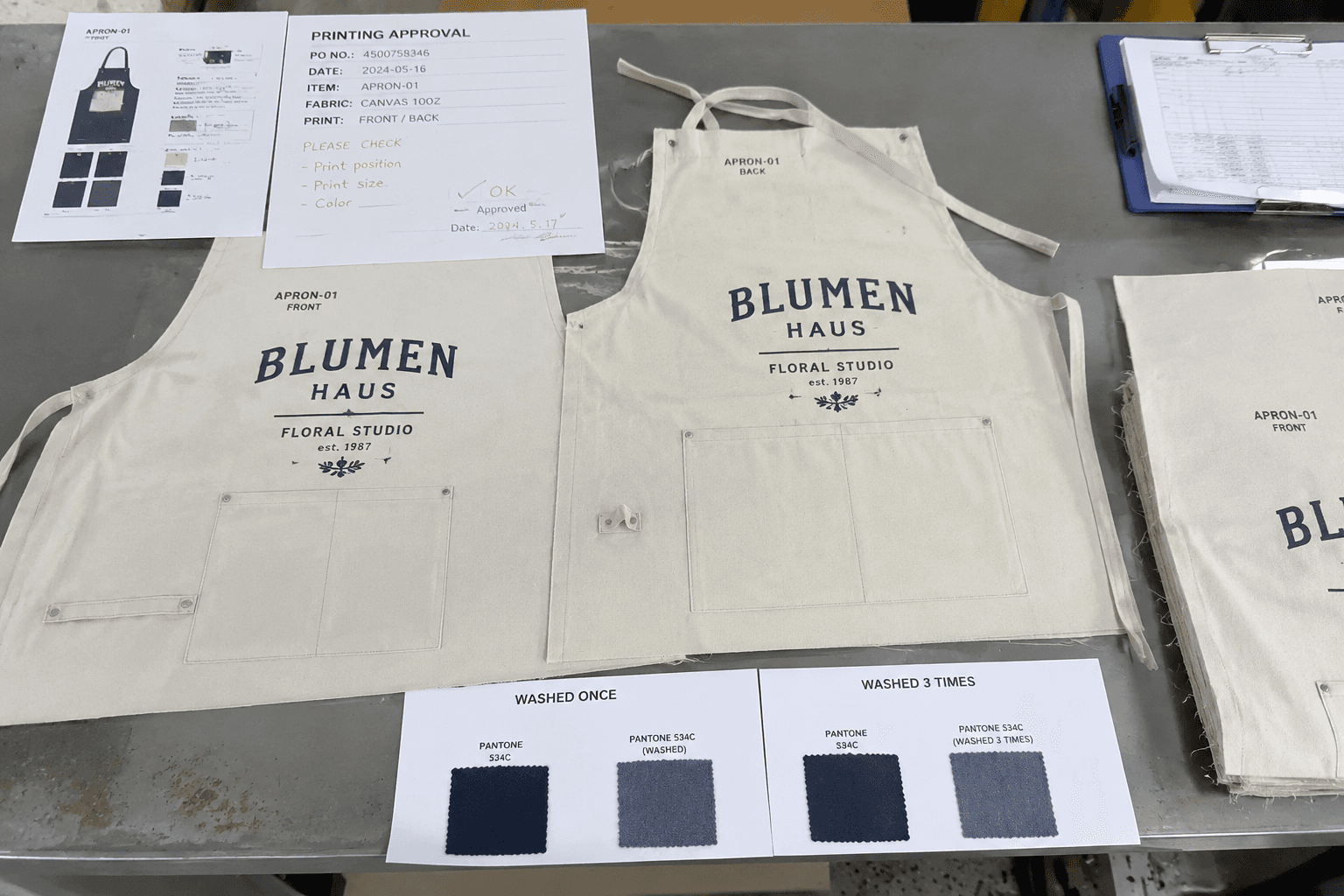
This matters when a buyer moves from 2-3 development samples to a 3,000-20,000 pc order. Small differences in fusing temperature, fold width, seam trimming, and pressing become visible across cartons. If the tech pack only says wide waistband or crisp waistband, the sewing line must interpret the target. That increases variation between salesman sample, PP sample, bulk output, and repeat order.
For standard sewn aprons, many professional buyers use AQL 2.5 for major defects and AQL 4.0 for minor defects. Waistband twisting, loose tie insertion, open seams, incorrect finished height, skipped topstitching, visible puckering, and uneven side alignment should be listed as inspection points. The waistband should be approved as a measured component, not as a general appearance feature.
- Typical custom apron MOQ: 500-1,000 pcs per color for stock fabric programs; 2,000 pcs or more for special dyed fabric or custom webbing.
- Common bulk order size: 3,000-10,000 pcs per style for hospitality, food service, catering, and promotional uniform programs.
- Sampling impact: waistband-only revisions usually need 5-7 production days when fabric and fusible are available.
- Bulk correction risk: changing waistband construction after cutting can add 12-20 days and may create fabric loss.
Apron waistband construction height by apron length and pocket load
Waistband height is the first decision because it changes pressure distribution, panel stability, fabric consumption, and sewing bulk. For short waist aprons, a finished height of 3.5-4.5 cm is the most common commercial range. It anchors the top edge without feeling heavy over a shirt or uniform. When the band exceeds 5 cm on a short apron, wearers may notice restriction while leaning forward, especially if ties are pulled tightly at the back.
Mid-length utility waist aprons need more judgment. If the apron includes divided tool pockets, order-pad pockets, towel loops, payment-device pockets, or pen channels, the waistband must resist torque. A 4.5-5.5 cm band can be useful when the wearer carries 300-500 g in the pockets. Going narrower may look lighter in a product photo, but the top edge can curl or sag under load.
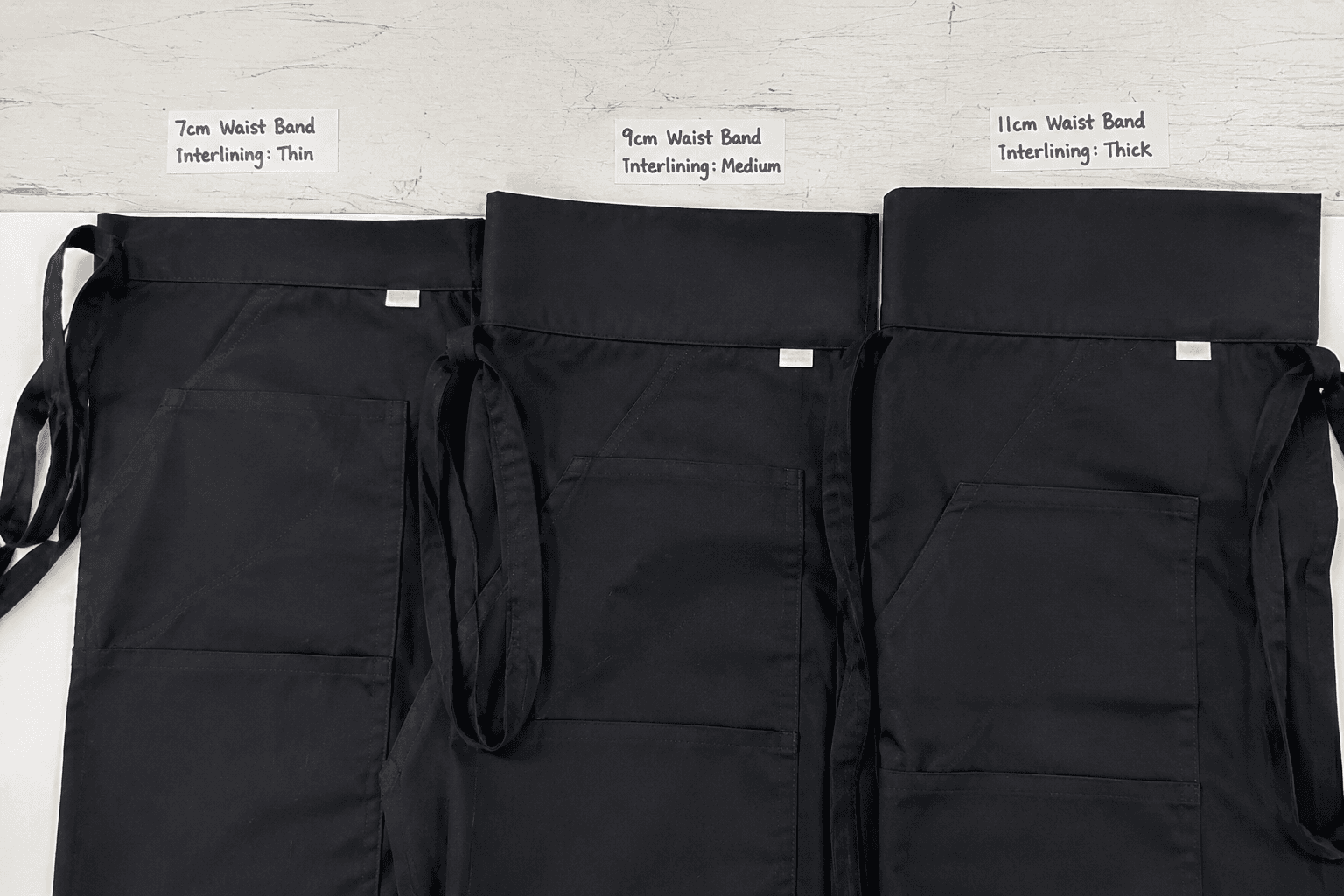
Bistro aprons have a different load profile. Finished lengths commonly run 70-90 cm, with front widths around 70-100 cm. The longer panel creates downward pull, especially in 240-280 GSM twill or canvas. A 5-7 cm waistband often spreads pressure better and keeps the top edge flatter. Extra height does not solve the problem alone. A tall band with heavy fusible can feel board-like when the wearer sits, climbs stairs, or bends during table service.
Buyers should match height to the actual job. A formal hotel bistro apron can justify a cleaner, wider band. A fast-service cafe apron worn over thin shirts in warm kitchens usually needs less bulk. If one style will be used across front-of-house and back-of-house teams, the safer specification is often moderate height with balanced reinforcement rather than maximum stiffness.
- Short waist aprons: 3.5-4.5 cm finished waistband for low to moderate pocket load.
- Utility waist aprons: 4.5-5.5 cm when pockets may carry 300-500 g.
- Bistro aprons 70-90 cm long: 5-7 cm when the front panel needs visible stability.
- Bands above 7 cm: test sitting, bending, side twist, and knot pressure before PP approval.
Stiffness ranges for waist and bistro apron waistbands
When buyers ask for a crisp waistband, they usually want a band that stays flat, resists rolling, and presents a straight top edge after washing. In production terms, stiffness comes from fabric density, weave, fusible GSM, layer count, stitch density, and pressing. A 280 GSM canvas folded into a double self-fabric band may already be firm without added interlining. A 180 GSM poly-cotton twill may need light support to avoid wrinkling after wash.
Too much stiffness creates predictable comfort complaints. The waistband may resist the body curve and gap at the side waist. At tie insertion points, several fabric layers can stack into a hard ridge. On slimmer wearers, that ridge may press near the hip bone. On larger wearers, a stiff top edge may tip outward instead of lying flat. These issues rarely show in flat sample photos but appear quickly in wearer trials.
Too little stiffness creates different failures. The band can roll into a rope-like edge, twist under asymmetric pocket load, or lose its pressed appearance after laundering. For restaurants, cafes, hotels, catering, and food service programs, the target is controlled support: enough body to hold shape, with enough flexibility to move with the wearer.
A useful starting point is to pair the shell fabric with the lightest reinforcement that still passes the load and wash tests. For 210-240 GSM cotton or poly-cotton twill, 30-50 GSM woven fusible often gives a balanced result. For long bistro aprons or premium uniform programs, 60-80 GSM woven fusible may be appropriate, but it should be tested on the exact shell fabric and finished band height.
- Soft support: self-fabric band without fusible, best for 200-240 GSM twill and low-load waist aprons.
- Balanced support: 30-50 GSM woven fusible inside a 4-6 cm band for general service use.
- Firm support: 60-80 GSM woven fusible for long bistro panels or sharper formal appearance.
- Use caution above 300 GSM shell fabric; a doubled heavy canvas band plus fusible can become uncomfortable.
Fabric, interlining, and seam build that change waistband feel
The same waistband measurement can perform differently with a different material stack. Cotton twill at 210-240 GSM is a stable starting point for waist aprons because it folds cleanly, accepts light-to-medium fusible, and has enough body for repeated tying. Poly-cotton blends such as 65/35 or 80/20 improve shrink control and drying speed, but can feel less forgiving when paired with hard nonwoven fusible. Canvas at 260-320 GSM adds abrasion resistance, yet the waistband can become bulky if the fabric is doubled and fully fused.
Interlining choice is a small cost item with a large comfort effect. Nonwoven fusible is usually cheaper and can work for budget programs, but it may feel papery or crease sharply after repeated washing. Woven fusible normally bends more naturally and has better wash recovery. In OEM quotations, moving from a basic nonwoven to a better woven fusible may add about $0.03-$0.08 per piece, depending on order quantity, width consumption, and local material availability.
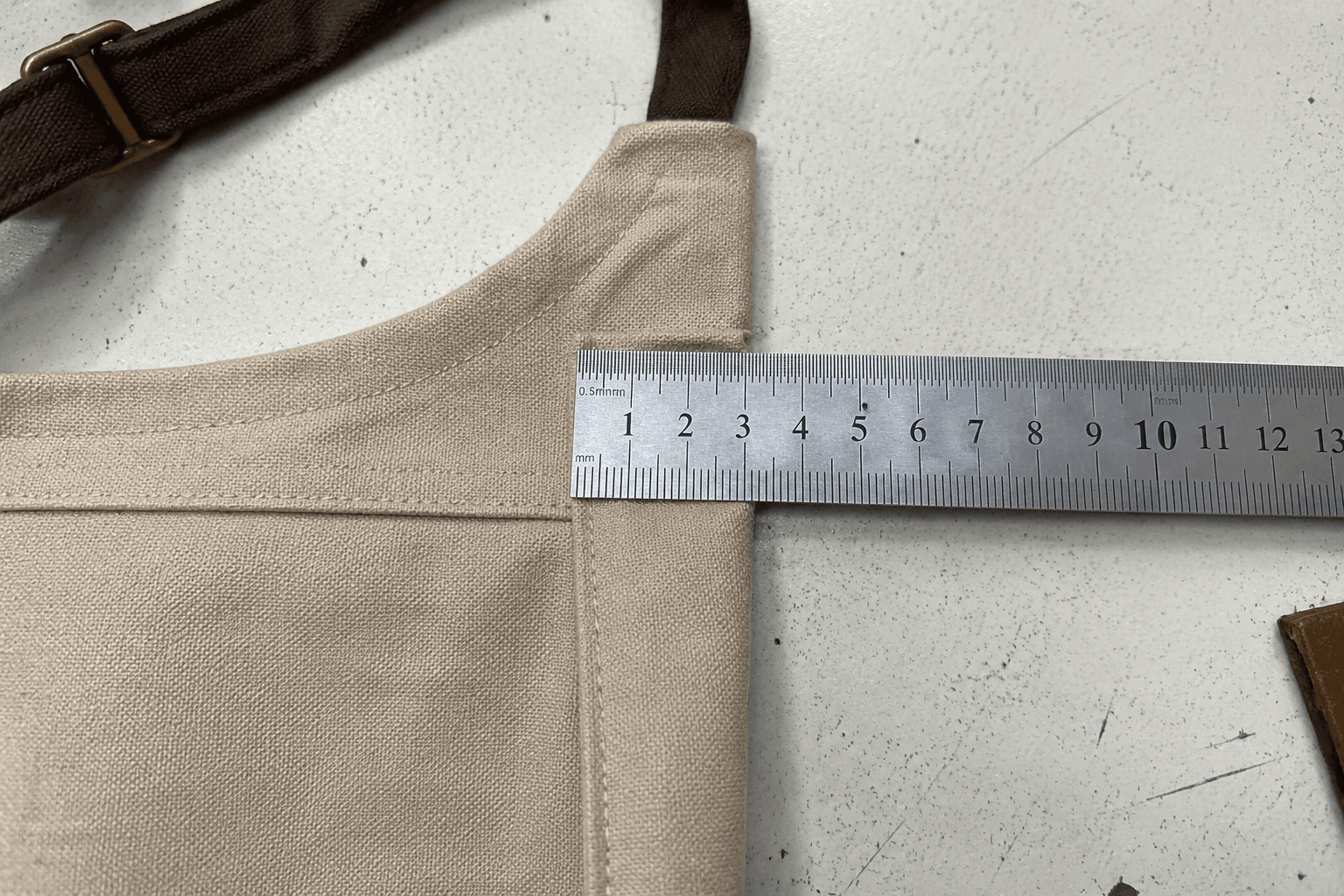
Seam build should be specified, not assumed. A common construction uses folded self-fabric, lockstitch attachment to the body panel, and edge topstitching 0.1-0.2 cm from the top and bottom edges. If seam allowance is not graded, the inner ridge can be felt against the body. If tie straps are inserted without reinforcement, repeated tight tying can stretch the side junction.
Tie dimensions also affect comfort. A narrow 2 cm tie can cut into the hand and waist when pulled tight, while a 4 cm tie may create bulk at the knot. For most waist and bistro aprons, 2.5-3.5 cm finished tie width is practical. Tie length depends on target users and whether the tie must wrap to the front; 80-100 cm per side is common for standard back tying, while wraparound styles may need 110-130 cm per side.
- General service fabric: 210-240 GSM cotton twill or 200-235 GSM poly-cotton twill.
- Heavy-use bistro fabric: 240-280 GSM twill or controlled 260-300 GSM canvas.
- Topstitch placement: 0.1-0.2 cm from edge for a clean, stable band.
- Tie reinforcement: bartack or box stitch at both side insertions for repeated commercial use.
Testing apron waistband construction before PP approval
Many apron tech packs list body size, fabric composition, and pocket dimensions but omit functional waistband tests. That leaves approval to subjective comments such as too hard or too soft. A better process converts comfort into repeatable checks tied to exact construction details. The factory can then reproduce the approved result instead of guessing during bulk production.
Testing should include the conditions that create real complaints. Evaluate the apron while standing, bending to 45 degrees, reaching forward, twisting side to side, and sitting for 3-5 minutes. If the apron includes pockets, test with a working load. An empty waist apron may feel acceptable, then roll when 300 g is placed on one side. A bistro apron may hang well in a fitting room, then pull downward during stair movement or fast walking.
Wash testing is equally important. Some waistbands soften after laundering; others shrink, ripple, or become more rigid. For commercial apron programs, buyers should test at least 5 industrial wash cycles before bulk approval. For rental laundry, hotel, or high-frequency food service programs, 10 cycles gives a clearer view of edge ripple, fusible bonding, shrinkage, and tie distortion.
Measurement should separate waistband shrinkage from body shrinkage. A body panel may remain within 2-3% tolerance while the waistband shrinks more because of interlining behavior or pressing tension. That difference can cause puckering along the top seam. If the apron will be sold as an easy-care uniform item, post-wash appearance should be reviewed without excessive hand pressing.
- Wear trial: check rolling, pressure, gapping, and tie comfort after at least 2 hours of movement simulation.
- Pocket load test: record twisting at 300 g, 500 g, and 700 g asymmetric load.
- Wash test: review after 5 cycles for standard programs and 10 cycles for industrial laundry programs.
- Shrinkage target: keep waistband shrinkage within 2-3% unless the buyer approves a different tolerance.
- Inspection standard: use AQL 2.5 for major defects and AQL 4.0 for minor workmanship defects unless the buyer requires a stricter plan.
Cost, MOQ, lead time, and PO controls for waistband changes
Waistband changes are usually easy before cutting and expensive after PP approval. Reducing finished height from 6 cm to 5 cm may require only a pattern update and one new sample. Changing from no fusible to 40 GSM woven fusible is also straightforward if material is available. But changing waistband height, tie length, pocket position, and body fabric at the same time means the full apron balance must be checked again.
In unit pricing, waistband upgrades are normally incremental. Adding fusible, increasing band height, or adding bartacks increases material use and sewing time, but the increase is usually modest compared with body fabric, embroidery, printing, or special dyeing. As a factory-side range, moving from a basic soft self-fabric waistband to a structured fused waistband may add about $0.05-$0.18 per piece. Bartacks at tie insertions add labor, but the cost is usually lower than a comfort-related remake.
The larger commercial risk is time. A waistband revision sample usually needs 5-7 production days if fabric and fusible are in stock. A PP sample after material confirmation can need another 7-10 days. Bulk production for 3,000-10,000 standard sewn aprons commonly runs 25-40 days after PP approval, depending on season, logo work, packing method, and accessory readiness.
The purchase order should write the construction into measurable terms. A practical waist apron specification may read: finished waistband height 4 cm; shell fabric 235 GSM 65/35 poly-cotton twill; 40 GSM woven fusible full length; ties 3 cm x 85 cm each side; tie insertion with bartack reinforcement; topstitch 0.15 cm from edge; finished height tolerance plus or minus 0.3 cm; post-wash waistband shrinkage within 3%; inspection to AQL 2.5 major and AQL 4.0 minor.
For a bistro apron, add finished front length, front width, expected pocket load, and laundering method. For example, a 78 cm bistro apron in 260 GSM twill with double pockets may need a 6 cm waistband and 50 GSM woven fusible, while a lighter 210 GSM cafe apron may perform better with a 4.5 cm band and softer reinforcement. The final specification should reflect the wearer’s job, not only the buyer’s visual preference.
- Waistband construction upgrade: approximately $0.05-$0.18 per pc for added fusible, height, or handling time.
- Sample revision: usually 5-7 production days for waistband-only changes using available materials.
- PP sample: usually 7-10 production days after all materials are confirmed.
- Bulk lead time: commonly 25-40 days after PP approval for 3,000-10,000 pcs.
- MOQ range: 500-1,000 pcs per color for stock fabric; 2,000 pcs or more for special dyed materials.
- PO requirement: state finished height, fabric GSM, interlining type and GSM, tie size, reinforcement, wash test, shrinkage tolerance, and AQL level.