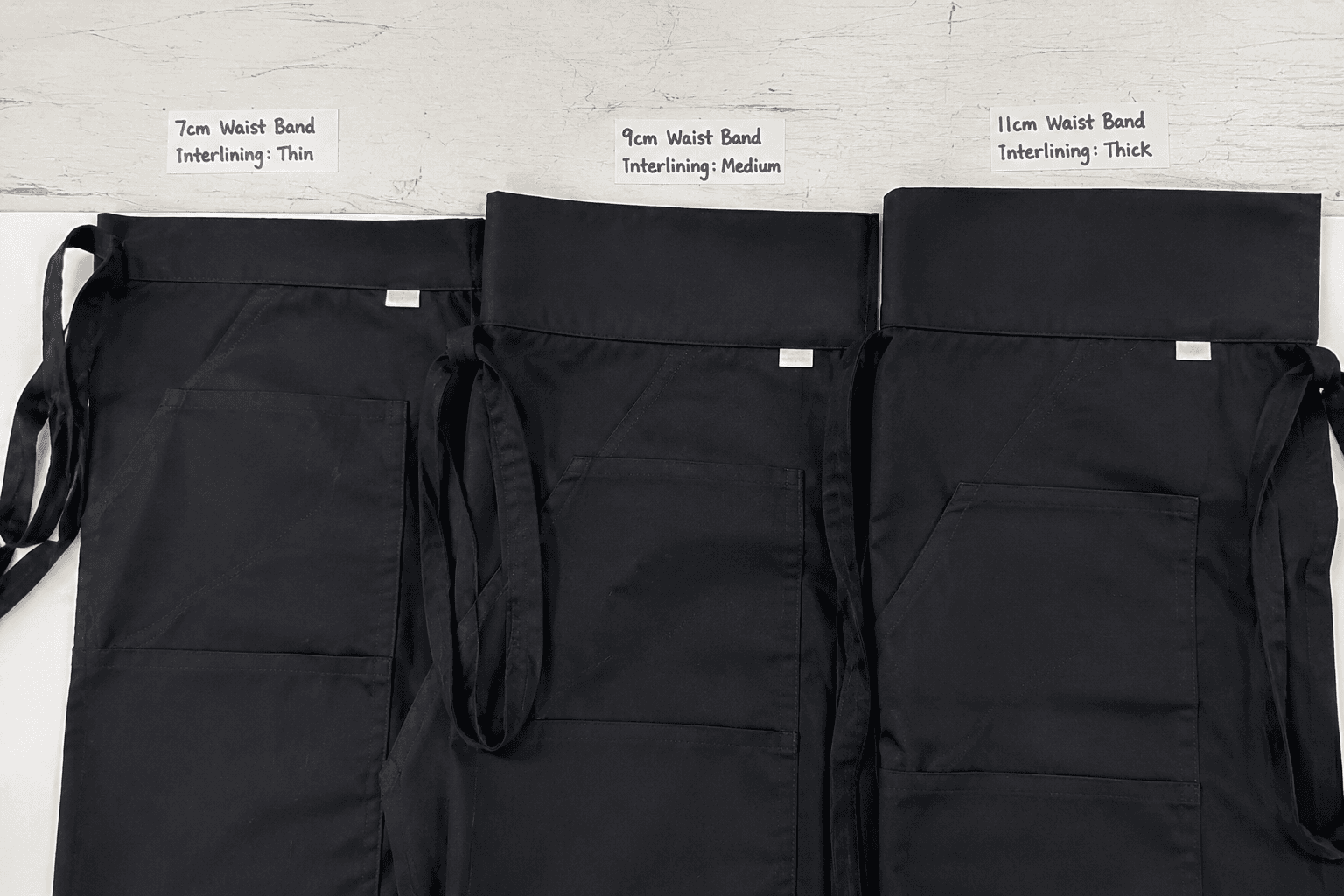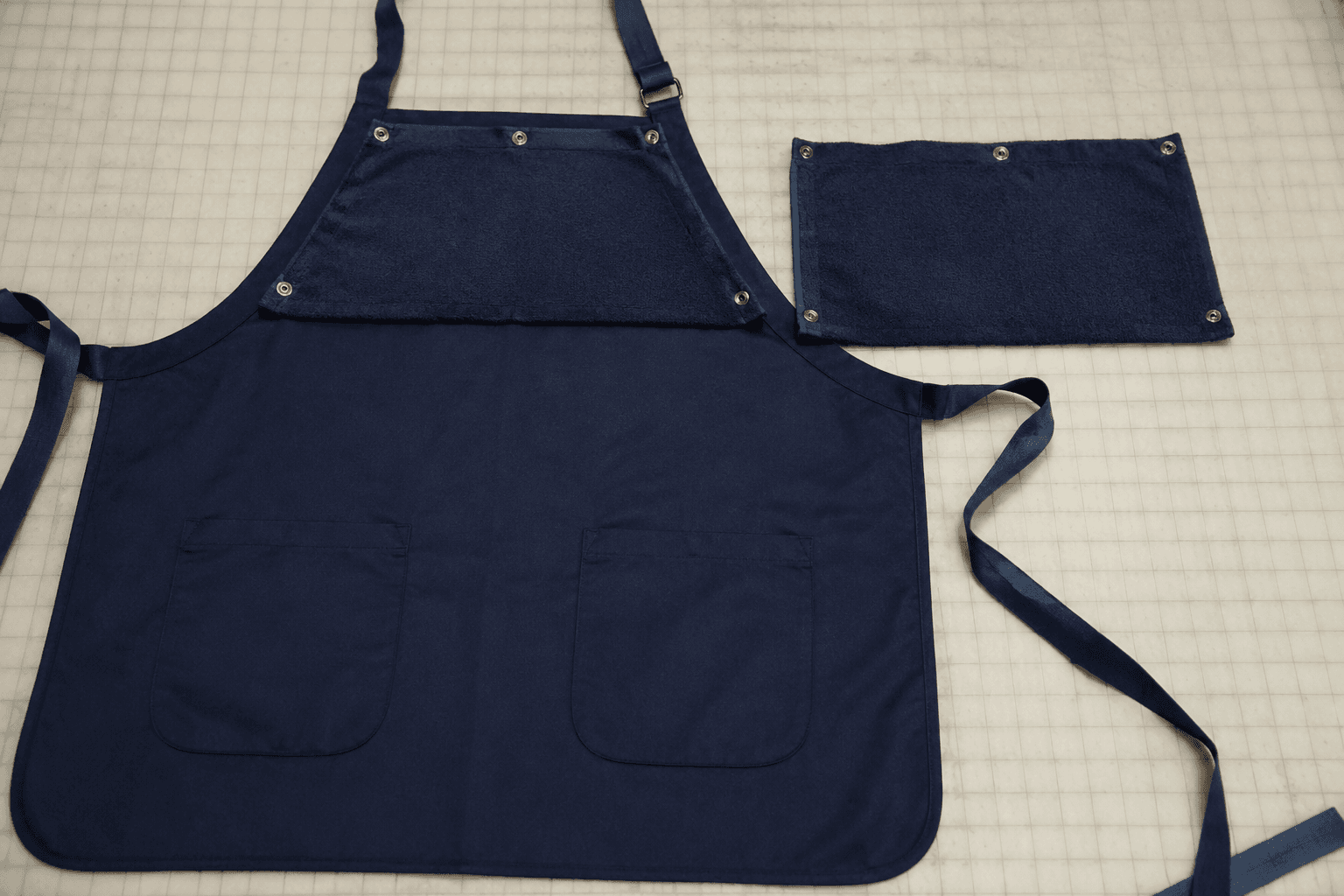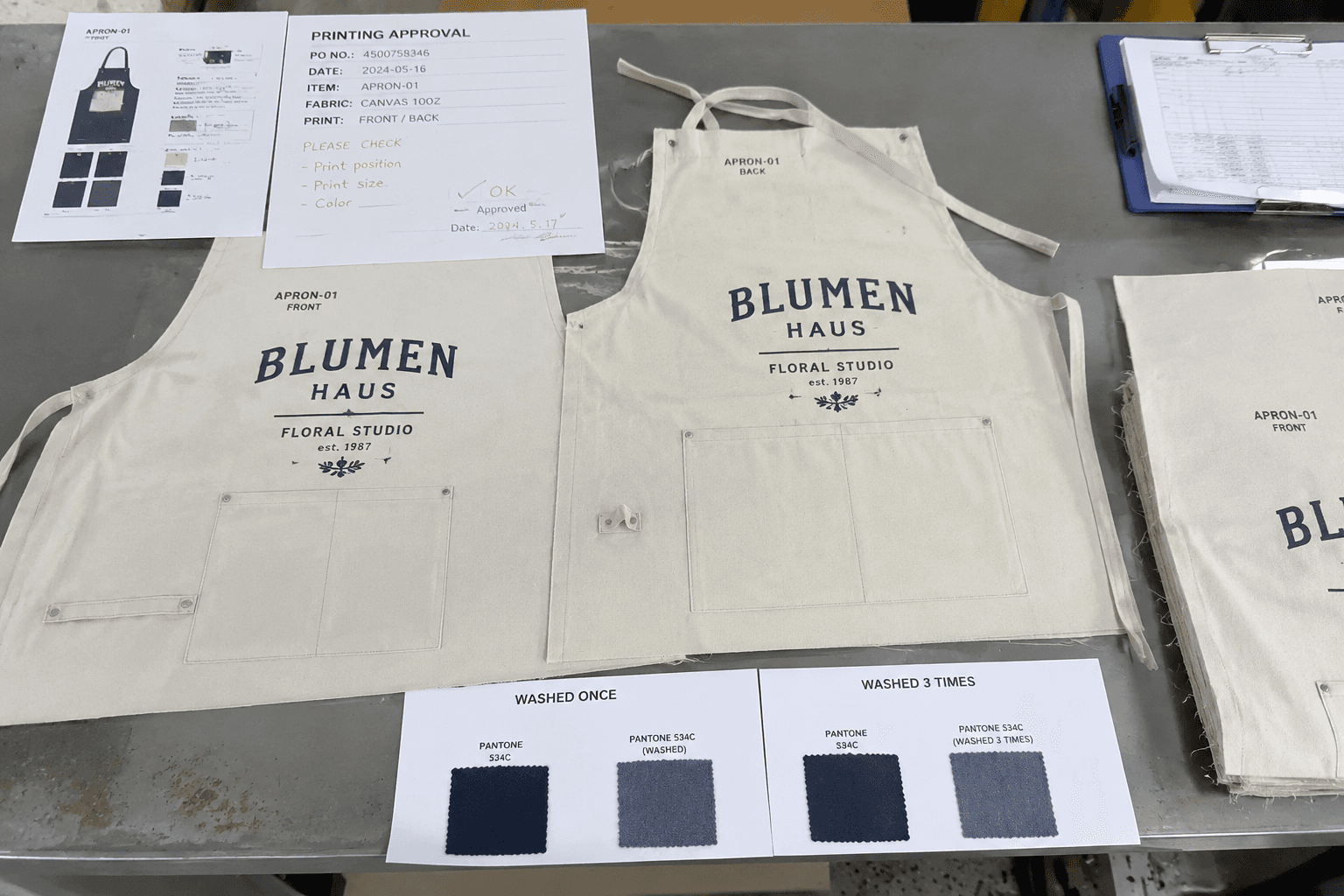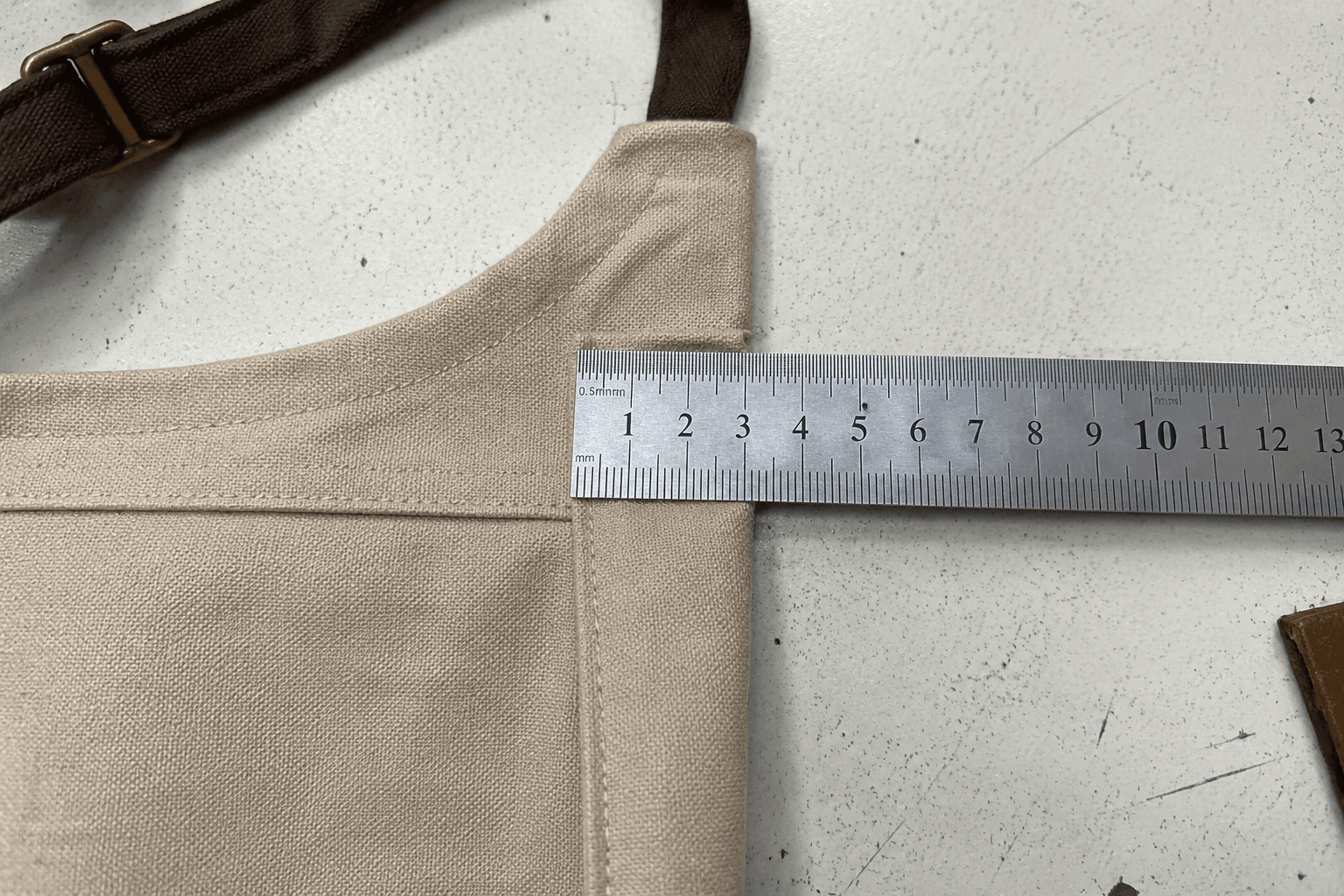
Professional apron buyers usually confirm fabric weight, finished size, pocket layout, logo method, packing, MOQ, carton quantity, and delivery date before discussing internal construction. The apron seam allowance deserves the same priority because it determines whether those visible requirements can be produced consistently in bulk.
In factory terms, seam allowance is the distance from the cut edge to the stitch line or fold line. On aprons it affects bib tops, side hems, bottom hems, pocket mouths, pocket divisions, waist tie insertion, neck strap joins, towel loops, hardware tabs, and reinforced tool zones. A 3-5 mm change can alter fabric consumption, operator handling, fraying risk, bar-tack security, and rejection rates under AQL inspection.
This guide explains how to write apron seam allowance into an OEM specification, how allowance choices affect fabric consumption and unit price, and how sourcing teams can compare supplier quotations without accepting weak hidden construction by accident.
- Specify apron seam allowance by seam position; bib edges, pocket mouths, side hems, straps, and tool zones carry different stress.
- Most commercial apron allowances sit between 6 mm and 15 mm, while functional pocket openings commonly need a 20-30 mm turn-back.
- Wider allowance can add USD 0.03-0.18 per apron, depending on GSM, fabric width, fabric price, shrinkage allowance, and marker efficiency.
- Narrow allowance can reduce consumption, but it raises risk on 260-420 GSM cotton twill, denim, canvas, garment-washed, and laundered uniform aprons.
- Lock construction before PP approval; later allowance changes can require revised patterns, markers, costing, sewing guides, and 2-4 extra working days before cutting.
1. Apron seam allowance standards to define before RFQ
Apron seam allowance should not be treated as a generic garment note. Aprons have fewer pattern pieces than shirts or jackets, but they have long exposed edges and concentrated pull points. A 70 cm x 85 cm bib apron can include 2.2-2.8 meters of finished outer edge before pockets, straps, loops, and ties are counted. A cross-back apron or tool apron adds strap channels, hardware tabs, divided pockets, and reinforcement layers.
For quotation, the factory needs both finished measurements and construction measurements. The same finished apron can be made with overlock plus single fold, double-fold hems, bound edges, enclosed strap seams, or intentionally raw-edge styling. Each method uses different allowance, labor, thread, needle size, pressing time, and inspection criteria. If one supplier prices an 8 mm single fold and another prices a 12 mm + 12 mm double fold, their FOB quotations are not equivalent.
A practical OEM specification should list allowance by location. For a 260 GSM cotton twill hospitality apron, a buyer may specify bib top 10 mm + 10 mm double fold, side hems 12 mm + 12 mm double fold, bottom hem 15 mm + 15 mm double fold, pocket sides 10 mm, pocket top 25 mm turn-back, and waist tie insertion depth 20-25 mm. These figures give patternmaking, cutting, sewing, and QC the same reference.
- 120-160 GSM promotional polyester apron: 6-8 mm allowance may be acceptable with overlock plus single fold for short-use campaigns.
- 180-260 GSM cotton or poly-cotton apron: 10-12 mm is common for bib edges, side hems, and pocket sides.
- 300-420 GSM canvas, denim, or 10-12 oz work apron: 12-15 mm gives better fold control and stronger topstitching on straight edges.
- Functional pocket opening: 20-30 mm turn-back is recommended for order pads, pens, thermometers, phones, or tools.
- Strap insertion zone: specify insertion depth, stitch box size, bar-tack length, and minimum distance from the raw edge.
2. Apron seam allowance by fabric weight, wash, and end use
The right allowance depends on fabric behavior and end use. A 150 GSM polyester promotional apron is stable, thin, and usually price-driven. A 240-260 GSM cotton twill cafe apron must tolerate repeated laundering, ironing, staff movement, and pocket loading. A 12 oz canvas workshop apron needs enough allowance to handle fabric thickness, abrasion, and the weight of tools without tearing at pockets or strap joins.
Cotton, linen blends, denim, and pigment-dyed fabrics need more control because they can fray during cutting, bundling, washing, and sewing. Garment-washed cotton aprons may shrink 3-8 percent depending on yarn, weave, enzyme wash, stone wash, and tumble process. If allowance is only 5-6 mm before wash, fraying and shrinkage can move too close to the stitch line. A 10-12 mm double fold is slower, but it encloses the raw edge and reduces seam breakdown after repeated commercial wash cycles.
Heavy fabric does not mean every seam should be wider. Excess allowance at corners creates bulk, uneven topstitching, needle deflection, and poor pressing. For 12 oz canvas, a factory may use 12-15 mm on straight edges, graded trimming at corners, Tex 40 or Tex 60 thread, size 16-18 needles, and 7-9 stitches per inch. For 220 GSM cotton twill, 10-12 mm allowance, Tex 27 or Tex 40 thread, and 8-10 stitches per inch may be enough.
- Non-washed polyester aprons: confirm edge finish and heat-transfer placement before increasing allowance near logo areas.
- Cotton twill uniform aprons: approve at least one washed sample before PP approval if shrinkage or puckering is a concern.
- Garment-washed aprons: state whether finished size and seam allowance are measured before wash or after wash.
- Waxed canvas or coated aprons: avoid unnecessary folded bulk near rivets, grommets, snaps, and pocket corners.
- Denim aprons: define whether fraying is an approved design feature or a workmanship defect.
3. How apron seam allowance changes fabric yield and FOB cost
Seam allowance looks small at one edge but becomes material in a bulk marker. A standard 70 cm x 85 cm bib apron in 240 GSM cotton twill may consume about 0.72-0.82 meters of 150 cm width fabric, depending on pocket size, strap method, shrinkage allowance, grain direction, and marker efficiency. Increasing selected allowances from 8 mm to 12 mm can add about 0.015-0.035 meters per piece.
At USD 2.20 per meter for dyed 240 GSM cotton twill, that increase is roughly USD 0.03-0.08 per apron before cutting loss, tax, and dye-lot variance. On 10-12 oz cotton canvas at USD 3.80-4.60 per meter, wider allowances can add USD 0.08-0.18 per piece. For a 20,000 pc restaurant chain program, the difference can reach USD 1,600-3,600. It should be discussed as a construction decision, not discovered after comparing FOB prices.
The cost choice should be made by risk area. It may be sensible to keep a standard 10 mm double fold at the bottom hem while increasing the pocket top to 25 mm and the strap insertion allowance to 25 mm. That protects the parts most likely to fail without adding unnecessary fabric across every edge. A quote that is USD 0.10 cheaper may rely on narrower allowance, lighter thread, fewer bar tacks, or simpler edge finishing.
- Ask all suppliers to quote against the same apron pattern specification, not only the same sketch or reference photo.
- Request estimated fabric consumption per piece and the assumed fabric width, such as 145 cm, 150 cm, or 57/58 inches.
- Separate cost-saving areas from strength-critical areas such as pocket mouths, strap joins, and tool loops.
- Expect post-sample allowance changes to trigger revised FOB on canvas, denim, garment-washed cotton, and custom-dyed fabric.
- For orders above 10,000 pcs, review marker yield before approving any construction change that affects allowance.
4. Bulk sewing risks when apron seam allowance is too narrow
A skilled sample sewer can make narrow allowance look clean on one showroom sample. Bulk production is different. Operators sew at speed, fabric rolls vary slightly, cutting stacks can shift 1-2 mm, and folded edges must stay consistent across hundreds or thousands of pieces per line per day. When allowance is too narrow, the line has little tolerance for normal production variation.
The first risk is seam failure. Cotton twill, linen blend, denim, and canvas can shed yarns during cutting, bundling, washing, and sewing. If the raw edge sits too close to the stitch line, the seam may open after laundering even when the approval sample looked acceptable. The second risk is uneven appearance. Long apron side hems can wave or twist when the operator cannot control the fold. Patch pockets can skew if side allowances vary, and pocket mouths can flare when the top turn-back is too shallow.
These issues usually appear in inspection as workmanship defects: open seam, raw edge exposed, uneven topstitching, twisted tie, puckered hem, loose pocket corner, or inconsistent finished measurement. Many apron programs use AQL 2.5 for major defects and AQL 4.0 for minor defects; stricter retail or uniform programs may use AQL 1.5 for major defects on first shipment. A written allowance rule gives inspectors a measurable standard instead of a subjective debate about whether the seam feels strong enough.
- Check internal construction on cut-open samples, not only outside appearance and front-view photos.
- Set measurable tolerance, such as 10 mm allowance with +/-2 mm tolerance at selected seams.
- Require bar tacks at pocket corners and strap joins when the apron carries tools, order pads, radios, or repeated pull stress.
- Use sealed PP samples and line reference samples so sewing operators and QC follow the same construction.
- Record exposed raw edges, missed fold capture, pocket skew, and loose bar tacks as workmanship defects during inline inspection.
5. Apron seam allowance rules for pockets, straps, and logo zones
A strong apron specification separates functional zones. Decorative or low-stress edges can use standard allowance, while load-bearing areas need more fabric, reinforcement, or a different seam type. This avoids overbuilding the whole apron while protecting the parts that fail first in real use.
Neck straps and waist ties need precise control. If ties are inserted into a side seam, the insertion depth must leave enough room for a stitch box or bar tack without cutting through the raw edge. A common target is 20-25 mm insertion with a box stitch or bar tack placed clear of the edge. For cross-back aprons, strap channels and hardware points need allowance that supports sliding movement without tearing or creating bulky folds.
Pockets need their own rules because they receive the most handling. A cafe apron pocket for an order pad may need a 25 mm top fold and bar tacks at both corners. A barbecue, carpenter, or barista apron with divided tool pockets may need 12 mm side allowance, reinforced backing, and bar tacks at pocket divisions. Logo areas should be checked at the same time. Embroidery near a thick fold can distort; heat transfer applied over uneven folded areas can lift after repeated washing.
- Bib top: define fold depth, stitch distance from edge, and neck strap insertion method.
- Side hem: confirm single fold, double fold, binding, or overlock plus topstitch.
- Pocket top: use a wider turn-back than pocket sides when the pocket carries functional load.
- Pocket divisions: add bar tacks or reinforced stitching where pens, phones, thermometers, or tools create point stress.
- Towel loop or hardware tab: specify backing layer, allowance, and stitch pattern.
- Logo zone: confirm finished seam thickness before approving embroidery, heat transfer, woven patch, or leather patch placement.
6. Sampling, MOQ, and lead-time control for apron seam allowance
The best time to finalize apron seam allowance is before price lock and PP approval. A normal OEM apron development sequence is 5-7 working days for the first sample after fabric, trim, and logo details are confirmed, then 3-5 working days for one revised sample if the buyer changes pocket size, strap length, logo position, or seam construction. Once the PP sample is approved, the factory prepares bulk patterns, cutting markers, sewing guides, and QC checklists.
MOQ depends on fabric and customization. A simple stock-color cotton twill apron may start at 500-1,000 pcs per color. Yarn-dyed stripe, custom-dyed canvas, garment-washed cotton, special webbing, brass hardware, or private-label packing often needs 1,000-3,000 pcs per color because mills, dye houses, and trim suppliers have minimums. Production lead time is commonly 25-35 days after PP approval for available fabrics, and 35-55 days when dyeing, washing, custom webbing, or imported trims are involved.
Changing allowance after PP approval is disruptive. The factory may need to revise pattern pieces, recalculate consumption, remake the marker, update sewing instructions, and confirm whether the approved finished size still holds after wash. Even a narrow change can add 2-4 working days before cutting, and more if the new marker requires additional fabric. For buyers working to a store launch, uniform rollout, or seasonal promotion, allowance decisions should be closed before the supplier books bulk fabric.
- Approve one sealed PP sample for buyer reference and one sewing reference sample for the production line.
- Request a construction table before final FOB confirmation, especially for orders above 1,000 pcs.
- Confirm whether allowance is measured before folding, after folding, before wash, or after wash.
- Do not approve from photos only when straps, pocket backs, and internal seams determine durability.
- Ask the supplier to state cost and lead-time impact in writing before any post-PP allowance change.
7. Writing apron seam allowance into a buyer specification
Buyers do not need an overcomplicated tech pack for every apron, but critical construction should be written down. A useful table includes seam position, seam type, allowance, stitch type, stitches per inch, thread size, reinforcement, tolerance, and wash status. This gives the factory enough information for costing and gives QC enough information for inspection.
For example, a hospitality bib apron specification could state: 260 GSM cotton twill, finished size 70 cm x 85 cm after wash, side hem 12 mm + 12 mm double fold, bottom hem 15 mm + 15 mm double fold, pocket side allowance 10 mm, pocket top 25 mm turn-back, 8-10 stitches per inch, bar tacks at pocket corners, and waist ties inserted 25 mm with box stitch. For a 12 oz canvas tool apron, the same table may call for 12-15 mm edge allowance, Tex 60 thread, size 18 needle, reinforced pocket backing, and AQL 2.5 major / 4.0 minor inspection.
The commercial goal is not to maximize allowance everywhere. The goal is to make each supplier quote the same apron and make each seam fit the apron's use. A low-cost promotional apron can accept simpler construction when expected wear is limited. A restaurant uniform apron worn weekly for 6-12 months needs stronger hems and pocket openings. A premium retail canvas apron needs construction that survives washing, handling, and customer review. Clear apron seam allowance rules let sourcing teams choose cost savings deliberately instead of discovering them in failed seams.
- Use one construction table for all suppliers quoting the same apron.
- State allowance by position, not as one general line for the entire product.
- Match allowance with seam type, stitch density, thread size, needle size, and reinforcement.
- Include inspection tolerance and whether destructive internal checks are allowed during final inspection.
- Review seam allowance together with fabric GSM, shrinkage, wash process, logo method, and final packing requirement.