In apron production, metal hardware is a small BOM line and a frequent source of avoidable claims. A snap that releases on a 200 GSM 65/35 poly-cotton bib apron during service, a tab that tears on a 300 GSM canvas waist apron after 30 industrial wash cycles, or black plating that rubs before store rollout can turn a US$0.08 trim choice into a rejected shipment or repeat replacement cost. For professional buyers, apron snap button options need the same level of control as fabric GSM, seam strength, shrinkage and shade continuity.
The right closure depends on apron category, strap construction, wash method, replacement route and target ex-works price. A chain-restaurant bib apron in 190 to 210 GSM twill, a bar apron in 280 to 320 GSM cotton canvas and a workwear bib apron in 12 oz to 14 oz duck canvas should not share one default metal fastening. Treating all snaps and buttons as interchangeable usually creates one of two problems: overspec cost on light aprons or preventable failure on heavier programs.
In OEM apron manufacturing, most hardware decisions come down to three systems: ring-spring or S-spring press studs, larger heavy-duty snaps, and nail-back jeans buttons. Each behaves differently on adjustable neck straps, detachable cross-back straps, side tabs, pocket flaps and towel loops. The sections below focus on the points that affect bulk apron sourcing outcomes: attachment strength, repairability, plating durability, MOQ, lead time and inspection control.
- Press studs are usually the most balanced choice for adjustable apron neck straps and side tabs on 180 to 320 GSM fabrics because they combine adequate holding force with faster field replacement.
- Jeans buttons suit fixed anchor points on 280 GSM to 450 GSM canvas, webbing and leather-supported tabs, but they are slower to repair and less suitable for daily opening on hospitality aprons.
- Attachment strength on aprons depends more on tab build, reinforcement, post length and pull direction than on trim type alone; weak tab construction defeats strong hardware.
- Replacement cost should be priced before launch. A snap that adds US$0.04 per apron can still reduce total service cost if it prevents full-apron replacement or on-site downtime.
- Plating risk is highest on black nickel, matte gunmetal and antique finishes, especially on aprons exposed to chlorine, steam, wet storage or repeated industrial laundering.
1. How to choose apron snap button options by fabric weight, wear pattern and laundry cycle
Start with the real apron workload rather than the showroom sample. Front-of-house bib aprons usually need frequent neck adjustment, fast dressing and washing after each shift, so consistent open-close performance matters more than maximum static pull. Kitchen, florist, barber and workshop aprons tend to carry more pocket weight and maintain steadier strap tension, so tab tear resistance and hardware stability become the first concerns.
On light service aprons in 180 to 220 GSM poly-cotton twill, a 15 mm press stud often works well when set through a folded two-layer tab with woven fusible backing. On medium aprons in 240 to 320 GSM cotton twill or canvas, 17 mm press studs or heavy-duty snaps generally feel more stable and reduce accidental release during wear. On 10 oz to 14 oz canvas aprons with 25 mm to 30 mm webbing or 1.2 mm to 1.8 mm leather-supported strap ends, buyers usually move to heavy-duty snaps or jeans buttons because fashion-grade studs loosen faster under angled pull.
Hardware usually adds only US$0.05 to US$0.30 per apron, but trim failure can create a claim rate far above its BOM value. For bulk apron inspections, missing parts, pop-off failures, cracked caps and red-rust staining should be treated as major defects. AQL 2.5 for major defects and AQL 4.0 for minor defects is a practical baseline for most professional apron programs, provided the inspection includes both appearance review and functional snap testing on finished garments.
- 180 to 220 GSM service aprons: usually 15 mm press studs on reinforced folded tabs.
- 240 to 320 GSM canvas or twill aprons: usually 17 mm press studs or heavy-duty snaps.
- 10 oz to 14 oz workwear aprons: usually heavy-duty snaps or jeans buttons on webbing-backed or leather-supported tabs.
- Typical hardware cost: US$0.05 to US$0.30 per apron depending on size, finish, base metal and logo.
- Inspection baseline: AQL 2.5 major and AQL 4.0 minor, with snap failure and corrosion logged as major defects.
2. Press studs as apron snap button options: force range, trim cost and common failure modes
For most OEM apron programs, ring-spring and S-spring studs remain the most practical apron snap button options. They are widely available, easy for factories to set in volume, and simpler for local repair vendors to replace than jeans buttons. On orders of 1,000 to 5,000 aprons per color, standard plated press stud sets in nickel, antique brass or matte black commonly add US$0.06 to US$0.14 per apron ex-works. Brass-based or stainless versions usually add another US$0.02 to US$0.05 per apron, but they reduce corrosion risk on laundry-heavy programs.
Press studs work best where the apron user needs repeated opening: detachable neck straps, side adjusters, towel holders and pocket flaps. A realistic opening-force target is around 6 to 8 kgf for 180 to 220 GSM aprons, 8 to 10 kgf for 240 to 280 GSM aprons, and 9 to 12 kgf for 300 to 320 GSM canvas aprons. Below those ranges, snaps may release during bending or lifting. Far above them, users pull harder, which distorts the tab, enlarges the hole and shortens the apron's service life.
Most failures blamed on the snap are actually failures in apron tab construction. Common causes are single-layer fabric, weak nonwoven interlining, over-long or under-long posts, and die settings that crush the socket unevenly. A 15 mm stud set directly into one layer of 190 GSM twill may tear the fabric before the metal part fails. The same stud on a folded tab with self-fabric backing and woven fusible usually survives far longer through wear and laundering. Pre-production testing should be done on actual apron panels, then repeated after one domestic wash for retail programs or after three industrial cycles for hospitality and rental orders.
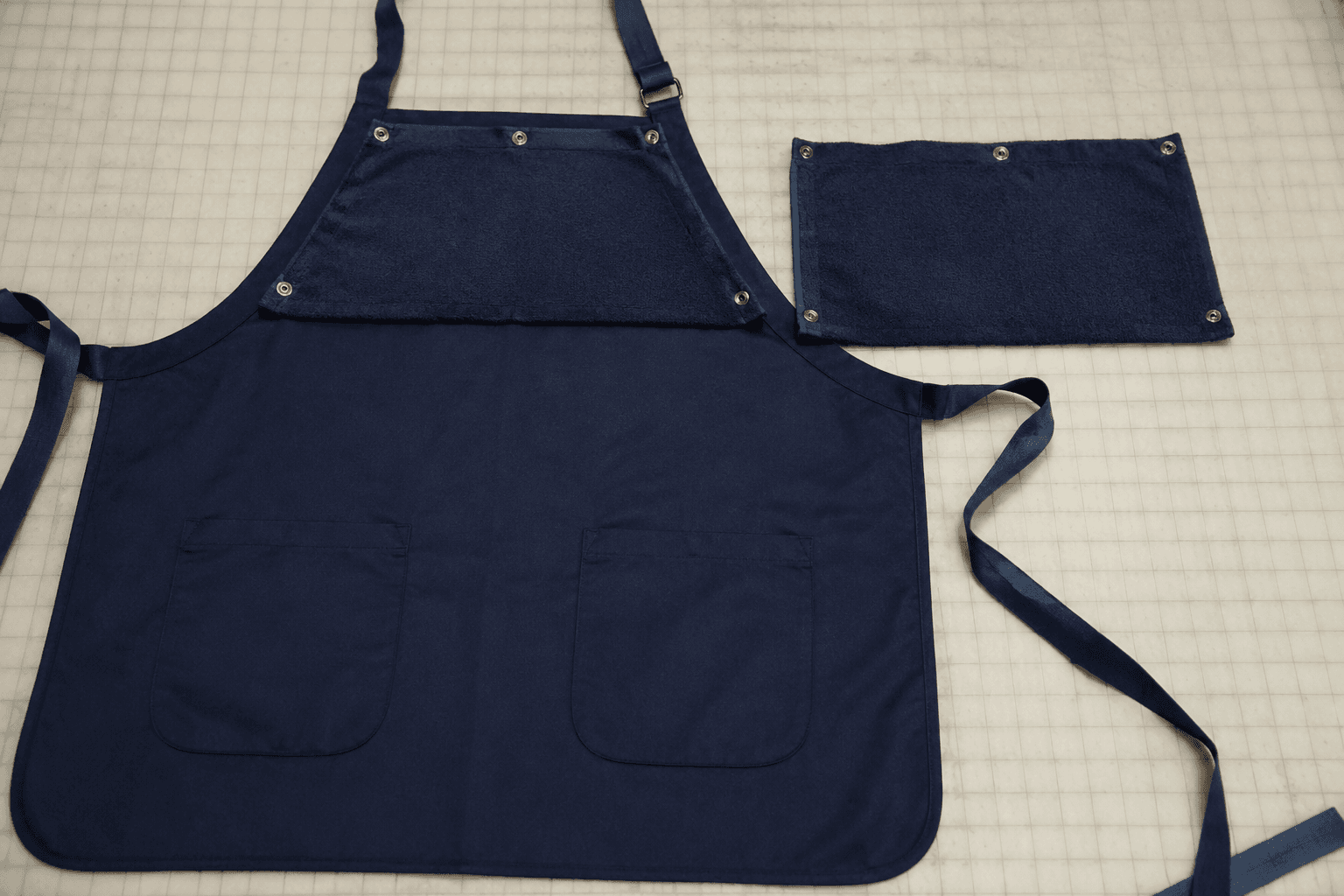
- Best positions: adjustable neck tabs, side waist tabs, towel loops and pocket flaps.
- Typical ex-works trim cost: US$0.06 to US$0.14 per apron for stock plated studs.
- Typical stock MOQ: 1,000 to 2,000 sets per finish; custom-logo caps usually start at 3,000 sets.
- Useful opening-force targets: 6 to 8 kgf for lighter aprons and 8 to 12 kgf for heavier canvas aprons.
- Main failure causes: weak tab build, wrong post length, poor die setting and insufficient reinforcement.
3. Jeans buttons on apron straps: where stronger anchoring outweighs slower replacement
Jeans buttons are usually chosen when an apron needs a rugged workwear look or a stronger semi-permanent anchor point. Because the cap and nail lock mechanically, straight-pull resistance is often higher than on a standard press stud. This makes jeans buttons suitable for dense 280 to 450 GSM canvas tabs, 25 mm to 30 mm cotton webbing, polyester webbing strap ends and leather-supported attachments on premium bib aprons.
Their weakness is daily usability. Jeans buttons are not ideal where staff need to open and close the fastening throughout service. If the apron uses a self-fabric buttonhole or slot, repeated use can distort the opening, especially on cotton fabrics that shrink 3% to 5% after washing. In practice, jeans buttons perform better as fixed neck anchors, cross-back strap connection points or decorative closures than as regular adjustment hardware on hospitality aprons.
Repair is the main commercial trade-off. A failed press stud can often be replaced with limited disturbance to the tab. A loose jeans button usually requires the nail to be cut off, and the compressed hole may remain too visible or too weak for a clean reset. On large uniform apron programs, that can turn a minor trim issue into a full-apron replacement. Standard jeans buttons commonly add US$0.08 to US$0.18 per apron, while custom-logo versions often reach US$0.20 to US$0.30 and add 7 to 12 days for mold and trim preparation.
- Best use: fixed neck anchors, cross-back strap tabs and decorative closures on heavy aprons.
- Avoid for: light aprons below 200 GSM unless the attachment point has substantial reinforcement.
- Typical trim cost: US$0.08 to US$0.18 per apron; custom-logo versions commonly run US$0.20 to US$0.30.
- Typical added development time: 7 to 12 days for custom-logo jeans buttons.
- Recommended validation: 20, 30 and 50 open-close cycles on the real apron strap or buttonhole material.
4. Attachment strength on aprons: reinforcement, post length and pull angle matter more than catalog claims
Buyers often ask which hardware is strongest, but on aprons the better question is which full attachment build is strongest. Trim performance depends on the complete assembly: shell weight, fold construction, reinforcement type, cap diameter, post length and pull angle during wear. A stronger metal part set into a weak apron tab still fails early, while a moderate-grade snap on a well-built tab can outlast it by a wide margin.
On a 260 GSM cotton twill apron, a double-fold neck tab with woven fusible and a 12 mm x 25 mm self-fabric backing patch often performs better than a single-layer 320 GSM canvas tab with no internal support. On cross-back aprons, angled strap tension concentrates force on one edge of the tab, so tab width, stitch margin and reinforcement area usually matter more than moving from a 15 mm snap to a larger cap. For 12 oz canvas and above, over-long posts are a common hidden problem. The hardware may look fully set on the line, then loosen after washing because the rolled post was unstable from the start.
Factories should agree the test method before bulk approval. Hand pull checks are useful for line setup but too subjective for production control. On orders above 3,000 pcs, buyers should request pull testing on finished apron panels from the pre-production sample and again from bulk production. A practical internal standard is to test before washing and after one wash for retail aprons, or after three commercial cycles for hospitality and rental programs. Recording both metal-part failure and fabric tear mode gives better approval data than a simple pass-fail note.
- Minimum practical build for load-bearing apron tabs: two shell layers plus one reinforcement layer.
- Common reinforcement choices: self-fabric patch, woven fusible, nonwoven fusible and webbing insert.
- For canvas above 12 oz, match post length to actual compressed thickness rather than nominal fabric spec.
- Test on finished apron panels before wash and after wash, not only on loose trim samples.
5. Replacement planning for apron snap button options: service model, spare trims and repair labor
When buyers ask for repairable hardware, the real issue is lifetime apron service cost. Restaurant groups, culinary schools, hospitality distributors and rental-uniform operators often keep aprons in use for 6 to 24 months, so repair speed matters. This is where apron snap button options should be judged against the after-sales model rather than against sample appearance alone.
Press studs are generally easier to support in the field than jeans buttons. If one side loses holding force after 30 to 50 commercial wash cycles, a trim repair shop can often replace the affected part in 3 to 5 minutes, especially when the snap sits on a separate neck tab or strap tab. Hardware installed directly through the visible bib body is harder to repair without leaving a ring mark or enlarged hole. On private-label retail apron programs, that cosmetic damage can make repair uneconomic even when the trim is technically replaceable.
Buyers should define in advance whether repairs will be handled by the apron factory, the importer, a local distributor or an alteration vendor. For long-life programs, it is sensible to order 1% to 2% spare hardware with the bulk lot and confirm that the trim supplier can match finish tone for repeat orders placed 6 to 12 months later. Without that planning, a repairable apron can still become a replacement case because parts are unavailable or finish tone no longer matches.
- Separate neck or strap tabs are easier to repair than snaps set through the main bib panel.
- Order 1% to 2% spare hardware for apron programs expected to run longer than one season.
- Confirm finish continuity for reorder repairs after 6 to 12 months.
- Define the repair owner before launch: factory, importer, distributor or local alteration vendor.
6. Plating risk, MOQ and lead-time control for apron hardware sourced from China
Plating durability is one of the most underestimated risks in apron sourcing. Buyers often approve a dry trim card, then see edge wear, shade shift or red rust after washing or humid storage. Black nickel, matte gunmetal and antique effects attract the most complaints because rub marks show quickly and exposed base metal changes color fast. For aprons used near steam, sinks, dish stations or outdoor food service, it is worth specifying both base metal and finish, then confirming performance through wash and corrosion checks before booking bulk.
Brass-based studs and snaps usually resist corrosion better than low-grade iron components, but they raise unit cost. The factory also needs to know whether the apron will be garment-washed, enzyme-washed, piece-dyed or industrially laundered, because each process increases plating risk differently. A finish that looks acceptable on a trim card can still leave rub marks on white, stone or beige apron fabric after wet processing. Approval should therefore be based on the real apron colorway and care method, not the supplier's finish name alone.
Lead time and MOQ change significantly with the hardware route. Standard stock snaps in common finishes can usually support trim confirmation in 3 to 5 days and bulk apron lead times of 25 to 35 days after pre-production approval. Custom-logo snap caps or jeans buttons often add 10 to 18 days, moving total production to 35 to 50 days depending on mold readiness and plating queue. Stock snaps commonly start at 1,000 to 2,000 sets per color, custom-logo snaps at 3,000 to 5,000 sets, and custom jeans buttons at 5,000 to 10,000 pcs. Many apron factories accept 500 to 1,000 aprons per style-color, but custom hardware can raise the effective MOQ because the trim minimum still has to be absorbed into the order.
- Highest plating-risk finishes for aprons: black nickel, matte gunmetal and antique effects.
- More stable finishes: nickel and antique brass, subject to wash approval on the actual apron fabric.
- Typical stock-snap timing: 3 to 5 days for trim confirmation, then 25 to 35 days bulk lead time after PP approval.
- Typical custom-hardware timing: 35 to 50 days total depending on mold, finish and plating queue.
- Typical trim MOQ: 1,000 to 2,000 sets for stock snaps, 3,000 to 5,000 for custom-logo snaps, and 5,000 to 10,000 pcs for custom jeans buttons.
7. Bulk approval checklist before locking apron snaps, buttons and press studs
Before approving apron hardware, buyers should move from visual preference to measurable criteria. That means documenting the trim type, size, base metal, finish, post length, reinforcement method, test requirement and defect standard on the apron tech pack. Leaving these details open usually pushes decisions to the trim setter during production, which is where inconsistency starts.
For a controlled bulk process, approve hardware only after reviewing the trim card, the pre-production apron and a short function record from the factory. That record should note snap size, tab build, pull-test result, wash result and any visible plating change. It does not need to be elaborate, but it should be consistent across styles. The same apron body can perform very differently when a 15 mm stock stud is substituted for a 17 mm brass-based stud, or when woven fusible is replaced by low-cost nonwoven.
The practical objective is simple: select the least complicated hardware that meets the apron's actual use condition. On most hospitality aprons, that is still a reinforced press-stud system. On heavier workwear aprons, jeans buttons or larger snaps may be justified at fixed points. In both cases, early clarity on force target, repair route, plating risk, MOQ and lead time prevents a small trim decision from turning into a larger sourcing problem.
- Specify trim type, size, base metal, finish and post length on the apron tech pack.
- Approve hardware on the finished apron construction, not from loose trim parts alone.
- Require wash verification before bulk on any apron program exposed to commercial laundering.
- Record AQL standard, pull target and repair method before purchase order release.