Franchise apron problems rarely start on the launch order. They appear on the second, third, or sixth reorder, when one distribution center receives a black bib apron in 250 GSM 65/35 poly-cotton twill, another market gets 268 GSM from a different mill, and a rush store-opening batch arrives with narrower ties, a pocket shifted 7 mm, and a black shade that reads charcoal beside older stock. At one site, those differences look small. Across 80, 200, or 450 locations, they become visible in audits, staff photos, mixed warehouse inventory, and brand reviews.
That is why professional buyers should write restaurant franchise aprons as technical products with measurable tolerances. Fabric should be fixed by blend, weave, and finished weight, such as 245 to 255 GSM or 8.0 to 8.5 oz twill. Finished dimensions, stitch construction, bartack points, trim widths, and logo placement should carry tolerances, while wash performance should be specified with practical limits such as under 3 percent shrinkage after three commercial wash cycles at 60 degrees Celsius, washing colorfastness grade 4 minimum, and logo placement tolerance within 3 mm.
Commercial controls matter as much as the construction details. Most franchise apron programs run on a 12- to 24-month cycle with a launch buy, staggered replenishment orders, seasonal store openings, and regional warehouse top-ups. If MOQ, lead times, AQL levels, approved alternates, and change-control rules are not settled before the first bulk PO, sourcing teams end up approving exceptions by email under delivery pressure. The result is higher replacement cost, slower replenishment, and visible variation between locations. The objective is simple: make repeat apron buying predictable.
- Write restaurant franchise aprons as controlled technical SKUs with fixed GSM or oz, dimensions, trim references, wash standards, and packing rules.
- Set reorder discipline on day one with a versioned tech pack, sealed approval sample, bill of materials, and formal deviation process.
- Use measurable acceptance standards such as AQL 2.5 for major defects, AQL 4.0 for minor defects, plus clear size, shade, and logo tolerances.
- Choose apron fabric by service conditions by comparing wash frequency, heat, soil level, and shift length instead of buying on appearance alone.
- Separate global standards from regional variants so climate and role adjustments do not break franchise consistency.
- Calculate total program cost using replacement rate, rejects, freight risk, and warehouse handling, not only first-order unit price.
Where restaurant franchise aprons start drifting after launch
The first production run is usually the cleanest because one approved sample, one fabric booking, and one line setup guide the entire order. Drift begins later, when a franchise group places a 600-piece top-up for one country, a 1,800-piece replenishment for a regional DC, and a rush 300-piece opening order for new stores. If the original PO only says "black bib apron with logo," the supplier still has room to change fabric weight, tie width, stitch density, reinforcement points, hardware finish, or embroidery backing while claiming the apron matches the approved look.
In most programs, the weak point is the reorder stage. A launch batch made in 250 GSM twill can return at 262 or 268 GSM from a later fabric lot and feel stiffer in service. A 10 oz cotton canvas apron can shrink 4 percent in one batch and 2 percent in another if finishing changes. Pocket placement that moves 6 to 8 mm may not matter on a single piece, but when older and newer stock are issued side by side, store teams notice immediately. Franchise systems amplify these small inconsistencies because staff move between locations, operations managers compare photos, and DC teams often mix stock from different deliveries in the same pick face.
The root cause is usually uncontrolled sourcing, not poor intent. Factories react to yarn availability, dye-house schedules, trim shortages, and shipment deadlines. If the tech pack and PO do not explicitly ban substitutions, practical changes will be made to protect lead time. The fix is to manage aprons as repeat SKUs with a locked bill of materials, narrow tolerance windows, and written approval rules for every fabric, trim, and decoration change.
- Specify shell fabric by blend, weave, and finished weight, such as 65/35 twill at 250 plus or minus 5 GSM.
- Seal trims by exact width and finish, for example 30 mm self-fabric ties or 38 mm matte black adjusters.
- Approve a shade standard and size sample for each colorway before bulk starts.
- State that any substitution requires written approval for mill, thread, hardware, label, or decoration backing.
How to write factory-ready specifications for restaurant franchise aprons
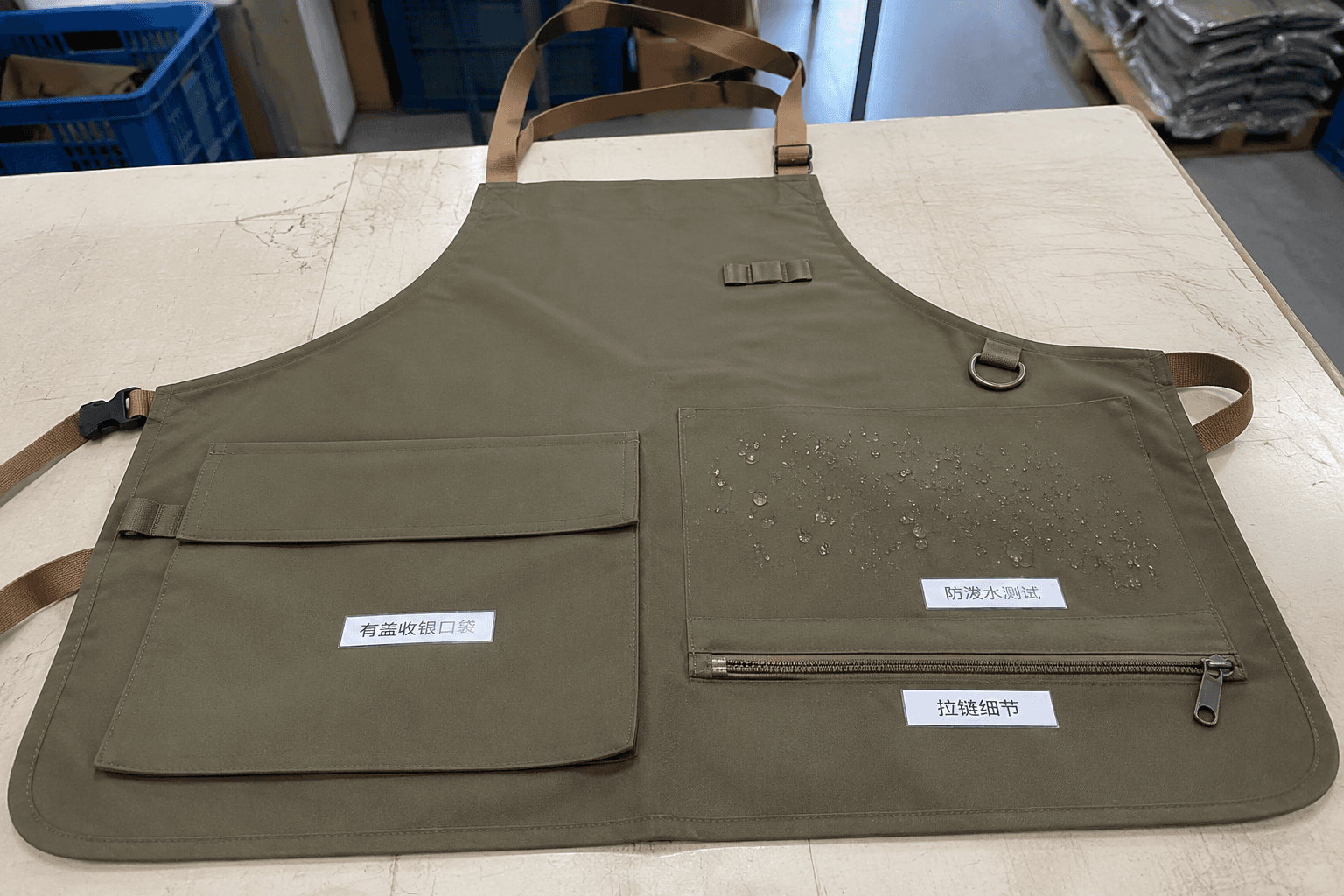
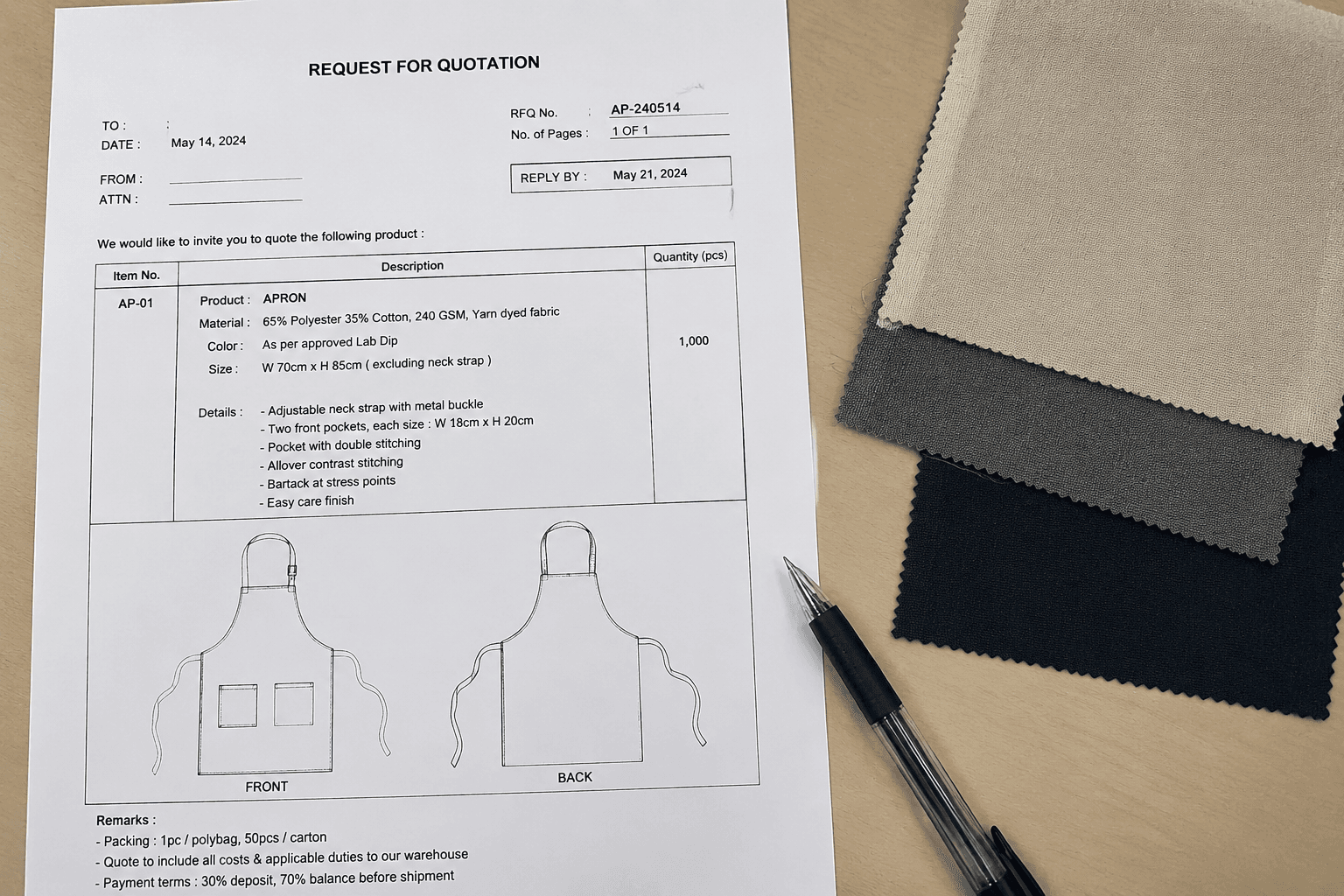
A usable apron specification is a production document, not a style memo. For bib-style restaurant franchise aprons, the tech pack should define finished width, body length, neck drop, pocket count, pocket size, hem depth, seam type, bartack points, strap construction, thread shade, logo position, wash-performance limits, labeling, and packing method. One practical example is a bib apron in 65/35 poly-cotton twill at 255 GSM, finished at 78 cm wide by 86 cm long, with two front pockets measuring 17 cm by 19 cm, self-fabric waist ties at 3 cm by 95 cm each side, and bartacks at all pocket openings and both tie joins.
Tolerance bands should sit in the same document. Buyers often use body length plus or minus 1.0 cm, body width plus or minus 1.0 cm, pocket placement plus or minus 0.5 cm, tie width plus or minus 0.3 cm, and embroidery position plus or minus 0.3 cm. Shrinkage can be capped at 3 percent in warp and 3 percent in weft after three washes at 60 degrees Celsius. Practical test thresholds include washing colorfastness grade 4 minimum, dry rubbing grade 4, wet rubbing grade 3 to 4, and seam slippage performance that meets the buyer's lab standard on the approved fabric.
Decoration needs the same level of control because logos are where inconsistency shows first. Embroidery is common for long-life franchise use because it generally performs better than low-cost print methods over 30 to 50 wash cycles, but it still requires specification. Buyers should define logo size, placement from fixed landmarks, thread type, backing type, and acceptable stitch density. On typical volume orders, a single-position screen print may add about US$0.25 to US$0.60 per piece, while a single-position embroidery logo often adds US$0.55 to US$1.10 depending on stitch count and thread colors. Heat transfer may suit short-life promotions, but it is less reliable for a core apron SKU expected to stay in circulation for a year or more.
A complete specification also shortens sampling. In a standard China production program, clear construction notes can remove 7 to 10 days of back-and-forth because the supplier does not need to guess dimensions or sewing details. A realistic calendar is 5 to 7 days for the first sample, 3 to 4 days for buyer comments, 5 to 7 days for the revision sample, and 25 to 35 production days when the fabric is standard and in stock.
- Include flat measurements with tolerances for body, neck strap, waist ties, pockets, and logo location.
- Lock wash-performance standards for shrinkage, colorfastness, seam stability, and decoration durability.
- Define pack-out rules, such as one piece per polybag and 25 pieces per export carton.
- Reference one version-controlled BOM so all future POs point to the same materials set.
Choose apron fabric by wash cycle, service intensity, and cost per wear
Fabric selection should follow operating conditions, not visual preference. High-volume quick-service, bakery, and fast-casual chains usually need aprons that tolerate frequent washing, grease exposure, and long shifts without becoming too heavy, too stiff, or unstable in color. In that environment, 235 to 260 GSM poly-cotton twill, roughly 7.0 to 8.5 oz, is often the most reliable commercial option. It typically wrinkles less than 100 percent cotton, dries faster, holds dark colors more consistently, and fits a manageable replenishment price band.
Premium casual and full-service concepts may prefer a heavier hand to create more structure on the floor. Common options include 300 to 340 GSM canvas, 10 to 12 oz cotton twill, or denim around 9 to 11 oz. These fabrics can look more substantial, but they also carry trade-offs: higher shrinkage risk, longer drying time, more shade variation between dye lots, and more wearer complaints in hot kitchens. For regional programs, buyers can protect the same visual silhouette while approving a lighter 240 to 250 GSM version for tropical markets and a heavier 280 to 300 GSM version for cooler regions, provided both sit under one controlled master standard.
Pricing should be discussed in realistic bands. A straightforward bib apron in standard poly-cotton twill with one simple logo application often lands around US$2.20 to US$3.80 per piece at 1,000 to 3,000 pieces FOB China. Heavier canvas, washed denim, contrast hardware, custom dyeing, or multi-position embroidery can push cost into the US$4.80 to US$8.50 range. Orders below 500 pieces often increase piece price by 15 to 30 percent because cutting loss, sewing setup, and decoration setup do not fall in proportion to quantity.
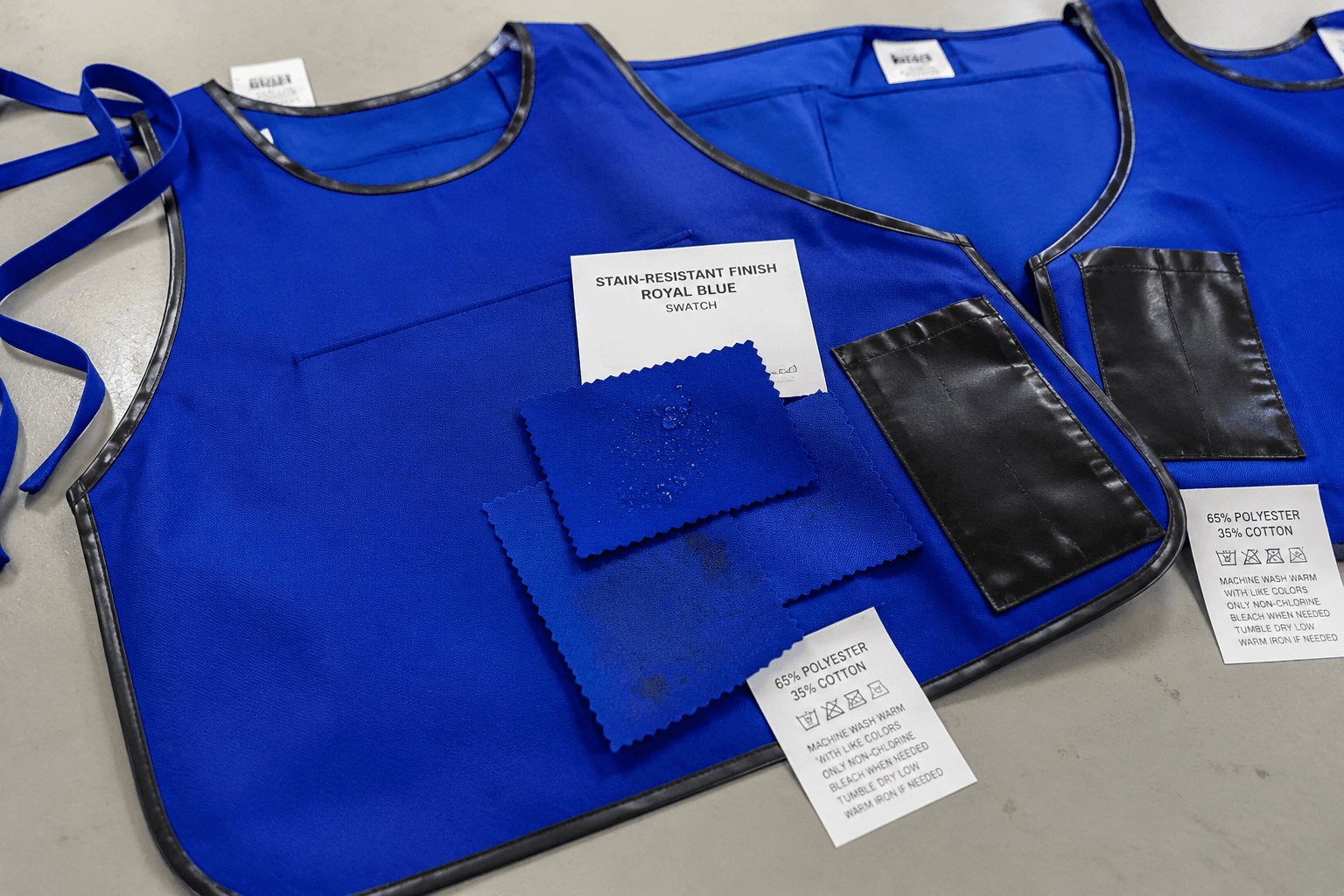
Testing turns fabric choice into a sourcing decision instead of a styling discussion. Buyers should request shrinkage, colorfastness, seam strength, and crocking data before bulk approval, especially on black, navy, burgundy, and forest shades. A fabric that saves US$0.18 per piece on the first order can cost more later if replacement demand rises by 8 percent or if dark crocking triggers complaints in front-of-house use.
- Choose 235 to 260 GSM poly-cotton twill for high-turn service where easy care and stable cost matter.
- Use 300 GSM and above only when the brand gains clear visual value from the added structure.
- Expect more shrinkage and shade variation in cotton-rich fabrics unless pre-shrunk finishing is specified.
- Compare cost per wear and replacement rate, not only first-cost per piece.
Build regional apron standards without losing franchise control
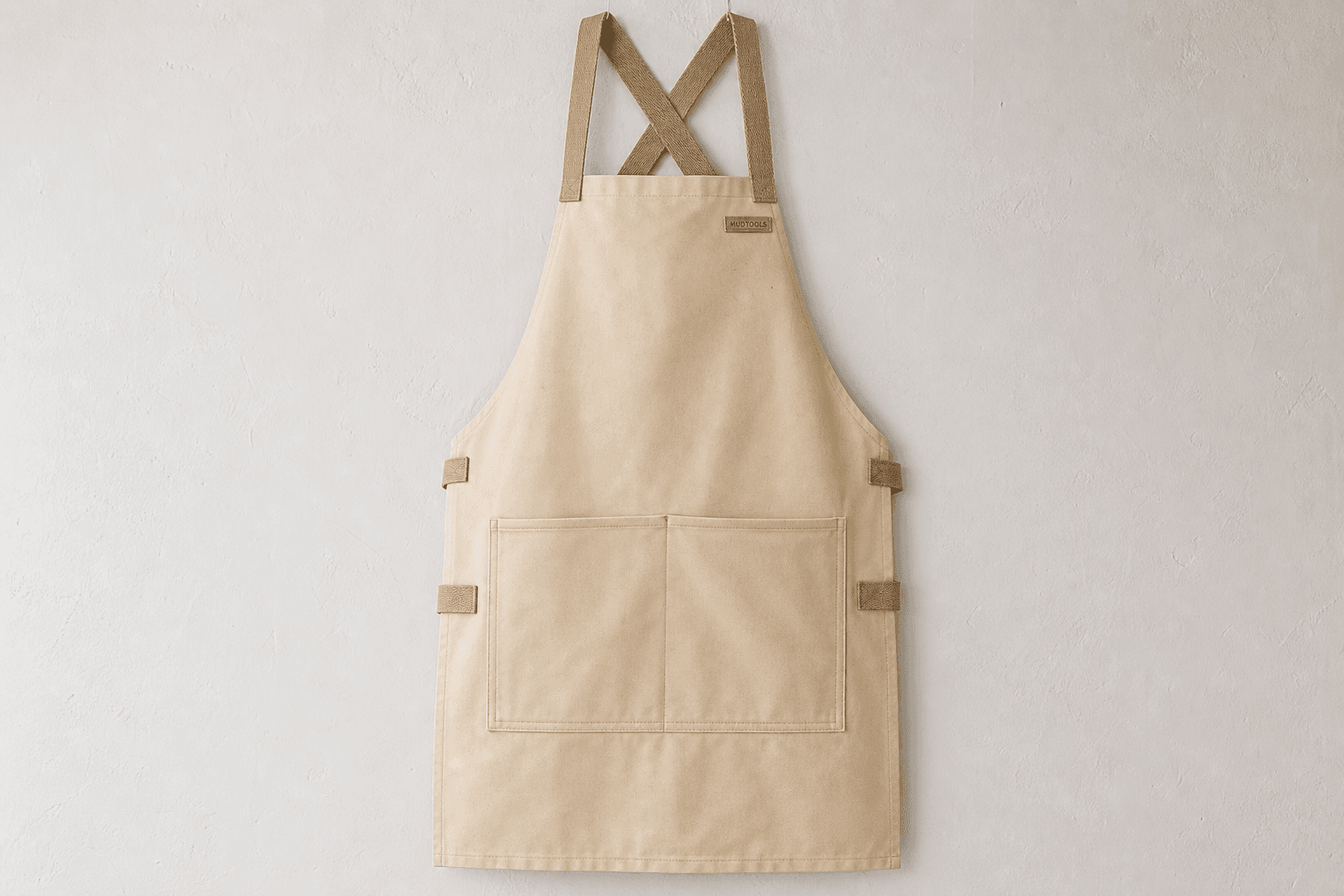
Most franchise groups should not force one apron setup onto every role and climate, but they also should not allow each market to source independently. The stronger model is a controlled apron family: one brand language with a small set of approved variants. That may include a core bib apron for front-of-house, a shorter bib for café service, a waist apron for bar teams, and a cross-back apron for selected bakery or open-kitchen roles. Silhouettes can vary, but color standards, logo position, trim identity, and minimum quality thresholds should stay aligned.
The sourcing task is to separate global rules from regional variables. Global rules usually include brand color references, logo artwork, minimum fabric standards, thread tone, label format, seam construction, and QC thresholds. Regional variables can include body length, tie length, care-label language, or fabric weight for climate comfort. For example, a chain in Southeast Asia may approve a 240 GSM bib apron at 82 cm body length for front-of-house teams, while the same brand in the UK uses a 270 GSM version at 86 cm for cooler conditions and heavier layering.
This structure protects consistency while limiting SKU growth. A franchise network with 100 to 150 locations can often operate effectively with three silhouettes and two core colors. A larger operator with multiple service formats may need five to seven active apron SKUs, but once the assortment goes beyond that level, forecasting, replenishment planning, warehouse storage, and dead-stock risk become harder to control. Every local exception adds storage cost, reorder complexity, and another quality-control point.
The discipline is simple: each regional change must tie back to the same master standard, sample approval path, and reorder rules. Climate and role adjustments are reasonable. Uncontrolled local sourcing is not. Buyers who set this boundary early support operations without fragmenting the apron program quarter after quarter.
- Define one global apron family with controlled variants by role or market.
- Keep logo position, color codes, and trim identity constant across approved versions.
- Adjust length, tie length, or fabric weight only when the variance is documented in the master spec.
- Limit active SKUs to the smallest workable set to reduce warehouse complexity and dead stock.
Set MOQ, lead times, and reorder rules before the first bulk PO
MOQ should be planned as part of the program instead of negotiated only at ordering time. Simple aprons in stock black or navy fabric may start at 300 to 500 pieces per color. Once the buyer adds custom-dyed fabric, multiple sizes, woven labels, special packaging, or branded hardware, the practical MOQ often moves to 800, 1,000, or 1,500 pieces per colorway. If the order is pushed below the workable minimum, the cost usually returns somewhere else through a higher piece price, less stable trim sourcing, or longer waiting time while the supplier consolidates materials.
Lead time should be broken into stages because many buyers underestimate the days before sewing begins. A realistic schedule is 5 to 7 days for the first sample, 3 to 5 days for comments, 5 to 7 days for revision, 7 to 12 days for fabric booking when custom color is required, 25 to 35 days for production on standard construction, and another 5 to 10 days for booking and export handling. More complex apron programs with custom dyeing, washed denim, or heavy specialty canvas can extend to 40 to 55 production days before shipment departure.
Reorder discipline separates stable programs from reactive ones. Every repeat PO should cite the current tech pack version, sealed sample code, BOM revision, packaging standard, and inspection plan. If the supplier proposes a change, such as shifting from 255 GSM to 245 GSM because fabric stock is tight or replacing matte black hardware with antique brass, the request should move through a formal deviation review with cost, lead-time, and performance impact documented before approval. It should never appear for the first time at final inspection or in the warehouse.
Replacement demand should also be tracked by store type. If kitchen-facing units replace bib aprons every 8 to 10 months while front-of-house café units replace them every 12 to 14 months, the next buy should reflect that difference. Those numbers help procurement decide whether to add 10 percent buffer volume, reinforce key stress points, or shift to a heavier twill before replacement cost climbs.
- Plan MOQ by fabric complexity, color count, and branding method, not by a generic target.
- Build the calendar from sampling, comments, fabric booking, production, and export handling, not sewing days alone.
- Require repeat POs to reference the tech pack version, sealed sample code, and BOM revision.
- Track replacement cycles by store format so reorder quantities reflect actual wear patterns.
Use AQL, wash testing, and packing controls to stop reorder drift
Inspection rules should be agreed before the first bulk PO is released. For most apron programs, AQL 2.5 for major defects and AQL 4.0 for minor defects is a practical baseline, with brand-specific checkpoints added for shade, measurements, logo position, stitch quality, hardware finish, and carton assortment. Aprons are visually simple, which makes defects easier to spot. A pocket set 1.0 cm off spec, a strap sewn with the wrong thread tone, or an embroidered logo tilted 4 mm will stand out when an entire service team wears the stock together.
Measurement control should be explicit. If the approved bib length is 86 cm with a tolerance of plus or minus 1 cm, anything outside that range should fail. If the pocket opening is specified at 16 cm, an actual opening of 14.5 cm changes function, not just appearance. Fabric weight should be checked against the approved window, such as 250 plus or minus 5 GSM after finishing. Decoration placement should be measured from fixed landmarks such as neckline seam, center front, or pocket top edge rather than judged visually at the inspection table.
Wash confirmation is also worth adding for core franchise aprons. A top-of-production sample can be washed three times under the agreed method to confirm shrinkage, skew, seam puckering, and decoration stability before the whole order is packed. This step is especially valuable when stores use commercial laundry, high-temperature washing, or aggressive stain-removal chemistry. Spending a small amount on early wash confirmation is usually cheaper than redistributing failed stock across 60 or 120 sites after complaints start.
Packing controls are often treated as secondary, but they directly affect receiving accuracy and replenishment speed. Carton labels should show style, color, size, quantity, PO number, and carton number in a fixed format. Inner-pack ratios should follow the warehouse issue plan, such as 10 small, 10 medium, and 5 large per carton if the DC replenishes by pre-sorted size runs. When pack rules are loose, warehouse teams lose time opening cartons and rebuilding assortments by hand.
- Use AQL 2.5 major and AQL 4.0 minor unless internal quality policy requires stricter levels.
- Measure body size, pocket placement, logo position, and fabric weight against the sealed sample and tech pack.
- Add three-wash confirmation for programs exposed to frequent commercial laundering.
- Standardize carton labeling and inner-pack ratios so receiving stays accurate.
Build a long-term sourcing system for restaurant franchise aprons
The strongest apron programs are built for the fourth order, not just the launch. Buyers should archive each approval asset in one controlled file set: tech pack version, BOM, shade standard, care-label artwork, packing guide, test report, sample photos, inspection notes, and production comments. When a replenishment request arrives 6, 9, or 12 months later, the sourcing team should be able to issue a repeat PO in hours instead of rebuilding decisions from email threads and memory.
This is where total program cost becomes clearer. A US$3.40 apron that passes inspection, launders predictably, and reorders cleanly often outperforms a US$2.95 apron that creates mixed dye lots, extra rejects, size complaints, and partial replacements. In a network of 120 locations, even a 3 percent defect rate or a 10-day delay can trigger real downstream cost through emergency freight, local stopgap buying, store complaints, and warehouse rework. Aprons are modest-cost items per unit, but they are operationally visible and highly repetitive purchases.
Professional buyers should also formalize change control. If the supplier proposes a new fabric mill, a different embroidery backing, or alternate hardware because of supply constraints, the request should document appearance impact, cost impact, lead-time impact, and test impact before approval. That record protects procurement and brand operations on later reorders while making supplier performance easier to review over a 12- to 24-month program.
The best long-term result is a narrow, stable standard that still allows approved regional adaptation. That is how restaurant franchise aprons stay visually aligned across markets, commercially predictable across reorder cycles, and practical for the operators who wear them every day.
- Archive a complete approval file set for each apron SKU so reorders do not depend on memory.
- Review cost against defect rate, replacement demand, freight exposure, and warehouse handling, not only quoted price.
- Treat all material, trim, and decoration changes as formal change requests with approval records.
- Keep the standard tight enough to protect the brand but flexible enough to support approved regional variants.