For buyers sourcing school cafeteria aprons, the brief should begin with wearer role, soil exposure and laundry method. Cafeteria staff work around children while handling tomato sauce, fryer oil, milk, gravy, fruit concentrate, flour dust and protein soils. Many districts launder aprons three to five times per week, which means a full-year program can reach 90-120 wash cycles before replacement.
The avoidable failures are measurable: fabric below 180 GSM that twists after hot wash, untreated cotton that shrinks 5-8%, pocket corners without bartacks, metal snaps that corrode or become detachable, and stain claims tested only with water drops. A professional purchase brief defines fiber blend, GSM, ounce weight, trim restrictions, pocket load, logo method, wash temperature, colorfastness target and replacement interval before sampling starts.
This final specification guide sets out a factory-side approach for serving-line, prep and dish-area apron programs. It gives realistic MOQ, lead-time, ex-factory price, wash-cycle and inspection benchmarks so distributors, uniform buyers and school procurement teams can compare apron offers by performance rather than broad supplier claims.
- Specify school cafeteria aprons by role, laundry method and target wash cycles before approving color or pocket style.
- For most programs, 190-240 GSM, equal to about 5.6-7.1 oz/yd2, is the practical fabric range.
- A 65/35 polyester-cotton twill around 210-235 GSM usually gives the best balance of shrinkage control, drying speed, comfort and cost.
- Child-safe trim control means avoiding exposed metal snaps, detachable rivets, loose badges, sharp eyelets and long free-hanging cords.
- Untreated cotton can shrink 5-8% in hot wash; stabilized poly-cotton should normally hold shrinkage near 2-3%.
- Bulk OEM pricing commonly ranges from US$2.20-US$6.80 per piece, depending on fabric, finish, pockets, logo method, packing and MOQ.
- Use measurable inspection targets such as AQL 2.5 major / 4.0 minor, washed PP samples and sealed reference samples for institutional orders.
1. Specify school cafeteria aprons by role, wash count and service life
A useful apron specification starts with the work zone. A serving-line employee needs front-body coverage, stable pockets and a clean appearance through multiple lunch periods. A prep worker needs better resistance to oil, sauce, flour dust and repeated wiping. A dish-area worker faces water, steam, detergent splash and heavier abrasion at the waist and lower front panel. One apron style can cover several roles, but the specification should be built around the hardest regular use, not the lowest-cost station.
Convert the use case into numbers before requesting samples. A district washing aprons three times per week for a 30-week school year creates about 90 wash cycles. If the planned replacement interval is one semester, a 45-wash target may be enough. If the apron must last the full academic year, the fabric, thread, pocket bartacks, labels and colorfastness should support 90-120 washes. That decision controls cost more rationally than simply asking for heavier fabric.
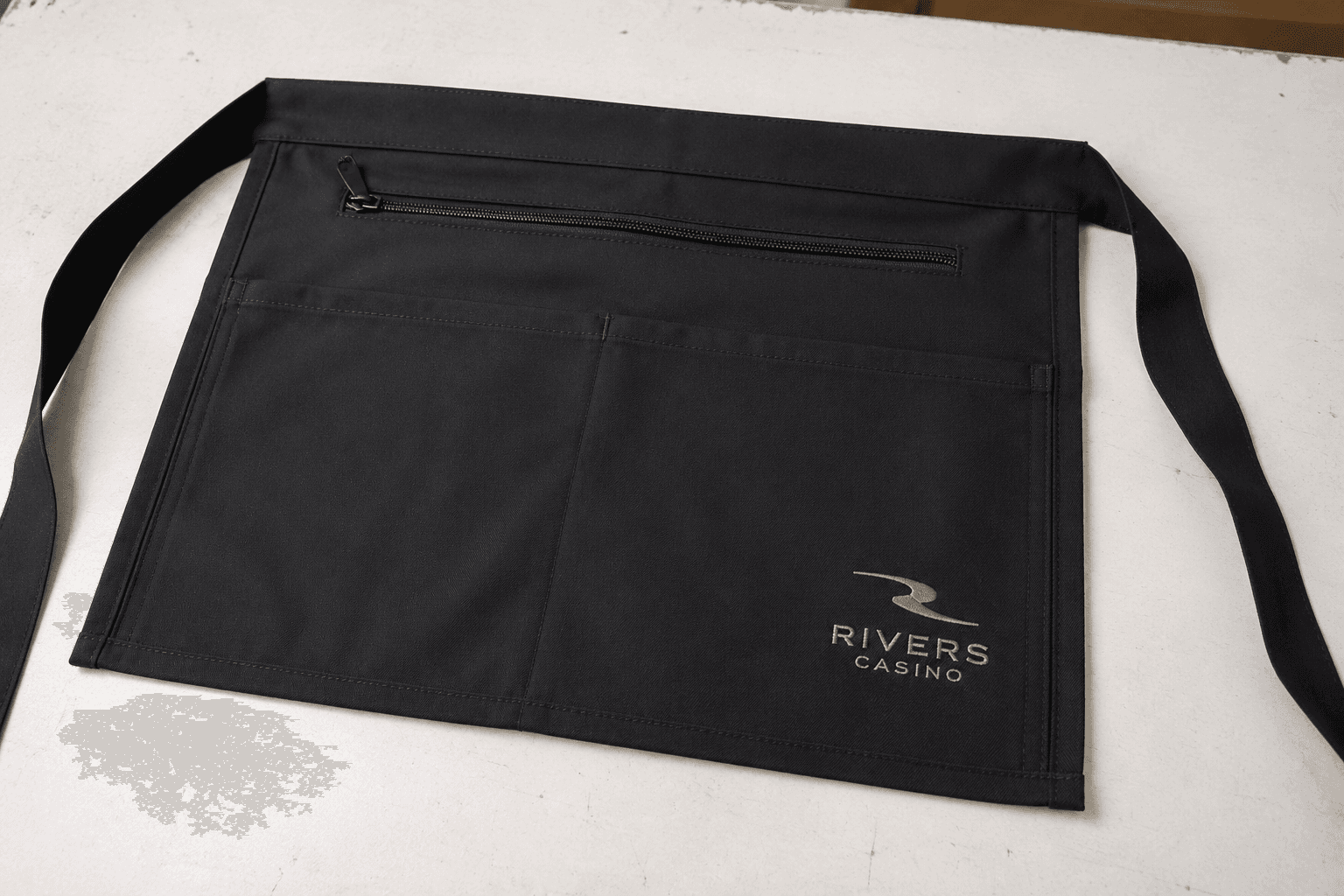
Logo method also belongs in the first brief. Embroidery on 190 GSM fabric can pucker unless the factory adds backing and controls stitch density. Heat transfer can lift at the edges if the laundry uses high heat or aggressive alkalinity. Screen print is cost-effective for runs above 1,000 pieces, but it should be checked after at least 10 wash cycles before bulk approval. A role-and-wash brief prevents the factory from optimizing only for the first sample photo.
- Define the wearer role: serving line, prep, dish area or multi-role.
- State the wash method: institutional laundry, on-premise laundry or controlled home wash.
- Set a target of 45, 90 or 120 wash cycles based on the replacement plan.
- Confirm logo method before fabric approval: embroidery, screen print, heat transfer or woven label.
- Specify whether the apron must be non-metal and free of detachable decorative parts.
2. Child-safe trims for school cafeteria aprons near students
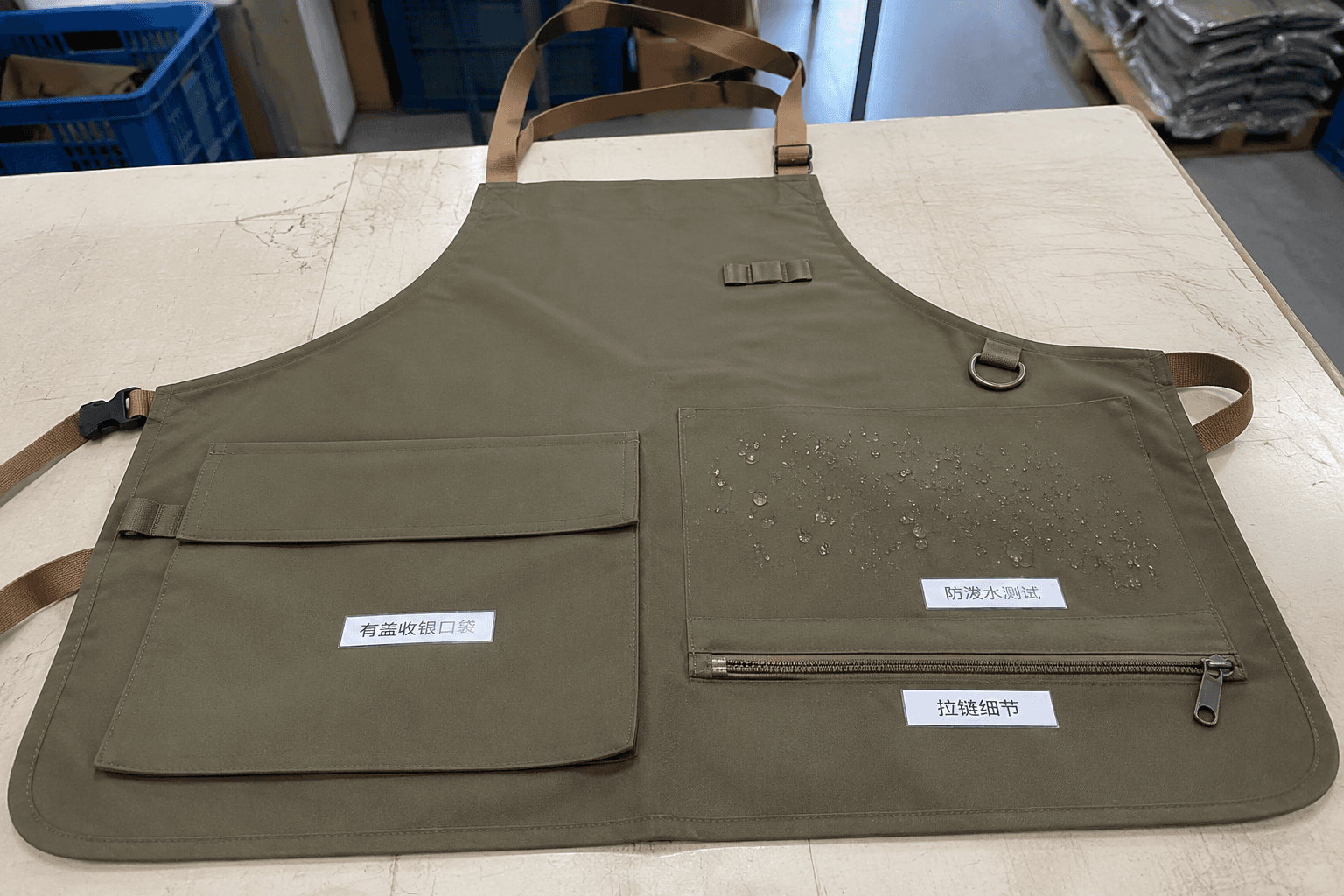
Trim choices should be conservative in schools. Metal D-rings, exposed snaps, loose rivets, decorative badges and sharp-edged eyelets may be acceptable in some hospitality uniforms, but they create avoidable risk where children stand close to staff garments. The safer construction is a sewn neck loop, cross-back strap or fabric tunnel adjustment with no removable hardware. If adjustment is necessary, fabric ties usually survive repeated hot wash better than lightweight plastic sliders.
The same trim rules improve wash durability. Hardware can chip, rust, deform or stain nearby fabric after chlorine, peroxide or alkaline detergent exposure. A stitched strap join with internal reinforcement and a bartack at the stress point is easier to inspect and less likely to fail. For waist ties, buyers should specify finished length by size. Ties that are too short frustrate staff wearing layered uniforms; ties that are too long can hang into work surfaces or snag on service equipment.
Labels and trimming are small details with high complaint value. A scratchy woven neck label, hard label corner or untrimmed thread tail can make a durable apron feel cheaply made. For school programs, printed care labels or soft satin polyester labels are usually enough. The cost impact is minor, often US$0.02-US$0.06 per piece, but it reduces wearer complaints and makes reorders easier to standardize.
- Ban detachable rivets, exposed snaps, loose badges and sharp metal eyelets.
- Use sewn fabric straps, tunnel ties or cross-back construction where possible.
- Specify tie length by size, with controlled free ends after tying.
- Require bartacks at neck, waist and pocket stress points.
- Use soft labels or printed labels with no sharp corners or loose thread tails.
3. Fabric GSM and oz/yd2 benchmarks for school cafeteria aprons
For cafeteria apron programs, the practical fabric range is usually 190-240 GSM, equal to about 5.6-7.1 oz/yd2. Below 180 GSM, aprons may feel light in the sample room but often show edge curling, pocket distortion and seam grin after institutional laundering. Above 260 GSM, abrasion resistance may improve, but drying time, wearer heat and freight weight increase. For most school foodservice buyers, 210-235 GSM is the commercial balance point.
Three fabric routes cover most orders. A 210-240 GSM 100% cotton twill gives a natural hand and strong presentation, but it wrinkles more, dries slower and can shrink 5-8% unless sanforized or otherwise stabilized. A 200-235 GSM 65/35 polyester-cotton twill is the common institutional choice because it holds shape better, dries faster and can keep shrinkage around 2-3% when properly finished. An 80/20 or 100% spun polyester fabric improves color retention and quick drying, but it can hold oily soils if the stain-release finish is weak.
Fabric construction matters as much as fiber. Twill hides abrasion and light staining better than plain weave at the same weight, while plain weave can be lower cost and adequate for lighter serving roles. Dark colors such as navy, black, burgundy and bottle green need colorfastness testing on the selected shade, not only on a stock black swatch. If aprons will be worn over white shirts, crocking control should be written into the purchase specification.
- 190-205 GSM: suitable for lighter serving roles and lower-cost programs.
- 210-235 GSM: practical range for most school cafeteria aprons.
- 240-260 GSM: useful for heavier wash demand, with longer drying time.
- 65/35 poly-cotton: strong balance of shrinkage control, price and comfort.
- Twill weave: better visual durability than plain weave for repeated cafeteria use.
4. Stain resistance for tomato, oil, milk and gravy soils
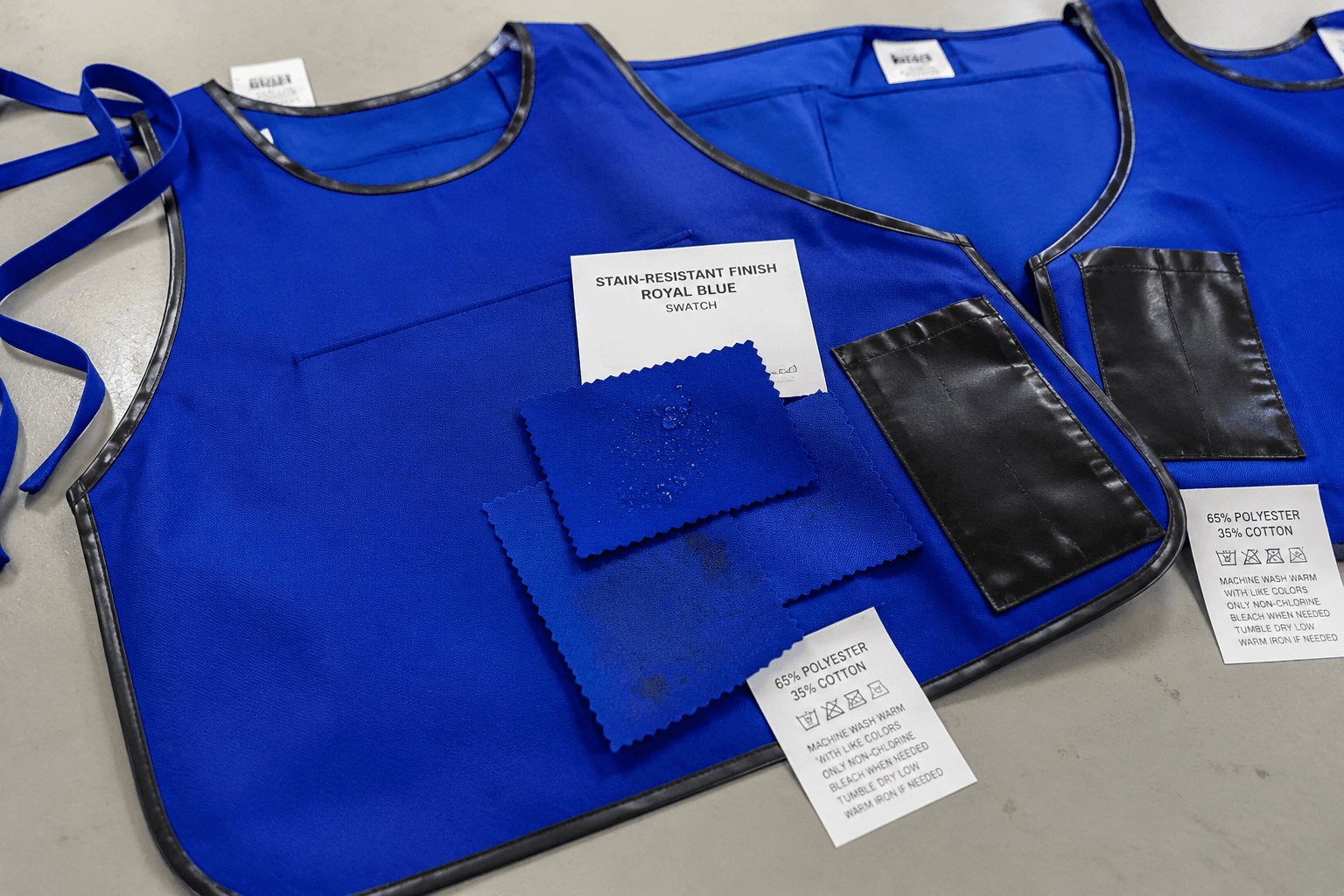
Stain resistance is not a single feature. Repellency helps liquid bead on the surface for a limited time. Stain release helps soils wash out during laundering. For school cafeteria aprons, stain release is usually more important because the main risks are tomato sauce, cooking oil, gravy, milk, fruit concentrate, chocolate and protein stains that may dry before the garment reaches the laundry.
A useful test brief names the soil, dwell time, wash temperature, detergent type and evaluation point. For example, a buyer can require acceptable visual results after ketchup, cooking oil and milk soils are left for four hours, then washed at 60°C with the same detergent family used by the laundry. A first-wash swatch test is not enough for institutional buying. The finish should be checked after 10, 25 and 50 wash cycles if the apron is expected to last a semester or longer.
The cost impact is real but manageable. A basic stain-release treatment may add US$0.08-US$0.18 per piece on a simple 65/35 twill apron at bulk volume. A more durable finish or combined repellency and release program may add US$0.20-US$0.35 per piece and can increase material lead time by 3-7 days. Buyers should approve the finished garment, not only finished fabric, because seam bulk, pocket layers and logo areas can change how stains and wash marks appear.
- Separate stain repellency from stain release in the specification.
- Test tomato, cooking oil, milk, gravy and fruit concentrate rather than generic water drops.
- Check results after 10, 25 and 50 wash cycles when service life requires it.
- Confirm wash temperature, detergent and bleach exposure before approving claims.
- Budget US$0.08-US$0.35 per piece for meaningful stain-finish upgrades.
5. Institutional wash construction, shrinkage control and AQL
Institutional laundry exposes weak apron construction quickly. Hems can rope, pockets can detach at the top corners, straps can twist and dark colors can show crease whitening. For bulk production, lockstitch seams at 8-10 SPI are usually appropriate for structural areas. Pocket tops, tie joins and neck strap joins should be reinforced with bartacks or equivalent dense stitching. Polyester thread is preferred for hot wash because it generally outperforms cotton thread in strength retention and drying stability.
Shrinkage should be measured on washed garments before production approval. A practical method is to record body length, body width, tie length and pocket position before and after three wash-and-dry cycles. For a stabilized 65/35 apron, many buyers set a maximum shrinkage target of 3%. For 100% cotton, the target may need to be wider unless the fabric is pre-shrunk and tested. Without wash-tested measurements, logo height and pocket usability can shift outside the approved standard after the first laundry cycle.
Inspection criteria should be explicit. For institutional apron orders, many buyers use AQL 2.5 for major defects and AQL 4.0 for minor defects, with zero tolerance for safety defects such as exposed sharp trim, loose metal parts or broken needle contamination. Major defects include open seams, wrong color, incorrect logo placement, missing bartacks and pockets outside tolerance. Minor defects include light thread tails, small shade variation within tolerance or minor measurement deviation that does not affect wear.
- Use 8-10 SPI lockstitch seams for main construction.
- Set post-wash dimensional tolerance, such as maximum 3% shrinkage for stabilized poly-cotton.
- Require bartacks at pocket tops, tie joins and strap stress points.
- Apply AQL 2.5 major / 4.0 minor for bulk inspection where appropriate.
- Set zero tolerance for sharp trim, broken needle contamination and unsecured detachable parts.
6. MOQ, lead time and unit cost for school cafeteria aprons
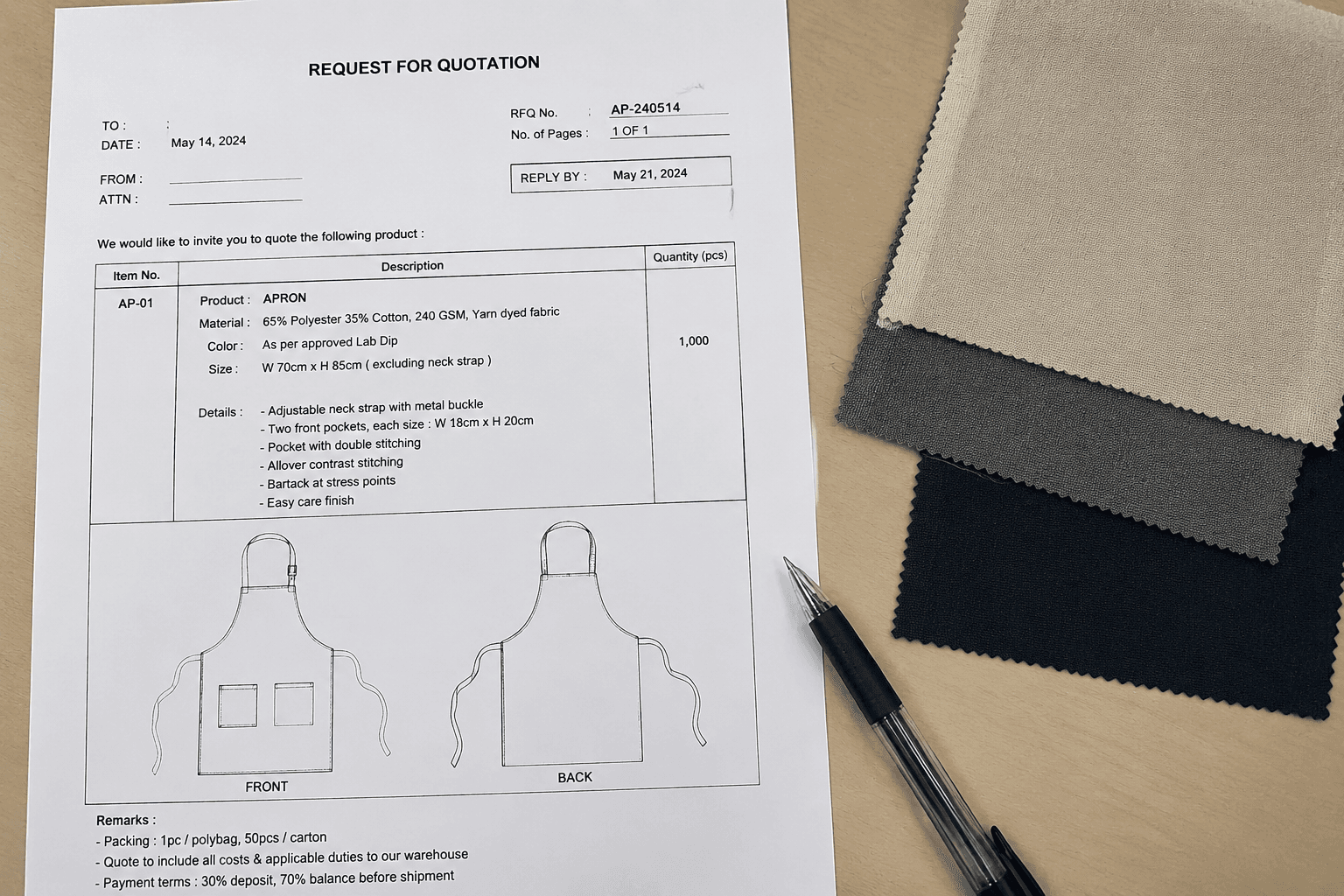
Apron price is driven by fabric, sewing minutes, finish, logo method and packing complexity. At 3,000-5,000 pieces, a basic bib apron in stock 65/35 twill, about 200-220 GSM, with one pocket and no special finish may land around US$2.20-US$3.10 per piece ex-factory. A 230-240 GSM apron with stain-release finishing, reinforced pockets, embroidery and custom color commonly moves to US$4.20-US$6.80 per piece. Small orders, multiple logo versions and segmented campus packing can push the effective unit cost higher.
MOQ depends on fabric availability. If the buyer accepts stock black, navy, dark green or burgundy, a factory may support 500-1,000 pieces per color for a simple style. Custom Pantone dyeing usually needs 1,500-3,000 pieces per color because dyeing and finishing mills require efficient lot sizes. If several school sites share the same fabric but use different logos, the combined fabric volume may meet MOQ while embroidery setup, carton marking and packing lists are managed separately.
Lead time should be planned backward from the school start date. Stock-fabric programs can often run 30-45 days after approval. Custom color or custom finish programs usually need 45-70 days ex-factory. A typical schedule includes 3-7 days for lab dips, 5-10 days for sample sewing, 15-25 days for custom fabric dyeing and finishing, 20-35 days for bulk sewing, and 2-5 days for final inspection and packing. Peak back-to-school production can add 7-14 days if approvals arrive late.
- Stock fabric MOQ: often 500-1,000 pieces per color for simple apron styles.
- Custom dye MOQ: commonly 1,500-3,000 pieces per color.
- Basic OEM range: about US$2.20-US$3.10 per piece at bulk volume.
- Enhanced institutional range: about US$4.20-US$6.80 per piece, depending on finish and logo.
- Custom programs should allow 45-70 days from approval to ex-factory shipment.
7. Bulk approval checklist for repeatable apron sourcing
Bulk approval should remove interpretation before cutting starts. The buyer should approve a pre-production sample made in the correct fabric, color, trim, thread, label, pocket layout and logo method. For school cafeteria aprons, the PP sample should be washed before final measurement approval. An unwashed sample is useful for fit and appearance, but it does not prove shrinkage, pocket stability or logo performance.
Packaging and distribution details affect the sourcing result. School districts often require campus-level carton labeling, mixed size ratios, polybag warnings, barcode labels or distributor packing lists. These items should be included before the final quotation because they add labor and can affect lead time. A simple apron packed 50 pieces per carton is different from a multi-campus order packed by school, role and logo version.
For repeat orders, sealed reference samples are essential. Keep one approved sample with the buyer, one at the factory and one with the QC team if third-party inspection is used. Record fabric GSM, ounce weight, shade standard, finished measurements, wash test results, trim details and logo placement. This makes reorders more consistent and prevents small changes in fabric lot, pocket size or strap construction from becoming disputes six months later.
- Approve a washed PP sample before bulk cutting.
- Record before-wash and after-wash measurements for body, ties and pockets.
- Seal reference samples for buyer, factory and QC inspector.
- Confirm carton labels, campus packing and barcode requirements before production.
- Use the same wash protocol for testing future repeat orders.