For dental chains, orthodontic groups, implant centers, DSOs and healthcare distributors, dental clinic aprons are patient-facing uniform items with heavier maintenance demands than standard promotional aprons. They face chairside water spray, polishing paste, disinfectant residue, glove powder, pen marks and frequent washing under bright clinic lighting.
The sourcing brief should start with role and exposure level. Reception aprons can use 180-200 GSM poly-cotton with light pockets and small branding. Chairside assistant aprons need better opacity, reinforced pockets and a defined fluid-resistance finish. Sterilization support aprons may justify PU-coated polyester, darker edging or a fabric that tolerates harsher wash programs.
Most B2B programs balance comfort, splash protection, white fabric maintenance and landed cost. A 220-240 GSM poly-cotton twill hides dark scrubs better than 160-180 GSM poplin, but it feels warmer. PU back coating improves liquid resistance, but reduces breathability. Embroidery looks professional, but needle holes and thread can absorb moisture. A useful RFQ defines these trade-offs before sampling.
- Dental clinic aprons usually perform best in 200-240 GSM poly-cotton twill when opacity, structure and routine washing matter.
- Fluid resistance should be quoted by finish type: DWR surface finish, PU back coating or TPU lamination, with a target wash-life range.
- White fabric maintenance depends on body fabric, thread, binding, labels, logo method and laundry chemistry, not fabric color alone.
- Branding should stay restrained: left-chest embroidery, small upper-bib transfer or a woven label at the pocket or side seam.
- Planning should allow 7-10 days for sampling and 25-40 days for bulk production after approval; coating, custom dyeing or lab testing can add 7-15 days.
1. Dental clinic aprons by role: match GSM, splash exposure and pocket load
Dental clinic aprons sit between healthcare presentation and practical chairside work. One apron specification should not cover reception, hygiene rooms, sterilization support, dental school training and distributor demonstrations without adjustment. Each role creates different wear points, fluid exposure, pocket load and branding requirements.
Reception and consultation staff usually need a clean silhouette over scrubs, polo shirts or clinic tunics. A 180-200 GSM poly-cotton twill with two lower pockets, adjustable neck tape and one small logo is usually enough. The priorities are comfort, low wrinkling, consistent white shade and a unit cost that works across multiple front-desk teams.
Chairside assistants need more structure. A 220-240 GSM poly-cotton twill or 190-230 GSM coated polyester gives better opacity and pocket stability. If the apron carries pens, polishing accessories, impression material packets or appointment cards, pocket corners and tie points should be bartacked. A lower pocket depth of 16-20 cm is common, but it should be checked against the actual items staff carry.
Sterilization support staff face more wet handling and residue risk. For this role, a PU-coated polyester apron, darker binding or pale grey pocket edging may be more practical than a fully white uncoated apron. For DSOs, dental schools and multi-location clinic groups, repeatability matters as much as first-order appearance. Buyers should lock GSM tolerance, logo placement, trim shade and size grading before bulk production.
- Reception and consultation: 180-200 GSM poly-cotton twill, two light-duty pockets, left-chest logo, FOB target about USD 2.20-3.60 at 1,000-3,000 pcs.
- Chairside assistant: 220-240 GSM poly-cotton or 190-230 GSM coated polyester, reinforced pockets, DWR or PU option, FOB target about USD 3.20-5.20.
- Sterilization support: coated fabric or darker trim, stronger bartacks, simple logo placement, FOB target about USD 3.80-6.50.
- Training and distributor programs: simpler decoration, consistent sizing, carton labeling by cohort or branch, and MOQ planning for repeat orders.
2. Fabric specifications for dental clinic aprons: opacity, hand feel and wash control
Fabric selection determines whether white aprons look professional after laundering and whether staff will wear them through a full shift. For most dental uniform apron programs, the practical base range is 200-240 GSM poly-cotton twill, often 65/35 or 80/20 polyester-cotton. This range gives better opacity over navy, black or dark green scrubs than 160-180 GSM poplin while staying wearable indoors.
Full polyester twill at 180-220 GSM dries faster and wrinkles less than poly-cotton, but it can look shiny after hot pressing and may feel less natural over clothing. Cotton canvas at 250-300 GSM has a substantial hand feel, but it absorbs moisture faster and can shrink 3-5% unless the fabric is pre-shrunk and the laundry process is controlled. For bright white clinic programs, cotton-heavy fabrics also need more careful yellowing and stain testing.
GSM alone is not a complete specification. Two 220 GSM fabrics can perform differently if one is a tight twill and the other is a loose plain weave. Buyers should request composition, weave, GSM tolerance, shrinkage after washing, whiteness consistency and recommended wash temperature. A realistic mill GSM tolerance is often plus or minus 5%, and shade variation between fabric lots should be reviewed before repeat orders.
Opacity should be checked in clinic-like conditions. Place the white apron over dark scrubs under cool white lighting and review the bib, pocket area, side seams and waist tie area. A sample that looks clean on a factory table can become semi-transparent in a treatment room, especially after the first wash removes finishing agents.
- 180-200 GSM poly-cotton twill: suitable for reception, consultation and light promotional use where comfort and cost lead the decision.
- 220-240 GSM poly-cotton twill: stronger choice for chairside use, with better opacity and less pocket sag.
- 250-300 GSM cotton canvas: durable hand feel, but higher shrinkage and stain absorption risk.
- 180-220 GSM full polyester twill: fast drying and wrinkle resistant; check shine, static and hand feel before approval.
- 190-230 GSM coated polyester: better splash resistance; test noise, stiffness and breathability before bulk production.
3. Fluid-resistant dental clinic aprons: specify DWR, PU or TPU before quoting
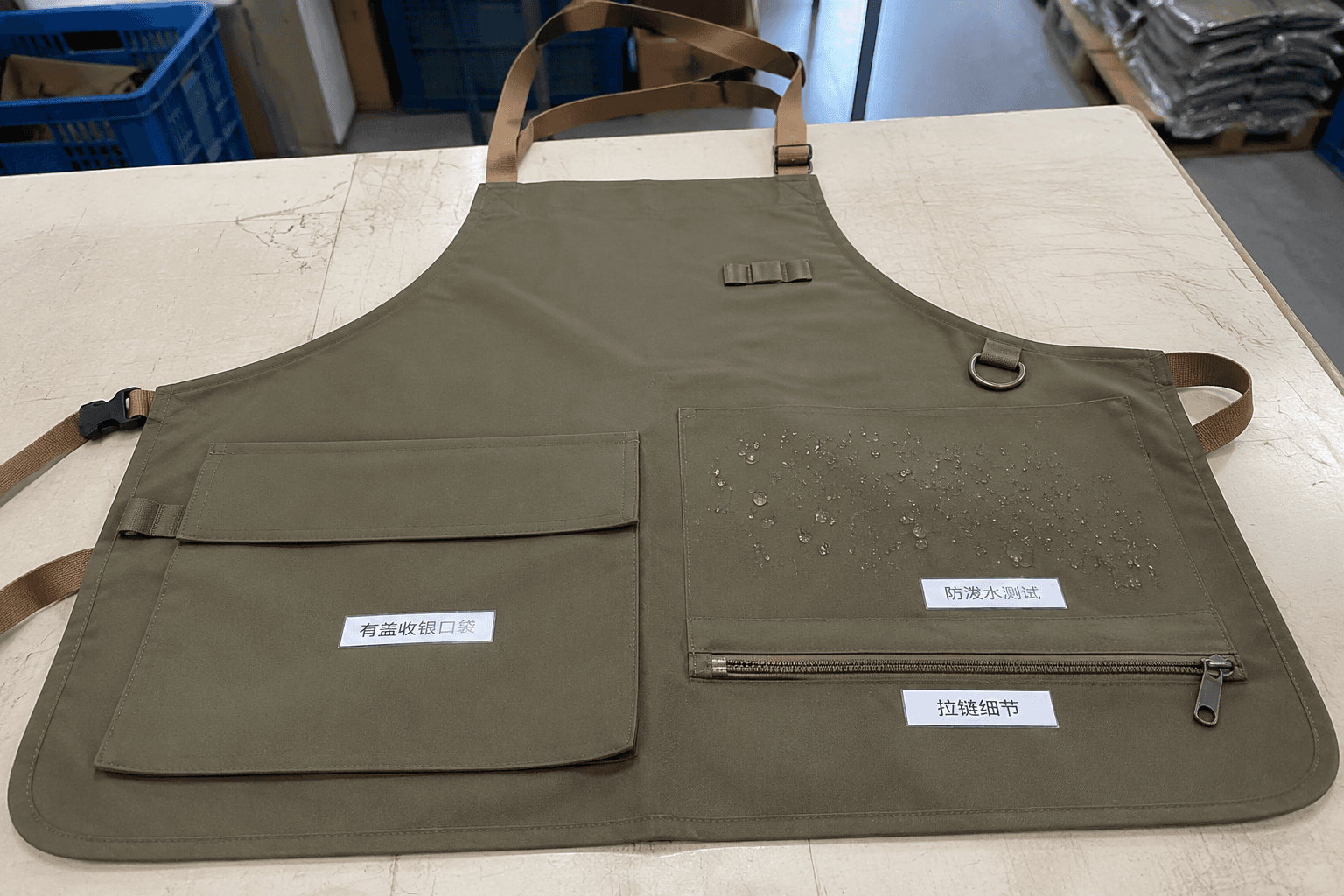
Fluid-resistant dental clinic aprons should be specified by construction, not by loose terms such as waterproof or splash proof. In apron production, a DWR surface finish, PU back coating and TPU film lamination are different solutions with different costs, comfort levels, wash limits and inspection points.
Most clinics need incidental splash resistance rather than full medical isolation protection. For low to medium exposure, a 220 GSM poly-cotton twill with a durable water-repellent surface finish may be suitable if the buyer accepts that repellency declines with laundering. A budget DWR can bead water on a new sample but lose useful performance after 10-15 home wash cycles. Better finishes may remain serviceable for about 25-40 cycles depending on detergent, wash temperature and drying method.
Where wet contact is more frequent, 190-230 GSM polyester with PU coating on the reverse side is more practical. It resists penetration better than DWR, but traps more heat and can feel less flexible during long shifts. TPU lamination can improve barrier performance further, but it increases material cost and may require seam planning because stitched seams can become weak points.
Laundry method changes the decision. High alkalinity, high heat, chlorine bleach and tumble drying can reduce water repellency, damage coatings and yellow trims. If the clinic uses an outside laundry contractor, the factory should receive the wash program before final fabric approval. A finish that survives 30 home washes may fail faster under industrial washing.
- DWR surface finish: softer hand feel, suitable for light splash exposure, target about 15-40 washes depending on finish grade.
- PU back coating: stronger liquid resistance, warmer feel, suitable for chairside and sterilization support.
- TPU lamination: higher barrier performance and higher cost, best used only when exposure level justifies it.
- PVC coating: usually avoided for premium healthcare apron programs because of odor, stiffness and sustainability concerns.
- Quote requirement: supplier must state whether resistance comes from surface finish, back coating or lamination, plus the expected wash-life range.
4. White fabric maintenance: control yellowing, transparency and trim mismatch
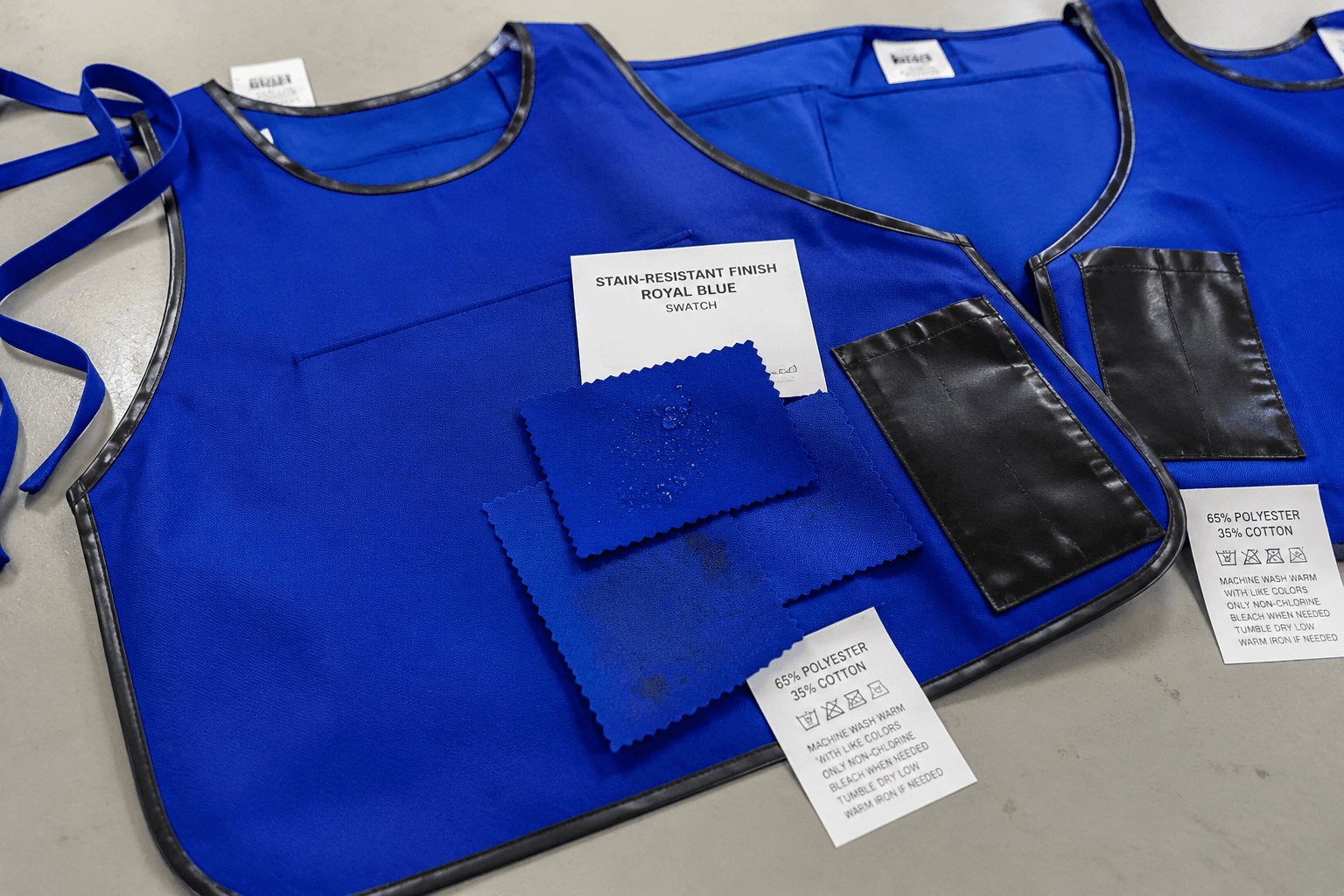
White clinic aprons usually fail visually before they fail structurally. Common problems include yellowing, grey cast, visible stains, dye migration from trims, transparent bib areas and uneven shade between body fabric, neck tape, waist ties, binding and labels. These issues are more visible in dental clinics than in food service or workshop settings because lighting is brighter and the patient-facing standard is higher.
Dental environments create specific stain risks: polishing paste, impression material, disinfectant residue, hand cream, makeup transfer, ink and metal contact around pockets. A clean pre-production sample is not enough. Buyers should request one unwashed sample and one sample washed at least 5 cycles before bulk approval, then retain both as inspection references.
A practical shrinkage target for poly-cotton aprons is within 3% after washing at 40 degrees Celsius. Better controlled fabrics can reach 2-3% with pre-shrinking. Cotton-rich aprons need more caution, especially if the clinic washes at higher temperatures. If chlorine bleach is used, logo decoration, water-repellent finish and sewing thread all need compatibility checks. Oxygen bleach is usually safer for white poly-cotton, but the exact detergent program still matters.
Component matching is critical. Polyester sewing thread is usually more stable than cotton thread for white aprons. Binding tape and waist ties should be washed with the body fabric before approval because different fibers can yellow at different rates. Labels must be colorfast; a private label that bleeds into a white seam can ruin a full batch.
- Check white fabric over navy, black and dark green scrubs, not only against a white table.
- Specify polyester thread for dimensional stability and shade consistency after washing.
- Avoid untreated cotton webbing straps for high-temperature laundry programs.
- Confirm whether chlorine bleach is allowed; many water-repellent finishes and logo methods should not be bleached.
- Consider pale grey binding or pocket edging if the clinic accepts a more forgiving look for high-use areas.
5. Branding on dental clinic aprons: durable, restrained and easy to reorder
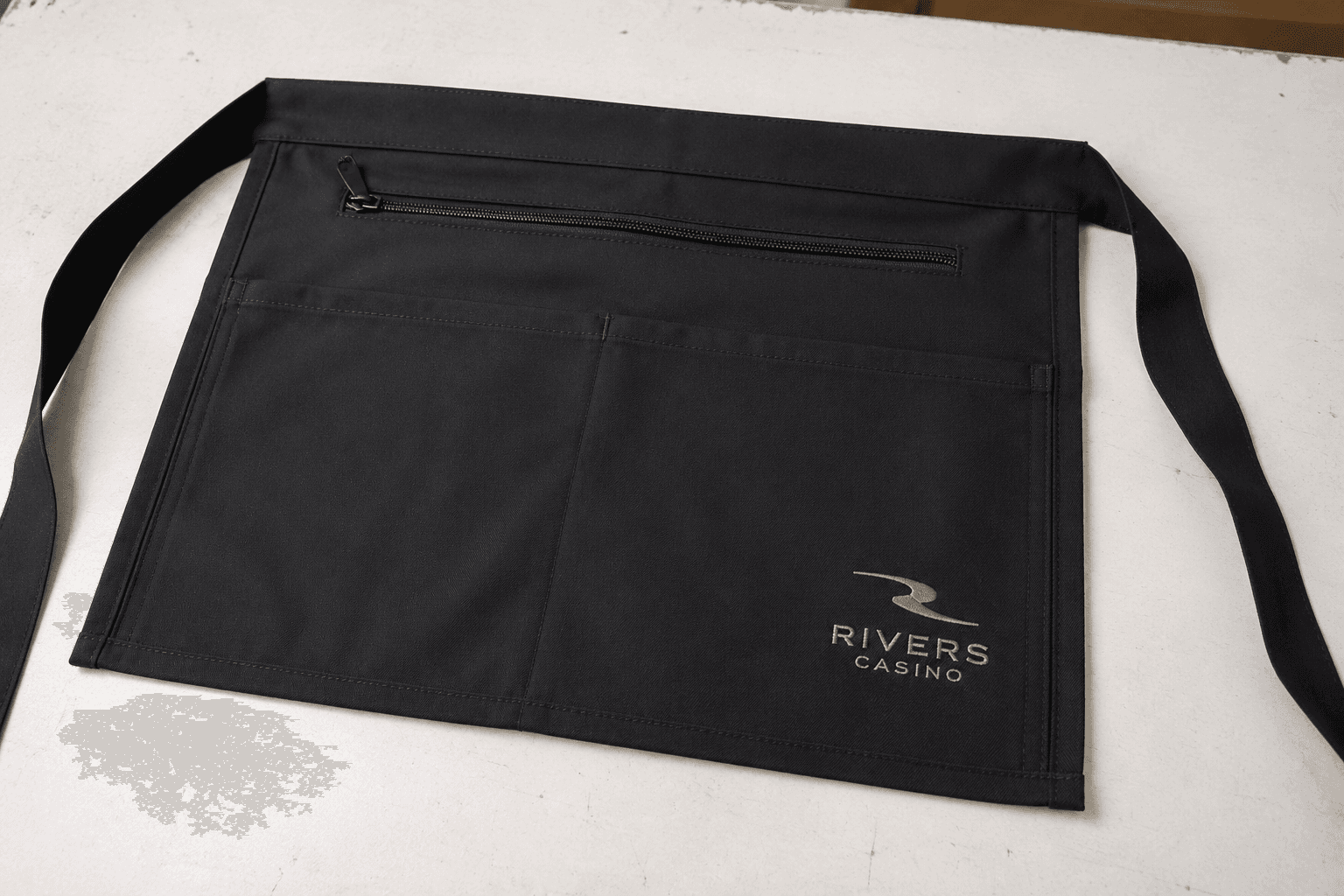
Branding on dental clinic aprons should support a clinical uniform system, not turn the apron into a giveaway item. Large front graphics can crack, collect stains or make the apron look less professional. Most B2B buyers get better results with a left-chest logo, small upper-bib transfer or woven label at the pocket edge or side seam.
Embroidery works well for clinic names, initials and simple marks. It gives a premium look and tolerates routine washing, but detail has limits. Small letters below about 5 mm height, fine tooth icons and gradient artwork usually lose clarity. On fluid-resistant aprons, embroidery also creates needle holes and absorbent thread points, so it is better placed away from the highest splash zones.
Heat transfer is better for fine logo detail and multi-color artwork. It keeps a flatter surface than embroidery, but adhesion must be tested after washing, and staff should not iron directly on the print. Screen printing can reduce unit cost for orders above about 1,000 pcs, but curing and ink selection must be controlled on white healthcare aprons to prevent yellowing, cracking or edge lift.
For clinic chains, color consistency is often more important than logo size. Pantone-matched blue, green or grey may shift between embroidery thread, transfer film and the white fabric background. The safest approval is a physical strike-off on the actual apron fabric, not a digital mockup. For repeat orders, keep the approved thread code, transfer film reference and logo placement measurements in the production file.
- Embroidery: best for simple logos and premium uniform programs; avoid tiny text and dense fill areas.
- Heat transfer: best for fine detail and multi-color clinic marks; require wash and ironing instructions.
- Woven label: best for private-label distribution, size identification and subtle brand presence.
- Screen print: economical at higher volume, but requires ink, curing and wash testing on the exact fabric.
- Placement: keep logos away from lower pockets, frequent hand contact and disinfectant splash zones.
6. MOQ, price and lead time for dental clinic apron sourcing
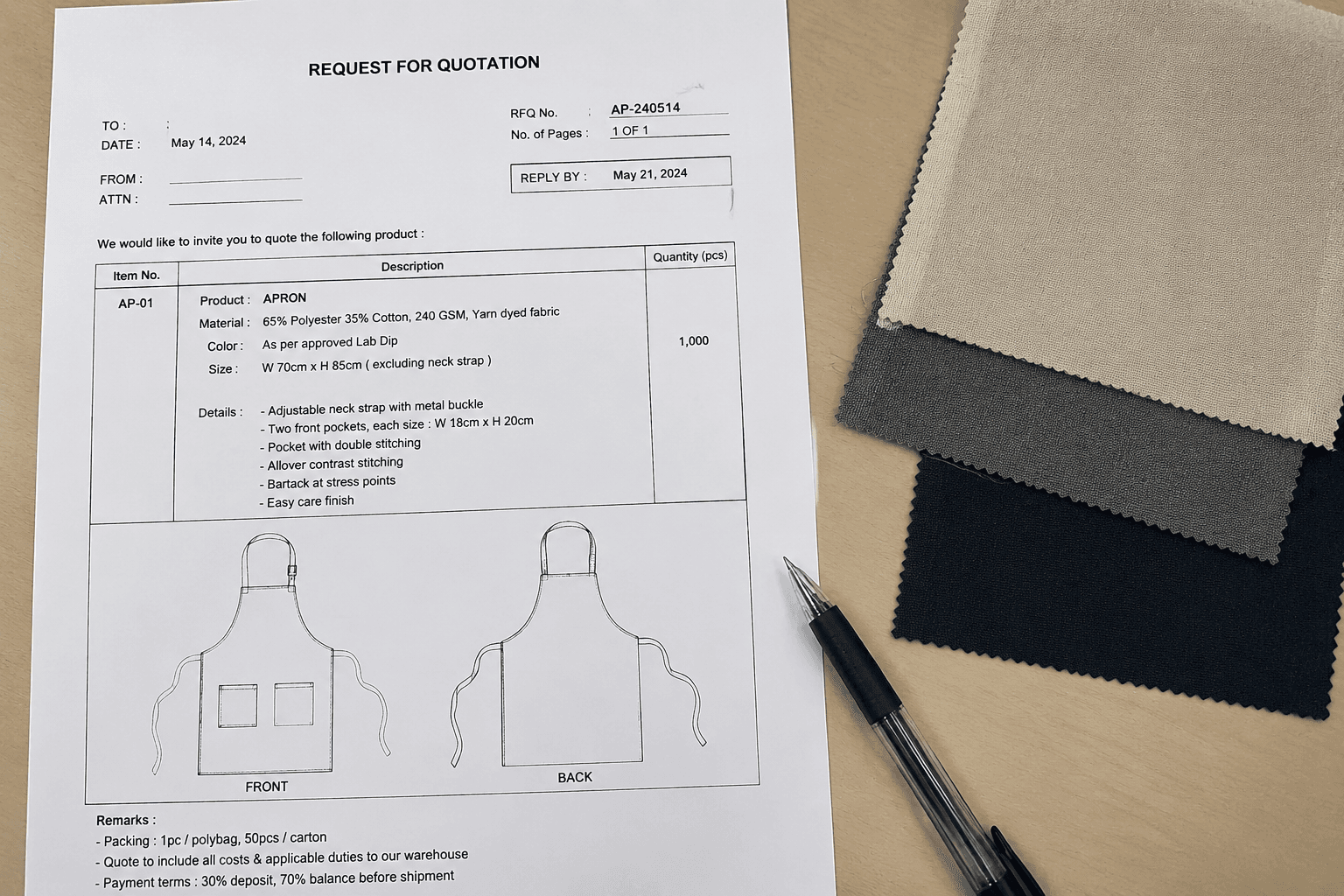
A reliable sourcing workflow starts with a technical brief. The brief should include apron dimensions, fabric composition, GSM, color, fluid-resistance requirement, pocket layout, strap style, logo method, packaging, wash target and delivery date. A reference photo helps with shape, but it cannot replace measurable specifications.
For stock white fabric and a standard logo, MOQ is commonly 500 pcs per style. Custom coated fabric, custom trim color, private woven labels or multiple sizes usually raise the effective MOQ to 1,000-3,000 pcs. Sample cost is often USD 30-80 per style for standard aprons, and higher when special coating, complex embroidery or lab testing is required.
A realistic development schedule is 1-2 days for artwork and specification review, 3-5 days to confirm fabric and trims, 7-10 days for sample making, and 2-4 days for sample comments. After approval and deposit, bulk production commonly takes 25-35 days for standard materials and 35-45 days when coating, custom dyeing or testing is involved. Add 7-15 days if the buyer requires third-party lab reports or special fabric finishing.
FOB pricing for dental clinic aprons normally falls around USD 2.20-6.50 per piece, depending on GSM, coating, pocket count, strap construction, logo method and packaging. A low quote may increase total cost if it causes more rejected pieces, faster staining, poor fit feedback or inconsistent reorders across clinic branches.
- Basic white apron, stock fabric, one logo: MOQ about 500 pcs, 25-35 days bulk lead time after approval.
- Custom trim, private label or coated fabric: MOQ about 1,000-3,000 pcs, 35-45 days bulk lead time.
- Standard sample: USD 30-80 per style, usually 7-10 days after confirmed artwork and fabric.
- Common FOB range: USD 2.20-6.50 per piece, depending on material, construction and decoration.
- Urgent air shipment: possible for small batches, but often inefficient for low-value apron programs.
7. Quality control for repeatable dental clinic aprons: AQL, measurements and wash references
Quality control should convert the approved sample into measurable checkpoints. For a 1,000-5,000 pc order, buyers can request inline inspection after cutting and pre-shipment inspection before packing. The retained approved sample should include fabric, logo, trim, packaging and a wash-tested reference where possible.
White aprons need brighter inspection conditions than dark workwear. Small stains, oil marks and shade differences can pass in dim warehouse lighting but become obvious in a clinic. Inspection should cover body shade, GSM, dimensions, logo position, stitch quality, pocket reinforcement, strap strength, stains, packing count and carton marks.
AQL levels should be agreed before production. Many apparel buyers use AQL 2.5 for major defects and AQL 4.0 for minor defects, with critical defects not accepted. For healthcare-facing white aprons, buyers may tighten visible stain and logo-placement tolerances because those defects affect brand presentation immediately. A logo tilted by 8-10 mm may be acceptable on a giveaway apron but not on a clinic uniform program.
For repeat orders, keep a production file with fabric lot, GSM report, trim supplier, thread type, logo file, approved sample photos and carton marks. This reduces drift between branches and seasons, especially for clinic chains that reorder the same apron every quarter or twice a year.
- Use AQL 2.5 for major defects and AQL 4.0 for minor defects unless the buyer's internal standard is stricter.
- Measure apron length, width, strap length, pocket position and logo placement against the approved spec sheet.
- Inspect stains and shade difference under bright neutral lighting suitable for white garments.
- Pull-check pocket bartacks and waist ties during inline and final inspection.
- Retain one approved sample and one 5-cycle washed sample for repeat-order comparison.