Outdoor vendor aprons are working uniforms, not display pieces. For markets, fairs, stadium events, food trucks, and pop-up retail, the apron has to handle sun, drizzle, dust, repeated reaching, cash handling, and long shifts without becoming heavy, hot, or slow to dry. In sourcing terms, the right spec is the one that matches the task and can be repeated without redesigning the whole program.
From the factory side, the most common mistake is treating every event apron as the same item. A ticket seller needs different storage and closure logic than a food stall worker. A festival crew apron may need water repellency and higher pocket security, while an outdoor retail apron may need lighter fabric, cleaner branding, and quicker restocking. If the first sample ignores that split, the bulk order usually comes back overbuilt in one area and weak in another.
For professional buyers, the useful questions are measurable: what GSM keeps the apron usable in summer heat, what pocket depth prevents notes and phones from dropping, how much splash resistance is enough for light weather exposure, what MOQ fits the reorder cycle, and how many days the supplier needs after sample approval. In most programs, the best answer is not the toughest apron on paper. It is the one that holds up through the event season and can be replenished without changing the base pattern every time.
- Outdoor vendor aprons should be specified by task first, because cash collection, food service, and general booth support need different pocket maps, closures, and strap balance.
- A 220-240 GSM twill or canvas is the most practical middle ground for many event programs because it gives pocket structure without turning the apron into a heat trap.
- For weather resistant apron programs, a DWR finish helps with splashes and light drizzle, but it is not a substitute for rainwear or a coated utility garment.
- A cash pocket apron should use segmented storage, bartack reinforcement, and pocket depths around 14-16 cm to reduce spill risk during bending and fast walking.
- Fast restocking works best when the buyer locks the base pattern, fabric family, and logo method, because color-only repeats are easier to replenish than orders with new pocket geometry.
- Festival staff aprons often fail on comfort before they fail on durability, so strap adjustment, waist balance, and pocket placement matter as much as fabric weight.
What outdoor vendor aprons must do in real service
Outdoor vendor aprons face more variables than indoor hospitality aprons. They see sun, wind, splash exposure, dust, seat abrasion, and repeated loading and unloading of small items. In practice, the apron becomes a pocket system, a light tool carrier, and sometimes a cash holder. If the pockets bounce, the waist drags, or the fabric traps water, staff stop wearing it correctly and the product fails in use.
For bulk sourcing, the first control point is the working environment. A dry craft market can use a 240 GSM cotton canvas apron with simple pocketing. A waterfront food stall often does better with a 65/35 poly-cotton blend and a light water-repellent finish. For all-day festival work, many buyers land in the 220-260 GSM range because it keeps enough body for pockets without becoming too warm. In factory quotes, moving from 180 GSM to 240 GSM usually adds only a modest amount to material cost, but it improves pocket stability and perceived quality.
The second control point is carry behavior. An event apron should not swing freely when the wearer bends, reaches, or squats. Adjustable neck straps, long waist ties, and reinforced stress points are not optional in outdoor use. If the user will carry cash, pens, order pads, barcode scanners, or small tools, the pocket structure needs bartacks, controlled seam allowance, and enough depth to keep contents from falling out during movement.
For buyers comparing outdoor vendor aprons, the starting point is not decoration. It is load, weather, and wear cycle. Once those are fixed, the fabric and pocket spec can be built around the real work instead of a generic apron pattern.
- Typical outdoor use variables: rain exposure, splash exposure, heat exposure, cash handling, tool carry, and repeated laundering.
- Common fabric bands: 180-220 GSM for light utility, 220-260 GSM for balanced durability, 260-320 GSM for heavy-duty outdoor work.
- Factory priority: pocket stability, strap adjustment, and drying behavior usually matter more than decorative details.
- Buyer risk: an apron spec built for indoor service often becomes too thin or too loose when moved outdoors.
Choosing fabric for outdoor vendor aprons
Fabric choice determines most of the user experience. Cotton canvas has the familiar hand feel many buyers want for retail branding, and it accepts print and embroidery well. It is also heavier when wet and slower to dry. Poly-cotton twill is often the better commercial compromise for outdoor service apron programs because it holds shape, resists wrinkles, and can be produced in a practical weight range. Full polyester is useful when quick drying and low water absorption matter more than natural texture, but it can feel less premium if the brand is aiming for a crafted or artisanal look.
For outdoor vendor aprons, the fabric specification should be written around performance, not just composition. A 65/35 poly-cotton twill at 220-240 GSM is a common commercial spec because it balances hand feel, washability, and pocket support. A 100% cotton duck at 10-12 oz can look stronger on paper, but it may be too warm for summer festivals and slower to return to service after rain. If the apron is expected to be wiped frequently with a damp cloth, a tighter weave and a light water-repellent finish will usually outperform a softer open weave.
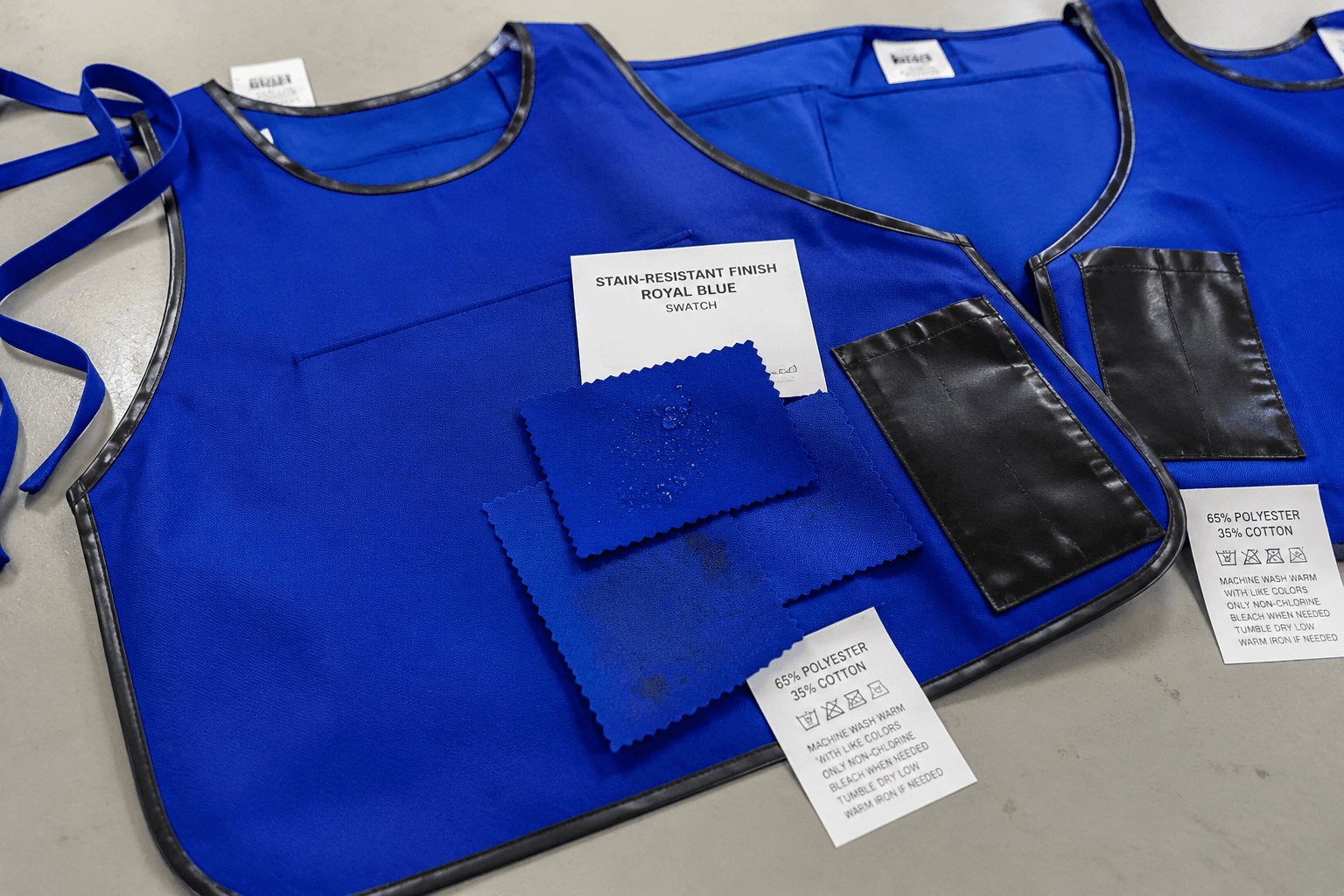
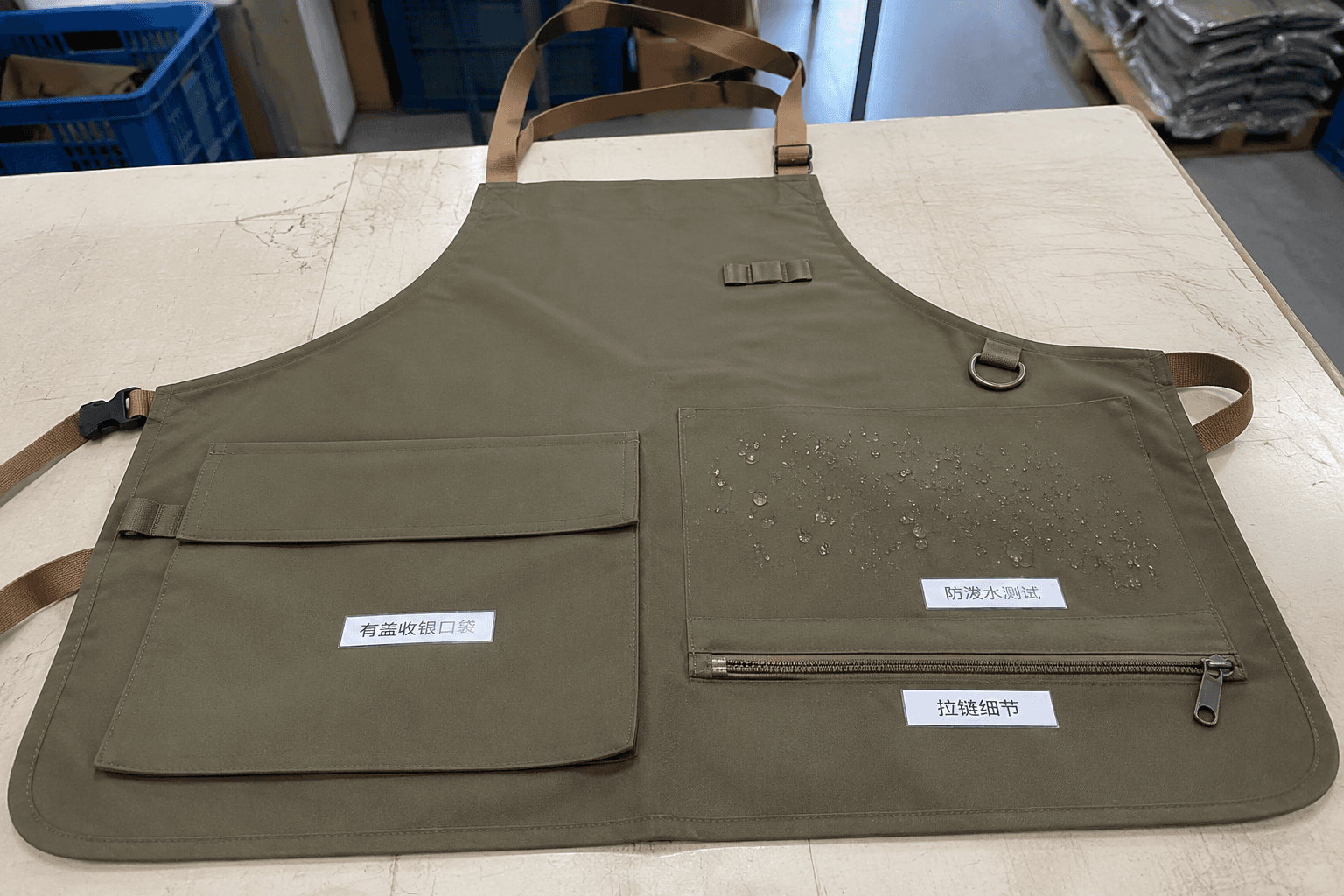
Weather resistant apron requests need precise wording. A DWR finish helps with splashes, drizzle, and brief exposure, but it does not turn the apron into rainwear. If the buyer expects prolonged outdoor exposure, the spec should include a coated back panel, quicker-drying yarn selection, or a removable waterproof pouch component rather than overpromising from the fabric alone. That distinction protects both the buyer and the supplier when field performance is checked after the event season.
For repeat orders, fabric consistency matters as much as the first sample. If the buyer can keep one approved fabric family in rotation, restocks are easier to price, sample, and reproduce within the same fit and hand feel.
- Best-fit fabric options: 65/35 poly-cotton twill, cotton canvas, polyester twill, or blended drill depending on brand feel and weather exposure.
- Useful target weights: 220-240 GSM for general event vendor apron programs, 260-300 GSM for heavier tool carry, 180-210 GSM for lightweight festival staff aprons.
- Weather treatments: DWR, anti-pilling finish, and pre-shrunk wash treatment are more practical than heavy coatings for most outdoor service apron orders.
- Trade-off: the more water resistance you add, the more you risk heat retention and slower drying.
Cash pocket apron layout and closure logic
A cash pocket apron has to be designed around movement, not just storage. The pocket closest to the working hand should be easy to reach without lifting the hem too high, but it also cannot sit so open that notes fall out when the wearer bends. In field use, the most common failure is shallow pockets that look tidy in the sample but become unstable once the apron is loaded with coins, bills, a phone, or a small handheld device.
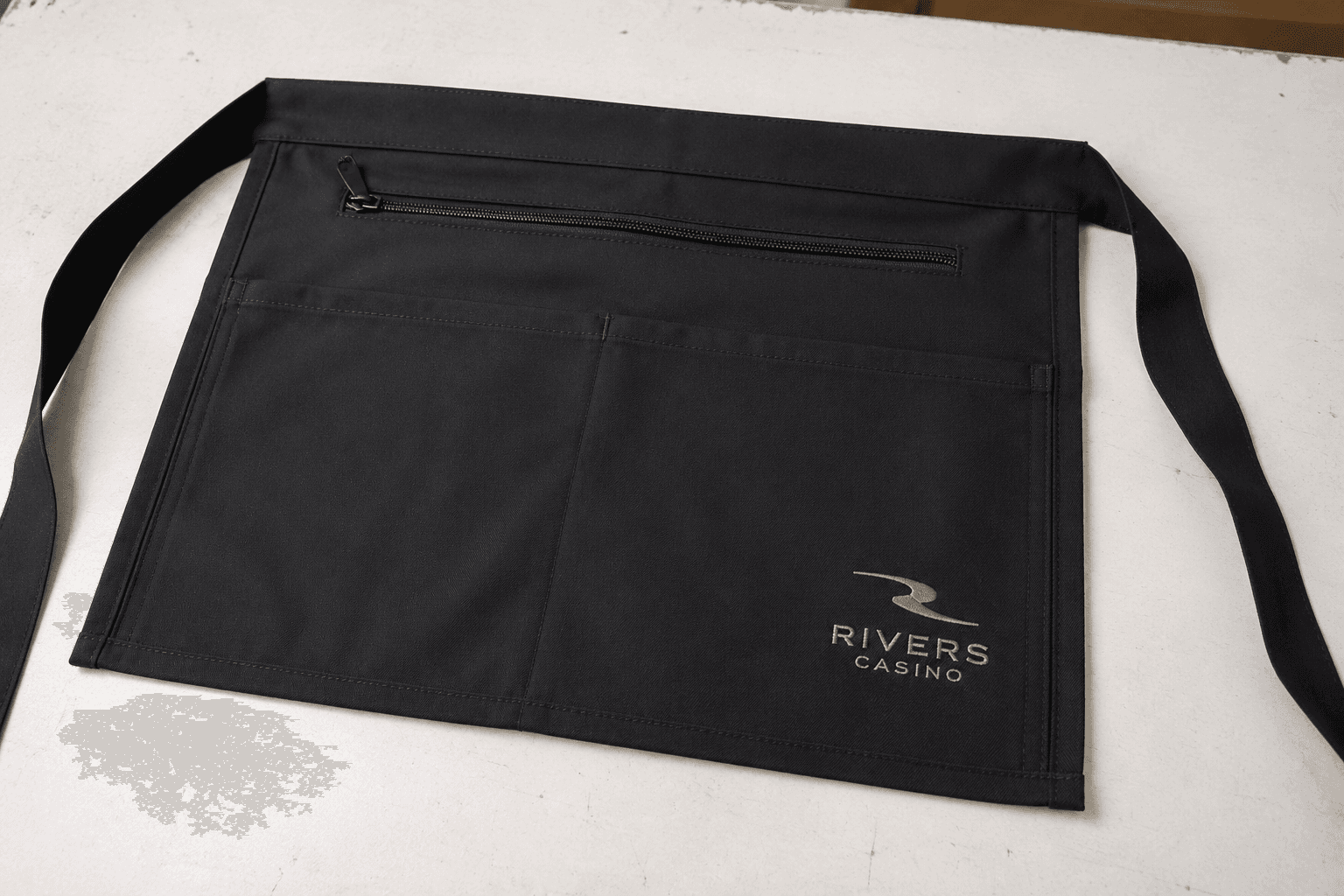
The most reliable layout for outdoor vendor aprons is usually a segmented front: one larger center pocket for notes or order pads, two narrow utility pockets for pens and markers, and one or two deeper side pockets for cash or small accessories. Many buyers also ask for a hidden internal pocket with zipper or Velcro closure. That helps when the apron is used for ticket sales or market cash collection, but it adds labor and can slow production. A well-made flap or snap closure sometimes works better in bulk because it is faster to sew and easier to keep consistent across 500 to 5,000 pieces.
The buyer decision should be made on what is carried every hour, not on a generic feature list. If cash volume is low and the wearer moves continuously, open compartments with deep stitching and secure top edges may be enough. If cash is carried in batches, a closed pocket with 14-16 cm depth and a reinforced opening is safer. If a radio or small scanner is included, the pocket width and side seam reinforcement should be set before sampling, not after approval.
For bulk production, pocket accuracy should be controlled within a few millimeters. On a high-volume run, a 1 cm error in pocket placement can make the apron feel uneven or cause contents to bounce. That matters in festival staff aprons, where the garment is also part of the uniform standard and gets judged visually by the buyer.
When the apron is used outdoors, closure logic has to match the pace of work. Fast access is useful, but it should never replace retention where cash or devices are involved.
- Recommended pocket specs: 14-16 cm depth for cash pockets, 8-10 cm width for pen slots, and bartack reinforcement at all pocket corners.
- Closure options: open top for speed, snap for moderate security, zipper for higher security, flap for low-cost weather protection.
- Buyer check: confirm whether the apron will carry cash, ticket pads, phones, radios, or scanners before the pocket pattern is frozen.
- Factory note: pocket changes are cheap at sampling stage and expensive after bulk cutting has started.
Weather resistant apron details that actually hold up outdoors
A weather resistant apron does not need to be complicated. It needs the right small decisions. Outdoor use fails fastest at seams, corners, strap anchors, and pocket openings. If the fabric resists light moisture but the stitching holes wick water, the apron still feels wet. If the straps absorb sweat and stretch out, the wearer keeps tightening them until the load sits poorly on the body. If the pocket tops curl after washing, the apron looks aged before it has seen a full season.
For outdoor vendor aprons, the most practical protection set is usually a tightly woven base fabric, a light DWR finish, reinforced bartacks, and edge binding or turned hems that reduce fraying. Some buyers ask for PU coating, but that should be used carefully. A full coating can help for utility-style festival staff aprons exposed to repeated splash, yet it also reduces breathability and can stiffen the garment. For food-oriented outdoor service apron programs, a lighter finish is often the better compromise because staff wear the product for long shifts.
Color choice matters outdoors as well. Darker shades hide dust and minor stains better, while lighter colors may look cleaner at the start of the day but show marks faster under use. If the apron supports a brand identity, the logo method should be selected alongside the fabric. Screen print is economical for large runs, embroidery is durable but can stiffen the area, and woven labels or patch branding can survive washing well when the base fabric is cleaned often.
When a buyer wants restocking speed, the weather spec should stay repeatable. A stable fabric family, fixed color numbers, and one agreed finishing method make it easier to reorder in 500-1,000 piece batches without requalifying the entire product. That is where outdoor vendor aprons become a supply chain item, not just a garment.
The point is to build enough resistance for field use without adding stiffness that makes the apron unpleasant to wear for a full shift.
- Outdoor durability points: bartacks, strap anchor reinforcement, edge finish, pocket mouth stability, and wash-fast logo application.
- Common finishes: DWR for splash resistance, PU coating for stronger barrier performance, pre-shrink for dimensional control.
- Practical warning: heavy coating increases stiffness and can reduce wear comfort in warm weather.
- Branding note: the logo method should survive the same wash and weather cycle as the fabric itself.
How to compare outdoor vendor aprons by buyer criteria
A useful way to compare outdoor vendor aprons is to score each option against the actual service model. For a craft market seller, the priorities may be comfort, visibility, and low unit cost. For a cash-heavy festival booth, security and pocket layout matter more. For a food truck or outdoor beverage stand, wipe-clean behavior and fast replenishment can outweigh a premium fabric hand. Instead of asking which apron is best in general, ask which spec is least likely to fail in the intended use case.
In factory quoting terms, a buyer can compare three common configurations. A light event vendor apron might use 180-200 GSM poly-cotton, one large pocket, and basic tie straps, with a target price around $2.20-$3.20 per piece at 1,000 pieces. A balanced outdoor service apron might use 220-240 GSM twill, segmented cash pockets, and reinforced bartacks, often landing around $3.20-$5.20 per piece depending on logo method and finishing. A heavier weather resistant apron with DWR, multiple pockets, and stronger trim can move into the $5.00-$7.50 range. These are working ranges, not fixed market prices, but they help buyers judge whether a quote matches the spec.
The comparison should also include lead time and replenishment behavior. A basic apron with standard fabric and one-color print may be ready in 20-30 days after sample approval. A custom pocket layout, special finish, or imported hardware can push that to 35-45 days. For buyers who restock during the season, the winning spec is usually the one that can be repeated with the fewest moving parts. That is why many brands keep one base outdoor apron and vary only logo color or pocket labeling by event.
Ranking should always follow buyer criteria. If price is the main filter, the light build wins. If pocket security is the main filter, the balanced build wins. If weather exposure is the main filter, the heavier build wins, but only if the wearer can still move comfortably.
That logic is more useful than calling one apron the best without saying what it is best for.
- Compare by criteria: fabric weight, pocket security, weather resistance, comfort, unit price, MOQ, and repeat order lead time.
- Light program: 180-200 GSM, simpler pocketing, lower cost, faster sew time.
- Balanced program: 220-240 GSM, segmented pockets, best general-purpose choice for outdoor vendor aprons.
- Heavy program: 260 GSM and above, more structure, better for tool carry and repeated exposure.
- Reorder rule: the fewer unique trims and closures, the easier the fast restocking cycle.
MOQ, lead time and fast restocking for bulk buyers
Bulk buyers usually care less about a perfect prototype than about repeatability. A workable MOQ for custom outdoor vendor aprons is often 300-500 pieces per color for simple construction, though some factories can accept 100-200 pieces if the order uses stock fabric and limited customization. Once pocket shapes, contrast binding, custom hardware, or special wash finishes are added, the MOQ may need to move higher because cutting and sewing efficiency drop. That is normal and should be priced clearly at the sampling stage.
Lead time depends on how much of the apron is custom. A stock-fabric event vendor apron with logo print can often be sampled in 5-7 days and produced in 15-25 days after approval. A more complex cash pocket apron with custom trim or embroidery may need 25-40 days. If the buyer wants a seasonal restock plan, it is better to lock the base pattern early and keep one approved material set in production reserve. That reduces the risk of color drift, pocket mismatch, or inconsistent shrinkage when the next batch is opened.
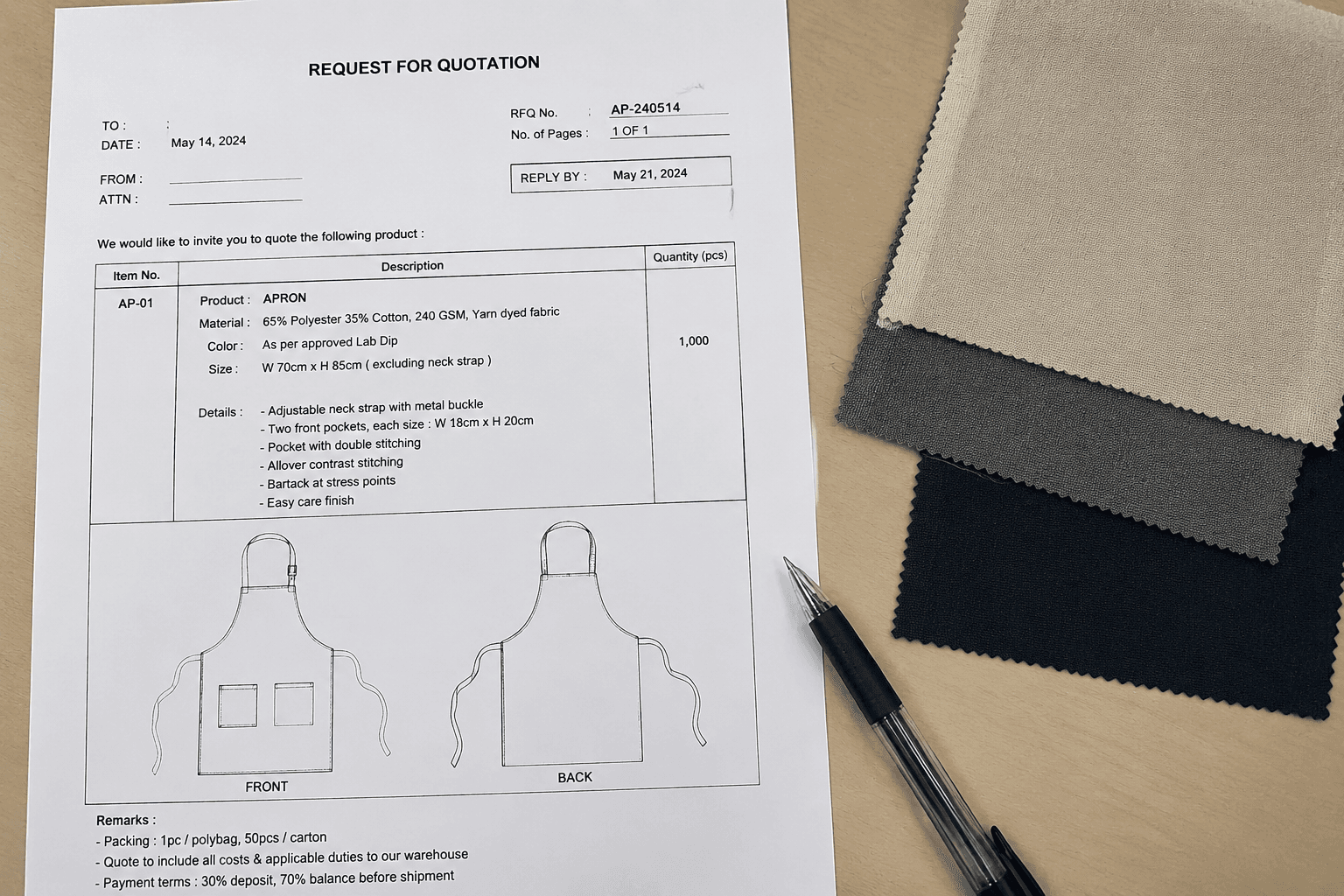
From the supplier side, the fastest restock programs are the ones with clear technical files. The file should include fabric composition, GSM or oz weight, pocket dimensions, strap width, logo method, packing ratio, carton marks, and acceptable shade tolerance. With that information fixed, a factory can reserve fabric, shorten re-sampling, and produce the next order with fewer line changes. For festival staff aprons that move every season, this is the difference between a usable replenishment system and a yearly re-development cycle.
Buyers should also decide how much variation is allowed between drops. If the same apron is reordered every quarter, small changes in pocket angle or strap length can create fit complaints even when the factory considers the order acceptable. A disciplined restock spec avoids that problem.
That is why the technical file matters as much as the PO. It protects the repeat order from slow drift over time.
- Typical MOQ: 300-500 pcs per color for custom production, lower only when stock materials are used.
- Typical sample path: 5-7 days for simple specs, 7-12 days for more detailed pocket or trim work.
- Typical bulk lead time: 15-25 days for simpler runs, 25-45 days for complex custom builds.
- Fast restock file: fabric spec, GSM, pocket map, strap details, logo method, packing, and tolerance notes.
Final spec guidance for outdoor vendor aprons
For most buyers, the best outdoor vendor aprons are not the heaviest or the most feature-loaded. They are the ones that stay comfortable, keep cash and tools secure, and can be reordered without rebuilding the product every time. That usually points to a mid-weight twill or canvas, a pocket structure matched to the service role, and a weather finish that reflects real exposure rather than an imagined extreme.
If the apron is for general event use, a 220-240 GSM poly-cotton body, reinforced straps, one secure cash pocket, and one or two utility pockets is a solid baseline. If the program is more demanding, move to 240-260 GSM and add stronger pocket reinforcement, but do not let weight creep past the point where staff stop wearing it properly. The best spec is the one people keep on through a full shift.
When buyers send an inquiry, the most useful brief is direct: target role, expected weather, carry items, desired hand feel, logo method, quantity per drop, and reorder schedule. That gives the factory enough context to price the apron accurately and avoid a sample that looks right but works wrong. For outdoor service apron and cash pocket apron programs, that clarity saves more time than any generic product description ever will.
In practice, the winning order is the one that aligns cost, comfort, and replenishment. If those three are set cleanly, the apron can be produced consistently and used without constant revision.
That is the standard that matters for outdoor vendor aprons in professional buying.
- Baseline spec: 220-240 GSM, reinforced pockets, adjustable straps, and a light weather finish.
- When to upgrade: frequent drizzle, heavier cash handling, tools, or all-day festival use.
- What to avoid: overspecifying weight and coatings until the apron becomes hot, stiff, and slow to dry.
- Best buyer input: role, environment, carry list, quantity, and restock timing.