For most bulk apron programs, the fastest way to reduce apron cost is not to ask the factory for a lower margin. The larger savings usually come from decisions made before the purchase order: fabric width, GSM tolerance, pocket layout, color count, trim standardization, packing method and production calendar. A supplier can quote the same design at very different apron unit cost levels depending on how efficiently it runs through cutting, sewing, finishing and packing.
In our Zhejiang apron factory, a basic waist apron can vary from about USD 0.85 to USD 1.45 per piece FOB depending on fabric, size, pocket construction and packing. A full bib apron for restaurant or retail use may range from USD 1.75 to USD 4.80 per piece, before special trims such as leather patches, metal buckles, heavy canvas, waxed finishes or individual retail packaging. These differences are not only about cheap apron manufacturing; they reflect real material consumption, labor minutes and quality-control risk.
This article explains seven practical ways sourcing managers and product developers can lower the apron price per piece without making the product feel cheaper to the end user. The focus is on preserving quality where it matters: fit, wash performance, seam strength, color fastness, pocket usability and brand presentation.
- Fabric efficiency is often the largest lever, especially when apron dimensions are adjusted to match fabric width and cutting yield.
- Standardized trims reduce apron unit cost by lowering purchasing MOQ, sewing handling time and inspection variation.
- Fewer colors and smarter dye choices can protect shade consistency while reducing lab dip, dyeing and inventory costs.
- Pocket simplification saves labor minutes without necessarily changing the perceived value of the apron.
- Production timing affects price because rush orders, split shipments and peak-season capacity all add cost.
- A clear apron cost breakdown helps buyers decide which savings are useful and which create avoidable quality risk.
Start with an apron cost breakdown before negotiating price
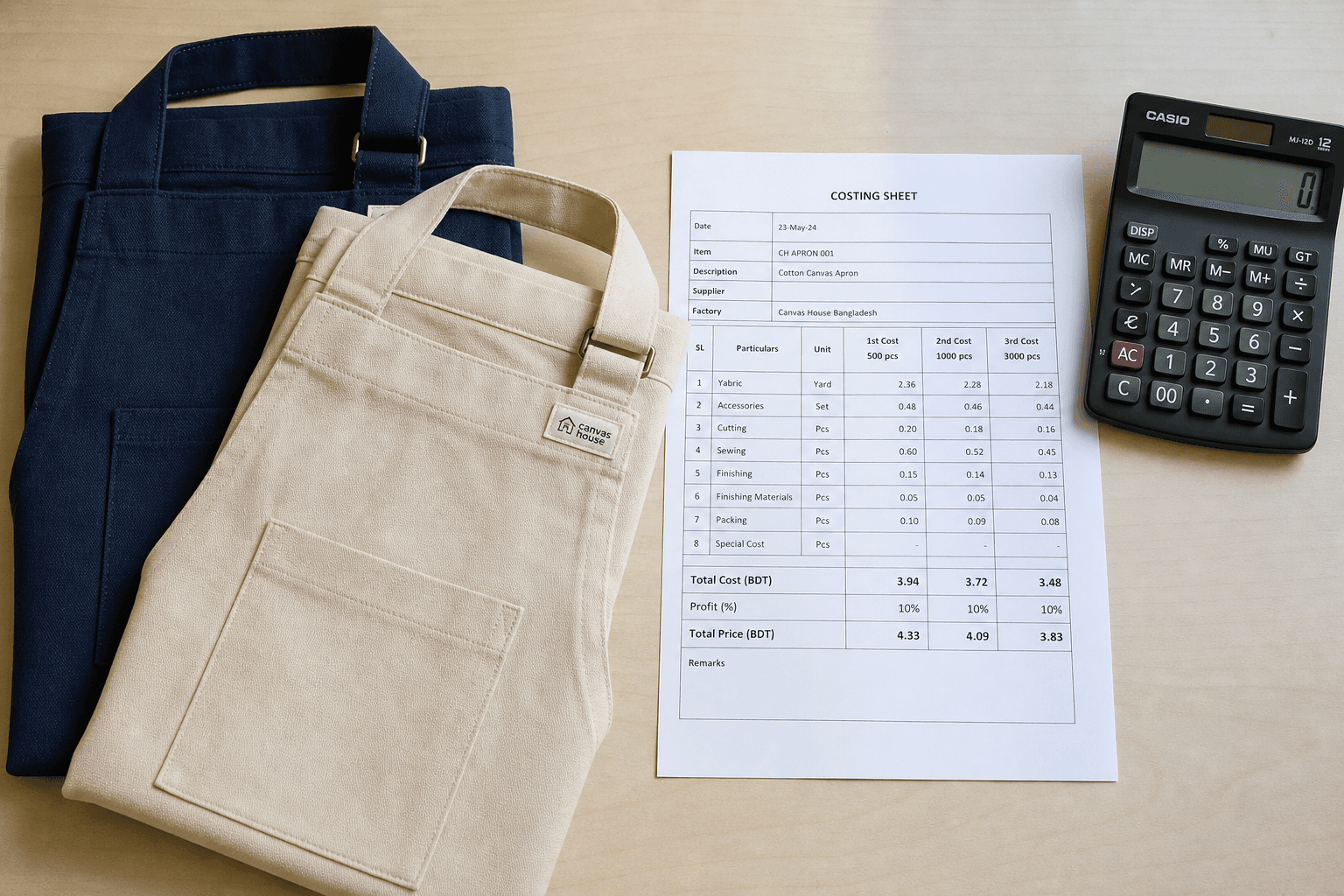
A useful cost reduction discussion begins with a realistic apron cost breakdown. For a standard bib apron, fabric normally represents 35% to 55% of the FOB cost, sewing labor 18% to 30%, trims and labels 5% to 15%, packing 3% to 10%, and overhead, loss allowance, QC and margin the balance. The exact ratio changes by design. A heavy 12 oz cotton canvas apron is fabric-driven. A lightweight polyester apron with many pockets, contrast binding and adjustable hardware is more labor-driven.
When buyers ask only for a target apron price per piece, the supplier may remove cost in ways that are hard to see at sample stage: narrower seam allowance, lower-density stitching, cheaper dyeing, lighter interlining, thinner ties, smaller pocket reinforcement or reduced inspection time. These changes can pass a visual check but fail after 10 to 20 commercial laundry cycles. A better approach is to ask the factory which cost items are fixed, which are variable, and which can be redesigned without reducing performance.
For example, if a bib apron is quoted at USD 2.65 per piece at 3,000 pcs, reducing the fabric from 260 GSM twill to 240 GSM twill may save USD 0.08 to USD 0.14 per piece, depending on cotton price and fabric width. Removing one double-layer pocket may save USD 0.04 to USD 0.09 in fabric and labor. Changing from individual polybag to 10 pcs per bag may save USD 0.03 to USD 0.06. These are controlled savings. Blind price cutting is not.
- Ask the supplier to separate fabric, trims, sewing, packing and testing in the quotation when the order value is significant.
- Compare costs at realistic volume breaks such as 500 pcs, 1,000 pcs, 3,000 pcs and 10,000 pcs instead of assuming a straight-line discount.
- Confirm whether the quoted price includes pre-production sample, lab dip, carton marks, needle inspection, metal detection and standard AQL inspection.
- Treat very low pricing as a question to investigate, especially if it is 12% to 20% below other qualified apron factories.
Reduce apron cost by improving fabric yield, not by using weak fabric
Fabric yield is one of the most overlooked ways to reduce apron cost. Aprons look simple, but their panels can waste fabric if the finished dimensions do not match the fabric width. Common woven widths for apron fabric are 57/58 inches and 63 inches, while some polyester fabrics are available at 150 cm or 160 cm. If the apron body, pocket pieces and ties cannot be nested efficiently, cutting loss can move from 8% to 15% or higher.
A buyer may request a bib apron finished size of 72 x 86 cm because it matches a previous supplier's spec. If the same wearing coverage can be achieved at 70 x 84 cm, and that dimension allows better marker efficiency on 150 cm fabric, the saving may be more valuable than changing from 240 GSM to 220 GSM. The customer sees almost no difference, but the factory cuts fewer meters for the same order quantity. For large foodservice or promotional programs, a 3% fabric saving can be meaningful.
The key is to protect hand feel and durability. A 200 GSM poly-cotton twill may be acceptable for light cafe use, but too weak for heavy kitchen laundry. A 260 GSM cotton canvas may feel premium but can shrink more and cost more to wash finish. A practical middle ground is often 230 to 250 GSM cotton twill, 240 to 280 GSM poly-cotton twill, or 8 to 10 oz canvas depending on the end use.
- Review finished apron width and length against available fabric width before approving the tech pack.
- Allow a practical tolerance such as +/-1 cm on non-critical dimensions if it improves cutting efficiency.
- Use the correct GSM for the use case: 180 to 210 GSM for promotional aprons, 220 to 260 GSM for restaurant bib aprons, and 280 to 340 GSM for heavier workwear styles.
- Do not reduce GSM without checking shrinkage, tear strength, seam slippage and opacity after washing.
Standardize straps, tapes and hardware across apron styles
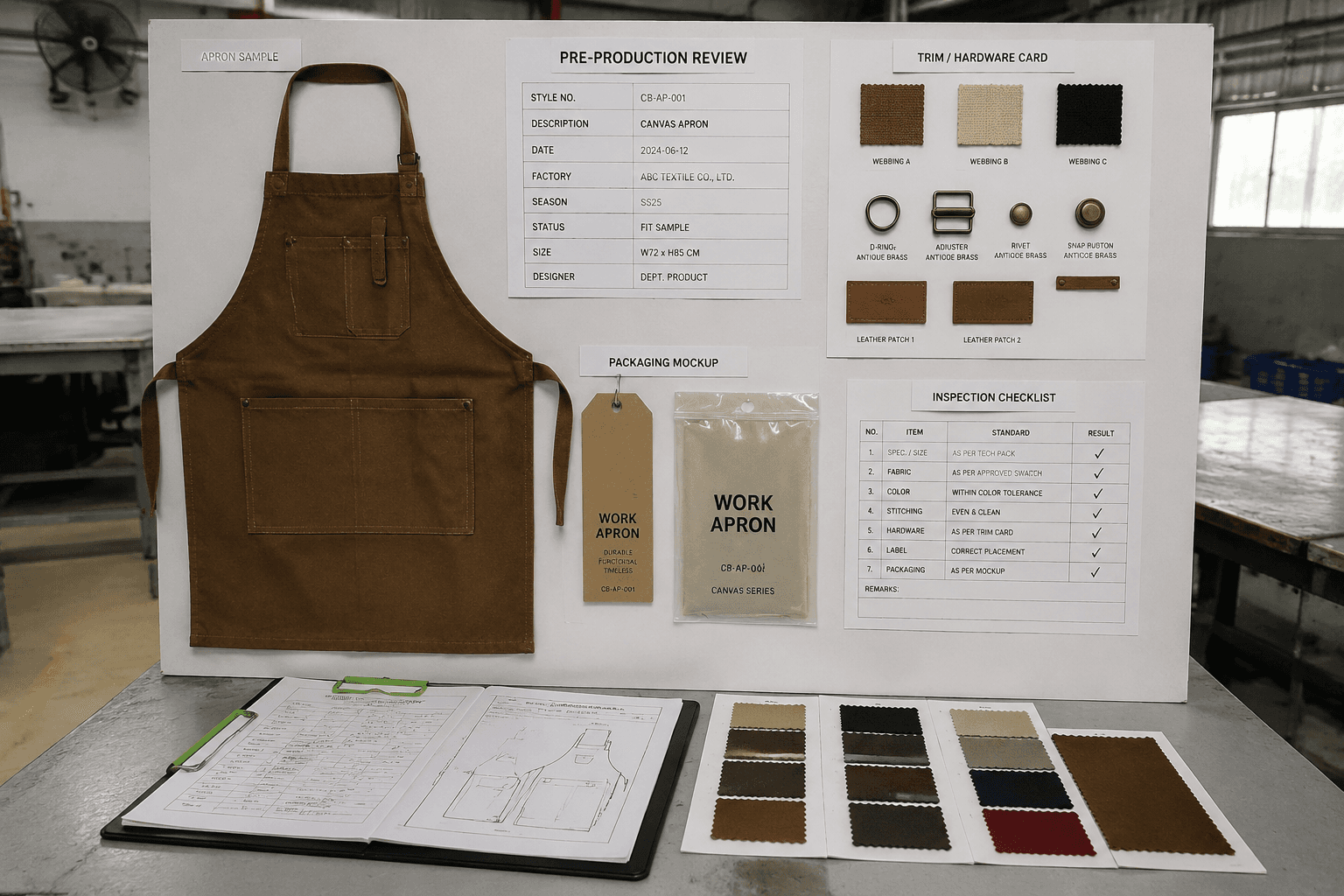
Trims can look small on a costing sheet, but they create many hidden costs. Every different neck strap, waist tie, D-ring, buckle, cord end, snap, rivet, label and thread color adds purchasing work, storage, line setup and inspection points. For custom apron orders below 3,000 pcs per color, trim fragmentation is one of the main reasons the apron unit cost stays high.
A simple example is neck adjustment. A metal slider buckle may add USD 0.08 to USD 0.18 per piece compared with a fixed neck strap, depending on the buckle quality and plating. A leather-look PU neck strap can add USD 0.25 to USD 0.60 per piece and may require additional needle control and reinforcement sewing. If the customer only needs fit adjustment for two uniform sizes, a cotton tape tie-through neck can sometimes give the same function with lower trim cost and easier washing.
The most efficient programs build a trim library. One 2.5 cm cotton webbing, one 3.0 cm herringbone tape, one black metal D-ring, one antique brass rivet, one woven label size and one thread standard can support multiple apron designs. This gives the buyer a consistent brand language and gives the factory better purchasing volume.
- Use the same waist tie tape across bib aprons, waist aprons and cross-back aprons when the brand design allows it.
- Limit metal hardware finishes to one or two standards, such as black nickel and antique brass, to avoid small-lot plating surcharges.
- Choose stock tape colors when possible; custom-dyed tape often needs 1,000 to 3,000 yards MOQ and 10 to 15 extra days.
- Keep label dimensions consistent so the sewing line does not need separate folders, placement guides or inspection standards for each SKU.
Simplify pocket construction where the user will not notice the difference
Pocket design has a direct effect on apron price per piece because it affects both fabric consumption and sewing minutes. A plain patch pocket is fast. A double pocket with pen slot is slower. A pouch pocket with angled openings, bar tacks, contrast stitching and internal divider may be useful for certain work settings, but it is expensive compared with its visual size. On high-volume apron orders, each extra sewing operation matters.
In a normal sewing line, one additional pocket attachment may add 20 to 45 seconds depending on size, alignment requirement and reinforcement method. If the apron has three pockets, contrast thread and strict symmetry requirements, the labor cost and QC rejection risk both rise. When the order is 10,000 pcs, a 30-second operation equals more than 83 labor hours before rework and inspection.
This does not mean removing pockets blindly. For server aprons, pocket function is part of the product. For barista aprons, a chest pen slot and lower utility pocket may be expected. For promotional kitchen aprons, one front pocket may be enough. The best saving comes from matching pocket complexity to actual use.
- Replace two separate lower pockets with one larger patch pocket divided by a single vertical stitch line when the function is similar.
- Use bar tacks only at stress points instead of decorative reinforcement everywhere.
- Avoid contrast pocket stitching unless the brand specifically needs it, because it increases thread changes and visible defect risk.
- Keep pocket corners slightly rounded only if the factory has the correct folder; otherwise square or simple angled corners are more efficient.
- For low-cost promotional aprons, consider no pocket or one basic pocket to reduce both labor and fabric waste.
Use color strategy to reduce apron cost without shade problems
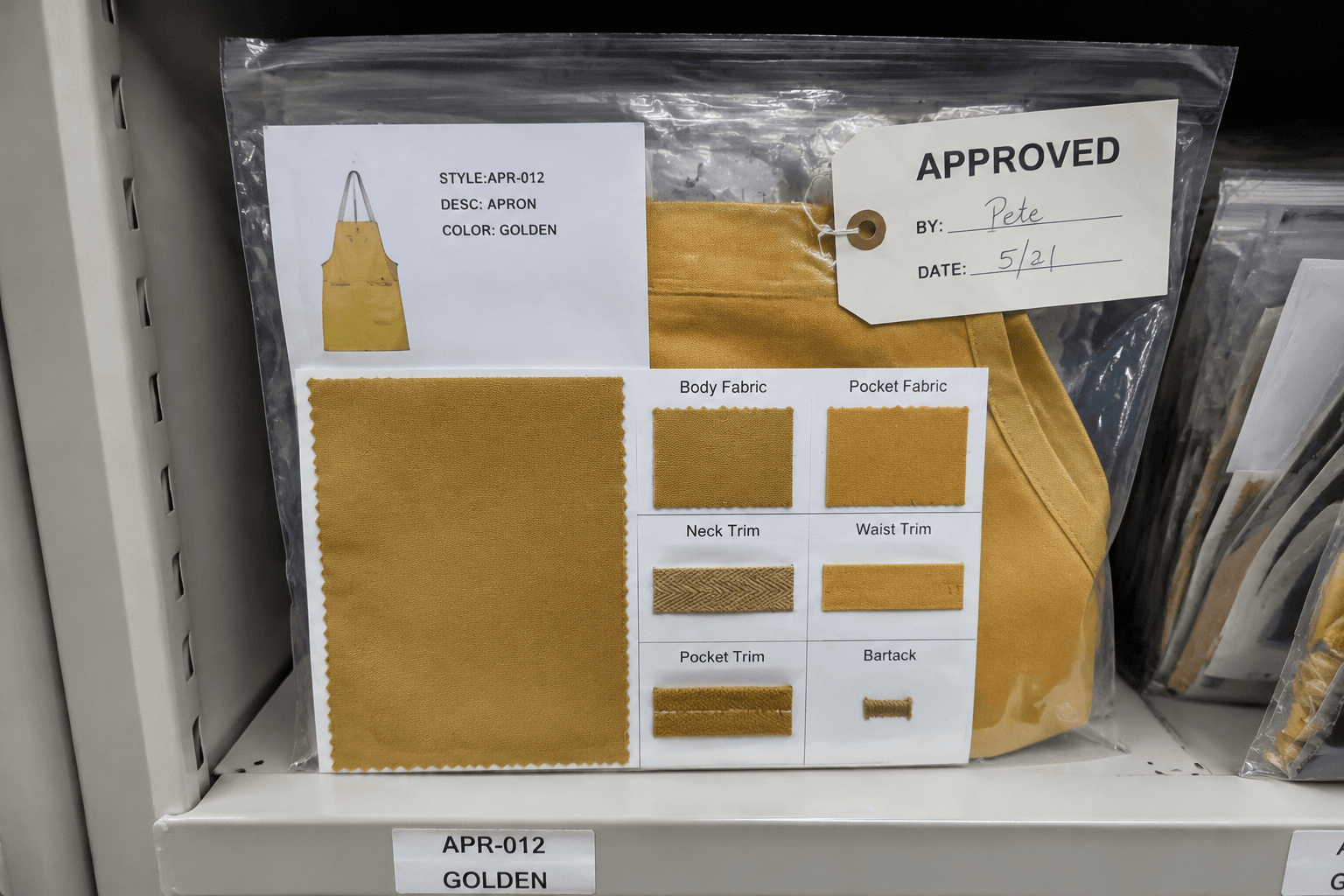
Color is a cost item as much as a design item. Each custom fabric color normally requires lab dips, approval time, dyeing MOQ and shade-control risk. For cotton and poly-cotton twill, custom dyeing MOQ may start around 500 to 1,000 meters per color, although the practical economical level is often higher. If an apron uses 0.75 meter of fabric, 1,000 meters can produce roughly 1,200 to 1,300 pieces after cutting loss. For small orders, that MOQ can create unused fabric cost.
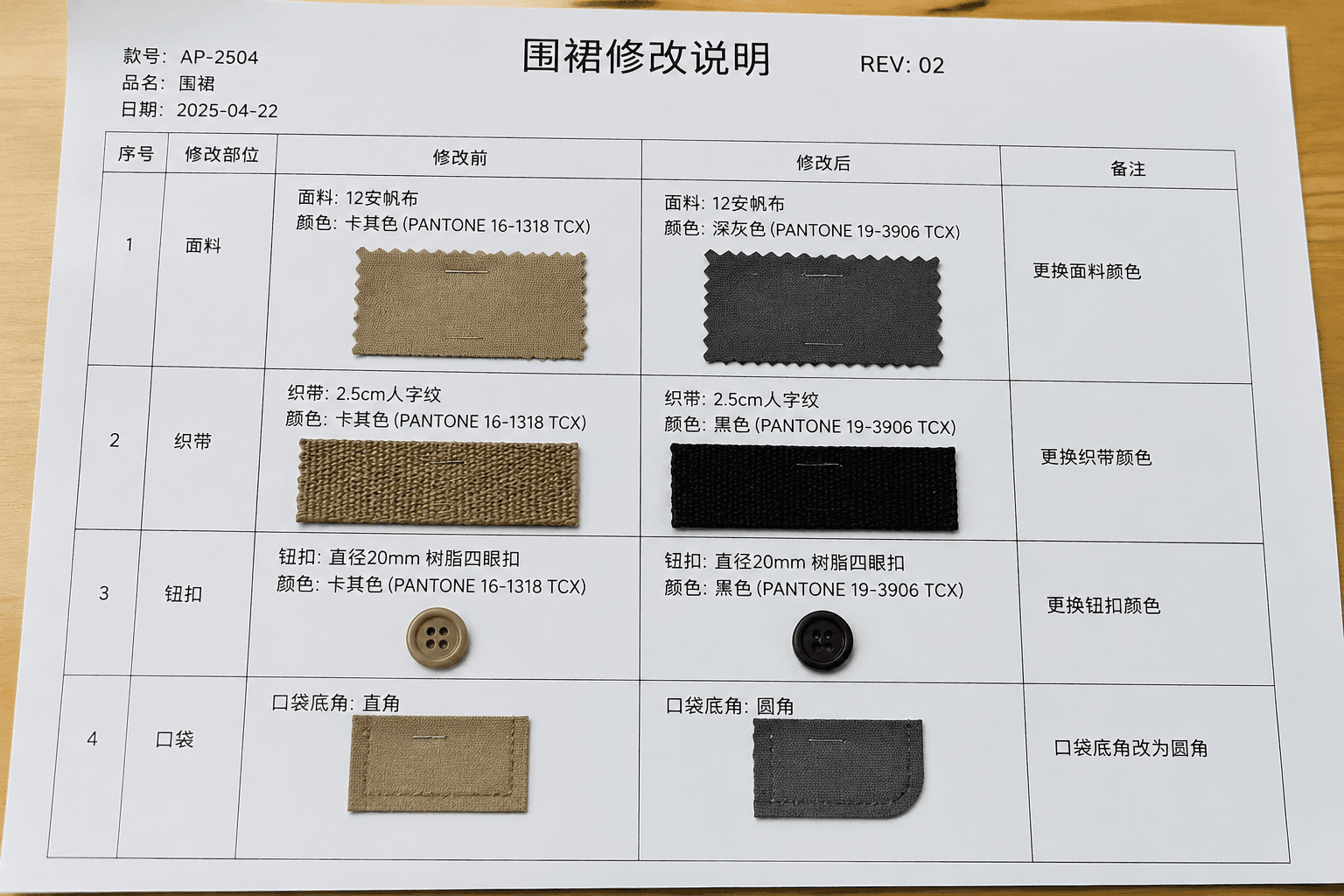
Stock colors are usually cheaper and faster, but they are not always suitable for brand programs that require exact Pantone matching. A practical compromise is to classify colors by risk. Core brand colors, such as a restaurant chain's signature red or a retailer's uniform navy, may justify custom dyeing and lab testing. Seasonal or internal-use colors may be selected from available stock fabric. This approach protects the customer-facing colors while keeping the whole program economical.
Color also affects quality performance. Dark navy, black, forest green and burgundy require careful color fastness testing, especially for cotton aprons used in commercial washing. Reactive dye on cotton may perform well but costs more than low-grade dyeing. Polyester-rich fabrics can have better color retention but different hand feel and heat resistance. A small saving in dyeing can become expensive if aprons bleed onto shirts, fade unevenly or fail a chain store's laundry test.
- Group SKUs into core custom colors and flexible stock colors before requesting quotation.
- Approve lab dips under D65 and TL84 light when the apron will be used in retail, restaurant or hotel environments.
- Expect 7 to 10 days for lab dips and 12 to 20 days for bulk dyeing after color approval, depending on mill capacity.
- For dark cotton aprons, request color fastness to washing and rubbing results before bulk production.
- Avoid ordering many low-volume colors, such as 200 pcs per color across 12 colors, if the target is a low apron unit cost.
Consolidate sizes and SKUs to improve factory efficiency
Aprons are more forgiving than fitted garments, so many programs can reduce SKU complexity without hurting usability. A restaurant chain may initially request separate sizes for S, M, L and XL, but a bib apron with adjustable neck and long waist ties may cover most workers in two sizes. A cross-back apron may need more size control because strap position affects comfort, but even then the range can often be simplified after fit testing.
Each additional SKU increases cutting tickets, bundling, sewing line separation, packing labels, carton planning and final inspection work. If the order is 5,000 pcs split into 20 SKU-color-size combinations, the factory handles it very differently from 5,000 pcs split into 4 combinations. The total quantity is the same, but the production efficiency is not. Small SKU quantities also increase leftover fabric and trim risk.
MOQ is connected to this issue. A factory may accept 300 pcs per color for a simple stock-fabric waist apron, but a custom-dyed bib apron with branded trims may need 1,000 pcs per color to price efficiently. When buyers understand the true MOQ behind each cost item, they can decide whether assortment complexity is worth the added cost.
- Use adjustable neck straps or longer waist ties to reduce the number of apron sizes.
- Combine slow-moving colorways into a stock fabric option instead of custom dyeing every color.
- Keep carton packing consistent across SKUs, such as 50 pcs per carton, to simplify warehouse receiving.
- For replenishment programs, forecast quarterly demand so the factory can reserve fabric or trims instead of buying small lots repeatedly.
Reduce packing cost while keeping the apron presentation suitable
Packing can be a quiet but real part of apron unit cost. A basic bulk pack may cost only USD 0.02 to USD 0.05 per piece for a simple inner bag allocation. An individual polybag with warning text, size sticker and barcode may cost USD 0.06 to USD 0.12. A retail paper band, hangtag, tissue wrap, printed insert and export carton with mixed SKU labels can add USD 0.15 to USD 0.40 per piece or more, depending on materials and handling.
For B2B uniform programs, individual retail packaging is often unnecessary. If the aprons go directly to a hotel, restaurant chain, distributor warehouse or laundry service, 10 pcs per inner bag or 25 pcs per inner bag may be enough. This saves material, reduces packing labor and lowers plastic waste. For e-commerce or retail shelf programs, the packaging may be part of the product and should not be removed. The point is to match packaging to the route to market.
Carton dimensions also affect landed cost. A thick canvas apron packed too loosely increases carton volume and freight cost. A very tight carton may deform the apron, damage labels or make warehouse handling difficult. For export, we normally prefer cartons below 18 kg gross weight when possible, with moisture protection for cotton goods. If the buyer ships by air, volume weight should be checked before final packing approval.
- Use bulk inner bags for uniform distribution programs instead of individual polybags when acceptable.
- Standardize barcode label size and position to reduce packing errors and scanning issues.
- Confirm carton quantity early, such as 50 pcs per carton for bib aprons or 100 pcs per carton for lightweight waist aprons.
- Avoid premium hangtags and paper wraps for back-of-house or staff uniform aprons unless the receiving process requires them.
- Check air freight volume weight if the order is urgent, because packing size can affect total landed cost more than the FOB saving.
Plan sampling, testing and production timing to avoid emergency costs
A rushed apron order is rarely the lowest-cost order. When the timeline is compressed, the factory may need to buy available fabric at a higher price, run overtime sewing, use express sample delivery, split shipments or prioritize one order over another. These costs appear as rush charges, higher unit price or reduced room for negotiation. For stable quality and better pricing, timing should be part of the sourcing plan.
A normal custom apron schedule is often 5 to 7 days for initial sample if fabric and trims are available, 7 to 10 days for lab dips, 3 to 5 days for pre-production sample after approvals, and 25 to 40 days for bulk production depending on quantity and complexity. Heavy canvas, custom-dyed fabric, enzyme wash, embroidery, screen printing or special metal trims can extend the timeline. For orders above 20,000 pcs, production planning should start earlier, especially before Chinese New Year and the September to November export peak.
Testing also needs time. If the apron must meet REACH, OEKO-TEX material requirements, color fastness, shrinkage, azo-free dye standards or customer-specific wash testing, the buyer should define this before quotation. Adding tests after bulk fabric is dyed can create rework, delay and cost. Good testing is not a place to save blindly, but duplicate or unnecessary tests can be reduced when requirements are clear.
- Allow 35 to 55 days from approved sample to shipment for most custom apron bulk orders, depending on quantity and fabric status.
- Book fabric early for repeat programs to avoid mill delays and price movement.
- Finalize artwork, embroidery files, label files and packing instructions before pre-production sample approval.
- Avoid split shipments unless the delivery date justifies the added handling and freight cost.
- Share the annual forecast with the factory if repeat orders are likely, because planned capacity usually prices better than urgent capacity.