After the first bulk apron shipment, buyer feedback becomes precise. A coffee chain may move from 245 GSM 65/35 poly-cotton twill to 320 GSM cotton canvas because the first issue looked thin after 30 commercial laundry cycles. A restaurant group may replace a self-fabric neck strap with 25 mm cotton webbing and a slider because staff reported neck pressure during 8-hour shifts. A hospitality distributor may shorten a bib apron by 2 cm and extend waist ties by 12 cm after fit checks across 18 stores. These are normal repeat-order corrections, but they should not be handled through scattered emails, chat screenshots or verbal comments.
In apron sourcing, apron specification change control is the documented method for deciding what changes, who approves it, what sample or test is required, what cost and lead-time impact applies, and which purchase order starts the revised version. It aligns the buyer, merchandiser, sample room, purchasing team, cutting room, sewing line, packing team and third-party inspector to one live standard.
The change itself is usually manageable. The commercial risk sits in the transition. Sales may approve a buckle change, purchasing may buy the old hardware, production may cut the previous pattern, and inspection may check against the first-order sample. A disciplined apron revision process creates one approved reference before fabric is booked, trims are ordered, marker plans are made or AQL inspection is scheduled.
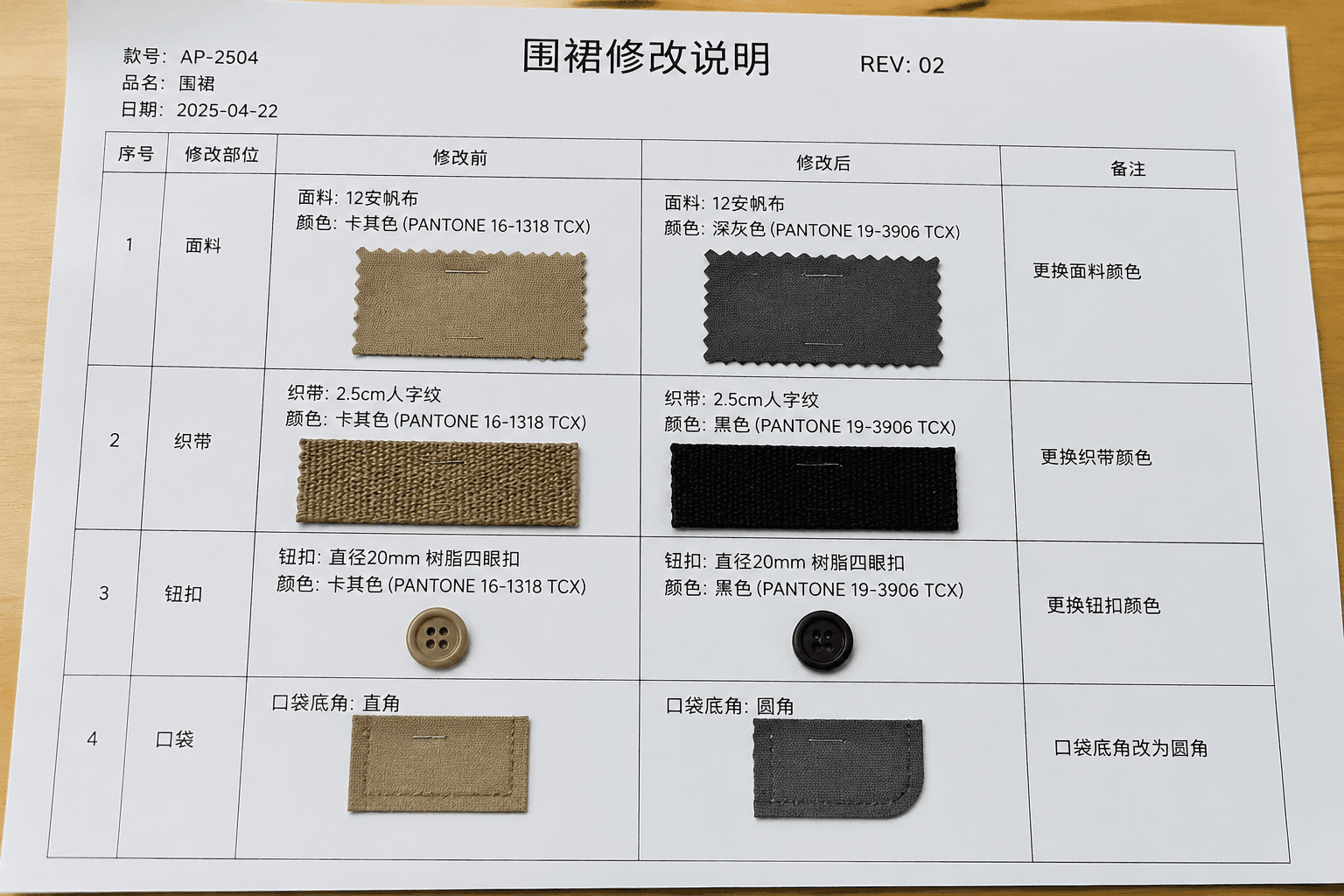
- Every repeat apron order update needs a revision code, even for small changes such as label placement, tie length or stitch color.
- Fabric changes must confirm finished GSM or oz, fiber content, width, dye standard, shrinkage tolerance, test method, MOQ and revised unit cost before bulk booking.
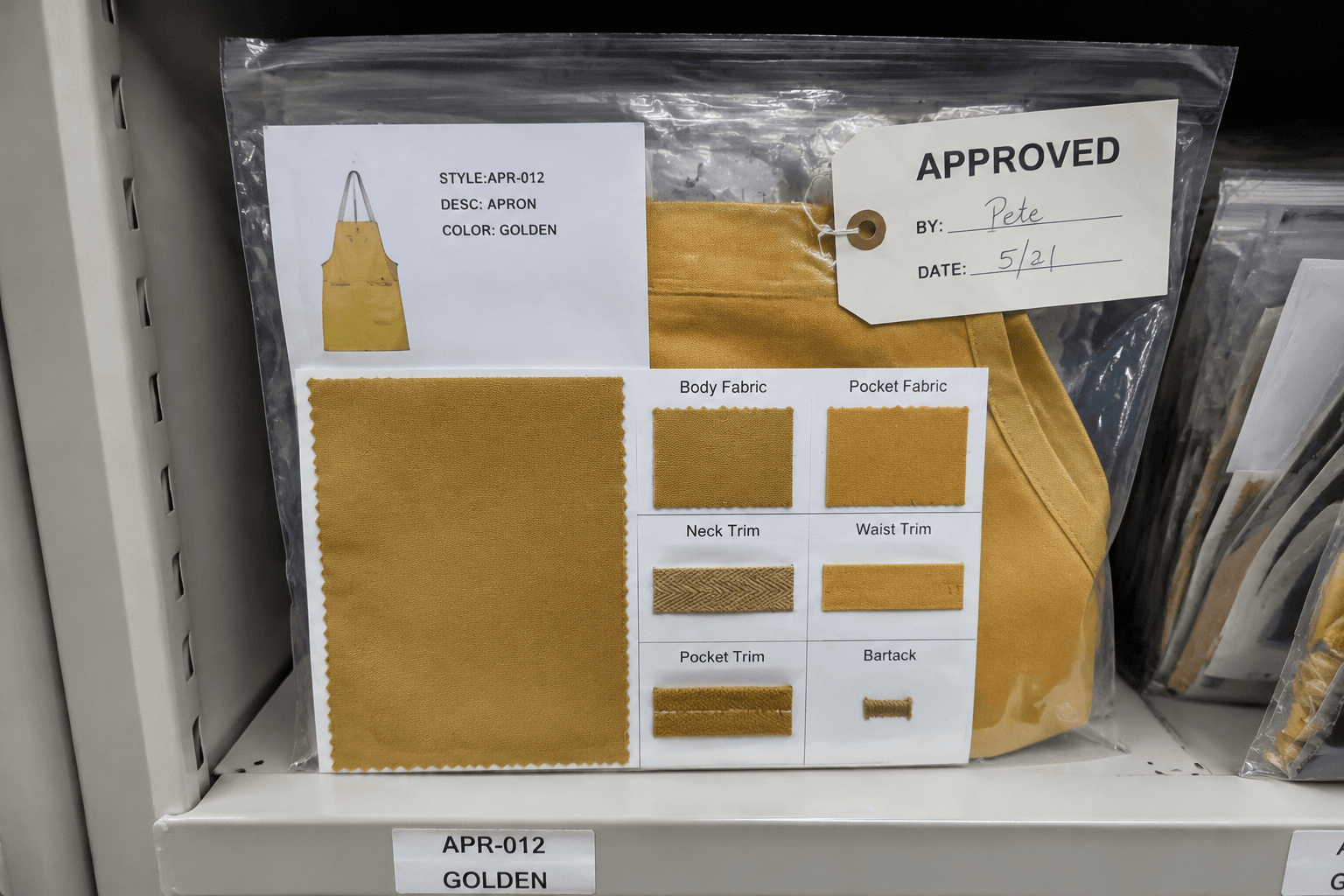
- Visible or load-bearing trim changes should be approved with a trim card or revised physical sample, not by photo only.
- Fit feedback must be converted into exact apron measurement points and tolerances, such as total length minus 2 cm, bib width plus 1.5 cm, or waist ties plus 12 cm.
- The factory should freeze the approved version before cutting because late changes affect marker efficiency, material consumption, labor minutes, lead time and carton planning.
- QC and third-party inspectors must receive the correct version file, including revised measurement chart, BOM, packing instruction and AQL criteria for the applicable PO.
Why apron specification change control matters after the first bulk order
The first bulk order becomes the working benchmark for repeat apron production. It sets the fabric article, approved shade, strap construction, buckle size, thread color, pocket layout, label position, folding method, carton pack and workmanship tolerance. When a buyer reorders 2,000, 8,000 or 25,000 aprons three to nine months later, the factory will normally repeat that approved baseline unless a formal revision replaces it.
Problems begin when a buyer treats a repeat order as almost the same. In aprons, small differences are visible and operational. A switch from 10 oz cotton canvas to 7.5 oz poly-cotton twill can lower material cost by about USD 0.30 to 0.55 per piece on a standard bib apron, but it also changes drape, opacity, shrinkage, crease recovery and wash appearance. If both versions arrive under one SKU, store staff may receive different-looking uniforms from the same replenishment program.
A controlled system does not need heavy bureaucracy. It needs one clear revision code, one approved description of the change, one updated BOM, one cost and delivery confirmation, and one cut-off PO date. In practice, this is what keeps apron sourcing stable when buyers adjust neck straps, webbing width, bartack points, pocket dimensions, labels or packing ratios after first bulk feedback.
For B2B apron buyers, the real value of apron specification change control is not administration. It is avoiding preventable waste: old trims bought in error, fabric booked to the wrong GSM, cutting done on the old pattern, failed inspection against the wrong sample, and price disputes after goods are already sewn.
- Use a simple revision system such as V1, V2 and V3 on the PO, tech pack, BOM, sample tag and inspection file.
- State exactly when the new version starts: next PO, a named shipment, a carton range, or a delivery window.
- Confirm whether old and new apron versions may be mixed in one carton, one DC receipt or one store rollout.
- Freeze the revised BOM before purchasing fabric, webbing, hardware, labels and polybags.
Classify apron changes before sampling: cosmetic, functional, material, fit or compliance
Not every apron revision should follow the same approval route. A spelling correction on a care label does not carry the same risk as changing from 320 GSM cotton canvas to 240 GSM twill. Before sampling, classify the change by impact on appearance, function, material performance, fit or compliance. This prevents oversampling simple changes and under-controlling changes that affect wash durability, wearer comfort or inspection acceptance.
Cosmetic changes usually include thread color, embroidery size, logo placement, topstitch color or label position. Functional changes include strap construction, buckle type, pocket opening, bartack reinforcement or cross-back adjustment. Material changes cover fabric GSM, fiber composition, coating, webbing, D-rings, snaps, eyelets or zipper quality. Fit changes affect body length, bib width, bottom sweep, tie length or pocket location. Compliance changes cover fiber content declarations, care instructions, restricted substance requirements or market labeling rules.
This classification should determine the proof required. A 1 cm shift in woven label placement on a stable repeat apron can often be approved by marked photos with a ruler reference. A change from brass-tone hardware to matte black alloy hardware should use a physical trim card because plating consistency, burr risk and strap grip cannot be judged reliably on a phone image. A change in fabric composition should not move to bulk until the buyer has a swatch, test data and revised costing.
- Cosmetic change: photo approval can work if scale, color and placement are already controlled.
- Functional change: use a physical apron sample and stress-check the revised area.
- Material change: require swatch, test data, revised cost sheet and revised lead time.
- Fit change: require updated measurement chart and, for larger programs, a wearer trial or size set.
- Compliance change: release only after label text, declaration format or test report is verified.
Apron specification change control for fabric GSM, weight and shrinkage
Fabric is the most common trigger for apron specification change control. Buyers may want a heavier look, lower unit cost, better stain resistance, improved wash stability or a recycled-content claim. Typical changes include moving from 245 GSM 65/35 poly-cotton twill to 300 GSM cotton canvas, from 8 oz dyed denim to 10.5 oz enzyme-washed denim, or from standard polyester to recycled polyester blend for front-of-house promotional aprons.
A fabric change is not only a purchasing decision. It changes marker yield, sewing handling, pressing, seam bulk, carton weight and sometimes freight cost. A bib apron cut in 150 cm usable-width 245 GSM twill may yield materially better than the same pattern in a narrower 57-inch heavy canvas. On a 5,000-piece order, a heavier fabric can increase consumption by 0.03 to 0.08 meters per piece depending on pattern layout and shrinkage allowance. That difference can move total fabric demand by 150 to 400 meters.
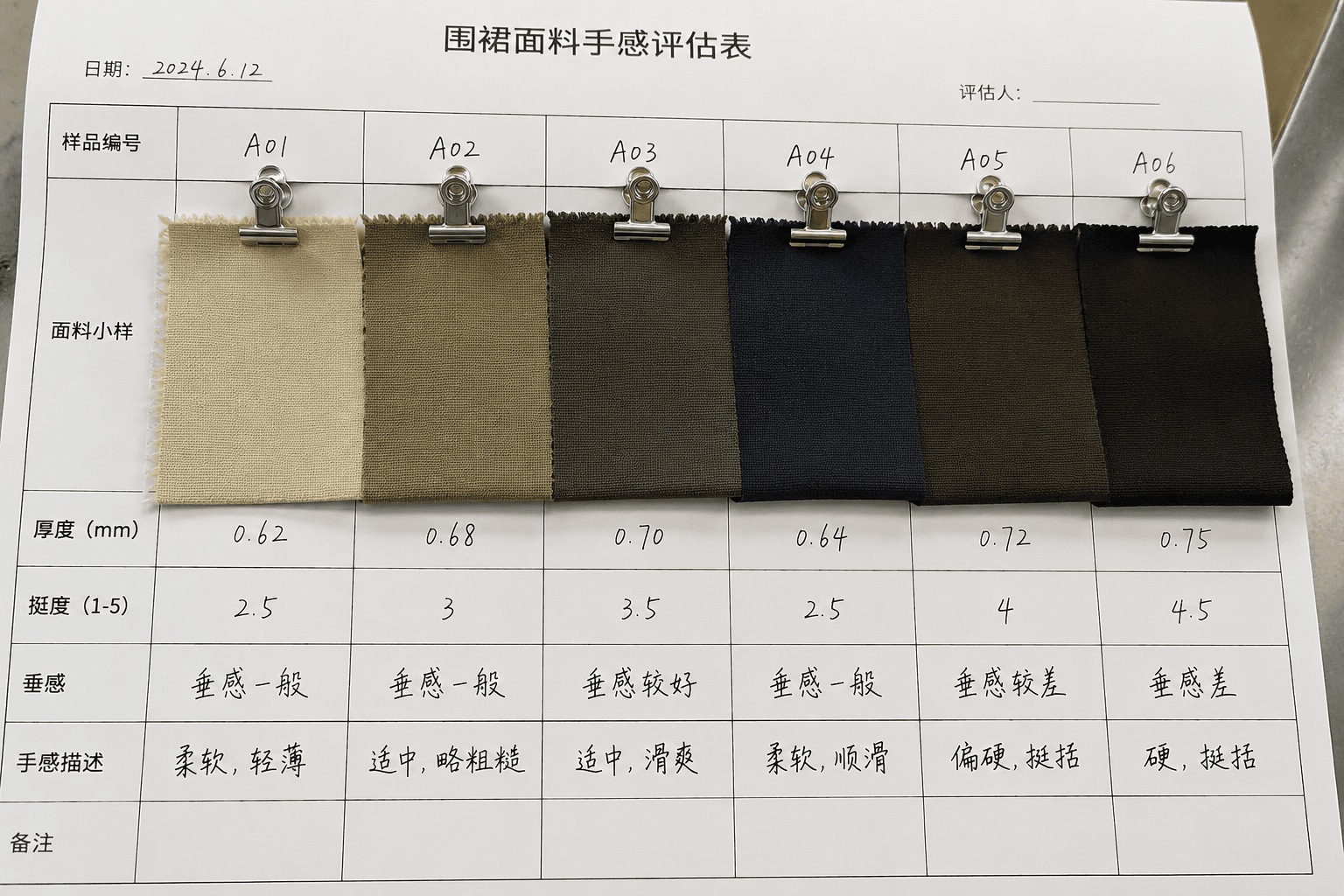
The revised specification must state finished composition and finished weight, not a rough commercial description. A usable line is: 65/35 poly-cotton twill, finished 245 GSM plus or minus 5 percent, width 150 cm, reactive dyed Pantone-matched black, shrinkage maximum 3 percent warp and 3 percent weft after 5 home-laundry cycles at 40 degrees Celsius. If the apron is for heavy-duty use, the buyer may instead require a commercial-laundry method, for example 60 degrees Celsius wash and tumble dry, with a maximum 5 percent shrinkage limit on cotton canvas.
Color should be reapproved whenever the substrate changes. Black on cotton canvas often reads deeper and more matte than black on poly-cotton twill. Natural cotton denim can also distort navy or charcoal targets after wash treatment. For uniform programs where shade consistency matters across stores, the factory should provide a lab dip before bulk dyeing and retain a sealed bulk cutting for inspection reference.
Material lead time must also be recalculated. A repeat order using stock black twill may start cutting within 3 to 5 days after deposit. A custom-dyed canvas fabric normally needs around 12 to 18 days for weaving allocation, dyeing, finishing and in-house inspection before cutting can begin. If wash testing is required, add another 3 to 5 working days.
- Specify finished weight, such as 240 GSM twill, 300 GSM canvas or 12 oz denim, not greige weight only.
- Set an agreed GSM tolerance; for woven apron fabrics, plus or minus 5 percent is common.
- State shrinkage method and limit, because cotton canvas may shrink 3 to 6 percent while poly-cotton twill is typically lower.
- Approve a lab dip and retain a sealed cutting when the apron is part of a chain uniform color standard.
- Check fabric MOQ early; custom dye lots often start at 800 to 1,200 meters per color.
Control trim changes on straps, buckles, labels and reinforcement points
Trim changes often look small on a cost sheet, but on aprons they can change comfort, durability and perceived quality. Common trim revisions include replacing self-fabric neck straps with 25 mm cotton webbing, changing 32 mm metal buckles to 25 mm acetal sliders, upgrading from a printed satin label to a high-density woven label, or adding bartacks at pocket corners after the first bulk order shows stress points in use.
Visible or load-bearing trims should be approved physically. A trim card or revised sample lets the buyer check tape thickness, weave density, buckle edge finish, plating consistency, label hand feel and colorfastness. Photos are useful for records, but not for judging whether black webbing bleeds on a light body fabric or whether a plated ring has rough edges that can abrade straps after daily use.
Lead time exposure is often underestimated in trim revisions. Stock black polyester webbing may be available in 2 to 3 days. Custom-dyed cotton webbing may need 7 to 12 days after lab-dip approval. Logo-engraved metal hardware may need 18 to 25 days, and a custom mold can push that to 30 days or more. If the repeat apron order is only 1,500 pieces, the MOQ on the new trim may also create a surcharge that was not in the original cost model.
Trim revisions should also be tested against the apron construction. If a buyer changes from 20 mm to 25 mm webbing, the pattern, loop width, stitch gauge and buckle size may all need adjustment. If bartacks are added at four pocket corners, labor may rise by USD 0.02 to 0.05 per piece depending on line speed and machine setup. These are modest numbers, but on 20,000 aprons they are not negligible.
- Record trim width, substrate and finish, such as 25 mm black cotton webbing, 1.2 mm thickness, reactive dyed.
- Match hardware size to strap width so the webbing holds firmly without slipping in wear.
- Approve label material, dimensions and exact placement because even a 5 mm shift is visible on bib aprons.
- Check colorfastness of dark tapes and labels against light apron bodies before bulk sewing.
- Add trim sourcing time to the revised critical path before confirming the ex-factory date.
Fit revisions need exact apron measurements, tolerances and wearer trials
Fit feedback after first bulk is common, especially when aprons are worn by mixed teams across cafés, hotels, restaurants or retail counters. Typical comments are that the bib sits too long, the waist ties are too short for back tying, the pocket opening is hard to reach, or the cross-back straps pull awkwardly on smaller wearers. Those comments only become manufacturable when translated into exact dimensions and reference points.
For aprons, the key measurement points are total length, bib height, bib width, waist width, bottom width, neck strap length, cross-back strap length, waist tie length, pocket width, pocket depth and pocket position from center front or top edge. A request to make the apron shorter should become something like total length from HPS to hem reduced from 86 cm to 84 cm. A request for better tie coverage should become waist ties increased from 78 cm each to 90 cm each finished length.
Tolerance must be explicit. For standard woven bib aprons, common tolerances are plus or minus 1 cm on smaller panel measurements and plus or minus 1.5 cm on total length or long straps. If the buyer asks for plus or minus 0.5 cm across all points, the factory should price the tighter control accordingly because extra checking, recutting and line balancing may be required. The target should be realistic for the apron construction and fabric stability.
A fit change can also alter consumption and line handling. Extending each waist tie by 12 cm adds 24 cm total strap length per apron. On 10,000 pieces, that is 2,400 meters of extra tie material before wastage. Widening the bib by 2 cm can affect pocket symmetry and marker efficiency. Lengthening cross-back straps may require retesting of adjustment range with the selected hardware.
For important wearability changes, a wearer trial is more reliable than flat measurement alone. If the revised apron is intended for a chain rollout over 5,000 pieces, asking three to five staff members of different body sizes to wear the sample for one shift can reveal issues that a table measurement cannot, especially around neck pressure, side coverage and pocket access.
- Use one unit system only; centimeters are usually clearer for apron tech packs than mixed inch and cm notes.
- Mark critical comfort points such as bib width, neck strap drop, cross-back length and waist tie length.
- Reference pocket position from fixed points, for example center front and top edge of apron body.
- Request a wearer trial when the change affects posture, neck load, plus-size coverage or pocket usability.
- Keep old and new apron patterns separated and labeled in the cutting room.
Calculate unit cost, MOQ and lead-time impact before approving the revised apron
A repeat apron program should not approve changes on appearance alone. The buyer needs cost, minimums and timing before release. Upgrading from 260 GSM poly-cotton twill to 340 GSM cotton canvas may increase unit cost by roughly USD 0.45 to 0.90 depending on fabric width, dye lot size and current cotton market. Replacing self-fabric straps with 25 mm cotton webbing plus one slider and one D-ring may add another USD 0.10 to 0.24 per piece. If the apron also needs extra bartacks or a stronger needle schedule, labor can rise again.
Lead time changes just as quickly. A standard repeat order using the same approved fabric and trims may ship in 25 to 35 calendar days after deposit and final PO confirmation. A revised order with custom-dyed fabric often needs 35 to 45 days. If the change requires a pre-production sample, lab dip approval, trim card, wash test and renewed packaging confirmation, add about 7 to 15 working days before bulk cutting starts. For hospitality openings or seasonal retail launches, that lead-time shift can be more important than the per-piece increase.
MOQ should be checked early because apron revisions often involve smaller trim components with larger supplier minimums. A new dyed tape may need 3,000 meters when the repeat order consumes only 1,900 meters. A custom woven label may have a 5,000-piece minimum. A special 12 oz denim color may need 1,000 meters per shade. If the buyer cannot absorb that usage over multiple POs, the factory should quote the surcharge or propose a stock alternative.
The transition plan also needs a commercial decision. If the factory still holds 1,600 meters of V1 body fabric or 4,000 pieces of old buckles, the buyer may choose to complete one last PO under V1 before moving to V2. That can reduce dead stock and avoid a write-off, but the PO, carton mark and warehouse SKU note must show exactly where V1 ends and V2 begins.
- Minor stitch-color or stock-label changes may add no unit cost if existing materials are used.
- Fabric weight or composition changes commonly move apron cost by USD 0.20 to 1.20 per piece.
- Custom trims can add 7 to 30 days for dyeing, plating, logo engraving or mold work.
- Fit changes can increase fabric or strap consumption by 1 to 5 percent depending on the revision.
- Using remaining old materials can lower waste, but only if the mixed-version plan is approved in writing.
Documentation, AQL and release workflow for apron specification change control
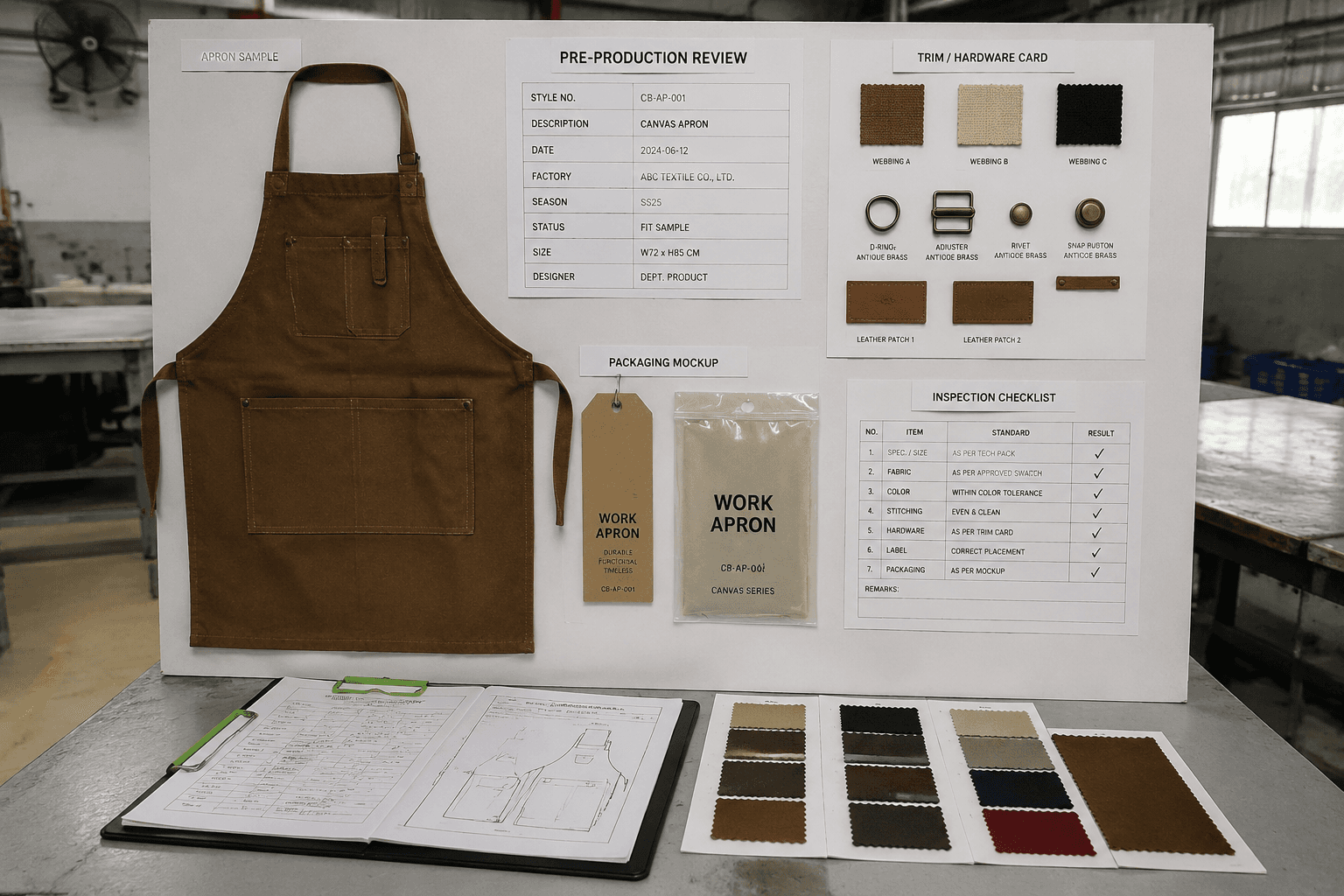
Documentation is what turns a sourcing decision into a reproducible apron. The factory should not rely on memory, chat history or an old showroom sample hanging by the line. The release pack for the revised version should include the updated tech pack, measurement chart, BOM, artwork file, label file, color standard, approved sample photos, test requirements, packing instruction and inspection checklist. Each document should carry the same revision code and issue date.
A simple structure works well: V1 for first bulk, V2 for first approved change, V3 for the next. The PO should call out the version directly, for example: style LA-204 black bib apron, specification V2 dated 2025-03-18. That one line prevents sales, purchasing, cutting, sewing and QC from using different references. If the buyer prefers a date-and-letter system, consistency matters more than format.
Transition notes are essential for larger uniform programs. If 1,200 pieces of V1 remain in the buyer's warehouse and 6,000 pieces of V2 will ship next month, the brand must decide whether both versions can be issued side by side. In franchise or chain operations, even a small difference in strap color, hem depth or label position may be unacceptable if staff in one location wear visibly different aprons.
The inspection file must match the version in production. If the order is inspected to AQL 2.5 for major defects and AQL 4.0 for minor defects, the inspector also needs the correct measurement chart, approved shade reference, pocket placement standard, trim card and packing method for that version. Inspecting V2 aprons against a V1 file is a common cause of false failures, shipment delays and unnecessary rework.
The most reliable workflow is linear. First, the buyer submits a change request with style number, current version, proposed revision and target quantity. Second, the factory confirms feasibility, MOQ, sample need, cost delta and revised lead time. Third, the factory prepares the required swatch, trim card or sample. Fourth, the buyer approves in writing. Fifth, the factory updates all release documents before purchasing and cutting. Sixth, QC checks first output against the revised standard before the line runs at full speed.
- Tech pack should show revision code, issue date, change summary and approver name.
- BOM should list exact fabric article, trim code, label artwork version and packaging material version.
- Sample photos should show front, back, pocket detail, strap detail, hardware detail and label close-up.
- Inspection checklist should reference revised measurements, shade standard, trim spec and packing method.
- For third-party inspection, state the AQL plan clearly, such as major 2.5 and minor 4.0.
- Do not release cutting until PO, sample, BOM, pattern and inspection file all show the same apron version.