Repeat-order drift in apron sourcing usually starts with one undocumented change. A 280 GSM cotton canvas is replaced by 255 GSM canvas. A 32 mm cotton herringbone neck tape becomes 30 mm polyester webbing. A divided pocket moves 8 mm off center. A hem approved at 9 SPI drops to 7 SPI after the line resets for faster output. Each change may look acceptable on one apron, but across 1,000 to 8,000 pieces it becomes visible inconsistency, a fit complaint, a failed incoming inspection or a chargeback.
An apron golden sample must be the master standard for one approved style, color, size and version. It should connect directly to the signed BOM, measurement chart, trim card, artwork file, wash record, packing instruction, final inspection comments and written approvals. If that chain is incomplete, the buyer and factory can both believe they are repeating the same apron while actually producing a drifted version.
For importers, hospitality groups, uniform distributors, retail private-label teams and promotional product buyers, the goal is practical: keep repeat apron orders predictable on quality, lead time and margin. A controlled archive tells the factory what must stay fixed, which substitutions need written approval, and when a new PP sample is required before cutting bulk fabric.
- Archive one sealed apron golden sample for each approved style-color-size-version; do not use one sample to cover similar SKUs.
- Tie the sample to hard data: fabric GSM or oz, BOM codes, trim supplier references, POM tolerances, artwork files, decoration positions and packing rules.
- Recheck high-risk apron variables on every reorder: fabric weight, shrinkage, strap width, hardware finish, pocket placement, logo position and folding method.
- Require a new approval sample when fabric source, trim source, wash route, decoration method or any finished measurement changes beyond tolerance.
- A controlled archive normally costs $50 to $120 per SKU per year and can prevent claims worth 3% to 8% of a repeat PO.
Why an apron golden sample fails when it is treated as a display piece
Many factories say they keep a golden sample, but the piece is often hanging in a meeting room, stored in an unmarked polybag or mixed with earlier development samples. In that condition, the apron golden sample is only a visual reminder. It does not prove whether the approved fabric was 100% cotton canvas at 280 GSM, whether the hem topstitch was 6 mm from edge, whether bartacks were 8 mm long, or whether the neck adjuster was matte black iron instead of antique brass zinc alloy.
Aprons look simple, which makes them easy to underestimate. A bib apron may have fewer panels than a jacket, but professional buyers still judge exact utility dimensions: finished body length, chest width, pocket depth, pocket divider symmetry, tie insertion point, towel-loop position, label placement and folded packing size. A 1 cm pocket shift or a 3 mm stitch-gauge change can make a repeat shipment look different from the first order when staff wear the aprons side by side.
The common failure is missing linkage. If the archived sample is not tied to a signed measurement sheet, BOM, trim card, color standard, artwork version and QC comments, the reorder depends on memory. Once the original merchandiser, pattern maker or line leader changes, drift becomes likely. On a 3,000-piece reorder at $3.80 FOB per apron, a 10% rework issue can erase factory margin and create avoidable claim exposure for the buyer.
- A sample without customer name, style code, color code, size, version and approval date is not controlled.
- A showroom sample cannot replace the final bulk approval sample used for production release.
- A physical sample without POM tolerances leaves fit, pocket utility and strap length open to interpretation.
- An archive without fabric lot, trim source and artwork version records increases the chance of silent substitution.
What to archive with the apron golden sample before the first shipment
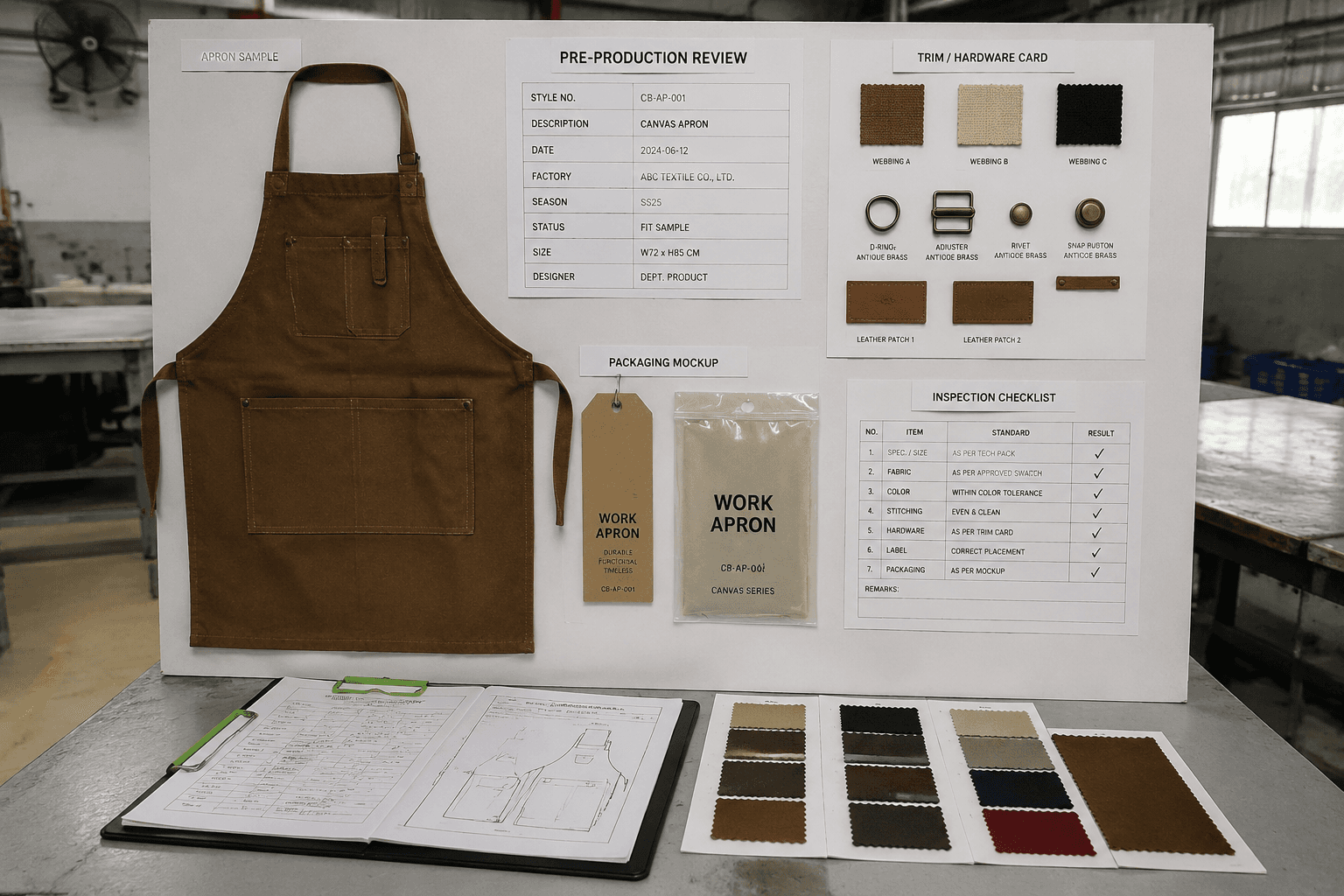
A reliable archive has two layers: one physical and one digital. The physical layer should be the exact approved production sample in the approved colorway, with the same labels, trims, hardware, decoration, wash, ironing and packing presentation required for bulk. For washed denim aprons, waxed canvas aprons and softened twill aprons, the retained piece should be the finished sample after wash or finishing, not the pre-wash piece, because shade, handfeel and measurements can shift during processing.
The digital layer must be complete enough for a new team to reproduce the style without informal explanation. At minimum, it should include the approved measurement chart, graded size rules if applicable, BOM with supplier codes, pattern revision number, print or embroidery artwork version, thread specification, construction notes, ironing standard, folding instruction, barcode placement, carton assortment and final inspection comments. Any buyer approval issued by email after sample sign-off should be saved in the same archive folder, not left in an inbox.
Vague commercial descriptions create repeat-order risk. Instead of writing "black canvas," record "100% cotton canvas, reactive dyed black, 280 GSM after finish, 57/58 inch usable width, warp shrinkage max 3%, weft shrinkage max 3%." Instead of "metal buckle," record "32 mm matte black iron slider, supplier TR-218, 24-hour salt-spray pass." This level of detail prevents debate when a reorder opens 6 to 12 months after the first shipment.
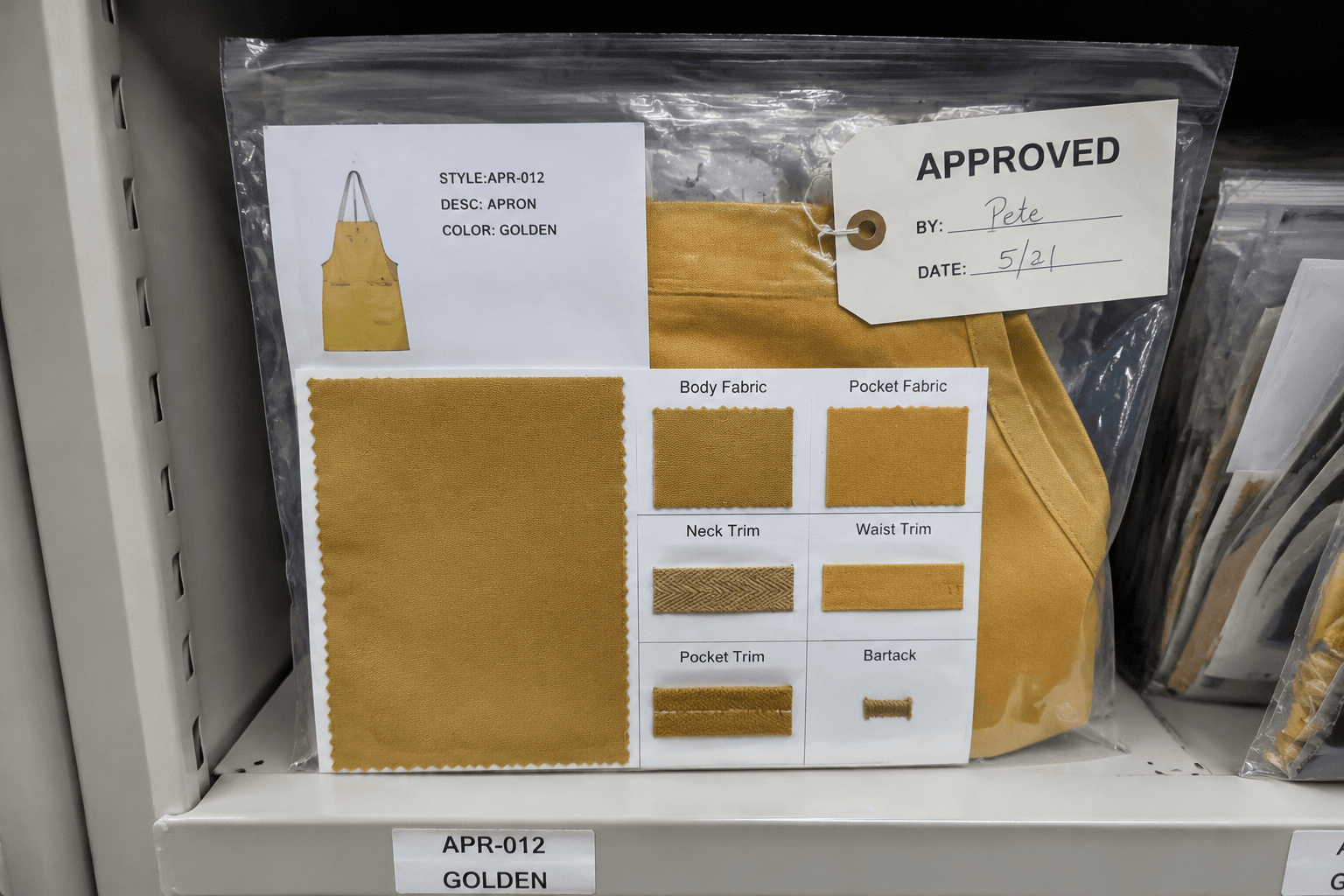
- Sealed approved sample labeled with customer, style, color, size, version, approver and approval date.
- Measurement sheet covering body width, body length, chest width, pocket width, pocket depth, tie length and neck-strap range.
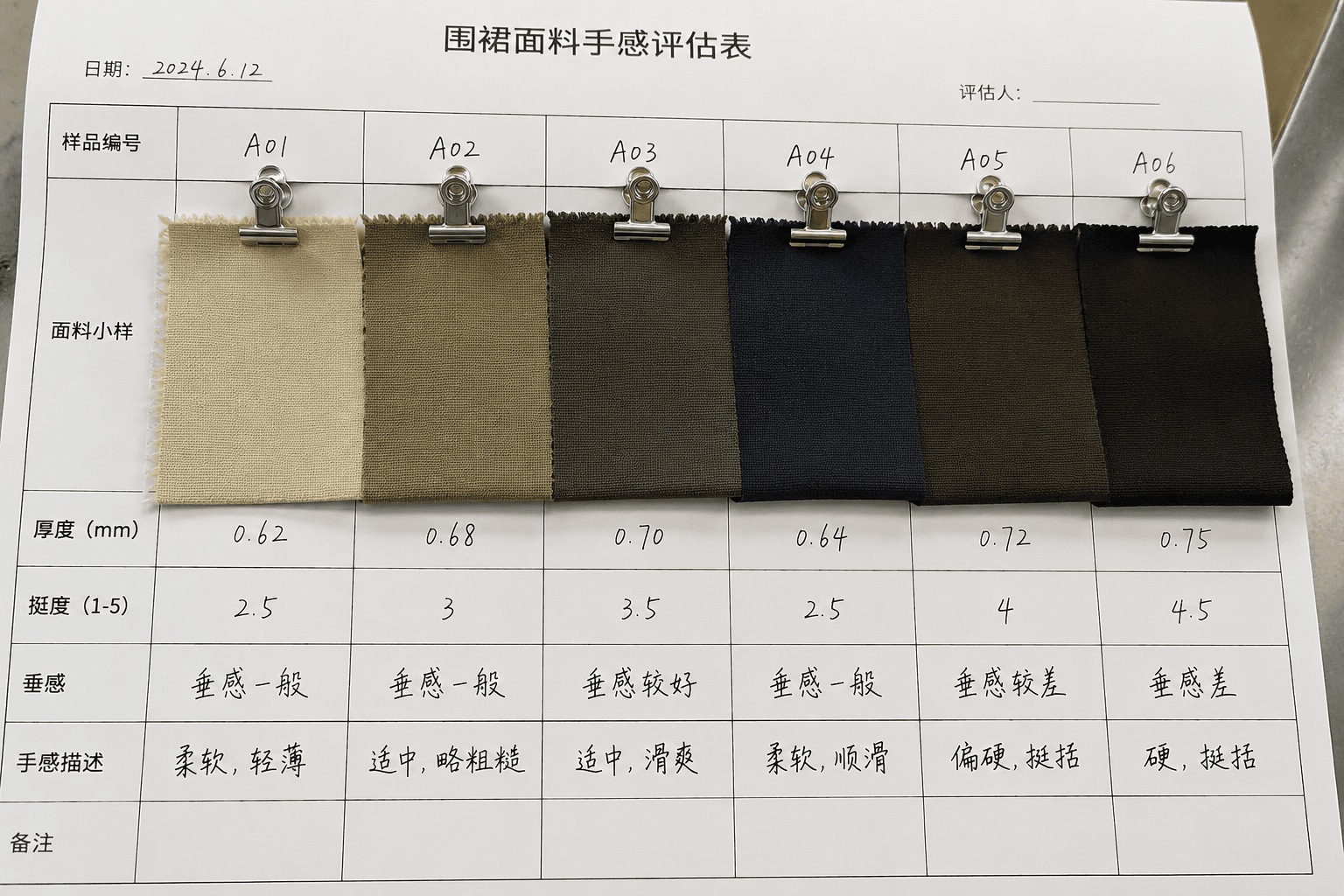
- Fabric record showing composition, weave, finish, GSM or oz, shrinkage result, color standard and mill reference.
- Trim card for webbing, hardware, labels, snaps, rivets, eyelets, thread and packaging materials.
- Workmanship file covering SPI, seam type, topstitch width, bartack positions, thread color and defect limits.
- Packing standard listing fold method, insert card, polybag size, carton quantity, carton marks and inspection level.
Use a 10-day apron golden sample archive workflow after approval
The archive process should begin immediately after the buyer approves the PP sample or final bulk approval sample. Waiting until shipment is finished creates confusion because production comments, shade approvals and packing changes can scatter across emails, chat messages and inspection reports. For apron programs with repeat orders every 4 to 12 months, the archive must still be usable after staff turnover, fabric-lot depletion and trim-supplier changes.
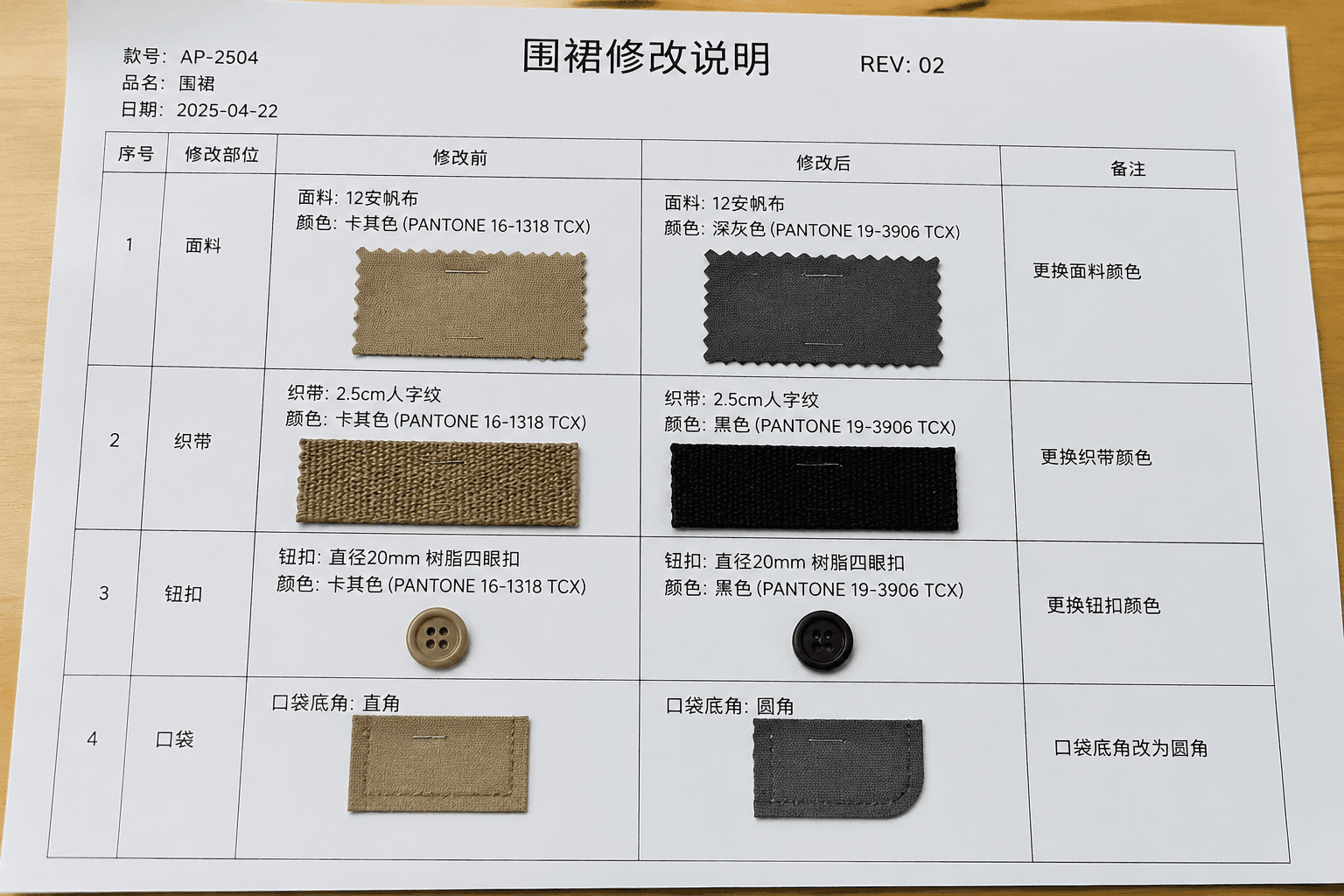
The most practical system is short and version-controlled. After approval, the factory should designate one unit as the master sample and remove it from general handling. A second signed duplicate can remain with merchandising for buyer communication. The full digital file should then be frozen under a version code such as V1.0. If the buyer later shortens waist ties from 100 cm to 95 cm, changes embroidery from 8,000 stitches to 11,500 stitches, or moves the logo 15 mm higher, the revised standard should become V2.0 instead of quietly replacing the first version.
Version control matters because apron programs often expand. A buyer may start with a black 10 oz bib apron, add natural 12 oz canvas, then request a lower-cost 65/35 poly-cotton twill option for a distributor channel. Without clear version records, teams can mix the wrong pocket size, trim finish or artwork file into a reorder. That is no longer a true repeat order; it is an undocumented hybrid.
- Day 1-2: close all sample comments and issue the final corrected approval sheet.
- Day 3-4: label, sign and seal the master sample; photograph front, back, label, pockets, straps and trims with a ruler in frame.
- Day 5-6: upload BOM, measurement chart, pattern number, artwork files, trim card, wash record and packing standard under one version number.
- Day 7-8: QA checks that digital records match the sealed physical sample and flags missing tolerances.
- Day 9-10: merchandising reviews fabric and trim availability for the next 6-month reorder window.
- At reorder stage: do not release the PI or book materials until the archive check and written deviation review are complete.
Control the apron measurements and workmanship points most likely to drift
On repeat apron orders, buyers often check color and logo first, but drift frequently appears in utility dimensions. For bib aprons, the highest-risk points are finished body length, chest width, neck-strap adjustment range, waist-tie length, chest-pocket position and divided-pocket width. For waist aprons, common drift points are total width, drop length, pocket alignment and tie reinforcement. For cross-back aprons, the strap path, crossover point and armhole comfort require special control because small measurement changes affect wearability.
Fabric records are another weak point. A reorder written only as "10 oz canvas" leaves too much room for interpretation because finished weight can vary by mill, dyeing and finishing. A cotton canvas sold as 10 oz may test near 270 to 300 GSM after finish. A washed 8 oz denim apron may shrink 3% to 5% and finish shorter if the pattern allowance is not controlled. A recycled poly-cotton twill can drape differently from conventional cotton twill at the same nominal weight, changing pocket appearance and how the ties hang.
Construction drift changes quality perception quickly. Pocket bartacks approved at 8 mm may become 12 mm in bulk. A 6 mm edge-stitch can widen to 10 mm. Stitch density can fall from 9 SPI to 7 SPI if production prioritizes speed. None of these changes sounds severe in isolation, but on a cafe chain, chefwear brand or promotional uniform program, the differences are visible across the shipment and measurable against the approved standard.
- Record finished dimensions in cm and inches, with tolerance by POM, such as +/-0.5 cm on pocket width and +/-1.0 cm on body length.
- Specify fabric by composition, weave and finished weight, such as 100% cotton canvas 280 GSM or 10 oz after finish.
- Define strap material completely, for example 32 mm cotton herringbone tape, 1.4 mm thickness, reactive dyed black.
- Set sewing standards such as single-needle hem, double-needle topstitch, 8-10 SPI and bartacks at all pocket openings.
- Photograph logo placement from fixed reference points, not from visual judgment alone.
Decide when the archived sample is enough and when to resample
A controlled archive does not eliminate sampling. It defines when the original approval still applies and when a new sample is mandatory. If the reorder uses the same pattern, fabric source, trim source, decoration method, wash route and packing method, the archived standard may be enough for a straightforward repeat. This is common for stable bib apron programs with quantities of 500 to 3,000 pieces and normal repeat lead times of 25 to 35 days after deposit and artwork confirmation.
A new approval sample is required when any core input changes. The most common trigger is fabric availability. The first order may use 12 oz cotton canvas from one mill, but the reorder 180 days later may require another mill or a new dye lot. Trim substitutions also matter: changing zinc alloy hardware to iron, replacing 32 mm cotton tape with 30 mm polyester webbing, switching from woven label to heat-transfer label, or changing snap suppliers. Decoration changes are also high risk because embroidery density, screen-print ink, heat-transfer film and backing can affect handfeel and distortion on the apron front.
The cost argument favors control. A fresh PP or approval sample for a custom apron usually costs $30 to $80, plus courier if a physical sign-off is required. That is minor compared with a claim on 2,000 pieces. Even a $0.60 per piece settlement equals $1,200, before sorting, delay or customer-service costs. For B2B buyers, resampling is not extra paperwork; it is a low-cost way to protect repeat-order consistency.
- Require a new approval sample if finished fabric weight differs by more than 5% from the approved standard.
- Require a new approval sample if fabric moves to a different mill, dye lot, wash house or finishing route.
- Require a new approval sample if hardware finish, webbing quality, label type, snap supplier or thread color changes.
- Require a new approval sample if logo size, decoration method, backing or placement changes.
- Require a new approval sample if the style has been inactive for 9 to 12 months and original materials are no longer available.
Set storage, AQL and release gates before every repeat apron order
Formal golden sample control is inexpensive compared with inconsistent bulk production. For most custom apron programs, retaining one master sample, one communication duplicate, digital photography and document filing adds about $50 to $120 per SKU per year. Against common apron FOB ranges of $2.20 to $7.80 per piece depending on fabric, hardware, wash and decoration, the archive cost is small. It can prevent remake, markdown or chargeback exposure that can exceed 3% to 8% of repeat PO value.
Storage discipline matters more than storage cost. Approved samples should be kept away from direct sunlight, moisture and dust, especially dark cotton canvas, natural canvas, washed denim and wax-finished fabrics. Metal trims can oxidize in poor conditions, and PU labels or coated straps can age. The master should stay in an individual PE bag with a clear label and desiccant where needed. Sales teams should use the duplicate sample, not the sealed master, for meetings or trade-show display.
Before any repeat apron order enters bulk, the archive should be part of the release gate. A complete file normally takes 1 to 2 working days to review. That check is useful for orders above typical MOQs of 300 to 500 pieces per color for simple aprons, or 800 to 1,000 pieces for washed, hardware-heavy or multi-color styles. It usually speeds production because it removes late clarification on fabric weight, trims, measurements, packing and inspection requirements.
Inspection standards should also be linked to the archive. For most apron orders, AQL 2.5 for major defects and AQL 4.0 for minor defects is a practical baseline unless the buyer contract requires tighter control. Critical defects such as wrong logo, unsafe hardware, sharp metal edges, severe shade mismatch or mold contamination should be set at zero tolerance. The final inspection should compare bulk units against the archived standard, not against a new verbal interpretation of the style.
- Verify customer, style, color, size, version, approval date and latest PO before material booking.
- Check fabric code, finished GSM or oz, shrinkage limit, color standard, trim source, artwork version and packing method.
- Compare body length, body width, pocket dimensions, strap length, label position and logo placement against the signed measurement chart.
- Use AQL 2.5 for major defects and AQL 4.0 for minor defects unless the contract specifies a different level.
- Issue a written deviation record before cutting if any item differs from the approved archive.