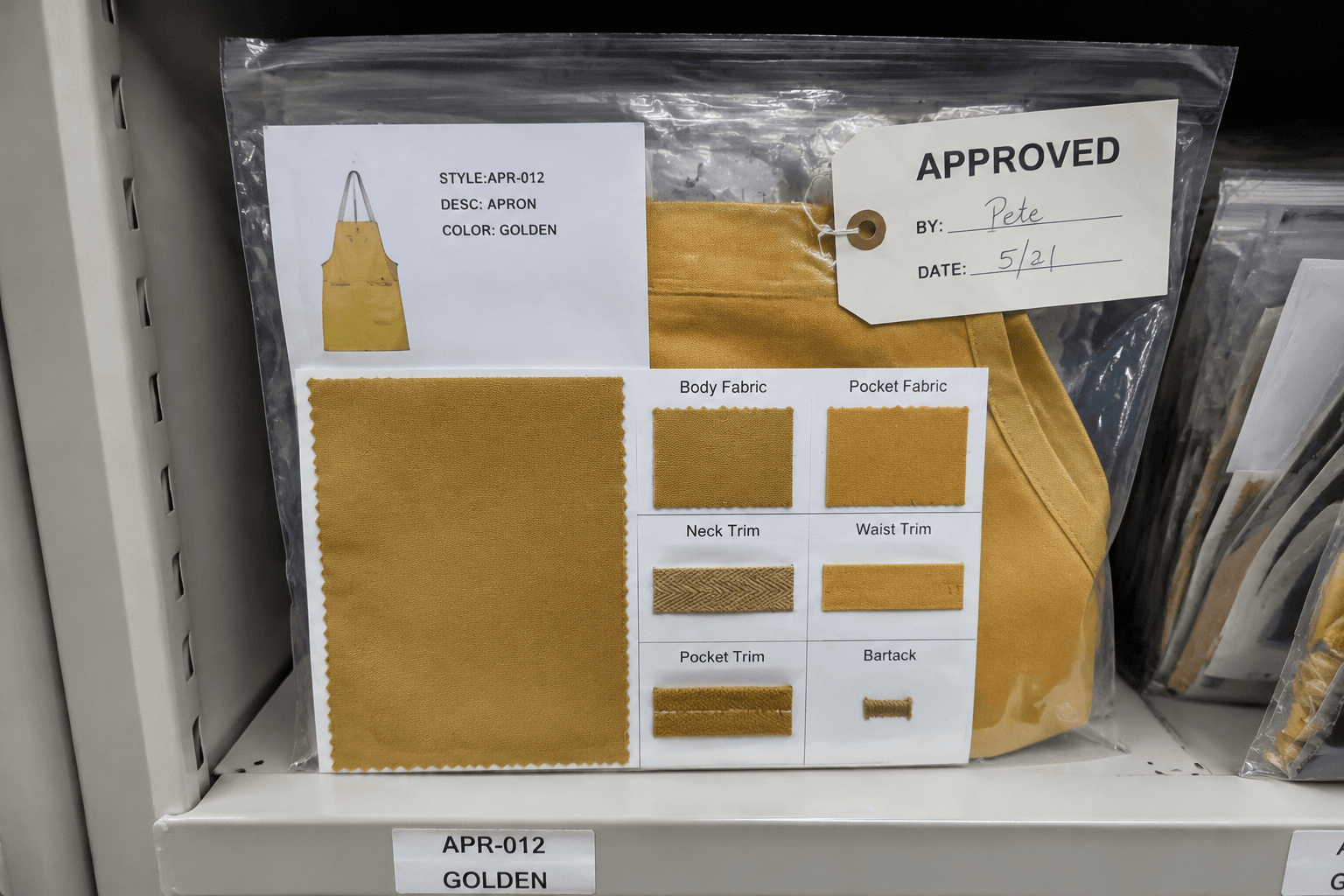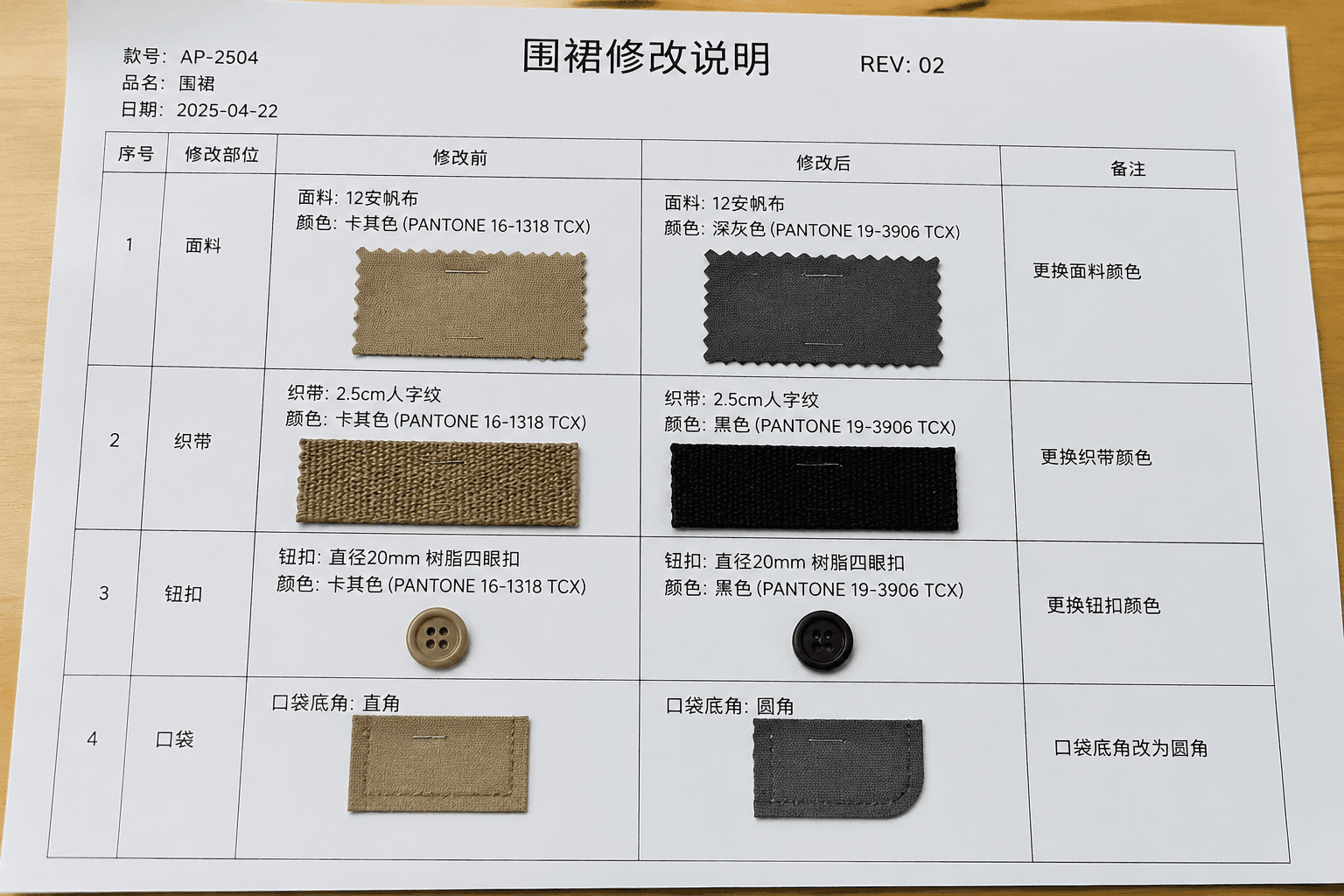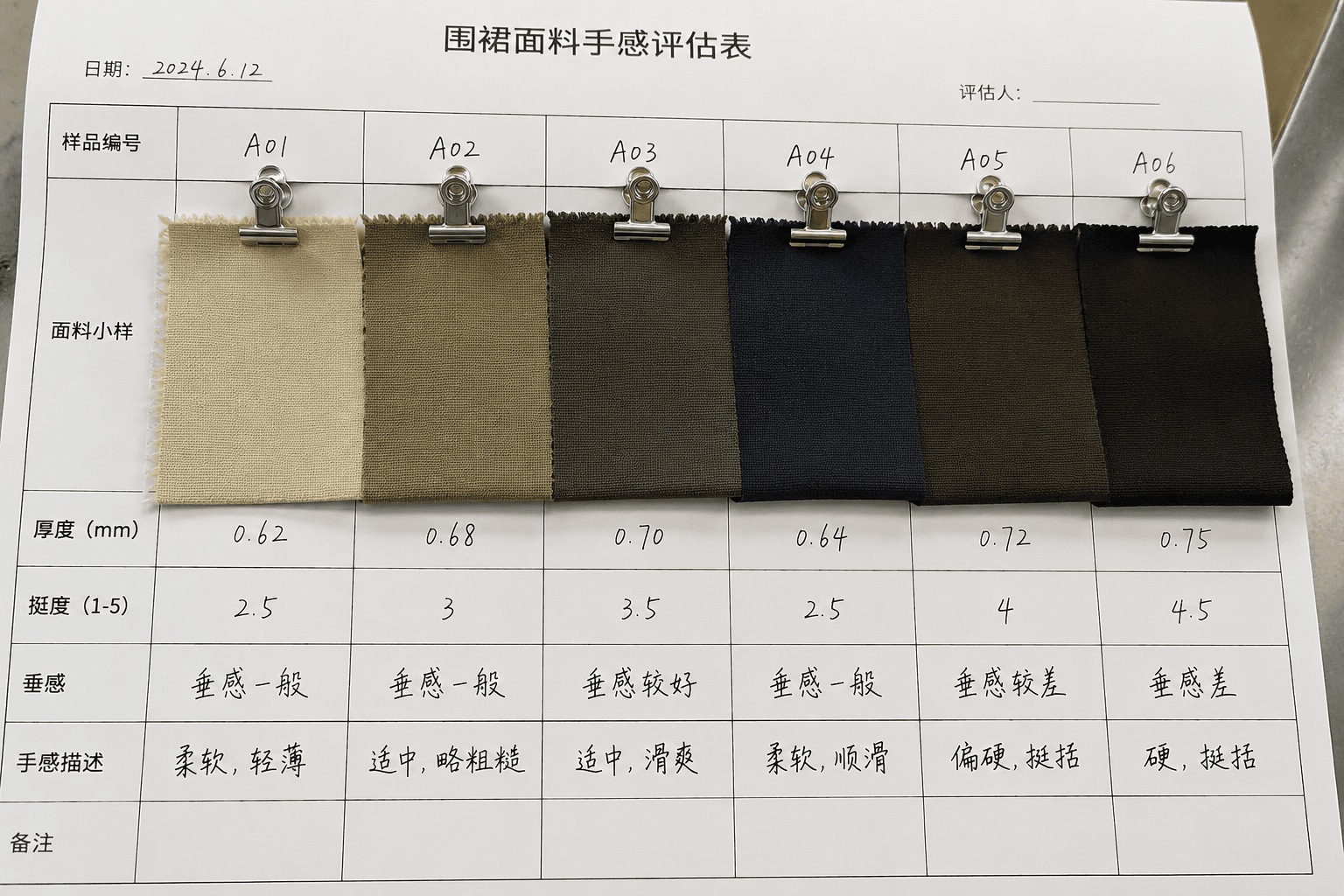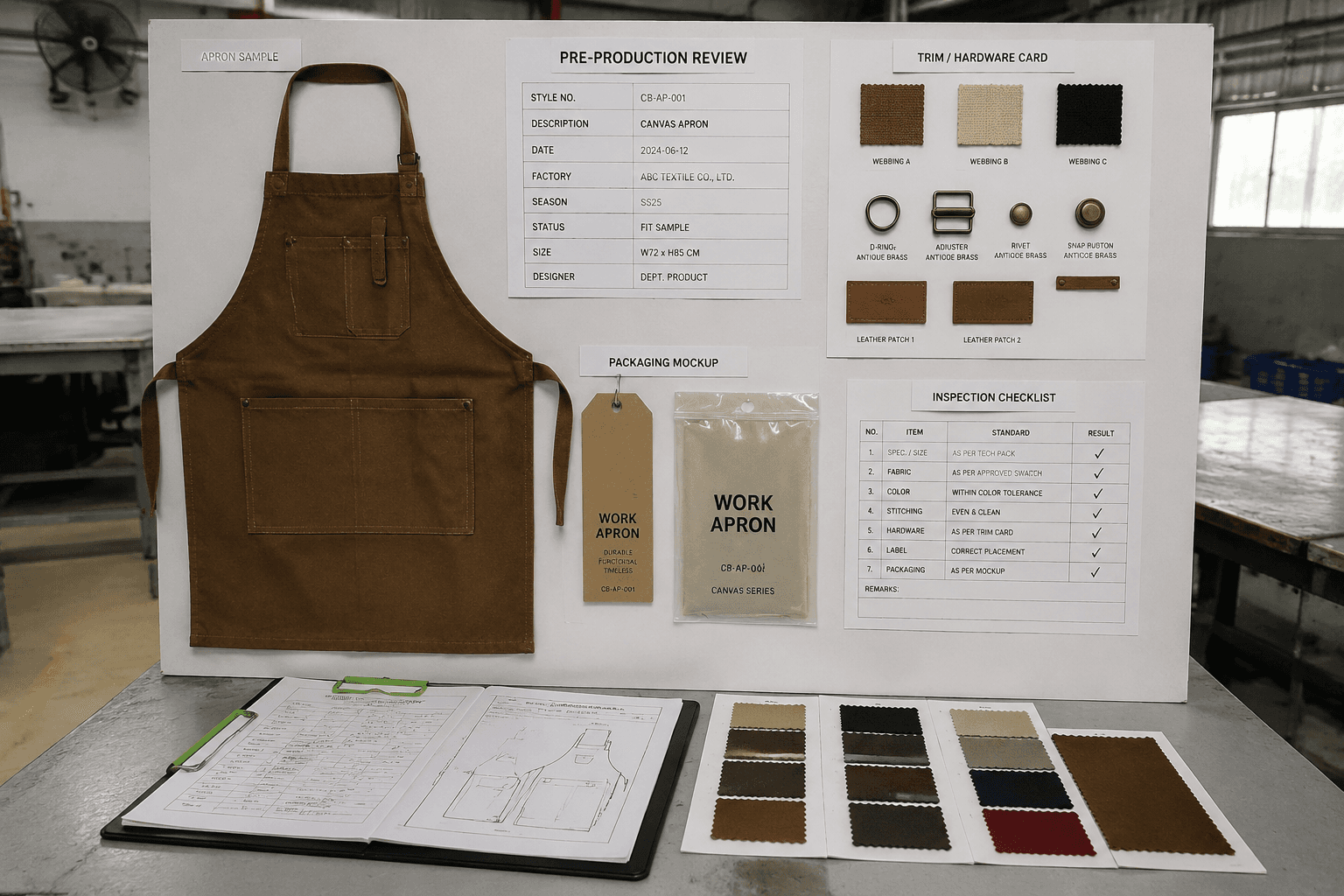
For B2B apron sourcing, the lowest-cost mistake is the one caught before bulk cutting. A proper apron pre production risk review checks the issues that usually become claims later: fabric weight, shrinkage, trim compatibility, seam construction, labeling, and carton packing. If those points are not tied to the approved sample and order sheet, the order is still exposed.
On a 5,000-piece apron program, small deviations become expensive quickly. A cotton twill that shifts from 210 GSM to 195 GSM changes drape, opacity, and stitch behavior. A buckle substitution can stop sewing for 2 to 5 days if the replacement does not feed cleanly or fails a pull test. A label error can force relabeling after packing, which is costly once cartons are staged for export. The review is not paperwork; it is the last point where the buyer and factory still have practical options.
The most useful way to treat pre bulk review aprons is as a release gate. The factory confirms material availability, lot consistency, packaging structure, and inspection method before cutting starts. The buyer confirms the approved sample, commercial tolerances, and the exact items that cannot change without written sign-off. That keeps apron production risk visible before it becomes scrap, delay, or a unit-cost overrun.
- Apron production risk usually comes from mismatched specs and substitutions, not sewing speed, so the control point is pre-production review.
- A serious fabric trim risk check should confirm GSM or oz, shrinkage, colorfastness, and trim lot consistency before cutting starts.
- Packaging matters at the same level as sewing when aprons ship in 12, 20, or 24 pcs per carton and must survive warehouse handling.
- A pilot or size set only helps if it uses the final fabric lot and the final trim source, not a look-alike material.
- A clear bulk release note should name the approved sample, the acceptable tolerance, the lead time in days, and who can authorize substitutions.
- For standard custom apron programs, a pre-production review usually adds 1 to 3 working days, but it can prevent 7 to 14 days of correction time later.
Apron pre production risk review: what to lock before bulk starts
A useful apron pre production risk review does not inspect everything at once. It focuses on the items that are costly or slow to correct after cutting begins. For aprons, the high-risk points are fabric hand and performance, trim compatibility, stitching details, print or embroidery placement, and packaging logic. If any of those are still vague, the order is not ready for bulk.
The review should be anchored to the approved sample and the final technical sheet. The buyer should confirm exact fabric composition, weight, finish, color standard, and accessory list. The factory should confirm which roll lot, trim supplier, and packaging structure will be used. For cotton drill, canvas, or poly-cotton twill aprons, the weight should be shown in both GSM and oz where relevant, because sourcing teams often receive one unit from the mill and another from the buyer. That mismatch is where many disputes start.
This is also the stage to set the commercial boundary. If the order is 3,000 pcs, the buyer should state whether any change to fabric supplier, buckle type, label artwork, or carton count requires written approval. Without that rule, a small substitution can become a production decision made too late to reverse.
- Confirm fabric composition, weight, width, shrinkage tolerance, and color standard against the approved sample.
- Confirm trim details such as neck strap material, buckle type, rivets, pocket shape, thread ticket, and label format.
- Confirm packaging details such as folding method, insert card, polybag size, carton pack count, and carton marking.
- Confirm the authorized sample and the person who can approve any substitution before production starts.
Fabric and trim risk check in apron sourcing
The most common fabric problem is inconsistency, not total failure. On a custom apron order, one roll can test at 210 GSM and the next at 195 GSM or 220 GSM. That difference affects drape, opacity, stitch behavior, and how a printed logo sits on the surface. For a midweight cafe apron, a buyer may specify 7.5 to 9 oz canvas or 180 to 220 GSM twill. For a heavier work apron, 11 to 13 oz canvas may be appropriate, but only if the buyer accepts the extra stiffness and longer break-in time.
Shrinkage is another frequent source of claims. If a cotton apron is sold as washable but the shrinkage is not controlled, a 3 percent to 5 percent change after the first wash can pull the hem, shift pocket placement, or shorten the body length enough to fail a uniform program. A solid fabric trim risk check should therefore include test data from the same lot, not only a mill certificate. Colorfastness matters as well, especially for black, navy, khaki, and dyed red or green aprons. For hospitality buyers, a grade 4 result is often a reasonable target; a grade 3 result may be acceptable only for low-cost promotional use.
Trim is where many orders fail quietly. A strap buckle that works on sample may not hold in bulk if the supplier changes resin grade or metal thickness. Webbing can shift by 1 to 2 mm and still look minor, but that can affect feeding at the sewing station and the final fit on the wearer. Labels create another risk. If woven labels, care labels, and hangtags are not approved before production, the factory may begin sewing with incomplete artwork, which creates waste and rework. On apron lines, trim mistakes are usually cheaper to prevent than to correct.
- Ask for fabric roll data, not just a general mill certificate.
- Test one bulk fabric lot for shrinkage and colorfastness before approving full cutting.
- Match buckles, snaps, and rivets to the approved sample, not to a similar catalog item.
- Lock label artwork, care content, and placement before production release.
Apron pre production risk review for sewing, sizing, and fit
Even when the fabric is correct, apron production risk can still appear in sewing. The usual issues are pocket placement, seam allowance drift, strap symmetry, and inconsistent topstitch density. In a 60 x 80 cm bib apron, a pocket shifted by 1.5 cm may look acceptable in a photo, but it can fail buyer measurement checks or create uneven load when the apron is used daily. For cross-back aprons, strap length and connection point matter even more because small changes affect how the apron sits across different body sizes.
A practical review should verify stitch specification by zone. The side seams may use single-needle topstitching, while load-bearing points on pockets or straps may require bar-tack reinforcement. If the apron is meant to carry tools, towels, or service accessories, the buyer should ask for pull-test results on reinforcement points. For denim or canvas aprons, thread ticket and stitch density matter because weak thread or sparse stitching can fail under repeated laundering. Typical production targets may sit around 2.5 to 3.5 stitches per cm on standard seams, but the right value depends on fabric thickness, wash performance, and appearance requirements.
Sizing also needs discipline. Buyers often use the phrase “standard apron” when the actual dimensions have not been frozen. The factory needs exact body width, body length, neck loop length, waistband length, pocket dimensions, and any grading rule for multiple sizes. A good bulk apron readiness review should reject vague tolerances like “reasonable” or “same as sample” unless the approved sample has already been measured and signed off.
- Measure body width, body length, neck loop length, and strap length on the approved sample.
- Check pocket placement against a dimension sheet, not just visual alignment.
- Specify reinforcement points for load-bearing seams and stress zones.
- Confirm stitch density and thread type for the final fabric weight.
Buyer scoring model for apron pre production risk review
Buyers usually need a simple way to decide whether an apron order is ready to release. A practical scoring model separates each critical item into ready, watch, or stop. If the fabric weight is locked, shrinkage is tested, trims are approved, and packaging is confirmed, the order can move forward. If one item is still under minor clarification, the factory can hold the order while that point is corrected. If core data such as fabric lot, logo method, or carton pack count is missing, bulk should not start.
The scoring should put the most weight on items that are hard to fix after cutting. Fabric lot approval and trim approval belong at the top. Print position and label content come next because they can force rework after sewing. Packaging and carton configuration matter because they affect damage rate and warehouse handling, but they are usually easier to correct than pattern or material mistakes. This is why an apron order checklist should be used as a release tool, not as paperwork stored after the fact.
A simple rule keeps decisions clean: if the problem would force the factory to remake cut panels, treat it as a stop item. If the problem only changes packing, marking, or carton count, it may be a watch item. That distinction keeps the buyer focused on the true cost center.
- Ready: approved sample, confirmed fabric lot, confirmed trim lot, confirmed artwork, confirmed carton spec.
- Watch: label wording pending, packaging insert pending, alternate carton supplier under review.
- Stop: unknown fabric roll source, missing shrinkage data, unapproved buckle or snap substitution, unresolved size spec.
Packaging, labeling, and carton checks for apron shipments
Packaging looks secondary until cartons arrive damaged or the buyer cannot scan, count, or distribute the goods efficiently. For apron programs, packaging should be reviewed at the same level as fabric and trim, especially when the buyer ships to retail DCs, food service accounts, or promotional distribution centers. A polybag that is too thin can tear during packing. A folded apron that is too bulky can distort carton count. A master carton that is overfilled can crush the neck strap or create wrinkling that the end buyer mistakes for quality failure.
Labeling needs the same attention. Care labels must match the actual fiber content and washing instructions. If the apron is cotton-poly, the content wording should not be guessed. If the product includes coated fabric, leather patches, or detachable trim, the content and care statement should reflect that construction. Many low-margin apron disputes start when the commercial label does not match the actual spec. That is avoidable with a proper pre-production review.
Carton planning belongs in the same gate. If the order is 5,000 pcs and the buyer wants 20 pcs per carton, the factory should confirm carton size, gross weight, and loading plan before production. A carton at 16 kg may be fine for one buyer and too heavy for another. The point is to verify handling risk before the shipment is already packed and booked.
- Confirm polybag thickness, fold method, and barcode location.
- Verify care label wording against the exact fiber and trim content.
- Check carton pack count, gross weight, and outer carton dimensions.
- Confirm that the final packed apron still matches the approved appearance standard.
Commercial control points for apron production risk, lead time, and cost
A buyer’s commercial review should translate quality risk into schedule and cost. A normal custom apron order from China may need 20 to 35 days for sampling and confirmation, then 25 to 45 days for bulk after all materials are approved. If the review is weak and the factory must re-source trim or re-check fabric, lead time can extend by 3 to 10 days, sometimes more if the item depends on a special buckle, custom webbing, or printed fabric. For seasonal orders, that delay can matter more than the nominal piece price.
Cost should be viewed the same way. A basic polyester apron might land around $1.20 to $2.20/pc at volume, while a heavier canvas, denim, or cross-back style can move into the $2.80 to $6.50/pc range depending on fabric weight, decoration method, and packing spec. A pre-production mistake can add hidden cost through cut waste, overtime, air freight, and relabeling. On a 3,000-piece order, even a $0.15/pc correction is $450 before freight impact is counted.
MOQ must be checked at the same time. If a logo print, woven label, or special buckle has a 1,000-piece MOQ and the order is only 600 pieces, the sourcing manager needs that constraint before purchase order issuance. A clean apron production risk review is partly a sourcing exercise: it confirms that the request is manufacturable within the budget, quantity, and schedule already committed.
- Expect 1 to 3 working days for a serious pre-production review on a standard apron order.
- Expect 3 to 10 extra days if trim or fabric issues force re-confirmation.
- Track hidden cost from cut waste, rework, and freight changes, not only from unit price.
- Match MOQ, lead time, and decoration method before releasing the order.
A practical apron pre production risk review workflow for bulk release
The cleanest workflow is short and documented. First, the buyer issues the final tech pack or order sheet with fabric, trim, size, print, packaging, and target quantity. Second, the factory confirms sourcing status and submits sample or material evidence for anything not yet locked. Third, the buyer reviews fabric hand, measurements, artwork placement, and packaging mockup. Fourth, both sides sign off the release note and only then start bulk cutting. This sequence is basic, but it prevents the most common failure: moving into production while one critical item is still open.
For many apron programs, a full fabric trim risk check will include a cut-table sample, a mini wash test, a strap pull check, and one packed carton review. That is usually enough to expose most problems without slowing the order unnecessarily. The buyer does not need a long internal memo. What the buyer needs is a clear yes or no on release, with exceptions written down. That is what turns an apron order checklist into a usable control tool.
The best outcome is not zero variation, because no bulk textile order has zero variation. The best outcome is controlled variation inside agreed limits. When the approved sample, fabric lot, trim lot, packaging structure, and commercial terms are aligned before production, the factory can run faster and the buyer can receive a shipment that matches the order intent. That is the real value of a disciplined pre bulk review aprons process.
- Release bulk only after tech pack, material status, and packaging mockup are all aligned.
- Use one signed approval record for fabric, trim, and packed sample.
- Keep exception notes short and specific so production can act on them without interpretation.
- Treat the review as a launch gate, not as a post-order courtesy check.