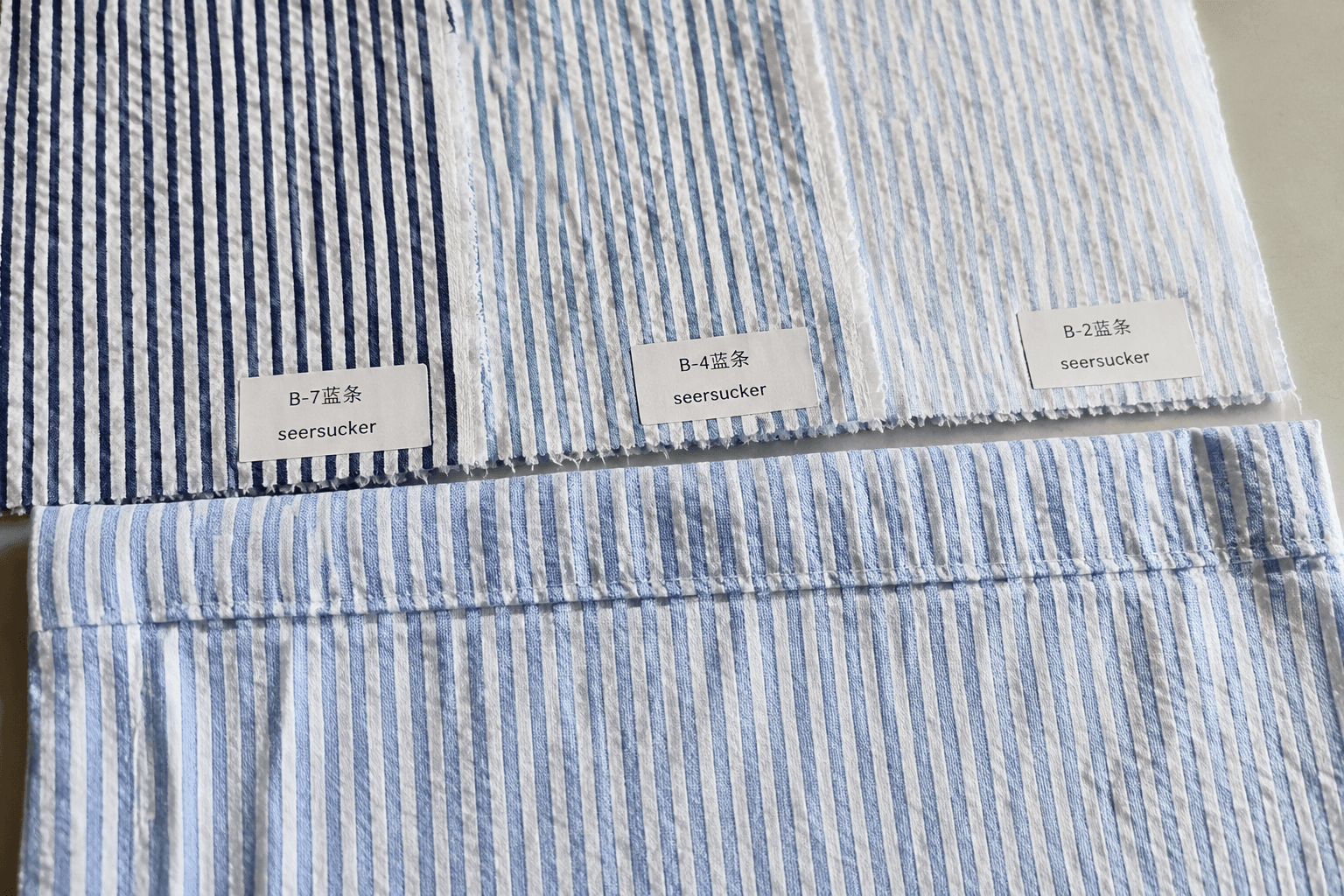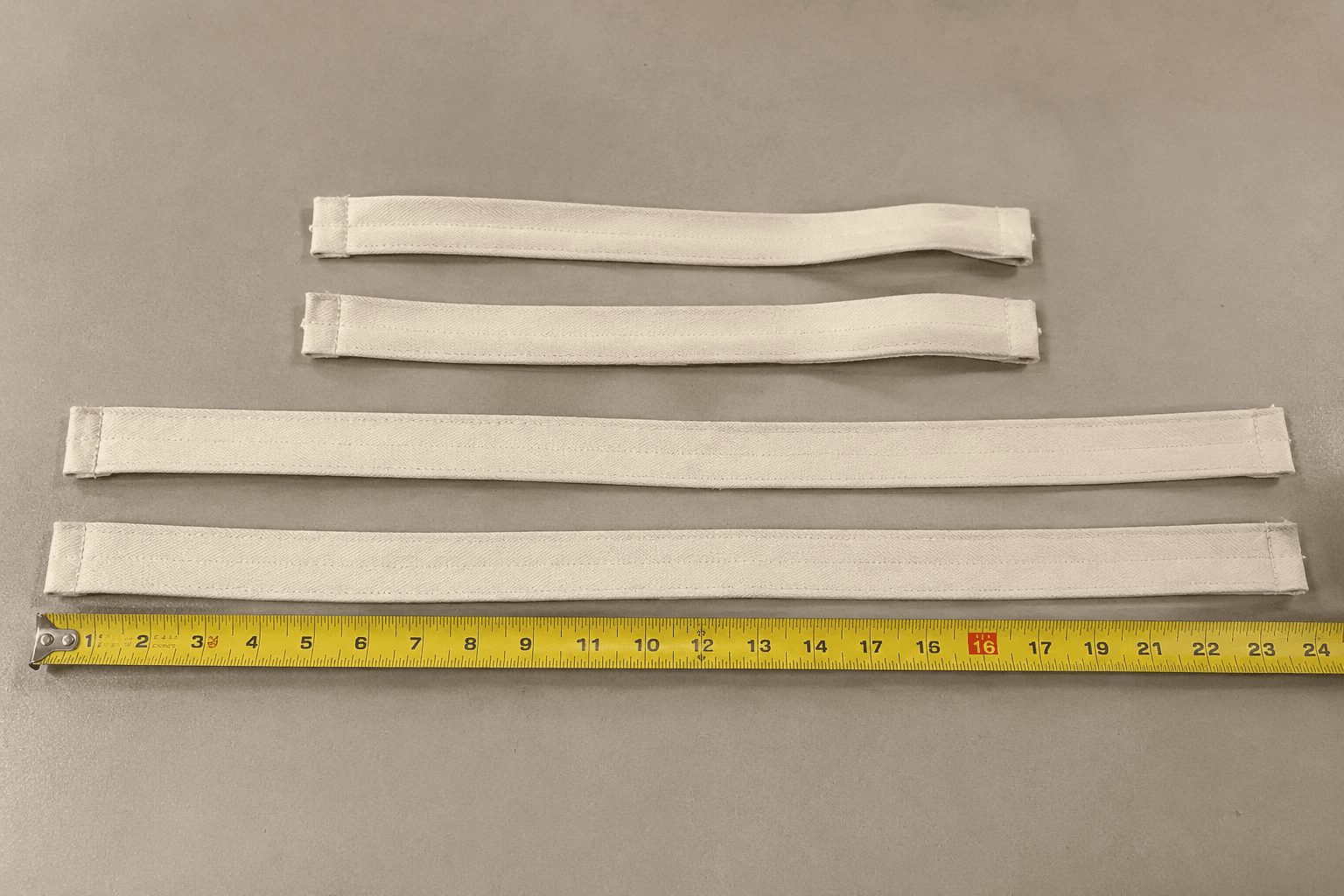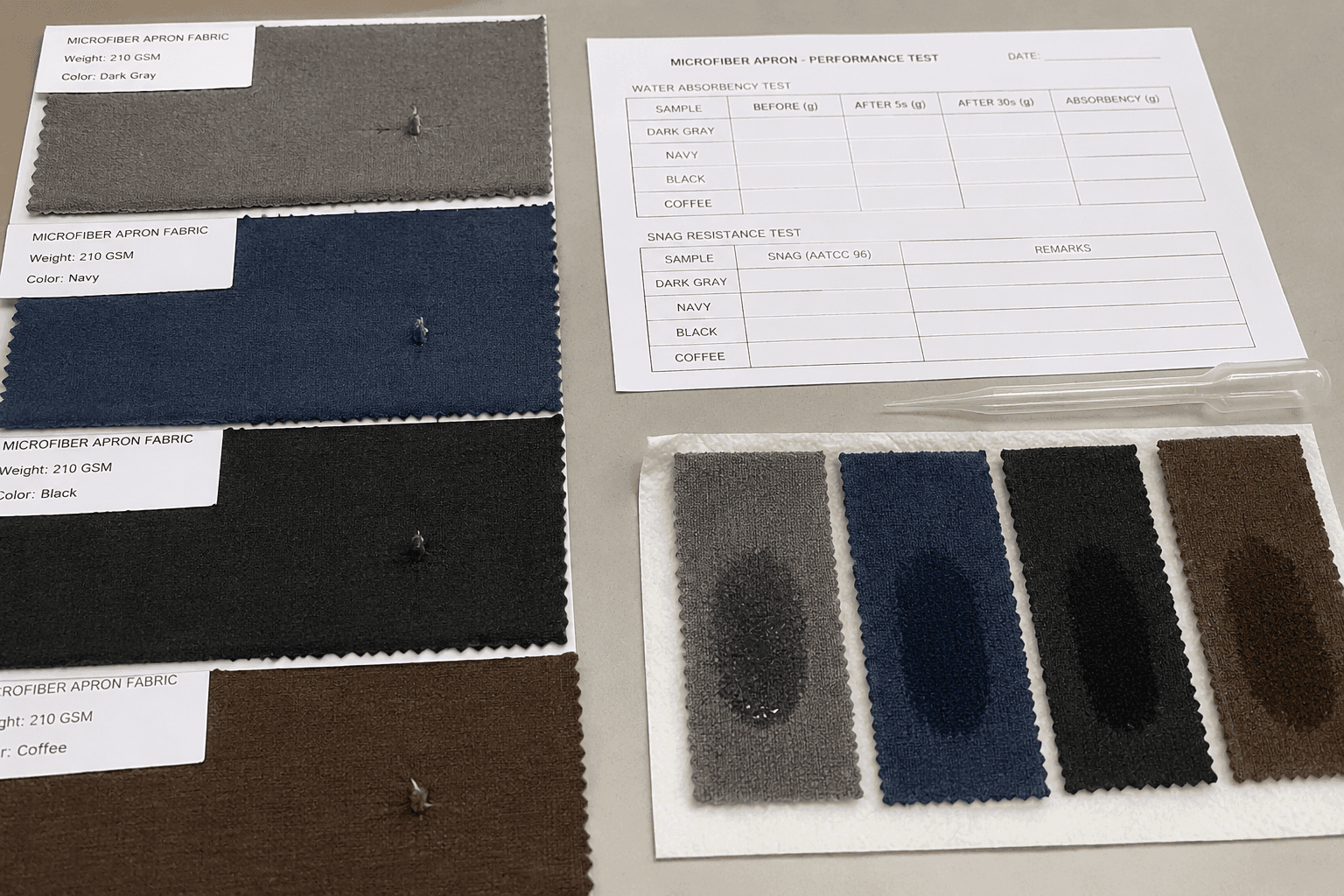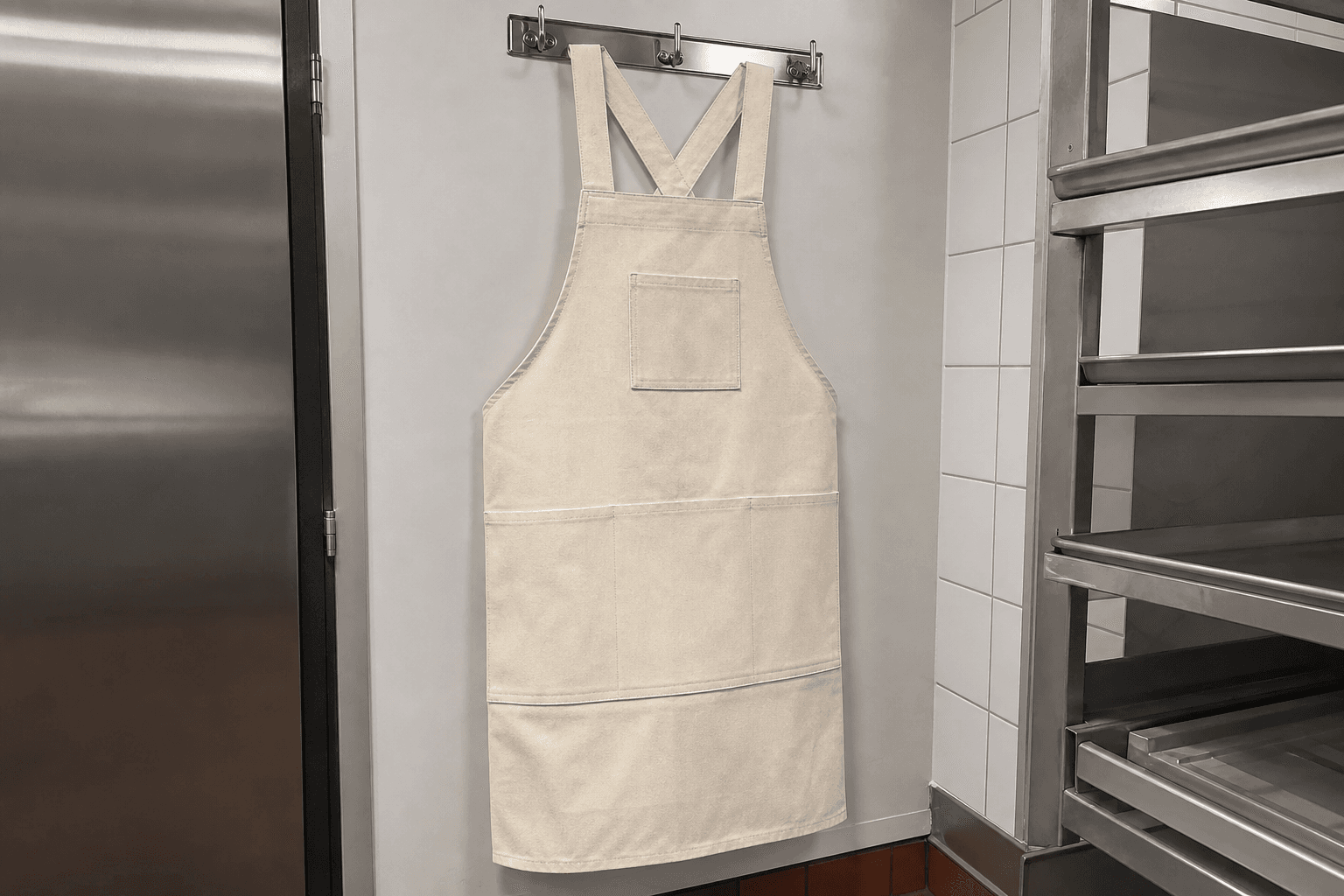
For professional buyers, the black apron dyeing method is a commercial control point, not a styling detail. Black aprons expose failure quickly because they have broad visible panels, repeated fold stress at the waist, abrasion at pocket mouths and tie ends, and constant contact with hands, countertops, towels and alkaline cleaners. In restaurant, café, bakery, workshop and retail-uniform programs, visible greying after 15-30 washes can trigger early replacement, store-level complaints and inconsistent appearance across locations.
This comparison matters most for 100% cotton twill and cotton canvas aprons in the 210-320 GSM range used for bib aprons, waist aprons and cross-back utility aprons. Those constructions cover the core sourcing volume for hospitality groups, uniform distributors, workwear resellers, private-label kitchen textile brands and promotional buyers. The practical questions are specific: what wash-fastness and crocking grades are realistic on black, which mills can book the fabric at the required MOQ, how many days will approval and dyeing add, and how much will the process move a target FOB of US$3.80-US$6.20 per piece?
In most factories, reactive black remains the default because more mills can run it, lab-dip approval is usually simpler, and repeat orders under 1,000 pieces are easier to service from smaller fabric bookings. Vat black becomes commercially relevant when the apron must keep a dense black appearance through heavier laundering, higher abrasion and a longer replacement cycle. For B2B apron sourcing, the right choice depends on fiber content, wash temperature, expected wash count, order volume, claim cost and whether the buyer can absorb a higher fabric minimum in exchange for better appearance retention.
- Reactive dyeing is usually the most practical black apron dyeing method for cotton aprons that need lower MOQ, shorter fabric booking time and acceptable home-laundry fastness.
- Vat dyeing usually gives better long-run black retention on 100% cotton aprons, especially after 30-50 wash cycles, repeated 60°C laundering or heavy abrasion at pockets and ties.
- For a 240-300 GSM cotton apron program at 3,000-10,000 pieces, vat black commonly adds US$0.18-US$0.45 per piece, raises fabric MOQ to around 3,000-5,000 meters per shade and adds about 3-7 extra fabric days.
- For 65/35 or 80/20 poly-cotton aprons, the decision is not a simple reactive-versus-vat choice because the polyester portion requires a different dye system and different fastness assumptions.
- Approve black aprons at garment level before bulk by checking wash fastness, dry and wet crocking, shrinkage, seam whitening and lot consistency against the intended wash condition.
- If the apron is specified for chain-uniform use, repeated 60°C washing or a replacement cycle longer than 4-6 months, a vat dyed cotton apron is often the safer commercial specification.
Why the black apron dyeing method changes MOQ, replenishment and claim exposure
In apron sourcing, dye selection affects the supply chain before it affects the shade card. It determines which mills can take the order, how much fabric must be booked per black shade, whether small repeat quantities are realistic and how much post-shipment risk remains with the buyer. A seasonal retail apron sold at US$2.80-US$4.20 FOB does not need the same wash-life profile as a restaurant uniform apron expected to stay presentable for 4-6 months of daily wear and weekly laundering. When one specification is forced onto both programs, the buyer either overpays for unnecessary durability or under-specifies a high-risk uniform item.
For 100% cotton, reactive black is the standard route because supplier choice is wider and booking minimums are lower. Many mills accept reactive orders from roughly 2,000-3,000 meters per shade on apron-weight twill or canvas, especially at 210-280 GSM. Stable vat black is less common. Mills that run vat black consistently on 240-320 GSM cotton fabrics often require 3,000-5,000 meters per shade, and some raise the minimum if the buyer wants a deeper black with tighter lot-to-lot control.
This matters when one fabric is shared across several SKUs. If a buyer combines bib aprons, waist aprons and cross-back aprons into one black fabric program, total meterage may justify vat black. If the order is split across several colors, small retailer packs or promotional assortments, reactive black usually fits the business model better. That is why the black apron dyeing method should be fixed before lab dips are approved and before the sewing quote is locked.
- Reactive black is usually easier to place on 1,000-3,000 pieces per style.
- Vat black becomes commercially realistic when total black demand exceeds about 3,000 meters per shade.
- For 210-240 GSM cotton twill aprons, reactive remains the market default at most OEM mills.
- For 260-320 GSM cotton canvas aprons with durability claims, vat black is more often worth costing.
Reactive black apron dyeing method: best for lower MOQ, faster booking and price-sensitive programs
A reactive dyed black apron is usually the right choice when the target is balanced sourcing: acceptable fastness, manageable cost and a shorter fabric calendar. Reactive dyes bond with cellulose, so they suit the cotton twills and canvases used in mainstream bib aprons, waist aprons and utility aprons. In real buying programs, this route is common for retail kitchen-textile lines, café merchandise, event aprons, licensed gift programs and entry- to mid-price hospitality uniforms where the buyer wants a solid launch shade without paying for the highest possible wash life.
On a typical adult bib apron in 240-280 GSM cotton twill, or a heavier canvas style around 280-300 GSM, reactive black usually keeps the fabric surcharge modest. After lab-dip approval, mills often need about 12-18 days for dyeing, finishing and internal inspection, depending on loom source, finishing queue and whether sanforizing or enzyme wash is required. A straightforward bib apron with one chest pocket, two lower pockets and an adjustable neck strap commonly lands around US$3.80-US$5.50 FOB at 3,000 pieces. In that price band, fabric weight, hardware count and packaging usually move the quote more than the black shade itself.
The weak point is long-run appearance retention. If wash-off is incomplete, residual surface dye can increase wet crocking and accelerate visible wash-down at fold lines, side seams, pocket edges and tie ends. A first sample may look dense and even, but the issue often appears after 10, 15 or 25 washes. Under home laundering at 30-40°C with mild detergent, a well-controlled reactive black apron can be fully acceptable for many retail and light-uniform programs. Under repeated 60°C washing, chlorine-adjacent cleaning chemistry or heavy abrasion, the performance gap versus vat black becomes easier to see.
- Typical wash-fastness targets for reactive black cotton aprons are around grade 3-4, subject to the buyer's test method.
- Wet crocking is usually the higher-risk point on black aprons than dry crocking, especially before full wash-off stabilization.
- Reactive black is often the best fit when target FOB must stay below about US$5.50 per apron.
- For poly-cotton aprons, a quote labeled reactive black may still involve a combined dye system rather than a pure reactive route.
Vat-dyed black aprons for 100% cotton programs that need longer wash life
A vat dyed cotton apron is usually selected when the buying brief prioritizes appearance retention over the lowest opening FOB. Vat dyeing requires reduction, dyeing, oxidation, soaping and careful wash-off, so it is more process-intensive and less widely available than reactive dyeing. When the mill executes it well on 100% cotton, especially in 240-320 GSM twill or canvas, the apron usually keeps a fuller black appearance through repeated laundering and shows less early drift toward charcoal, brown-black or uneven grey at abrasion points.
This route becomes relevant for restaurant groups, bakery chains, barista uniforms, butcher-shop aprons and workshop aprons washed 1-3 times per week. In garment reviews, the difference is often visible after roughly 30-50 wash cycles. Reactive black may still pass baseline lab tests, but vat black more often maintains visual density across the body panel, ties and pocket zones. On black aprons, that matters because fading shows clearly beside printed logos, contrast bartacks, natural herringbone tapes and light-colored shirts.
The trade-off is commercial discipline. Vat-dyed fabric often needs 15-25 days for bulk dyeing and finishing under normal mill load, compared with 12-18 days for reactive fabric. Supplier choice is narrower, lot minimums are higher and small top-up orders are less efficient after the original fabric lot is consumed. On a medium-weight cotton apron program of 3,000-10,000 pieces, the added FOB cost commonly falls between US$0.18 and US$0.45 per piece. Below about 2,000 pieces, vat black is often hard to justify unless the apron sells at a higher price point or the cost of claims and early replacement is materially higher than the dye premium.
- Vat black is primarily a 100% cotton decision, not the default route for poly-cotton aprons.
- Mill MOQ commonly starts around 3,000-5,000 meters per shade.
- The usual calendar impact is about 3-7 extra fabric days before cutting can start.
- Vat black makes more sense when replacement cost, store-image risk or uniform claim cost is high.
How to test black apron wash performance before bulk approval
For professional apron buyers, lab data alone is not enough. Black apron wash performance should be reviewed on the sewn garment because failure usually appears first in construction stress zones: pocket mouths, waist ties, neck seams, side folds, bartack points and areas that rub against the body or work surfaces. A flat swatch can look acceptable while the finished apron still shows seam whitening or edge abrasion after laundering because cutting, sewing and turning expose fiber surfaces differently than a lab sample does.
The most useful approval package combines formal testing with a simple garment wash review. At minimum, buyers should check colorfastness to washing, dry crocking, wet crocking and dimensional change after laundering. For many B2B apron programs, the commercial threshold is not perfect shade retention. It is whether the apron still looks uniform-ready or retail-ready after the agreed number of cycles. A café merchandise apron may only need to remain acceptable after 10-20 home washes. A chain-uniform apron may need to hold appearance through 30 washes or more, sometimes at 60°C.
Testing also separates dye chemistry from mill execution. A poorly controlled vat run can underperform, while a carefully processed reactive run can beat a cheap vat offer. Buyers should therefore ask for the test method, cycle count, temperature, detergent assumption and adjacent-fabric staining results, not just a statement that the fabric is washable. For black aprons, it is good practice to review one sewn sample after 5, 10 and 20 cycles using the intended wash condition before giving bulk release.
- Request wash fastness, dry crocking, wet crocking and shrinkage data from the approved bulk lot, not only from development fabric.
- Inspect the washed apron, not only the dyed shell swatch.
- Review seam whitening, pocket-edge abrasion and tie fading separately from overall body shade loss.
- Use the buyer's real wash condition, such as 40°C home wash or 60°C service wash, when comparing mills.
Cost, lead time and MOQ by black apron dyeing method
The clearest sourcing difference between reactive and vat black appears in the costing sheet and production calendar. A standard adult bib apron in 260 GSM cotton canvas often consumes around 0.80-0.95 meter of shell fabric, depending on finished length, hem allowance, strap construction and pocket layout. At that consumption, even a modest fabric upcharge matters once the order reaches several thousand units. Reactive black usually keeps cost pressure lower because more mills compete for the booking and dye minimums are easier to consolidate with other cotton runs.
A realistic quote range for a plain 100% cotton bib apron at 3,000 pieces is often US$3.90-US$5.60 FOB in reactive black and US$4.15-US$6.05 FOB in vat black. At 10,000 pieces, the spread may narrow slightly because fabric booking becomes more efficient, but vat still carries a process premium. If the apron includes branded snaps, rivets, leatherette labels, recycled polybags or printed cartons, those trims can add more than the dye route itself. Even so, dye selection remains a core commercial lever because it affects both fabric-booking efficiency and the probability of color-related claims.
The schedule impact is equally important. A common sequence is 5-7 days for initial lab dips, 3-5 days for buyer comments and resubmission, then 12-18 days for reactive bulk fabric or 15-25 days for vat bulk fabric. Cut-and-sew on 3,000-5,000 aprons usually adds another 18-25 days, subject to trim readiness, inline inspection and final booking. If the launch date is fixed, the lower-risk approval path of reactive black often wins even when vat performs better in wash trials.
- Orders below 2,000 pieces rarely absorb vat black efficiently unless claim risk is high.
- A common vat premium is US$0.18-US$0.45 per apron on medium-weight cotton styles.
- Fabric MOQ usually drives the decision more strongly than sewing capacity.
- Black shade approval often needs 2 lab-dip rounds, so the production calendar needs buffer.
PO specification points that prevent black apron disputes
The safest buying practice is to specify performance and process together. A purchase order should not say only 'black cotton apron' if dye route affects the claim profile. It should define fiber content, fabric weight in GSM or oz/yd², weave, approved black standard, required dye class where necessary, wash test method, crocking targets and shrinkage tolerance. If vat black is mandatory, that instruction should be fixed before fabric booking. Once shell fabric is dyed and cut, changing the route usually means restarting material preparation and extending delivery.
The specification should also match the sales channel and reorder model. If the apron is a low-cost promotional or entry-retail item, reactive black is often the correct commercial answer even if vat wins on paper. If it is a replenishment uniform for a restaurant chain ordering every quarter, a higher vat MOQ may be sensible because demand can be amortized across forecast volume. Reorder strategy matters: a top-up of only 500-800 aprons is often manageable with reactive fabric, but may be uneconomic with vat black once the original lot is exhausted.
Before bulk release, buyers should approve the sewn garment against a short written checklist rather than a lab dip alone. Set acceptance standards for wash fastness, crocking, shrinkage and visible seam whitening. Align inspection terms such as AQL 2.5 for major defects and AQL 4.0 for minor defects, then keep one sealed bulk swatch and one washed reference apron from the approved lot. In black apron programs, this discipline prevents more disputes than arguing over dye chemistry after shipment.
- State the dye class in the PO when vat black is required.
- Define GSM or oz, wash method, crocking grades and shrinkage tolerance before fabric booking.
- Align small-repeat expectations early if the business may need replenishment orders.
- Retain one sealed bulk swatch and one washed reference apron for claim review.