For buyers sourcing seersucker aprons for restaurants, cafes, hotels, catering teams, bakeries, and retail staff, the value is operational: more airflow, a lighter hand feel, and a texture that still reads neat after a long shift. In warm service environments, that matters more than a style statement. The right apron should help staff stay comfortable while still looking structured under daylight and indoor LED lighting.
That only happens when the production spec is tight. A seersucker apron can be too sheer, too light, too unstable in wash, or too inconsistent from roll to roll. On the factory side, the real job is balancing breathability, opacity, seam strength, shrink control, and size consistency across bulk lots. Those outcomes usually come down to fabric weight, fiber blend, construction method, and a wash target the buyer can enforce.
This article is written for sourcing managers and product developers who need seersucker aprons that work in service, not just on a sample card. The goal is a warm-weather apron program that looks professional, stays within budget at scale, and survives repeated commercial laundering without turning into a quality claim.
- Seersucker aprons are strongest in warm service roles where staff need airflow, visual texture, and a lighter feel without moving to a flimsy plain weave.
- A practical fabric range is usually 120-180 GSM for cotton or cotton-poly seersucker; 140-160 GSM is the most common middle ground for service use.
- For repeated commercial washing, shrinkage control matters more than the texture itself; ask for pre-shrunk fabric and finished size tolerances of about +/- 1.5 cm on key dimensions.
- Seersucker helps hide light creasing, but it does not hide poor cutting, weak stitching, or uneven dye results.
- For bulk programs, MOQ commonly starts around 300-1000 pcs per color/style, and lead time often runs 25-45 days after sample approval.
- The best sourcing decision compares comfort, opacity, wash appearance, and unit cost together, not texture alone.
Why seersucker aprons fit warm service environments
The reason buyers specify seersucker aprons is straightforward: the puckered surface lifts the cloth away from the body and creates small air gaps. In hot kitchens, terrace dining, bakery counters, garden cafes, and summer catering lines, that can reduce the sticky feel staff notice after several hours on shift. It is a functional comfort feature, not a decorative one.
Compared with flat cotton canvas or dense twill, a seersucker apron usually feels cooler at the chest and waist, where heat and moisture build up first. It also keeps a more intentional look in warm weather because the texture gives the apron body without adding much weight. Buyers usually want that balance: enough coverage to look professional, but not so much fabric that the apron feels like an extra layer of workwear.
The trade-off is clear. If the construction is too open, grease marks show faster, pale colors become semi-transparent under bright light, and the garment can lose shape after repeated washing. The fabric name alone does not solve that. The use case has to match the spec.
In practice, seersucker is strongest for service programs where staff are visible to guests and mobility matters more than barrier protection. It is weaker in jobs that need abrasion resistance, heavy spill protection, or long contact with oil and moisture. That distinction should guide the purchase before price does.
The buyer should also evaluate appearance after a full shift, not only on delivery. A well-made seersucker apron keeps some structure even when slightly rumpled, which makes it more forgiving between laundering cycles. That is useful in busy front-of-house programs where staff may change aprons only once per day.
For a warm-weather uniform program, the buyer should think in terms of service reality: 8- to 12-hour shifts, 40-60 wash cycles in a season for some accounts, and staff who need the apron to look clean at the end of service as well as at opening. Seersucker earns its place when it improves that daily wear pattern without raising replenishment risk.
- Best fit: summer service, front-of-house uniforms, cafes, bakery counters, terrace dining, and light catering.
- Less suitable: warewashing, butchery, oily prep zones, and jobs needing thick barrier protection.
- Buyer priority order: comfort first, then opacity, then wash appearance, then cost per piece.
<strong>Seersucker aprons</strong>: fabric weight, coverage, and wash appearance
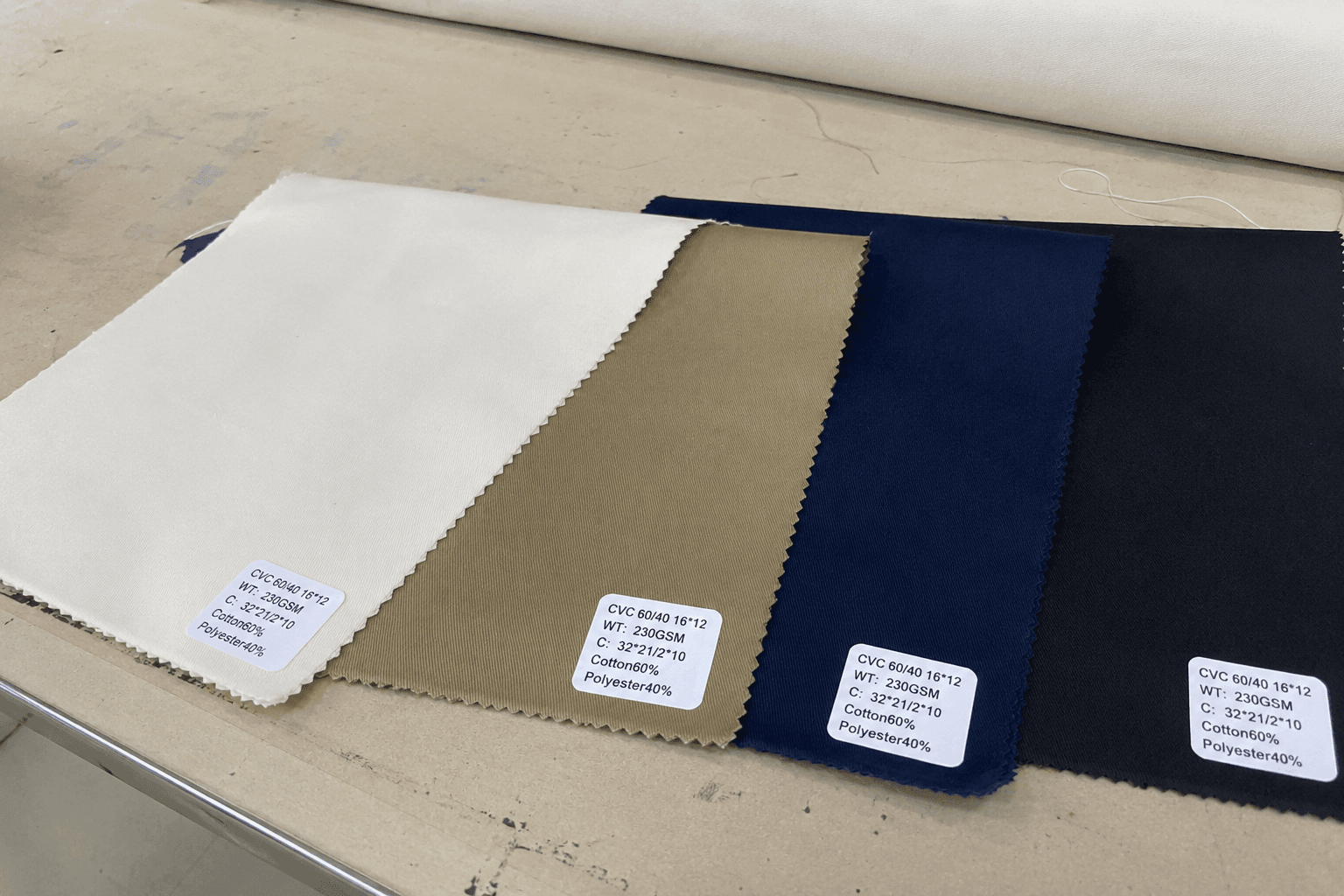
In apron sourcing, performance comes from construction, not the label. Seersucker aprons may be made from 100% cotton, cotton-poly blends, or less commonly polyester-heavy blends. For service aprons, cotton-rich fabric usually gives a softer hand feel and a more natural drape, while polyester content can improve drying speed and reduce shrinkage. Which one is right depends on whether the customer launders in-house or uses a commercial wash program.
For bulk apron orders, a realistic working range is usually 120-180 GSM. Below 120 GSM, coverage can become weak and the apron starts to read like a fashion accessory instead of a work uniform. Above 180 GSM, the apron still has texture, but the warm-weather benefit is reduced and the piece begins to behave more like a standard medium-weight apron. Many buyers land at 140-160 GSM because it gives enough structure without losing breathability.
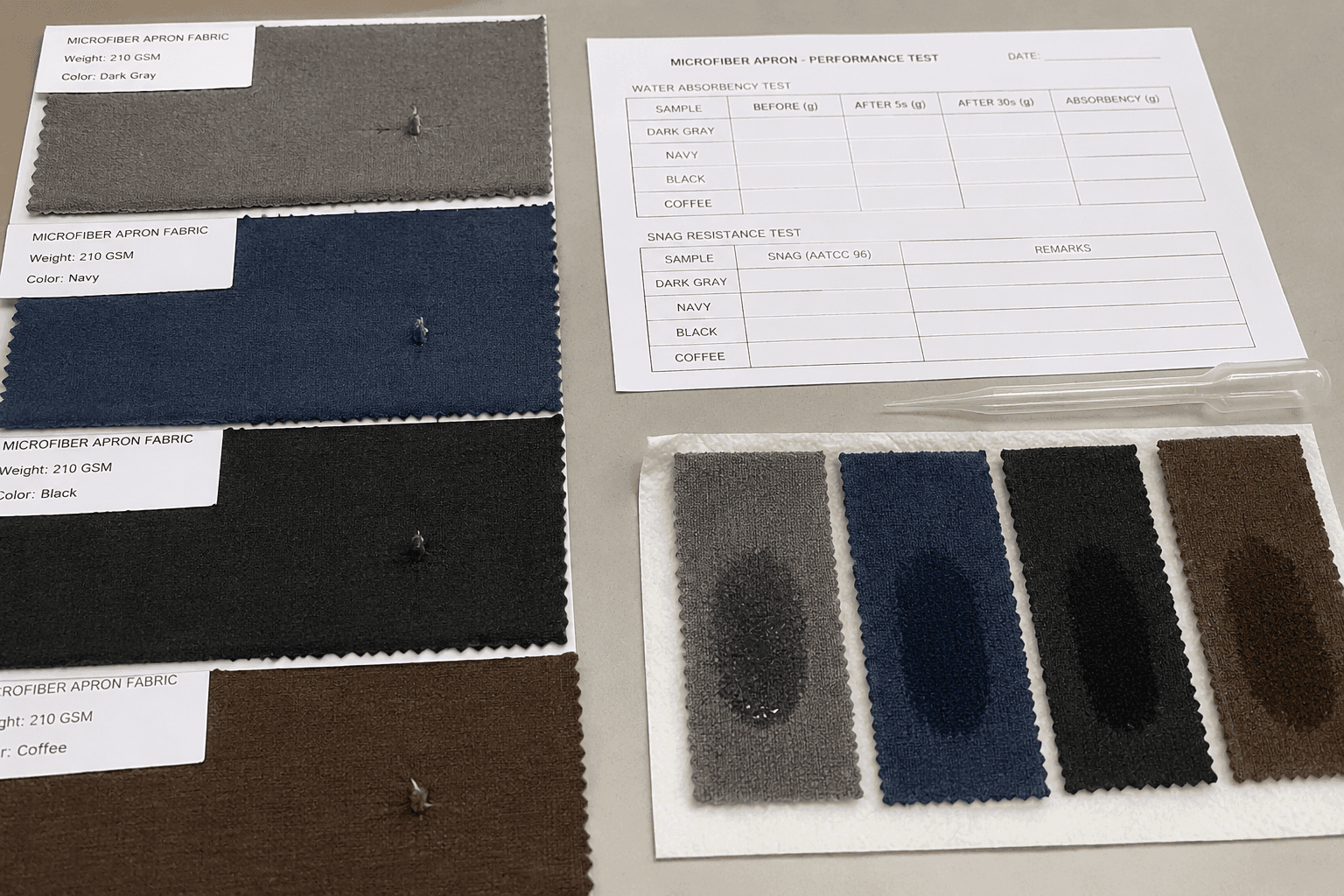
Coverage matters most in white, pale blue, and light stripe programs. Seersucker ridges soften the look of wrinkles, but they do not prevent transparency. If a buyer wants a clean front-panel appearance under daylight and indoor lighting, the fabric has to be tested in both conditions, not judged from a swatch on a desk. That is especially important for hospitality brands that expect the apron to look consistent across a dining room or retail floor.
Color and pattern also affect how the apron performs visually. Dark navy, charcoal, and tighter stripe layouts hide service wear better than very pale tones. Lighter shades can still work, but only when the fabric weight, coverage, and garment cut are sufficient for the intended environment.
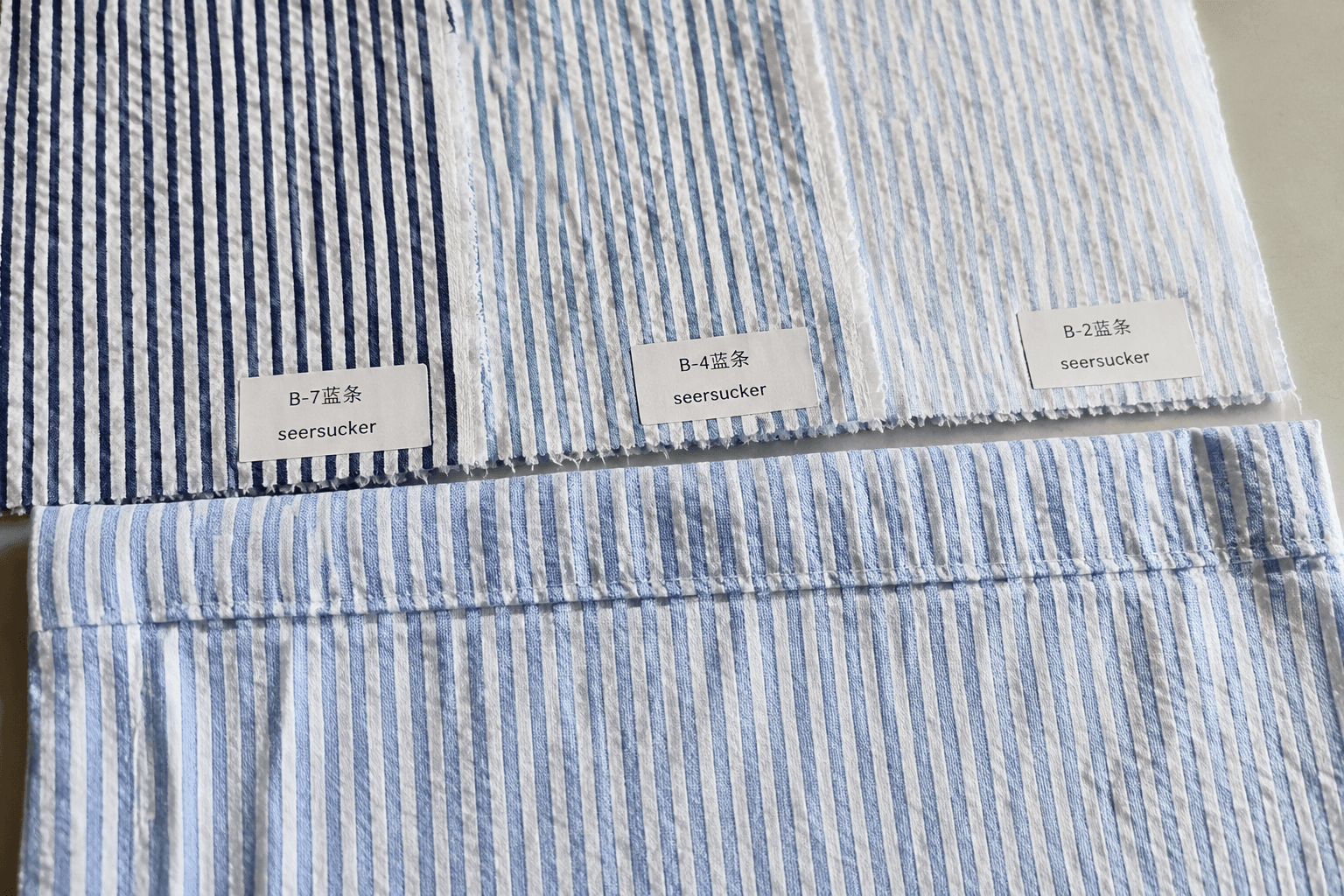
A final detail is recovery after washing and wear. If the yarns or weave structure are unstable, the seersucker effect can flatten unevenly, leaving the apron looking tired after only a few cycles. Buyers should ask how the texture is created and whether the look remains stable after repeated laundering. Yarn-dyed construction is usually more dependable than a low-cost printed imitation when the account expects repeat ordering and a consistent visual standard.
A practical buyer check is simple: compare the sample on a hanger, on a body, and under service lighting. A fabric that looks acceptable in one condition can fail in the others, especially with light colors. For seersucker aprons, the real test is whether the surface still looks intentional after movement, heat, and washing.
- Common fabric choices: 100% cotton seersucker, 65/35 cotton-poly seersucker, 80/20 cotton-poly seersucker.
- Common working weights: 120, 140, 150, and 160 GSM for warm-weather apron programs.
- Specification checks: opacity under light, shrinkage after wash, color consistency across rolls, and surface recovery after wear.
Best fabric choice for <strong>seersucker aprons</strong> by buyer priority
There is no single best fabric for every program. The right choice depends on what the buyer is optimizing for, and that needs to be stated before sampling starts. For seersucker aprons, the decision usually comes down to four buyer priorities: cooling comfort, wash durability, price control, and presentation quality.
If comfort is the top priority, a cotton-rich seersucker at about 140-150 GSM is usually the most convincing choice. It feels more breathable, drapes well, and suits front-of-house service where staff move between guest areas and prep points. The trade-off is that cotton-rich fabric may shrink more unless it is pre-shrunk and tightly controlled in production. For a hospitality buyer, that means the sample should be checked after wash, not only before it is cut.
If wash durability and fast drying matter more, a cotton-poly blend around 150-160 GSM is often the safer option. That mix can hold size better and dry faster after commercial laundering, which matters for hotels and multi-unit operators. The trade-off is a slightly less natural hand feel than pure cotton. In exchange, the buyer often gets better consistency across repeat lots and fewer complaints about size drift.
If the buyer is price-sensitive, a simpler blend and a standardized color range usually keep cost in check. That can bring the apron into a more manageable factory price band, but only if the buyer accepts a narrower styling range and less premium hand feel. A lower unit price is not useful if the apron loses appearance after several wash cycles.
The most defensible approach is to choose fabric by service model, not by style preference. A boutique cafe with front-of-house visibility may accept more fabric cost for a better drape. A chain with centralized laundry may value dimensional stability and predictable replenishment more than softness. That is why seersucker aprons should be specified against operating conditions, not mood boards.
The buyer should also decide whether the program needs a lighter seasonal replacement or a year-round uniform component. In seasonal use, a 140 GSM cotton-rich apron may be enough. In year-round hospitality use, a 150-160 GSM cotton-poly blend can be the better commercial choice because it keeps its shape longer between wash cycles.
- Comfort-led programs: cotton-rich seersucker, 140-150 GSM, pre-shrunk, softer drape.
- Laundry-led programs: cotton-poly seersucker, 150-160 GSM, better size stability and faster drying.
- Cost-led programs: standardized blend, limited color count, simplified trim package.
- Presentation-led programs: darker stripe or deeper solid tones to hold appearance longer.
Cost, MOQ, and lead time for bulk <strong>seersucker aprons</strong>
For bulk sourcing, the price of seersucker aprons depends on fabric composition, size, pockets, strap style, branding, and packing requirements. As a practical production reference, a simple bib apron in 140-160 GSM cotton-poly seersucker may land around $2.20-$4.80/pc at moderate volume. Heavier fabric, custom trims, embroidery, or complex pocket layouts can push that higher. Cross-back styles usually cost more than basic neck-loop designs because they require extra material and more sewing time.
MOQ is usually driven by fabric availability and color development. For standard stripe options or stocked base cloth, many factories can support 300-1000 pcs per color/style. If the buyer wants custom-dyed fabric or a Pantone-specific shade, MOQ may rise because dyeing and shade approval require larger batches. That is not a sales tactic; it is a production reality tied to fabric runs and color consistency.
Lead time commonly falls around 25-45 days after sample approval and deposit. If the fabric has to be woven, dyed, or tested from scratch, the schedule can stretch beyond that. Buyers should treat sample approval as a real gate, not a formality, because late changes in pocket size, strap length, or trim color can add days and increase waste.
The hidden cost is rework. A low bid can disappear once shrinkage, skew, sewing defects, and size inconsistency are counted. On a 10,000 pc program, spending an extra $0.18-$0.30/pc on pre-shrunk fabric, tighter cutting control, and stronger stress-point sewing is often cheaper than replacing returns or sorting mixed-size cartons later. That is especially true for hospitality accounts that reorder on a fixed schedule and expect matching garments across multiple locations.
Packing also affects cost. Flat-fold retail-style packing, hangtagging, barcoding, and carton labeling add labor. Buyers should ask for a full landed quote, not just a fabric-and-sewing price, so the comparison is actually usable. If the apron is being distributed to multiple outlets, carton pack counts and master carton markings should be fixed before production to avoid receiving delays at the warehouse.
When the program is repeat business, consistency is more valuable than chasing the lowest first order. A stable apron spec with a clear MOQ and reliable 35-day replenishment often beats a cheaper sample that changes from batch to batch. For seersucker aprons, small savings vanish quickly if the cloth shade, size spread, or wash recovery shifts on the second order.
- Budget drivers: fabric weight, strap hardware, pocket count, embroidery, and packaging.
- MOQ drivers: dyed fabric, custom stripe layout, labels, and carton configuration.
- Lead-time drivers: lab dip approval, strike-off approval, fabric availability, and wash-test results.
- Risk control: request a landed quote with packing, labeling, and carton specs included.
Wash performance, shrinkage control, and sewing details that protect apron value
The value of seersucker disappears quickly if the fabric is treated casually in production. Buyers should ask how the seersucker effect is created, because yarn tension, weave variation, and post-treatment all affect wash behavior differently. Yarn-dyed seersucker usually holds its appearance better than a low-cost printed imitation, especially after repeated laundering.
For hospitality programs, it is reasonable to request wash testing before bulk confirmation. A useful baseline is 5 washes at 40C for light commercial use, or 10-20 washes if the apron is meant for regular industrial laundering. The buyer should check shrinkage, seam puckering, color bleeding, pocket distortion, and strap twist. If contrast binding or trims are used, they should be washed with the main fabric because mismatched shrinkage can distort the entire garment.
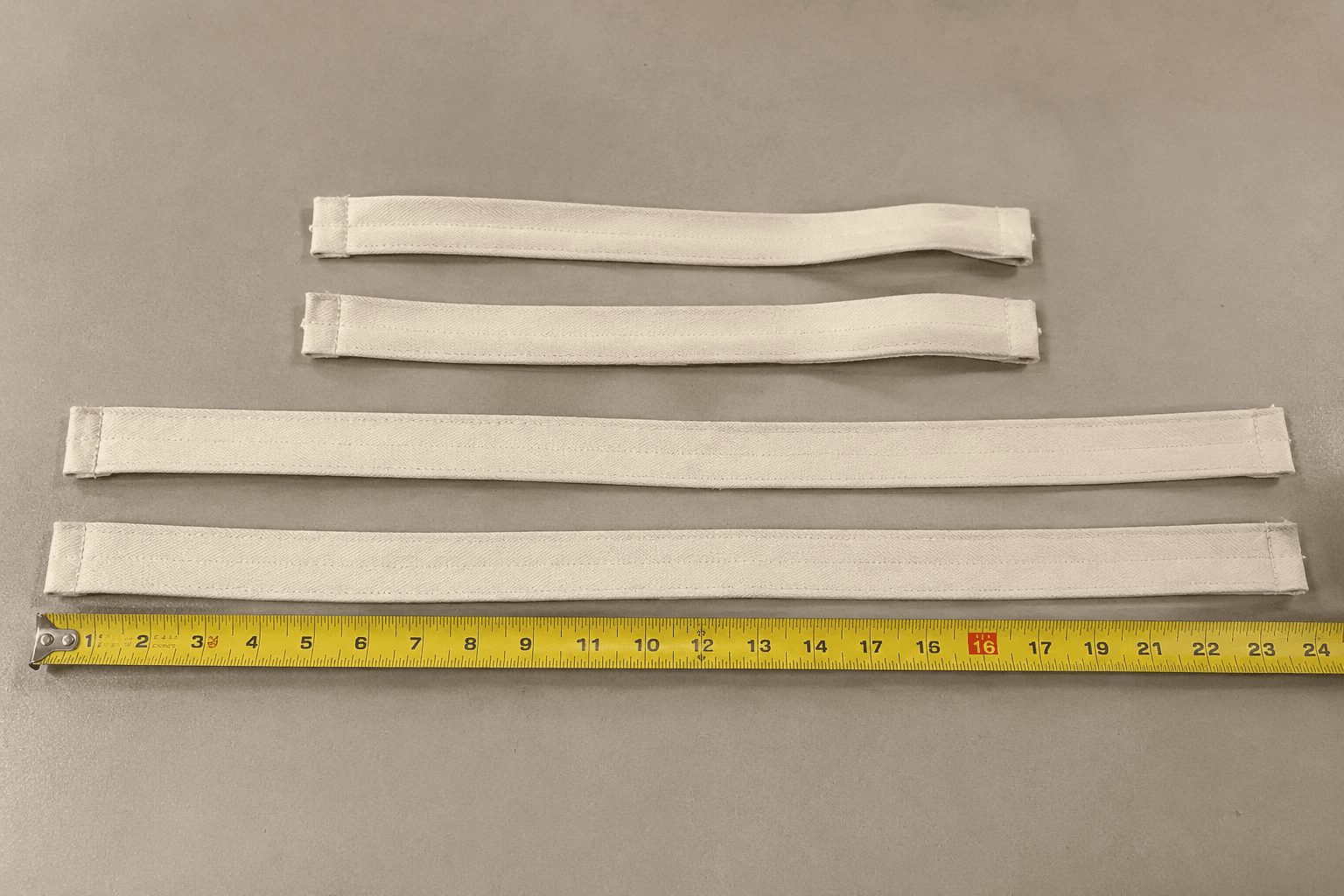
Construction details matter as much as the cloth. The seersucker texture may hide some surface irregularity, but it can also make weak stitching easier to see when the apron stretches under use. That shows up most clearly at pocket corners, bib corners, and strap attachment points. Reinforcement should be written into the tech pack instead of assumed. A strong program usually specifies bar-tacks at stress points, secure topstitch spacing, and thread that matches the wash standard.
A useful technical target is grade 4 colorfastness for laundering and rubbing where the buyer expects regular wash cycles. If the account runs weekly or twice-weekly laundering, the apron should also be checked for seam slippage and edge stability after repeated wash-and-dry cycles. These are the details that determine whether the apron looks acceptable after 60 or 90 days in service, not only when it leaves the factory.
For final approval, ask for pre-shipment measurement data from the first lot. Finished length, width, bib height, pocket placement, and strap balance all matter. A seersucker apron that arrives with uneven measurement spread will not look premium once it is distributed across a team.
The point is not to over-specify every line. The point is to specify the few things that protect appearance and service life: fabric weight, pre-shrink status, wash standard, reinforcement points, and size tolerances. If the buyer wants seersucker aprons to remain commercially useful, those points need to be written into the purchase order rather than left to verbal alignment.
One more practical point: ask whether the factory is quoting piece-dyed cloth, yarn-dyed cloth, or stock stripe fabric. The answer affects both lead time and lot-to-lot consistency. For repeat programs, stable supply matters as much as headline price.
- Confirm fabric GSM from the production lot, not just a salesman swatch.
- Check opacity under daylight and indoor LED light, especially for pale colors.
- Request wash testing for shrinkage, colorfastness, and shape recovery.
- Specify reinforcement at pocket corners, neck straps, and waist ties.
- State acceptable tolerances for finished length, width, and bib height.
- Approve packaging if the aprons must arrive flat-folded for hospitality distribution.
Designing <strong>seersucker aprons</strong> for summer hospitality use
The strongest use case for seersucker aprons is front-of-house service where appearance matters and heat is a daily issue. That includes cafes, terrace dining, event catering, gelato shops, bakeries, and outdoor beverage service. In these settings, the apron should look like part of the uniform system, not like an added layer of workwear. Seersucker works because the texture feels seasonal without becoming overly casual.
Design choices should match the job. A bib apron with moderate chest coverage works better than an oversized full-cover style when the staff is active and heat relief is the goal. Cross-back straps reduce neck strain and suit longer shifts, while a neck-loop design remains common where the brand wants a simpler silhouette and lower cost. Pocket count should be functional. One or two usable pockets for order pads, pens, or tools are better than decorative pockets that never get used.
Color strategy affects both appearance and maintenance. Navy, charcoal, and stripe combinations hide wear better than pale white or cream. Light blue, stone, and soft sage can still work, but only when the buyer accepts more careful laundering and a narrower wear window between wash cycles. In real service programs, a slightly deeper tone often keeps its market-ready appearance for longer and reduces complaints about visible stains.
Branding should stay restrained. Small embroidery, a woven label, or a pocket mark usually works better than a large print that interrupts the seersucker texture. If the logo is too large, it can flatten the visual value of the fabric and make the apron look less considered.
The best designs are the ones that stay useful after repeated wear. Buyers should test movement, reach, and pocket access during sampling, not just check the apron on a hanger. That small step often exposes whether the size, strap length, and bib height are actually suited to the role. For seersucker aprons, fit and access matter as much as the texture itself.
For chain programs, consistency across sizes and stores matters more than novelty. A simple, repeatable design with stable fabric and clear reordering terms is easier to manage than a more complex fashion-led apron that creates replenishment problems later. The buying standard should be service performance over a full season, not a one-day presentation sample.
- Good summer colors: navy stripe, blue-white stripe, charcoal seersucker, muted sage, stone, and denim-look shades.
- Strap choices: self-fabric ties for lower cost, cross-back straps for comfort, adjustable sliders for fit control.
- Branding choices: small woven label, chest embroidery, or pocket mark; oversized prints are usually a poor match for textured fabric.
How to brief a supplier on <strong>seersucker aprons</strong> correctly
A clear brief is the fastest way to get a usable quote. For seersucker aprons, the supplier needs more than a reference photo. They need the end use, target fabric weight, blend, finished size, pocket layout, branding method, wash standard, and packing format. If the aprons will be used by a chain account, the buyer should also define the service environment: indoor dining, outdoor service, kitchen support, or mixed use.
A workable tech-pack summary might read: 150 GSM cotton-poly seersucker, bib apron, 70 x 85 cm finished size, adjustable neck strap, two front pockets, navy-white stripe, pre-shrunk, colorfast to grade 4 minimum, 300 pcs per color, 35-day lead time after sample approval. That level of detail lets the factory price accurately and reduces the risk of later disputes over what lightweight or professional was supposed to mean.
For larger programs, ask for first-production photos in natural light, plus a pre-shipment measurement report. If the apron depends on texture and wash appearance, these checks are not optional. They are what separate a sample that photographs well from a bulk order that actually works across staff, stores, and laundry cycles.
The buyer should also lock down acceptable variance before production starts. If the order allows too much flexibility in color shade, pocket position, or finished dimensions, the factory will still deliver something wearable, but it may not be consistent enough for a professional uniform rollout. Clear tolerances protect both sides.
Finally, do not skip sample wear testing. A staff member using the apron through a normal shift will reveal problems that do not show up in a flat measurement check: strap slippage, pocket placement, front-panel coverage, and whether the texture is genuinely comfortable after several hours. That test is small, but it prevents expensive mistakes in bulk.
For a clean supplier brief, the buyer should separate must-have requirements from preferences. Must-haves usually include fabric GSM, blend ratio, wash target, color family, size tolerance, and MOQ. Preferences can cover pocket depth, strap finish, label type, and carton pack count. That distinction helps the supplier price the order without padding it for uncertainty.
- Brief the use case, not only the product shape.
- State fabric weight, color tolerance, and wash standard in writing.
- Require sample approval before bulk cutting starts.
- Ask for first-lot photos, measurement data, and packing confirmation.
- Set tolerance limits for dimensions and shade before production.