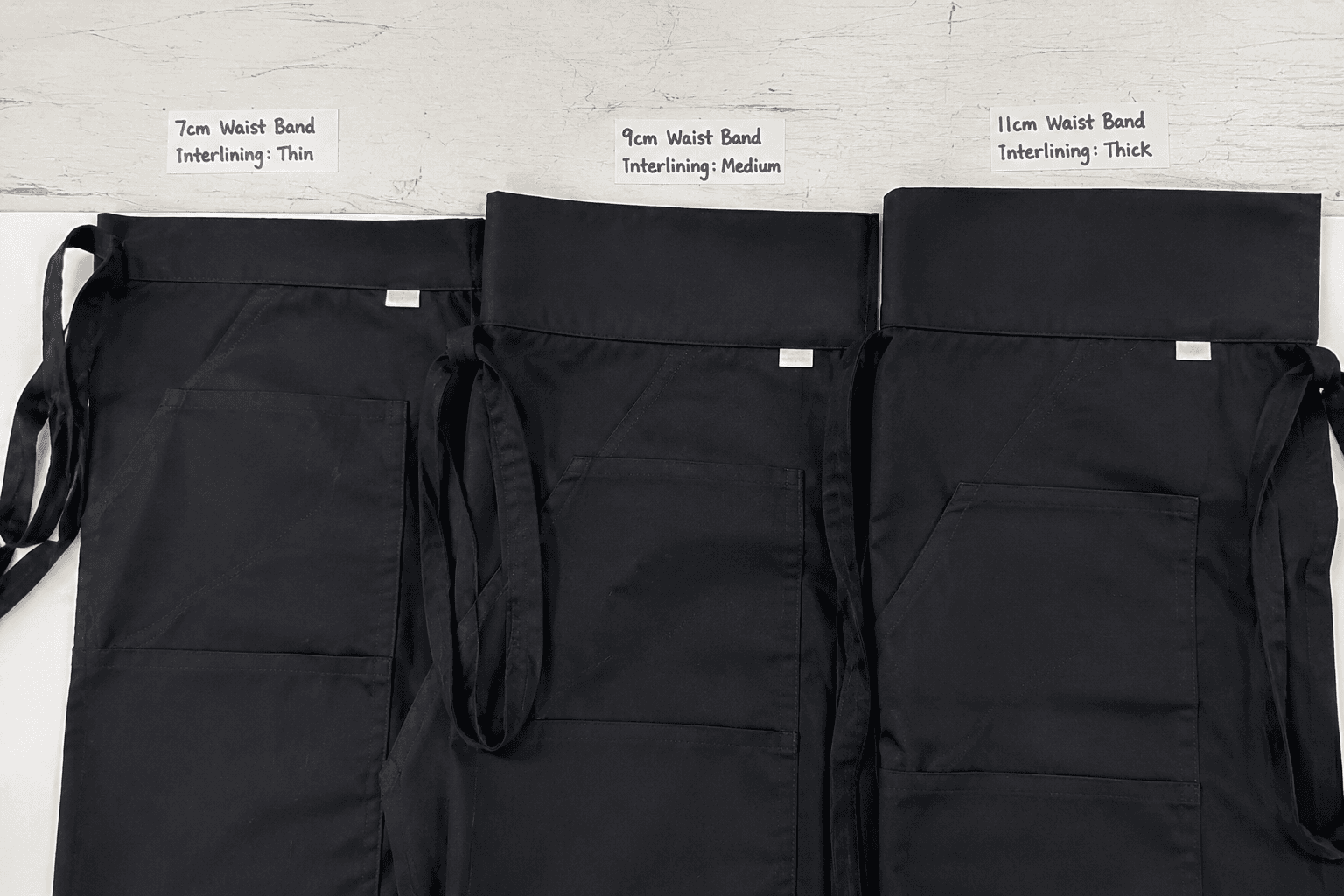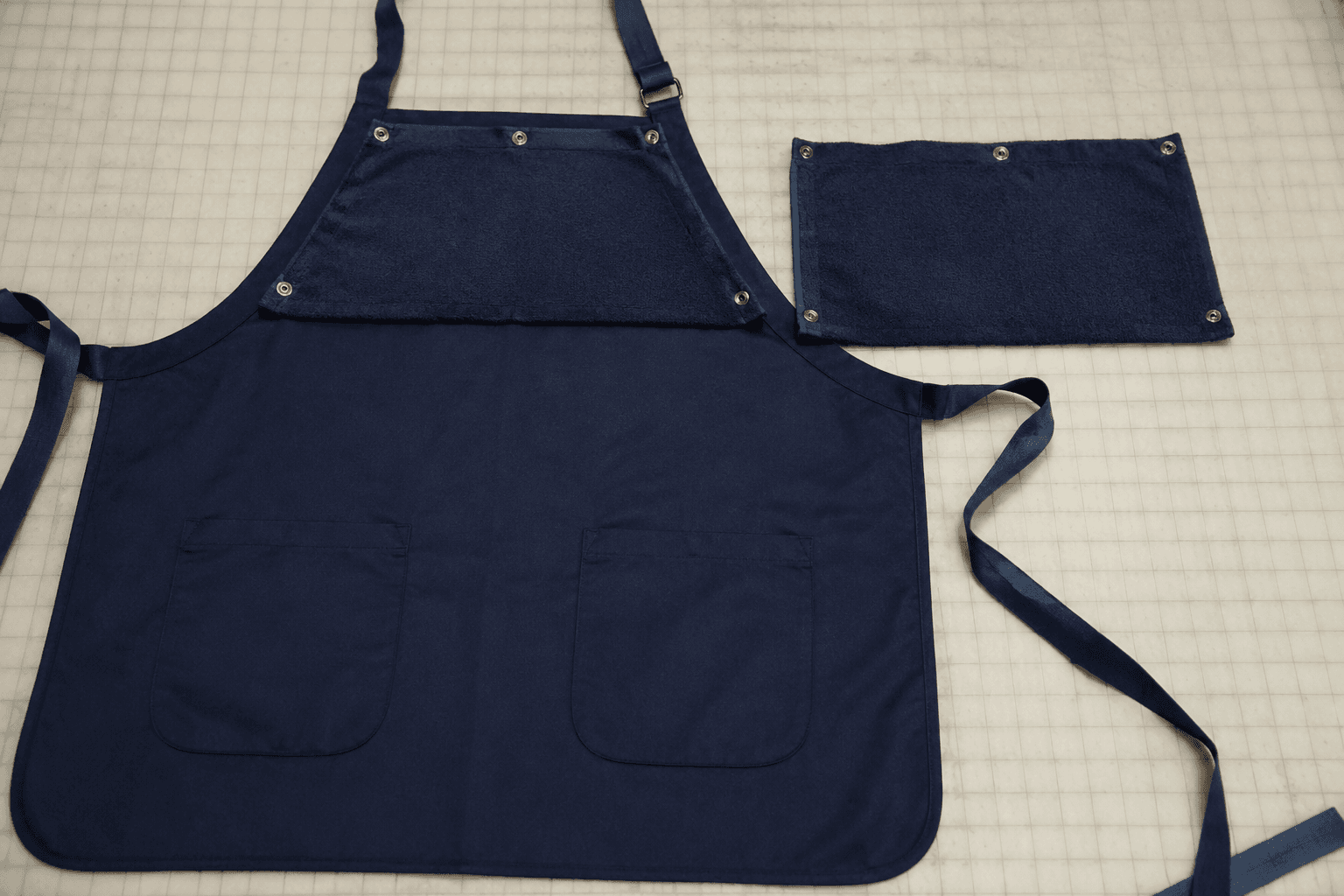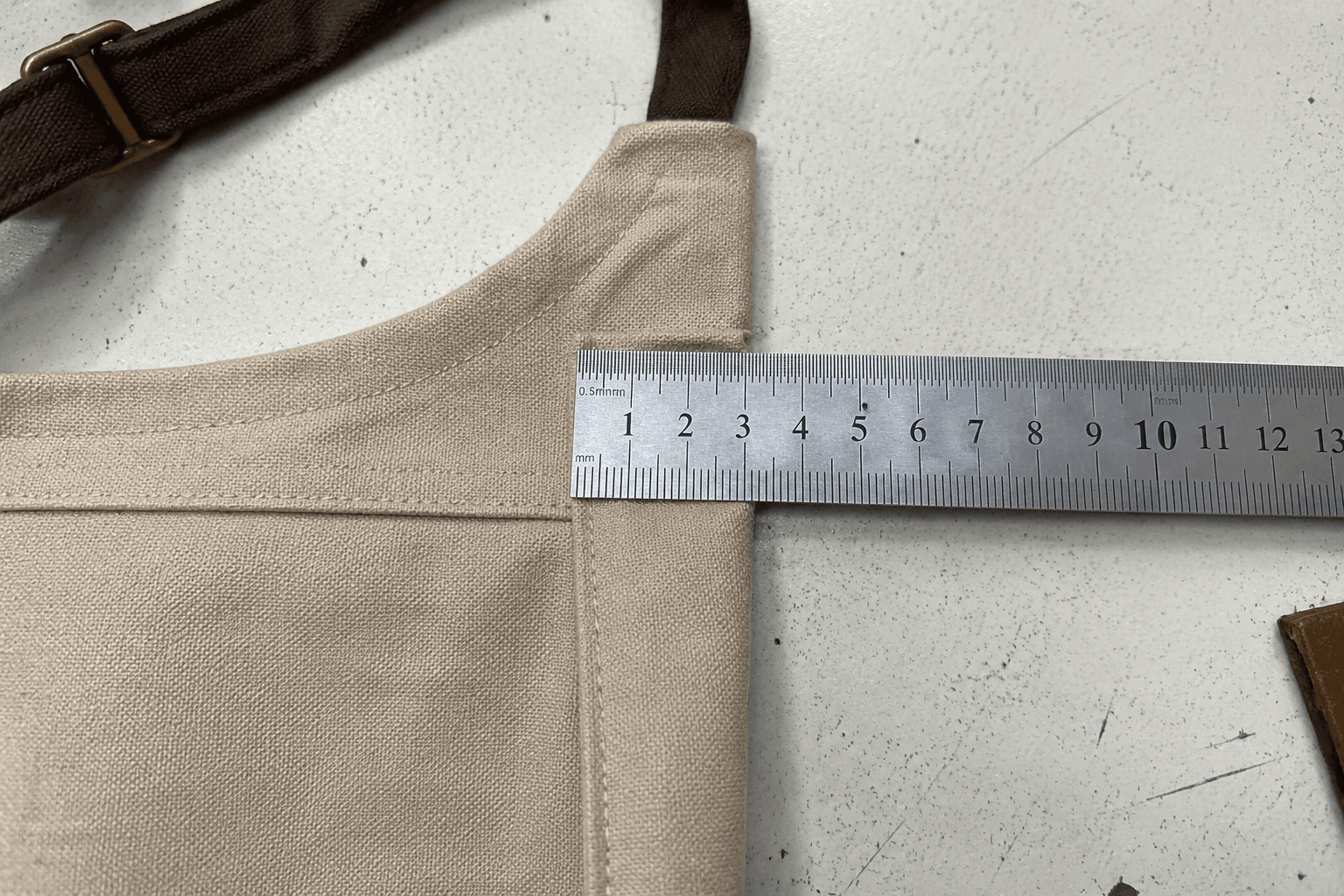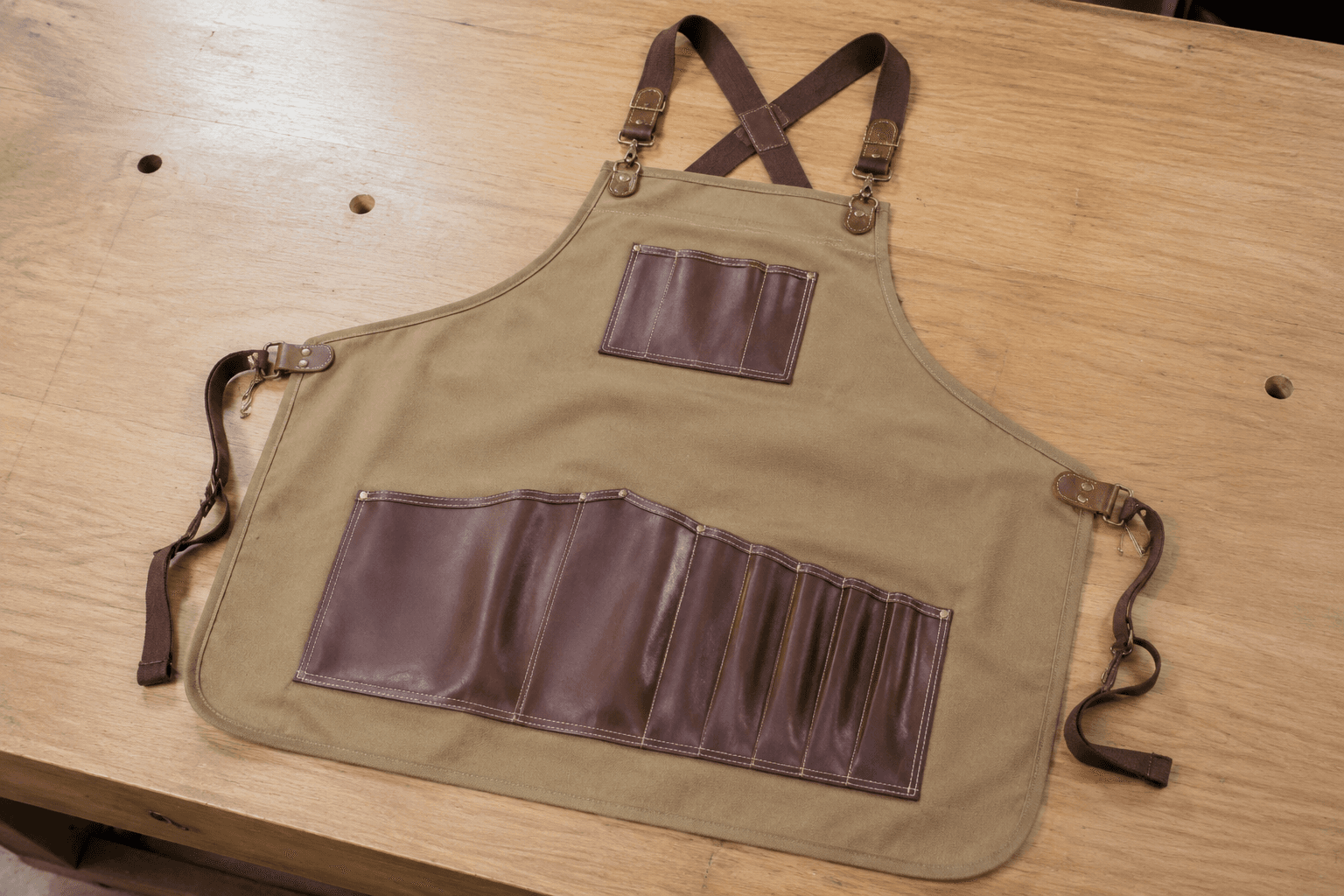
For professional apron programs, a QR label is a traceability component, not a decoration. Restaurant groups, hotel laundries, food processors, culinary schools and uniform rental operators use qr code labels for aprons to identify each garment by style, color, production lot, store allocation, wearer issue or replacement history. When one PO covers 6,000-20,000 aprons across several colorways and staged deliveries, garment-level labeling reduces picking errors, narrows claims to the correct sewing batch and improves reorder accuracy.
Most scan failures begin in sourcing, not in software. A QR symbol that scans at packing can fail after 25 commercial washes if the label stock swells, the ribbon loses contrast, the quiet zone is trimmed below tolerance or the label is sewn into a fold line on the apron. Buyers should lock six variables before PP approval: wash profile, substrate, print method, payload logic, symbol size and exact placement on the apron pattern.
This article stays strictly on apron procurement for B2B buyers. It covers bib aprons for hospitality, waist aprons for service teams, cross-back aprons for retail and workshop use, and utility aprons for food production or rental circulation. The focus is practical: wash durability, compact data structure, apron-specific placement, AQL control, MOQ, added lead time and realistic factory cost per piece.
- Trim engineering drives durability: substrate, ribbon, sealing method and stitch position usually determine scan life more than the QR artwork itself.
- Short serialized IDs work best: a 16-24 character payload linked to a database is easier to print, wash and scan on aprons than a dense code carrying full text.
- Lead time impact is predictable: variable-data setup commonly adds 3-7 days, while pre-bulk wash validation usually adds 5-10 more days.
- Wash targets must be numeric: light café programs often accept 20-30 home washes, while rental and food-service aprons more often require 50-75 commercial cycles.
- Placement is a common failure point: neck folds, bartack zones, tie attachments, pocket corners and high-rub counter-contact areas regularly shorten scan life.
- The buyer brief should define acceptance clearly: QR size, quiet zone, substrate, wash profile, placement, AQL level and unreadable-rate limit should all be fixed before trim booking.
Why multi-site buyers now specify qr code labels for aprons at RFQ stage
Carton labels are no longer enough for many apron programs. A buyer may receive 12,000 bib aprons in black, navy and burgundy, split by franchise stores, training centers and replacement stock. Once those aprons move through store transfers, wearer assignment or commercial laundry, carton-level identification no longer supports accurate replenishment or claims handling. Garment-level QR labeling lets the buyer isolate problems by fabric lot, sewing line or trim batch instead of disputing an entire shipment.
This matters most in high-turn categories such as café bib aprons, server waist aprons and rental utility aprons. If one dyed lot shows crocking, or one sewing batch develops seam slippage after wash, the garment code helps the buyer identify the affected serial range within hours rather than checking cartons manually. That shortens root-cause analysis and reduces unnecessary replacement of compliant stock.
The cost is usually manageable when the requirement is specified before trim booking. On a 5,000-piece apron order, a static care label carrying a fixed QR often adds about $0.01-0.03 per piece. A serialized label with variable data and basic scan verification more often lands at $0.03-0.08 per piece. A higher-durability construction for commercial laundry, especially with TPU or laminated synthetic stock, typically reaches $0.06-0.12 per piece. For buyers managing returns, laundry sorting or site-level replenishment, that cost is often lower than one avoidable reverse-logistics cycle.
- Typical custom trim MOQ is 3,000-5,000 pcs per style/color; below 1,000 pcs, suppliers often charge a $50-150 setup surcharge.
- Most buyers encode style code, color code, production lot and unique serial, while the database stores wearer, store and claim history.
- A practical incoming target is 98.5%-99.5% first-pass scan success using the buyer’s actual handheld device at 10-20 cm scan distance.
- If serialization is added after cutting starts, expect higher risk of trim delay, placement compromise and incomplete wash validation.
Wash durability standards for qr code labels for aprons: materials, ribbon and cycle counts
The correct label system starts with the apron’s actual wash environment. A 6.5 oz 65/35 poly-cotton twill café apron washed at home at 40°C needs a different label construction from a 10.5 oz utility apron sent to commercial laundry at 60-75°C with alkaline detergent, stain treatment and hot tumble finishing. Buyers should state wash temperature, chemistry exposure, drying method and target number of readable cycles at RFQ stage. Without that information, trim vendors often default to economical stock that scans at packing but degrades too quickly in service.
For light-duty aprons, satin polyester or woven-edge synthetic care labels can be acceptable when the requirement is 20-30 home washes. For mid-duty hospitality programs targeting 30-50 moderate commercial cycles, coated synthetic stock printed by thermal transfer with full-resin ribbon is a safer baseline. For rental, food-processing or central-kitchen aprons requiring 50-75 cycles, TPU film, specialty coated synthetic or laminated constructions usually hold up better because they resist detergent attack, edge fray and fold cracking more effectively than basic satin labels.
Print method matters as much as substrate. Wax ribbon is inexpensive, but it generally loses edge definition too quickly for washed serialized labels. Wax-resin can work on low-risk programs with short service life, but full-resin thermal transfer more consistently retains contrast on synthetic stock after repeated laundering and abrasion. Heat-transfer QR marks reduce seam bulk and may improve comfort on lighter aprons, yet they need careful testing on textured canvas, stain-resistant coatings and slub fabrics because cracking or adhesion loss can appear after only 15-25 washes.
Buyers should ask for wash checkpoints rather than a single final claim. A sensible protocol is scan and visual review at 10, 25 and 50 cycles, then at 75 cycles if required. Record not only whether the code reads, but also whether the label shows curl, stain pickup, delamination, edge lift or module distortion. A code that still reads after 50 washes but needs three scan attempts is already weak for a high-throughput apron program.
- 20-30 home washes: common target for front-of-house café or bakery aprons using improved satin or basic synthetic labels.
- 30-50 commercial washes: typical target for restaurant, hotel and culinary-school aprons using coated synthetic stock plus resin ribbon.
- 50-75 industrial washes: common requirement for rental, food-production and central-laundry apron programs using TPU or laminated synthetic constructions.
- Common failure modes are contrast fade, fold-line cracking, stitch distortion, detergent staining, edge fray and delamination.
- Request wash records by cycle count, not only a supplier statement such as "washable" or "durable".
Data format and symbol size: what apron buyers should encode and what should stay in the system
A common sourcing mistake is overloading the symbol. On aprons, label area is limited and repeated distortion makes dense QR codes harder to print and less tolerant after washing. For most B2B programs, the code should carry only a short unique ID, while the ERP, WMS or laundry platform stores the full record. That gives the buyer garment-level traceability without forcing a high-density symbol onto a narrow care label.
A practical payload is usually 16-24 alphanumeric characters. One workable structure is supplier code, style code, year-month lot and a 6- to 8-digit serial. That is enough to create garment-level uniqueness across multiple POs without crowding the symbol. If the buyer wants wearer assignment, compliance references, care instruction, fabric composition or replacement history, those fields should sit in the linked database rather than inside the QR graphic itself.
Symbol size should be driven by scan reliability, not appearance. In flat lab conditions, a 12 x 12 mm symbol can work for a short payload on a smooth label. In apron production, where labels are folded, stitched, wrinkled and scrubbed, qr code labels for aprons generally perform better at 15 x 15 mm minimum, with 18 x 18 mm to 20 x 20 mm often giving stronger read stability in daily use. The quiet zone must remain intact after cutting and sewing; if the stitch line or hot knife cuts into that margin, scan performance can fail even when print quality looked acceptable before attachment.
Before bulk approval, buyers should verify the serialization file as carefully as the physical sample. Check duplicate-prevention logic, sequence continuity, character restrictions and scanner compatibility. The most expensive QR error is not always an unreadable symbol; it can be a readable code assigned to the wrong apron style, color or delivery batch.
- Use a unique ID linked to a database, not a long embedded text block.
- Keep payload length to 16-24 characters for most bib, waist and cross-back apron programs.
- Specify 15 x 15 mm minimum; use 18 x 18 mm to 20 x 20 mm where wash stress or scan speed is critical.
- Maintain a 4-module quiet zone on every side after cutting and sewing.
- Approve the serialization file, duplicate-check logic and scanner compatibility before PP sign-off.
Placement on bib, waist and cross-back aprons: where qr code labels for aprons hold up best
Placement often determines whether a QR system survives real handling. Aprons bend, tie, rub against counters and compress at the waist in ways that shirts and jackets do not. A label placed at a fold point or stress zone can lose readability long before the apron body reaches end of life.
For bib aprons, the inner side seam or inside waist seam is usually more stable than the neck seam. Neck areas seem accessible, but repeated folding and strap tension often crease directly through the symbol. On waist aprons, the inside waistband works well if the label is kept clear of tie insertion points, bartacks and seam bulk. On cross-back aprons, the inner side panel is generally safer than the strap junction, where twisting and load are concentrated. On heavier 10-12 oz canvas or denim aprons, label bulk also affects wearer comfort, especially when the label sits at a body-contact point during long shifts.
Scanning workflow should also influence placement. If laundry staff or store teams need to scan aprons quickly during issue-return or sorting, a deeply hidden care label slows processing. Some buyers therefore use two identification points: one internal label for compliance and traceability, and one smaller accessible ID tag at the hem return, pocket back or inner side edge. This adds trim cost and a sewing step, but it can cut handling time on high-volume programs.
Placement should be approved on the apron pattern or technical sketch, not by text description alone. A note such as inside side seam leaves room for interpretation between pattern room, sewing line and trim supplier. Marking the exact distance from seam junction and hem edge reduces variation in bulk production and gives inspectors a clear reference.
- Avoid neck folds, bartack zones, tie attachments, pocket corners, rivet areas and heavy seam intersections.
- For heavy aprons, keep labels away from high-pressure body-contact zones to reduce discomfort and curling.
- If operational scanning is frequent, choose a position that supports fast access without fully unfolding the apron.
- Where handling speed matters, consider dual labeling: one internal QR care label and one smaller accessible ID tag.
Production control and AQL: how to inspect serialized apron labels before claims appear
QR trim should be treated as a controlled production component. The factory must manage data generation, print contrast, roll segregation, cutting tolerance and sewing orientation. A symbol that scans perfectly is still a major defect if the wrong serial range is attached to the wrong apron color or style. For that reason, serialized apron orders need both physical QC and data reconciliation.
A practical approval flow has three stages. First, approve raw printed labels before sewing; this confirms size, contrast, quiet zone and human-readable text. Second, approve sewn samples before wash; this confirms orientation, stitch clearance and placement. Third, approve post-wash samples at the required cycle count. On orders above 10,000 pieces with unique IDs, many factories add handheld or camera verification during label printing to catch unreadable codes, skipped numbers and duplicates before the rolls reach sewing.
Inspection standards should match business risk. If the QR is mainly used for internal stock control on a low-risk café apron program, random scan checks under AQL 2.5 for major defects may be sufficient, with a tighter internal limit for unreadable labels. If the code supports rental circulation, food-production control or high-value claims tracing, a stricter method is better: 100% verification at label-print stage, sequence reconciliation by roll and post-sewing random inspection under AQL 1.5 or buyer-defined acceptance criteria. That process adds cost, but it reduces downstream relabeling, chargebacks and replacement claims.
Buyers should state the unreadable-rate threshold numerically. Terms like good scanability are too vague for bulk acceptance. A stronger requirement is under 1.0% unreadable at final inspection after sewing for standard programs, or under 0.3%-0.5% for high-control rental programs. Clear numeric limits help both factory and buyer align on sampling, rework and liability.
- Approve artwork, data logic and sewn scan samples, not artwork alone.
- Ask for a sequence reconciliation sheet showing printed, issued, used, rejected and balance quantities.
- For higher-risk programs, use 100% verification at label-print stage plus random scans after sewing and after wash test.
- Typical acceptance targets are <1.0% unreadable for standard programs and <0.3%-0.5% for stricter rental or traceability programs.
- Budget about $0.01-0.03 per piece for stronger variable-data handling and verification controls.
MOQ, lead time and the buyer brief that prevents avoidable apron QR failures
Commercial planning should separate one-time setup from recurring unit cost. On a 5,000-20,000 piece order, a standard non-serialized care label may sit around $0.01-0.02 per apron. A wash-resistant QR label more commonly falls at $0.03-0.06. A serialized, wash-resistant label with verification usually runs $0.06-0.12, especially when order volume is below 3,000 pieces or the wash target is 50 cycles or more. One-time setup for numbering logic, sample generation and pre-bulk wash trial often adds $50-200, depending on the trim supplier and data complexity.
Lead time must be built into the critical path early. After artwork approval, custom label production commonly needs 5-8 days. Serialization setup, sample file validation and duplicate-check review usually add 3-7 days. If the buyer requires wash validation before PP approval, add another 5-10 days depending on whether the factory is testing to 25, 50 or 75 cycles. In peak season, a late QR decision can delay sewing start because the apron body may be ready while the verified trim is not.
The most efficient developments start with a concise technical brief. That brief should identify apron type, fabric composition, fabric weight, wash environment, QR payload structure, symbol size, quiet zone, placement, readable-life target and acceptance standard. A workable example for restaurant service is a 7.2 oz 65/35 poly-cotton twill bib apron with a 15 x 15 mm resin-printed synthetic QR label, placed inside the right waist seam, carrying a 20-character serialized ID and tested to 30 home washes with under 1.0% unreadable at final inspection. A stricter rental example is a 10.8 oz utility apron with TPU label stock, dual-label placement, a 50-75 commercial wash target and 100% label-stage verification.
When the brief is precise, sampling rounds drop and bulk disagreements decline. When the brief is vague, factories fill the gaps with assumptions on substrate, symbol density or placement, and those assumptions are where avoidable failures begin.
- State the end use: restaurant front-of-house, hotel laundry, retail, central kitchen, butcher counter or rental circulation.
- Define readable-life target numerically, such as 30, 50 or 75 washes, with wash temperature if known.
- Provide payload structure, serial sample and duplicate rule before artwork release.
- Mark approved placement on the apron sketch or pattern with distance reference points.
- Set the inspection rule in advance, such as AQL 2.5 random scan checks or 100% label verification for high-risk serialized programs.