In plant retail and workshop use, apron failure is usually predictable. The lower front panel rubs against pot rims, bench edges, trolley rails and soil bags; wet compost and splash add weight; pruners and markers stress pocket corners; and staff bend, lift and kneel through 6-10 hour shifts. For B2B buyers, the issue is service life, wash stability, replacement frequency and whether the apron layout supports the work without creating complaints.
The common sourcing mistake is to buy plant shop workshop aprons as if they were cafe uniforms. A light 180-220 GSM cotton twill apron can reduce first cost, but in active pot handling it often shows face abrasion, seam distortion and pocket fatigue within 8-12 weeks. A more reliable baseline is 245-280 GSM poly-cotton twill for mixed retail use or 300-340 GSM poly-cotton canvas for heavier bench work, backed by bartacks, reinforced tie joins and pockets sized around actual tools.
Before requesting quotations, separate front-of-house advising, repotting bench work, receiving and mixed-use roles. That one decision clarifies fabric weight, drying expectations, pocket depth, trim selection and acceptable price bands. It also cuts sample revisions and keeps the approval calendar realistic.
- For daily wet pot handling and soil contact, 245-320 GSM is the practical starting range; below that, lower-front wear and pocket distortion rise quickly.
- A 65/35 poly-cotton twill at 245-280 GSM is usually the best value for multi-store programs because it balances abrasion resistance, drying speed, color retention and cost.
- For repotting benches, receiving and heavier stock movement, 300-340 GSM poly-cotton canvas usually lasts longer than lighter twill even when FOB is $0.45-0.95/pc higher.
- Tool loops work best on the dominant-hand side, 6-10 cm from the side seam; center-front loops often hit pots, benches and thighs during bending.
- Typical FOB pricing runs from $3.20-4.60/pc for a basic bib apron at 2,000 pcs to $5.90-8.80/pc for heavier utility styles with divided pockets, webbing loops and embroidery.
- Before bulk approval, lock MOQ, lead time, AQL level, shrinkage tolerance, pocket dimensions, loop load, wash method and carton standard in writing.
Why plant shop workshop aprons fail in 60-90 days when spec'd like light retail uniforms
Apron wear in plant retail follows a repeatable pattern. The lower front panel takes constant abrasion from 10-25 cm pot rims, bench edges, trolley rails and bagged growing media. Fine grit stays on the fabric face and acts like sandpaper each time staff lean, slide containers or kneel at bench height. Once the apron is wet, the cloth gains weight, friction increases and the front body loses appearance faster.
Most claim reviews come back to four faults: visible face wear on the lower body, tearing at pocket corners, seam stress at tie anchors and slow drying after irrigation splash or wet pot contact. These are usually specification problems, not random sewing defects. A 210 GSM cotton bib apron with a single-needle patch pocket may land at $2.40-2.90/pc FOB at 1,000 pcs, but in active bench use it often shows visible wear within 60-90 days. A 280 GSM twill or 300 GSM canvas apron with bartacks and reinforced joins may cost $4.20-5.60/pc, yet the longer replacement cycle usually reduces annual spend per store.
The correct buying question is not whether the apron looks heavy duty on a hanger. It is how many wear hours per week it must survive. If staff only wear aprons for customer service and light merchandising, a lighter spec can work. If the same team spends 30-45 hours per week repotting, watering and moving stock, the RFQ should identify the style as workshop grade from the start.
- Failure zone 1: lower-front abrasion from pots, benches and cart contact
- Failure zone 2: pocket corner tearing from pruners, gloves, pens and phones carried together
- Failure zone 3: tie-anchor strain caused by bending, twisting and lifting
- Failure zone 4: edge distortion after wet use and repeated laundering
Fabric specs for plant shop workshop aprons: 245-340 GSM ranges, blends and wash behavior
When buyers ask for soil-resistant aprons, they usually mean three separate requirements: slower visible abrasion, less obvious dust pickup and easier soil release in washing. No single fabric leads all three. The commercial decision is a balance of wear life, drying speed, color retention, hand feel and FOB cost. For professional plant shop workshop aprons, the practical choices are cotton twill, poly-cotton twill, cotton canvas and poly-cotton canvas.
For multi-store retail programs, 65/35 poly-cotton twill at 245-280 GSM is usually the most efficient starting point. It dries faster than all-cotton alternatives, holds dark shades more consistently through 20-30 commercial washes, and generally releases light soil better at 40 C laundering. In this range, a plain bib apron usually sits at roughly 8.5-9.9 oz fabric weight and can price around $3.20-4.10/pc FOB at 2,000 pcs, depending on pocket count and logo method.
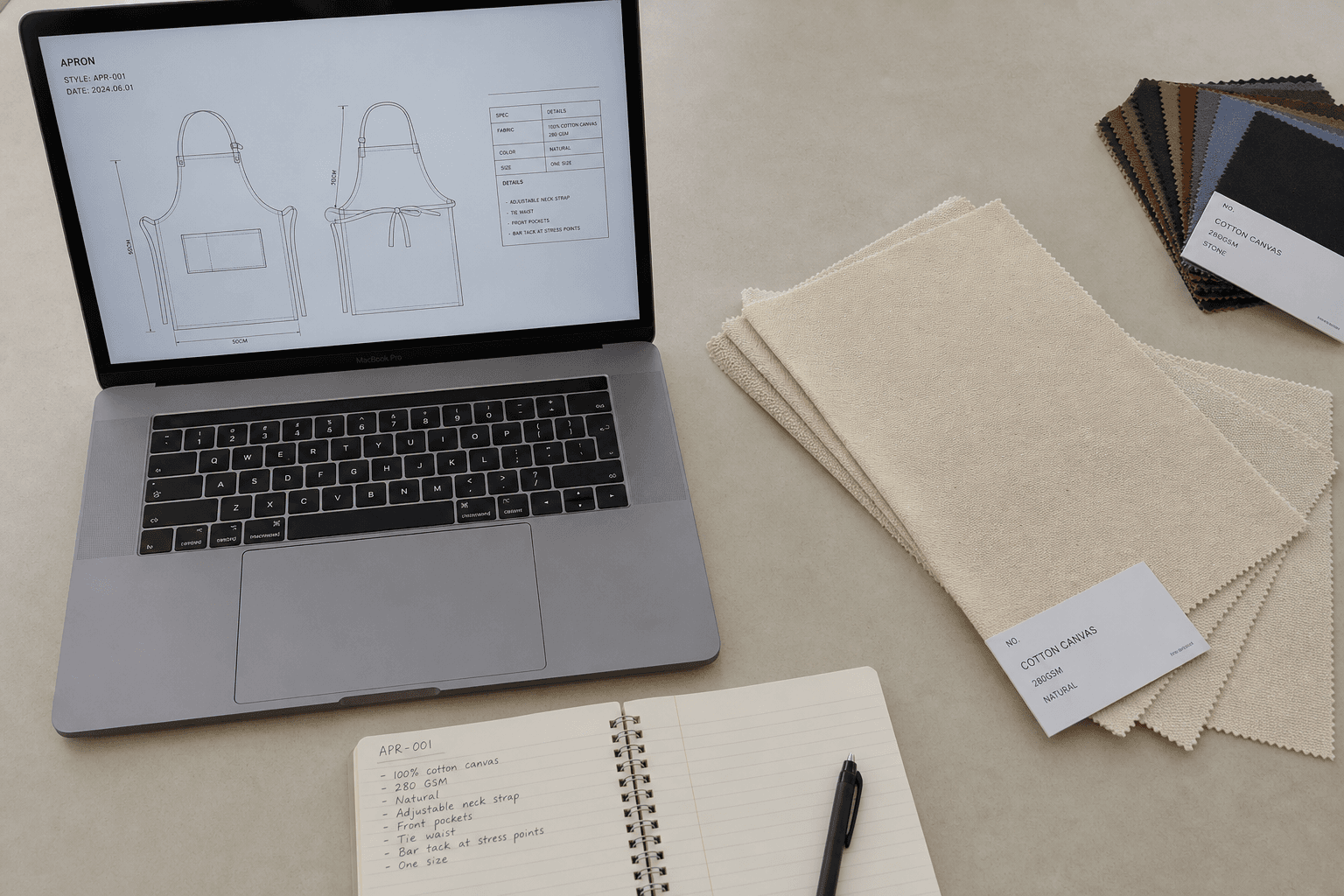
If the buyer wants a fuller hand and a more natural surface for customer-facing stores, 280-320 GSM cotton canvas can present well. That is roughly 9.9-11.3 oz. The tradeoff is higher water absorption, slower drying and more visible wet marks during the shift. For operations that repot heavily or handle wet stock all day, 300-340 GSM poly-cotton canvas, about 10.6-12.0 oz, is usually safer. Compared with a 250 GSM twill, moving to a 320 GSM canvas often adds $0.45-0.95/pc at 2,000 pcs, but that increase is usually justified if replacement drops from every 3 months to every 6 months.
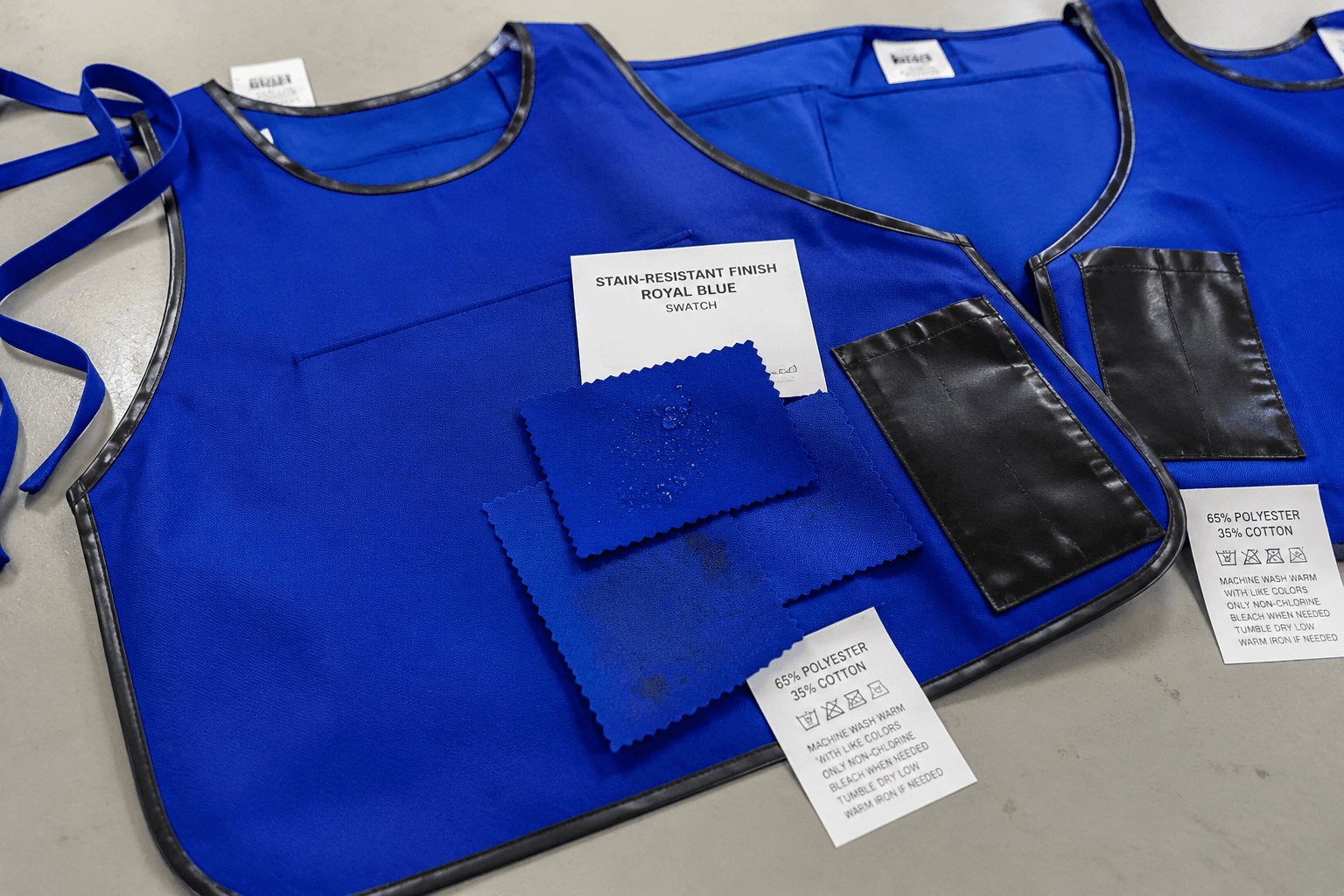
Water-repellent finishes help only at the margin. A fluorine-free DWR may improve splash behavior for about 10-20 washes. Heavy PU or PVC backing blocks water more effectively, but it stiffens drape, traps heat and reduces comfort in full-shift wear. For most plant-store apron programs, a darker base fabric in the right GSM does more for performance than a heavy coating.
- Best all-round spec: 245-280 GSM 65/35 poly-cotton twill
- Customer-facing premium spec: 280-320 GSM cotton canvas
- Heavier operational spec: 300-340 GSM poly-cotton canvas
- Practical dark shades: black, charcoal, olive, bark brown and dark khaki
Construction details for wet pot handling: straps, seams, bartacks and shrinkage limits
Once an apron is splashed by irrigation, damp foliage and freshly watered pots, stress shifts to the neck strap, bib join, pocket mouth and waist ties. Buyers who compare only fabric composition miss this. In daily use, strap width, seam reinforcement and stitch control often matter more than a claimed water-resistant finish.
For aprons in the 260-320 GSM range, neck straps narrower than 2.5 cm are usually a false economy. They twist more easily and feel uncomfortable once tools are added. A practical strap width is 3.0-3.8 cm with an adjustable slider. Waist ties should generally be at least 2.5 cm wide and 85-95 cm long on each side so staff can tie over layers. On heavier styles, the tie anchor should be sewn into a reinforced side seam or backed with an internal patch.
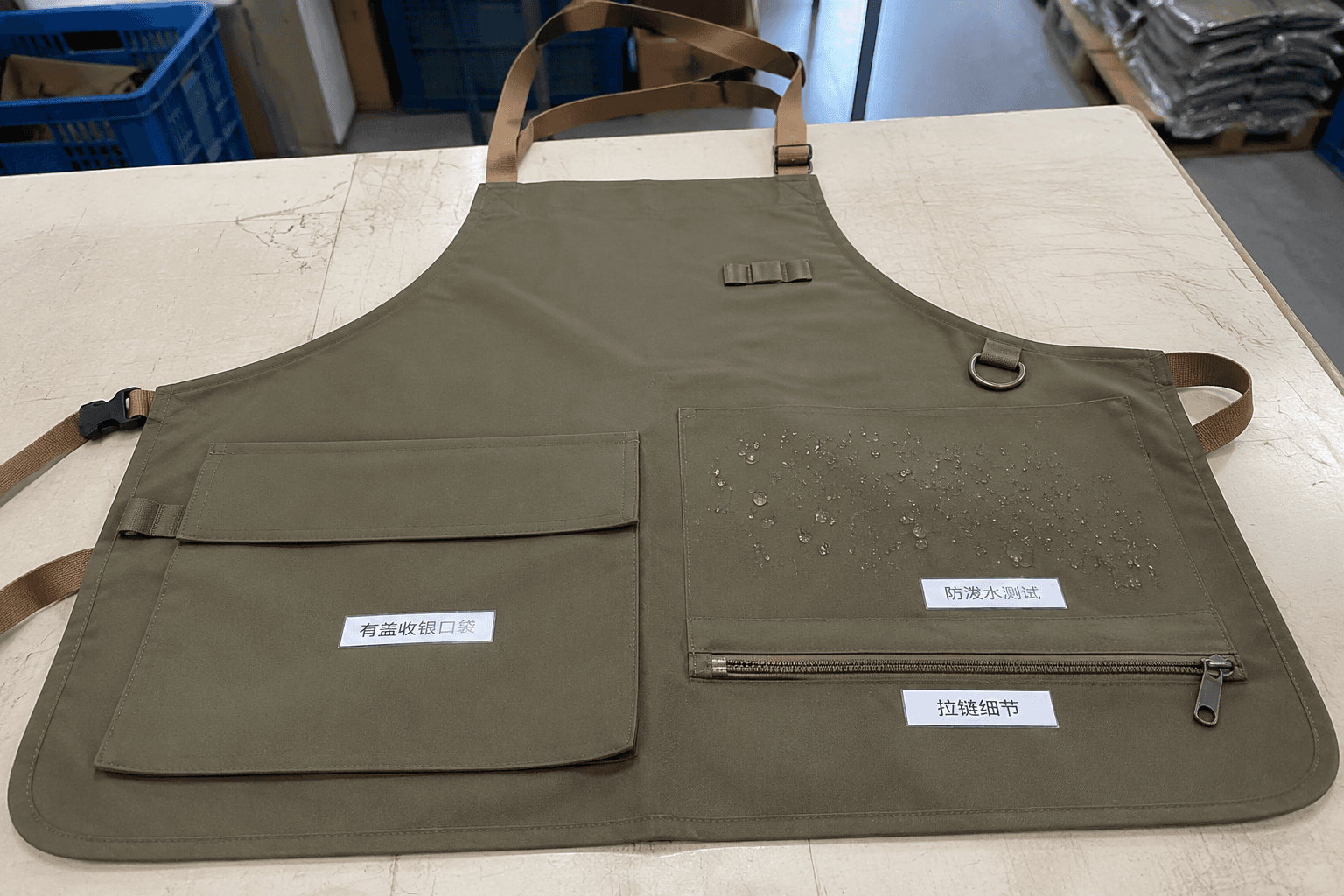
Pocket construction needs workshop-level spec as well. A single topstitch line may pass appearance review but is weak for pruners, gloves and markers carried every day. A better baseline is double-needle pocket attachment with bartacks at both top corners and at each internal division end. For hems, a 1.5-2.0 cm double-fold hem usually stays flatter than a narrow fold after repeated washing. Buyers should request wash testing before PP approval and cap dimensional change at 3% in both length and width.
Cross-back aprons can reduce neck fatigue, but they also add hardware points, pattern complexity and sewing minutes. On many East China production lines, a standard bib apron usually runs 25-35 days after PP approval, while a cross-back utility style with multiple webbing points often needs 35-45 days. That difference is manageable, but it must be built into the launch plan.
- Minimum reinforcement points: pocket corners, tie joins, loop anchors and bib-strap joins
- Recommended stitch density: 7-9 stitches per inch on medium to heavy aprons
- Target wash result: no more than 3% shrinkage in length or width
- Typical bulk inspection standard: AQL 2.5 major, AQL 4.0 minor
Pocket dimensions that work for pruners, gloves, tags and scanners
Pocket design is where many apron programs lose function. Buyers approve a balanced-looking sample, then discover in wear trials that pruners sit too high, gloves bunch, phones tip forward during bending or internal divisions are too narrow for gloved hands. Effective pocket planning starts with the actual carry set, not visual symmetry.
In most plant retail operations, staff carry some mix of hand pruners, marker pens, plant tags, twine, gloves, a phone, a small scanner or a notebook. These items do not need the same access speed. A practical setup for mixed-use staff is a lower front pocket block with 20-23 cm depth and 2-4 internal divisions sized around real tools. For phones in protective cases, a sleeve of roughly 9-10.5 cm width and 16-18 cm depth usually works better than a flat open compartment. A chest pocket for tags and pens is often most useful at about 12 x 15 cm. A pruner channel should include base reinforcement to slow point wear.
Buyers should also decide whether the apron will be used mainly upright on the sales floor or in repeated bend-and-lift work at bench height. On long aprons, pockets placed too low may look balanced on a hanger but become inefficient in use because staff reach down too far hundreds of times per shift. Raising the pocket block by 3-5 cm often improves access without changing the appearance materially.
Pocket complexity has a direct cost effect. On an order of 1,500 pcs, a simple lower patch pocket may add only $0.18-0.30/pc in sewing cost. A divided utility pocket with pen slots, a phone sleeve and extra bartacks can add $0.60-1.20/pc. That added cost makes sense only if it reduces separate carry pouches, misplaced tools or user complaints.
- Useful lower pocket depth: 20-23 cm
- Useful phone sleeve width: 9-10.5 cm with case allowance
- Common chest pocket size for tags and pens: about 12 x 15 cm
- Best practice: test pocket access while bending and while wearing gloves
Tool-loop placement in plant shop workshop aprons: dominant-hand positioning and load limits
Tool loops are frequently requested and frequently placed for appearance instead of movement. A center-front loop may look tidy in a sample photo, but in actual work it lets pruners or snips strike pots, bench edges and the wearer's thighs during bending. For plant shop workshop aprons, loop placement should be approved only after live movement testing.
The most reliable position is usually on the dominant-hand side, roughly 6-10 cm in from the side seam or aligned with the outer edge of the lower pocket block. That position improves reach while reducing swing during walking, kneeling and bench work. Loop material matters as well. Self-fabric loops look clean, but they soften and collapse under repeated clipping. 2.0-2.5 cm cotton or polyester webbing is normally more stable, especially when metal pruners are clipped on and off 30-60 times per shift.
Buyers should specify whether the loop is for temporary parking or full-time carry. Temporary parking may only need a bar-tacked webbing loop. Full-time carry for tools weighing 150-250 g usually requires an internal reinforcement patch or doubled fabric behind the anchor point. This upgrade often adds only $0.08-0.18/pc in bulk, but it can remove repeat claims around tearing, distortion and broken stitching.
- Best general position: dominant-hand side, 6-10 cm from side seam
- Preferred loop width: 2.0-2.5 cm webbing
- Add backing reinforcement for metal tools over 150-250 g
- Avoid oversized loops that allow tool swing while walking or kneeling
MOQ, FOB and lead-time ranges for custom apron sourcing
Apron pricing moves more with the specification package than with the silhouette. Fabric weight, fiber blend, pocket count, loop type, hardware, logo method and order volume all shift FOB. For a standard bib apron in 245-260 GSM poly-cotton twill with one lower pocket, adjustable neck strap and one-color print, buyers commonly see $3.20-4.60/pc FOB at 2,000 pcs. A heavier 300-320 GSM utility apron with divided pockets, webbing loop, embroidery and custom hardware usually lands around $5.90-8.80/pc at the same volume.
MOQ depends heavily on whether the factory can cut from stock materials. With stocked black, olive, charcoal or khaki fabric, MOQ may start at 300-500 pcs per color. Once the buyer requests Pantone dyeing, woven brand labels, custom hardware or multiple role-specific pocket layouts, the workable MOQ usually shifts to 800-1,500 pcs per style per color. Trying to force one apron spec across sales-floor and back-room roles may protect MOQ, but it often creates a compromise product that fits neither job well.
Lead time should be built from approvals, not just sewing days. Lab dips usually need 4-7 days, sample revision 5-7 days, PP approval 5-7 days, fabric booking 7-15 days and bulk production 20-30 days. In normal season, a realistic full custom calendar is 35-55 days from specification lock to shipment. Custom plated hardware or repeated embroidery revisions can add another 5-10 days.
QC terms should be fixed before PO confirmation. For most apron programs, AQL 2.5 major and 4.0 minor is workable. Buyers should also state carton count, needle-control policy, acceptable shade-band tolerance and whether pre-shipment inspection happens at 80% packed or 100% packed. Those points prevent more disputes than late email clarification.
- Stock-fabric MOQ: 300-500 pcs per color
- Custom-dyed or trim-heavy MOQ: 800-1,500 pcs per style per color
- Basic bulk timeline after approvals: 25-35 days
- Full custom timeline: 35-55 days from spec lock to shipment
Sampling and approval controls that reduce rework and claims
Most avoidable delays come from weak briefs. Buyers send reference photos and a logo file, but omit pot sizes handled, shift length, carried tools, wash frequency, target service life and whether the apron is for presentation or bench work. For apron sourcing, those operating details are part of the specification. Without them, the factory can only quote a generic garment.
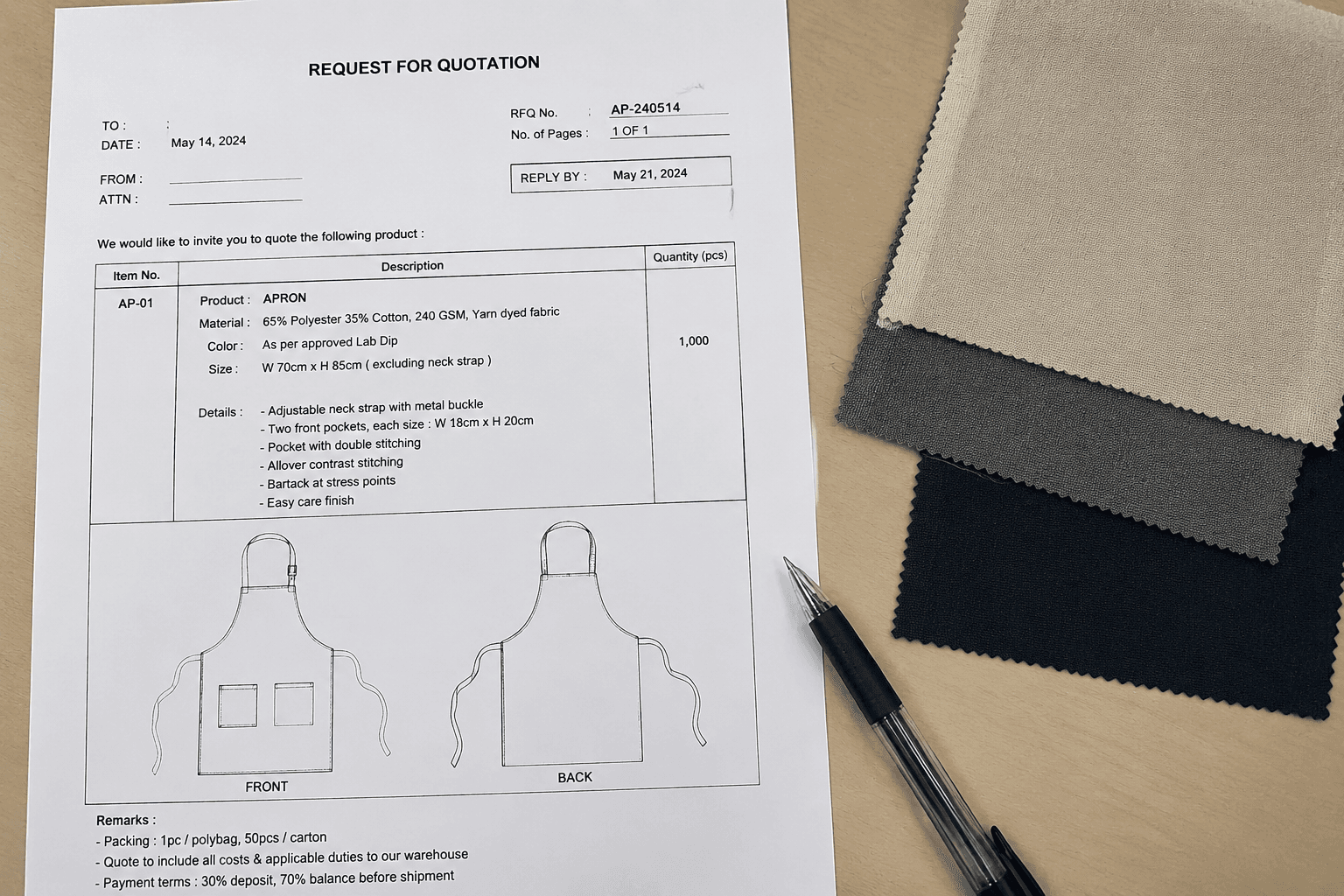
A workable brief should state end use, target GSM, fiber content, finished dimensions, pocket count, loop function, logo method, target unit price and wash expectation. If the buyer has failure data from an existing style, include it. Complaints such as lower-front wear after 12 weeks, fading after 15 washes or pocket seam failure under pruner load are far more useful than broad terms like heavy duty or premium.
Before bulk approval, buyers should test two samples: one appearance sample and one working sample. The working sample should be loaded with actual tools, worn during bending and lifting, exposed to wet pot contact and washed at least once under the intended care method. Moving a loop by 5 cm, increasing pocket depth by 2 cm or switching from cotton to poly-cotton twill is easy before fabric booking. After fabric is cut and trims are confirmed, the same adjustment becomes delay, extra cost or write-off.
The approval path should be explicit: tech pack release, lab dip approval, first proto, revised sample, PP sample, bulk fabric confirmation and pre-shipment inspection. Compressing all comments into one late approval round usually creates the exact timing risk buyers are trying to avoid.
- Define role by use: sales floor, repotting bench, receiving or mixed
- State target GSM, fiber blend, shrinkage tolerance and colorfastness expectation
- List actual tools and device sizes for pocket planning
- Approve pocket, logo and loop positions on the same sample
- Request one washed sample and one live-use sample before bulk sign-off