In professional grooming, an apron is a working protective garment, not a lifestyle accessory. A pet grooming apron is exposed to repeated spray, diluted shampoo, clipped fur, dander, nail dust and constant hand wiping during 8 to 10 hour shifts. For salon chains, distributors and private-label buyers, apron performance directly affects staff comfort, branch presentation, replacement frequency and the labor minutes spent brushing off hair or cleaning garments between appointments.
Most sourcing mistakes start with an incomplete brief. Terms such as water resistant, hair repellent and easy clean are not factory-ready unless they are tied to fabric weight, denier, coating method, strap construction, pocket layout, wash expectation and acceptance criteria. Moving from a basic 180 GSM PU-coated polyester apron to a 205 GSM TPU-laminated build can raise FOB pricing from roughly $3.10 to $5.90 per piece at 500 pcs, while also changing drape, heat retention and wipe-down feel.
For most B2B programs, the target is not maximum waterproofness. The better target is a salon apron that sheds clipped hair quickly, blocks light-to-moderate splash at the chest, wipes clean in seconds, remains wearable under dryers and task lights, and keeps a presentable appearance through repeated laundering or disinfectant wiping. Buyers who define those trade-offs before sampling usually cut one or two development rounds and receive more comparable quotations.
- PU-coated polyester at 170 to 210 GSM remains the most reliable cost-performance range for a professional pet grooming apron.
- A realistic OEM MOQ is often 300 pcs per color for stock black or navy fabric, and 500 to 1,000 pcs per color for custom-dyed, laminated or trim-heavy orders.
- Cross-back or H-back straps generally outperform halter-neck designs during 8 to 10 hour grooming shifts.
- Many salon buyers specify no lower pockets or only one small chest pocket because lower patch pockets collect fur, damp debris and nail dust.
- Proto samples commonly take 5 to 7 days; revised sales samples take 7 to 12 days; bulk production usually takes 25 to 40 days, with 7 to 10 days extra around peak export periods.
- A practical QC standard is AQL 2.5 for major defects and AQL 4.0 for minor defects, with checks for splash strike-through, hair adhesion, seam leakage, strap security, coating peel and post-wash appearance.
Why a pet grooming apron needs a salon-specific specification
A grooming salon creates a very different wear pattern from foodservice, spa or retail use. The apron is not dealing with hot oil or dry dust; it is handling intermittent spray, diluted shampoo, wet-fur contact, clipped hair and frequent wiping by wet hands. That changes the sourcing priority. The best pet grooming apron is rarely the heaviest or most waterproof model. It is usually the one that combines a smooth face, moderate splash resistance, fast hair release and enough flexibility for bending, lifting and side movement around tubs and grooming tables.
This is why hospitality aprons often fail in grooming. A 10 oz cotton canvas apron, about 340 GSM, can look premium and hold embroidery well, but it absorbs water, traps short hair in the weave, holds odor and feels heavier as the shift progresses. By comparison, a coated synthetic apron at 170 to 200 GSM dries faster, shows less visible hair retention and usually needs less aggressive washing to remain presentable.
Movement matters more than many buyers expect. Groomers crouch, pivot and restrain animals dozens of times per hour. If the apron is too long, too stiff or too wide at the hem, it interferes with footwork and table access. In many multi-branch programs, a finished body length of 78 to 88 cm and width of 68 to 72 cm provides enough front coverage without slowing movement.
- Typical salon apron length is 78 to 88 cm.
- Common finished fabric weight is 170 to 210 GSM for coated synthetics.
- Cotton-rich shells usually increase drying time, odor retention and visible hair cling.
- A lighter bib apron generally performs better in grooming than a heavy full-length hospitality style.
Material choices for a water-resistant pet grooming apron
Material selection drives most day-to-day performance and most of the FOB cost. The main commercial options are PU-coated woven polyester, microfiber-faced polyester with light coating, TPU-laminated polyester and PVC-coated synthetic fabric. For mainstream salon programs, PU-coated woven polyester remains the volume choice because it balances comfort, wipeability, supply stability and price.
A practical entry commercial spec is 100% polyester, 150D to 300D yarn, plain weave, finished weight 170 to 195 GSM, with medium PU coating on the back. In China OEM production, that build commonly prices at $3.10 to $4.20 FOB at 500 pcs per color for a standard bib apron with adjustable straps, one chest pocket and one simple logo application. If the buyer upgrades to a 195 to 210 GSM TPU-laminated shell for stronger splash blocking and a cleaner wipe surface, the cost typically rises by $0.90 to $1.50 per piece, and airflow usually drops.
PVC-coated fabrics can deliver strong splash blocking at a low raw-material cost, but they are often the wrong choice for customer-facing grooming staff. They tend to feel stiff, create more movement noise and look industrial. Microfiber-faced options can improve drape and surface appearance, but buyers should verify whether the softer hand increases hair cling, especially with fine cat hair or short terrier clippings.
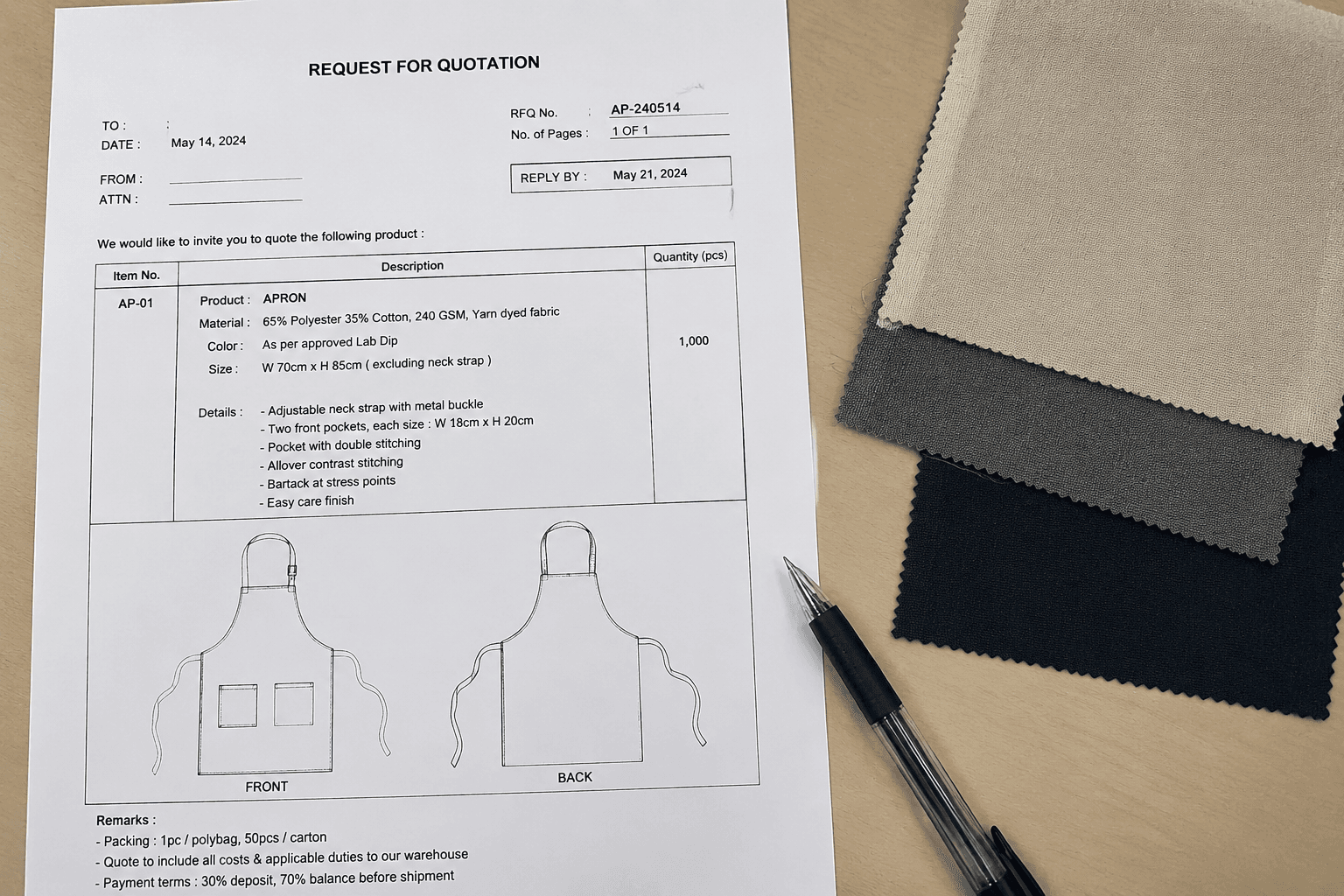
Good quote comparison depends on a complete material sheet. Buyers should ask every supplier to declare denier, weave type, finished GSM, coating or lamination type, color standard and wash expectation. Without those details, a price gap of $0.60 to $1.20 per piece is difficult to judge because the fabrics may not be equivalent.
- 170 to 195 GSM PU-coated polyester is the most common all-round salon fabric.
- TPU lamination typically adds $0.90 to $1.50/pc over a standard PU-coated construction.
- PVC can reduce material cost, but often loses on comfort, drape and front-of-house appearance.
- Every RFQ should request denier, finished GSM, coating type and wash expectation.
Hair control design in a pet grooming apron: surface, pockets and closures
No apron is truly hair-proof, so the realistic sourcing objective is low adhesion and quick release. In grooming use, smooth synthetic faces outperform brushed finishes, textured slubs, open weaves and decorative seam-heavy constructions. Short clipped hair catches easily on rough surfaces and stitch edges. A tightly woven, low-texture face with minimal seam interruption usually brushes clean faster between appointments.
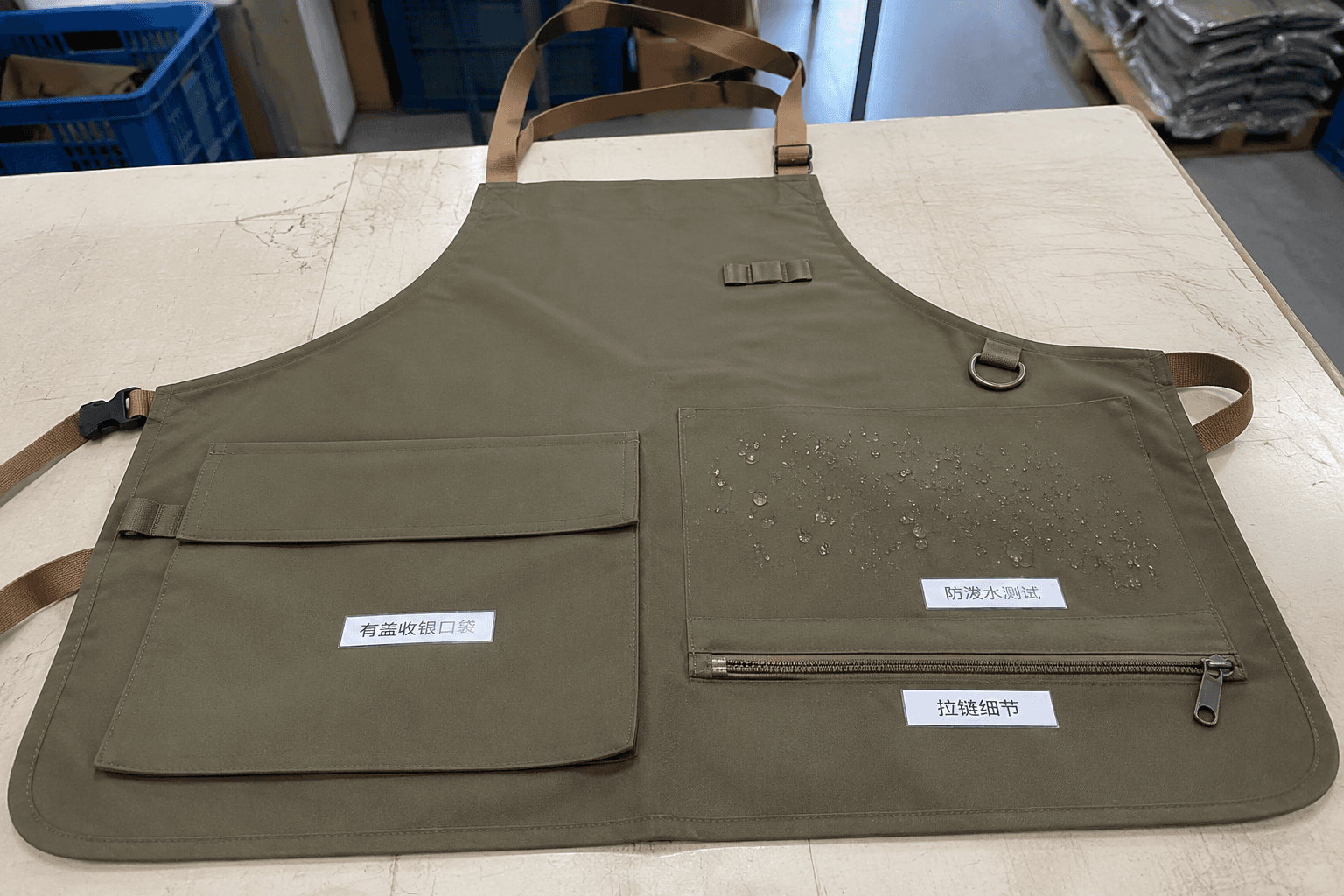
Pocket layout is one of the most common design mistakes in grooming uniforms. Large lower patch pockets may look practical in catalog photos, but in actual use they collect clipped fur, damp wipes, comb residue and nail dust within the first half of a shift. Many salon operators now specify no lower pockets at all, or one small chest pocket sized only for a pen, phone or appointment card. That change often improves real usability more than moving to a heavier fabric.
Closures and adjustment parts matter for the same reason. Hook-and-loop tape traps fur quickly and becomes difficult to clean after a few appointments. Snaps, sliders, D-rings and clean-finished webbing adjusters usually perform better. If detachable straps are required for laundering or branding, the joining point should be approved for wipeability and hair buildup, not only for appearance.
Anti-static finishing can help in dry climates or under heavy forced-air drying, but it should be tested after laundering. A finish that works on an unwashed sample is not enough for a chain rollout. A practical in-house check is to brush short pet hair onto the apron face, remove it by hand or lint roller, then repeat after 5 wash cycles and again after 10 wash cycles.
- Specify a smooth-face woven polyester when hair release is a priority.
- Delete lower patch pockets unless the salon has a confirmed storage need.
- Avoid exposed hook-and-loop because it traps fur within hours.
- Check hair adhesion before washing and again after 5 to 10 wash cycles.
Easy-clean performance: wipe-down speed, seam construction and dark-color standards
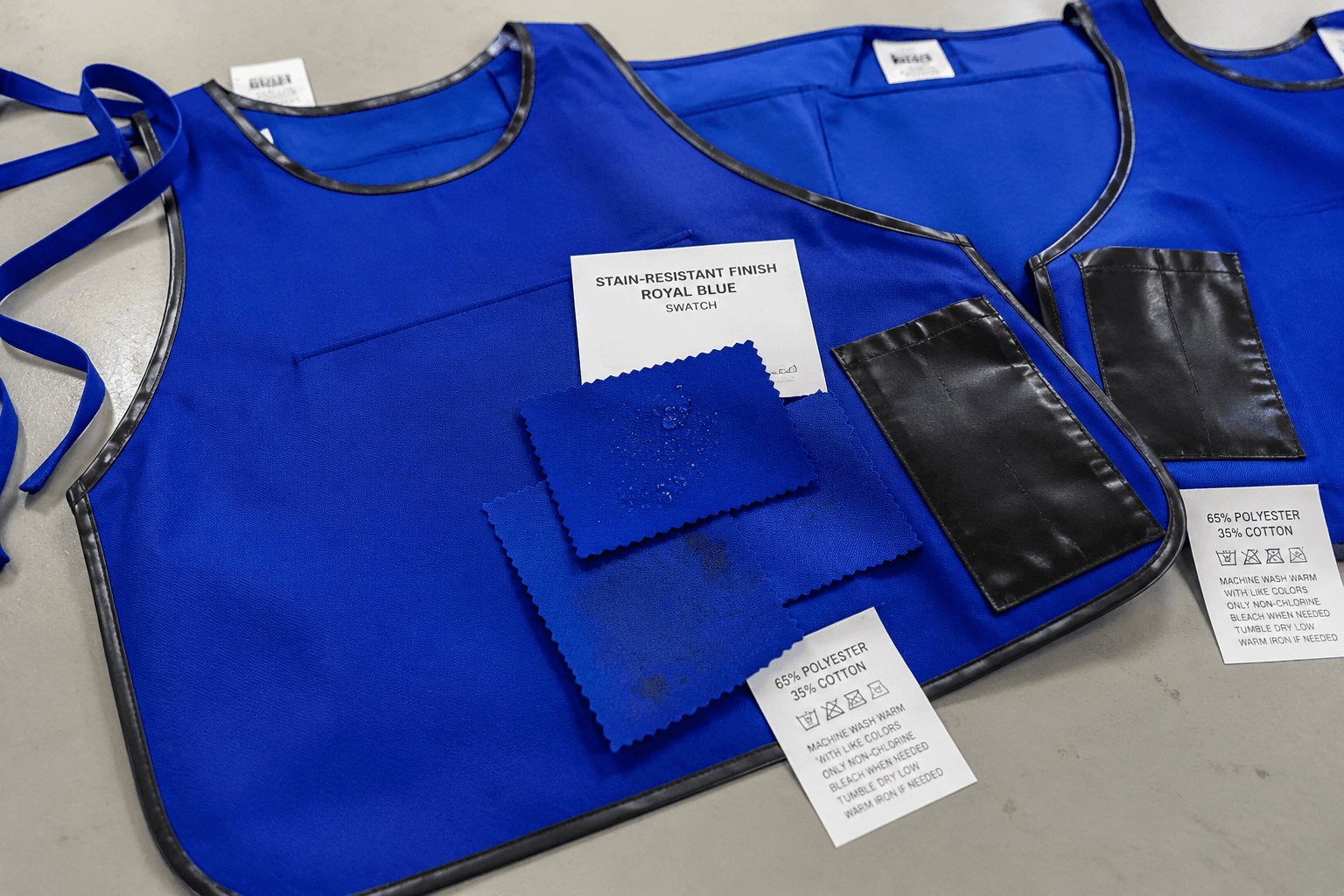
An easy-clean apron should not only survive laundering; it should also wipe down quickly between dogs. In actual salon use, staff wipe wet hands on the bib, brush off loose fur, clear diluted shampoo residue and remove muddy paw marks throughout the day. Fabrics with a smooth coated surface and moderate density usually perform best because residue stays near the surface instead of sinking into absorbent fibers or textured yarns.
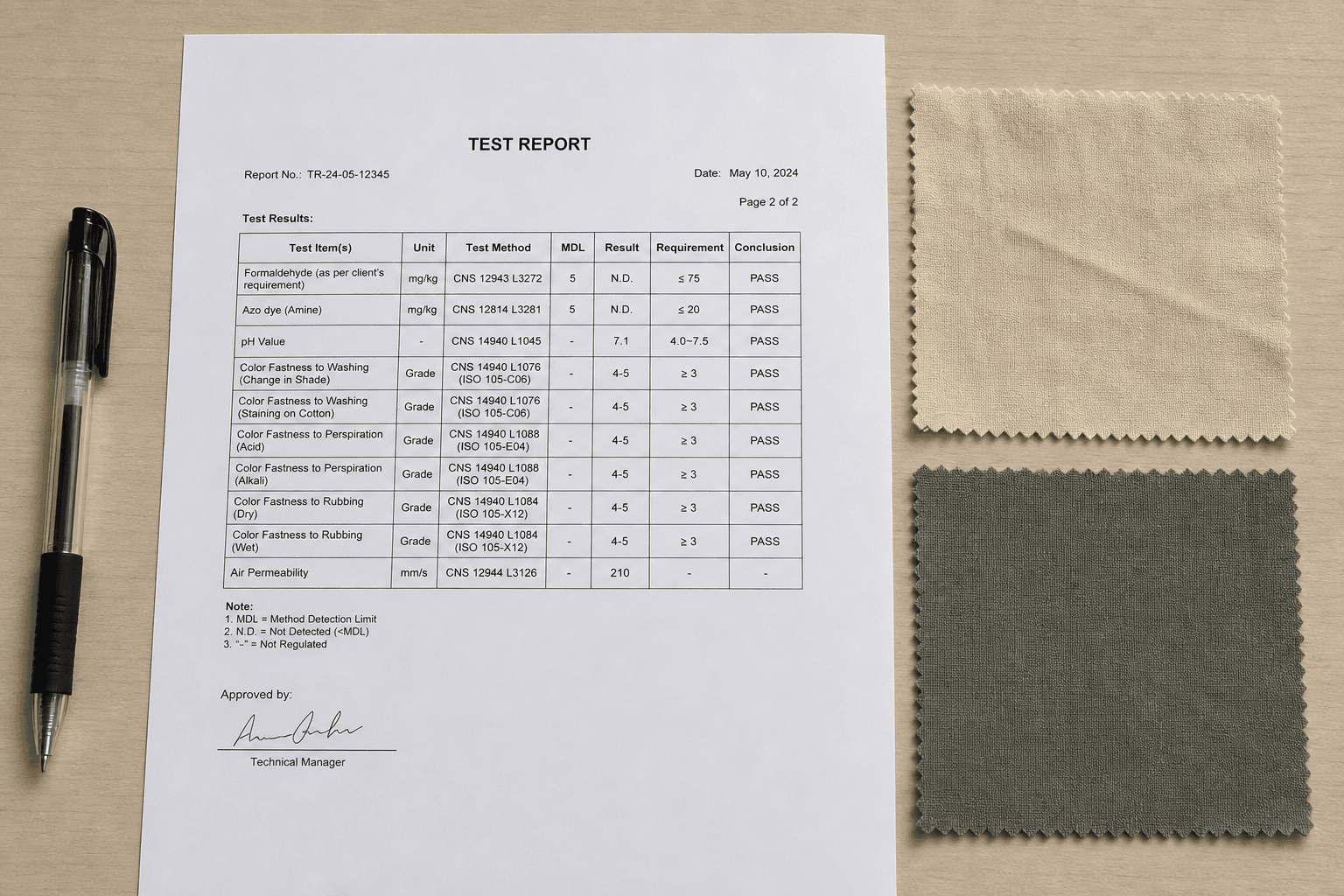
Color affects maintenance cost more than many buyers expect. Black, charcoal, navy and dark olive remain the safest choices for multi-branch programs because they hide light staining and reduce visible wipe marks. Pale grey, beige and pastel brand colors can work, but they usually require more frequent laundering, tighter stain-release targets and a clearer replacement budget. If a buyer wants light shades, sample approval should include contact tests with diluted shampoo, clay-based dirt and wet fur rather than relying only on dry crocking data.
Seam construction is another common weak point. Most salons do not need fully seam-sealed waterproof aprons because that adds cost, stiffness and lead time without matching the actual use case. What they do need is controlled needle-hole leakage in the upper chest and mid-body zones. A double-layer bib panel, stitch density around 8 to 10 stitches per inch and clean seam finishing at the chest usually delivers a better commercial result than upgrading the entire apron to a heavier laminated shell.
QC language should remain measurable. For example: no obvious strike-through on the chest panel within 3 minutes of light spray exposure from 30 cm; no visible coating peel after 20 wash cycles; no permanent visible mark after one wipe with diluted neutral detergent. Standards written this way are easier for factories and third-party inspectors to apply consistently.
- Dark colors usually lower visible staining and reduce replacement frequency.
- A double-layer bib can improve splash control without making the full apron heavy.
- Use measurable spray, wipe and wash criteria instead of generic waterproof claims.
- Inspect coating appearance after 20 wash cycles when laundering is part of the brief.
Fit and strap engineering for 8 to 10 hour grooming shifts
Wearability determines whether staff keep the apron on through a full day. In professional grooming, the most common complaints are neck pressure, trapped heat, strap slippage, weak side coverage and bunching at the waist during lifting. A halter-neck bib can work on very light garments, but once the shell reaches 190 to 210 GSM and is worn for full shifts, cross-back or H-back designs usually distribute weight more evenly and reduce fatigue.
Straps deserve their own line in the tech pack. Self-fabric ties may look neat in a sample, but they often twist, absorb moisture and wear through at fold points faster than webbing. Polyester webbing in 2.5 to 3.0 cm width is a common commercial standard because it holds adjustment well without becoming bulky. Hardware should also be tested, not merely color-matched. Coated metal can support a more premium presentation, but low-grade components may corrode, chip or lose finish after repeated exposure to damp hands and disinfectant wiping.
Coverage should follow the work station. Bathing staff and de-shedding stations usually need more splash protection than dry trim stations. Some buyers control total cost by splitting the line into two SKUs: a lighter 170 to 180 GSM general grooming apron and a heavier 200 to 210 GSM bathing apron. That is often more efficient than overbuilding one model for every role.
For chain programs and wholesale supply, one adjustable core size usually works better than a full graded size run. If extra coverage is needed, adding 4 to 6 cm to waist width often solves the issue without increasing SKU count and inventory complexity.
- Cross-back and H-back straps usually reduce neck strain over 8 to 10 hours.
- 2.5 to 3.0 cm polyester webbing is a common strap specification.
- Separate bathing and dry-grooming SKUs can reduce total program cost.
- One adjustable size often works if body width and strap range are set correctly.
MOQ, lead times, pricing and QC for bulk pet grooming apron sourcing
MOQ is usually driven by fabric availability, color setup and branding complexity rather than by sewing difficulty. If the factory uses stock black or navy PU-coated polyester, a custom pet grooming apron with woven label or one-color logo print often starts at 300 pcs per color. If the buyer needs custom dyeing, TPU lamination, contrast trim, multiple logo placements or branded retail packaging, the practical MOQ usually moves to 500 to 1,000 pcs per color.
Sampling is generally fast when the brief is complete. A proto sample from stock fabric typically takes 5 to 7 days. A revised sales sample with approved trim, logo placement and strap changes often takes 7 to 12 days. After pre-production approval and deposit, bulk manufacturing of 500 to 3,000 pcs usually requires 25 to 40 days. Before Lunar New Year or autumn export peaks, buyers should add a buffer of 7 to 10 days.
Pricing becomes comparable only when it is tied to a defined use case. A vague RFQ for a grooming apron can produce offers from $2.80 to $6.20 FOB because suppliers assume different fabric weights, coatings and trim levels. A stronger RFQ should state finished dimensions, target GSM, coating type, strap material, hardware finish, pocket layout, logo method, packaging standard and expected wash life. That shortens quotation cycles and reduces sample revisions.
Quality control should be fixed before production starts. For most B2B apron orders, AQL 2.5 major / 4.0 minor is a practical benchmark, with special attention to coating consistency, color match, stitch security, strap symmetry, measurement tolerance and post-wash appearance. Common tolerances are +/-1 cm on body length and width, and +/-0.5 cm on chest-pocket placement when a pocket is included. If the apron is intended as a 3 to 6 month consumable uniform, those standards are usually sufficient. If the target service life is 9 to 12 months, buyers should raise fabric, strap and hardware specifications before approving price.
- Stock fabric MOQ often starts at 300 pcs/color.
- Custom-dyed or laminated programs often require 500 to 1,000 pcs/color.
- Proto sampling usually takes 5 to 7 days; bulk production usually takes 25 to 40 days.
- A practical inspection benchmark is AQL 2.5 major / 4.0 minor.
- Typical body measurement tolerance is +/-1 cm.