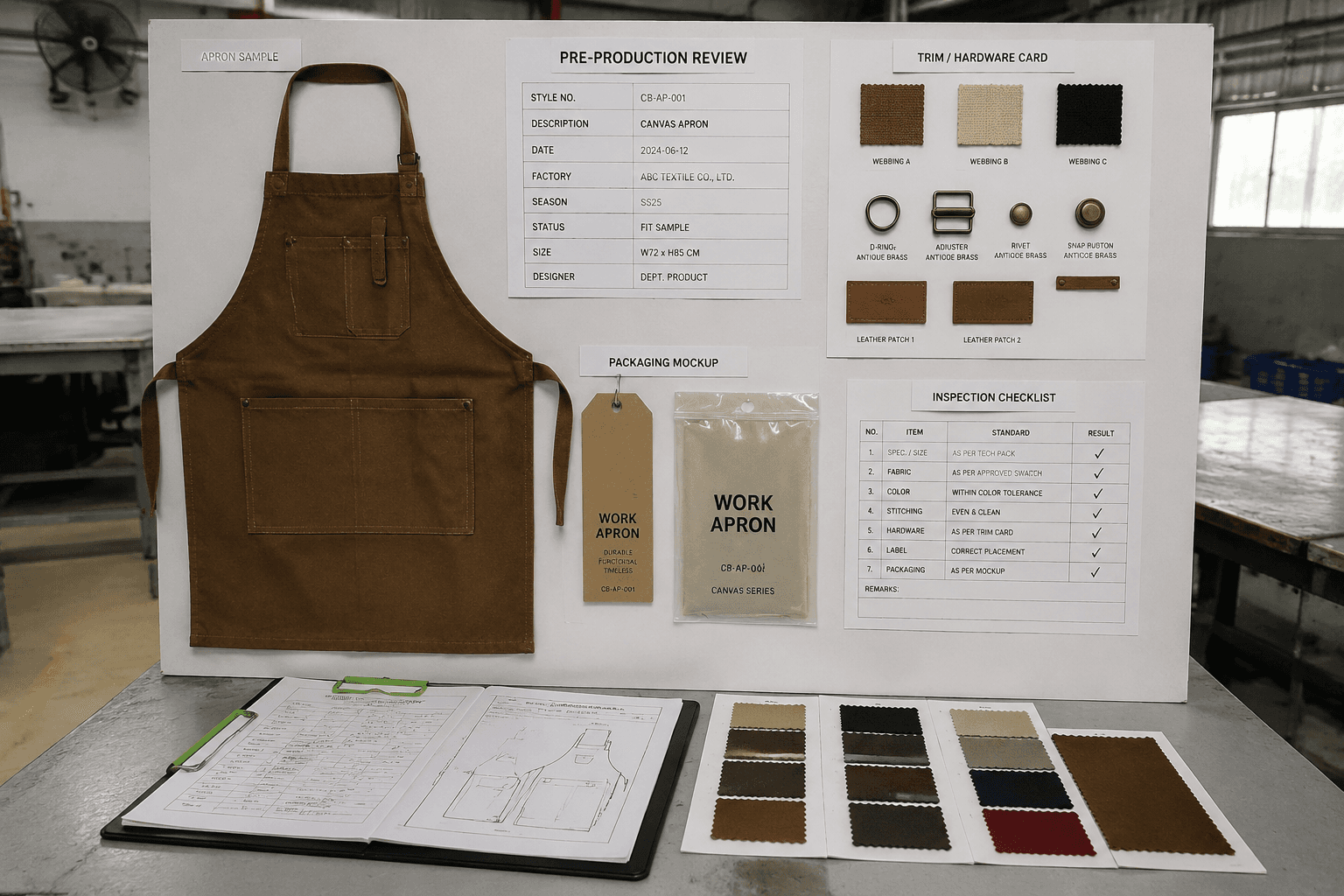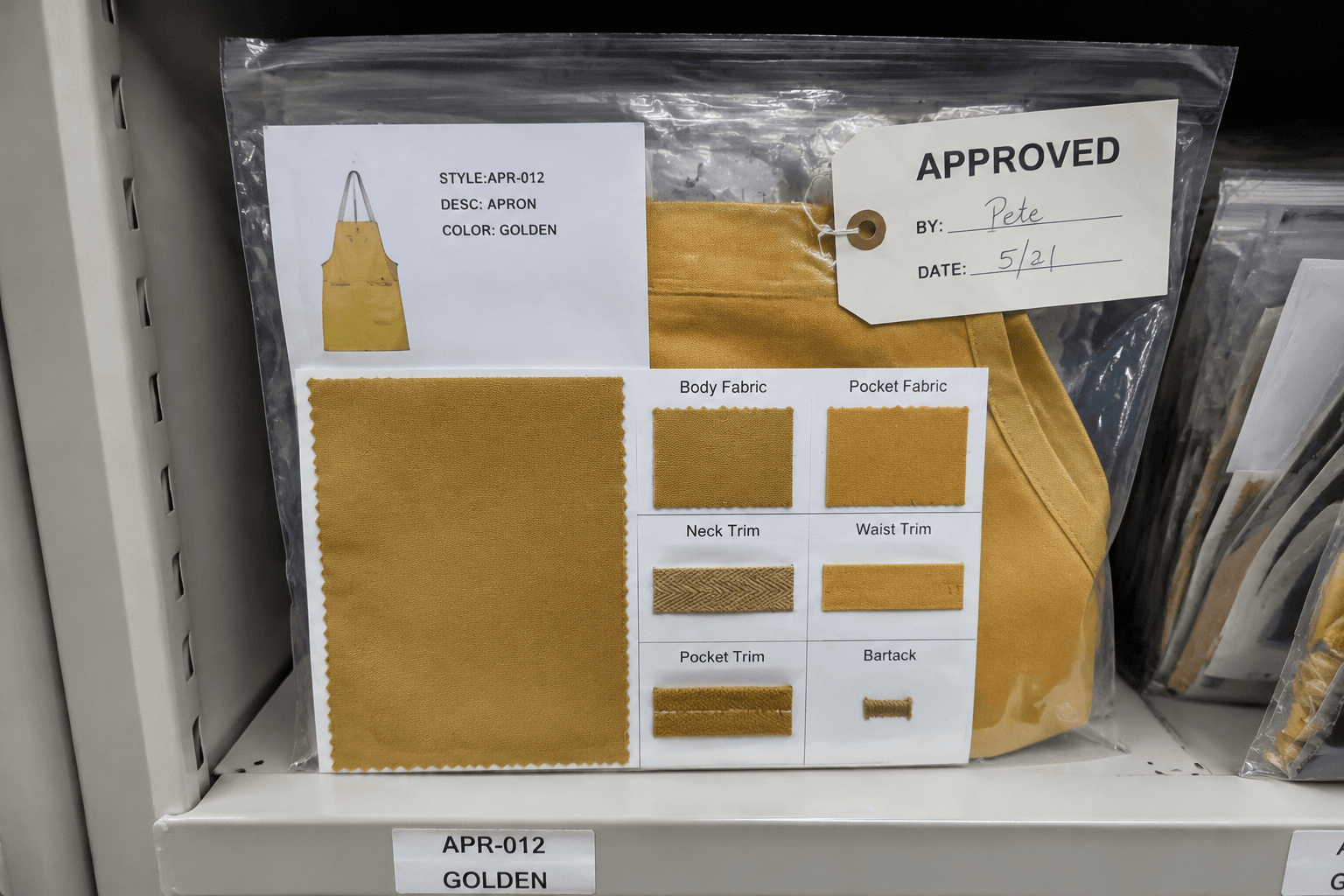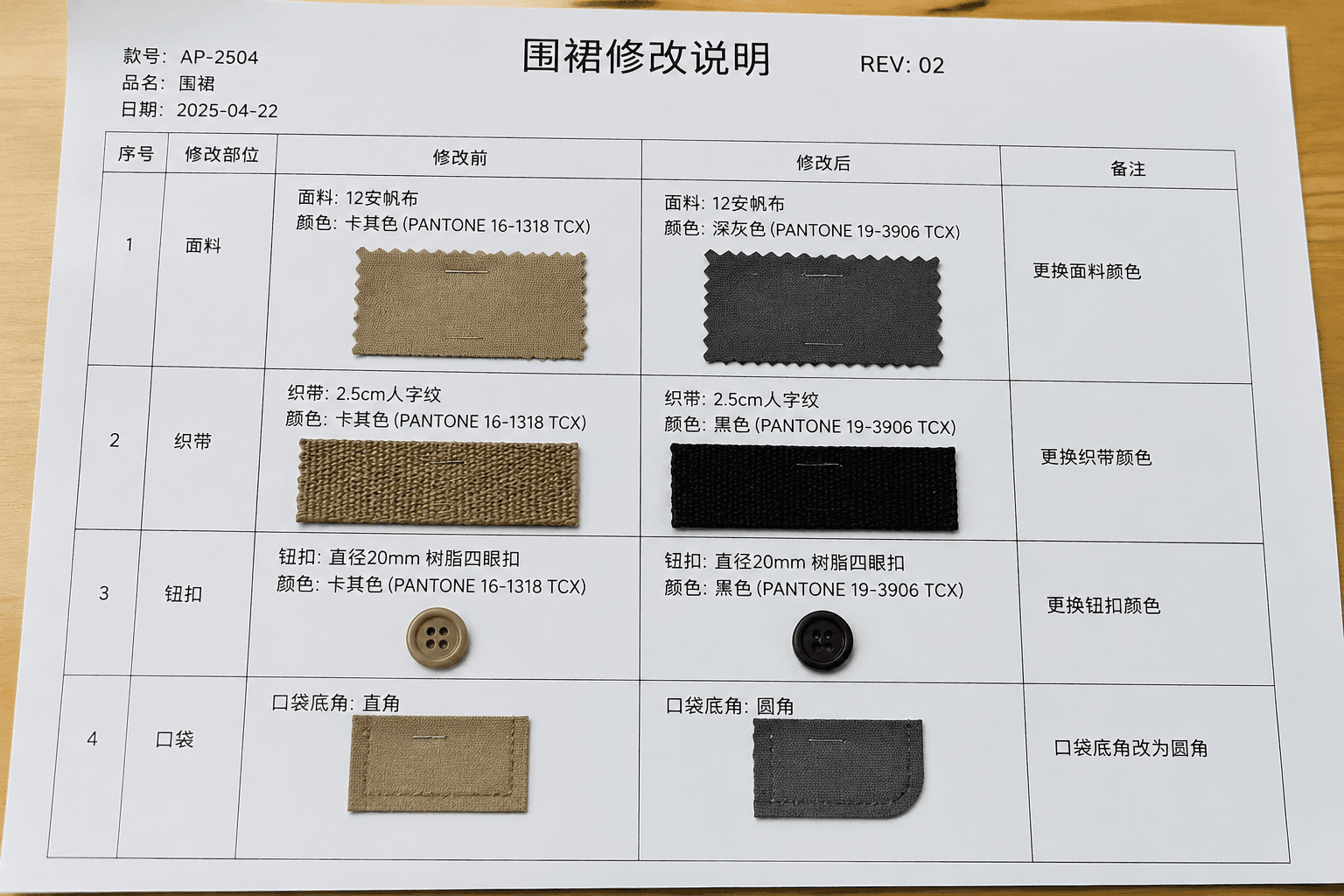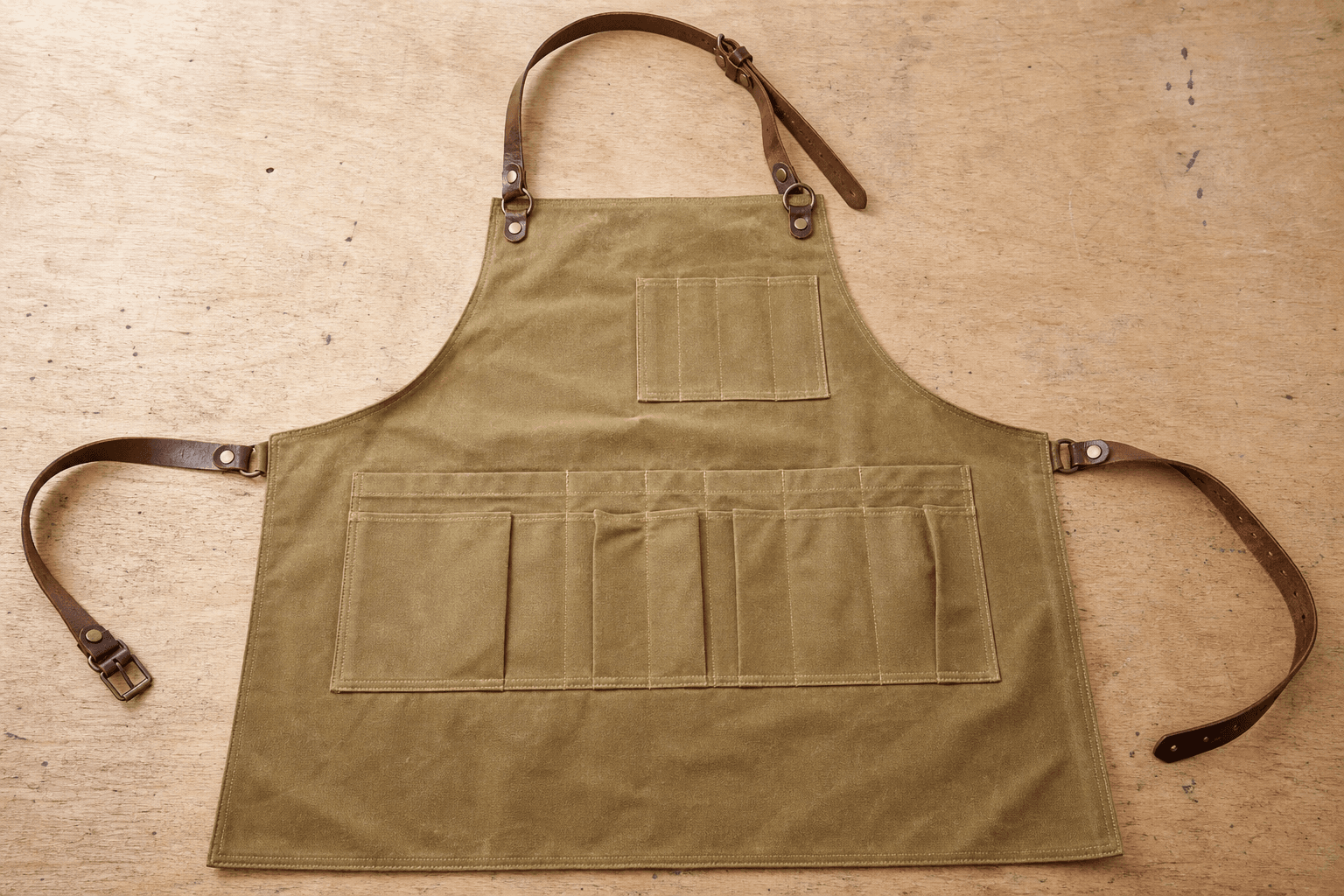
For professional sourcing teams, apron pps sample approval is not a courtesy sample review. It is the production gate that confirms the pre-production apron matches the purchase order, tech pack, bill of materials, approved artwork, measurement chart, and packing standard closely enough for bulk cutting to start with controlled risk. If a bib apron body is narrow by 1.0 cm, a waist tie is short by 2.0 cm, or a chest logo sits 1.5 cm off center, that error scales fast when 2,000 to 10,000 aprons enter sewing.
A reliable PPS for aprons should be made in actual bulk fabric or in a clearly declared substitute that is approved in writing. It should use the intended webbing, ties, hardware, thread color, print or embroidery method, care label, hangtag, fold, polybag, and carton method. If the order is a 240 GSM TC 65/35 twill bib apron at 3,000 pcs, a PPS sewn in 200 GSM sample-room fabric is not a valid approval standard unless the variance is documented and accepted. If the order is a 10 oz cotton canvas cross-back apron with antique brass adjusters and a divided tool pocket, those exact construction details should appear on the sample.
The commercial purpose of apron pps sample approval is simple: confirm that the apron is production-ready at the quoted cost, MOQ, and lead time before fabric is committed. In many China apron programs, one PPS correction adds 3 to 7 calendar days. A mistake found after cutting often adds 15 to 30 days, plus replacement fabric, sewing rework, QC disruption, and shipment delay for restaurant groups, retailers, uniform distributors, and private-label programs.
- Do not release bulk cutting until fabric, trims, branding, measurements, labels, and packing match the intended bulk standard, or every variance is accepted in writing.
- For most apron styles, practical sewing tolerances are +/-0.5 cm on smaller details and +/-1.0 cm on main body dimensions, but pocket position, strap usable length, and logo placement often require tighter control.
- A realistic PPS must match commercial reality: a basic 200 to 240 GSM polycotton bib apron often lands at US$2.20 to US$3.40 per piece at a 2,000-pc MOQ, while a 10 oz to 12 oz canvas cross-back apron with hardware and premium pack-out often runs US$4.80 to US$8.50 at 500 to 1,000 pcs.
- Written signoff should separate approved for bulk, approved with comments, and revise and resubmit so factory, QC, and buyer use the same standard.
- In a typical apron factory, PPS correction adds 3 to 7 days; replacing a wrong-cut bulk lot can add 20 days or more once fabric is rebooked and the line is rescheduled.
1. What apron PPS sample approval must freeze before cutting starts
In apron manufacturing, the PPS becomes the working standard for cutting, sewing, printing, embroidery, finishing, inline inspection, and final packing. It should sit in the live production file with the latest tech pack, BOM, approved artwork, measurement sheet, label file, carton marks, and PO revision. If approval is given through vague comments such as 'looks fine' or 'please proceed,' cutting, sewing, and QC teams often follow different assumptions once bulk starts.
Aprons appear simple, but they contain many highly visible control points. On a bib apron or cross-back style, buyers need to lock bib width, finished body length, neck drop, strap usable length, pocket width and depth, pocket partition spacing, topstitch distance, logo alignment, label position, fold method, and pack quantity. On a 3,000-pc order in 240 GSM twill or a 1,000-pc order in 10 oz canvas, a late 2.0 cm body-length change or a pocket redesign can force recutting, extra fabric consumption, and 5 to 10 lost production days.
A disciplined apron pps sample approval process asks one practical question: if this exact sample is signed today, can the factory start cutting within 1 to 3 working days without technical doubt? If the answer is no, the sample is not ready. The correct action is to hold cutting release, document each open point, and request either a revised PPS or a written detail confirmation with photos and measurements.
- Match the PPS to the exact style code, colorway, size range, order quantity, and PO revision.
- Confirm whether shell fabric, labels, webbing, buckles, snaps, rivets, and packaging are actual bulk components or temporary substitutes.
- Require written comments for every pending item, such as test reports, print strike-off approval, barcode file confirmation, or carton review.
- Use the approved PPS as the standard for production, inline QC, and final inspection, not only as a presentation sample.
2. Use bulk-realistic fabrics and trims during apron pps sample approval
Many apron failures begin in the sample room, where 'close enough' materials are used to save time. For B2B buyers, that shortcut weakens the PPS immediately. A bib apron sampled in 220 GSM polycotton may look acceptable on a table, but if bulk production will run in 280 GSM TC twill, the drape, stiffness, seam turn, and pocket hang will change. The same applies to canvas: an apron approved in 8 oz fabric does not reliably represent the structure, wash handfeel, or seam thickness of a 10 oz or 12 oz bulk fabric.
Trim accuracy matters as much as fabric accuracy. If the sample uses 2.5 cm cotton webbing while bulk booking is 3.0 cm polyester webbing, strap handling, buckle path, bartack width, and wear comfort all change. If the PPS uses bright nickel hardware while the confirmed trim is antique brass, the buyer is approving the wrong visual standard. On coated aprons or water-resistant polyester styles, a different backing or coating finish can also change needle-hole visibility, seam puckering, and topstitch appearance.
Material realism protects costing discipline as well. A basic custom bib apron in 200 to 240 GSM polycotton with one front pocket and a one-color screen print typically falls around US$2.20 to US$3.40 per piece at a 2,000-pc MOQ. A utility or barista apron in 10 oz washed cotton canvas with cross-back straps, metal hardware, embroidery, and individual belly-band packing commonly sits around US$4.80 to US$8.50 per piece at 500 to 1,000 pcs. If the PPS is made with lighter substitute fabric or sample-room trims, the buyer cannot judge whether the quoted build is still commercially accurate.
- Verify fabric composition, such as 100% cotton, TC 65/35, CVC, recycled cotton blend, or PU-coated polyester, against the BOM.
- Check actual fabric weight in GSM or oz and record the allowed bulk tolerance, for example +/-5% on fabric weight.
- Confirm trim details including webbing width, buckle finish, snap diameter, eyelet color, label material, and thread shade.
- Ask the factory to identify every substitute component on the PPS comment sheet before any signoff is issued.
3. Measure fit, pocket function, and seam quality before approval
A clean-looking sample can still fail in use. The pre-production apron should be reviewed against both the measurement chart and real wearer function. For a standard bib apron, core points usually include finished body width, finished body length from top edge, top bib width, neck loop range, waist tie usable length, pocket width, pocket depth, and pocket partition position. For cross-back aprons, strap routing, back balance, wearer comfort, and ease of taking the apron on and off are equally important.
Tolerance control should be written, not assumed. In many apron programs, workable sewing tolerances are around +/-0.5 cm on small details and +/-1.0 cm on major body dimensions, depending on fabric type, wash process, and seam construction. But some points carry higher risk than others. A 0.7 cm variance in hem turnback may be acceptable. A 1.0 cm shortage in strap usable length can reduce fit for larger wearers. A 1.5 cm shift in pocket position is highly visible on a plain-front bib apron and is often unacceptable for hospitality, retail, or private-label uniform programs.
Construction review should focus on repeatability under bulk conditions. Buyers should inspect bartacks at pocket corners and strap joins, seam allowance consistency, stitch density, skipped stitches, seam grin, thread tension, and puckering around embroidery or thick seam intersections. On aprons with divided utility pockets, the buyer should test function by inserting pens, order pads, thermometers, tools, or service cloths. Flat-table appearance is not enough if the apron is meant for daily use in foodservice, salon, retail, or workshop environments.
- Measure body width, body length, bib width, neck drop, tie usable length, pocket width, pocket depth, and partition spacing against the approved spec sheet.
- Check wearability on a relevant fit model, especially tie reach, neck adjustment range, and whether loaded pockets pull the front panel out of shape.
- Inspect stress points for bartack placement, stitch density, seam margin, skipped stitches, and seam slippage risk.
- Review left-right symmetry at bib corners, strap ends, pocket edges, and visible topstitch lines.
4. Build a cutting-release checklist into the apron pps sample approval workflow
Experienced buyers do not approve aprons from memory. They use a cutting-release checklist that ties the physical PPS to every live production document. This is where many sourcing errors are prevented. A sample may look correct while the factory still holds an outdated care label file, an earlier logo revision, the wrong carton ratio, or a superseded barcode format. When cutting, sewing, and packing teams work from different references, the factory can meet one standard and still fail the order.
The checklist should be cross-functional and short enough to use consistently. It needs to cover merchandising, technical review, quality, labeling, and logistics on a single control sheet. Whether the order is for restaurant bib aprons, salon aprons, café barista aprons, promotional event aprons, or workshop utility aprons, the logic is the same: do not release bulk cutting until sample, paperwork, and pack-out align. In a well-organized apron factory, cutting can usually start 1 to 3 working days after full PPS approval if fabric and trims are already in-house and fabric inspection has passed under the factory's internal standard or buyer-required 4-point system.
When the checklist identifies a correction, buyers should estimate schedule impact immediately. A measurement change, revised logo position, or updated fold method usually adds 3 to 7 calendar days for remake and reconfirmation. A major trim issue, such as redyed webbing, custom buckles, or reissued woven labels, can add 10 to 20 days depending on supplier lead time. Checklist discipline feels slower at PPS stage, but it is usually the fastest way to protect the ex-factory date.
- Match the PPS to the latest tech pack revision, approved artwork, BOM, and PO notes.
- Verify care label language, country-of-origin statement, label fold type, hangtag attachment, and barcode format.
- Confirm folding method, polybag size, warning text, carton dimensions, carton marks, and assortment ratio.
- Check that fabric inspection, color approval, and print or embroidery strike-off approval are already closed.
- Release cutting only after every open point is marked approved, waived, or replaced by a revised PPS.
5. Lock branding, labels, packing, and compliance before bulk fabric is spread
Small details generate a disproportionate share of apron claims. Branding is a common example. A chest embroidery placed 2.0 cm too high on the bib can look visibly unbalanced when worn. A woven side label that is 0.5 cm wider than planned can distort a narrow seam. A print that appears centered on a flat sample may sit low once a heavy divided pocket pulls the front panel. These are not minor preferences in B2B programs; they affect retail presentation, uniform consistency, and final inspection acceptance.
Packing deserves the same discipline as sewing and branding. Many buyers review the apron carefully but approve the pack-out from a PDF only. In practice, factories often use the PPS pack-out as the physical standard for final finishing. If the approved method is flat folded, one piece per polybag, size sticker at the lower-right corner, belly band centered, and 20 pcs per export carton, then the PPS should show exactly that. Packing affects carton cube, freight planning, barcode scanning efficiency, and how the apron reaches distributors, stores, or central warehouses.
Compliance should also be fixed before cutting, especially for children's aprons, retailer programs, or destination markets with stricter requirements. Depending on the market, the buyer may require azo dye restrictions, REACH-related controls, formaldehyde limits, CPSIA tracking information, metal detection, or a defined needle policy. The PPS does not replace lab testing, but it should confirm that the labels, materials, and trim versions shown for approval are the same versions intended for bulk use.
- Check logo position from fixed reference points such as top edge, center front, side seam, or pocket edge, with measurements in cm.
- Approve the actual print size, embroidery thread colors, backing method, and any special finish such as puff, silicone, or high-density print.
- Review the physical pack-out, including fold direction, polybag orientation, sticker position, and carton quantity.
- Confirm labels and compliance statements before cutting for programs with legal or retailer-specific requirements.
6. Define approval status clearly and know when to reject the PPS
Many bulk disputes come from weak approval language rather than poor sewing alone. A comment such as 'OK for production' is not enough if the PPS still contains substitute fabric, temporary labels, pending barcode artwork, or unapproved hardware. A useful signoff record should identify what is fully approved, what is approved with conditions, and what still blocks cutting release. It should include style code, colorway, sample revision number, sample date, buyer contact, factory contact, and supporting photos for any detail-specific decision.
For multi-color apron orders, the signoff should also state whether the approval applies only to the reviewed colorway or to the full color set. This matters when dark shades, washed finishes, contrast straps, or light-on-dark prints are involved. The approved PPS then becomes the control sample for inline inspection and final random inspection. If the buyer uses AQL inspection, the sample standard should align with the intended acceptance level, such as AQL 2.5 for major defects and AQL 4.0 for minor defects, so quality teams are not interpreting workmanship differently from production.
Buyers should reject or require resubmission whenever the issue affects pattern, bulk material, visible branding, compliance labeling, wearer function, or pack-out. Typical stop points include ties too short for the target wearer, pocket partitions too narrow for the intended tools, bib width materially off spec, logos visibly misplaced, or substitute fabric that changes structure and cost. By contrast, minor thread trimming, light pressing issues, or isolated loose ends can usually be handled as workmanship comments if the underlying construction is correct. In many apron programs, a first PPS is ready 7 to 12 days after fabric and trims are confirmed, one revision takes another 3 to 7 days, and bulk production for 2,000 to 5,000 standard aprons then runs about 20 to 35 days. Losing four days at PPS stage is usually far cheaper than losing three weeks after cutting starts.
- Use explicit approval terms: approved for bulk, approved with listed comments only, or revise and resubmit.
- Record every exception, including substitute trims, pending tests, temporary artwork, or packaging placeholders.
- Attach measurement results and key detail photos so production, merchandising, and QC teams follow the same reference.
- Stop cutting release if pattern, branding, material, compliance, or packing is still materially unresolved.