For apron buyers, GRS is useful but often misunderstood. A GRS certified apron does not automatically mean the fabric is 100% recycled cotton, carbon neutral, or better performing than virgin cotton. It means the recycled content and supply chain controls have been audited under the Global Recycled Standard, with transaction certificates linking each certified step from fiber or yarn through fabric, dyeing, cutting and sewing.
In factory discussions, the most important question is not simply whether a recycled cotton apron can carry GRS. The practical question is what recycled percentage is being claimed, which components are included, which supplier holds scope certification, and whether the finished apron shipment can be supported by a valid transaction certificate. These details affect MOQ, price, handfeel, shrinkage, color matching and lead time.
This article explains what the certificate actually proves, what it does not prove, and how sourcing managers can specify a recycled cotton apron program without creating avoidable cost or compliance risk.
- GRS proves audited recycled content and chain of custody, not automatic product superiority.
- A recycled cotton apron normally uses blended yarns because 100% recycled cotton has strength and consistency limitations.
- The transaction certificate is shipment-specific and is more important than a supplier's general scope certificate.
- Color, GSM, shrinkage and handfeel need separate approval because GRS does not replace fabric testing.
- MOQ and lead time are usually higher when every step, including dyeing and sewing, must remain inside certified supply chains.
- Brand artwork, trims and packaging should be checked early if the buyer wants the complete apron to be sold as a GRS certified apron.
What GRS actually proves for a recycled cotton apron
GRS stands for Global Recycled Standard. In apron sourcing, it is mainly used to verify recycled input material and control the chain of custody through each processing stage. If a factory ships a recycled cotton apron with a valid GRS transaction certificate, the certificate supports that the declared recycled content passed through certified suppliers and was not freely mixed with non-certified material outside the approved system.
This matters because recycled cotton moves through several hands before it becomes an apron. Waste cotton may be collected from pre-consumer cutting waste, post-industrial yarn waste, or post-consumer textile waste. It is then sorted, opened, re-spun or blended, woven or dyed, finished, cut, sewn and packed. GRS does not rely only on the final apron factory's statement. Each certified party needs a scope certificate, and the movement of certified material is documented by transaction certificates.
For a buyer, the most useful wording is specific. Instead of asking, 'Can you make an eco apron?', ask whether the factory can supply a GRS certified apron with a transaction certificate for the finished shipment, and state the target recycled content, fabric construction, GSM, color and order quantity.
- The scope certificate shows that a company is approved to handle certain GRS processes, such as trading, weaving, dyeing, cutting or sewing.
- The transaction certificate is issued against a specific shipment and quantity, for example 5,000 pcs of black bib aprons in 280 GSM recycled cotton blend.
- The recycled content claim should identify the percentage and material type, such as 60% recycled cotton / 40% virgin cotton or 70% recycled cotton / 30% recycled polyester.
- The certificate does not automatically cover trims, straps, thread, labels, packaging or embroidery unless those components are included in the certified claim and documentation.
Why recycled cotton apron fabric is usually blended
Most commercial recycled cotton apron fabrics are blends, not 100% recycled cotton. Mechanical recycling shortens cotton fibers. Shorter fibers reduce yarn strength, create more neps, and can increase pilling or linting if the yarn is pushed too far. For aprons used in restaurants, coffee shops, bakeries, workshops and retail uniforms, durability is normally more important than achieving the highest possible recycled percentage on paper.
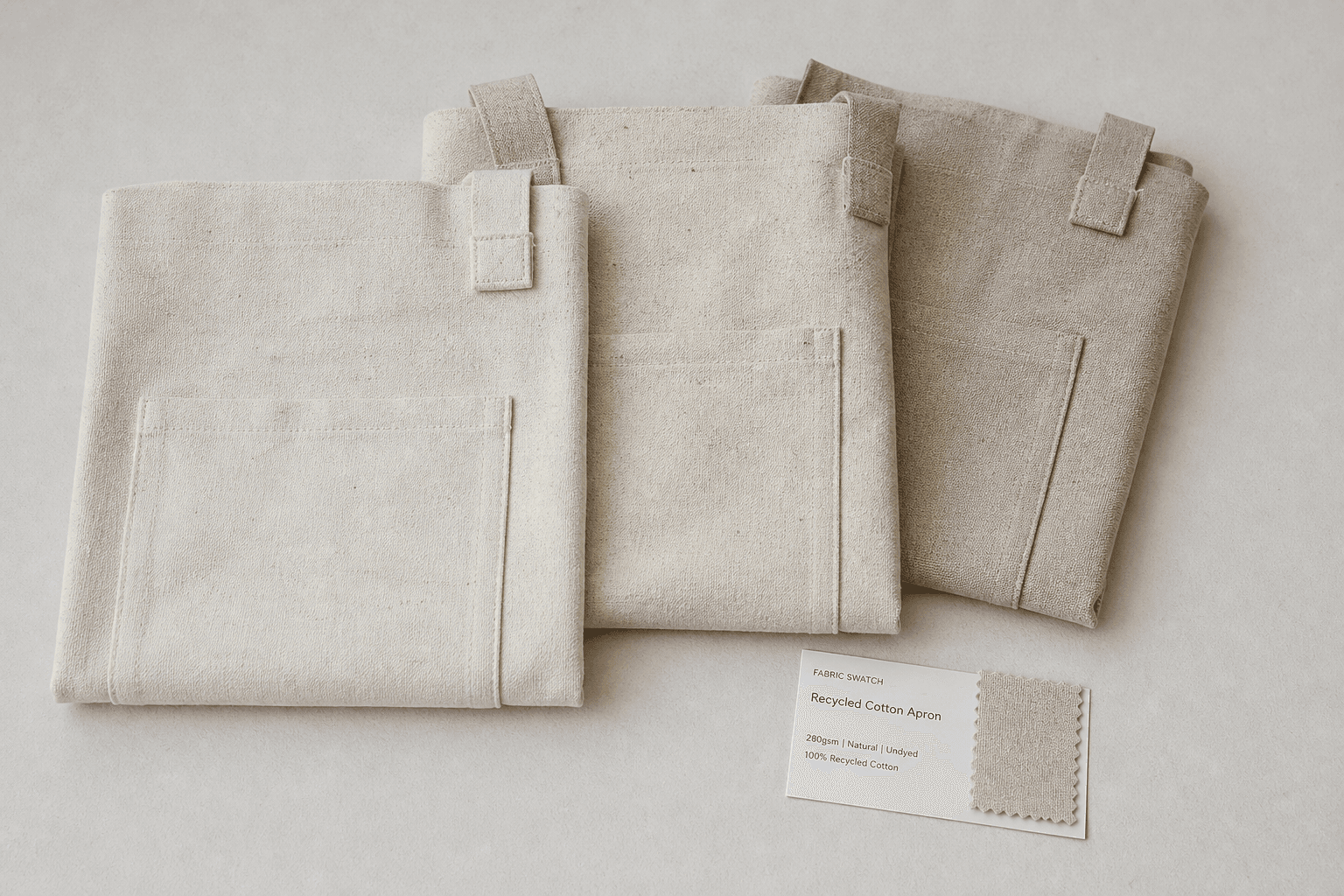
Common constructions for a recycled cotton apron include 60/40 recycled cotton/virgin cotton, 50/50 recycled cotton/polyester, 70/30 recycled cotton/recycled polyester, and canvas blends around 240-340 GSM. For a mid-market hospitality bib apron, 280 GSM twill or canvas is a practical starting point. For a heavier workshop apron, 320-380 GSM may be needed. For promotional aprons, 200-240 GSM may be acceptable, but wash durability and wrinkle recovery will be weaker.
The blend should be chosen according to use case. A cafe apron washed twice per week has different requirements from a promotional giveaway worn twice per year. GRS certification can verify the recycled input, but it cannot make a weak fabric behave like a heavy-duty workwear fabric.
- For cafe and restaurant uniforms, 240-300 GSM recycled cotton blend is usually cost-effective and comfortable.
- For barista, bakery and light workshop use, 300-340 GSM gives better drape, abrasion resistance and perceived value.
- For industrial or tool-carrying aprons, recycled cotton alone is often not enough; buyers may need heavier canvas, polyester reinforcement, waxed finish or non-recycled strength yarns.
- For low-cost promotional aprons, 180-220 GSM can reduce $/pc, but buyers should accept more wrinkling, lighter coverage and shorter service life.
The difference between a GRS certified apron and a normal sustainable apron fabric claim
Many apron quotations use terms such as sustainable apron fabric, recycled fabric, eco apron or low-impact apron. These phrases are not equal to GRS. A supplier may use reclaimed cotton yarn without being able to issue GRS documents. The fabric may contain recycled content, but if the spinning mill, fabric mill, dye house or sewing factory is not covered by the required certification chain, the finished product cannot be sold as a GRS certified apron with formal proof.
From a sourcing perspective, this distinction affects both compliance and price. A non-certified recycled cotton apron may be suitable for internal uniforms or price-sensitive programs where the buyer only needs a material story and basic test reports. A GRS certified apron is more suitable when the buyer needs auditable ESG documentation, retailer compliance, marketplace claims, or brand-level reporting. The second route costs more because documentation, certified material segregation and audit controls add work at each stage.
The certificate also controls claim language. If only the main body fabric is certified but the neck strap, waist ties, pocket fabric and thread are not certified, a careful buyer should avoid saying the entire apron is made from GRS recycled materials unless the certification body confirms that claim. In many projects, the correct statement is narrower: 'main fabric contains X% GRS certified recycled cotton.'
- A normal recycled fabric claim may rely on supplier declaration only.
- A GRS claim requires certified input and documented movement through certified supply chain steps.
- An eco apron claim can include many features, such as organic cotton, water-based printing, low-impact dyes, recycled packaging or plastic-free packing, but these are separate from GRS.
- Retailers and brand compliance teams usually prefer shipment-level transaction certificates instead of screenshots, mill letters or old audit files.
Cost, MOQ and lead time trade-offs when buying from a recycled apron manufacturer
For China apron production, the GRS route is not difficult, but it should be planned early. A recycled apron manufacturer needs to align certified yarn or greige fabric availability, dyeing capacity, accessory sourcing and factory certification scope before confirming the bulk order. If the buyer changes color, GSM or composition after sampling, the lead time may reset because certified stock cannot always be substituted freely.
As a working reference, a standard custom bib apron in 280 GSM recycled cotton blend may have an MOQ of 1,000-3,000 pcs per color when using available fabric. If yarn-dyed stripes, custom weave, custom GSM or exclusive color dyeing is required, MOQ may move to 3,000-5,000 pcs per color. For small trial orders under 500 pcs, it is often possible to produce aprons from certified stock fabric, but the color and fabric options will be limited and the unit price will be higher.
Price depends on composition, GSM, certification coverage and design complexity. Compared with a similar non-certified cotton-poly apron, a GRS certified recycled cotton apron may add roughly USD 0.25-0.80 per pc for basic styles, and more if trims, packaging, embroidery thread or all process steps must be certified. A simple 280 GSM bib apron with one pocket, cross-back ties and logo embroidery may range from about USD 3.20-5.80 per pc at 3,000 pcs, depending on fabric width, dyeing, sewing minutes, thread count, hardware and packaging. These are planning ranges, not fixed offers.
Lead time should be split into sampling and bulk. Lab dips usually need 5-7 days after color standards are confirmed. A fit sample or pre-production sample normally takes 5-10 days, depending on fabric availability. Bulk production for 3,000-10,000 pcs commonly takes 25-45 days after deposit, artwork approval and material confirmation. GRS transaction certificate issuance may add several days after shipment documents and production records are prepared.
- Stock certified fabric route: usually 7-12 days sampling and 20-35 days bulk production for simple aprons.
- Custom dyed certified fabric route: usually 10-18 days sampling/lab dips and 30-45 days bulk production.
- Custom woven fabric route: usually 20-35 days material development before sewing time starts.
- Small MOQ route: possible at 300-500 pcs in some cases, but color choice, GSM and certification claim may be restricted.
- Full certified component route: higher cost and longer sourcing time because trims, sewing thread, labels and packaging must be checked separately.
Fabric testing still matters after GRS certification
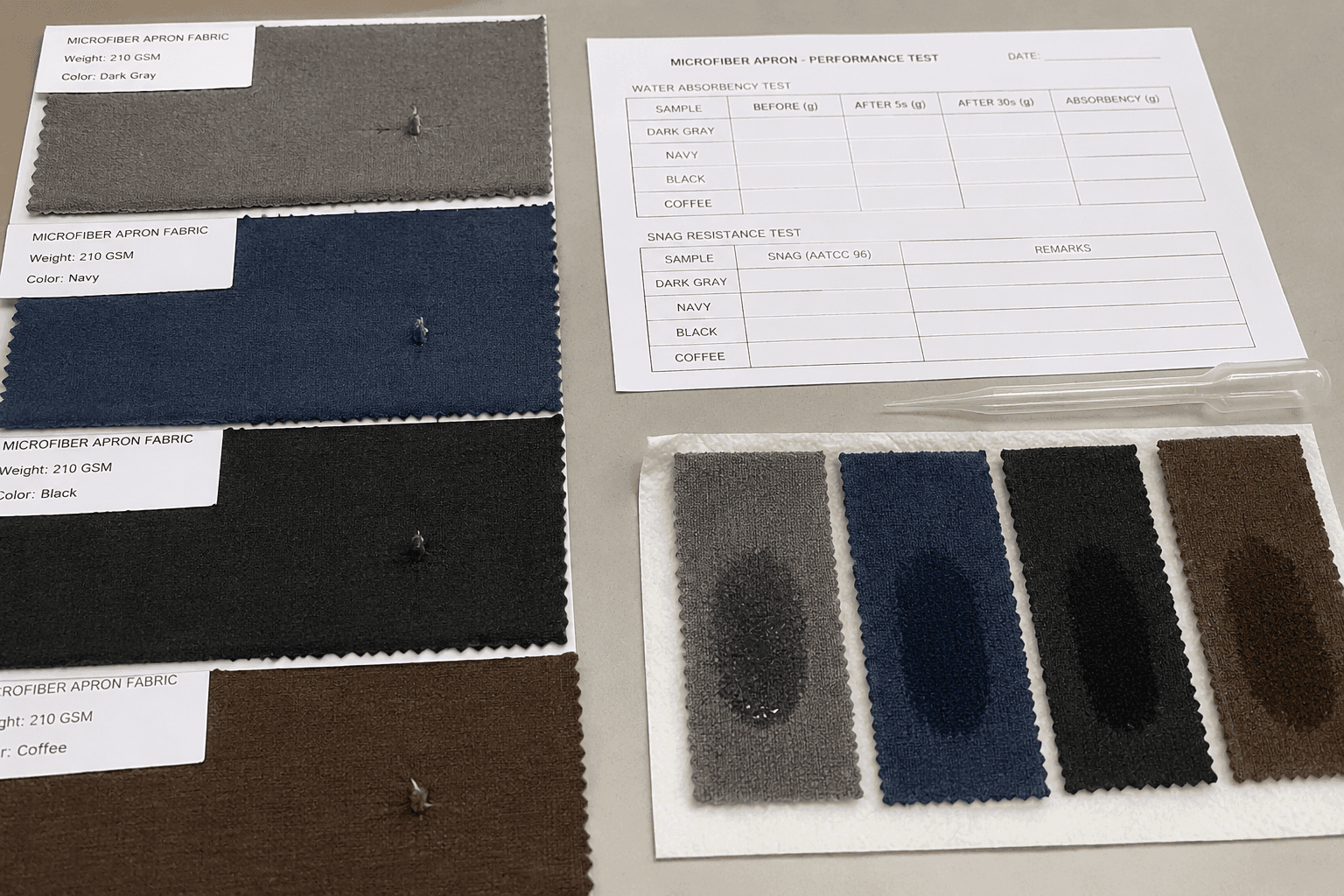
A common mistake is treating GRS as a replacement for performance testing. It is not. GRS checks recycled content, chain of custody, chemical restrictions and social/environmental management criteria for certified operations. It does not guarantee that an apron will pass a buyer's required shrinkage, crocking, tearing strength, seam slippage, colorfastness or laundering standards. These must be specified and tested separately.
For aprons, shrinkage and colorfastness are especially important. A hospitality apron may be washed at 40 degrees Celsius or 60 degrees Celsius depending on the end user. Recycled cotton blends can shrink differently from virgin cotton fabrics because fiber length, yarn twist and finishing tension vary. If the buyer accepts a sample without wash testing, the bulk apron may look correct when packed but become too short or twisted after several laundering cycles.
For a practical specification, state the test method and acceptable result. For example, dimensional change after washing should be within +/-3% for premium uniform programs, or within +/-5% for more price-sensitive promotional programs. Dry and wet rubbing should be checked for dark colors such as black, navy, charcoal, chocolate and bottle green. If the apron will be worn over white shirts, wet crocking risk needs attention before bulk dyeing.
- Check fabric weight tolerance, commonly +/-5%, because a quoted 280 GSM fabric may arrive between 266 and 294 GSM unless tighter control is agreed.
- Confirm shrinkage after the intended wash temperature, not only after room-temperature soaking.
- Test seam strength at waist ties, neck straps and pocket corners because these areas fail before the flat fabric does.
- For dark colors, request dry and wet rubbing results before approving bulk cutting.
- For foodservice use, confirm whether the buyer needs OEKO-TEX, REACH, PFAS-free, AZO-free or heavy metal testing in addition to GRS.
How to specify a recycled cotton apron for quotation
A clear RFQ saves time and reduces the risk of receiving prices that cannot be compared. For a recycled cotton apron, the RFQ should separate the product design, material claim, certification requirement and packing requirement. If these are mixed together in vague wording, suppliers may quote different assumptions: one may price certified main fabric only, another may include certified sewing, and another may quote non-certified recycled fabric with no transaction certificate.
The most efficient approach is to provide a technical sheet or a structured message. Include apron type, size, fabric composition, GSM, color, pocket layout, strap construction, logo method, quantity per color, packaging and required documents. If exact composition is not fixed, give the target. For example: 'We need 3,000 pcs black bib aprons, 280-300 GSM, minimum 50% GRS recycled cotton in main fabric, finished shipment TC required, one chest pocket, two waist pockets, cross-back straps with metal eyelets, logo embroidery 80 mm wide.'
Buyers should also state the claim they intend to make. If the hangtag says 'made with GRS certified recycled cotton,' the supplier can check whether the fabric certificate supports that language. If the buyer wants to print 'GRS certified apron' on packaging, the certification coverage and logo-use rules need to be reviewed before artwork approval. This step is small but important; claim corrections after packing artwork is printed can delay shipment and waste packaging.
- Product: bib apron, waist apron, cross-back apron, cobbler apron, bistro apron or tool apron.
- Material: recycled cotton percentage, blend fiber, GSM, weave, color and finishing requirement.
- Certification: GRS scope requirement, transaction certificate requirement and whether trims must be certified.
- Decoration: embroidery, screen print, heat transfer, woven patch, leather patch or metal hardware branding.
- Performance: shrinkage limit, colorfastness level, wash temperature, needle detection and restricted substance testing.
- Commercials: order quantity per color, target $/pc, delivery term, packing method and required shipment date.
Documentation buyers should request before and after production
Documentation should be checked in two stages. Before production, the buyer should verify that the supplier's certification route is realistic. This means reviewing the scope certificate of the apron factory or nominated processor, confirming the certified material source, and checking whether the dyeing and sewing operations are inside the required chain. At this stage, the supplier may not yet have a transaction certificate for the finished goods because the shipment has not been produced.
After production, the buyer should request the transaction certificate covering the actual shipment. The quantity, product description, composition and supplier names should be consistent with the purchase order and invoice. Small wording differences are normal, but major mismatches should be clarified before the buyer uses the certificate for retailer submission or sustainability reporting. For example, if the PO says 60% recycled cotton apron but the transaction certificate describes certified fabric only, the compliance team may reject the claim.
A disciplined document flow prevents most problems. In our factory experience, delays often happen when buyers request GRS documents only after goods are packed or shipped. Certification bodies need production records, input-output reconciliation and shipment details. If the requirement is known from the start, the factory can keep certified fabric rolls segregated, record cutting consumption, control wastage and prepare the certificate application promptly.
- Before order confirmation, request the supplier's valid GRS scope certificate and check expiry date, product category and process scope.
- Before bulk cutting, request fabric composition, GSM report, lab dip approval, pre-production sample approval and material lot confirmation.
- During production, request inline photos showing fabric roll labels, cutting, sewing and packing if the buyer needs internal traceability records.
- After shipment, request the GRS transaction certificate, commercial invoice, packing list and any required third-party test reports.
- For repeat orders, recheck certificate validity because scope certificates expire and certified suppliers may change.
Practical sourcing position on recycled cotton apron programs
A recycled cotton apron is a good product category for GRS because aprons use relatively simple woven fabrics, stable patterns and repeatable bulk production. The design usually has fewer components than jackets or bags, so chain-of-custody control is manageable. However, the program still needs precise specification. The buyer should decide whether the priority is the strongest sustainability claim, the lowest $/pc, the softest handfeel, the highest wash durability, or the fastest replenishment.
For many brand buyers, the best commercial balance is not the highest recycled percentage. A 50-70% recycled cotton blend in 240-320 GSM fabric often gives a practical mix of claim value, sewing stability and wear life. If the apron must carry tools, survive industrial laundry, or hold dark color after repeated washing, it may be better to accept a lower recycled cotton percentage and use stronger blended yarn or heavier construction. A sustainable apron fabric that fails quickly is rarely a good sourcing decision.
The most reliable buying process is straightforward: define the claim, confirm the certified route, approve fabric and wash performance, then lock the construction before bulk production. GRS gives the buyer traceability evidence, but the apron still has to work as a garment. When both sides treat certification and product engineering as separate requirements, the result is a cleaner quotation, fewer compliance surprises and a bulk apron that matches the intended use.