In commercial kitchens, dishwashing steward aprons operate in one of the harshest apron environments on site. They face constant splash, alkaline detergent residue, 50-85°C rinse exposure, rack impact, trolley abrasion, and repeated hang-dry cycles between shifts. In this setting, apron failure usually starts at the lower edge, strap joins, seam perforations, or coating fold lines before the front panel looks worn out.
That is why apron sourcing should start with station exposure, not color, logo size, or FOB alone. A pre-rinse operator, pot-wash steward, and banquet scullery team do not stress an apron in the same way. Water volume, contact time, movement range, issue frequency, and care routine all change the correct specification for GSM, coating chemistry, cut length, edge finish, and strap construction.
For procurement teams, the more useful benchmark is replacement-cycle cost over a controlled wear window such as 60, 90, or 150 working days. When buyers compare waterproof construction, hem drainage, seam method, strap material, MOQ, lead time, and AQL control together, they reduce leak claims, limit emergency reorders, and build a more predictable apron program for wet back-of-house operations.
- PVC-coated polyester at 320-450 GSM usually gives the best barrier-to-cost ratio for full-shift dish pit work, while PU-coated options fit mixed-task stations that need softer drape.
- Dishwashing steward aprons usually fail first at hems, webbing joins, neck attachments, and stitched seam lines rather than at the center panel.
- A closed bottom hem can retain 150-300 g of water during a shift, increasing wearer fatigue, drying time, and trouser-front wetting.
- For OEM programs, MOQ 300-500 pcs per color is common on stocked material, while custom-developed fabric or tooling often starts at 500-1,000 pcs.
- Bulk inspection terms should be fixed before production; many buyers use AQL 2.5 major and AQL 4.0 minor for apron orders.
- An apron at $4.20/pc lasting 120 working days usually costs less to run than an apron at $2.70/pc failing in 45-60 days.
How dishwashing steward aprons fail in live wet stations
Buyers who are used to chef bibs or service aprons often under-specify dishwashing steward aprons because the failure pattern is different. On a cook line, the main issues are staining, dry abrasion, and moderate heat. In dishwashing areas, the common failures are seam seepage, hem water retention, coating crack on fold lines, curled edges, corroded hardware, and torn strap anchors caused by the apron getting heavier as it stays wet through the shift.
A showroom sample rarely reveals those risks. An apron can look acceptable when flat-packed or worn for five minutes, then fail after 20-30 wash-and-hang cycles or repeated contact with chlorinated and alkaline chemistry. Wet-work apron sourcing should define the actual use case: intermittent splash, continuous sink work, or heavy pot-wash exposure. Those are three different buying categories, and one generic waterproof apron rarely performs well across all three.
Material type sets the minimum performance level. Woven poly-cotton aprons at 180-240 GSM are generally unsuitable for true dish pit duty, even with a water-repellent finish. Professional programs usually move to coated constructions from about 220 GSM for light-duty PU styles up to 500 GSM, or roughly 0.45-0.50 mm total thickness, for durable PVC aprons used in full-shift wet stations.
- Intermittent splash: lighter waterproof apron, lower retained wet weight, but shorter life if reassigned to full-time sink use.
- Continuous sink work: stronger coating, reinforced strap anchors, and a lower edge designed for runoff.
- Pot-wash stations: higher abrasion resistance, 25-32 mm webbing, and stronger bartacks to carry added wet load.
- Key sourcing check: ask suppliers for expected working-day life by station, not only fabric description.
Waterproof construction choices for dishwashing steward aprons
For dishwashing steward aprons, the commercial material decision usually comes down to PVC-coated polyester, PU-coated polyester, or TPU-laminated synthetic fabric. Each can work, but each solves a different sourcing problem. PVC-coated polyester remains the standard choice for institutional kitchens, hotel stewarding teams, and central wash areas because it delivers strong standing-water resistance, stable wipe-clean performance, and a workable bulk price.
A typical PVC apron in this category uses a polyester base with total fabric weight around 320-450 GSM or a finished thickness of about 0.30-0.45 mm. In standard OEM volumes, FOB commonly lands around $2.20-$4.80/pc, depending on apron size, webbing package, logo process, packing method, and order quantity. That makes PVC the usual choice when the target is 90-150 working days in high-splash stations and the buyer needs consistent barrier performance more than soft hand feel.
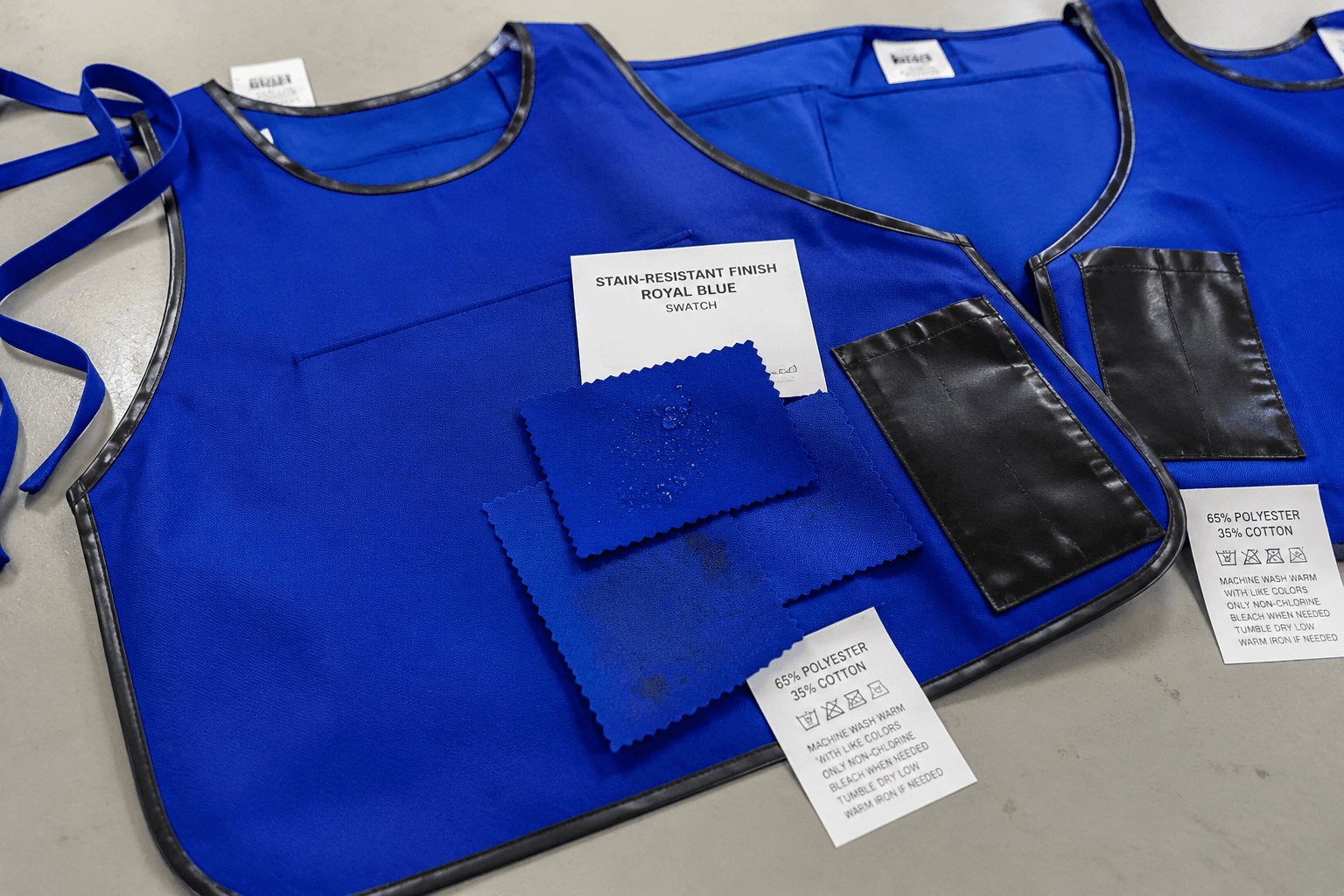
PU-coated polyester is more often selected when the station mixes rinsing, shelving, and trolley handling, and the wearer needs easier movement. Common weights are around 220-320 GSM, with FOB often in the $2.90-$5.40/pc range for custom bib aprons in 500-piece runs. The risk is coating quality: low-grade PU can hydrolyze, crack, or delaminate faster in damp alkaline conditions, especially when aprons are stored wet or stacked before fully drying.
TPU laminates and specialty waterproof synthetics offer a cleaner look, lower odor retention, and better flexibility than heavy PVC, but they usually sit in a higher price band and often require higher MOQs. In many OEM cases, FOB starts near $4.80/pc and can rise to $7.50/pc or more in smaller runs. For B2B buyers, the right construction is the one that hits the required replacement window at acceptable comfort and cost, not the one with the most technical label.
- PVC-coated polyester: strongest barrier per dollar, heavier hand, dependable for full-time wet stations.
- PU-coated polyester: softer drape and better mobility, but coating stability must be verified against alkaline exposure.
- TPU laminate: flexible and cleaner-feel, but usually higher unit cost and less forgiving MOQ.
- Typical MOQ: 300 pcs per color on stocked fabric; 500-1,000 pcs per color on custom-developed material.
- Typical lead time: 7-12 days for sample revision and 25-40 days for bulk production after PP approval.
Hem drainage details that improve dishwashing steward aprons
The lower edge is one of the most overlooked engineering points in waterproof aprons. In constant splash work, water runs down the front panel and collects at the bottom. If the apron uses a deep turned-up closed hem, that fold can trap water through the shift. In field use, retained water of 150-300 g at the lower edge is common on poorly specified styles. The result is added weight, slower drying, odor risk, and a wet edge that transfers moisture to trousers and footwear.
For that reason, buyers should specify lower-edge construction clearly on the tech pack for dishwashing steward aprons. A note such as 'hemmed edge' is too vague for OEM production. The buyer should define whether the lower edge is bound, sealed, welded, or built with a drainage exit. Corner shape should also be fixed because square corners retain more water than rounded or angled corners under continuous runoff.
In wear trials, drainage design often improves comfort more than simply increasing GSM. A 340 GSM apron with efficient runoff can feel lighter after four hours than a 450 GSM apron that holds water in the hem fold. In banquet sculleries and central wash areas where one apron may be worn across two meal periods, that difference directly affects compliance, drying speed, and replacement frequency.
- Avoid deep closed bottom hems in full-time wet stations.
- Use bound, sealed, or welded lower edges where the material and price target allow.
- Specify rounded or angled lower corners to reduce pooling.
- Request a retained-weight check: dry weight versus weight after 30 minutes of live splash exposure.
- Keep printed logos at least 12-15 cm above the main runoff line to reduce peeling and print wear.
Matching GSM, cut, and strap load to station exposure
Not every stewarding station needs the same apron. Buyers get better results when they map exposure by task instead of issuing one specification to every wet area. A pre-rinse worker may face heavy frontal splash but moderate abrasion. A pot-wash operator may strike sinks, racks, and trolley corners dozens of times per shift. A general steward may move between waste handling, shelving, and wash zones where mobility matters almost as much as waterproofness.
As a practical sourcing guide, aprons around 220-280 GSM usually fit lighter splash exposure or operations that can change aprons mid-shift. Programs in the 300-380 GSM range are the most common all-round choice for general dishwashing teams. Heavier constructions from 400-500 GSM, or about 0.40-0.50 mm total thickness, are justified in heavy splash or low-change environments, but only if the cut, strap width, and neck load are controlled properly.
Cut dimensions matter as much as fabric weight. An apron that is too long can catch on racks and push trapped water against the shin. An apron that is too narrow leaves the hip exposed and shifts runoff onto the trouser side seam. In many institutional programs, a finished size around 72-78 cm wide by 100-110 cm long works well for adult bib aprons, but the right measurement still depends on sink depth, bench height, and user movement.
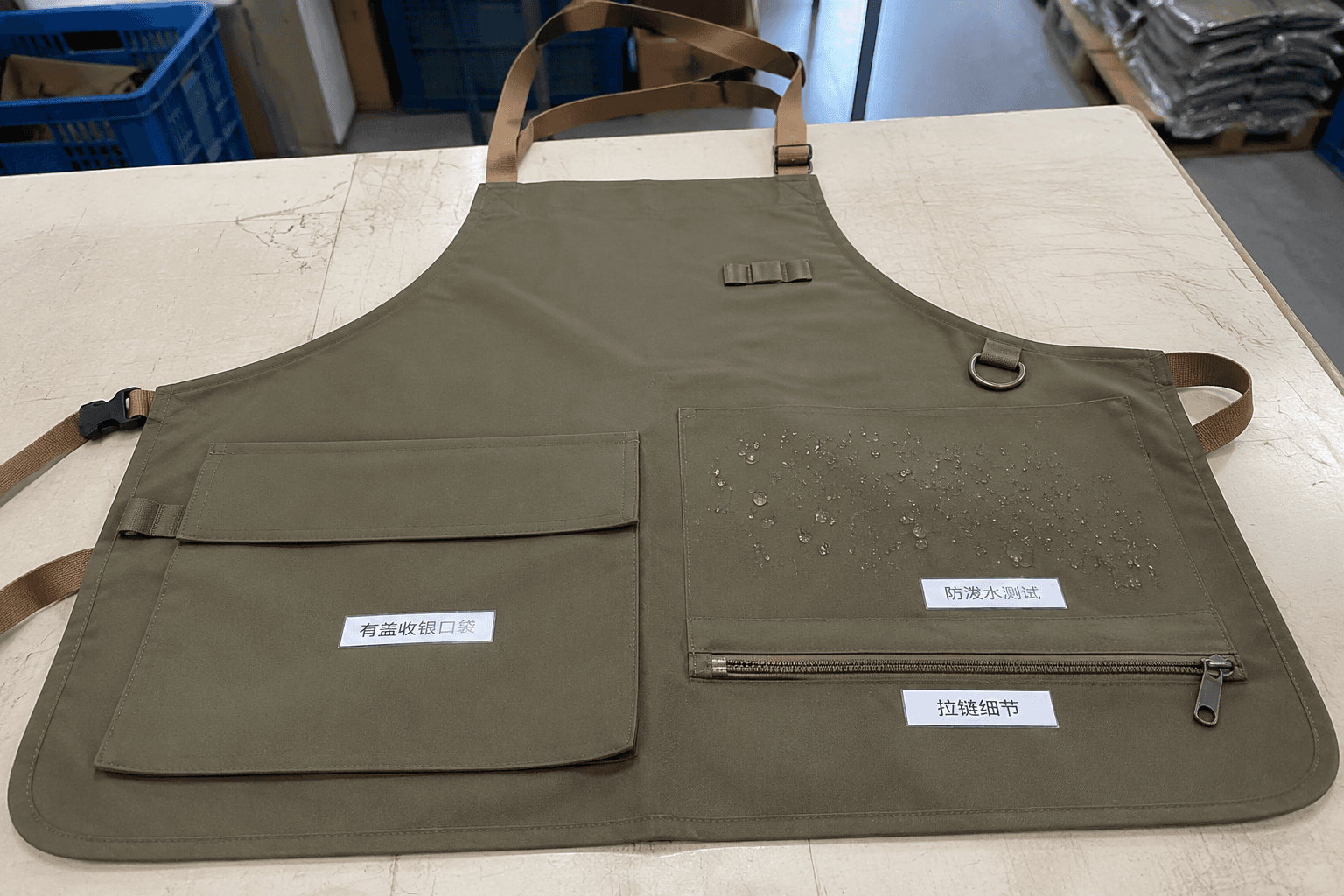
Strap engineering deserves the same attention as the panel. In wet conditions, narrow or low-density webbing can twist, cut into the neck, or tear out of the body after repeated loading. For full-shift use, buyers often specify 25-32 mm webbing, reinforced bartacks at stress points, and strap pull testing on pre-production samples.
- 220-280 GSM: light splash, higher mobility, but shorter life in true dish pit use.
- 300-380 GSM: balanced specification for most full-shift steward teams.
- 400-500 GSM: stronger barrier for heavy wet work, but test fatigue and neck pressure before rollout.
- Typical bib size: 72-78 cm width by 100-110 cm length for many adult programs.
- Recommended webbing width: 25-32 mm for better wet-load distribution.
Replacement-cycle cost, MOQ, and quality controls before bulk order
For professional buyers, the correct comparison is cost per working day, not cost per piece. Consider two apron programs in the same dish room. Apron A is $2.70/pc FOB and lasts 50 working days. Apron B is $4.20/pc FOB and lasts 120 working days. Apron A costs about $0.054 per working day, while Apron B costs about $0.035 per working day. The lower FOB item is not the lower operating-cost program once replacement frequency is measured accurately.
That gap becomes larger across hotel groups, institutional kitchens, and contract catering sites using 800-1,500 aprons per year. If the replacement window improves from 60 days to 120 days, planning becomes more stable, safety stock falls, and emergency air shipments become less likely, even when unit price rises by 20-30 percent. For this reason, a wear-trial report should track the reason for failure separately: leak-through, coating crack, seam split, neck-strap break, odor retention, and visual rejection should not be grouped into one line called 'damaged'.
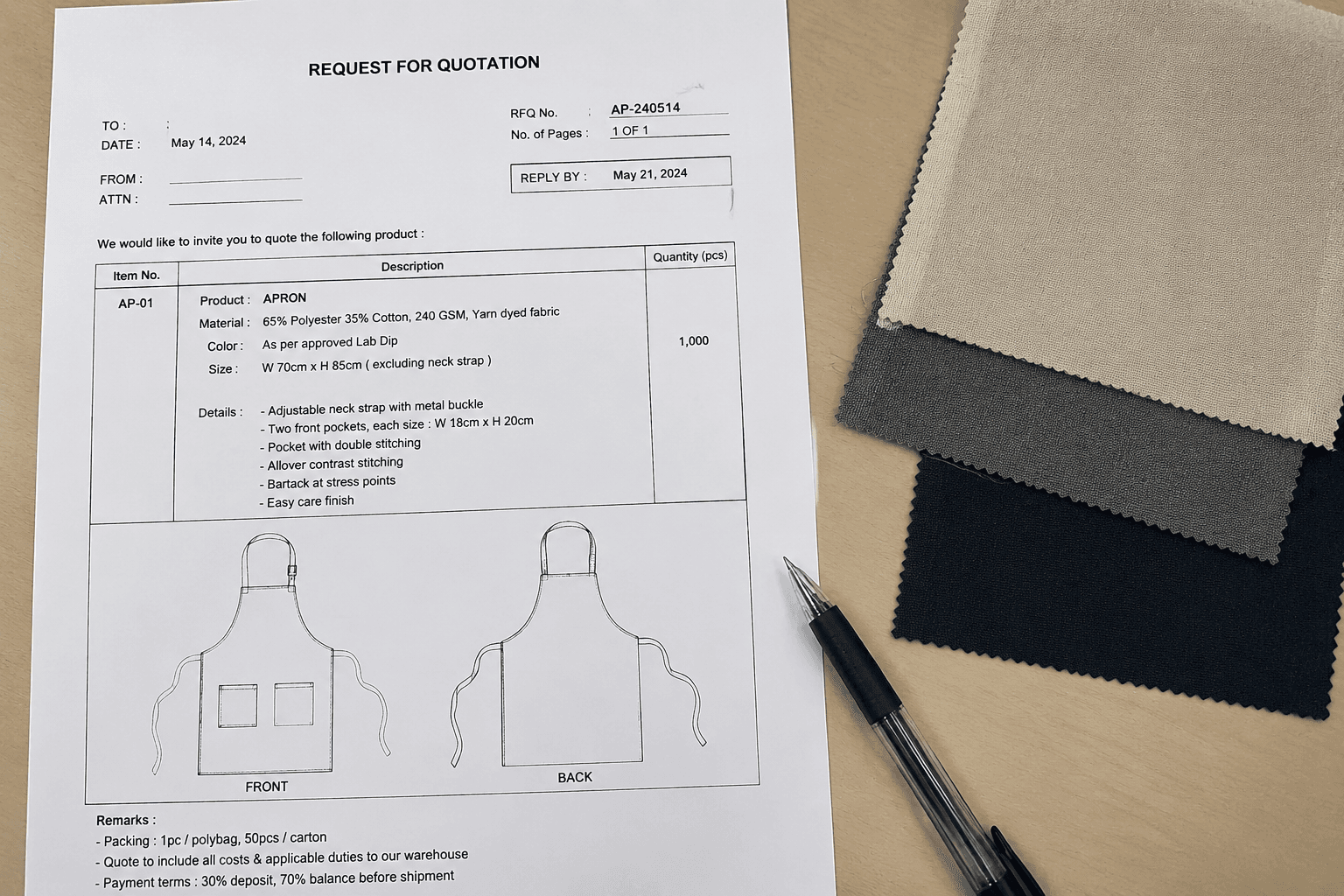
Many avoidable claims begin with incomplete specifications. Buyers may approve color, logo, and size, then leave hem depth, seam type, webbing grade, bartack count, or hardware finish to the factory. In apron sourcing, those details directly affect leakage, comfort, and replacement-cycle cost. A proper tech pack should define finished dimensions, material composition, GSM or thickness, strap material, seam construction, edge finish, logo position, packaging, tolerance limits, and inspection standard before cutting starts.
Commercial terms should also reflect actual OEM practice. For stocked PVC or PU material with standard screen print or woven-label branding, many factories can support MOQ 300-500 pcs per color. If the buyer needs custom pantone-matched fabric, molded badge branding, special welding tooling, or a newly developed laminated structure, the workable MOQ often rises to 500-1,000 pcs per color. Standard sample lead time is commonly 5-7 days on stocked material, revised prototypes take 10-15 days, and bulk production is often 25-35 days after PP approval when fabric is ready.
Inspection terms should be agreed before production, not after the goods are packed. Many B2B apron buyers use AQL 2.5 for major defects and AQL 4.0 for minor defects. Major defects commonly include coating breach, wrong size outside tolerance, failed strap attachment, open seam, or heavy contamination. Minor defects may include print position variance, light edge waviness, or small surface marks that do not affect wear.
- Track failures by category: leak, strap break, seam split, coating crack, odor, and appearance rejection.
- Measure apron life in working days or shifts, not calendar months.
- Use a detailed tech pack covering GSM, seam method, edge finish, webbing specification, and packaging.
- Plan MOQ at 300-500 pcs on stocked material and 500-1,000 pcs on custom developments.
- Fix inspection terms at AQL 2.5 major and AQL 4.0 minor before production starts.
Common sourcing mistakes that shorten apron service life
The most common mistake is buying by appearance instead of failure mode. A thicker, glossier apron may look more industrial, but if it uses weak webbing, shallow bartacks, or a water-trapping lower hem, it can fail faster than a simpler style. A second mistake is over-specifying fabric weight without checking ergonomics. If the apron becomes too stiff or too heavy when wet, workers remove it between tasks, which cancels out the value of a stronger barrier specification.
Another frequent error is assuming all waterproof aprons can be cleaned the same way. Some are designed for wipe-clean use and hang drying. Some tolerate moderate machine washing. Others degrade quickly under strong oxidizing chemistry, high heat, or damp storage. Buyers should map the real care process before purchase order release because coating chemistry and cleaning method must match the site routine.
Finally, buyers sometimes skip wear trials because the apron looks simple. For wet-work apron sourcing, a 7-10 day trial across at least two stations usually reveals the main risks: neck load, runoff pattern, trouser-front wetting, drying time, strap durability, and whether the lower edge stays saturated between tasks. Those findings normally save more money than negotiating another $0.05/pc off the quoted FOB.
- Do not approve only by dry sample appearance; request live splash testing.
- Do not increase GSM automatically without checking movement, wet weight, and drying behavior.
- Do not treat webbing, bartacks, and hardware as secondary trims; they often determine service life.
- Do not release bulk production before validating care method and station wear-trial results.