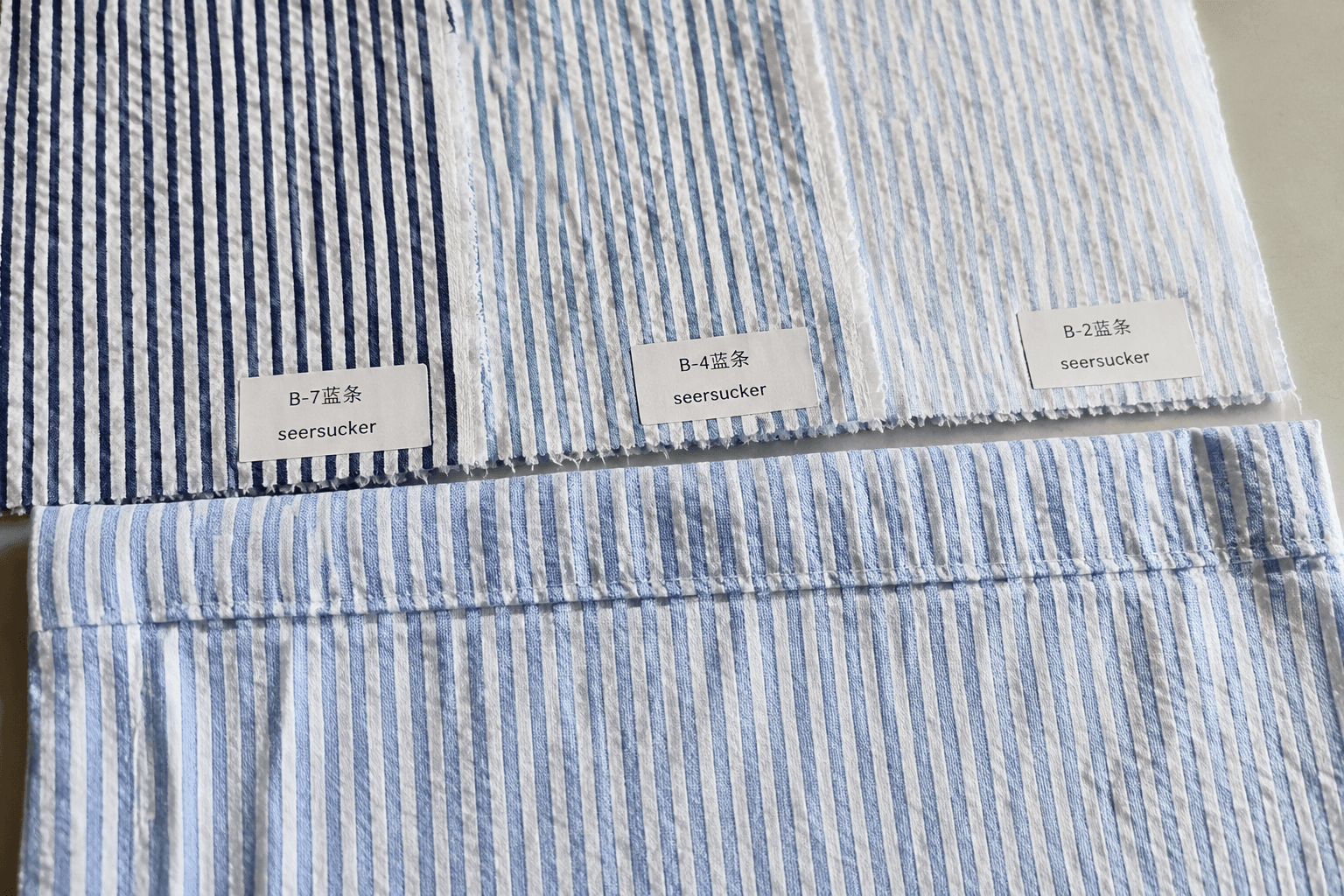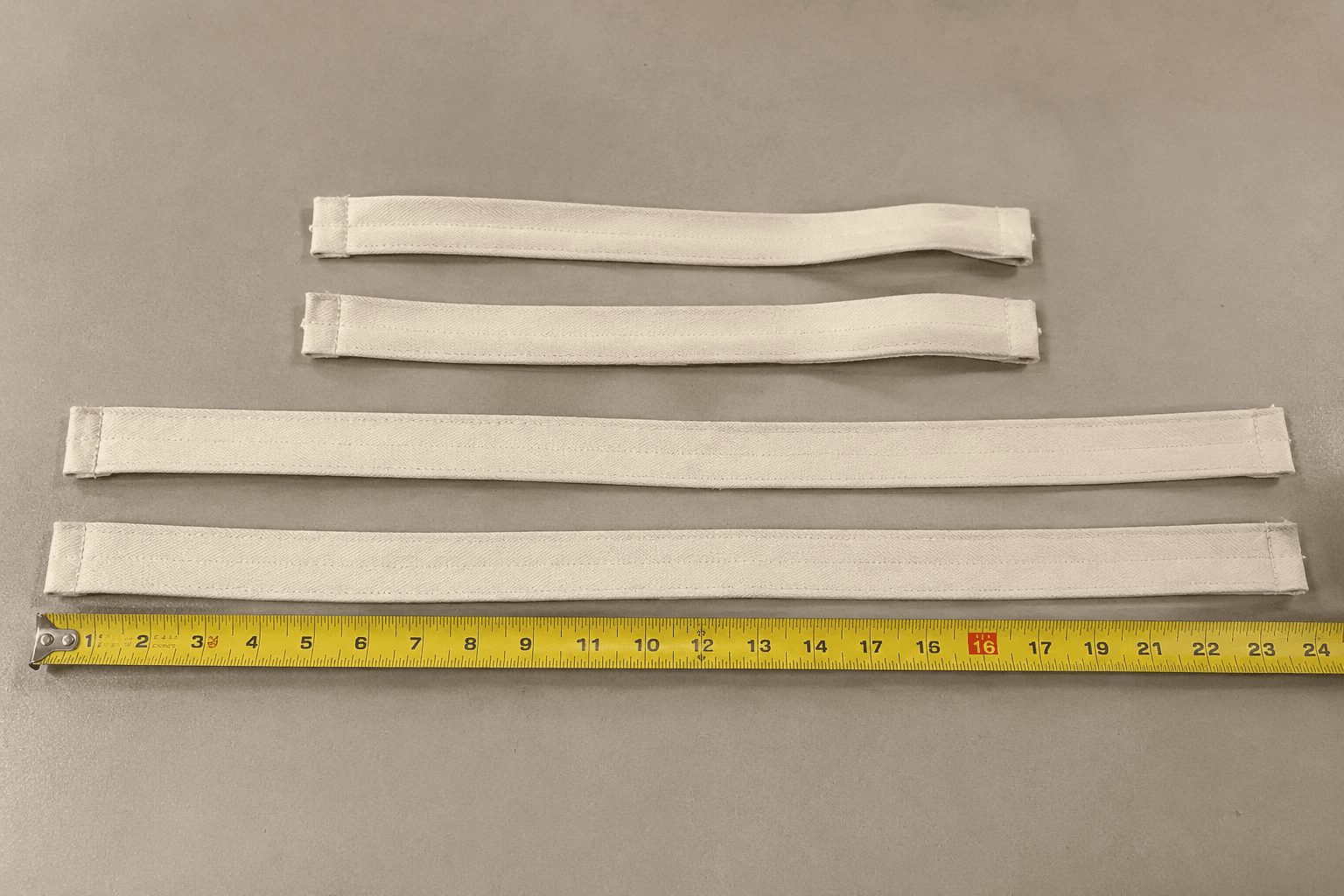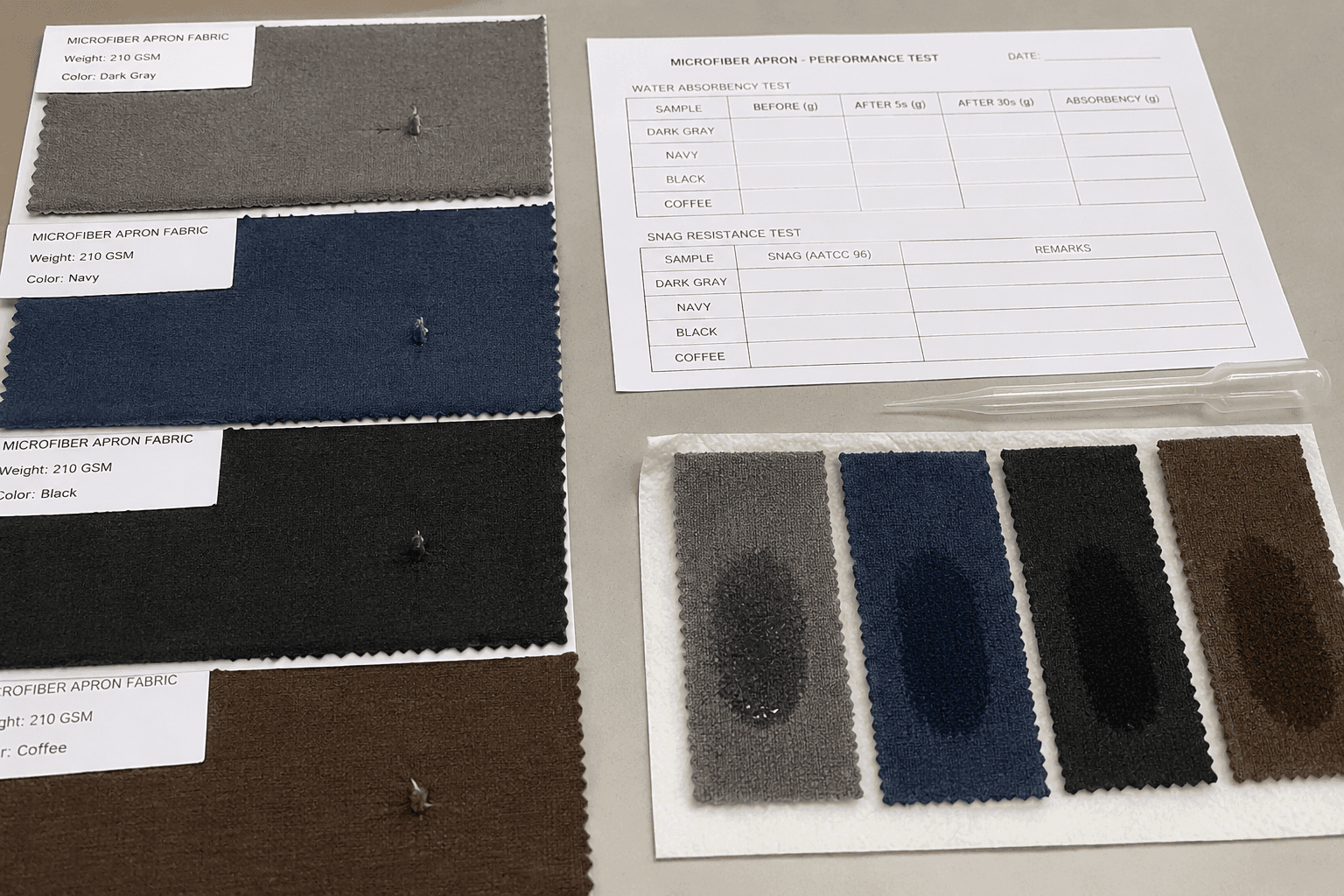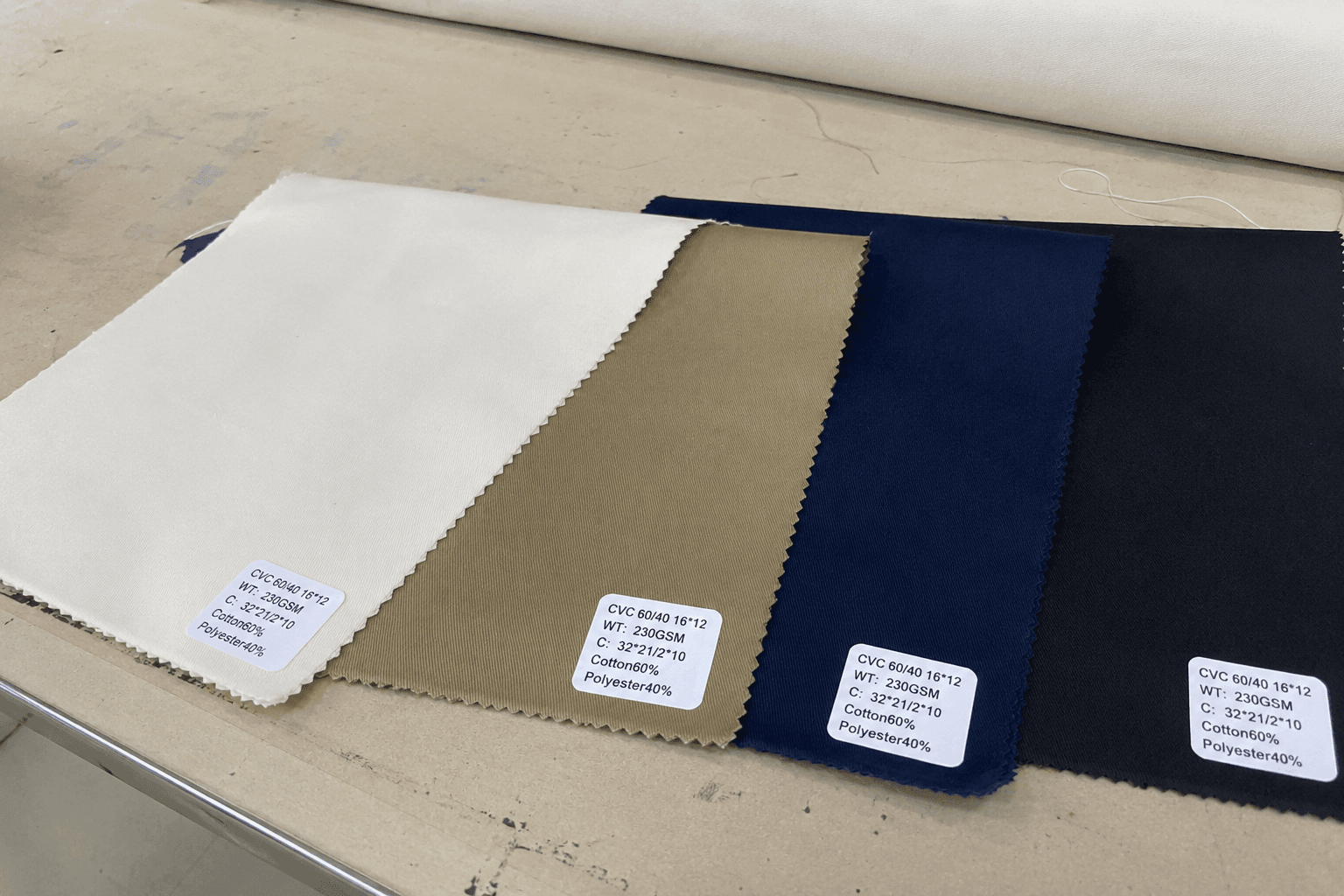
For café chains, bakeries, restaurants, salons, retailers, and promotional uniform buyers, cvc apron fabric is often the most workable middle ground between natural cotton appearance and predictable laundering. In apron sourcing, CVC means chief value cotton: cotton is the larger share of the blend, with 55/45, 60/40, and 65/35 cotton/polyester as the usual commercial ratios.
That ratio matters because aprons are washed, tied, pulled, stained, and reissued more often than many uniform items. Compared with 100% cotton, a cotton-rich CVC apron usually dries faster, wrinkles less, and has lower shrinkage after repeated washing. Compared with polyester-dominant apron fabric, it gives a softer touch and a more natural surface for front-of-house teams.
A purchase order should not say only “CVC apron.” A 210 GSM 55/45 2/1 twill for a café bib apron is a different product from a 260 GSM 65/35 twill for a barber apron with rivets and tool pockets. Strong sourcing starts with specific targets for GSM, weave, shrinkage, colorfastness, pocket reinforcement, MOQ, lead time, FOB price, and AQL inspection before bulk cutting begins.
- 55/45 to 65/35 cotton/polyester is the normal CVC range for aprons; 55/45 is usually the safest starting point for chain programs that need price control and wash stability.
- 200-245 GSM covers most commercial bib and waist aprons; 180-190 GSM suits light promotional use, while 240-280 GSM is better for barber, utility, and hardware-heavy styles.
- 2/1 and 3/1 twill are the main apron constructions because they drape well, hide light soil, and sew more cleanly around pockets than many plain weaves.
- Bulk approval should include washed sewn aprons, not only fabric swatches; review shrinkage, shade change, seam distortion, strap curling, pilling, and pocket stress after 5, 10, and 20 cycles.
- Typical OEM MOQ is 800-1,500 pcs per color/style with stock dyed CVC fabric; custom colors usually require 1,000-3,000 meters per shade at the fabric mill.
- Repeat lead time is usually 25-35 days after deposit and final approval; new CVC apron fabric development or custom dyeing is more realistic at 40-60 days.
- Common FOB pricing is about $2.20-$3.40/pc for basic CVC bib aprons and $3.60-$5.80/pc for developed styles with cross-back straps, embroidery, rivets, or multi-pocket construction.
What cvc apron fabric means in apron OEM sourcing
In OEM apron production, cvc apron fabric means a cotton-majority blend designed to keep the look and touch of cotton while reducing some of cotton’s maintenance problems. The common ratios are 55/45, 60/40, and 65/35 cotton/polyester. More cotton usually gives a softer, warmer surface. More polyester usually improves drying speed, crease recovery, and shrinkage control.
The term CVC is not a complete specification. Two fabrics can both be called CVC and behave very differently after laundering. A 220 GSM 55/45 2/1 twill with heat setting and pre-shrinking will not perform like a 185 GSM 65/35 plain weave with only basic finishing. For apron buyers, the controlling variables are blend ratio, finished GSM, yarn construction, weave, dyeing method, finish, colorfastness, and the real wash conditions used by the customer.
CVC is most useful when the apron must look presentable after frequent service use but still feel more natural than polyester-heavy uniform fabric. Chain cafés, bakeries, casual dining groups, florists, salons, and retail staff programs often need aprons to move through several wash turns per week while staying neat at the counter. The commercial value is fewer size complaints, steadier reorder quality, and longer service life, not just a soft first touch on a showroom sample.
- Common apron ratios: 55/45, 60/40, and 65/35 cotton/polyester.
- Commercial weight range: 180-260 GSM for most standard bib, waist, and cross-back aprons.
- Default constructions: 2/1 twill, 3/1 twill, plain weave, and canvas-style plain weave.
- Useful tolerances: GSM ±5%, fabric width ±1 inch, and shrinkage within 3% after the agreed wash method.
Choosing cvc apron fabric ratios by wash intensity
The right cvc apron fabric ratio depends on where the apron will be used and how it will be washed. A 55/45 cotton/polyester twill is often the best starting point for large uniform programs because it keeps a cotton-rich look while controlling drying time, wrinkling, and shrinkage. It is practical for cafés, bakeries, quick-service restaurants, grocery counters, and retail teams where aprons may be washed 3-5 times per week.
A 60/40 CVC fabric gives a slightly softer hand and a more cotton-like surface while still offering better stability than 100% cotton. This ratio works well when the buyer wants a more premium feel for front-of-house staff but cannot accept major size movement after laundering. A 65/35 CVC fabric can look closer to cotton and suit boutique hospitality, barber, florist, or retail concepts, but it needs stricter wash approval. If the user washes at 60°C, tumble dries at high heat, or treats oil stains with strong alkaline chemistry, the extra cotton content may increase wrinkling, shrinkage, and shade loss.
Buyers should compare ratios after washing, not only on the sample table. A soft development sample may come from enzyme finishing, silicone softener, or small-lot handling that is hard to repeat in bulk. The practical test is whether the apron still hangs cleanly after 5, 10, and 20 wash cycles: hems should not twist, pockets should not distort, straps should not curl, and dark shades should not fade unevenly at pocket edges or tie ends.
- 55/45 CVC: best for chain orders focused on stability, drying speed, and cost control.
- 60/40 CVC: good middle option when buyers want better handfeel without moving too close to pure cotton behavior.
- 65/35 CVC: suitable for premium apron programs if shrinkage and shade change pass repeated wash tests.
- 100% cotton comparison: stronger natural feel, but usually more wrinkling, slower drying, and higher dimensional movement.
Match GSM, weave, and apron style before quoting
Blend ratio should be selected together with GSM, weave, and apron style. For most professional apron bodies, 200-245 GSM is the working center of the market. This range gives enough opacity, pocket support, and drape without making the apron too stiff for a full shift. Below 190 GSM, CVC aprons are better suited to light promotional programs, short events, or low-duty waist aprons. Above 250 GSM, the product feels more substantial, but sewing time, freight weight, needle wear, and wearer fatigue increase.
Twill is the safest default for most cotton-rich apron programs. A 2/1 twill at 210-230 GSM works well for café and bakery bib aprons because it hangs cleanly, hides light soil, and sews reliably around patch pockets. A 3/1 twill at 230-260 GSM gives a slightly richer face and is useful for barber, florist, craft retail, and specialty food aprons. Plain weave can reduce cost and give a crisper surface, but it may show creasing and seam stress more clearly around large pockets or heavy trims.
Apron style changes the correct weight. Bib aprons need enough body to hang smoothly from chest to hem and support chest or hip pockets. Waist aprons can be lighter because they do not carry shoulder load. Cross-back aprons need careful weight control because staff may wear them for 8-10 hour shifts. Utility aprons with tool pockets, towel loops, rivets, or metal adjusters often need 240-280 GSM plus stronger pocket stitching and bartacks.
- Bib aprons: 210-245 GSM twill is the main commercial range.
- Waist aprons: 180-220 GSM works for restaurants, bars, and light service roles.
- Cross-back aprons: 200-230 GSM with a softer finish improves comfort over long shifts.
- Barber and utility aprons: 240-280 GSM supports larger pockets, rivets, and heavier trims.
- First development default: 220 GSM 60/40 2/1 twill for broad market testing.
Wash tests and AQL levels for cvc apron fabric approval
Aprons should be approved as washed work products, not as flat fabric swatches. For hospitality, foodservice, salon, and retail use, the relevant question is how the finished apron performs after stains, detergent, heat, drying, and repeated handling. Before bulk approval, buyers should test both fabric and fully sewn aprons under conditions close to the final laundry process.
A practical approval protocol includes shrinkage, colorfastness to washing, dry and wet crocking, pilling, tensile strength, seam slippage, and appearance after laundering. For many commercial CVC aprons, shrinkage within 3% in warp and weft after the agreed test method is a realistic target. Dark colors such as black, navy, charcoal, forest green, chocolate, and burgundy need closer review because edge fading, pocket abrasion, and tie-strap shade loss become visible earlier in service.
Inspection standards should be written into the PO before production. For export apron programs, AQL 2.5 major and AQL 4.0 minor is a common benchmark, with critical defects set at 0 acceptance. Critical defects should include sharp hardware, broken needle contamination, wrong fiber composition, severe shade mismatch, incorrect logo placement, and unsafe attachments. Major defects usually include open seams, missing bartacks, measurements outside tolerance, broken stitches at stress points, and visible stains that cannot be removed.
- Wash review timing: check appearance after 5, 10, and 20 wash cycles.
- Shrinkage target: within 3% warp and 3% weft after the agreed laundering method.
- Colorfastness target: washing grade 4 minimum, dry rubbing grade 4 minimum, wet rubbing grade 3-4 minimum.
- Inspection benchmark: AQL 2.5 major, AQL 4.0 minor, and 0 acceptance for critical defects.
- Stress areas: pocket corners, strap insertions, neck adjusters, bartacks, towel loops, side ties, and bottom hems.
MOQ, lead time, and FOB price for CVC apron orders
In China apron OEM sourcing, MOQ is usually controlled by fabric availability before sewing capacity. If the factory can use stock dyed CVC twill in common colors such as black, navy, khaki, beige, olive, charcoal, or burgundy, the MOQ is often 800-1,500 pcs per color/style. If the buyer needs a custom Pantone shade, exclusive weave, special finish, or yarn-dyed stripe, the fabric mill may require 1,000-3,000 meters per color before sewing can begin.
Lead time depends on whether the fabric, trims, artwork, and pattern are already approved. Repeat orders using an existing pattern, approved CVC fabric, and standard trims can often ship in 25-35 days after deposit and final confirmation. New development normally needs 40-60 days because lab dips, strike-offs, fabric dyeing, finishing, testing, cutting, sewing, inspection, and packing all add time. Embroidery, metal hardware, leather-look patches, contrast webbing, custom labels, or retail packaging can add 5-10 days if materials are not in stock.
Pricing should be compared against a complete specification sheet, not against a photo. As a broad FOB reference, a basic bib apron in 210-240 GSM CVC twill with one or two patch pockets and simple neck adjustment often falls around $2.20-$3.40/pc at volume. A developed apron with cross-back straps, several pockets, bartacks, rivets, embroidery, branded trims, or heavier 240-280 GSM fabric commonly lands around $3.60-$5.80/pc. A much lower quote often means lighter GSM, simpler dyeing, weaker trims, fewer bartacks, looser packing, or less inspection time.
- Stock fabric MOQ: 800-1,500 pcs per color/style.
- Custom color minimum: usually 1,000-3,000 meters per shade.
- Repeat order lead time: 25-35 days after approval and deposit.
- New development lead time: 40-60 days, depending on lab dips, testing, and trim sourcing.
- Basic CVC bib apron FOB: about $2.20-$3.40/pc.
- Developed CVC apron FOB: about $3.60-$5.80/pc.
Specification mistakes that cause apron claims
The first common mistake is approving by handfeel alone. A small sample can feel soft because it has been specially finished, washed, or pressed. Bulk fabric may feel different if GSM tolerance, finishing chemistry, dye lot, or heat setting is not controlled. Buyers should record blend ratio, finished GSM, weave, width, finish, shrinkage target, color standard, and test method before releasing a PO.
The second mistake is treating fabric and apron construction as separate issues. Aprons usually fail at stress points: pocket corners, strap attachments, neck adjusters, side ties, towel loops, and bottom hems. A good CVC fabric can still create claims if the apron has low stitch density, no bartacks, weak thread, or heavy hardware on fabric that is too light. For most commercial aprons, 8-10 stitches per inch and bartacks at pocket corners and strap ends are reasonable starting requirements.
The third mistake is assuming home-laundry results represent commercial use. A restaurant or bakery may wash aprons at higher temperature, use stronger detergents, pre-treat oil stains, and tumble dry more aggressively than a household user. If the real use is 3-5 wash turns per week at 60°C, a softer 65/35 fabric may not be the most economical choice. A 55/45 or 60/40 twill may deliver lower replacement cost even if the first-touch handfeel is slightly firmer.
- Do not specify only “CVC”: include ratio, GSM, weave, finish, and test standard.
- Do not approve unwashed samples: review size, shade, handfeel, drape, and pocket shape after laundering.
- Do not ignore trims: rivets, eyelets, sliders, and heavy webbing increase fabric stress.
- Do not skip sewn-garment testing: pocket distortion and strap curling may not appear on fabric swatches.
- Do not compare quotes by photo: align fabric weight, trims, stitching, packaging, AQL, and lead time first.
Sourcing checklist for repeatable cvc apron fabric programs
A repeatable apron program starts with a narrow fabric trial, not a large stack of unrelated swatches. For example, a café buyer can compare a 210 GSM 55/45 twill, a 220 GSM 60/40 twill, and a 235 GSM 65/35 twill in the same bib apron pattern. The decision should be based on after-wash appearance, wearer comfort, drying time, pocket stability, and replacement cost per service cycle, not only the lowest FOB price.
The technical pack should define finished measurements before and after wash, fabric composition, GSM, color standard, pocket position, stitch density, bartack placement, strap length, hardware finish, label method, carton packing, inspection level, and claim window. For export orders, many buyers also define shipment tolerance at ±5% unless otherwise agreed. These details prevent reorder disputes when the next purchase is placed months later and the original development team has changed.
For most B2B buyers, cvc apron fabric remains one of the most useful bases for custom apron sourcing because it gives a cotton-rich look with more manageable laundering than pure cotton. The strongest results come from matching ratio to wash intensity, GSM to apron style, and construction to stress points. Once those details are fixed in the specification, repeat orders are easier to quote, faster to produce, and less likely to create claims after delivery.
- Request fabric data: composition, GSM, weave, width, finish, mill source, and available colors.
- Approve with wash evidence: shrinkage, crocking, colorfastness, pilling, and sewn-apron appearance.
- Lock sewing standards: SPI, bartack count, thread type, pocket reinforcement, and strap attachment method.
- Confirm business terms: MOQ, lead time, over/under tolerance, AQL level, payment term, and claim period.
- Evaluate true cost: FOB price plus wash life, replacement rate, freight weight, and reorder consistency.