For bulk apron programs, the cotton-poly blend is usually selected because it sits between two buyer priorities: a cotton-like touch for kitchen staff and enough polyester performance to survive repeated laundering. A well-specified cotton poly chef apron can reduce shrinkage, improve drying speed and hold color better than 100% cotton, while still looking appropriate for restaurants, hotels, catering teams and culinary retail.
The trade-off is that not every cotton poly apron fabric behaves the same. A 65/35 poly-cotton twill at 240 GSM is a different product from a 80/20 cotton-poly canvas at 320 GSM, even if both are described as blended chef apron fabric. Fiber ratio, yarn count, weave density, dye method and finishing decide whether the apron releases oil stains, resists puckering at seams and keeps a flat front panel after 50 industrial wash cycles.
From a factory sourcing perspective, the right specification should be built around the actual laundry environment. Domestic washing, hotel laundry and tunnel industrial wash all create different stress on fabric, straps, bartacks and trims. Below is a practical guide to specifying cotton-poly blend chef aprons for stain release and industrial wash performance.
- 65/35 polyester-cotton twill at 230-280 GSM is the most balanced option for many restaurant and catering apron programs.
- Stain release finishing should be confirmed by wash testing, not only by a supplier's fabric label or verbal claim.
- Industrial wash aprons need stronger thread, reinforced stress points and controlled shrinkage, not just heavier fabric.
- Dark colors hide stains but require better dye fastness control, especially for black, navy, charcoal and burgundy.
- MOQ and lead time change when custom fabric weight, custom dyeing or special stain release finishing is required.
- Pre-production wash testing is the cheapest way to avoid fit, shrinkage and color complaints after delivery.
Why a cotton poly chef apron is chosen for professional kitchens
In chef apron sourcing, cotton-poly blends are often chosen because they give buyers a practical middle position. Pure cotton feels natural and absorbs moisture, but it can shrink more, wrinkle heavily and take longer to dry. Pure polyester is durable and color stable, but it can feel less premium and may show shine after repeated pressing. A cotton poly chef apron uses both fibers to balance comfort, appearance and service life.
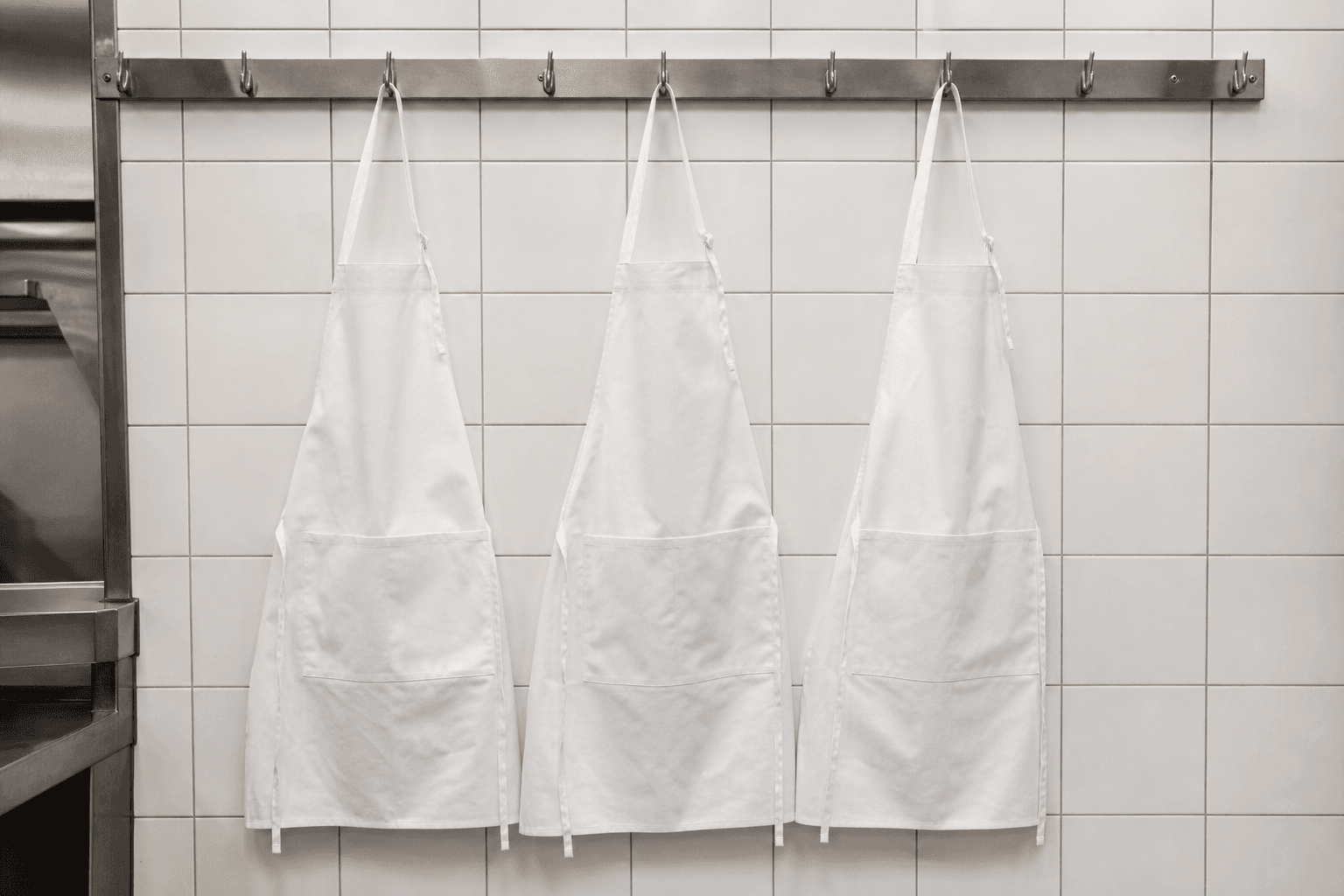
For restaurant groups, culinary schools, catering operators and uniform rental companies, the apron must look consistent across many staff members and many wash cycles. The front bib should hang cleanly, the waist ties should not twist into ropes, and the fabric should not become stiff after repeated detergent exposure. A 65/35 poly-cotton twill is one of the most common choices because polyester provides dimensional stability while cotton improves touch and absorbency.
The blend also gives cost control. In many China apron programs, a standard 65/35 twill chef apron at 240-260 GSM can be produced more economically than a heavy 100% cotton canvas apron, especially when the order is 1,000-10,000 pcs per color. For OEM buyers managing seasonal menus, store openings or uniform refresh schedules, this matters because fabric performance must fit within a target landed cost.
- A 65/35 polyester-cotton blend usually offers better shrinkage control than 100% cotton.
- A 60/40 or 65/35 twill chef apron normally dries faster than a comparable cotton canvas apron.
- A cotton-rich 80/20 blend gives a softer hand but usually needs more attention to shrinkage and wrinkle control.
- A polyester-rich blend improves color stability but may feel less natural against the body in hot kitchens.
Fabric ratios, GSM and weave choices for cotton poly apron sourcing
The first specification to lock is fiber ratio. In apron production, the most requested ratios are 65/35 polyester-cotton, 60/40 polyester-cotton, 80/20 cotton-poly and 50/50 blends. For commercial chef aprons, 65/35 is usually the most predictable. It supports stable dyeing, manageable shrinkage and acceptable hand feel, while keeping fabric cost under control. A 50/50 blend is also workable, but buyers should confirm whether the fabric is truly 50/50 or only described that way for convenience.
GSM determines weight, drape and perceived durability. Lightweight cotton poly apron fabric in the 180-210 GSM range is suitable for cafe, bakery, promotional and front-of-house aprons, but it may not feel substantial enough for back-of-house chef use. Midweight fabric at 230-280 GSM is the main zone for chef aprons. Heavy fabric at 300-340 GSM gives a stronger feel but increases heat retention, shipping weight and drying time.
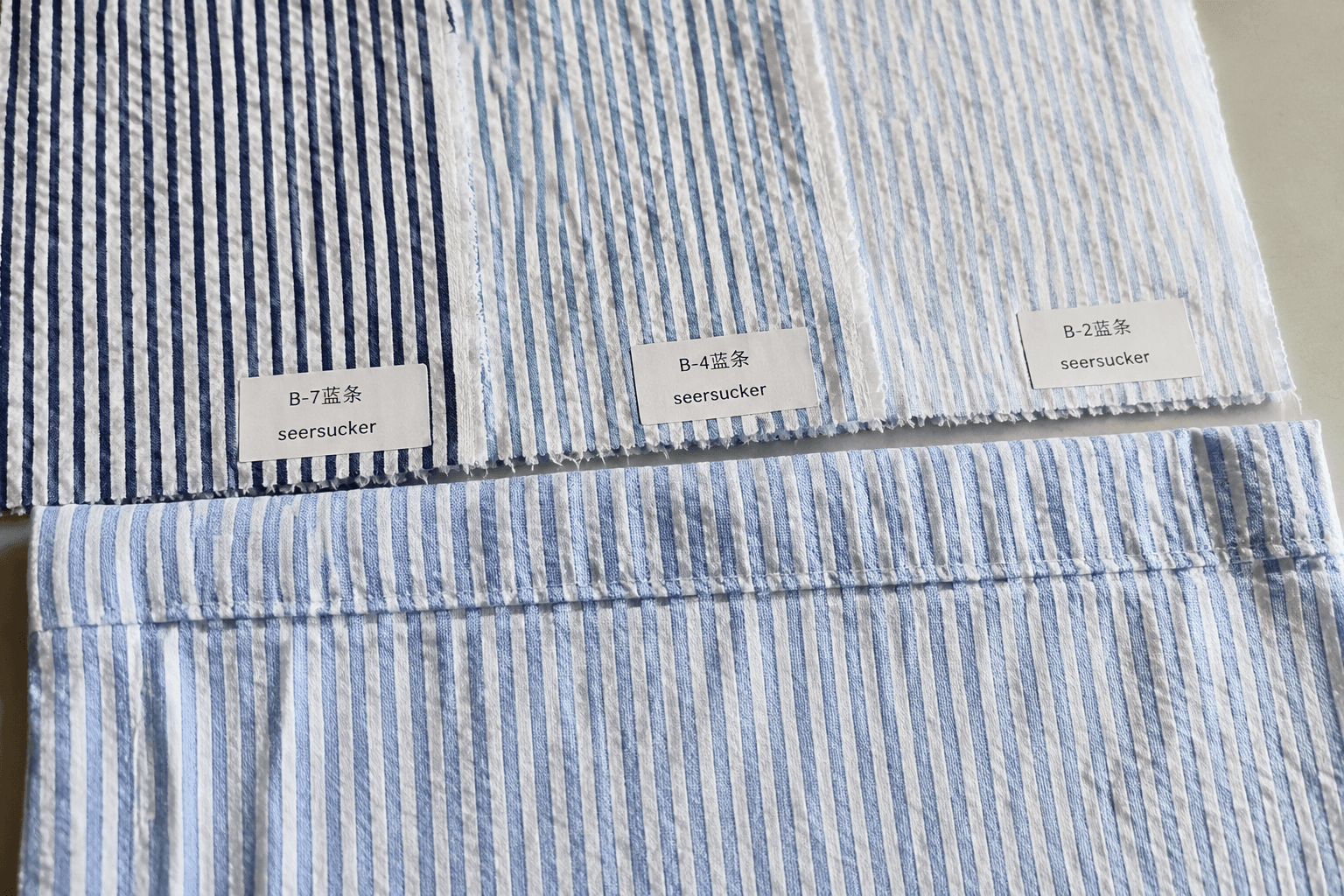
Weave matters as much as weight. A twill chef apron has diagonal ribs that help the fabric drape well and hide minor stains or abrasion better than a flat plain weave. Canvas feels firm and durable but can become rigid if the finishing is not controlled. Herringbone is visually premium but may cost more and can show shade variation if the dye lot is not managed carefully.
- 180-210 GSM: suitable for light-duty service aprons, cafe aprons and promotional programs.
- 230-280 GSM: suitable for most chef bib aprons, bistro aprons and restaurant uniform programs.
- 300-340 GSM: suitable for heavier-duty aprons, but buyers should check comfort and drying time.
- 65/35 poly-cotton twill: a practical default for bulk industrial wash apron orders.
- 80/20 cotton-poly canvas: better cotton hand, but higher shrinkage risk and often higher fabric cost.
Stain release performance: what the finish can and cannot do
A stain release apron is not the same as a stain-proof apron. The finish is designed to help oil, sauce, coffee, wine and protein stains detach more easily during washing. It does not prevent all staining during use, and it does not replace proper laundry chemistry. For chef aprons, stain release performance is most useful when staff work with cooking oil, tomato sauce, flour, chocolate, dairy or colored beverages.
In cotton-poly fabric, stain release finishing is important because polyester can attract oily soil. Without the right finish, grease may remain after washing and create gray shadow marks, especially on lighter colors such as white, natural, stone, khaki or light grey. A good finish helps the water and detergent access the stain instead of allowing oil to bond tightly with the polyester portion of the fabric.
Buyers should ask how the finish is applied and tested. For repeat OEM programs, we recommend approving fabric after at least 5 home wash cycles or 10 industrial wash simulation cycles, depending on the intended use. Some low-cost finishes look good on first inspection but lose performance after early laundering. For uniform rental or hotel laundry customers, the finish should be evaluated after 25 and 50 cycles if the apron is expected to stay in circulation for months.
- White and light-colored chef aprons need stronger stain release control than black or navy aprons.
- Oil-based stains are more difficult for polyester-rich fabric than water-based stains.
- A stain release finish may add about USD 0.08-0.25 per apron depending on fabric weight, order volume and chemistry.
- Finishing can slightly change fabric hand feel, so approval samples should use production fabric, not showroom fabric.
- Repeated high-temperature drying can reduce finish life if the chemistry is not selected for industrial laundry.
Industrial wash apron construction is more than fabric weight
Industrial laundry exposes aprons to stronger mechanical action than domestic washing. A tunnel washer, washer-extractor or commercial dryer can create abrasion, seam stress and twisting that a home machine will not. For this reason, an industrial wash apron needs a complete construction specification: fabric, thread, stitching density, reinforcement, label type and strap design all matter.
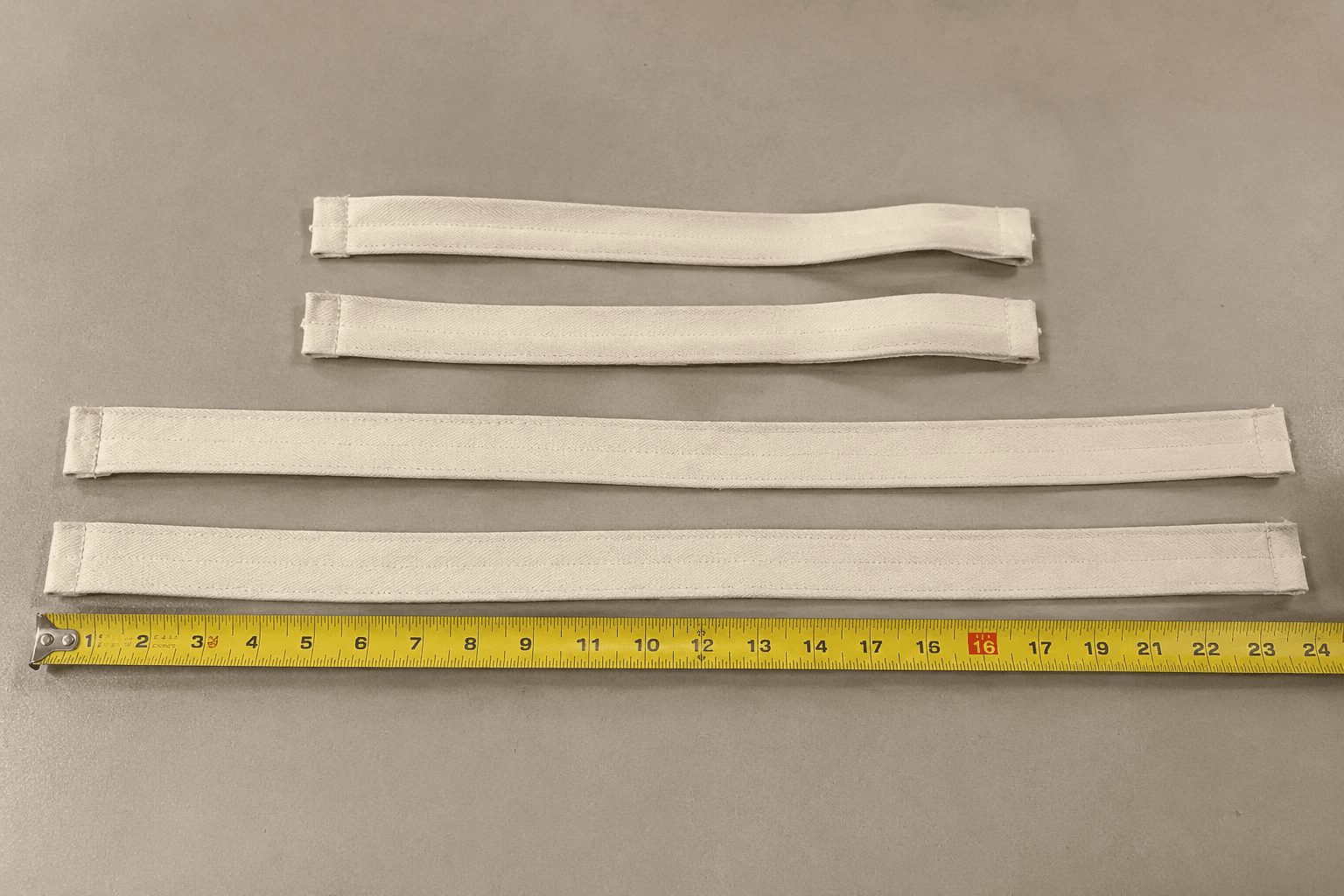
For a cotton poly chef apron used in industrial wash, we usually recommend polyester sewing thread instead of cotton thread. Ticket size depends on fabric weight, but Tex 40 to Tex 60 is common for midweight chef aprons. Stress points should be bartacked at neck strap joins, waist tie joins and pocket corners. If the apron has a large front pocket, the pocket opening should be reinforced because staff repeatedly pull thermometers, pens, order pads or towels from the same area.
Shrinkage must be controlled before size grading is finalized. A bib apron that measures 70 x 85 cm before wash may lose 1-3% in width and 2-5% in length depending on fabric ratio and finishing. For cotton-rich blends, the shrinkage can be higher if the fabric is not sanforized or compacted. Buyers should define acceptable shrinkage, for example within 3% after 5 washes or within 5% after 25 industrial wash cycles.
- Use bartacks at waist ties, neck strap attachment points and pocket corners.
- Specify polyester core or spun polyester thread for better wash durability.
- Avoid weak cotton tape ties if the apron will enter commercial laundry circulation.
- Use woven labels or heat-resistant printed labels if dryers run at high temperature.
- Confirm finished measurements both before wash and after the agreed wash test.
Color, dye fastness and shade control for twill chef apron orders
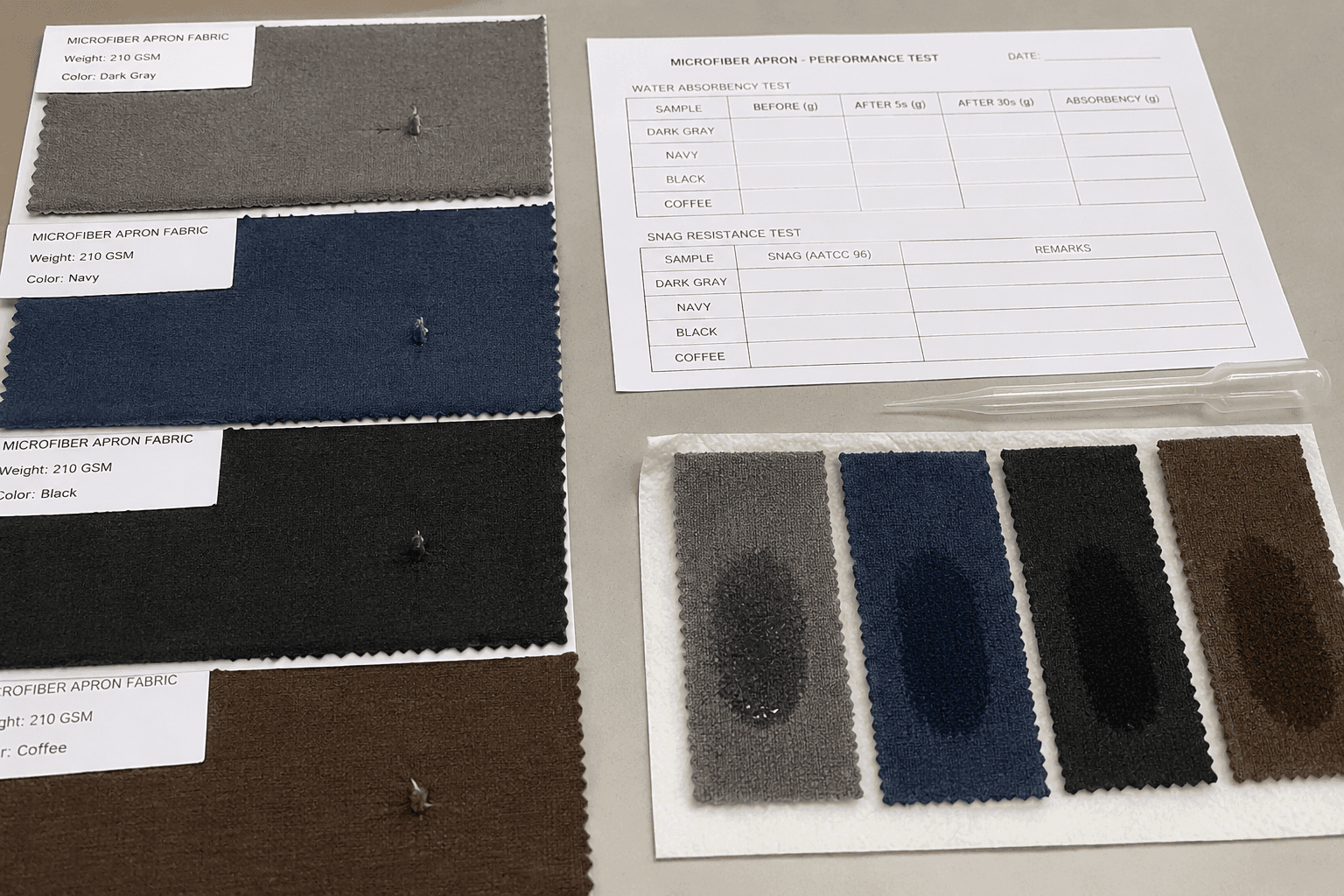
Color selection affects both appearance and performance. Black, navy, charcoal and dark brown hide stains well, but they require good dye fastness to washing, rubbing and perspiration. White and natural chef aprons look clean and traditional, but they show oil shadows and need stronger stain release. Mid-tone colors such as olive, denim blue, grey, burgundy and khaki are often practical because they balance stain visibility with brand identity.
For custom dyed cotton poly apron fabric, buyers should expect lab dip approval before bulk dyeing. Lab dips normally take 3-5 working days after the factory receives a Pantone TCX, fabric swatch or physical standard. Bulk dyeing usually adds 7-12 days compared with stock fabric. If color accuracy is critical, the buyer should approve under D65 and TL84 lighting, because restaurant and hotel environments use mixed lighting that can reveal metamerism.
Shade control is especially important when an order includes multiple apron styles in the same color, such as bib aprons, waist aprons and cross-back aprons. If fabric is dyed in separate lots, the same Pantone reference can still produce small differences. For a chain restaurant rollout, it is better to dye all related styles from one fabric lot when possible. If not possible, the buyer should define an acceptable shade tolerance before production.
- Stock colors can reduce lead time by 7-12 days compared with custom dyed fabric.
- Dark colors should be tested for dry and wet rubbing, especially when worn over white chef jackets.
- Reactive, disperse and blended dye processes must match the fiber ratio of the fabric.
- Piece-dyed fabric offers broad color choice, while yarn-dyed fabric gives a more structured visual effect at higher cost.
- Pantone matching should be confirmed on the actual chef apron fabric, not on paper or unrelated fabric.
Cost structure, MOQ and lead time for cotton poly chef apron programs
For sourcing managers, the useful question is not only whether a cotton poly chef apron performs well, but what specification reaches the target price without creating after-sales risk. In Zhejiang production, a basic 65/35 poly-cotton twill bib apron with one front pocket, adjustable neck strap and 240-260 GSM fabric may fall roughly in the USD 2.20-4.20 per piece range depending on order quantity, size, trims, packaging, testing and exchange rates. Heavier fabric, cross-back straps, metal hardware, special labels and complex pockets all move the price upward.
MOQ depends mainly on fabric availability. If a buyer chooses stock 65/35 twill in black, white, navy, grey or khaki, MOQ can often start from 300-500 pcs per color for simple OEM production, though price is better at 1,000 pcs and above. If custom dyeing is required, fabric mill MOQ may be 800-1,500 meters per color, which often translates to about 1,200-2,500 bib aprons depending on size and marker efficiency. Custom woven fabric, special stain release finishing or small-batch Pantone colors may require higher MOQ.
Lead time should be counted from confirmed sample, approved fabric and deposit, not from first inquiry. A normal stock-fabric apron order may need 20-30 days for bulk production after approval. A custom dyed cotton poly apron program may need 35-50 days, including lab dips, bulk dyeing, fabric finishing, cutting, sewing, inspection and packing. If third-party testing is required, add 5-10 working days depending on the laboratory schedule.
- Stock fabric sample: usually 3-7 working days depending on apron complexity.
- Lab dip approval: usually 3-5 working days per color round.
- Bulk production with stock fabric: usually 20-30 days after approval.
- Bulk production with custom dyed fabric: usually 35-50 days after approval.
- Estimated price impact of metal hardware: commonly USD 0.10-0.35 per apron depending on buckle and quantity.
- Estimated price impact of individual polybag packing: commonly USD 0.03-0.08 per apron.
Testing plan before placing a repeat industrial wash apron order
The best way to reduce risk is to test before scaling. For a new industrial wash apron program, buyers should approve one fit sample, one pre-production sample and one washed sample. The fit sample confirms dimensions and pocket placement. The pre-production sample confirms final fabric, trims, label, logo method and packaging. The washed sample confirms shrinkage, seam behavior, shade change and stain release after laundering.
For logo methods, embroidery is durable but may pucker on lighter cotton poly apron fabric if backing and stitch density are not controlled. Screen printing is economical for larger logos, but it must be tested for wash fastness and cracking. Heat transfer can be clean and detailed, but high-temperature industrial drying may reduce its life unless the transfer is specified for workwear laundering. For chef aprons that will be washed frequently, a small woven label or controlled embroidery is often safer than a large decorative transfer.
Inspection should include measurement tolerance and functional checks, not just visual review. AQL inspection can catch open seams, stains, shade mixing, incorrect labels, short straps, uneven pockets and poor bartacks. For apron programs, waist tie length and neck strap adjustability are often overlooked but important. A difference of 5 cm in strap length may affect how the apron fits larger staff members, especially in Western restaurant markets.
- Check shrinkage after 5, 25 or 50 wash cycles depending on expected service life.
- Measure apron width, apron length, neck strap length and waist tie length before and after washing.
- Test oil, tomato sauce, coffee and wine stains if the apron is sold as a stain release apron.
- Check seam puckering around embroidery, pockets and bartacks after drying.
- Confirm whether the accepted tolerance is plus or minus 1 cm, 1.5 cm or 2 cm by measurement point.
- Keep one sealed approval sample at the factory and one with the buyer for final comparison.
How to write a clear cotton poly chef apron specification
A good purchase specification should be detailed enough for the factory and fabric mill to quote the same product every time. Describing an item only as a black cotton poly chef apron is not enough. The factory still needs fabric ratio, GSM, weave, finished size, pocket layout, strap type, logo method, color standard, wash requirement, packing method and inspection standard.
For example, a practical specification could read: 65/35 polyester-cotton twill, 250 GSM, piece dyed black to approved lab dip, stain release finish, bib apron size 70 x 86 cm, adjustable neck strap with plastic slider, two waist ties 95 cm each, one divided front pocket, polyester thread, bartacks at stress points, shrinkage within 3% after 5 washes, individual polybag, carton packed. This level of detail gives both buyer and supplier a shared reference when reviewing samples, pricing and inspection results.
For long-term sourcing, the specification should also record what is not acceptable: no fabric substitution without approval, no mixed dye lots within one carton, no change to pocket size, no change to label position and no replacement of trims after sample approval. These controls are practical, not bureaucratic. They protect consistency when the order moves from sampling to bulk cutting and when repeat orders are placed months later.
- Define fiber ratio, GSM and weave instead of using only the term cotton poly.
- Specify whether the apron is for domestic wash, hotel laundry or industrial wash.
- State the color standard and approval method before bulk dyeing begins.
- List reinforcement points, thread type and pocket construction.
- Record logo method, logo size and exact placement from the top edge or pocket edge.
- Keep the approved fabric swatch and sealed sample as the standard for repeat orders.