Buyers sourcing deli counter aprons for olive oil, vinegar and prepared-food counters are usually managing repetitive light contamination rather than continuous liquid pressure. The real exposure pattern is bottle-neck drips, refill splash, brine transfer at the service edge, oil smears on the lower bib and frequent hand wipe contact. In most stores, staff need an apron that buys a 15-30 second wipe window, keeps the front panel presentable in customer view and stays comfortable through an 8-10 hour shift.
That operating reality makes many heavy waterproof constructions the wrong commercial choice. PVC, TPU and thick PU-coated aprons can block liquid effectively, but they commonly run 320-450 GSM, trap heat under retail lighting and feel rigid at the bib, hem and tie points. Most front-of-house programs get better wear acceptance from 200-230 GSM woven twill with a fluorine-free C0 repellent or a very light PU-assisted finish that slows absorption without making the apron glossy, noisy or hard to knot.
From a sourcing standpoint, performance depends on four variables working together: fiber blend, fabric density, finish chemistry and sewing layout. Over-specify one variable and another problem appears. A soft cotton-rich apron without finish stains too quickly. A heavily coated apron resists splash but loses drape and mobility. The best commercial decision for deli counter aprons balances stain control, wash durability, MOQ, lead time and replacement cost across the full uniform cycle.
- For most deli counter aprons, the practical weight target is 200-230 GSM with light splash resistance, not full waterproof coating.
- The most common bulk fabric for this category is 65/35 or 80/20 poly-cotton twill, usually with MOQ of 800-1,500 pcs per style depending on color route and finish.
- A light repellent finish typically adds $0.18-$0.45 per piece; once coating adds about 20-30 GSM, wearer complaints usually increase.
- Bulk approval should test olive oil and vinegar separately at 15 seconds, 30 seconds and 2 minutes, then re-check after 5, 10 and 20 washes.
- Useful construction details include 80-88 cm body length, 75-95 cm waist ties, reinforced pocket corners, metal neck hardware and a pocket layout matched to deli counter tasks.
Why deli counter aprons should be specified for splash resistance, not full waterproofing
Many buying briefs start with the word "waterproof," but that is usually the wrong starting point for olive oil and vinegar service. Front-counter staff face intermittent splash, bottle drips, ladle contact, brine transfer and repeated food smears on the front body. They are not typically working in hose-down sanitation, fish-processing lines or standing wash water. When an apron is specified like industrial PPE instead of retail workwear, staff acceptance drops quickly and replacement requests often rise within the first 30-60 days of issue.
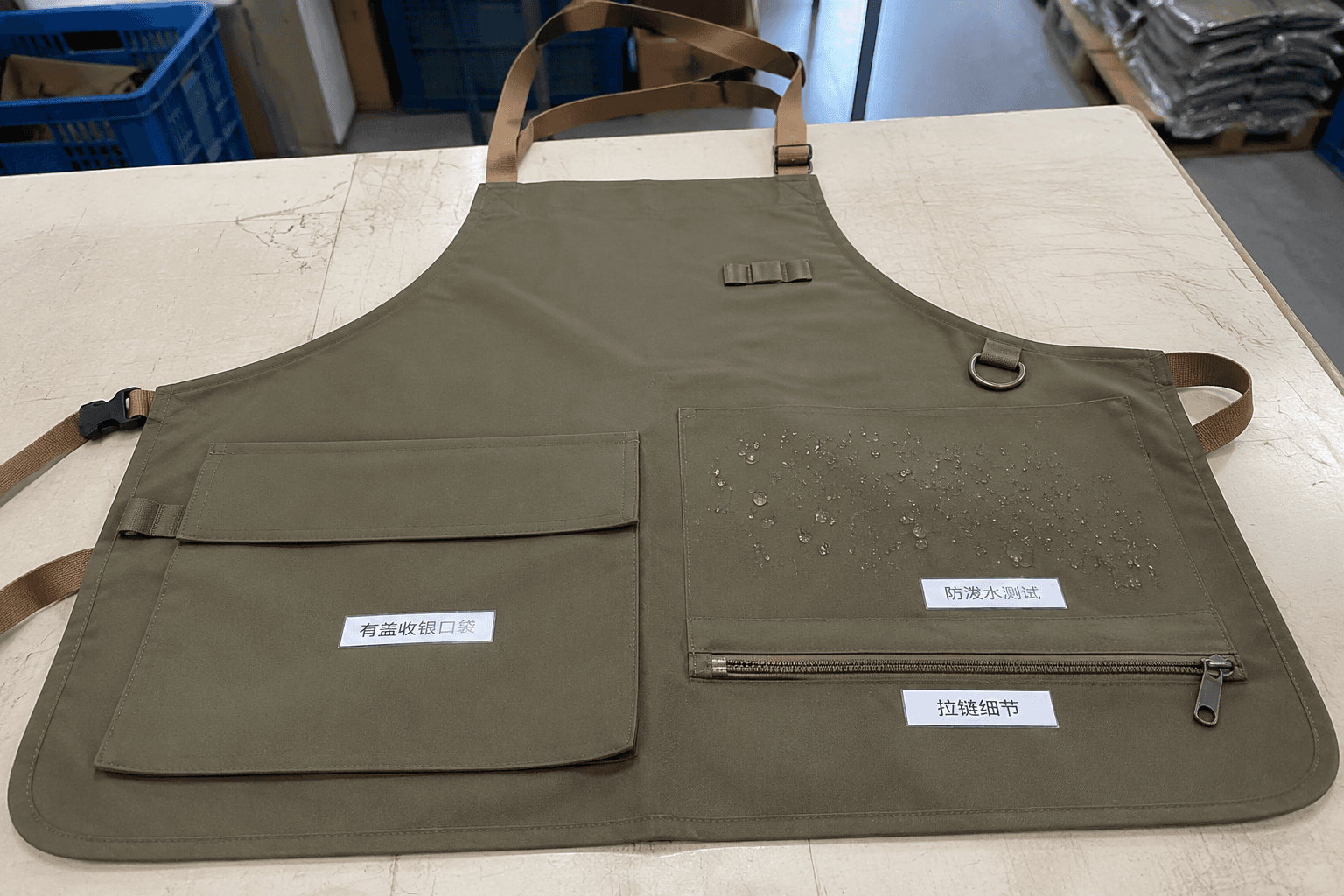
True waterproof aprons normally use PVC, TPU or heavier PU lamination over a textile base. These constructions commonly sit at 320-450 GSM and create visible bulk at hems, bib folds and pocket joins. That extra mass changes drape, makes embroidery and topstitching less clean and pushes FOB cost above what many deli chains want to pay for a garment with regular replacement. By contrast, most deli counter aprons only need enough repellency to buy time for a wipe before oil, vinegar or brine penetrates deeply.
For B2B buyers, the more useful specification is controlled splash resistance with stable appearance after washing. A woven apron that delays wetting for 15-30 seconds, wipes with limited shadow staining and holds shape after repeated laundering is usually more valuable than a heavier barrier apron that blocks more liquid but wears poorly at the counter.
Best fabric specifications for deli counter aprons handling oil and vinegar
For most commercial programs, woven twill is the most dependable base cloth. Compared with knit fabrics or open canvas, twill gives tighter yarn packing, cleaner logo presentation and better dimensional stability after laundering. In current factory practice, the strongest working options for deli counter aprons are 65/35 poly-cotton twill at 205-230 GSM, 80/20 poly-cotton twill at 200-220 GSM and dense 100% polyester twill at 210-230 GSM.
Each blend solves a different operational problem. A 65/35 poly-cotton twill is usually the broadest commercial choice because it balances hand feel, sewing stability and cost. An 80/20 blend reduces absorbency and dries faster after spot cleaning, which helps in high-turnover prepared-food counters, although the hand is slightly firmer. Dense polyester twill offers stronger colorfastness and lower moisture uptake, but some wearers find it warmer under strong store lighting or limited air circulation.
Cotton-rich fabrics can still work when brand image requires a softer, matte presentation, but the specification has to be realistic. A 240-260 GSM cotton-rich twill may look premium on a hanger, yet it will take oil faster than a polyester-rich twill if the finish is weak or inconsistent. Vinegar exposure also exposes low-density fabrics quickly because open constructions allow liquid to spread through yarn gaps and leave visible rings after drying. For that reason, buyers should evaluate density, not just fiber content and fabric weight.
- 65/35 poly-cotton twill, 205-230 GSM: balanced cost, stable sewing, broadest retail use
- 80/20 poly-cotton twill, 200-220 GSM: lower absorbency, quicker drying, slightly firmer hand
- 100% polyester twill, 210-230 GSM: strong color retention and stain resistance, can feel warmer
- Cotton-rich twill, 240-260 GSM: softer premium look, but higher oil-mark risk unless finish quality is tightly controlled
Finish chemistry for deli counter aprons: wipe window, stain control and wash durability
The finish usually decides whether an apron performs like usable front-of-house uniform stock or just standard twill that darkens too quickly. Buyers often combine water repellency, stain resistance and waterproofing into one request, but these are different targets with different cost and handling consequences. A light repellent finish helps liquid bead on the surface. A stain-release system improves wash-out later. A coating or membrane gives stronger barrier performance but changes hand feel much more aggressively.
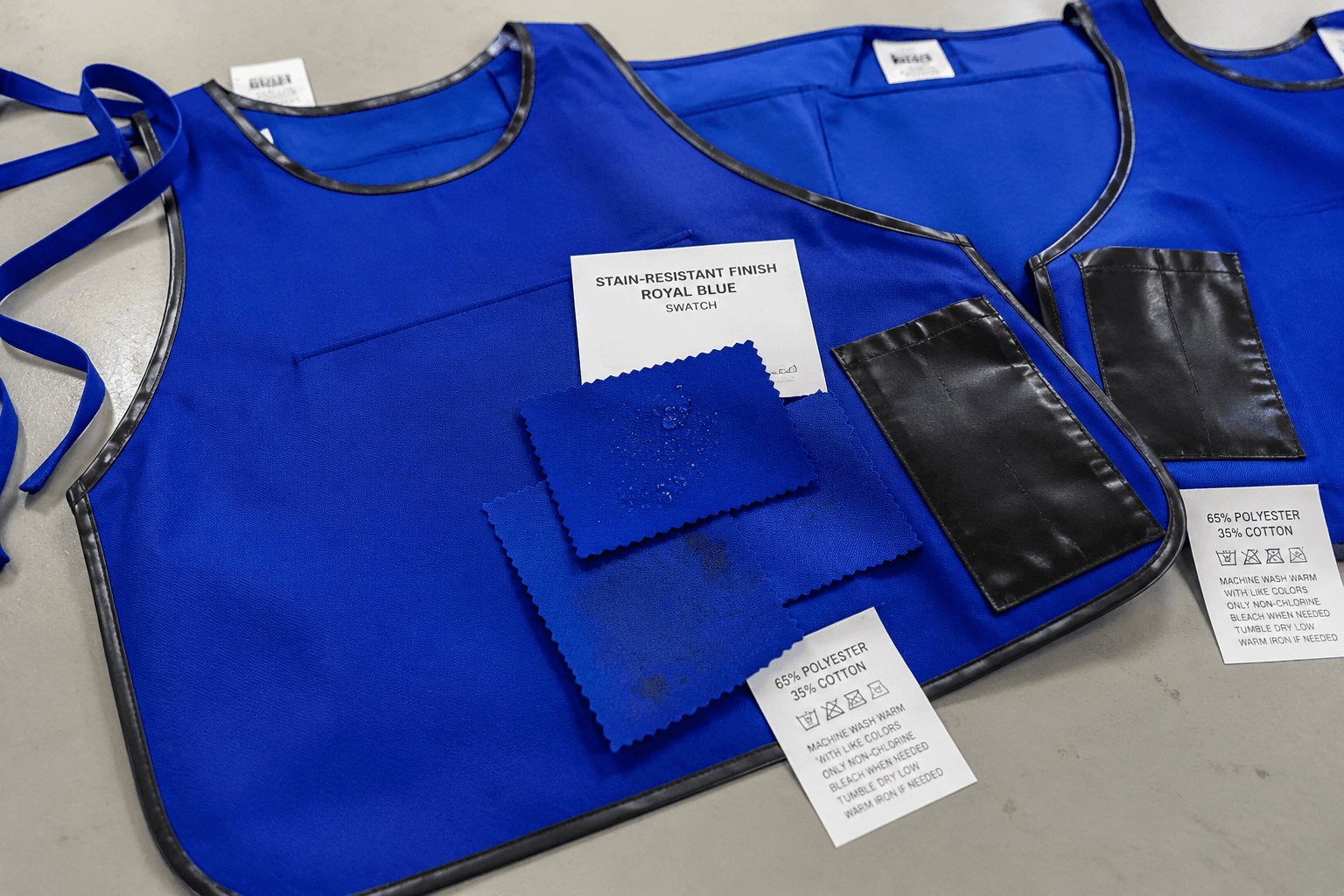
For olive oil, no light finish will make a woven apron fully oil-proof. Oil has lower surface tension than water-based splash, so the realistic target is delayed absorption, easier wipe-off and reduced shadow staining after laundering. For vinegar, buyers need to monitor not only wetting but also ring marks, odor retention and finish loss after repeated washing. In current sourcing, fluorine-free C0 repellents and light PU-assisted top finishes are the most common routes for this category, but results vary sharply by mill application quality, curing control and fabric density.
For buyer briefs that prioritize comfort, the safest route is a dense twill with a light pad-cure finish. That approach preserves flexibility, keeps the apron easy to fold and avoids an overly reflective surface under retail lighting. Where the front body needs more resistance, a very light top finish can be added, but the total add-on should be controlled carefully. Once coating adds roughly 20-30 GSM, the bib often feels flatter, tying becomes less natural and the apron starts to read as back-of-house protective wear rather than customer-facing apparel.
- Indicative finish cost add-on: $0.18-$0.45 per piece at scale
- Noticeable stiffness often starts when coating adds about 20-30 GSM
- Practical approval target: delayed spread or beading for 15-30 seconds before wiping
- Wash checks should cover at least 5, 10 and 20 cycles, not pre-wash appearance only
Construction details that make deli counter aprons work on shift
Fabric selection gets most of the attention, but weak construction can undermine a sound material choice. Deli staff lean over counters, reach for bottles, turn between scales and wrapping stations and carry towels, pens and labels through the shift. If the bib is too narrow, splash lands outside the protected area. If waist ties are too short, staff over-tighten knots and stress the side seams. If pockets are too large and undivided, they collect crumbs, oil residue and mixed tools that slow service.
For most unisex retail programs, bib width of 26-30 cm, body width of 70-75 cm and body length of 80-88 cm are practical starting points. These dimensions cover the main splash zone without making the apron look oversized on smaller staff. Neck adjustment should use metal hardware or a reinforced self-fabric slider that has already passed laundering checks. Low-grade plastic adjusters fail too often in tumble drying and repeated wash cycles, and replacement trims rarely match the approved color or finish.
Pocket layout should follow real counter tasks rather than standard chef-apron templates. One large kangaroo pocket may look clean on a tech pack, but it is less efficient in use. A divided lower pocket, one narrow pen channel and a side towel loop usually work better for deli service. Bartacks at pocket corners, tie joins and towel loops add very little unit cost, often only $0.04-$0.08 per piece, but they reduce common field failures and extend service life.
- Recommended body length: 80-88 cm
- Recommended waist tie length: 75-95 cm per side depending on fit target
- Preferred neck hardware: metal adjusters or wash-tested self-fabric sliders
- Suggested bulk inspection standard: AQL 2.5 major / 4.0 minor for sewing and appearance defects
FOB cost, MOQ and lead-time benchmarks for custom deli counter aprons
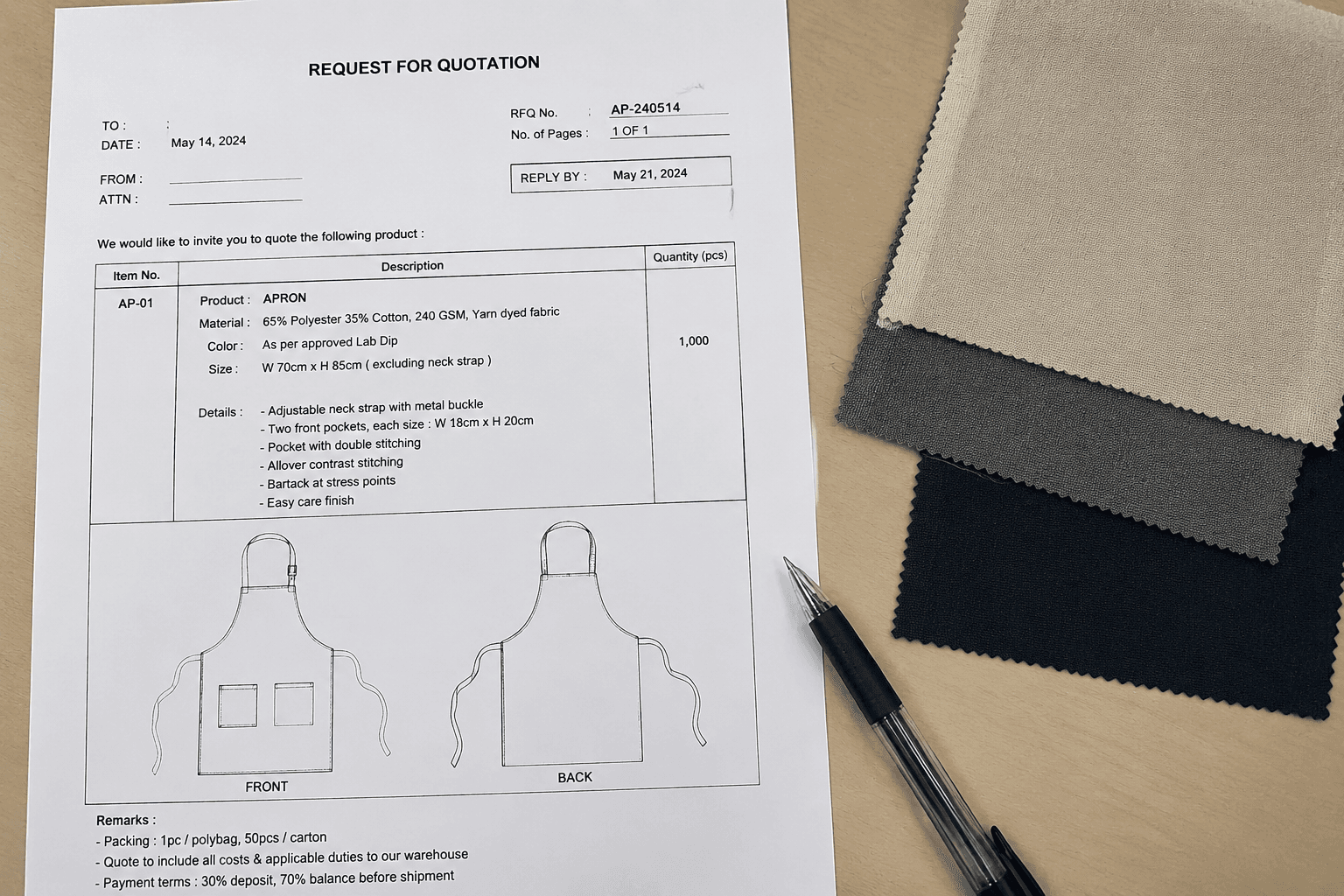
In apron sourcing, cost is driven first by fabric and finish, then by logo method, trim count and packaging detail. Buyers often negotiate sewing cost aggressively while leaving the finish requirement vague, which makes supplier quotations difficult to compare. For splash-resistant deli counter aprons, the costing sheet should separate base cloth, finish type, logo application, neck hardware, pocket construction, packaging and any store-level barcode or polybag requirement.
As a realistic FOB China range, a standard bib apron in 205-220 GSM 65/35 poly-cotton twill with one screen print, adjustable neck and divided front pocket commonly lands at $2.20-$3.30 per piece at 2,000 pcs. Adding a stronger repellent finish usually shifts that to $2.45-$3.75 per piece. If the buyer moves to recycled polyester, embroidery, custom metal trims, yarn-dyed fabric or individual store labeling, pricing can rise to $3.90-$5.20 per piece. Orders below 1,000 pcs usually carry a visible surcharge because finish MOQs, marker efficiency and trim minimums are less favorable.
MOQ planning should start with fabric-mill reality, not only garment-factory capacity. A sewing line may accept 500 pcs, but a custom-dyed fabric with a special finish can still require 800-1,500 meters per color at mill level. Stock black, charcoal and deep olive reduce this pressure and usually shorten the calendar. For repeat programs, fixing one or two standard body fabrics across multiple logo variants is often the cleanest way to control both unit cost and replenishment speed.
- Indicative FOB price at 2,000 pcs, standard custom bib apron: $2.20-$3.30 per piece
- Indicative FOB price with upgraded splash finish: $2.45-$3.75 per piece
- Sample development lead time: 7-12 days with standard fabric routes; 12-18 days with custom finish confirmation
- Bulk lead time: 25-35 days with stock fabric; 35-45 days with custom dye and finish
Bulk testing standards before approving deli counter aprons for production
One of the most common sourcing failures in this category is approving a salesman sample on appearance and hand feel alone. A professional approval process should challenge the apron with actual deli contaminants: olive oil, white vinegar, balsamic vinegar and at least one prepared-food smear such as marinade or brine-based sauce. The aim is not lab-grade perfection. The aim is to measure how fast liquid spreads, how cleanly the surface wipes, how much shadow remains after laundering and whether the apron still feels commercially acceptable after repeated care cycles.
A practical protocol is simple enough for both buyer and supplier to repeat. Apply measured drops or a controlled splash to the bib and lower front body, record the surface at 15 seconds, 30 seconds and 2 minutes, then wipe with a standard cloth and consistent hand pressure. After that, launder the sample 5 times for early screening, 10 times for approval and 20 times if the program expects longer service life or mixed laundry conditions. The review should also include color change, seam roping, hardware stability, shrinkage and any loss of drape between tested and untested areas.
Shipment approval should rely on written metrics rather than broad phrases such as "good splash resistance." A clear protocol reduces later claims and makes accountability easier across mill, factory and buyer. In practice, buyers should set maximum shrinkage at 3%, define acceptable stain shadow after 10 washes, prohibit broken bartacks or failed neck hardware and confirm bulk inspection at AQL 2.5 major and 4.0 minor. Those details prevent most avoidable disputes.
- Test liquids: olive oil, white vinegar, balsamic vinegar and one prepared-food smear
- Record wipe result at 15 seconds, 30 seconds and 2 minutes after application
- Typical shrinkage target: within 3% under the agreed wash method
- Written bulk standard should define stain shadow, seam integrity, hardware durability and AQL level
How to match deli counter aprons to brand image and replacement cycle
The right apron specification depends on how the buyer plans to use, launder and replace the garment. If a retailer rotates uniforms every 90-120 days, a 200-210 GSM poly-cotton twill apron with a light finish may be commercially sufficient. If the target wear life is 6-12 months across multiple stores, it usually makes sense to move to a denser 210-230 GSM base cloth, stronger bartack reinforcement and a more durable finish application. The lowest first cost often becomes the highest annual cost once replacement frequency, staff complaints and small repeat orders are counted.
Brand presentation matters as much as service life. Premium olive oil boutiques and natural-food concepts often prefer a matte surface, softer hand and quieter drape, even if absolute repellency is slightly lower. High-volume prepared-food counters usually prioritize darker shades, quicker drying and lower visible staining. In both cases, successful deli counter aprons are specified around actual store workflow rather than copied from chef uniforms or industrial protective wear.
For most B2B buyers, the safest development path is to compare two or three realistic fabric-finish combinations side by side, wash them repeatedly and make the branding decision only after performance is confirmed. That sequence protects launch budgets and avoids a common sourcing error: approving a presentation sample that looks good on day one but performs poorly once oil, vinegar and daily laundering start to accumulate.
- Short replacement-cycle programs usually prioritize controlled cost, clean drape and acceptable front-of-house appearance
- Longer-life programs should prioritize finish durability, bartack reinforcement and color stability
- Dark shades such as black, charcoal, deep olive and dark brown usually hide oil marks better than beige or stone
- Logo embroidery should stay out of the main splash zone because dense stitching can trap residue and alter drape