Choosing between apron styles is not only a design decision. For a buyer placing 500, 5,000, or 50,000 units, the style affects fabric consumption, sewing minutes, packaging volume, trim sourcing, size grading, compliance testing, and final landed cost. A bib apron, waist apron, bistro apron, and crossback apron can all look simple on a showroom rail, but they behave very differently on a production line.
From a factory perspective, the most common problems come from matching the wrong apron construction to the work environment. A cafe brand may select a heavy 12 oz canvas bib apron for visual identity, then find staff reject it in hot kitchens. A hotel group may order a short waist apron with too few pockets, then request a costly rework after sampling. A retail brand may specify crossback straps without considering strap length, hardware, and size range.
This guide compares the main apron styles in practical sourcing terms: coverage, fit, fabric GSM, typical unit price drivers, order quantities, sample timing, and where each construction performs best. The numbers below reflect normal custom production in China, assuming OEM manufacturing with buyer-supplied artwork or factory-developed tech packs.
- Bib aprons give the best front-body coverage but require careful neck or strap engineering for comfort.
- Waist aprons are usually the lowest-cost apron style because fabric use and sewing operations are limited.
- Crossback aprons reduce neck pressure but increase labor cost, strap consumption, and fit-control requirements.
- Bistro aprons work well for service teams needing a clean uniform look with moderate fabric weight.
- Fabric weight should match the job: 180-240 GSM for light service, 240-320 GSM for daily hospitality, and 320-450 GSM for workshop or premium retail use.
- For custom apron styles, sampling normally takes 5-10 days and bulk production usually takes 20-35 days after fabric and trims are approved.
How apron styles affect sourcing cost and production risk
Apron styles should be reviewed as production formats, not only silhouettes. A small change in shape can change fabric yield by 8-25%, especially when the apron has a wide bib, curved armholes, long waist ties, or separate straps. For a 5,000-piece order, this can mean hundreds of meters of additional fabric. If the fabric is a dyed 10 oz cotton canvas at 150 cm width, the difference is visible in both material cost and cutting efficiency.
The simplest apron style is usually a waist apron with one front panel, hemmed edges, waistband ties, and optional pockets. A standard short waist apron may use 0.28-0.42 meters of fabric per piece, depending on width and pocket layout. A full bib apron often uses 0.65-0.95 meters. A crossback apron can use a similar body panel to a bib apron but adds longer straps, hardware, bar tacks, and more sewing time. That is why two aprons using the same 280 GSM twill can have very different FOB prices.
Buyers should also consider risk during size approval. Waist aprons are flexible because they tie around the waist and do not need to fit the torso. Bib aprons need bib width, neck drop, and tie position checked. Crossback aprons need even more control because the strap path crosses the back and changes how the bib sits on different body heights. For mixed staff groups, we normally recommend testing one-size samples on at least three body types before approving bulk production.
- Typical sampling time is 5-7 days for waist or simple bib aprons, and 7-10 days for crossback aprons with metal hardware or complex pockets.
- Normal MOQ is 300-500 pcs per color for stock fabric, and 1,000-2,000 pcs per color for custom-dyed cotton or poly-cotton fabric.
- Factory FOB pricing for basic custom aprons often starts around US$1.20-2.20 for simple waist aprons, US$2.20-4.80 for bib aprons, and US$4.20-8.50 for heavier crossback aprons, depending on fabric, trims, and order size.
- Bulk lead time is commonly 20-25 days for available fabric and 30-45 days when custom dyeing, yarn-dyed stripes, or special hardware is required.
Bib apron: the standard full-coverage work style
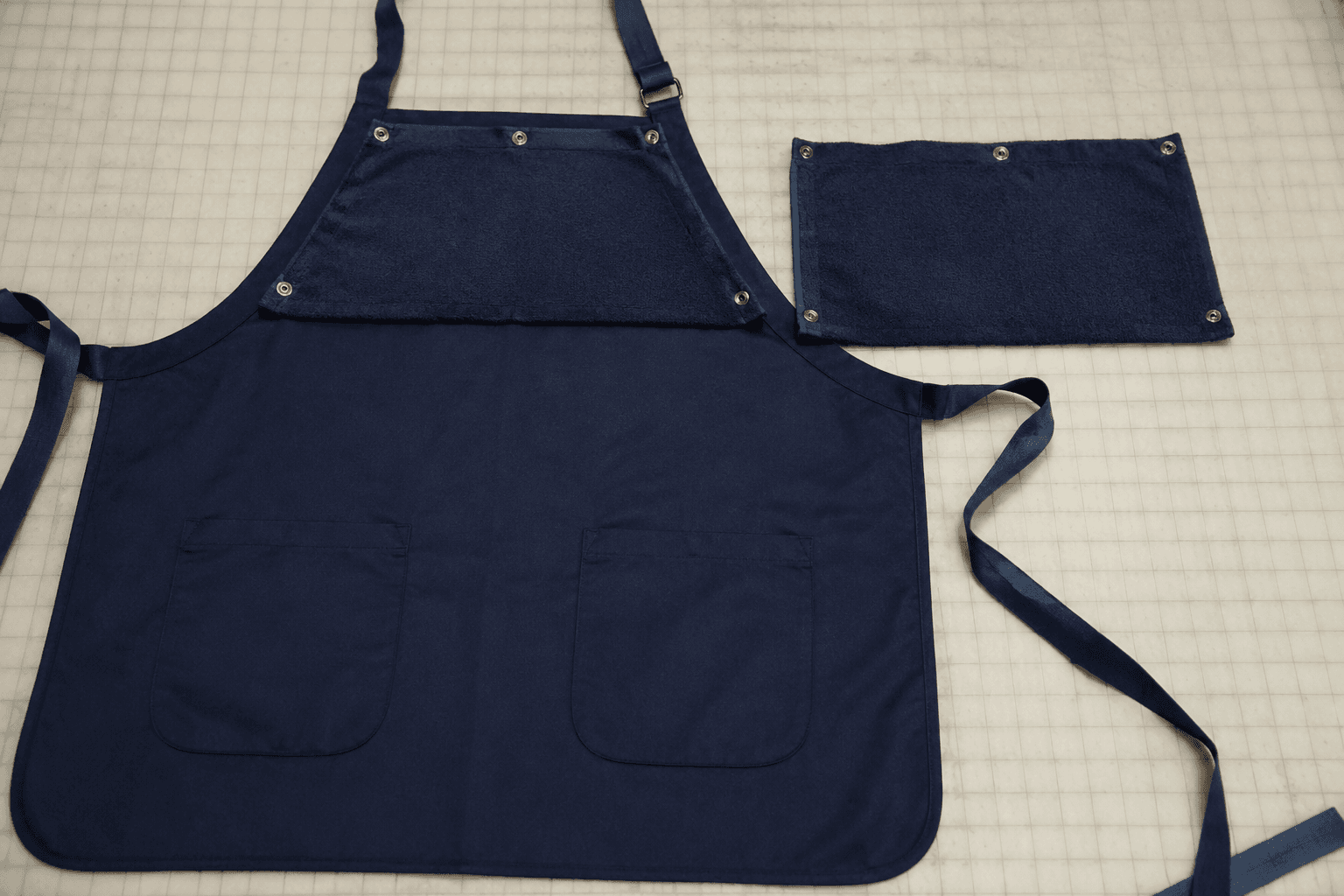
The bib apron is the most widely ordered full-coverage apron style for restaurants, cafes, bakeries, beverage chains, florists, craft workshops, and promotional uniform programs. It covers the chest and front waist area, so it protects staff uniforms better than a waist apron. For buyers who need a single apron family across kitchen, service, and front-of-house roles, the bib apron is usually the starting point.
A common adult bib apron measures around 70-75 cm wide by 80-90 cm long. Economy versions may use 180-220 GSM poly-cotton twill, while better hospitality programs often use 240-320 GSM cotton twill, canvas, or TC blend. Premium retail and workwear-inspired versions may use 10-12 oz cotton canvas or denim, roughly 340-410 GSM. Above 450 GSM, the apron can look substantial, but it becomes warmer, slower to dry, and more expensive to ship.
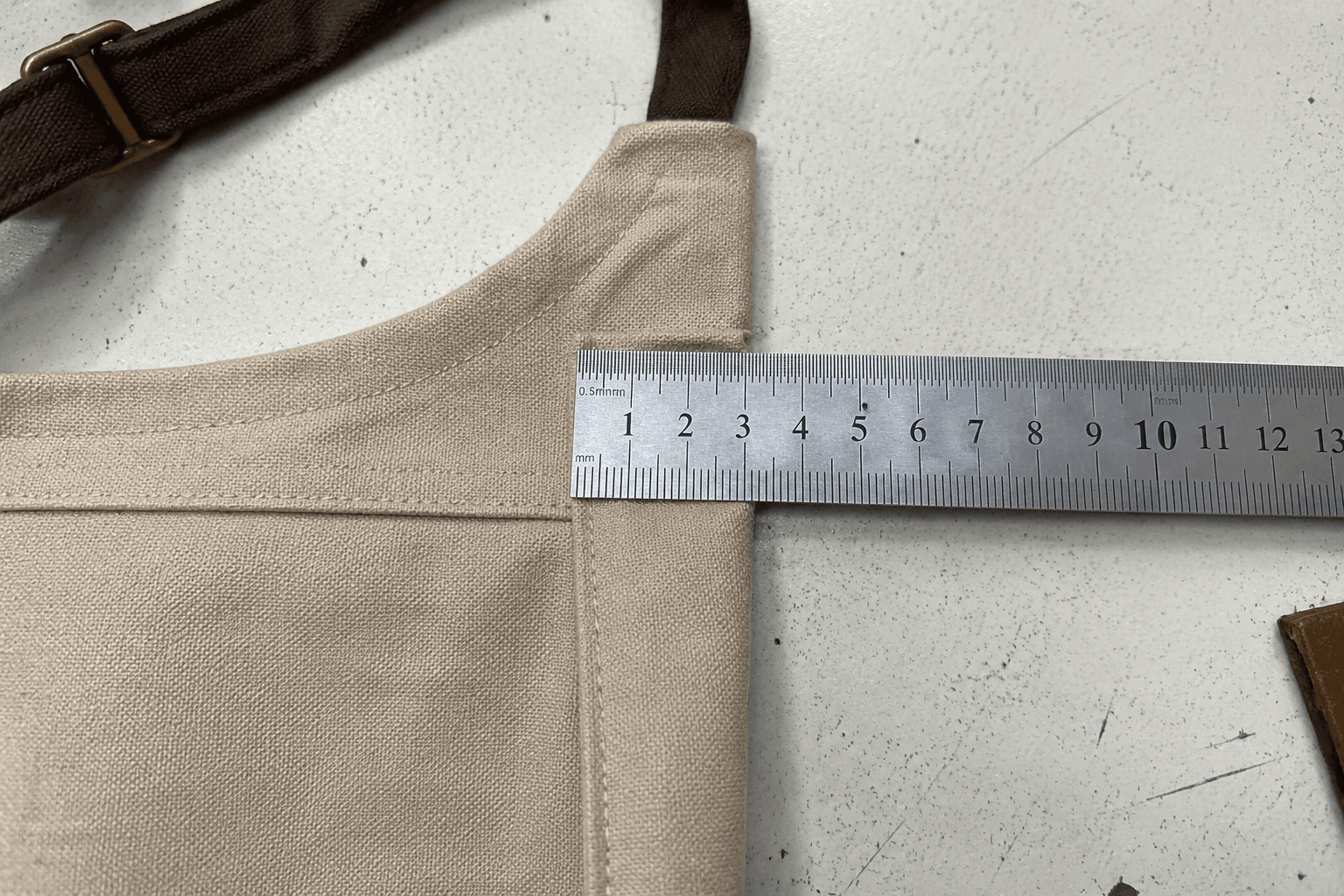
The neck construction is the main comfort issue. A fixed neck loop is cheapest, but it fits only an average body range. Adjustable metal buckle neck straps improve sizing but add hardware cost and inspection points. Cotton webbing neck straps feel stable, while self-fabric straps give a cleaner retail look but can twist after washing if too narrow. For high-volume uniform use, we often recommend adjustable neck or adjustable side-tie construction, especially when one size must fit both male and female staff.
- Best use cases include cafes, bakeries, restaurants, barista uniforms, workshops, garden centers, and branded promotional aprons.
- Common fabrics include 200 GSM poly-cotton twill, 260 GSM cotton twill, 320 GSM cotton canvas, 10 oz denim, and 12 oz canvas for heavier programs.
- Cost drivers include bib width, pocket count, neck adjuster type, embroidery size, webbing quality, and whether straps are self-fabric or tape.
- Key quality checks include bib symmetry, neck strap length, pocket alignment, bar tack strength, colorfastness to washing, and shrinkage after laundering.
Waist apron and bistro apron: efficient styles for service teams
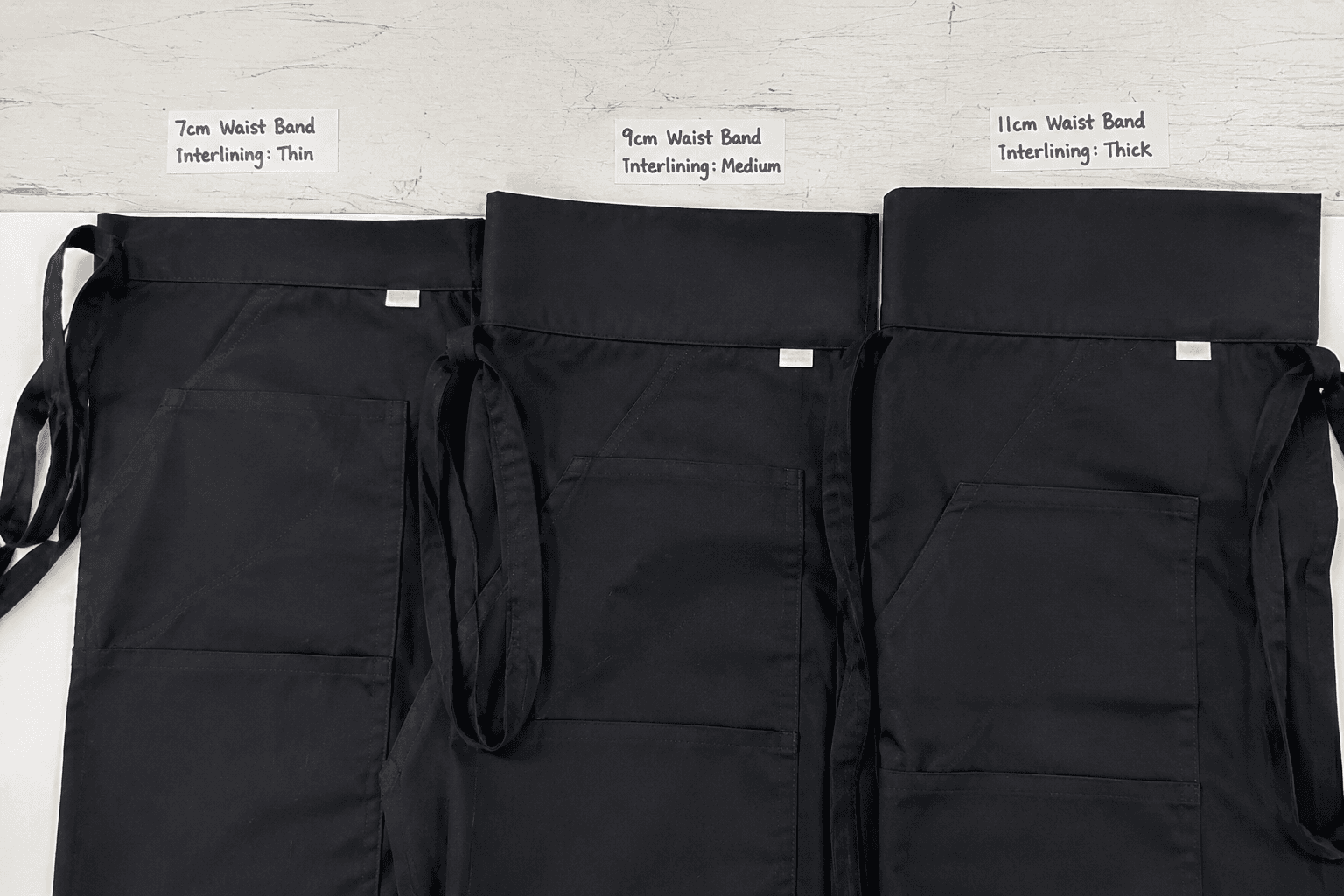
The waist apron is the most cost-efficient option when chest protection is not required. It is used heavily in cafes, quick-service restaurants, hotels, bars, cleaning service, catering, and event staffing. The short waist apron usually finishes above the knee and focuses on pocket utility. A bistro apron is a longer waist apron, often knee-length or below-knee, used when the buyer wants a cleaner, more formal front-of-house look.
For sourcing, the waist apron has several advantages. It uses less fabric than a bib apron, packs flatter, and has fewer fit problems. Most designs can be produced in one size with long waist ties. Sewing time is relatively low unless there are multiple pockets, zipper compartments, contrast trims, or reinforced tool loops. A simple three-pocket waist apron in 220 GSM TC twill is often one of the lowest-risk custom apron items for first-time buyers.
The main trade-off is protection. A short waist apron protects only the lap and upper thigh area. It is not suitable for messy kitchen preparation, wet bar work, pottery, painting, or outdoor work where chest coverage is needed. The bistro apron gives more leg coverage but can restrict movement if too narrow. For waitstaff who walk quickly and bend often, a back slit, side slit, or softer 240-280 GSM fabric may improve comfort.
- Short waist aprons commonly measure 50-70 cm wide by 30-45 cm long, with 85-100 cm ties on each side.
- Bistro aprons commonly measure 70-90 cm wide by 70-85 cm long, depending on the target market and uniform style.
- A practical fabric range is 180-240 GSM for promotional or event use, 240-300 GSM for hospitality uniforms, and 300-360 GSM for premium bistro styling.
- Pocket layouts should be confirmed by use case: pen slots for servers, wider patch pockets for order pads, and divided lower pockets for tools or cloths.
Crossback apron: comfort benefits with higher production control
The crossback apron has become popular in coffee, bakery, florist, craft, and premium hospitality programs because it removes pressure from the neck. Instead of hanging from a neck loop, the straps cross over the shoulders and tie or fasten at the waist. For staff wearing aprons for 6-10 hours per shift, this can be a real comfort benefit, especially with heavier canvas or denim bodies.
From a manufacturing viewpoint, the crossback apron is not just a bib apron with different straps. Strap length, crossing point, waist attachment position, and hardware all affect fit. If the straps are too short, the bib pulls up and the waistline sits high. If too long, the bib drops forward and gapes. If hardware is used, the metal ring, button, or buckle must be tested for rust resistance, coating durability, and strength after washing.
Crossback styles are normally more expensive because they require longer straps and more labor. A 280 GSM cotton twill bib apron with a simple neck loop may require 10-14 sewing minutes. A crossback version with detachable straps, metal eyelets, and reinforced stress points may require 16-24 sewing minutes, depending on factory layout and pocket complexity. In FOB terms, the difference can be US$0.60-1.80 per piece for mid-volume orders, and more if the fabric is heavy or the hardware is custom.
- Use crossback construction when staff comfort and brand presentation justify the added cost.
- Avoid overly heavy fabric unless the buyer has tested movement and heat comfort in real working conditions.
- Specify strap width clearly; 2.5-3.5 cm is common for fabric straps, while 3.0-4.0 cm may be better for heavier canvas.
- Request fit photos on different body sizes before approving bulk production, especially for one-size crossback aprons.
- For detachable straps, confirm spare strap policy, attachment strength, and whether laundering may cause twisting or tangling.
Comparing apron styles by fabric, GSM, and washing performance
Fabric choice should be decided together with apron style. A 220 GSM TC twill can work well for a waist apron because the garment is smaller and does not need to carry much structure. The same fabric may look too light on a premium crossback apron. A 12 oz canvas may look strong on a crossback or work apron, but it can be excessive for a bistro apron used in a warm dining room.
For hospitality programs, we usually see three practical fabric zones. Light service aprons use 180-240 GSM fabric, often polyester-cotton or polyester-rich twill, where cost, colorfastness, and quick drying matter. Mid-weight aprons use 240-320 GSM cotton twill, TC twill, or canvas, balancing durability and comfort. Heavy aprons use 320-450 GSM canvas, denim, or duck fabric for barista, craft, workshop, and retail brand positioning. Above that range, sampling becomes important because the garment may feel stiff and increase freight weight.
Washing performance is often underestimated. Cotton aprons can shrink 3-8% depending on fabric construction and finishing. Garment washing or pre-shrinking can reduce buyer complaints but adds cost and 3-7 production days. Polyester-cotton blends generally shrink less, often 1-3%, and dry faster, but they may not have the same natural handfeel. Dark colors such as black, navy, charcoal, and deep green require colorfastness checks, especially if the apron will be washed industrially.
- For bib apron programs, 240-320 GSM is a reliable range for daily hospitality use.
- For waist apron programs, 200-280 GSM is often enough unless the buyer needs a premium retail handfeel.
- For crossback apron programs, 280-380 GSM usually gives structure without becoming too heavy for long shifts.
- For bistro apron programs, 240-300 GSM gives a clean drape while keeping walking comfort acceptable.
- For stonewashed or enzyme-washed styles, allow extra tolerance in shade and finished measurements because each batch may vary slightly.
Pockets, trims, and branding decisions that change the apron quote
Many buyers compare apron styles using only body shape and fabric, but pockets and trims often create the larger cost difference. A plain bib apron and a four-pocket bib apron may look similar in a catalog, but the second style requires more cutting pieces, folding operations, pocket topstitching, bartacks, alignment checks, and sometimes reinforcement fabric. On a large order, pocket complexity can change both FOB cost and defect rate.
Branding also needs early technical review. Embroidery is durable and suitable for premium uniforms, but large embroidery on heavy canvas can increase needle breakage and production time. Screen printing is cost-effective for simple logos or promotional programs, but the print handfeel and wash durability must match the apron fabric. Heat transfer can work for small logos and sharp details, but it may not be ideal for high-temperature industrial laundry. Woven labels, leather patches, rubber patches, and metal rivets each add their own MOQ and lead-time considerations.
Trims should be selected according to the real use environment. Metal eyelets and rivets look strong, but low-quality plating can rust after repeated washing. Leather patches can bleed or harden if not specified correctly. Polyester webbing is stable and colorfast, while cotton webbing has a more natural handfeel but may shrink. For food service customers, buyers should also check whether trims create cleaning issues or catch on equipment.
- A single patch pocket may add US$0.10-0.25 per piece, while multiple divided pockets can add US$0.30-0.80 depending on construction.
- Small embroidery often adds US$0.15-0.60 per piece, while large dense embroidery can exceed US$1.00 on heavy fabric.
- Screen print setup is efficient for 500+ pcs, but buyers should approve print strike-offs before bulk cutting.
- Custom metal hardware may require 1,000-3,000 pcs MOQ and 12-20 days lead time if not available from stock.
- For retail aprons, packaging such as belly bands, hangtags, and individual polybags should be included in the quotation from the first sample stage.
Selecting apron styles for common buyer scenarios
The right choice depends on staff role, brand positioning, wash method, and target price. For a restaurant chain ordering 10,000 pieces per season, the best style is usually the one that staff will keep wearing without complaint after repeated laundering. For a retail brand selling aprons as lifestyle products, the customer may accept heavier fabric, crossback straps, and more detailed trims because the apron is also a visible product. For promotional buyers, unit cost and delivery time may matter more than construction richness.
For quick-service restaurant and delivery kitchens, a bib apron in 220-260 GSM TC twill is often practical. It gives coverage, washes easily, and holds color better than low-grade cotton. For cafes and bakeries, a 280-340 GSM cotton twill or canvas bib apron can give stronger visual identity without becoming too heavy. For formal service teams, a black or dark grey bistro apron in 240-280 GSM twill looks clean and has a lower unit cost than a full bib. For craft, florist, and specialty retail teams, a crossback apron in 300-380 GSM canvas or denim gives a premium workwear appearance, but only if fit is approved carefully.
Buyers should build the request for quotation around function first, then appearance. A clear RFQ should include apron style, finished size, fabric composition, GSM or ounce weight, color standard, pocket layout, strap type, logo method, packing method, target quantity, test requirements, and delivery deadline. Without these details, suppliers can only quote a rough range, and the lowest quote may simply be based on a lighter fabric or simplified sewing.
- For price-sensitive programs, choose a waist apron or simple bib apron with stock TC twill and limited pockets.
- For balanced hospitality uniforms, choose a bib apron in 240-320 GSM fabric with adjustable neck and reinforced pocket corners.
- For premium front-of-house teams, choose a bistro apron or crossback apron with controlled fabric weight and clean trim details.
- For workshop or maker brands, choose heavier canvas or denim, but test heat comfort, shrinkage, and strap pressure before bulk approval.
- For multi-location rollouts, keep one core body pattern and vary color, logo, or pocket detail to reduce sampling and production risk.
Practical approval steps before bulk production
A disciplined approval process prevents most apron sourcing problems. The first sample should confirm shape, size, pocket placement, strap length, logo position, and fabric handfeel. The pre-production sample should confirm final fabric, final color, final trims, final logo execution, and final packaging. For repeat orders, a sealed reference sample is useful because it gives both buyer and factory a physical standard when fabric shade, stitching density, or logo placement is questioned.
Measurement tolerance should be realistic. For most woven aprons, +/-1 cm on small parts and +/-2 cm on body length or width is common. Heavy washed canvas may need wider tolerance because shrinkage and garment washing create variation. Pocket placement should be checked carefully because a pocket that is 1.5 cm off-center is easy to see on a plain apron front. Bar tacks at pocket corners, strap joints, and tie ends should be included for workwear or high-use hospitality programs.
Final inspection should match the order risk. For a basic 500-piece waist apron order, normal AQL inspection may focus on appearance, measurement, stitching, logo, and packing. For a 20,000-piece chain rollout, buyers may add fabric test reports, colorfastness, shrinkage, needle detection if required, and carton drop checks. Aprons are not complicated garments, but because they are washed frequently and used in visible service roles, small specification gaps become obvious after delivery.
- Approve lab dips before bulk dyeing when color consistency matters across stores or seasons.
- Test one washed sample before bulk approval if the apron is cotton, dark colored, garment washed, or intended for industrial laundry.
- Confirm carton quantity and carton weight; heavy canvas aprons can create cartons above 18-22 kg if packed too densely.
- Keep a signed pre-production sample at both buyer and factory sides for comparison during inspection.
- Allow 3-5 days for sample comments and revisions in the calendar, not only the factory sewing time.