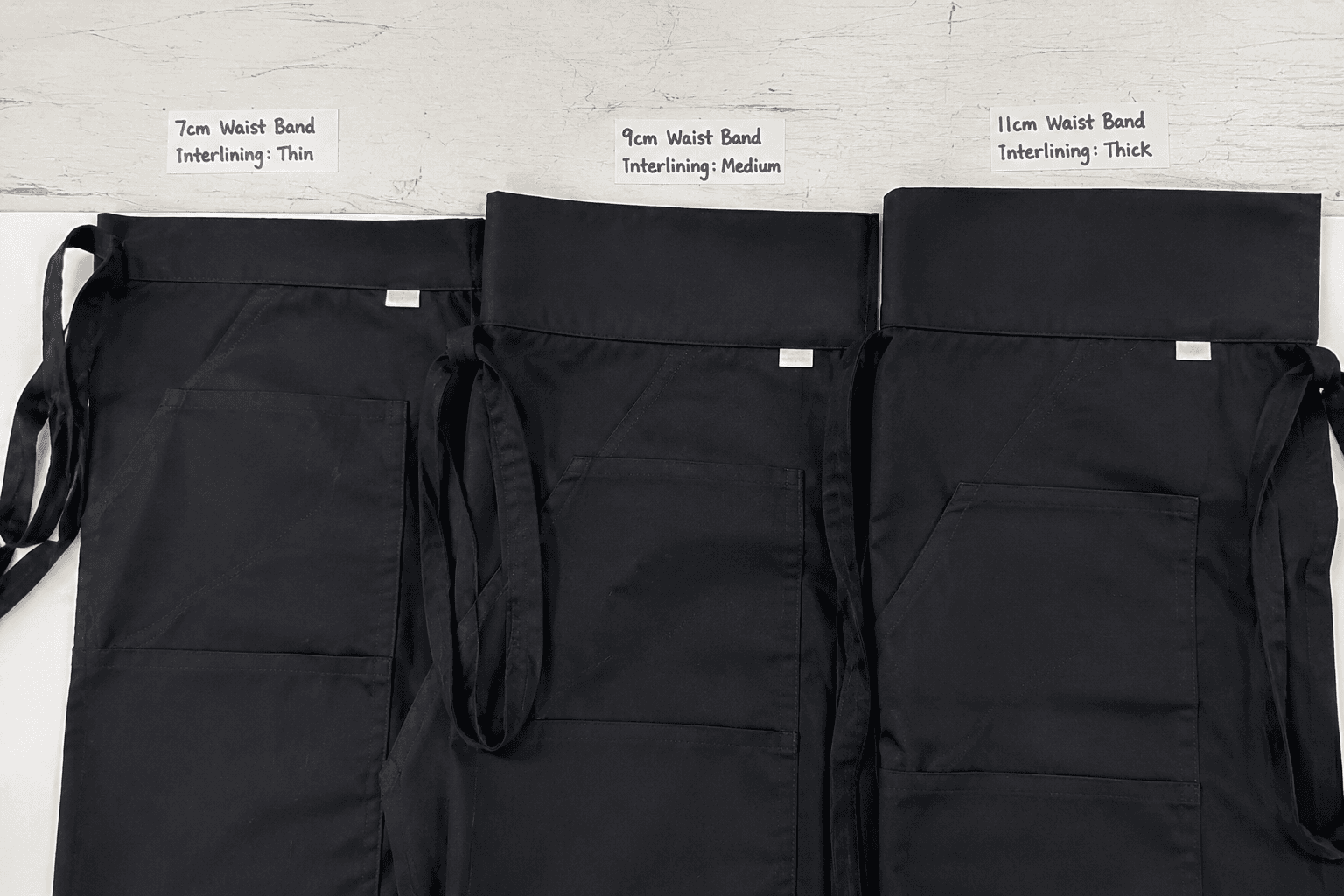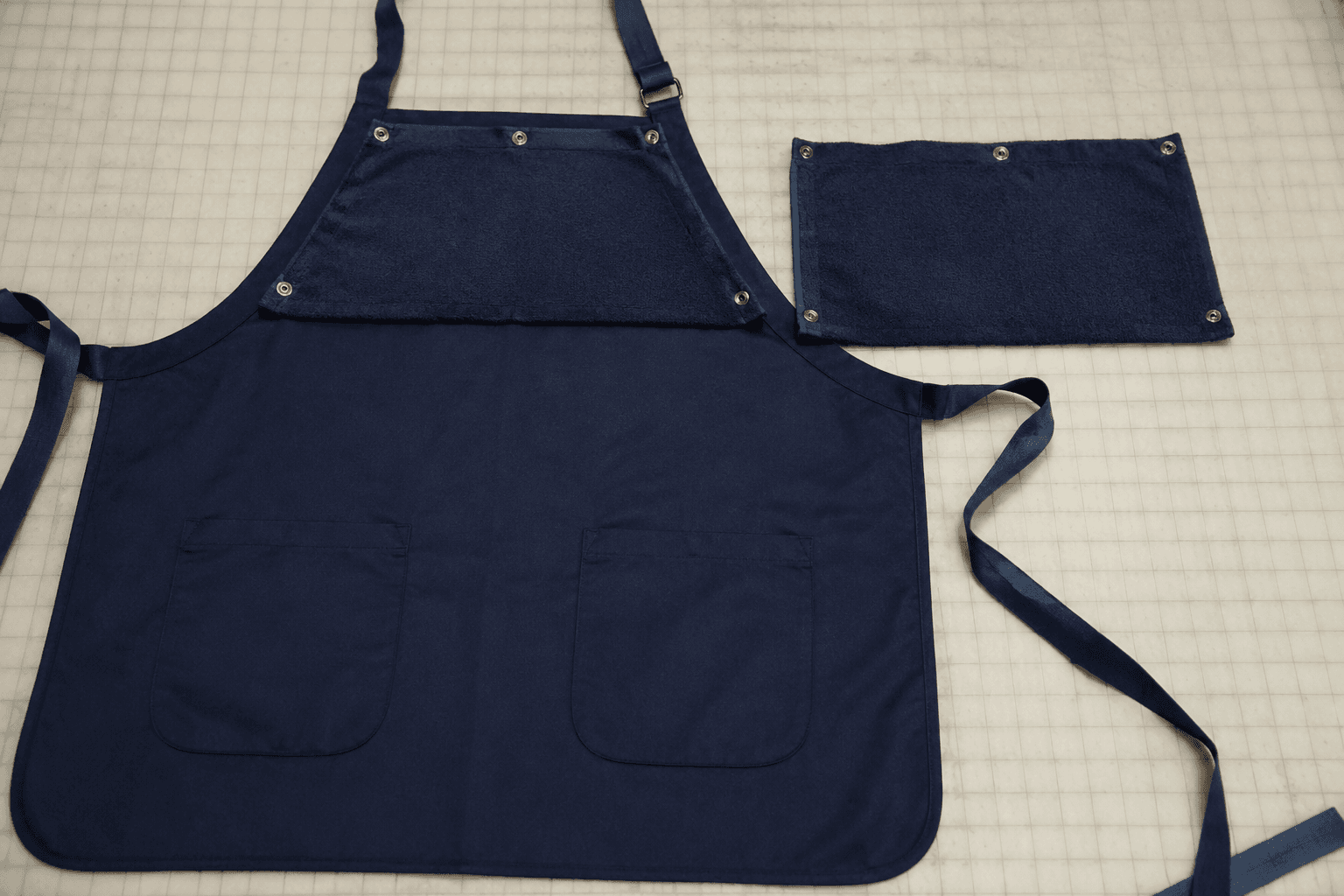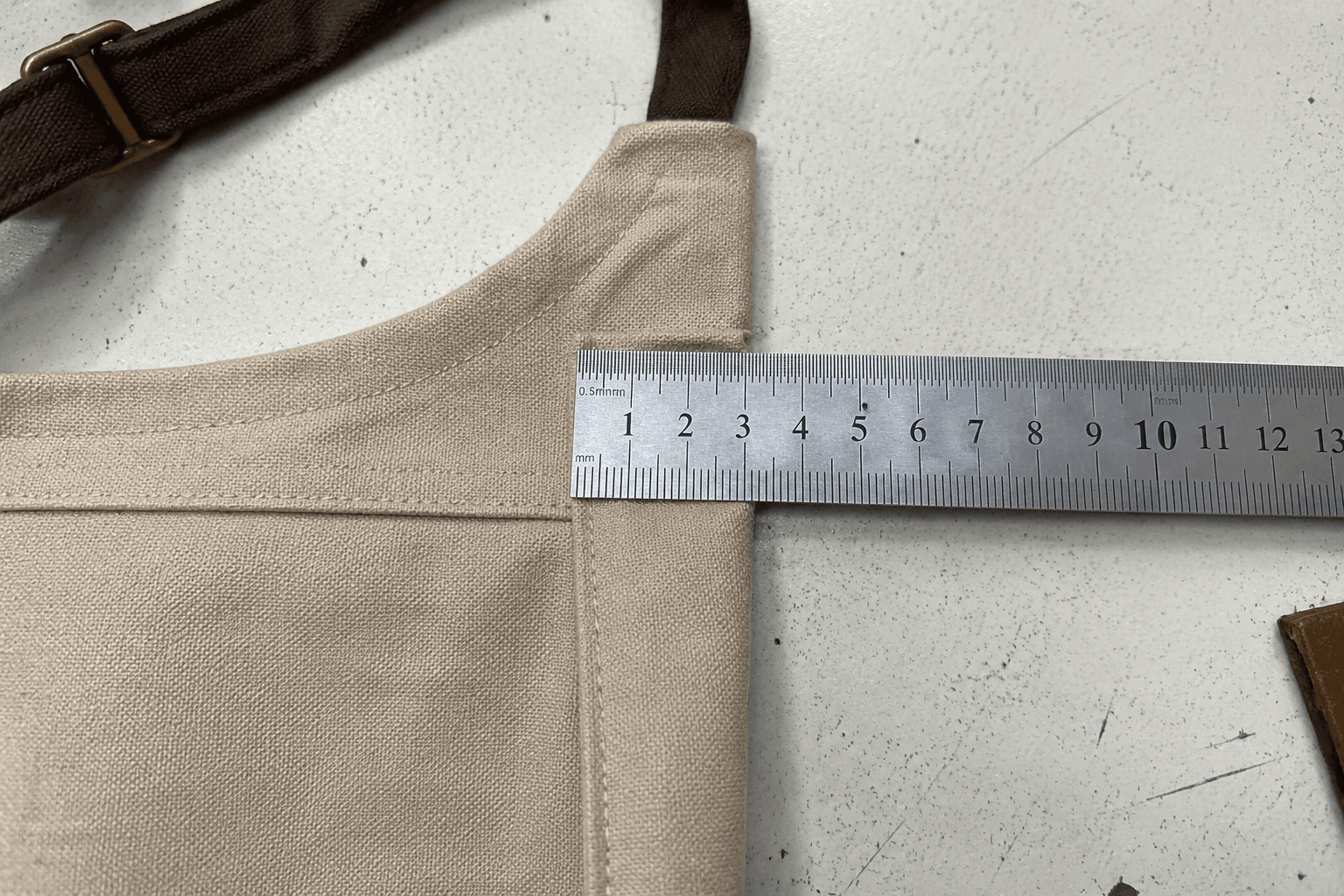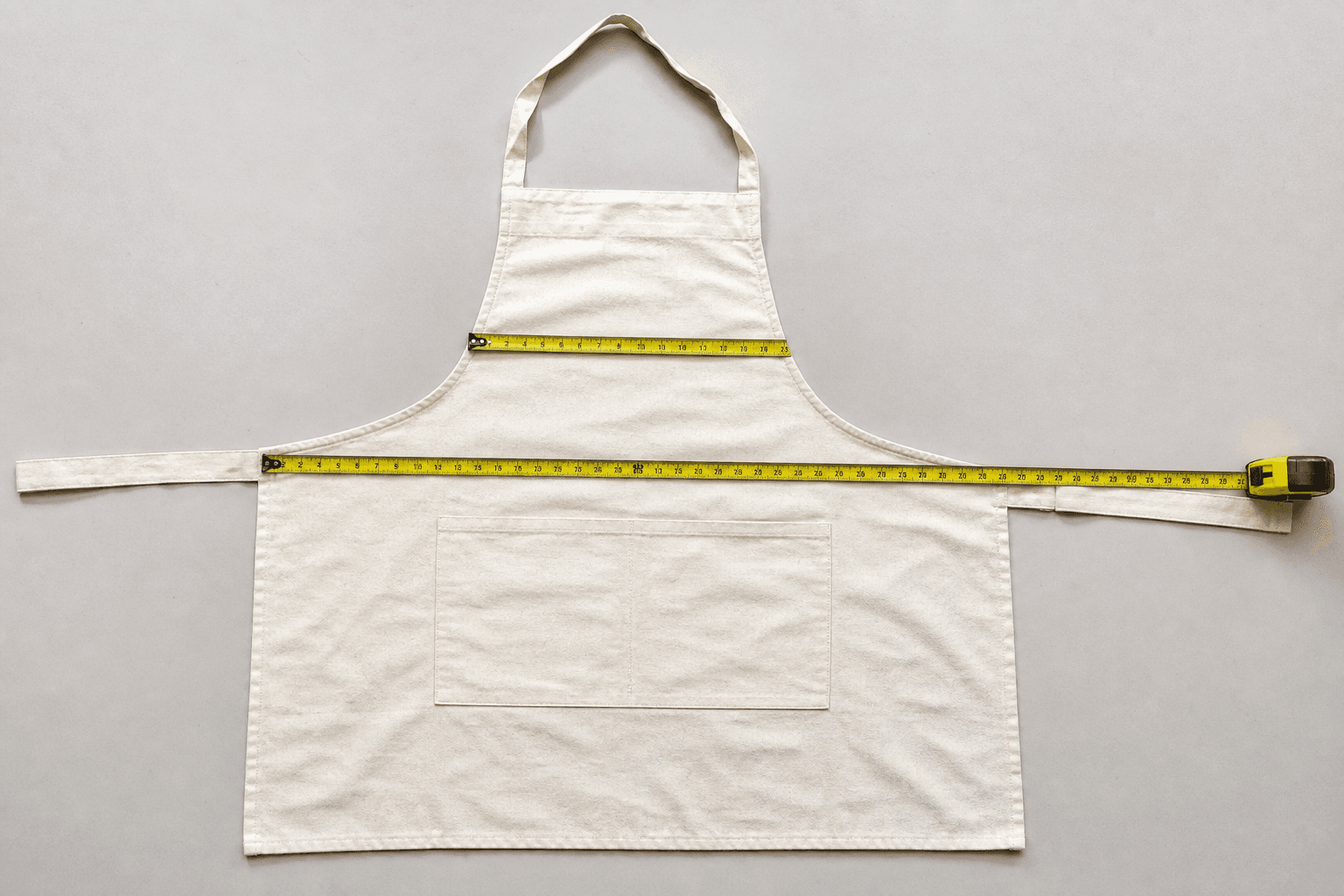
For custom apron programs, sizing problems usually appear late: after the salesman sample looked acceptable, after the size set was approved quickly, or after bulk goods arrived at the warehouse and different wearers started testing the product. A practical apron size chart reduces this risk by defining not only width and length, but also neck drop, waist tie length, pocket position, cross-back strap range, and acceptable tolerance.
From a factory perspective, apron sizing is less complex than shirts or trousers, but it is not simple. Aprons sit over many body types, uniforms, and work postures. A one size apron can work well for cafe, kitchen, salon, pottery, or retail use, but only when the apron measurements are built around the intended wearer group and wearing method.
This article explains how buyers can build an apron size chart that suppliers can cut, sew, measure, and repeat in bulk production. The focus is on woven cotton, poly-cotton, canvas, denim, TC twill, and coated utility aprons ordered from China in typical MOQs of 300-3,000 pieces per color.
- An apron size chart should include functional dimensions, not only total width and total length.
- One size apron development still needs grading logic when the wearer range includes both smaller and larger body types.
- Fabric GSM and shrinkage affect finished measurements, especially in cotton canvas, denim, and garment-washed aprons.
- QC tolerance should be agreed before bulk cutting, normally +/-1 cm for small parts and +/-1.5 cm to +/-2 cm for main body length.
- Strap construction can solve more fit issues than body panel grading for cross-back, halter, and bib apron styles.
- A trusted apron size chart must match real use cases, such as standing service, hot kitchen work, barbering, pottery, or heavy tool storage.
Why the apron size chart matters before sampling
Many buyers send a reference apron and ask the factory to copy the sizing. This can be efficient for a repeat style, but it becomes risky when the reference apron has been worn, washed, stretched, or altered. A used cotton canvas apron can shrink 2-4% in body length after repeated washing, while waist ties may stretch slightly during use. If the factory copies that used sample directly, the production apron may not match the buyer's original commercial fit.
A clear apron size chart allows both buyer and supplier to discuss the same product in measurable terms. For example, a bib apron listed as 72 cm wide x 86 cm long is still incomplete. The neck strap length, bib top width, waist tie length, pocket placement, pocket opening, hem allowance, and strap attachment points all affect how the apron wears. Two aprons with the same overall size can feel very different if one has a short neck loop and high bib, while the other has a longer neck drop and lower waist position.
For sourcing managers, the size chart also helps control quotation accuracy. A 2 cm increase in body width may not change cost much on a light 180 GSM TC twill apron, but it can affect marker efficiency on 320 GSM cotton canvas or 12 oz denim. Longer waist ties, wider straps, reinforced bar-tacks, and larger pockets add fabric, sewing time, and sometimes packaging thickness. When these measurements are fixed early, the supplier can quote closer to the final bulk cost.
- A sampling size chart should state finished garment measurements, not only pattern measurements.
- A reference sample should be measured flat after relaxing for at least 12 hours, especially if it has been washed.
- Measurement points should be named consistently, such as body length from bib top to hem, not simply apron length.
- Any adjustable strap range should show minimum and maximum usable length.
- Tolerance should be listed beside the measurement table, not discussed only after inspection.
Core apron measurements buyers should define
For most bib aprons, the essential measurements are total body length, body width at waist level, bib top width, bib height, waist tie length, neck strap length, pocket size, and pocket position from top edge or hem. These dimensions are enough to control common hospitality and retail aprons, but more technical styles need additional points. A barber apron may need chest pocket depth for combs and clips. A pottery apron may need split-leg panel length. A BBQ apron may require tool loop placement and reinforcement size.
The factory should measure finished aprons on a flat table without stretching the fabric. For soft 160-220 GSM fabrics, light hand smoothing is enough. For heavy canvas above 300 GSM or waxed fabric, the apron should lie naturally because forcing it flat can create false measurements. On a cross-back apron, strap length must be measured along the actual strap path, not diagonally across the table, because small differences in strap route can change wearing comfort.
A reliable apron size chart also separates decorative measurements from functional measurements. Logo embroidery height may be important for brand presentation, but it does not control fit. Waist tie length, bib top width, and neck drop are functional. Pocket position is both functional and visual: a pocket set 3 cm too low can interfere with bending or tool access, while a pocket set too high may distort the chest area on smaller wearers.
- Body length is usually measured from the top center of the bib to the bottom hem.
- Body width is usually measured at the waist tie seam or widest body point, depending on style.
- Bib top width should be measured straight across the upper edge, excluding straps.
- Neck strap length should state whether hardware adjustment is included in the measurement.
- Waist tie length should be measured from side seam to tie end, per side, not total tie length unless clearly stated.
- Pocket position should use one fixed reference point, usually from bib top or bottom hem.
Building an apron size chart for one size apron programs
A one size apron is common in bulk sourcing because it simplifies inventory and reduces SKU count. For restaurants, cafes, coffee chains, salons, studios, and promotional events, one size can be commercially correct. However, one size does not mean no sizing work. It means the size chart must balance coverage, movement, and strap adjustability for the main wearer group.
For a standard adult bib apron, factories often see body lengths between 80-90 cm and body widths between 65-75 cm. A common hospitality size is around 70 cm wide x 85 cm long, with each waist tie at 85-95 cm. This fits many adult wearers when the neck strap is adjustable. For taller kitchen staff, 90 cm length may be preferred. For retail or cafe front-of-house teams where the apron should look neat and not too heavy, 78-82 cm length may be enough.
The biggest mistake is trying to make one size cover every wearer by simply making the panel larger. A wider and longer apron can look bulky on smaller staff and may interfere with walking or bending. In many cases, adjustable neck and waist systems solve more fit problems than a larger body panel. A slider buckle, buttonhole neck strap, or cross-back strap can create a better wearing range without increasing fabric consumption too much.
- For adult hospitality aprons, a practical one size range is often 68-72 cm body width and 82-88 cm body length.
- For petite-focused retail aprons, 62-68 cm width and 75-82 cm length may look cleaner.
- For kitchen or BBQ aprons, 72-78 cm width and 88-95 cm length may improve front coverage.
- For waist aprons, 70-90 cm width and 40-55 cm length are common, depending on pocket load.
- For children or family gift sets, do not scale adult one size directly; make separate child and adult charts.
Apron sizing and grading for multiple sizes
When buyers order S/M/L aprons, apron grading should be simple and controlled. Unlike fitted garments, aprons do not need complex body contour grading. The main changes are usually body length, body width, waist tie length, bib width, and strap range. Pocket size may stay constant across sizes if the functional need is the same, but pocket position should move with body length so the visual balance remains correct.
For example, a three-size bib apron set may use S at 66 cm wide x 78 cm long, M at 70 cm wide x 85 cm long, and L at 74 cm wide x 92 cm long. Waist ties may increase from 80 cm to 90 cm per side, while bib top width increases only 1-2 cm per size. This kind of grading keeps the apron recognizable as one style while giving real fit improvement. If the buyer uses the same logo size across all sizes, the embroidery placement should be graded by measurement from bib top or adjusted visually during sample approval.
Multiple-size apron programs can increase cost through cutting complexity and inventory separation. For a 1,000 piece order split across S/M/L and three colors, the factory is managing nine size-color combinations. The MOQ per combination may be higher if fabric dyeing, washing, embroidery, or printing is involved. A realistic MOQ may be 300 pieces per color for stock fabric styles, but 500-1,000 pieces per color for custom dyed canvas or denim, especially when garment washing is required.
- Grade body width by 3-4 cm between adult sizes for most bib aprons.
- Grade body length by 5-7 cm between adult sizes when wearer height range is broad.
- Keep bib top width changes moderate, usually 1-2 cm per size, to avoid gaping.
- Increase waist ties by 5-10 cm per side for larger sizes if staff need front tying.
- Move pocket position with the body length, especially on aprons longer than 88 cm.
- Confirm carton labels and polybag size stickers if the order includes multiple sizes.
Fabric, shrinkage, and measurement tolerance
Fabric behavior is one of the main reasons a technically correct apron size chart can still fail in production. A 190 GSM poly-cotton twill apron will normally have better dimensional stability than a 320 GSM 100% cotton canvas apron. Cotton canvas, denim, and garment-washed fabrics can shrink, twist, or relax after washing. If the buyer requires machine washable aprons, shrinkage testing should happen before final size approval.
For woven apron fabrics, common shrinkage targets after home laundry are within 3% for pre-shrunk cotton, within 2% for poly-cotton, and 3-5% for untreated cotton canvas or denim unless pre-washed. Garment washing can help stabilize the apron and soften handfeel, but it adds cost, usually around $0.20-$0.60 per piece depending on wash type, local water treatment cost, and order quantity. Heavy enzyme wash, stone wash, or wax finish can cost more and may require longer lead time.
Measurement tolerance should reflect both sewing reality and buyer expectation. For standard aprons, +/-1 cm is reasonable for pockets, bib top width, and strap width. For body width and body length, +/-1.5 cm is common, and +/-2 cm may be acceptable on washed heavy canvas where fabric relaxation varies. Very tight tolerances increase rejection risk and inspection dispute. A good supplier will ask which measurements are critical-to-fit and which are visual only.
- A 180-220 GSM TC twill apron is usually more stable and lower cost than heavy cotton canvas.
- A 260-320 GSM cotton canvas apron gives stronger structure but needs shrinkage control.
- A 10-12 oz denim apron may require pre-wash or allowance for shrinkage before bulk cutting.
- Coated or waxed aprons should not be measured under forced flattening because the finish changes drape.
- Garment-washed aprons should use post-wash finished measurements in the apron size chart.
Straps, ties, and adjustability in apron grading
Strap design is often the most important fit decision in apron development. A fixed neck loop is cheaper and faster to sew, but it creates more fit complaints because the bib height cannot be adjusted. A long neck loop may sit too low on smaller wearers, while a short loop can pull on the neck of taller wearers. For bulk hospitality orders, adjustable neck straps usually add a small cost, often $0.08-$0.25 per piece depending on buckle material and sewing method, but they reduce sizing risk.
Cross-back aprons distribute weight better than halter neck aprons, especially when the apron uses 300 GSM canvas, denim, leather patches, or loaded pockets. However, cross-back sizing must be tested carefully. If straps are too short, larger wearers cannot tie comfortably. If they are too long, smaller wearers have excess strap length hanging at the waist. The size chart should state total strap length, strap width, attachment points, and whether the straps are removable, tied, buttoned, or passed through eyelets.
Waist tie length depends on how the apron is worn. If staff tie at the back only, 75-85 cm per side is often enough for average adult sizes. If staff tie at the front after wrapping around the body, 95-110 cm per side may be required. For thicker canvas ties, very long ties add bulk at the knot and may not pack neatly. For lighter TC twill or polyester ties, longer lengths are easier to manage but may feel less premium.
- Use adjustable neck straps for mixed wearer groups unless the brand requires a fixed minimalist look.
- Specify strap width, because 2.5 cm, 3 cm, and 4 cm straps feel different under weight.
- Confirm whether ties must support front tying on larger wearers before approving bulk size.
- For cross-back styles, fit test with at least one smaller wearer and one larger wearer before size set approval.
- Use reinforced box stitch or bar-tack at stress points when apron fabric is above 260 GSM or pockets carry tools.
Sample approval, QC inspection, and bulk production lead time
A trusted apron size chart becomes useful only when it is connected to sample approval and QC inspection. During proto sampling, the buyer and supplier should review whether the measurements are commercially right. During pre-production sample approval, the same size chart should become the production standard. If changes are made after the PP sample, they should be listed in a revised chart with date, version number, and clear notes. Verbal changes are a common source of bulk mistakes.
For a normal custom apron order using available fabric, sampling usually takes 5-10 days after artwork and size details are confirmed. Bulk production for 500-2,000 pieces often takes 18-30 days after PP sample approval, depending on fabric stock, printing, embroidery, washing, and packaging. Custom dyed fabric may add 10-20 days. If the order includes multiple apron sizes, embroidery, woven labels, metal hardware, and garment wash, buyers should plan closer to 35-45 days for stable execution.
At final inspection, the QC team should measure a sample size based on AQL or buyer requirement. The measurement method should match the approved chart exactly. If the chart says body length is measured from bib top center to bottom hem, QC should not measure from strap attachment or side edge. For one size apron orders, inspection should still check multiple pieces across cartons because cutting piles, sewing tension, and washing batches can create variation.
- Proto sample timing is typically 5-10 days for stock fabric and simple logo work.
- PP sample approval should freeze apron measurements, fabric GSM, trims, logo placement, and packing method.
- Bulk lead time is often 18-30 days for stock fabric orders of 500-2,000 pieces.
- Custom dyeing, garment washing, or special hardware can extend lead time to 35-45 days.
- Final QC should measure finished goods after pressing or packing relaxation, not immediately after sewing if the fabric is distorted.
Common apron size chart errors and how to avoid them
The most common error is mixing body measurements with garment measurements. A buyer may say the apron is for a 100 cm chest wearer, but the factory needs the finished apron width, bib width, and strap range. Aprons are not fitted around the full body in the same way as shirts. They cover the front body and rely on ties or straps for adjustment. If the buyer provides only wearer body measurements, the factory must guess the coverage and ease.
Another frequent problem is ignoring the end use. A server apron used for light order taking does not need the same length as a chef apron used near heat, oil, and splashing water. A florist apron may need lower pockets for scissors and tape. A woodworking apron may need shorter length for movement and heavier reinforcement at tool pockets. The apron size chart should therefore be written after the buyer defines the wearer, work environment, pocket load, and washing method.
Buyers should also avoid approving size from a photo only. Aprons can look correct on a mannequin but fail on real staff. Before large-volume ordering, it is worth testing a fit sample with 3-5 wearers across the target size range. The feedback should be practical: bib too high, pocket too low, ties too short for front knot, neck pressure after two hours, hem catches on knees, or pocket opening too narrow. These comments can be converted into measurable changes before bulk production.
- Do not approve apron sizing from overall length and width alone.
- Do not assume a one size apron fits all staff without testing strap range.
- Do not use pre-wash measurements for garment-washed or shrink-prone cotton aprons.
- Do not change pocket placement after logo approval without checking visual balance.
- Do not set unrealistic tolerances that the fabric and sewing process cannot hold.
- Do not forget packaging impact when ties are very long, heavy, or fitted with metal hardware.