Handfeel problems in apron sourcing usually surface after the visible details are already approved: color, logo size, pocket layout, strap construction, carton marks and barcode labels. A bulk apron can match the tech pack line, such as 100% cotton canvas at 300 GSM, 65/35 polyester-cotton twill at 210 GSM or 10 oz denim, and still fail in use. The bib may pull at the neck, the pocket mouth may collapse, the waist panel may flare, or the fabric may feel abrasive against a uniform shirt during a long shift.
A practical apron fabric handfeel approval process treats softness, stiffness and drape as sourcing specifications, not taste comments. A 180 GSM promotional waist apron should not be judged against a washed 10 oz barista apron. A 12 oz tool apron should carry enough body for hardware and pocket load without forcing the wearer to fight the garment. The buyer’s job is to define the right feel for the apron’s end use, approve physical references and stop cutting if incoming fabric does not match.
This guide shows how professional buyers can standardize apron fabric handfeel approval with target weights, wash routes, sample stages, drape checks, golden swatch records, cost expectations and QC hold rules. The examples reflect realistic OEM apron programs: MOQs from 300 to 2,000 pieces per color, custom dyeing from 500 to 1,000 meters, development cycles of 7 to 21 days, bulk production of 20 to 40 days, and final inspection commonly using AQL 2.5 for major defects and AQL 4.0 for minor defects.
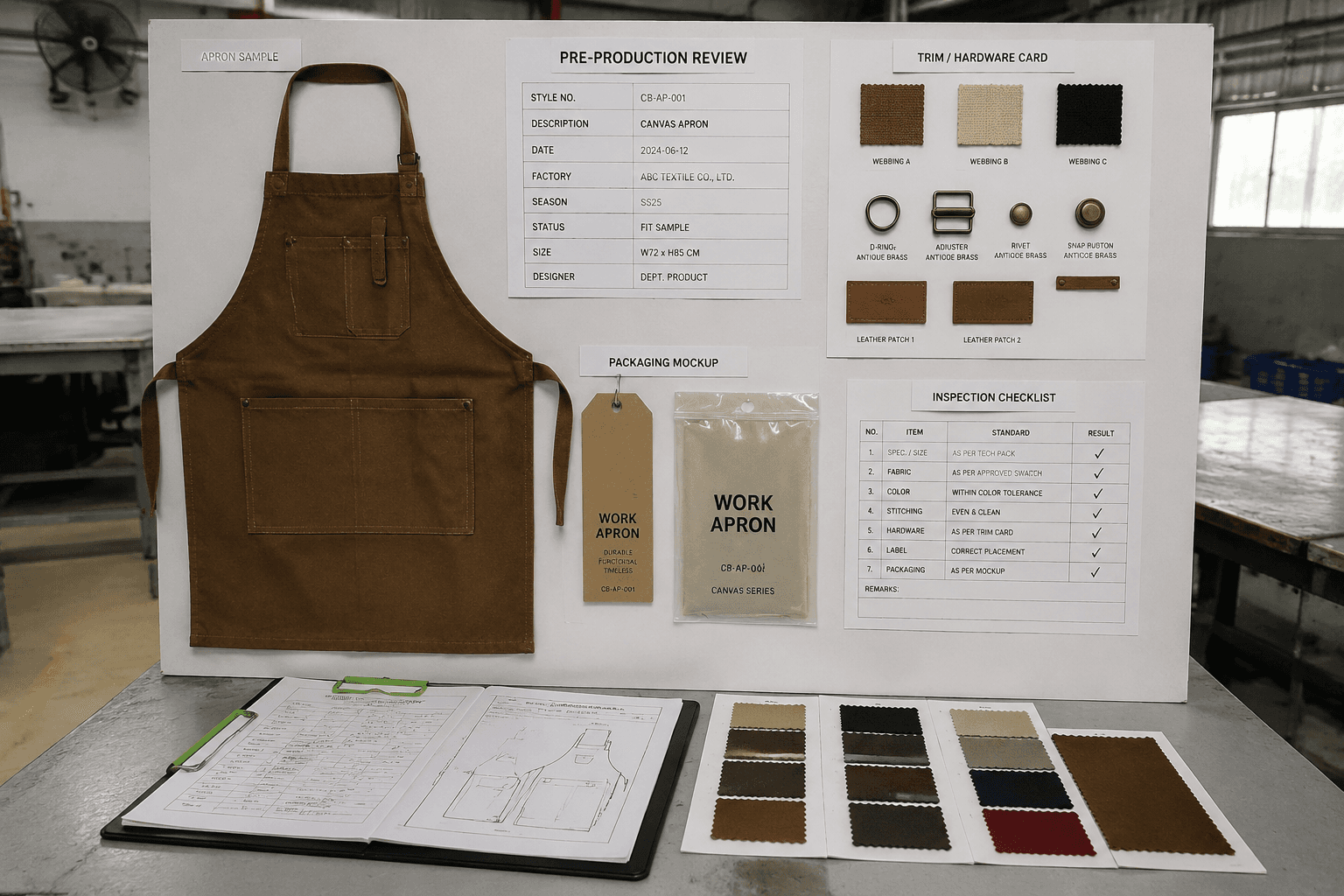
- Apron fabric handfeel approval needs signed physical standards, including a sealed fabric swatch and one finished apron sample.
- Softness, stiffness and drape must be approved on the finished apron, because straps, hems, pocket layers, bartacks and hardware change the wearing feel.
- Fabric weight should be controlled with realistic tolerances, usually plus or minus 5 percent for GSM or oz unless the buyer pays for tighter control.
- Drape checks can be simple but repeatable: same apron size, same conditioning time, same hanging point and same photo distance.
- Softening treatments can affect shade, shrinkage, absorbency, print adhesion and tensile strength, so they should be tested before bulk dyeing or garment washing.
- Bulk fabric that feels materially different from the approved control should be held before cutting, because correction after sewing can add 7 to 18 days and avoidable cost.
Apron fabric handfeel approval before bulk cutting
Most apron handfeel disputes start with weak buying language. Phrases such as “soft canvas,” “premium twill,” “heavy but not stiff” or “nice drape” leave too much room for interpretation by the mill, dye house and sewing factory. Even a tighter line, such as 100% cotton canvas, 280 GSM, reactive dyed, can produce different results depending on yarn count, weave density, desizing, enzyme level, softener type, calendaring pressure and whether the fabric is approved before or after washing.
For aprons, the finished garment matters more than a loose swatch. A bib apron includes neck straps or cross-back straps, waist ties, folded edges, pocket layers, bartacks and sometimes rivets, snaps or metal eyelets. These details add localized stiffness. A 20 cm swatch can feel acceptable in a meeting room, while the same fabric may pull at the neck during a four-hour cafe shift or make a large front pocket stand away from the body.
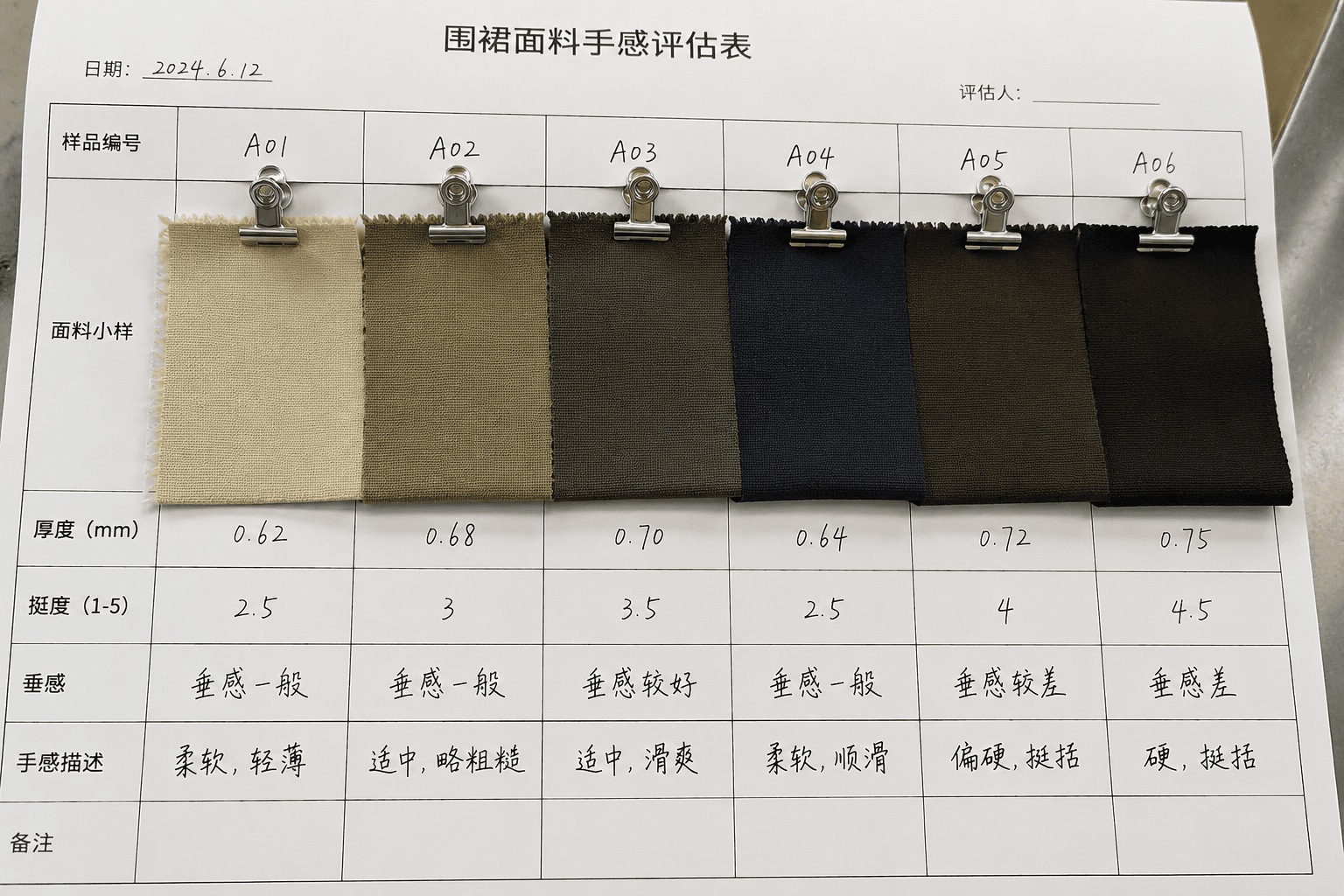
Buyers should separate three approval terms. Softness is surface touch and compressibility when the fabric is rubbed, squeezed or worn over a shirt. Stiffness is resistance when the fabric is bent, folded or layered at the hem and pocket. Drape is how the sewn apron hangs under its own weight. Each term should be tied to the approved swatch, the approved finished apron and a repeatable inspection method.
If handfeel is challenged after production, the options are limited. Re-softening may shift shade by Delta E 0.5 to 1.5, create residual odor, increase shrinkage or weaken print adhesion. Rewashing finished aprons can add 3 to 7 days. Replacing fabric after cutting can add 10 to 18 days plus fabric loss, sewing disruption and reinspection cost. The practical control point is before spreading and cutting.
- Approve handfeel with a signed fabric swatch and a finished apron sample, not with wording alone.
- Record target weight, such as 240 GSM plus or minus 5 percent or 10 oz plus or minus 0.5 oz.
- State whether approval is for greige, dyed, finished, garment-washed, pressed or packed condition.
- Stop bulk cutting if incoming fabric is clearly rougher, boardier or limper than the approved control.
- Tie comments to apron function, such as neck comfort, pocket support, bib flatness or waist drape.
Set handfeel targets by apron use, GSM and oz
The right handfeel depends on the apron’s job. A hotel breakfast waist apron needs light weight, clean drape and fast laundering. A barista bib apron needs enough body to look structured over a uniform. A butcher apron needs coverage, stain performance and durability. A gardening or workshop apron needs pocket stiffness so tools do not pull the front panel out of shape.
For hospitality bib aprons, a common range is 200 to 280 GSM in cotton twill, polyester-cotton twill or light canvas. The fabric should bend easily at the waist while keeping the bib panel reasonably flat. For coffee shops, bakeries and casual restaurants, 280 to 360 GSM cotton canvas or 8 oz to 10 oz denim is common. These aprons may feel firm at first wear but should soften after washing without twisting seams or collapsing pocket openings.
Industrial, craft and tool aprons usually need more body. A realistic range is 320 to 450 GSM cotton canvas, duck canvas or 10 oz to 12 oz denim. The buyer should decide whether the apron is meant to feel rigid and protective or washed and broken-in. Heavy fabric can improve perceived value and pocket strength, but it also increases freight weight, needle wear, seam bulk and wearer fatigue, especially when the apron uses a narrow neck strap instead of cross-back straps.
Promotional aprons sit at the lighter end. A 150 to 220 GSM polyester, polyester-cotton or light twill can work for campaigns where the MOQ is 300 to 1,000 pieces per color and the expected wear cycle is limited. Buyers should not expect this fabric to feel like washed cotton canvas while also hitting a low price. A buyer targeting USD 1.20 to 2.20 per piece for a basic waist apron needs simpler fabric, fewer trims and less finishing than a USD 6.00 to 12.00 washed denim bib apron.
- Hospitality bib apron: 200 to 280 GSM, moderate softness, clean vertical drape and flat bib panel.
- Coffee shop canvas apron: 280 to 360 GSM or 8 oz to 10 oz, structured hand with acceptable first-wear firmness.
- Workshop or tool apron: 320 to 450 GSM or 10 oz to 12 oz, stronger stiffness, reinforced pockets and durable stress points.
- Promotional waist apron: 150 to 220 GSM, smooth touch, lower cost and lighter durability expectation.
- Denim apron: approve washed and unwashed handfeel separately because rinse wash, enzyme wash and stone wash change drape, shade and shrinkage.
Apron fabric handfeel approval sample sequence
A reliable approval path starts before the pre-production apron. First, review two to four fabric directions by composition, weave, GSM or oz, color feasibility, finish route and target price. Too many near-identical choices slow internal approval and create inconsistent comments. For stock fabric, a factory can often provide references in 2 to 4 working days. Custom woven, custom dyed or special finish references usually need 7 to 14 working days before the buyer sees a meaningful sample.
After the direction is selected, approve a small yardage or softness approval sample made with the intended finishing route. For cotton, that may include desizing, enzyme wash, silicone softener, resin-free softener or garment wash. For polyester-cotton, it may include softener padding, anti-pilling treatment, brushing or calendaring. A stock swatch should not be treated as final approval if bulk fabric will be dyed and finished from new greige goods.
The pre-production apron should confirm the finished feel after sewing, washing if required, pressing and normal packing recovery. It should use the same pattern, strap construction, pocket layers, bartack locations and hardware as bulk. If the approved swatch feels correct but the sewn apron feels wrong, the cause may be construction rather than fabric. Thick folded hems, double-layer pockets, dense embroidery and metal hardware can all make an apron feel stiffer than the fabric alone.
For typical custom apron orders, buyers should plan 5 to 10 working days for lab dips or small yardage, 3 to 7 working days for sample sewing after fabric arrives, and 20 to 40 days for bulk production depending on fabric source, quantity, washing and decoration. Handfeel approval should sit before bulk dyeing or cutting in the calendar. Compressing it into the final pre-production approval often forces the buyer to accept risk or restart the fabric process.
- Stage 1: approve fabric direction by GSM or oz, composition, weave, finish and apron use case.
- Stage 2: approve lab dip and small yardage handfeel before bulk dyeing or finishing.
- Stage 3: sew one to three pre-production aprons from approved yardage.
- Stage 4: approve finished apron softness, stiffness, drape, shrinkage, measurements and workmanship.
- Stage 5: seal the golden swatch and finished apron sample before fabric spreading and cutting.
Run apron drape and stiffness checks that QC can repeat
Most apron programs do not need expensive lab equipment to control drape. A practical hanging comparison is enough if the buyer and factory use the same method. Condition the approved apron and test apron in the same room when timing allows, ideally for at least 4 hours. Hang both from the same point, leave them for 10 minutes, then compare lower hem width, side fold depth, bib twist and pocket behavior.
For bib aprons, hang from the neck strap point on a flat rail or board. Let waist ties hang naturally unless the apron is normally displayed tied. Measure the width across the lower hem and note whether the bib flares, twists or stands away from the body. For waist aprons, hang from the waistband and check whether pocket panels curl, flare or collapse. Photos should be taken from the same distance, usually 1.5 to 2 meters, under similar lighting.
A quick stiffness check can help incoming QC before cutting. Cut a 5 cm by 20 cm strip from the approved swatch and from the bulk roll. Place 10 cm of each strip over a table edge and measure droop after 30 seconds. If the approved strip droops 7 cm and the bulk strip droops 3 cm, the bulk fabric is materially stiffer. If it droops 12 cm, it may be too limp for pocket support. This is not a formal bending-length test, but it gives the factory a practical hold signal.
For retail uniform programs or orders above 5,000 pieces, buyers can add formal bending length, flexural rigidity, shrinkage and color fastness testing. For smaller OEM apron runs, the stronger control is usually a sealed comparison standard, roll-by-roll inspection and a written decision rule: same as approved, slightly softer accepted, slightly harder accepted, or hold for buyer review.
- Use the same apron size, fabric construction, pocket layout and strap type for comparison.
- Record whether the sample is fresh pressed, unpressed, washed, packed or recovered after carton storage.
- Check drape after packing if the order uses tight polybags, vacuum packing or 50 to 100 pieces per carton.
- Use AQL 2.5 for major workmanship defects and AQL 4.0 for minor defects when agreed in the PO or inspection protocol.
- Segregate any roll with visibly different handfeel before relaxation, spreading and cutting.
Control softness without weakening apron performance
Softness is often the first handfeel comment from buyers, but softer is not always better. Heavy silicone softener can make cotton feel smoother, yet it may reduce absorbency, weaken stain-release performance, affect screen print or heat transfer adhesion and create a greasy touch if overdosed. Enzyme washing can reduce cotton harshness, but aggressive processing may lower tensile strength and increase shade variation across lots.
For cotton aprons, softness can be adjusted through yarn quality, weave density, desizing, enzyme treatment, garment wash and finishing chemistry. Combed cotton usually gives a cleaner touch than open-end yarn, but it costs more. A looser weave improves pliability, but it can reduce abrasion resistance and pocket strength. Garment washing gives a relaxed feel, but it adds shrinkage control work and may change measurements after sewing.
Cost should be discussed before the buyer signs off on handfeel. On a 1,000-piece custom apron order, garment washing may add about USD 0.20 to 0.60 per piece depending on fabric weight, color, wash recipe and local capacity. A light softener finish may add about USD 0.05 to 0.15 per piece. Brushing can improve warmth and touch, but it may increase lint pickup and pilling risk, especially on dark hospitality aprons washed frequently.
For printed or embroidered aprons, the factory should test decoration after the approved finish. A very soft finish can interfere with plastisol, water-based screen print, heat transfer film or silicone labels. Dense embroidery needs enough fabric body to prevent puckering. If the apron has a chest logo, large front print or woven label, handfeel approval and decoration testing should be linked in the same pre-production review.
- Use enzyme wash for a broken-in cotton feel only when the buyer accepts higher shade and shrinkage control risk.
- Use silicone softener cautiously when absorbency, stain release or print adhesion matters.
- Use combed yarn or better fabric construction when the buyer wants cleaner touch without heavy chemical finishing.
- Test heat transfer, screen print and embroidery on the approved finished fabric, not only on greige or stock fabric.
- Run a wearer trial when a bib apron exceeds 300 GSM or uses heavy metal hardware with a neck strap.
Golden swatch records for repeat apron fabric handfeel approval
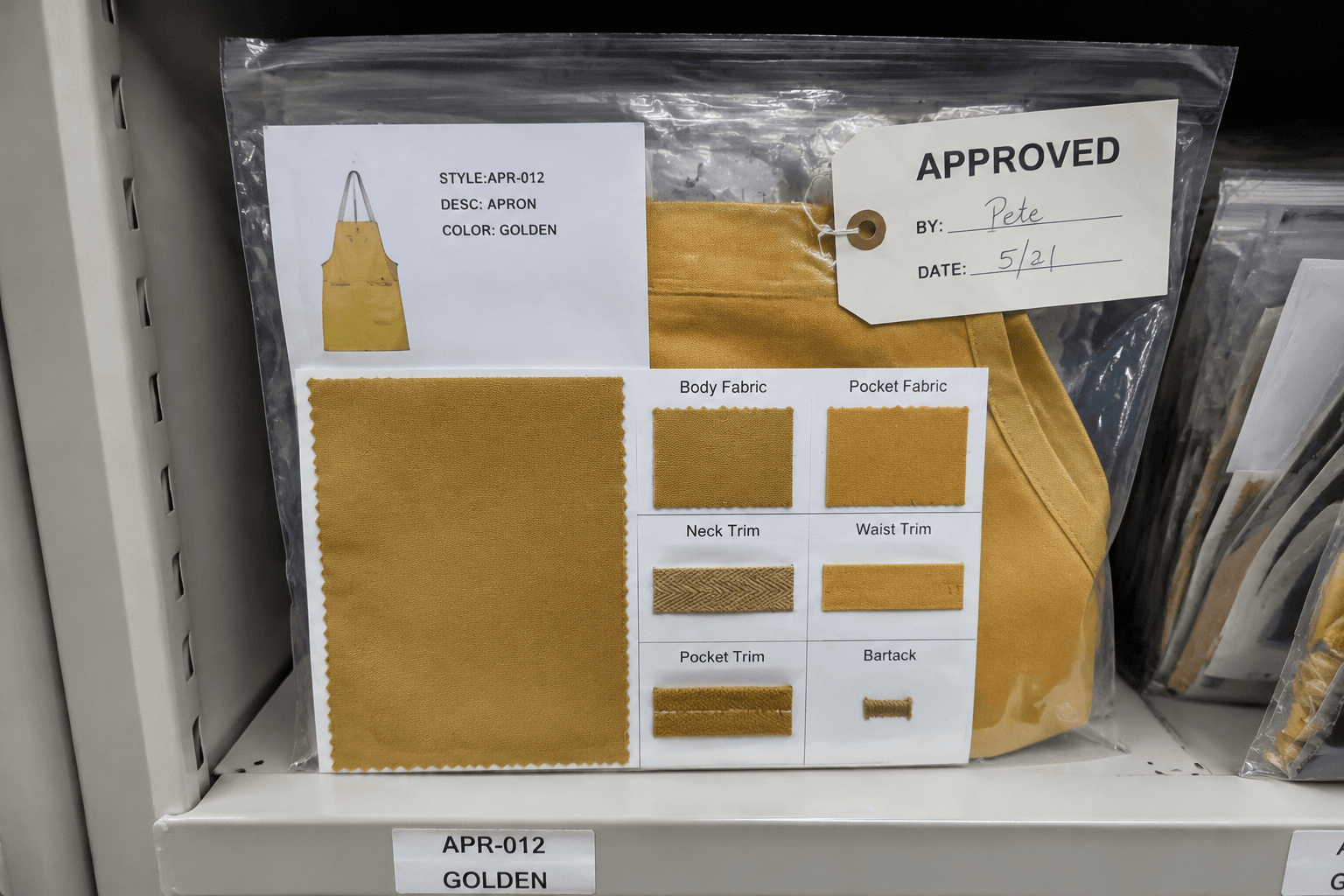
Golden swatch approval is the bridge between development and bulk QC. A usable golden swatch is not just a fabric cutting stapled to a file. It should show fabric code, composition, construction if available, GSM or oz, width, finish, color name, dye lot, wash status, approval date, approved order number and buyer or merchandiser confirmation. For repeat apron orders, these details prevent the factory from matching the wrong season, wrong mill lot or wrong finish.
The factory should keep two references: a sealed fabric swatch and a finished apron sample. The fabric swatch is used by the mill and incoming fabric inspector. The finished apron is used by sewing, pressing, packing and final inspection. If the apron includes garment wash, wax finish, brushing, coating, leather patches, rivets or heavy embroidery, the finished apron sample carries more practical information than the loose fabric.
Incoming fabric inspection should compare every bulk lot against the approved standard before cutting. QC should check GSM or oz, usable width, shade, defects, skew, shrinkage and handfeel. A normal fabric weight tolerance is plus or minus 5 percent unless the buyer specifies tighter control and accepts the cost. Roll-to-roll shade and handfeel variation should be reviewed before mixing rolls in the same shipment or size run.
Commercially, early approval is cheaper than late correction. Stock fabric can support smaller MOQs, often 100 to 300 pieces per color if inventory exists, but exact handfeel control is limited. Custom dyeing and finishing normally require 500 to 1,000 meters per color, sometimes more for special canvas or denim. A basic 200 GSM polyester-cotton waist apron may price around USD 1.20 to 2.20 per piece, while a 280 GSM cotton twill bib apron may be USD 2.80 to 5.00. A washed 10 oz to 12 oz canvas or denim apron with cross-back straps, metal hardware and reinforced pockets can reach USD 6.00 to 12.00 or more.
- Keep one sealed golden swatch at the factory, one with the buyer or buying office, and one with the fabric mill when possible.
- Label the approved standard with weight tolerance, finish route, wash status, dye lot and approval date.
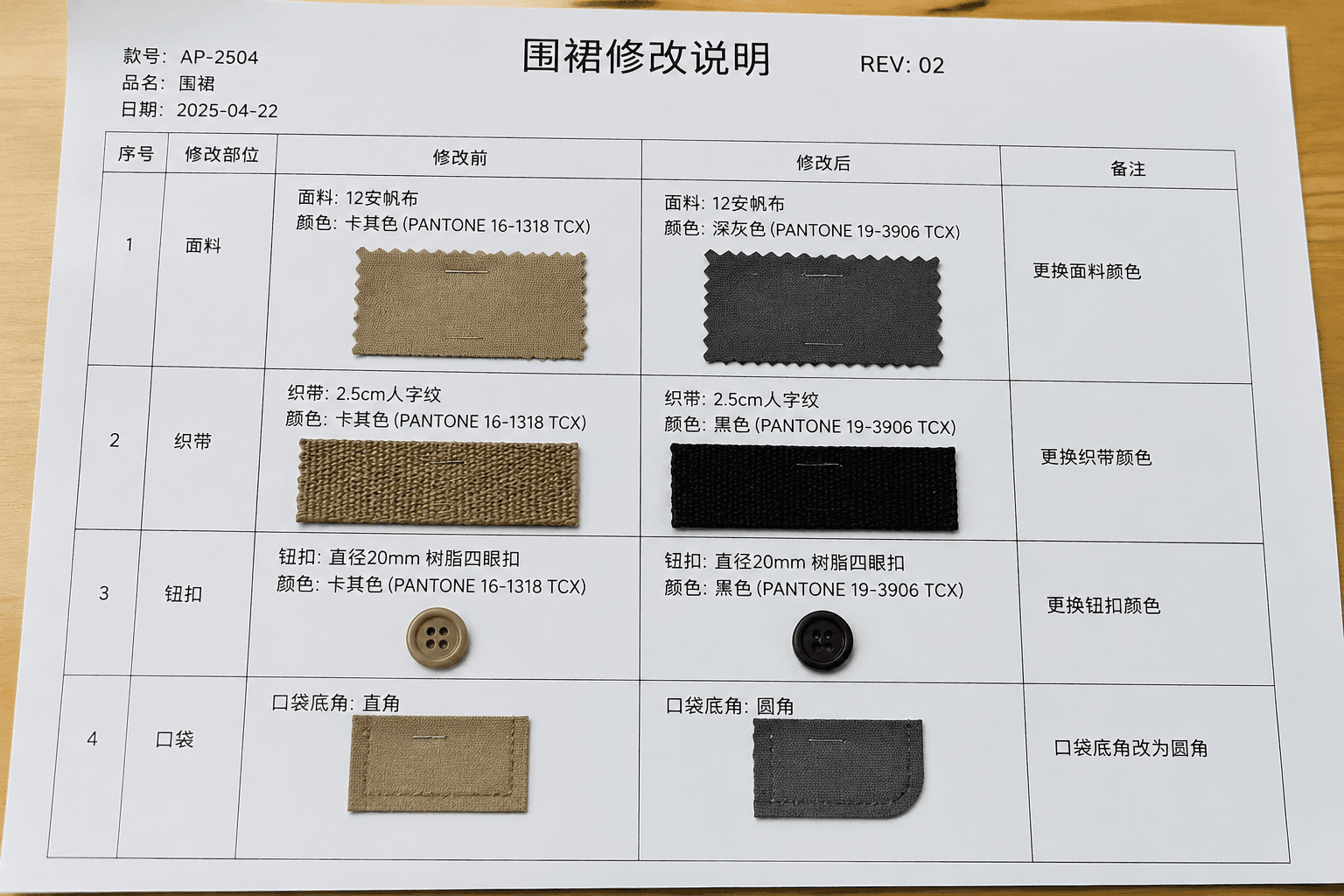
- Reapprove handfeel if the mill changes yarn source, dyeing factory, finishing line, fabric width or washing recipe.
- Use the finished apron sample during inline and final inspection, not only during development meetings.
- Hold production for buyer review if bulk fabric is clearly rougher, boardier or limper than the approved standard.
Write PO hold rules for apron handfeel deviations
Handfeel control is only useful if the purchase order gives the factory a decision path. The PO or quality manual should state who can approve a deviation, how fast the buyer must respond, and what happens to fabric waiting for review. Without a written rule, production teams may cut questionable rolls to protect the sewing schedule, especially when trim, workers and inspection dates are already booked.
A practical hold process is simple. Incoming QC compares each lot with the golden swatch, marks any doubtful roll, records roll number and weight, and sends photos or a short video with the droop check. The factory should not mix held rolls into the marker plan. For urgent orders, the buyer can approve use in less visible components, such as waist ties or inside pocket facings, but only if shade and performance remain acceptable.
Response time matters. For a 1,000 to 3,000 piece apron order, a 24 to 48 hour buyer decision window is realistic. If a replacement finish is needed, add 3 to 7 days. If new fabric must be dyed or washed, add 10 to 18 days depending on mill capacity and color. These delays are smaller than discovering the issue after sewing, packing and final AQL inspection.
The final inspection checklist should still include handfeel, but final inspection is a confirmation point, not the first control point. At final inspection, the inspector should compare packed aprons against the sealed finished sample, check whether carton compression has changed drape, and record any major deviation as a buyer-review defect. For B2B uniform, hospitality and retail apron programs, that discipline protects reorder consistency more than any adjective in the original tech pack.
- Define the handfeel decision owner in the PO: buyer, merchandiser, QA manager or nominated buying office.
- Require roll number, dye lot, GSM or oz result, shrinkage result and handfeel comment for any held fabric.
- Set a response window, commonly 24 to 48 hours after the factory sends the hold report.
- Do not cut held rolls until the buyer approves, rejects or assigns them to a lower-risk apron component.
- Record accepted deviations for the next reorder so the approved standard does not drift silently.