For most custom apron orders placed with a China OEM factory, a realistic apron lead time is 35 to 45 days after sample approval and deposit. This range assumes normal fabric availability, standard dyeing or stock colors, one to three decoration positions, and carton export packing. It does not include the buyer's internal approval cycle before production release, nor the ocean or air transit time after the goods leave the factory.
Buyers often ask why aprons take this long when the sewing operation itself may only need 6 to 10 working days. The answer is that apron production time is not only stitching. A complete apron manufacturing schedule includes fabric confirmation, bulk fabric procurement or dyeing, shrinkage control, cutting, logo application, sewing, trimming, needle inspection, packing, final QC, and export handover. Several of these steps cannot run at the same time without creating quality risk.
This article breaks down where the 35 to 45 days actually go, using practical factory timing for cotton canvas, polyester-cotton twill, denim, oxford, and recycled polyester aprons. The numbers are typical for bulk custom aprons from 1,000 to 20,000 pcs, with normal seasonal workload in Zhejiang and nearby textile supply chains.
- Apron lead time starts after all approvals are locked, including fabric, color, artwork, size spec, label, carton mark, and payment.
- Fabric is usually the longest single variable, taking 3 to 5 days for stock fabric and 12 to 20 days for dye-to-order fabric.
- Logo method changes the schedule, with simple screen print often faster than embroidery, patch application, or multi-position heat transfer.
- Sewing is only one part of apron production time, typically 6 to 10 working days for common bib aprons once all materials are ready.
- Final inspection and export booking need real calendar days, especially when the buyer requires AQL inspection, carton photos, or third-party QC.
- Rush orders are possible only when fabric, trims, and printing capacity are already available; otherwise speed usually increases defect risk.
Apron lead time begins after production release, not inquiry date
A factory cannot start counting the formal apron lead time from the first inquiry email. At that stage, the design may still be changing, the buyer may not have confirmed GSM, color, logo placement, pocket layout, neck strap construction, waist tie length, label position, or packing method. For a custom apron, these details are not minor. A change from 240 GSM twill to 320 GSM canvas changes fabric sourcing, cutting behavior, carton weight, and sometimes the sewing needle size. A change from printed logo to embroidered patch changes the decoration sequence and subcontractor booking.
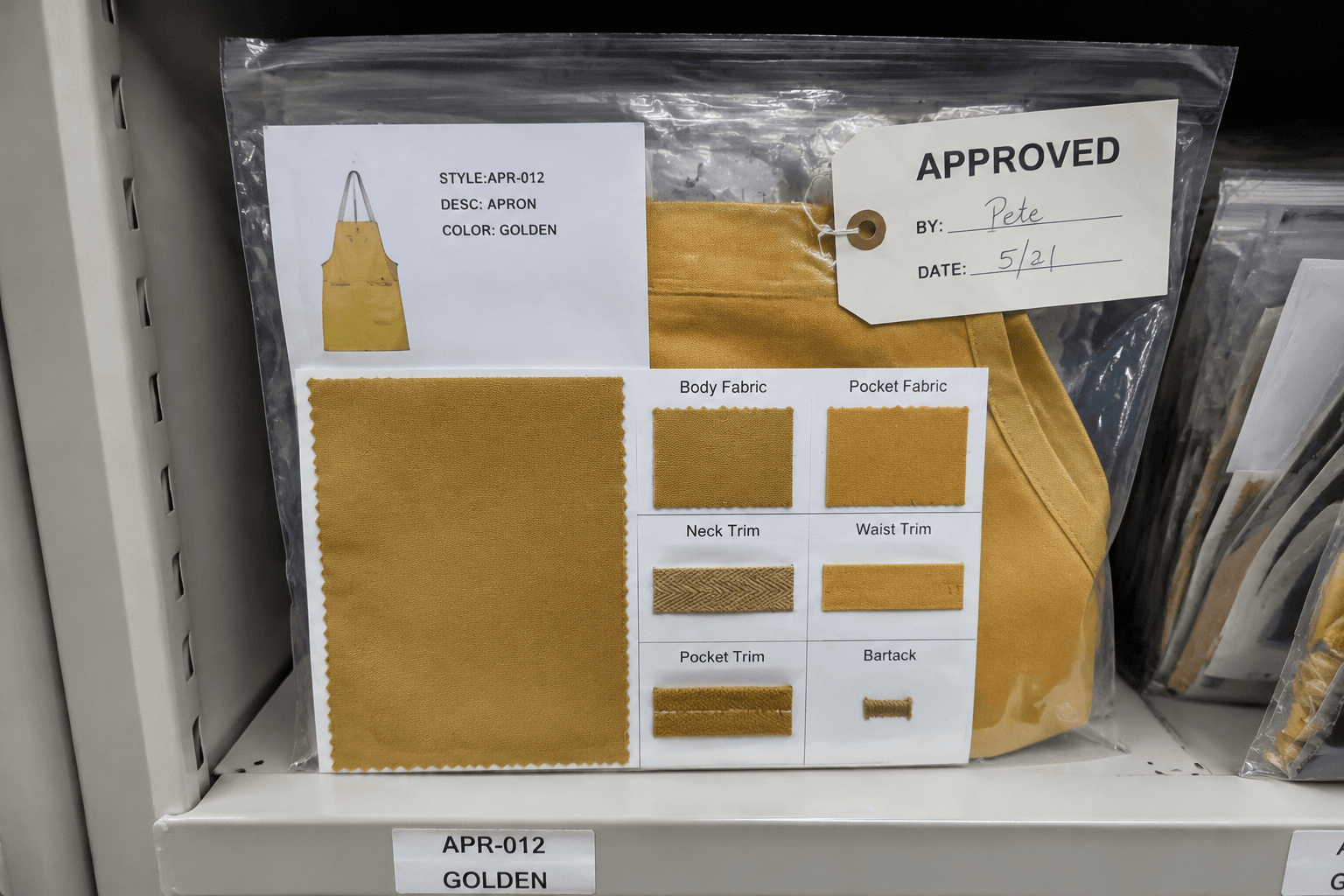
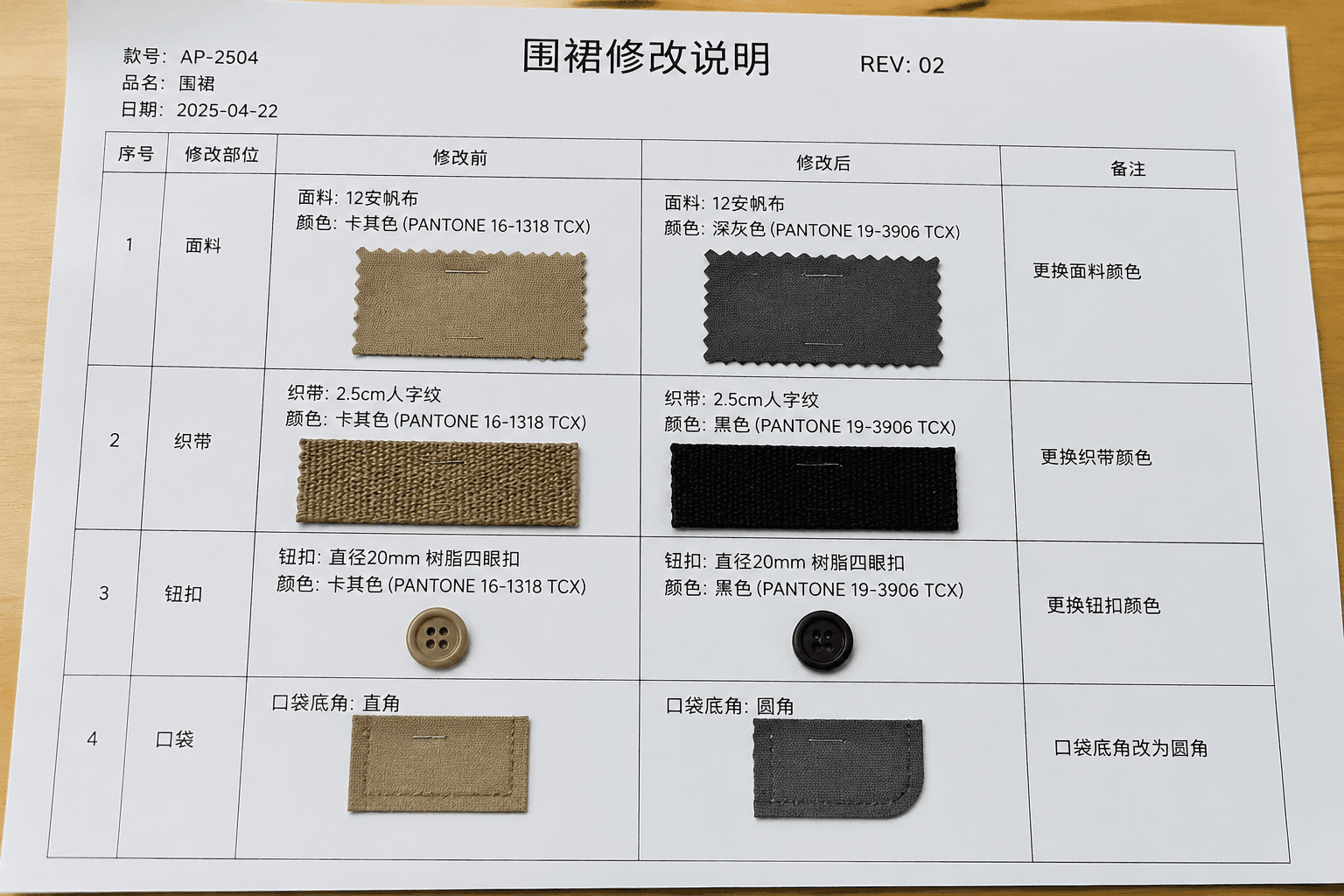
In normal OEM practice, the production clock starts after the buyer approves the pre-production sample, confirms artwork files, signs the proforma invoice, and pays the deposit. If the buyer approves the sample on Monday but sends revised Pantone color, carton mark, or barcode label on Thursday, the factory schedule usually starts from Thursday. This is why two orders quoted with the same 40-day apron manufacturing schedule may ship one week apart in reality.
For repeat orders, the release point is faster because the pattern, cutting marker, fabric quality, logo film, embroidery file, wash care label, and carton data already exist. A repeat order using stock fabric can sometimes be released within 1 to 2 working days after deposit. A new custom apron program with a new fabric, new trim, new hangtag, and a new retail carton normally needs 5 to 10 days before bulk production can be safely released.
- The factory can open bulk fabric purchase only after the buyer confirms fabric composition, GSM, color, and shrinkage requirement.
- The printing or embroidery workshop can book capacity only after artwork size, Pantone color, and placement are approved.
- The cutting room should not cut bulk fabric until the approved size spec and tolerance are frozen.
- The packing team cannot prepare carton labels, barcodes, or polybags until the buyer confirms the final packing instruction.
Days 1 to 7: order confirmation, sampling closure, and material planning
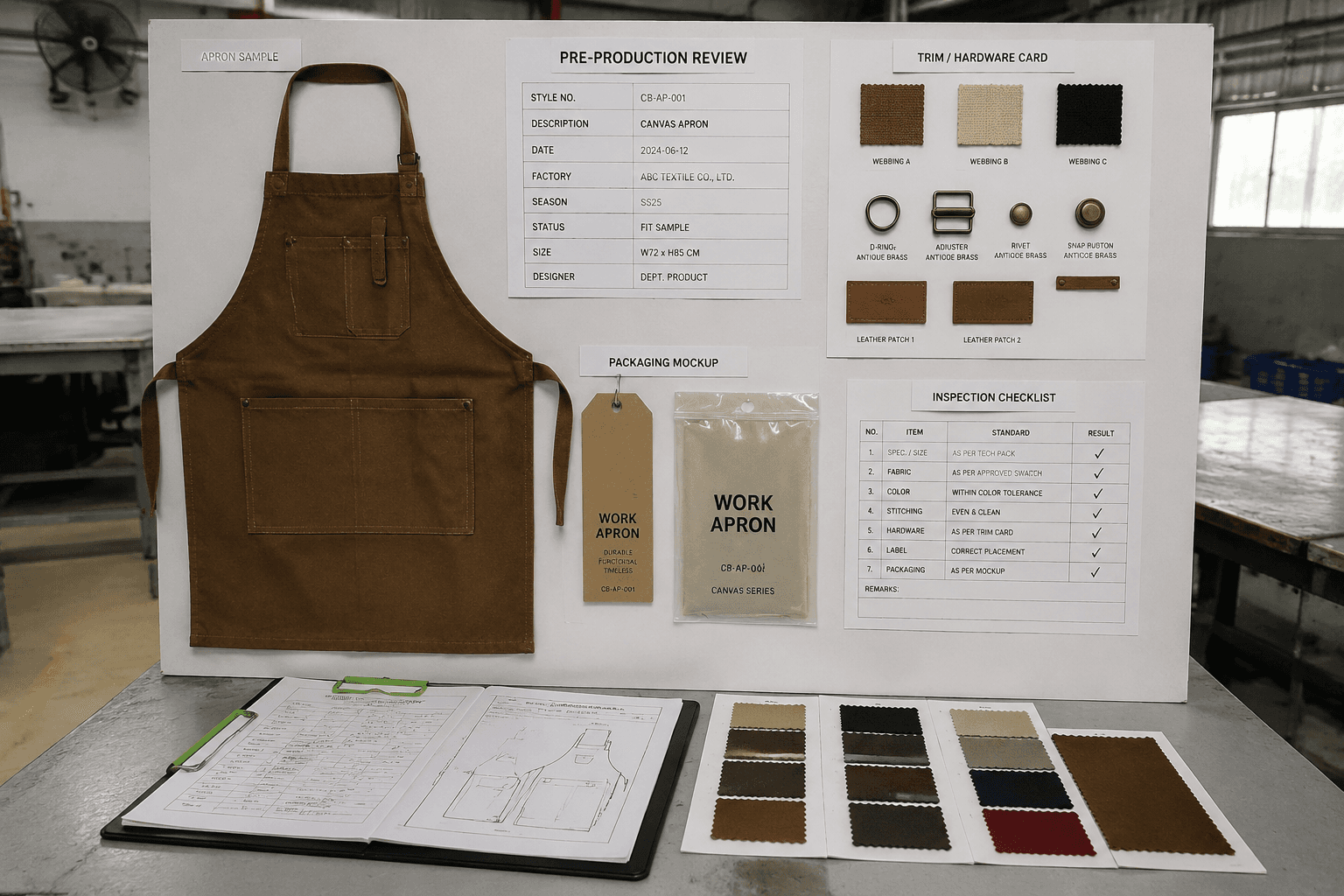
The first week is often administrative and technical, but it determines whether the rest of the custom apron timeline will run smoothly. The merchandiser converts the buyer's tech pack into a factory production sheet. The pattern room checks whether the apron size, strap length, pocket opening, bar tack position, and logo placement are practical for bulk sewing. The purchasing team confirms whether the fabric is available from stock, greige fabric, or dye-to-order production.
For a simple bib apron in 240 to 280 GSM polyester-cotton twill, stock fabric in black, white, navy, red, grey, or beige may be available within 2 to 4 days. For a heavier chef or bar apron in 10 oz or 12 oz cotton canvas, denim, or enzyme-washed fabric, the supplier may need to check roll quantity, shade continuity, and width. If the apron uses recycled polyester with GRS documents, organic cotton, flame-retardant finish, water-repellent coating, or special colorfastness requirement, material planning can take longer because certificates and test reports must match the buyer's compliance file.
At this stage, a responsible factory will also confirm consumption. A standard adult bib apron measuring about 70 x 80 cm may use around 0.55 to 0.75 meters of fabric depending on width and pocket design. A cross-back apron with long straps, large pockets, or contrast panels can use 0.85 to 1.10 meters. If consumption is estimated too low, the order may face fabric shortage near the end of sewing. If it is estimated too high, the buyer pays unnecessary fabric cost.
- Typical planning time for repeat aprons is 1 to 3 days after deposit and approved artwork.
- Typical planning time for new custom aprons is 4 to 7 days, especially when a fit sample or revised sample is involved.
- Fabric consumption should include cutting loss, shade grouping, shrinkage allowance, and defect allowance.
- MOQ pressure usually appears here; small orders below 500 pcs may rely on stock fabric, while dye-to-order fabric often needs 800 to 1,500 meters per color.
Days 5 to 20: fabric sourcing, dyeing, finishing, and shrinkage control
Fabric is the largest swing factor in apron production time. If the buyer selects stock black 240 GSM TC twill and the warehouse has enough same-lot fabric, material can arrive at the apron factory in 3 to 5 days. If the buyer needs a specific Pantone color in 280 GSM cotton twill or 12 oz canvas, the mill may need greige fabric preparation, dyeing, finishing, drying, inspection, and delivery. This commonly takes 12 to 20 days, and in peak months before Christmas or Chinese New Year it can stretch further.
Aprons are not garments worn for only a season on a runway. They are workwear, uniform items, or promotional products that must survive washing, oil, food stains, industrial kitchens, cafes, workshops, or retail staff use. For this reason, fabric testing matters. A cotton apron with poor shrinkage control may lose 3 to 5 cm after washing. A dark denim apron with weak rubbing fastness can stain a white shirt. A cheap polyester fabric may look acceptable in a photo but fail after heat transfer because the surface cannot tolerate press temperature.
Factories usually test bulk fabric for width, GSM, color shade, hand feel, slub, stains, holes, and shrinkage before cutting. For washed aprons, the process is more complex because washing may happen before or after sewing depending on the desired effect. Garment washing adds around 3 to 7 days and requires a shrinkage-adjusted pattern. If the buyer approves an unwashed sample but then requests an enzyme wash for bulk, the apron manufacturing schedule must be recalculated.
- Stock polyester-cotton twill: usually 3 to 5 days for fabric arrival if color and GSM are common.
- Dyed cotton twill or canvas: usually 12 to 18 days for dyeing, finishing, inspection, and delivery.
- Denim, yarn-dyed stripe, or washed fabric: usually 15 to 25 days depending on mill workload and wash effect.
- Certified recycled or organic fabric: usually 15 to 30 days if documentation, transaction certificates, or batch traceability are required.
- Fabric testing and shade approval: usually 1 to 3 days, but failed shrinkage or colorfastness can restart part of the process.
Days 12 to 26: trims, labels, packaging, and decoration preparation
While fabric is being prepared, the factory should organize trims and packaging. For aprons, common trims include neck strap adjusters, D-rings, eyelets, snap buttons, leather or PU patches, woven labels, care labels, waist ties, contrast tapes, and pocket rivets. These items look small but can block production if they arrive late. A missing D-ring is enough to stop sewing on an adjustable-neck apron.
Standard trims are fast. Black or nickel D-rings, common cotton webbing, and generic care labels may be ready in 3 to 5 days. Custom woven labels usually need 7 to 10 days after artwork approval. Leather patches, embossed PU patches, customized metal hardware, kraft hangtags, retail header cards, barcode stickers, and printed inner cartons can take 10 to 18 days. If the buyer needs FSC paper, recyclable polybag markings, or Amazon FBA carton compliance, the packing file must be checked early, not after sewing is finished.
Decoration preparation also happens here. Screen printing requires film, screen making, ink mixing, and strike-off approval. Embroidery needs digitizing, thread color matching, and stitch density testing. Heat transfer needs transfer sheet production and press testing. For thick canvas aprons, embroidery may look premium but can cause puckering if the backing, stitch count, and hooping are not controlled. For low-cost promotional aprons, one-color screen print is usually faster and cheaper.
- One-color screen print on one position may add 3 to 5 working days after artwork approval.
- Multi-color screen print or large front print may add 5 to 8 working days because registration and drying need more control.
- Embroidery usually adds 5 to 10 working days, depending on stitch count and quantity.
- Woven or PU patch application usually adds 7 to 14 days including patch production.
- Heat transfer can be fast for simple logos, but poor fabric compatibility can cause peeling, gloss marks, or dye migration.
Days 20 to 32: cutting, printing sequence, and sewing line allocation
Once bulk fabric passes inspection, the cutting room can start spreading and cutting. Cutting for aprons is simpler than tailored garments, but it still needs control. Canvas and denim must be relaxed before cutting if there is tension from rolling. Stripe or yarn-dyed fabrics need alignment. Large pockets must be cut in the correct direction. Contrast straps and main panels must be shade matched. For a 5,000 pc order, cutting may take 1 to 3 days depending on fabric thickness and number of components.
The decoration sequence depends on the design. A front chest logo or large center print is usually applied after cutting and before sewing, because it is easier to place accurately on flat panels. Pocket printing may be done before the pocket is attached. Embroidery can happen on cut panels before sewing, or on finished aprons if the placement and machine frame allow it. The wrong sequence can create uneven placement, slow production, or rejected pieces.
Sewing time for common aprons is often shorter than buyers expect. A basic bib apron with neck loop, waist ties, one pocket, and hemmed edges may run at 800 to 1,500 pcs per day on a prepared line, depending on fabric and workmanship standard. A heavier cross-back apron with metal hardware, double pockets, bar tacks, contrast tape, and reinforced corners may run at 300 to 700 pcs per day. For small orders, line setup time matters more. For large orders, output depends on how many sewing operators and special machines the factory can allocate.
- Simple promotional bib apron: usually 4 to 7 sewing days for 5,000 pcs after all panels and prints are ready.
- Mid-weight cafe apron with pockets and adjustable neck: usually 6 to 10 sewing days for 5,000 pcs.
- Heavy canvas, denim, or cross-back apron: usually 8 to 14 sewing days for 5,000 pcs, especially with bar tacks and hardware.
- Multiple colors in one order reduce efficiency because cutting, thread changes, shade control, and packing separation take extra time.
- Small MOQ orders below 1,000 pcs may still need 3 to 5 sewing days because line setup and QC preparation are fixed tasks.
Why the 35 to 45 day apron lead time is not just sewing
A buyer looking only at sewing capacity may calculate that 10 operators can finish 5,000 aprons in a week. That may be true for the sewing section, but it misses the calendar time before and after sewing. Fabric dyeing cannot start until color is confirmed. Printing cannot start until panels are cut. Final inspection cannot start until packing is complete. Export booking cannot be finalized until the carton quantity, gross weight, and cargo ready date are reliable.
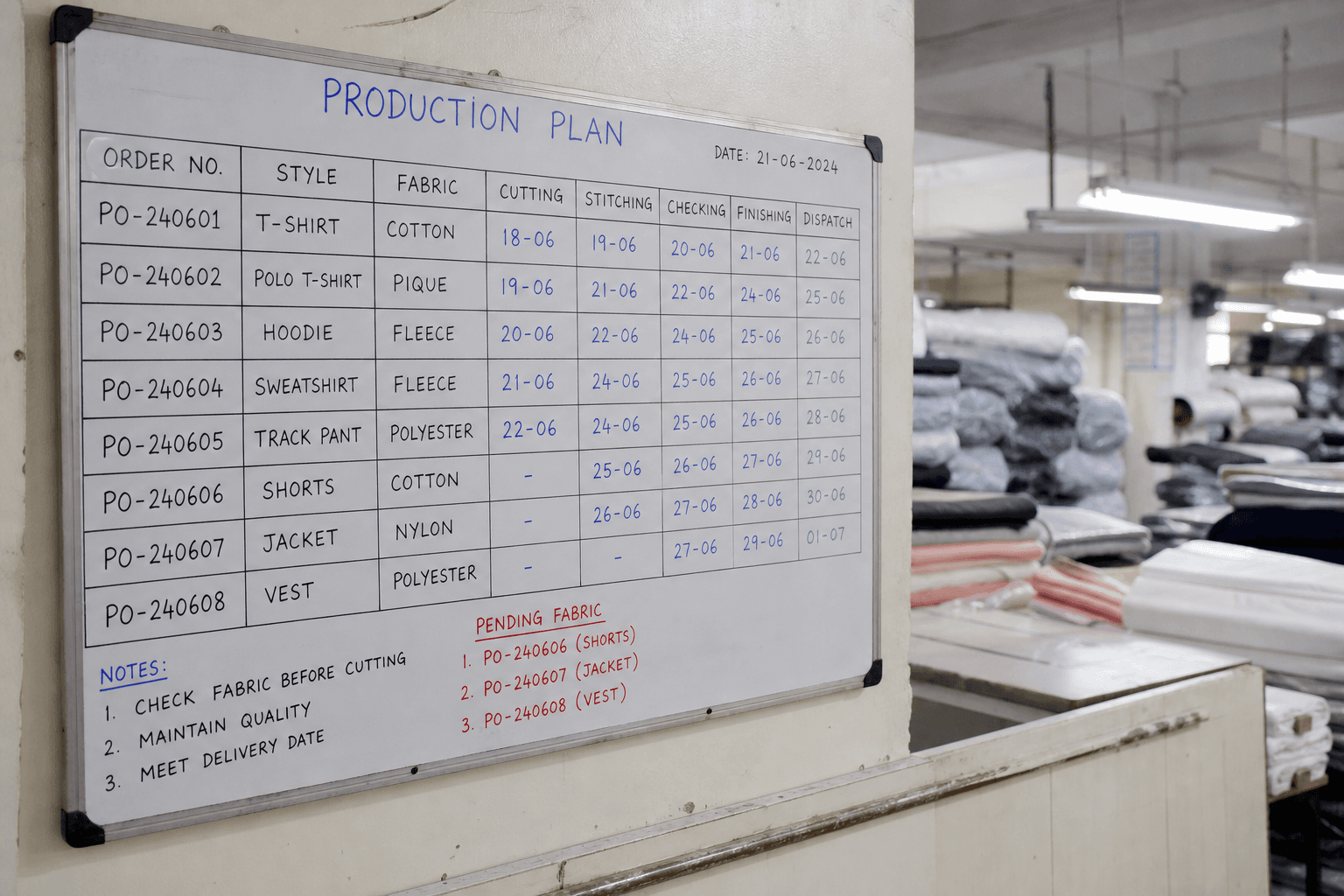
A typical 40-day apron lead time for a new custom order may look like this: 3 days for order release and production sheet confirmation, 15 days for dyed fabric, 7 days for trims and labels running in parallel, 2 days for fabric inspection and cutting, 5 days for printing or embroidery, 8 days for sewing, 3 days for finishing and packing, 1 day for internal QC, and 1 to 2 days for buyer or third-party inspection arrangement. Some of these steps overlap, but not all of them can overlap safely.
The custom apron timeline becomes longer when the order includes many SKUs. For example, 2,000 pcs split into 8 colors, 4 sizes, and 3 logo versions is more complicated than 10,000 pcs in one color and one print. Each SKU needs separate material control, cutting bundles, production records, packing counts, carton marks, and inspection sampling. The total quantity may be lower, but the management work is higher.
Inspection, packing, and apron delivery time after production
After sewing, the order is not finished. Aprons must be trimmed, thread-cleaned, measured, pressed or folded, checked for stains, checked for needle damage, and packed according to the buyer's instruction. For food service, hospitality, and uniform buyers, visual consistency is important because staff may wear the aprons side by side. Differences in pocket height, logo position, strap length, or shade are easy to notice.
Most export apron orders use AQL inspection. A common standard is AQL 2.5 for major defects and 4.0 for minor defects, though some brands use stricter limits. Major defects include wrong logo, broken stitch, open seam, obvious stain, wrong color, wrong size, metal contamination, or missing label. Minor defects include slight loose thread, small print imperfection, or minor measurement deviation within agreed tolerance. Internal QC may take 1 to 2 days for a mid-size order. Third-party inspection usually needs booking 2 to 5 days in advance.
Packing time depends on the method. Bulk pack in master cartons is faster. Individual polybag with size sticker, barcode, warning text, hangtag, carton assortment, and pallet requirement is slower. A 5,000 pc apron order may need 1 to 2 days for simple packing, or 3 to 5 days for retail-ready packing. Once cartons are ready, apron delivery time depends on the shipping method. Air freight from Shanghai or Ningbo may take 5 to 9 days door to door after customs and flight arrangement. Sea freight may take around 18 to 35 days port to port depending on destination, plus local clearance and trucking.
- Internal QC and rework usually need 1 to 3 days depending on defect rate and order size.
- Third-party inspection should be booked before the cargo ready date, normally with 2 to 5 days notice.
- Simple export carton packing is usually 1 to 2 days for a mid-size order.
- Retail packing with barcode, hangtag, size sticker, and carton assortment is usually 3 to 5 days.
- Ocean freight is separate from apron lead time; it should be added to calculate total landed delivery time.
How buyers can shorten apron production time without increasing risk
There are practical ways to reduce apron production time, but most of them must happen before the order is placed. The fastest orders are not rushed orders; they are clean orders. A clean order has approved artwork, confirmed Pantone references, a stable size spec, acceptable fabric alternatives, clear packing rules, and quick decision-making. Every unresolved detail becomes waiting time inside the factory.
Using stock fabric is the most effective way to shorten the schedule. If the buyer can accept stock black, navy, grey, white, red, or natural canvas, the factory may reduce the material stage from 15 days to 3 to 5 days. Choosing a standard 240 GSM or 280 GSM polyester-cotton twill instead of a custom-dyed 320 GSM cotton canvas can also reduce cost. A basic promotional apron in stock fabric with one-color print may be possible in 18 to 25 days if capacity is available. A heavy washed denim apron with leather patch and retail packing should still be planned at 45 to 60 days.
Buyers should also separate approval speed from factory speed. If a print strike-off waits 4 days for approval, the factory schedule moves 4 days. If the buyer changes the logo size after bulk printing starts, the order may need rework or replacement panels. A disciplined approval process protects both cost and delivery. For annual programs, the best method is to approve core fabrics and trims in advance, then release purchase orders against reserved material.
- Confirm one final tech pack before deposit, including measurements, tolerance, fabric, GSM, label, packing, and carton marks.
- Use stock fabric colors when the target ship date is tight or the MOQ is below normal dyeing quantity.
- Approve print strike-offs, embroidery swatches, and trim samples within 24 hours where possible.
- Avoid changing logo size, pocket position, or strap construction after bulk cutting starts.
- For repeat programs, reserve greige fabric or finished fabric before peak season to protect the apron manufacturing schedule.
- Calculate total delivery from deposit to warehouse, not only factory lead time; include inspection, export handover, sailing, customs, and domestic trucking.