For imported aprons, labeling is not a cosmetic packing detail. It is part of customs entry, retail compliance, and post-sale risk control. A correct apron country of origin label needs to identify where the apron was made, and it must stay consistent with the purchase order, commercial invoice, packing list, product specification sheet, and sewn-in care label.
In our Zhejiang apron factory, label compliance is usually confirmed before fabric cutting, not at final inspection. The reason is simple: once 30,000 woven labels or printed neck labels are attached to aprons, correcting an origin mistake can mean unpicking seams, replacing hangtags, delaying vessel booking by 5-10 days, and adding USD 0.08-0.25 per piece in rework cost depending on label position and garment construction.
This article explains practical apron label requirements from a supplier-side view. It focuses on bulk custom aprons made in China for food service, hospitality, retail, promotional, industrial, and workwear programs, where buyers need stable labeling across repeat orders and multiple fabric qualities.
- An apron country of origin label should normally be permanent, legible, and consistent with customs documents.
- A made in china label is not optional when the apron is substantially manufactured in China for most import markets.
- Care content, fiber content, RN or importer identity, size, and origin should be approved together before bulk label production.
- Origin marking mistakes are cheaper to prevent at sample stage than to repair after sewing and packing.
- Different apron constructions require different label positions, especially bib aprons, waist aprons, cross-back aprons, and disposable or coated aprons.
Why the apron country of origin label matters before production
Country-of-origin marking tells customs authorities and end users where the apron was manufactured. For aprons sourced from China, the wording is usually simple, such as "Made in China" or "Made in P.R.C.", depending on the buyer's market and retailer policy. The risk is not the wording alone. The risk is a mismatch between the sewn label, the hangtag, the carton mark, and the import declaration.
For example, a buyer may nominate Japanese cotton canvas, German snap buttons, and packaging printed in the United States, while the cutting, sewing, pocket attachment, trimming, inspection, and packing are completed in Zhejiang. In that normal sourcing structure, the apron country of origin is still China because the substantial transformation occurs during garment manufacturing. The label must reflect the manufacturing country, not the fabric mill's country or the buyer's brand location.
Origin marking also affects retail receiving. Many chain stores inspect care labels during inbound QC. If a carton contains 1,200 bib aprons with an approved care label but the label says only "Designed in USA" and does not show the actual origin, the warehouse may quarantine the shipment. The problem then becomes commercial: storage charges, air freight replacement, relabeling authorization, and delayed store launch.
- Confirm origin wording at sales sample stage, before woven or printed labels are ordered.
- Match origin wording across sewn label, hangtag, belly band, polybag sticker, and carton mark when those materials mention origin.
- Do not treat supplier address, brand address, or fabric origin as a replacement for garment origin.
- Keep signed label artwork and size set approval files for every bulk order and repeat order.
Common apron label requirements by product type
Aprons are simple garments, but their labeling needs vary by construction. A 240 GSM cotton waist apron used in a coffee shop has different label placement options from a 420 GSM waxed canvas cross-back apron, and both differ from a PVC-coated dishwasher apron or a disposable nonwoven apron. The buyer's compliance manual should decide the final rule, but the factory needs a workable position that survives washing, wearing, folding, and packing.
On standard bib aprons, we usually place the care and origin label in the inside side seam, 8-12 cm below the waist tie seam or along the inner side edge. For waist aprons, the label is often sewn into the waistband seam or side seam. For cross-back aprons, labels may be placed inside the lower side seam to avoid discomfort at the neck and shoulder straps. For premium retail aprons, buyers sometimes request a separate brand woven label on the outside pocket and a compliance label on the inside seam.
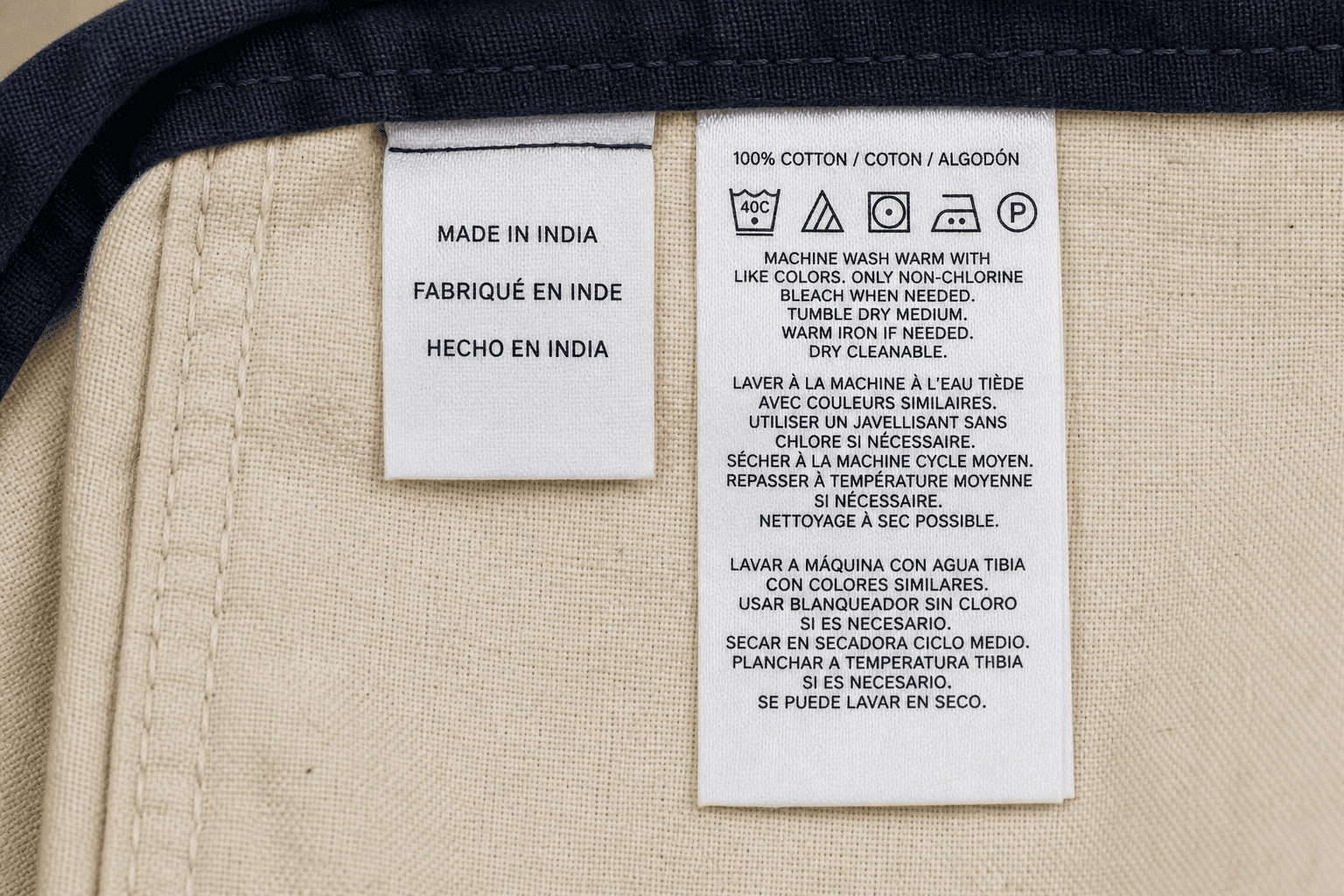
The most common label components are origin, fiber content, care symbols or care text, brand or importer identification, size, style number, lot code, and sometimes registration numbers such as an RN for the U.S. market. A single label can carry all information, but on thicker canvas aprons it may be better to split branding and compliance into two labels so the care label remains readable and the exterior branding remains clean.
- Bib apron: inside side seam or inner lower edge usually gives stable visibility without irritating the neck.
- Waist apron: waistband seam label is compact, but thick twill ties may make sewing less clean.
- Cross-back apron: avoid label placement near shoulder strap contact points because workers wear these aprons for 6-10 hours per shift.
- PVC or PU-coated apron: use heat-resistant or coating-compatible label material and test stitch perforation strength.
- Disposable nonwoven apron: printed polybag or carton labeling may be used when the product itself cannot carry a durable sewn label, subject to market rules.
Apron country of origin label wording: what factories need from buyers
A factory should not guess label wording. We can advise from production experience, but the importer of record and brand owner must confirm the legal wording for the destination market. In practice, the buyer should provide approved artwork showing exact capitalization, punctuation, language, and placement. "Made in China", "MADE IN CHINA", and "Made in P.R.C." may all be technically short phrases, but retailers can reject a shipment if their vendor manual requires one version and the bulk goods show another.
For U.S. apron programs, origin is normally expected to be clear and conspicuous, and textile products commonly require fiber content, country of origin, and manufacturer or dealer identity. For EU-bound aprons, language requirements may depend on the member state and retail channel, while fiber composition must use accepted fiber names. For UK, Canada, Australia, Japan, and Middle East markets, buyers often have their own language and importer address requirements. A single global label can work, but it becomes crowded quickly on small waist aprons.
From a factory costing view, label decisions affect unit price and timeline. A standard polyester satin care label in one color may cost USD 0.015-0.035 per piece at 5,000 pieces. A woven damask label with brand logo may cost USD 0.04-0.12 per piece depending on size and color count. Heat-transfer neck labels are less common on aprons than on T-shirts because many apron fabrics are coarse, coated, or textured, but they can be used on some cotton twill and poly-cotton styles after wash testing.
- Provide final label artwork in AI, PDF, or editable vector format before pre-production sample approval.
- State the destination market, not only the buyer's company country, because the apron may ship to multiple regions.
- Confirm whether "Made in China" must appear on the sewn label, hangtag, polybag, carton, or all of these.
- Approve label dimensions, usually 25 x 50 mm, 30 x 60 mm, or folded 35 x 70 mm for most apron care labels.
- Decide whether lot code, PO number, or production date must be included for traceability.
Care label law issues specific to apron fabrics
Apron care label law is closely tied to the actual fabric and finishing. A buyer may order one design in 180 GSM poly-cotton twill, 280 GSM cotton canvas, 330 GSM denim, and 500 GSM waxed canvas, but those four fabrics should not automatically share the same care label. Washing temperature, tumble drying, bleaching, ironing, dry cleaning, and shrinkage risk can change by fabric and finish.
Cotton canvas aprons often shrink 3-5 percent after domestic washing if fabric is not pre-shrunk. Heavy denim aprons can have indigo crocking, especially in dark shades. Poly-cotton twill at 195-240 GSM is easier to care for and often suitable for commercial laundries, but thread, webbing tape, metal eyelets, leather patches, and printed logos must also survive the declared care method. A care label saying "machine wash hot" can become a claim problem if the faux leather neck strap cracks after ten wash cycles.
Industrial and hospitality buyers should be especially careful with performance claims. If an apron is described as water-resistant, oil-resistant, flame-retardant, or bleach-cleanable, the label and test reports should support the claim. A PVC-coated apron can be wiped clean, but may not tolerate high-temperature tumble drying. A flame-retardant apron may need specific washing limits to maintain treatment performance. These details must be decided before bulk labels are printed.
- Run a wash test on the full apron, not only the shell fabric, when trims and printing are included.
- Check shrinkage after 1 wash and 3 washes for cotton, denim, and canvas qualities.
- Use separate care labels for waxed, coated, leather-trimmed, and printed apron versions when care conditions differ.
- Avoid claiming commercial laundry suitability unless the apron has passed buyer-approved laundering tests.
- Align care instructions with fabric GSM, dyeing method, trim materials, and logo decoration process.
Fiber content, trims, and mixed-material apron labeling
Fiber content is one of the most common areas where apron labeling becomes untidy. A plain cotton bib apron may be easy: 100% cotton. A restaurant apron with polyester-cotton body, cotton tape, PU leather neck loop, brass eyelets, and a polyester embroidery patch is less simple. Textile labeling compliance usually focuses on the textile fiber composition of the product, but market rules and retailer manuals may require disclosure of non-textile parts or special trims.
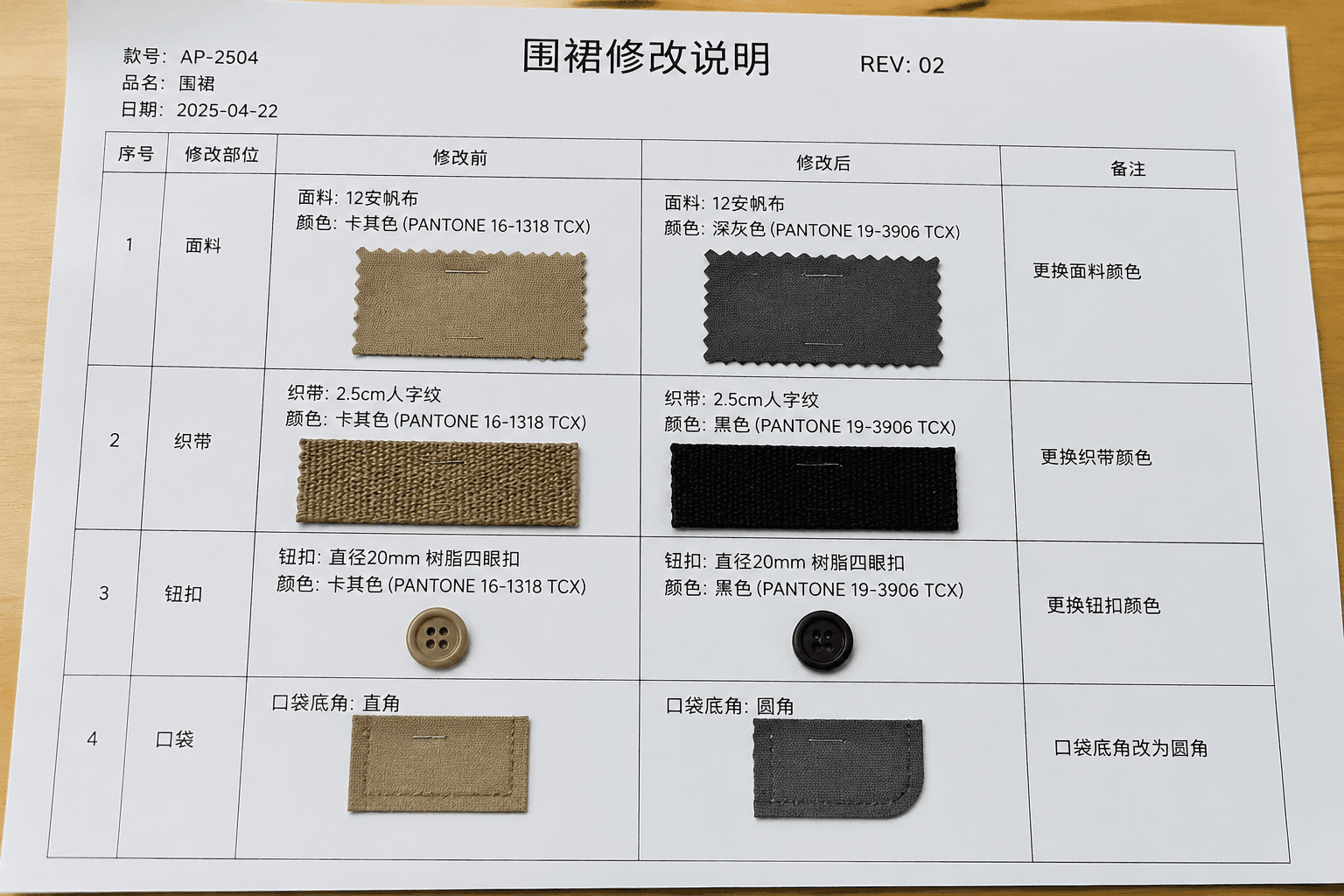
For bulk apron orders, the factory should lock the bill of materials before label artwork approval. If the original quotation uses 65/35 poly-cotton twill at 210 GSM but the buyer later changes to 80/20 poly-cotton canvas at 260 GSM, the fiber label must change. If pocket fabric, waistband, or strap material differs from the main body, the label may need wording such as "Body: 65% polyester 35% cotton; Straps: 100% cotton" depending on market requirements and buyer policy.
Decoration also matters. Screen printing, embroidery, woven patches, leather badges, reflective tape, and metal hardware do not usually change the main origin of an apron, but they may affect care labeling and safety warnings. For children's craft aprons, metal parts, drawstrings, and coatings may introduce additional testing and labeling obligations. For adult work aprons, trims are usually a durability and care issue rather than a safety label issue, but the buyer should still confirm intended end use.
How label compliance fits into apron sampling and production
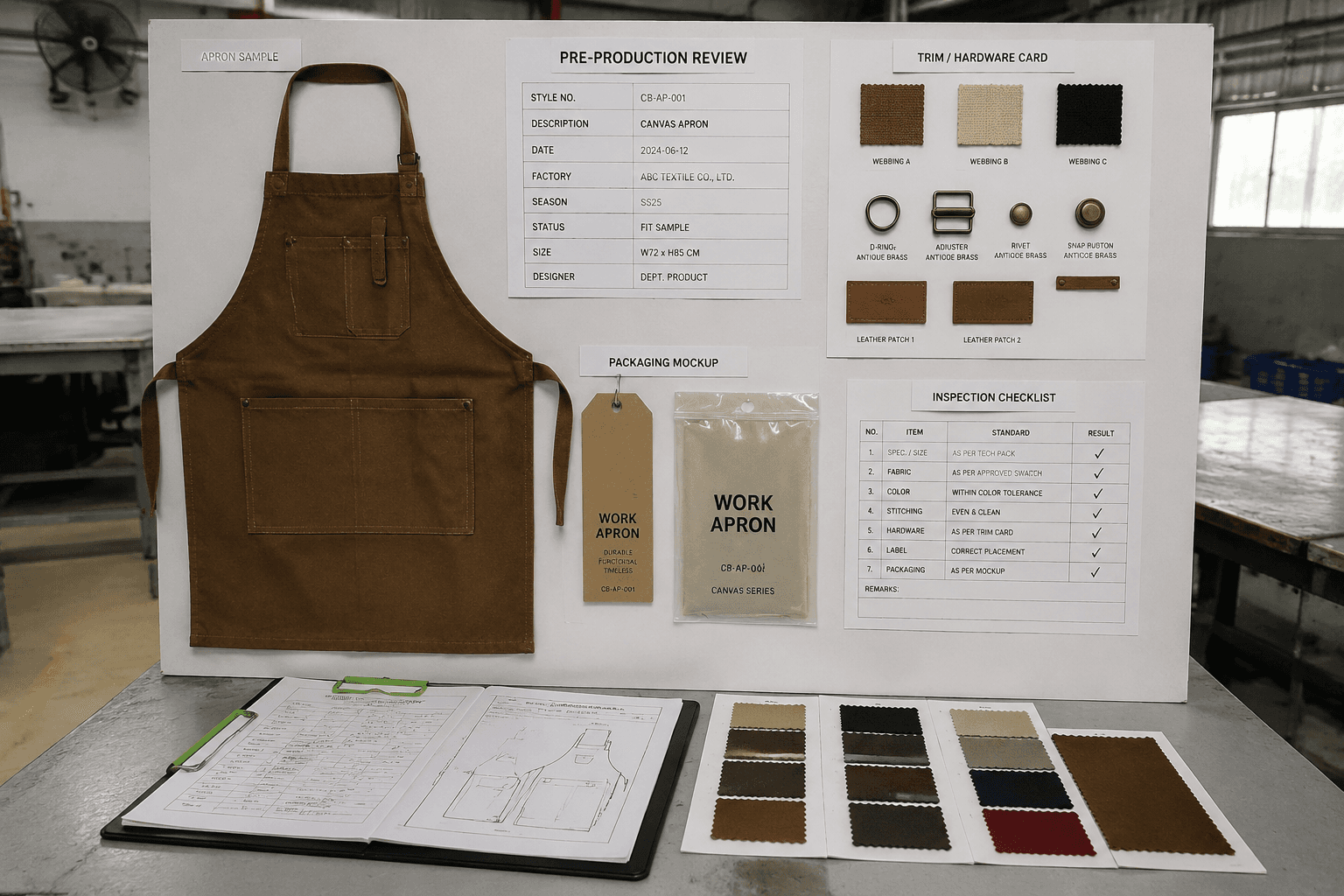
A practical label workflow starts with the tech pack. The buyer should include label artwork, label position, material, folding method, thread color, and all compliance wording in the same file as apron measurements and fabric specification. During development sample stage, the factory can use a dummy label to show placement, but the pre-production sample should use the approved bulk label whenever possible.
Typical timing is straightforward. Woven labels usually need 5-7 days for sampling and 7-12 days for bulk production after artwork approval. Printed satin care labels often need 3-5 days for sampling and 5-8 days for bulk. If the apron order MOQ is 1,000 pieces per color and the buyer needs six languages on the care label, we may need a larger label size or multiple folded pages, which affects sewing time and unit cost. For a 20,000-piece order, a label decision delayed by one week can push cutting and sewing slots into the next production window.
Inline QC should verify label content early. In our factory process, the first 20-50 pieces from each sewing line are checked for label position, orientation, and content before the line continues. Final inspection then checks random cartons using AQL sampling. However, final inspection is too late to discover that a made in china label is missing from every apron. The cost of prevention is a few minutes of pre-line review; the cost of correction can be several days of rework.
- Development sample: confirm practical label position and comfort.
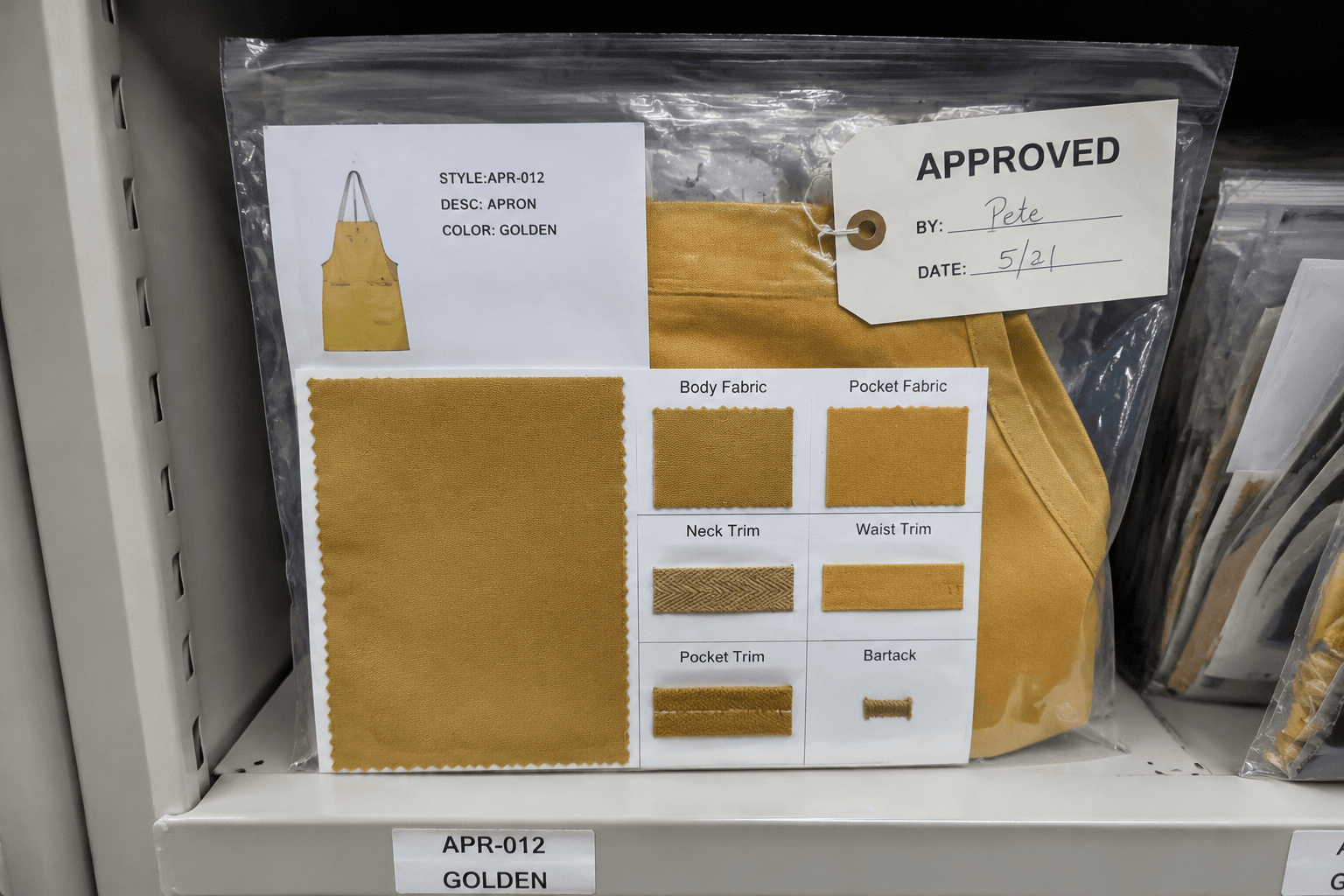
- Pre-production sample: confirm exact label material, wording, folding, and stitching.
- Pre-line meeting: compare approved sample against bulk labels and first output.
- Inline inspection: check label position, reverse sewing, missing origin, and unreadable print.
- Final inspection: verify label content against PO, carton marks, and destination market requirements.
Cost and lead-time impact of made in china label corrections
Label corrections are not all equal. If the issue is found before sewing, the solution may be as simple as replacing a label roll, with only a 2-4 day delay. If the issue is found after sewing but before packing, workers must open the seam area, remove the incorrect label, sew in the correct label, trim threads, and re-press the apron. For a simple waist apron, relabeling may cost USD 0.06-0.12 per piece. For a heavy cross-back canvas apron with bound seams, it may cost USD 0.15-0.35 per piece.
If the issue is found after export, the cost becomes much higher. Relabeling in the destination country may require warehouse labor at USD 0.40-1.50 per piece or more, depending on local labor rates and whether the apron must be removed from individual polybags. Retail chargebacks can exceed the physical relabeling cost. Customs problems can also occur if origin marking is absent, misleading, or inconsistent with entry documents.
The best control is a label approval checklist tied to the purchase order. For repeat programs, do not assume last season's label is still correct. A buyer may change importer name, RN number, fiber content, destination country, or retailer channel. A small change in legal entity after a brand acquisition can make thousands of existing labels unusable.
- Before label production: correction is usually low cost, often only artwork revision and 1-3 days lost.
- After label production but before sewing: replacement label cost is usually USD 0.02-0.12 per piece plus 3-10 days.
- After sewing: rework can add USD 0.06-0.35 per piece depending on construction.
- After packing: labor increases because polybags, cartons, and packing ratios must be reopened and restored.
- After import: local relabeling, chargebacks, and customs delays can exceed the apron manufacturing margin.
Factory checklist for apron country of origin and textile labeling compliance
A reliable apron supplier should treat labels as controlled components, not accessories bought at the last minute. The label supplier, fabric supplier, sewing line, QC team, and merchandiser all need the same approved information. For custom apron orders, especially private-label programs shipped to supermarkets, restaurant groups, hotels, breweries, and uniform distributors, the approval trail should be clear enough that a repeat order can be made six months later without re-asking basic questions.
The checklist below is the same type of control we recommend before mass production. It is not a substitute for legal advice in the import market, but it reduces the factory-side errors that most often create rejected shipments. For high-volume programs above 50,000 pieces per year, it is worth creating a master label matrix by style, destination, fabric composition, and care instruction.
When buyer and factory agree on label rules early, production becomes smoother. The apron country of origin, care instructions, fiber composition, and traceability information can be approved with the sample, checked at pre-line, and verified at final inspection. That is the practical route: clear artwork, stable bill of materials, controlled label purchasing, and no surprises when cartons reach the importer's warehouse.
- Confirm destination market and importer of record for each apron purchase order.
- Confirm exact apron country of origin wording, including capitalization and punctuation.
- Check fiber content against the final bulk fabric composition and trim materials.
- Verify apron care label law requirements for washing, drying, bleaching, ironing, and special finishes.
- Approve label position by apron type and size range before bulk sewing.
- Keep a sealed pre-production sample showing final label content and placement.
- Inspect first-line output before continuing mass production.
- Retain photos of labels, carton marks, and packing for shipment records.