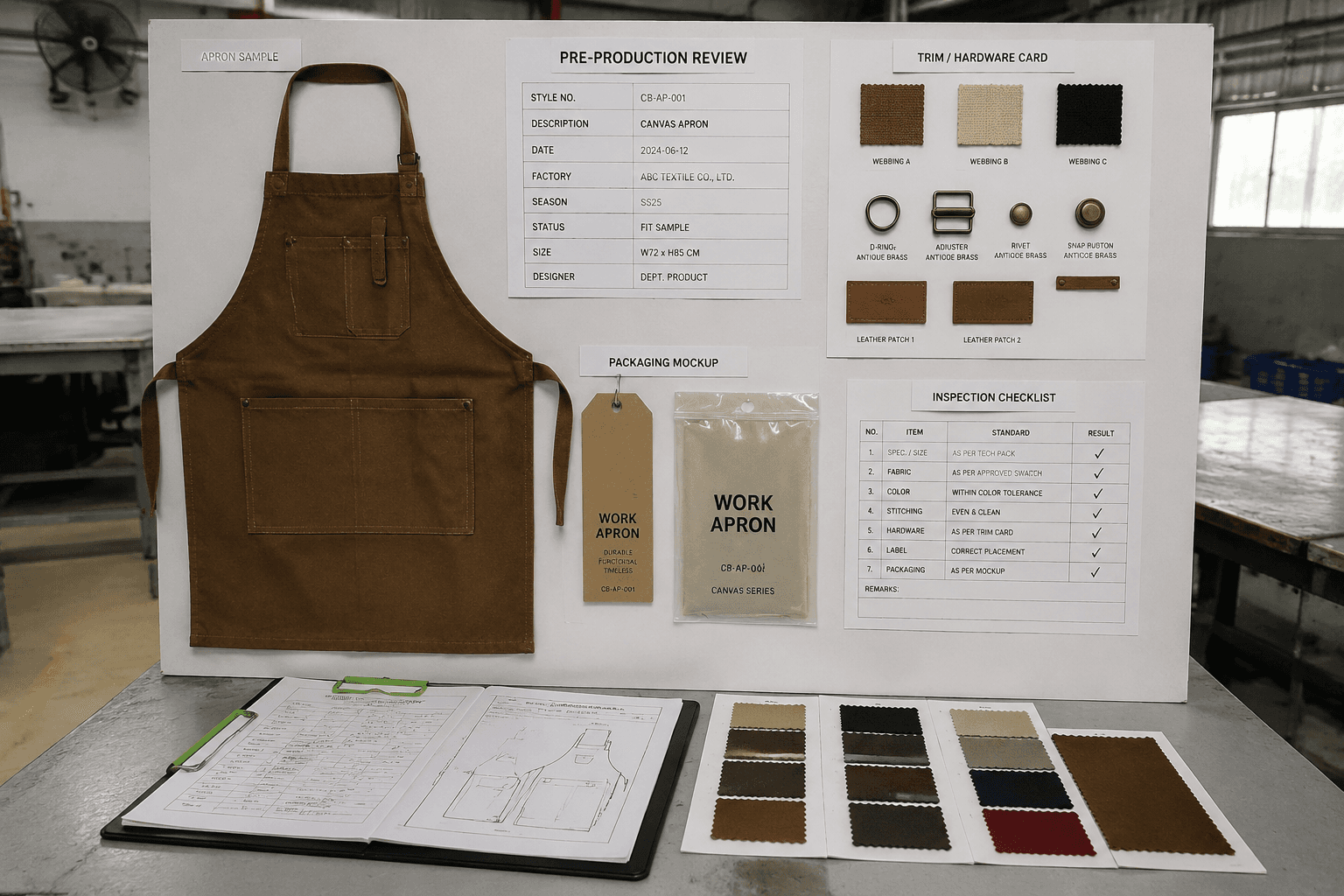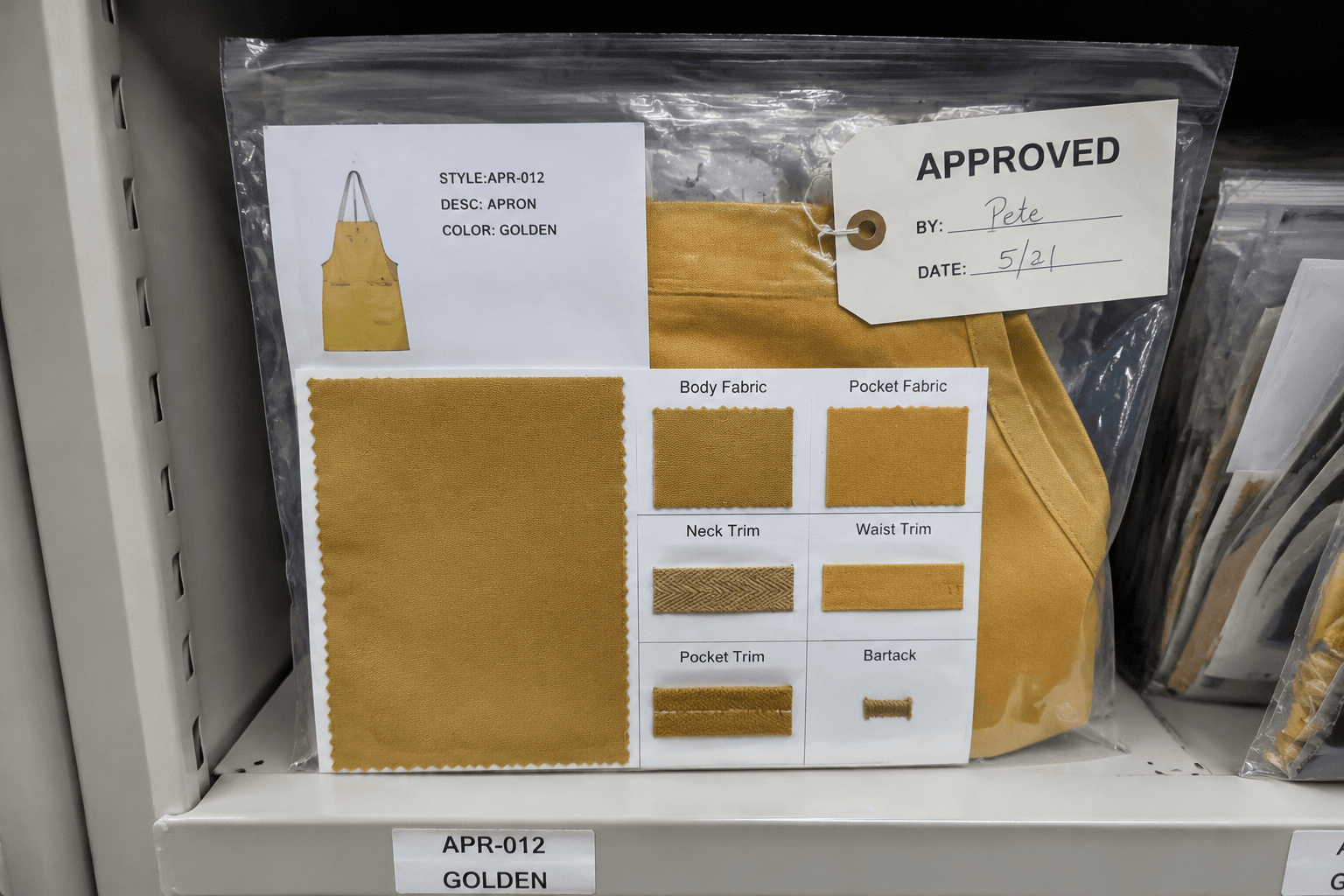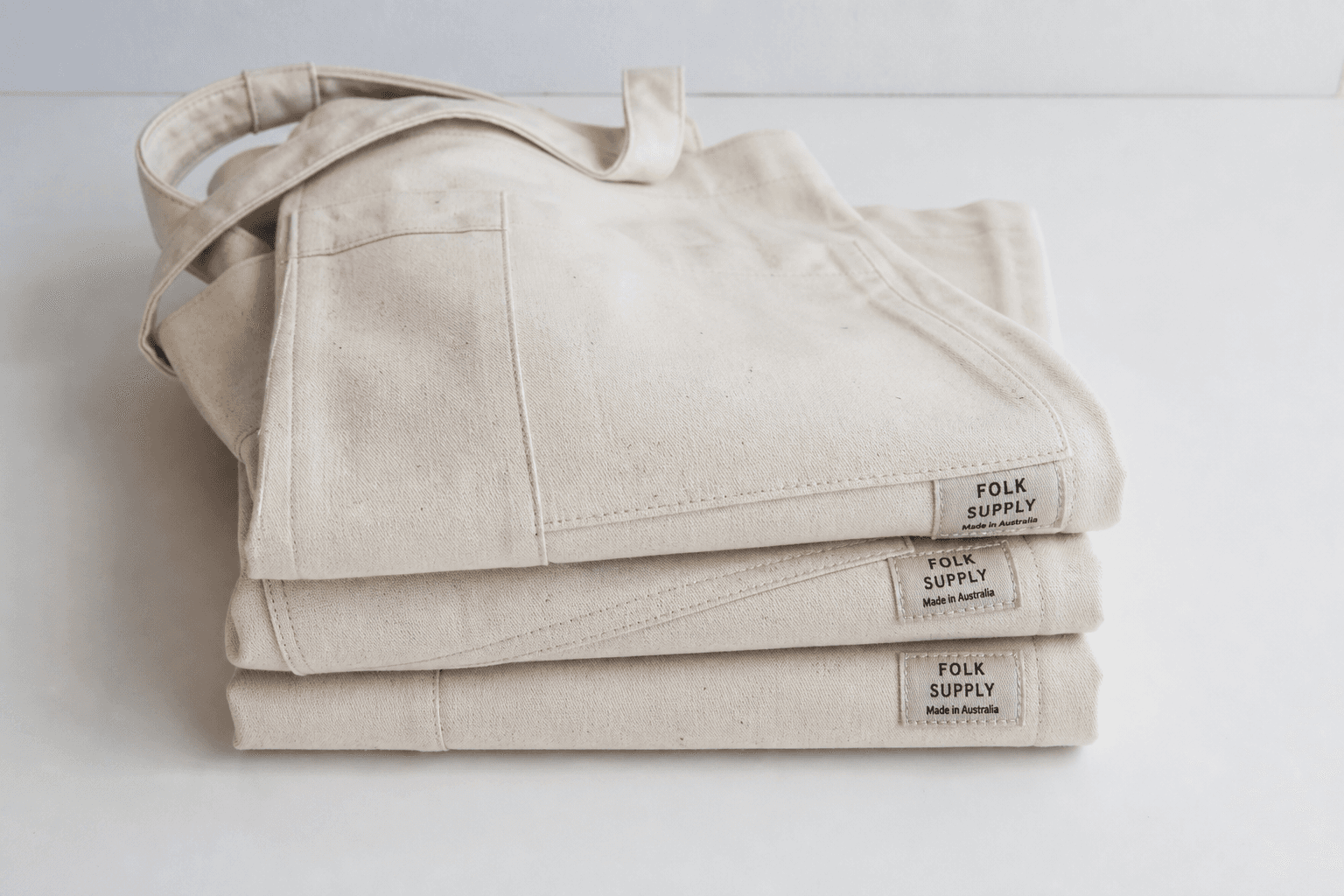
In apron sourcing, price gaps usually start before negotiation. They start inside the apron consumption sheet, where the factory turns a tech pack, approved sample or production pattern into shell fabric usage, trim counts, cutting loss and packing cost. If two suppliers quote the same bib apron at different FOB levels, the difference is often caused by different consumption logic, not just different margins.
A disciplined sheet should show fabric in meters, actual width, GSM or oz weight, pocket and strap usage, trim counts, packaging format and wastage. For example, a 240 GSM cotton canvas bib apron at 150 cm width may consume 0.86 to 0.93 meters per piece before trim, while a 12 oz cross-back utility apron with two patch pockets, webbing straps and metal hardware can move above 1.05 meters. On a 5,000-piece order, that gap changes the fabric bill by several hundred dollars before labor is added.
For professional buyers, the apron consumption sheet is also a control document for MOQ planning, trim sourcing, lab dip timing, PP sample alignment, bulk booking and re-quote discipline after spec changes. Used properly, it helps buyers compare suppliers on the same basis, challenge weak assumptions early and reduce disputes later over price, lead time or bulk yield.
- Fabric width, panel orientation and strap construction usually move apron cost more than buyers expect, especially on bib and cross-back styles.
- A usable apron consumption sheet separates net consumption from wastage instead of hiding both inside one fabric number.
- Trim choices such as webbing, buckles, rivets, branded labels and retail packaging can add $0.25 to $1.40 per piece depending on MOQ and spec.
- Wastage assumptions should change by fabric type, print direction, order size and cutting complexity; a flat 5% across all apron styles is rarely credible.
- The strongest supplier comparisons use one worksheet format with the same GSM, width, dimensions, AQL target, MOQ and lead-time basis for every quote.
What an apron consumption sheet must show before quoting
A professional apron quote starts with material consumption, not labor. The merchandiser or costing team reads the approved dimensions, checks whether seam allowances are already included, and lists every component that must be cut, purchased or packed. On a basic bib apron, that usually includes the main body, pocket, neck strap, waist ties, labels and export packing. On a waist apron, the biggest cost drivers are often pocket count, tie length and waistband construction.
A reliable apron consumption sheet records each line with a unit of measure, net usage and wastage basis. Shell fabric may be entered as 0.89 meters per piece at 150 cm width, cotton webbing as 2.20 meters, antique brass slider as 1 piece, D-rings as 2 pieces, main label as 1 piece, care label as 1 piece, polybag as 1 piece and carton ratio as 50 pieces per master carton. Those figures are then multiplied by current buy prices, such as $2.65 per meter for 10 oz cotton canvas or $0.11 per set for stock metal hardware.
The same sheet should also align departments. If the quote is based on 280 GSM recycled canvas but the sample room uses a lighter 240 GSM stock fabric to save time, the unit price may look competitive while the bulk margin becomes unstable. Serious suppliers use the sheet as a cross-functional control document for merchandising, sampling, procurement and production planning, not as a rough sales estimate.
For B2B buyers, the practical test is simple: if a supplier cannot explain exactly how the apron was broken into fabric, trim and packing lines, the quote is not yet ready for comparison. A good sheet makes the costing logic visible enough that a buyer can verify whether the quoted apron matches the requested construction, quality level and order basis.
- Typical line items are shell fabric, contrast fabric, pocket fabric, webbing, sliders, D-rings, rivets, labels, polybag, inner pack and carton.
- Units should be stated clearly as meters, yards, pieces, sets or kilograms, with metric-to-yard conversion shown when needed.
- Standard quote bases should include MOQ, Incoterm, expected ex-factory lead time and target inspection level such as AQL 2.5 major / 4.0 minor.
Apron consumption sheet fabric math: from pattern to marker yield
Fabric consumption starts with the cut pattern, not the finished size printed on a spec sheet. A bib apron shown as 72 by 86 cm finished may need a cut dimension closer to 76 by 92 cm once side turnings, bottom hem, top seam allowance and shrinkage buffer are added. If the style also includes two waist ties at 8 by 80 cm, one neck strap at 4 by 72 cm and two patch pockets at 18 by 20 cm, the total cut area rises quickly above what the visible finished apron suggests.
That theoretical area is only the first stage. Real quoting depends on marker efficiency on the actual fabric width. On a plain-dyed 240 GSM cotton canvas at 150 cm width, a standard bib apron with self-fabric ties may consume around 0.84 to 0.91 meters per piece. If the same style moves to a 57 inch yarn-dyed stripe where all body panels and pockets must follow stripe direction, marker efficiency often drops and usage may rise to 0.96 to 1.04 meters. Directional prints, brushed twill with nap and PU-coated fabrics can push it higher again because panels cannot be rotated freely.
This is why experienced buyers ask whether the supplier used a net-area method or a marker-based method. Net-area costing is acceptable for a quick RFQ, but in apron production it often understates real bulk usage by 3% to 10%. Marker-based estimating is slower, but it is closer to what cutting will actually consume. On a 10,000-piece order, a difference of 0.05 meters per apron at $2.65 per meter means $1,325 on shell fabric alone.
Fabric width and weight must also be read together. A 270 GSM recycled twill at 150 cm width may cost more per meter than a 240 GSM cotton canvas at 145 cm, yet the wider fabric may save 0.03 to 0.05 meters per apron. For buyers, the meaningful comparison is not price per meter by itself; it is cost per usable apron after width, marker efficiency and wastage are applied.
Factories that quote accurately also normalize the fabric basis before pricing. Some mills quote by yard, some by meter, and some coated fabrics are discussed by kilogram. A good consumption sheet converts all of that into a common per-piece usage basis so the buyer can see whether the apron is being costed on a like-for-like foundation.
- Basic bib aprons in 8 oz to 10 oz canvas commonly consume 0.78 to 0.95 meters per piece at 145 to 150 cm width.
- Heavy bib or utility aprons in 12 oz to 14 oz canvas with multiple pockets often consume 0.95 to 1.18 meters per piece.
- Three-pocket waist aprons often sit around 0.40 to 0.58 meters per piece, but long ties can add 0.05 to 0.10 meters.
- Cross-back aprons usually consume more than neck-loop aprons because two long straps reduce nesting efficiency.
Trim, hardware and packing lines on the apron consumption sheet
Many buyers focus first on shell fabric, but trim is often where apron quotes separate. A simple café apron may need only self ties, one woven label, one care label and a polybag. A premium workwear apron can include cotton herringbone tape, polyester webbing, an antique brass slider, D-rings, four to eight rivets, bartack reinforcement, a towel loop, a leather-look patch, a hangtag and retail insert. Each item looks small in isolation, yet together they can add $0.35 to $1.40 per piece before labor is touched.
Accurate trim costing starts from the construction sheet. If the neck system uses one slider and two D-rings on 32 mm cotton webbing, that is a different cost structure from a self-fabric neck loop with button adjustment. If pocket corners are reinforced with six rivets, the factory must cost both the rivets and the attachment process. If the apron has 10 to 14 bartack points, thread cost stays modest, but sewing time rises and should be reflected in the quote rather than hidden later as a surcharge.
MOQ changes trim economics sharply. A stock black acetal buckle may be available with a purchase quantity of 500 pieces and a short replenishment cycle. A custom logo metal buckle may require a mold charge, plating approval and a trim MOQ of 3,000 to 5,000 pieces, even if the apron order itself is only 1,000 units. That can add $0.18 to $0.45 per apron on a short run. By contrast, on a 10,000-piece program the same trim may be commercially acceptable.
Packaging is part of trim logic and should not be treated as an afterthought. Export polybag packing with suffocation warning is one cost basis; retail-ready packing with belly band, barcode sticker, insert card and hanger is another. In apron sourcing, unclear packing assumptions are one of the most common reasons a quote looks low at RFQ stage and rises later at order confirmation.
- Cotton or polyester webbing for straps commonly runs 1.80 to 3.20 meters per apron depending on style.
- Standard stock hardware often adds $0.08 to $0.40 per piece; custom-finished hardware can exceed that range.
- Retail packaging can add $0.12 to $0.35 per apron beyond basic export polybag packing.
- Common trim MOQs are about 500 to 1,000 pieces for stock items and 3,000 to 5,000 pieces for custom metal trims.
Wastage assumptions buyers should verify on an apron consumption sheet
No factory cuts aprons at perfect yield. Real production includes marker loss, roll-end loss, splice loss, shade segregation and defects found during spreading or cutting. Wastage is therefore not optional; the issue is whether the assumption is realistic and whether it is added transparently. For aprons, a preliminary allowance of 5% to 6% may be reasonable on a plain solid style cut from stable fabric with simple rectangular panels, but that number should not be copied blindly to every program.
On a 240 GSM solid cotton canvas bib apron at 150 cm width, 5% to 7% total fabric wastage can be defensible on an order of 2,000 to 5,000 pieces. On a yarn-dyed stripe apron with pocket matching, single-direction cutting and multiple size variants, 8% to 12% is more credible. Waxed cotton, coated fabrics and narrow-width specialty twills can also require higher allowances because spreading is slower, face direction is controlled and reject risk is less forgiving.
MOQ matters here as much as style. A 300-piece custom apron order may need the same dye-lot minimum or fabric booking rule as a 1,500-piece order, which means the purchased fabric per piece goes up even if net consumption stays unchanged. Larger repeats generally cut more efficiently because roll planning, shade management and marker making are more stable. For that reason, a supplier should not quote the same wastage basis for a 500-piece trial and a 10,000-piece reorder unless the fabric program is identical.
Buyers should also separate cutting wastage from quality assumptions. A well-run apron factory might quote on the basis of final inline and final inspection targets tied to AQL 2.5 major / 4.0 minor, plus a normal cutting allowance. If a supplier quietly blends expected reject risk into one vague fabric percentage, the quote becomes hard to audit. Clearer sheets show whether the wastage covers marker loss only or also defect allowance and roll-end loss.
- Simple solid aprons often use 5% to 8% total fabric wastage.
- Stripes, checks, directional prints and coated fabrics often need 8% to 12% or more.
- Small MOQs usually produce worse effective yield than repeat runs with stable fabric booking.
- The sheet should state whether wastage is included inside the consumption figure or added as a separate percentage.
How to compare suppliers with one apron consumption sheet format
When buyers compare apron suppliers, the FOB total by itself is not enough. The useful comparison is whether each supplier quoted the same apron under the same conditions: same finished dimensions, same GSM, same fabric width, same trim construction, same packaging basis, same MOQ and similar inspection target. Without that discipline, a $3.95 quote and a $4.22 quote may not be costing the same product at all.
A strong worksheet breaks the quote into shell fabric, contrast fabric if any, trim total, direct labor, finishing, packaging and overhead or conversion. Some factories will not disclose every internal labor rate, which is normal, but they should still provide enough consumption detail to let the buyer validate the material logic. If one supplier prices a bib apron at $4.10 based on 10 oz canvas, stock webbing and 35-day ex-factory lead time, while another prices $4.34 based on 12 oz canvas, custom hardware and 50-day ex-factory, the difference is logical rather than suspicious.
Lead time should be read with the same care as cost. Stock-fabric apron programs can often ship in about 30 to 40 days after deposit and approval, while custom-dyed or custom-trim programs may need 45 to 60 days. If a supplier offers an aggressive price but has not included time for lab dips, trim development, PP sample approval and material in-house checks, the quote may be commercially weak even if the unit cost looks attractive.
For sourcing teams, the best practice is to keep one standard comparison format across all RFQs. That allows the buyer to see where one supplier is lighter on fabric, lower on trim standard or optimistic on wastage. It also makes later re-costing faster when the apron spec changes after fitting or sales feedback.
- Ask every supplier to quote against the same width, GSM, dimensions, trim spec, packing method and MOQ.
- Request lead time in days, not vague terms such as fast or standard.
- Flag any quote that does not state whether straps are self fabric, stock webbing or mixed construction.
- Treat missing packaging, missing wastage or undefined inspection assumptions as pricing risk, not as savings.
Why apron consumption sheets differ between factories
Different factories often produce different consumption figures for the same apron because their starting assumptions are not aligned. One may cost directly from finished dimensions, while another costs from production patterns with seam allowances included. One may assume self-fabric ties; another may assume 32 mm cotton webbing. One may build a folded pocket from one larger cut panel, while another uses separate pocket pieces. These differences are normal, but they need to be made visible before order placement.
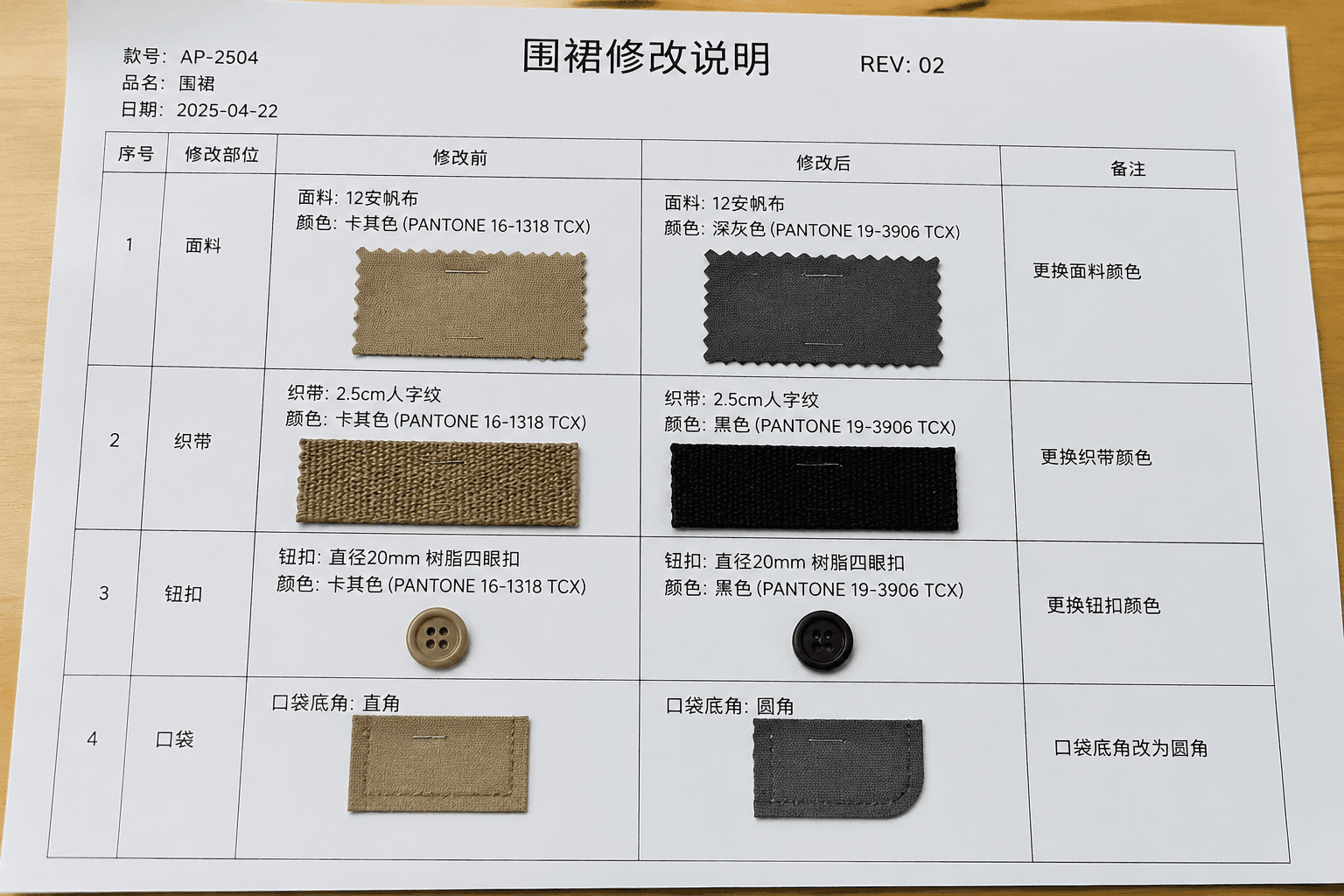
Sampling-stage changes are another frequent cause of re-costing. A proto may start with a 70 cm body width and 75 cm ties, then move to a 74 cm body and 85 cm ties after fit comments. That can add 0.05 to 0.10 meters of shell fabric and 0.20 meters of webbing, which in turn affects both material cost and marker efficiency. If the quote is not updated after those revisions, the final order price will drift away from the approved estimate.
Fabric sourcing basis also changes the logic. A mill quoting 300 GSM canvas at 57 inches wide does not create the same economics as a mill quoting 240 GSM canvas at 150 cm, even if both fabrics are casually called canvas. The factory must normalize meter-to-yard conversion, usable width and weight before claiming that two options are comparable. Otherwise, the buyer sees similar descriptions but very different material economics beneath them.
Compliance requirements can also change the sheet indirectly. If the apron must meet specified colorfastness, dimensional stability or restricted-substance standards, the factory may need to upgrade the fabric, hardware finish or label material. The visual sample may still look similar, but the approved bulk basis is not the same. A disciplined supplier updates the consumption sheet to reflect the approved compliance route, not only the original sample room setup.
The right buyer response is not to demand that all factories show the same number. It is to ask each one to declare its assumptions clearly enough that the quote can be normalized. Once the assumptions are transparent, cost negotiation becomes factual instead of argumentative.
- Common variance drivers are seam allowance treatment, tie construction, pocket engineering and hardware assumptions.
- Pattern or size revisions after proto approval should trigger immediate re-costing.
- Meter-to-yard conversion errors and width assumptions are still common in mixed sourcing environments.
- Compliance-driven upgrades can change trim or fabric cost even when the apron design looks unchanged.
Using the apron consumption sheet to negotiate without losing quality
The most effective use of an apron consumption sheet is not forcing every supplier to the lowest possible price. It is identifying which cost drivers are fixed, which are negotiable and which are simply based on different assumptions. Fabric market price is usually less flexible once GSM, composition and finish are set. By contrast, strap construction, hardware standardization, pocket simplification, packaging level and MOQ consolidation are often negotiable without damaging the commercial intent of the apron.
In practice, the cleanest negotiation happens one variable at a time. Confirm the shell fabric first: for example, 10 oz cotton canvas at 150 cm width, reactive dyed, pre-shrunk, with colorfastness and dimensional stability aligned to buyer standards. Then review construction levers such as whether self-fabric ties can switch to stock webbing, whether four rivets can replace eight, whether one internal pocket can be removed, or whether each waist tie can be shortened by 5 cm. Savings of $0.04 to $0.12 per piece may look small, but on 20,000 aprons they become meaningful.
MOQ strategy is another major lever. If a buyer combines colorways into one fabric booking or uses stock hardware instead of custom-finished hardware, the supplier may improve both trim price and lead time. A program quoted at 1,000 pieces per color with 55-day delivery may become more efficient at 3,000 pieces assorted colors with 40 to 45 days if the material route is simplified. Those are sourcing decisions that a good consumption sheet makes visible.
For repeat styles, buyers should keep approved sheets as a benchmark library. When the same bib apron is reordered six months later, the team can compare fabric inflation, trim movement, actual bulk yield and any pattern optimization achieved in earlier runs. That creates faster re-quoting, cleaner target costing and more disciplined negotiations with current or alternate suppliers.
The commercial goal is simple: use the sheet to remove avoidable ambiguity. Once fabric usage, trim counts, wastage, MOQ and lead time are clear, the buyer can negotiate hard on the right items without pushing the supplier toward hidden substitutions or unrealistic production assumptions.
- Negotiate high-impact items first: shell fabric, strap system, hardware standard and packaging level.
- Request revised costing after every approved dimension or construction change.
- Use repeat orders to benchmark quoted consumption against actual bulk yield and defect performance.
- Be cautious with very low quotes if the sheet omits wastage, packaging, trim MOQ or lead-time assumptions.