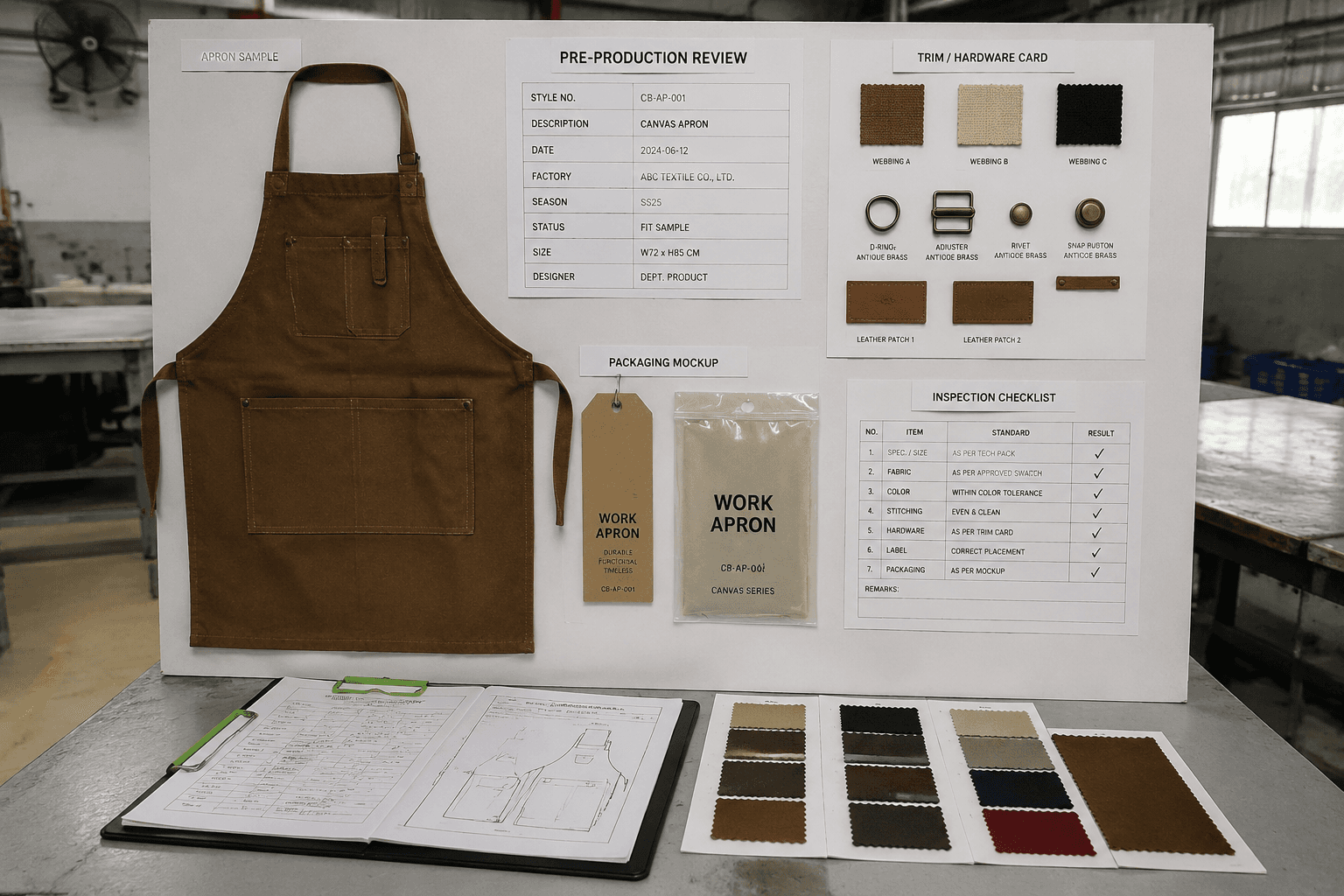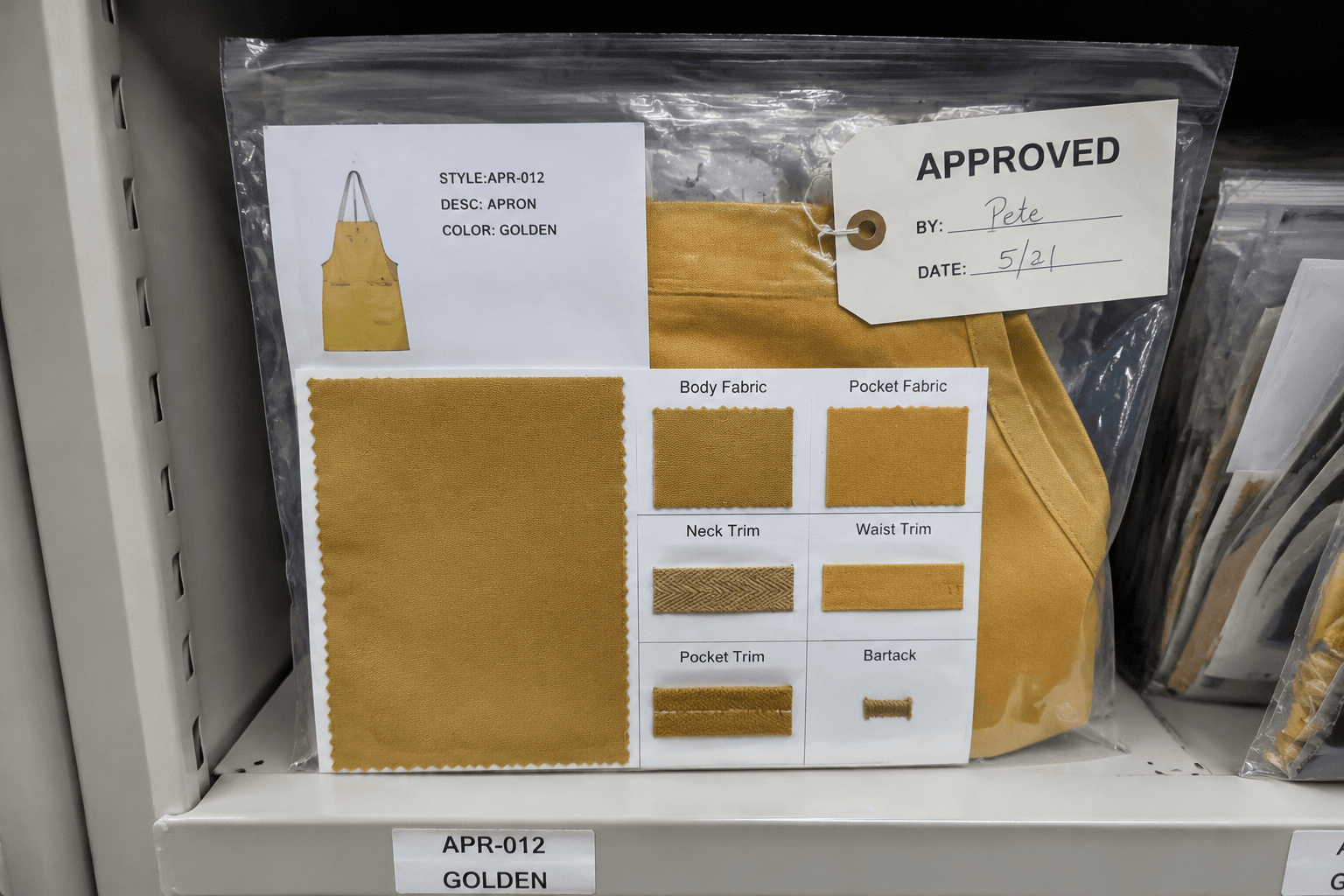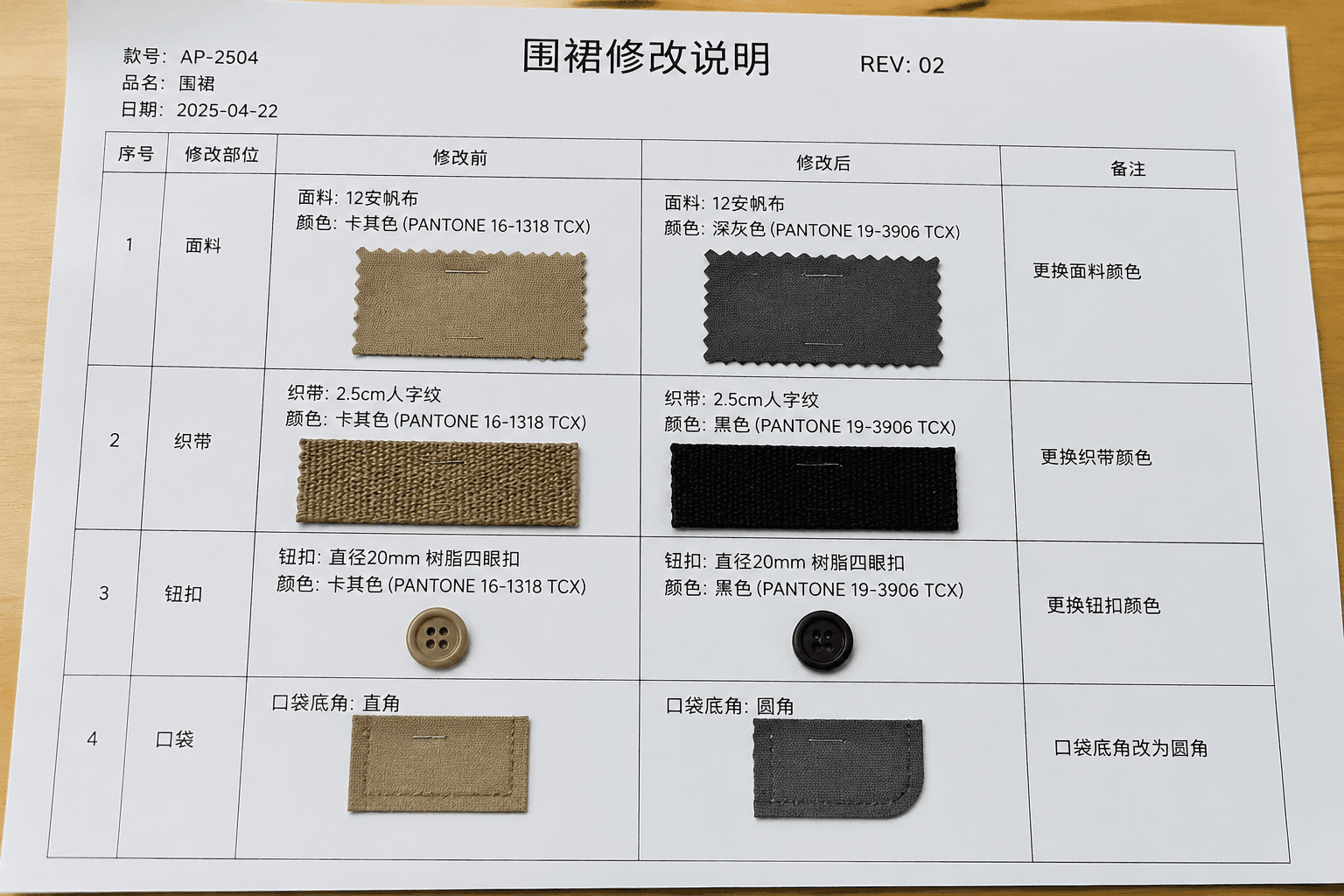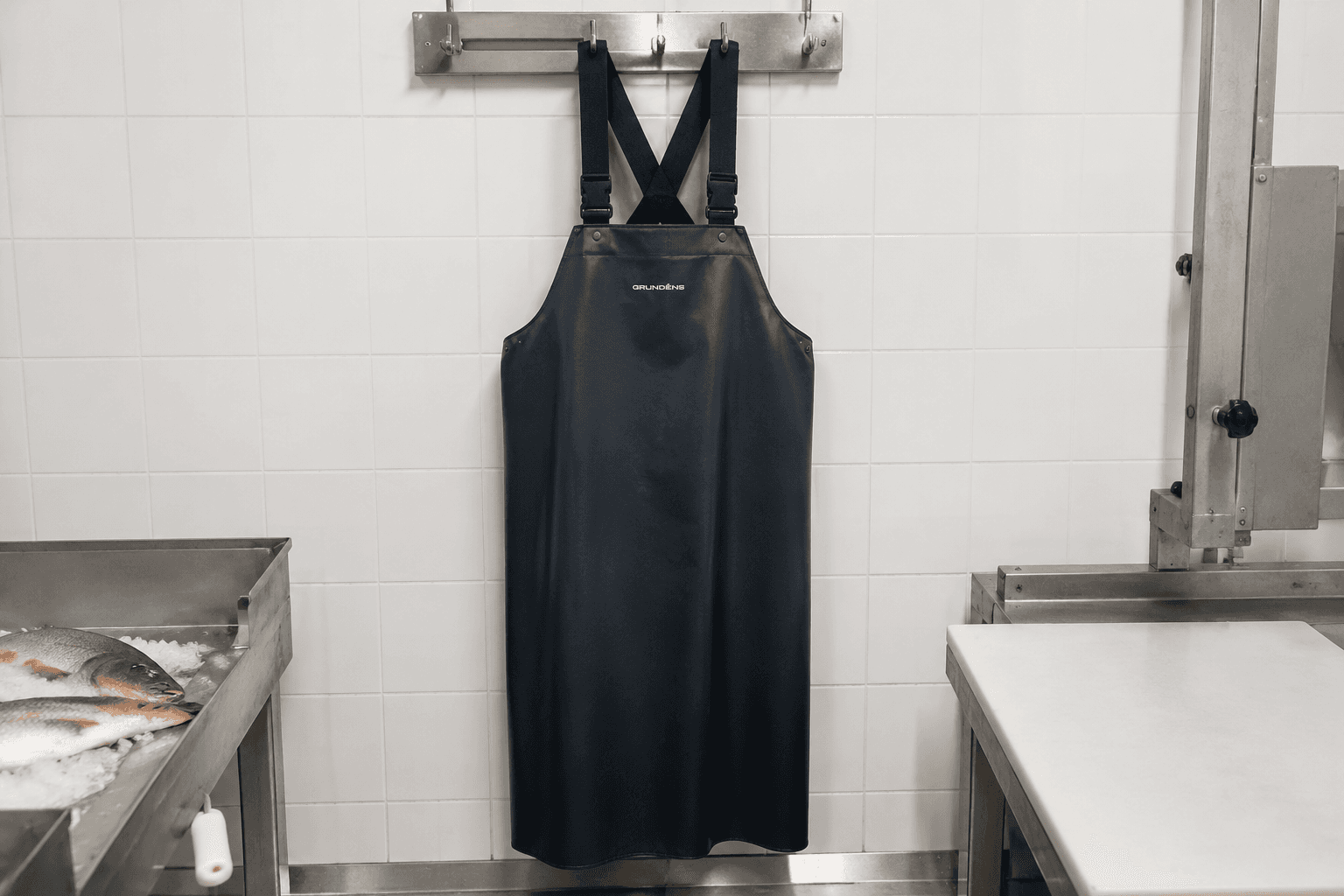
For professional buyers sourcing aprons from China, Pakistan, Vietnam, or India, physical samples still matter, but they should not be the first place where basic pattern errors are discovered. When a factory moves from tech pack straight to sewing without a structured apron cad pattern approval step, the first sample often comes back with predictable faults: body length off by 3 to 5 cm, chest pocket placed 1.5 to 2.0 cm too high, waist ties too short for front fastening, logo width too large for the usable chest panel, or hardware added without checking seam allowance and fabric thickness. Each correction round typically adds 8 to 14 calendar days once pattern revision, sample sewing, internal review, and courier transit are counted.
In apron manufacturing, digital approval should function as a technical checkpoint rather than a styling exercise. A usable approval file set needs the finished CAD pattern, graded measurements, pocket coordinates, seam and fold allowances, logo safe zones, trim positions, and construction notes. That matters for bib aprons, waist aprons, cross-back aprons, salon aprons, butcher aprons, and promotional aprons because pocket access, strap adjustment, decoration placement, and reinforcement details directly affect service performance, sewing minutes, and FOB cost.
A practical digital review will not remove every sewn sample, but it often reduces development from three rounds to one confirmation sample before bulk approval. For sourcing managers running remote programs across time zones, that can recover 10 to 24 calendar days, reduce sample and freight spending by roughly $70 to $240 per style, and establish a dated technical baseline before MOQ, deposit, and production booking are finalized.
- Apron cad pattern approval should lock body size, pocket coordinates, strap configuration, decoration position, seam allowance, and tolerances before the first sewn sample is cut.
- A disciplined digital review can remove 1 to 2 sample rounds, typically saving 10 to 24 calendar days in overseas apron development.
- For fit approval, buyers should prioritize finished width, finished length, neck drop, waist tie length, pocket opening width, split height, and strap adjustment range rather than judging a front view alone.
- The factory should issue CAD views, measurement sheets, construction notes, component maps, and revision logs, not only flat artwork or logo mockups.
- MOQ, fabric width, GSM or oz weight, and decoration method should be checked during pattern review because they can change FOB cost by $0.20 to $1.50 per piece and move practical MOQ from 300 pcs to 2000 pcs.
- Remote approvals work best when one buyer-side owner returns one consolidated file within 24 to 48 hours and the factory responds with a dated revision record.
1. Why <strong>apron cad pattern approval</strong> should happen before the first sewn sample
Many buyers still treat digital files as branding previews, but in apron sourcing the CAD stage should be a pre-sample technical gate. An apron is simpler than a jacket, yet it still combines coverage, movement, reinforcement, hardware placement, wash durability, and branding constraints. If those points are not checked digitally, the first physical sample often becomes a list of avoidable faults: a bib body too narrow for hospitality staff, a towel loop positioned above natural hand reach, a split-leg opening too shallow for walking, or a centered logo partly blocked by the pocket topstitch line.
A proper apron cad pattern approval step lets the buyer confirm panel shape, finished dimensions, seam allowances, fold allowances, and trim positions before the factory cuts fabric. For a standard bib apron in 220 to 280 GSM poly-cotton twill or 8 oz to 10 oz cotton canvas, a digital review usually takes 2 to 4 working days when the tech pack is complete. By comparison, each sewn sample round commonly consumes 8 to 14 calendar days after pattern revision, sewing, factory QC, packing, and courier transit.
The commercial value is measurable error prevention. If the approved file states a finished body size of 72 x 86 cm, a chest pocket at 16 x 18 cm placed 7 cm below the top edge, waist ties at 95 cm each side, and seam allowance at 1.0 cm, both buyer and factory are working from the same baseline. That is far more reliable than comments such as slightly longer or move the pocket down a bit. Clear CAD approval also gives QC a fixed standard later at inline and final inspection.
- Typical CAD review window for a standard custom apron: 2 to 4 working days
- Typical sewn sample round including shipping: 8 to 14 calendar days
- Common avoidable corrections: body proportion, pocket placement, tie length, logo scale, hardware position
- Best stage for low-cost design changes: before the first sample fabric is cut
2. What a complete apron approval pack must include
A workable approval pack needs more than front and back artwork. Buyers should expect a technical file set that supports product review, not only visual review. For bib aprons, waist aprons, cross-back aprons, utility aprons, and cobbler aprons, the minimum useful package usually includes a flat CAD drawing, a finished measurement sheet, a component map, and a construction summary. Without those documents, comments stay subjective and sample rounds increase.
For apron OEM programs, strong digital packs also show where styling changes create functional or cost consequences. Raising an embroidered logo by 3 cm may push it into the fold allowance. Deepening a lower patch pocket from 20 cm to 24 cm may improve storage but also increase fabric consumption if the pocket is a separate cut panel. Changing from a fixed neck strap to a D-ring adjustable strap adds trim cost, bartacks, and a different sewing sequence. These points are easy to settle during pattern review and expensive to correct after repeated physical samples.
Revision control matters as much as drawing quality. Every file should show the style code, revision number, issue date, and marked changes from the previous version. In cross-border apron sourcing, one unclear email chain can add more delay than the sewing itself. Buyers coordinating merchandising, branding, sales, and end-customer comments need one controlled approval record that can be referenced later during sample review, pre-production confirmation, and final inspection.
- Flat CAD views with front, back, and detail callouts for pockets, straps, loops, rivets, and hardware
- Finished measurement sheet in cm and inch with tolerances such as +/-0.5 cm for pocket dimensions and +/-1.0 to 1.5 cm for overall body dimensions
- Component map showing distances from top edge, center line, side seam, and hem
- Material notes covering fabric composition, GSM or oz, strap material, hardware finish, and print or embroidery method
- Revision log with version, date, approver, and accepted changes
3. <strong>Apron cad pattern approval</strong> for fit, pocket function, and logo placement
In apron sourcing, digital approval is usually most effective in 2D rather than fashion-style 3D simulation. Aprons do not rely on complex body contour, but they do depend on accurate checks for coverage, accessibility, and movement. Buyers should therefore use the digital stage to approve measurable function first.
For fit, the key points depend on end use. A cafe bib apron often works at 68 to 72 cm finished width and 82 to 86 cm finished length to balance coverage with mobility. A chef bib apron usually runs 74 to 78 cm wide and 86 to 95 cm long for stronger front protection. A waist apron for service staff may need a 50 to 60 cm body width with 85 to 105 cm ties on each side so the wearer can tie at the front or back. These measurements matter more than whether the rendered apron looks balanced on screen.
Pocket review should be equally practical. A lower pocket opening that appears neat in artwork may be too tight once seam turn-in and reinforcement stitching are added. A pen slot at 2.5 cm width may hold a standard pen but fail for a marker or thermometer. A towel loop placed 5 cm too high slows access in service use. The same discipline applies to branding. A 9 cm chest embroidery may distort if it sits over a curved pocket edge, fold line, or heavy seam intersection. During approval, the factory should define safe decoration zones and note whether screen print, heat transfer, or embroidery is suitable for the selected fabric weight and texture.
- Approve coverage points first: body width, body length, neck drop, side cut, split height
- Check pocket usability: opening width, pocket depth, entry angle, reinforcement points, pen slot size
- Confirm tie and strap logic: waist tie length, adjustable range, cross-back route, buckle position
- Mark safe logo zones away from seams, folds, rivets, bartacks, and stacked pocket layers
4. End-use specifications that should drive apron fit approval
Many sample rounds happen because the buyer asks for a generic fit review on an apron intended for a specific job role. Effective approval starts with the actual use case. A cafe apron, chef apron, salon apron, florist apron, butcher apron, and workshop apron may share a similar silhouette, but their functional priorities are different enough to require different pattern decisions.
Service and cafe programs often favor 200 to 245 GSM twill or 7 oz to 8.5 oz light canvas because they wash frequently and need easier movement. Kitchen and chef styles more often require 240 to 300 GSM fabric, stronger neck construction, and longer front coverage. Butcher and workshop aprons may need 10 oz to 14 oz canvas, reinforced pocket corners, metal hardware, or coated surfaces. Salon aprons usually need lighter splash resistance, cleaner front branding, and pocket placement that does not interfere with seated work or side movement.
This is why the factory should ask for measurable approval points instead of broad comments about appearance. For a chain cafe uniform, a workable one-size bib apron may be 70 x 85 cm in 245 GSM poly-cotton twill with an adjustable neck strap, two lower patch pockets, and 90 cm ties. For a premium retail canvas apron, the body may shift to 76 x 90 cm in 12 oz cotton canvas with cross-back straps, antique brass hardware, and a chest pocket sized for tools or tablets. These are not cosmetic differences. They change pattern shape, trim count, sewing minutes, and FOB cost.
If the buyer wants one size to protect MOQ efficiency, that can work, but the fit compromise should be agreed in advance. If grading is required for S/M and L/XL or for different regional markets, the CAD review should cover every approved size set before the first sewn sample. Otherwise, the sample size may pass while larger or smaller sizes create proportion problems later in production.
- Cafe and service bib aprons commonly use 200 to 245 GSM twill or light canvas
- Chef and kitchen bib aprons often run 86 to 95 cm finished length for stronger coverage
- Workshop or butcher styles may move to 10 oz to 14 oz canvas with added reinforcement and metal trims
- One-size programs support MOQ control, but buyers should define the wearer range and fit compromise before approval
5. Cost, MOQ, lead time, and QC points to settle during pattern review
Buyers often ask whether digital approval saves sample cost. It does, but the larger gain is control of the full development calendar. In remote apron sourcing, each unnecessary sample round adds pattern revision time, sewing time, buyer review time, and courier expense. For a basic custom bib apron, development sampling often costs $25 to $55 per piece, while courier shipping for one parcel commonly adds $35 to $90 depending on destination and service level. If one style avoids two extra rounds, the direct saving is meaningful, but the bigger commercial benefit is often 2 to 3 weeks recovered before bulk booking.
Unit cost also starts moving earlier than many buyers expect. During the CAD stage, small specification changes alter fabric consumption, trim usage, and sewing minutes. Extending body length by 8 cm can add roughly 0.05 to 0.08 meter of fabric depending on apron width, fabric width, and marker efficiency. Adding a second chest pocket, rivets, detachable straps, snap closures, or metal grommets can raise FOB by about $0.20 to $1.20 per piece. Switching decoration from a simple one-color screen print to embroidery may add $0.30 to $1.50 per piece depending on stitch count and order quantity. These decisions belong in pattern review, not after the second sample.
MOQ should be clarified at the same stage. Many apron factories can accept 300 to 500 pieces per color for straightforward styles in stock fabric with standard labels. Once the buyer requests custom-dyed fabric, digital print, jacquard webbing, garment wash, wax finish, or custom hardware color, the practical MOQ often rises to 800, 1000, or 2000 pieces. Standard bulk lead time after final approval and deposit is commonly 25 to 35 days for simple aprons and 35 to 50 days for more customized programs.
QC expectations should also be tied to the approved CAD and spec sheet. For most apron orders, buyers should align on inspection under AQL 2.5 major and 4.0 minor, with measurement checks taken against the approved points of measure. If pocket position, strap length, and logo placement are not defined at pattern stage, final inspection becomes subjective and disputes are harder to settle.
- Typical development sample cost: $25 to $55 per piece
- Typical courier cost per development parcel: $35 to $90
- Simple custom apron MOQ in stock fabric: 300 to 500 pcs per color
- More customized apron MOQ: 800 to 2000 pcs depending on fabric, print, wash, and hardware
- Typical bulk lead time after approval and deposit: 25 to 50 days depending on complexity
- Recommended inspection baseline for most orders: AQL 2.5 major / 4.0 minor
6. How buyers and factories should manage remote approvals
The strongest remote approvals are centralized and sequential. Problems usually start when different departments send different comments at different times. Merchandising asks for deeper pockets, branding requests a larger logo, sales wants lower cost, and the end client wants longer ties. If the factory revises against scattered feedback, the sewn sample may reflect a mix of outdated and current instructions, which leads to approval disputes.
A more reliable process is straightforward. The buyer assigns one approval owner, collects all internal comments, and returns one marked file. The factory then issues a revised CAD with every accepted change highlighted and dated. For a standard bib or waist apron, one to two digital revision rounds are usually enough before a sewn confirmation sample is made. More technical styles such as waxed canvas cross-back aprons, removable-strap aprons, or hardware-heavy workshop aprons may need a third review round because thickness, fold behavior, and metal placement require closer checking.
Response time matters. If the buyer returns consolidated comments within 24 to 48 hours, the factory can usually maintain pattern and sample momentum. If the file sits open for 5 to 7 days across several departments, the reserved sampling slot may move, especially before hospitality peak seasons, trade-show deadlines, or holiday retail launches. Once timing slips at approval stage, bulk delivery risk increases quickly.
- Assign one buyer-side approval owner for comment control
- Return one marked file instead of separate email threads
- Approve in order: measurements, construction, branding, packaging notes
- Target buyer feedback within 24 to 48 hours per revision
- Keep a dated approval trail so later disputes can be checked against the accepted CAD version
7. When digital approval is enough and when a physical sample is still required
Digital approval is powerful, but it is not a full substitute for physical evaluation. For repeat programs based on an already approved block, stock fabric, unchanged pocket layout, and unchanged decoration placement, some buyers can move from apron cad pattern approval directly to a pre-production sample or, in limited cases, to bulk approval with only a strike-off, color confirmation, and measurement check. This is most realistic for simple waist aprons or repeat bib apron programs with stable materials and known fit.
A physical sample is still advisable when material or construction introduces tactile or performance risk. That includes waxed canvas, 320 to 450 GSM heavy cotton canvas, PU-coated fabric, leather straps, unusual buckles, contrast topstitching, enzyme wash, stone wash, or a new cross-back system. In these cases, the buyer needs to judge drape, stiffness, edge bulk, wash response, and how smoothly hardware works in actual use. CAD can confirm placement and dimensions, but it cannot show how a 14 oz canvas apron hangs on the body or whether a selected buckle slides consistently after repeated adjustment.
The practical goal is not to eliminate sewn samples completely. It is to use them later, when the remaining questions are the right ones. If the digital stage has already locked body measurements, pocket logic, tie length, strap route, and decoration position, the first sewn sample can focus on hand-feel, color, workmanship, laundering, and final commercial presentation instead of correcting obvious pattern mistakes.
- Digital-only progression is more realistic for repeat styles, stock fabrics, and unchanged construction
- Physical samples remain important for heavy canvas, coated fabrics, leather details, new hardware, and washed finishes
- The first sewn sample should answer material and workmanship questions, not basic measurement errors