Applique apron branding is usually requested when a buyer wants a logo with more texture than flat screen print, but with better wash durability and perceived value than a standard heat transfer. On aprons, applique can work well for hospitality uniforms, retail merchandise, barbecue brands, coffee chains, craft workshops, and premium promotional programs, provided the base fabric, logo size, stitch density, and washing requirement are specified early.
From a factory perspective, dimensional branding is not one process. A raised logo apron may use cut-and-sew applique, 3D puff embroidery, puff screen print, silicone print, or a combination of twill patch plus embroidery. Each method has a different hand feel, setup cost, production speed, and risk profile. The right choice depends less on the logo alone and more on the apron fabric weight, order quantity, target unit price, and how the apron will be washed.
For bulk orders from China, the safest approach is to treat applique apron branding as a product engineering decision rather than a decoration afterthought. Buyers should lock logo artwork, Pantone colors, fabric GSM, pocket construction, and care label standard before sampling. When these details are left open until pre-production, the decoration can force pattern changes, longer lead times, or avoidable price increases.
- Applique works best on medium to heavy apron fabrics, typically 220-360 GSM cotton canvas, twill, denim, or poly-cotton blends.
- 3D puff embroidery needs simplified artwork, usually bold letters or icons above 8 mm stroke width, not small text or fine gradients.
- Puff print is cheaper than sewn applique at higher volumes, but it has more limits under industrial washing and heavy abrasion.
- Sampling should include wash testing, because dimensional apron branding can fail by edge lifting, foam collapse, cracking, or puckering.
- MOQ and lead time depend on tooling, with typical custom applique programs starting from 300-500 pcs and 25-45 production days after approval.
- Logo placement must consider apron function, including bib fold, pocket seams, waist ties, and the wearer's bending position.
What applique apron branding means in factory production
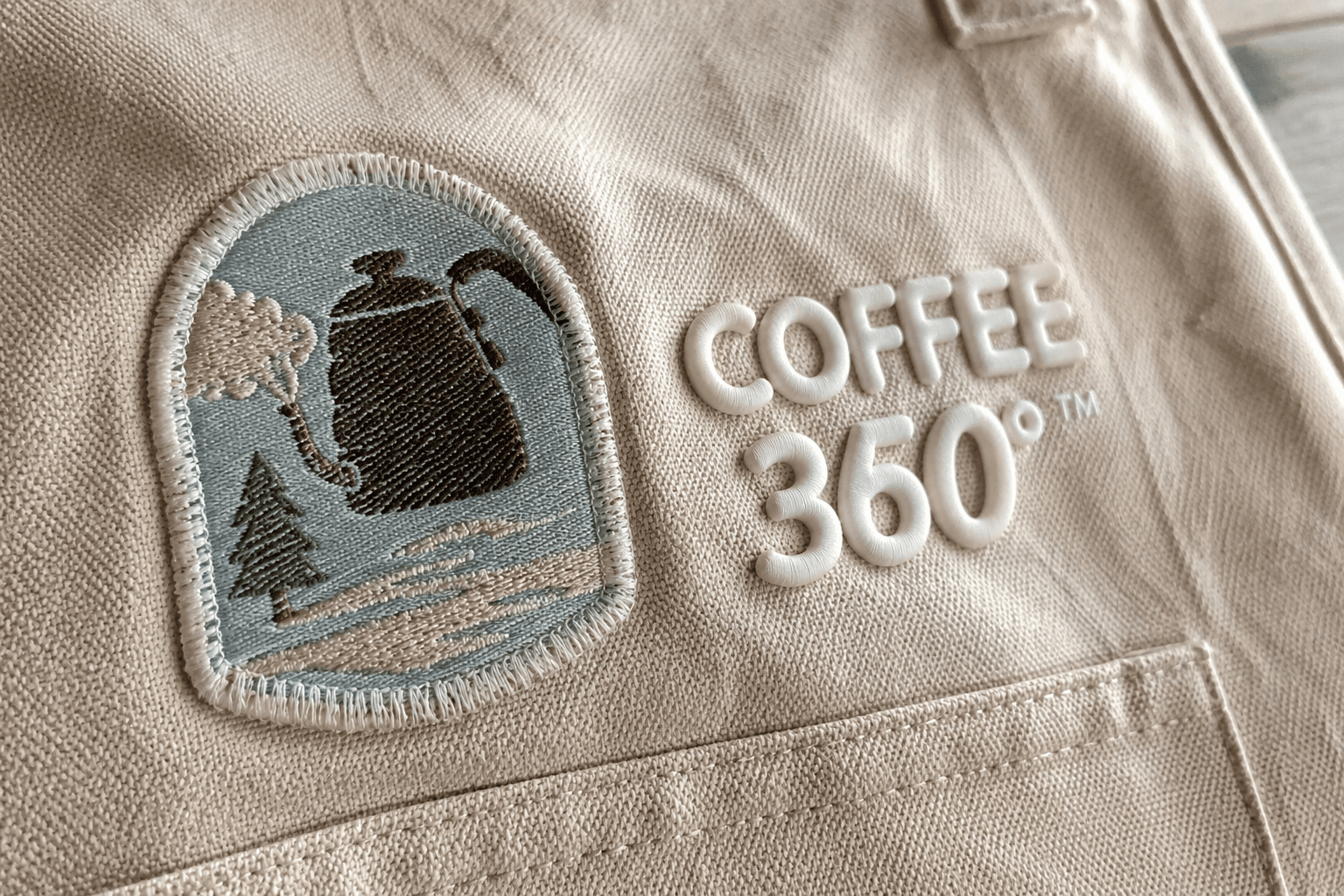
In apron production, applique means that a separate fabric or synthetic piece is cut to shape and attached to the apron body, usually with embroidery stitching around the edge. The applique piece may be cotton twill, felt, denim, canvas, PU leather, woven label fabric, or a printed patch. For a restaurant or retail apron, the result is a logo with visible material thickness and a crafted edge. It feels more substantial than flat print because the logo is physically built onto the garment.
A common construction is 280 GSM cotton twill apron body with 190-220 GSM twill applique, satin stitch edge at 3.5-5.0 mm width, and stabilizer on the reverse side to reduce puckering. For a heavier work apron, we may use 12 oz canvas or denim with a felt or twill applique. For a fashion apron, PU leather applique can be used, but it requires careful heat and needle control because PU can mark, stretch, or crack at the stitch holes.
The buyer should separate true applique from similar-looking options. A heat transfer patch may look dimensional but is bonded rather than sewn. A woven patch sewn onto the bib is easier to control but gives a badge effect rather than integrated applique apron branding. Puff embroidery apron decoration uses foam under the thread, not a separate fabric layer. Each option can be correct, but they should not be quoted as the same process.
- True applique uses a cut material layer attached by stitching, usually with an embroidered border.
- Patch branding is pre-made separately and sewn onto the apron as a finished badge.
- 3D puff embroidery raises thread over foam and is best for bold shapes.
- Puff print creates raised ink on the fabric surface and is usually faster for larger runs.
- Silicone or high-density print can give a raised logo apron effect with sharper edges than standard puff ink.
Applique apron branding cost drivers buyers should calculate early
The cost of applique apron branding is driven by more than logo size. The factory must consider digitizing, cutting method, material yield, stitching time, operator handling, thread changes, and quality inspection. A 90 x 45 mm one-color twill applique on the bib is very different from a 180 x 120 mm multi-layer logo across a pocket. The second style may require separate die cutting or laser cutting, more embroidery minutes, more stabilizer, and slower sewing to avoid distortion.
For reference, on a 500 pc apron order, a simple one-layer applique logo may add around USD 0.45-1.20 per piece compared with a plain apron, depending on size and material. A larger multi-layer applique with embroidery detail may add USD 1.50-3.50 per piece. 3D puff embroidery for a compact chest logo often adds USD 0.35-0.90 per piece, while puff print may add USD 0.20-0.60 per piece at 1,000 pcs if the artwork is one or two colors. These figures vary with exchange rate, thread count, fabric waste, and inspection standard, but they are useful for initial budgeting.
Tooling and sample fees should also be expected. Digitizing for embroidery may be USD 20-60 per logo, depending on complexity. Laser cutting setup or knife mold charges can add USD 30-100 for repeatable applique shapes. A development sample with custom fabric, custom logo, and apron pattern adjustment usually takes 5-10 working days after artwork and material confirmation. For urgent sourcing, a buyer can approve decoration on stock fabric first, then confirm final body fabric in the pre-production sample.
- Logo size affects material consumption and embroidery running time.
- Number of applique layers affects cutting, placement, and inspection time.
- Curved or sharp artwork edges increase the risk of fraying or uneven stitch coverage.
- Pantone-matched applique fabric may require dyeing MOQ, often 300-500 meters depending on the mill.
- Small orders carry higher per-piece cost because setup and sampling are spread across fewer aprons.
Choosing between applique, 3D puff print apron decoration, and puff embroidery
Buyers often ask whether they should use applique, 3D puff print apron decoration, or puff embroidery apron branding. The practical answer depends on wash requirement, logo shape, and the visual level required by the brand. Applique gives the strongest cut-and-sewn look and usually performs well when stitched correctly. Puff embroidery gives height and a premium thread surface, but it cannot reproduce thin lines well. Puff print is cost-efficient and good for bold promotional aprons, but it can crack or flatten sooner under harsh laundering.
For coffee shop and bakery aprons washed at home or in light commercial cycles, all three methods can be acceptable if tested. For butcher, kitchen, industrial, or rental-laundry aprons, sewn applique or standard embroidery is usually safer than puff print. For outdoor barbecue and workwear-style aprons, a felt or twill applique on heavy canvas can match the product language better than glossy raised ink. For boutique retail aprons, tonal applique with edge stitching can look quieter and more premium than a high-contrast puff logo.
One issue we see in sourcing briefs is that the artwork is designed for flat print but requested as dimensional apron branding. Small taglines, thin serif letters, distressed textures, and color gradients do not translate well. For applique, the minimum practical gap between cut elements is often 2-3 mm after scaling. For 3D puff embroidery, strokes below 6-8 mm may collapse or look crowded. For puff print, very small raised dots can become uneven after curing.
- Use applique when the brand wants a sewn, durable, material-based logo with visible edge stitching.
- Use 3D puff embroidery when the logo has bold letters, simple icons, and a target height of about 2-4 mm.
- Use puff print when the order needs lower cost, faster output, and moderate wash durability.
- Use woven or embroidered patches when the same logo must be applied to multiple apron styles.
- Avoid dimensional methods for legal text, nutrition-style data, QR codes, and fine-line illustrations.
Fabric, GSM, and apron construction limits
The base apron fabric is the foundation for any raised logo apron. On fabric below 180 GSM, dimensional branding can pull, ripple, or sag after washing because the body cloth does not have enough stability. Lightweight polyester aprons can accept puff print, but sewn applique may cause puckering unless backing and stitch density are reduced. For most custom aprons, applique is more stable on 220-360 GSM cotton twill, 10-12 oz canvas, denim, or poly-cotton twill above 210 GSM.
Fabric composition changes the decoration result. Cotton accepts stitching well and gives a matte, natural surface, but it shrinks. If the body fabric shrinks more than the applique after washing, the logo area may wrinkle. Poly-cotton blends are more dimensionally stable and often better for uniform programs, but the surface may be smoother and less rustic. Denim and canvas give excellent structure, but needle size, thread tension, and stabilizer must be adjusted to avoid broken thread or visible needle damage.
Construction also matters. A bib logo placed too close to an adjustable neck strap seam can distort when the strap is pulled. A logo crossing a pocket opening will slow sewing and create weak points. On waist aprons, a large applique near the upper edge may fold when the wearer bends. For this reason, we usually recommend keeping a bib applique at least 25-30 mm away from major seams and 20 mm away from pocket edges. For large front logos, a flat panel without pocket interruption is preferred.
- 180-210 GSM fabric is possible for puff print but less suitable for heavy applique.
- 220-280 GSM twill is a balanced range for hospitality apron applique.
- 300-360 GSM canvas supports larger applique and patch branding with less distortion.
- 10-12 oz denim or canvas can carry rugged applique, but sewing speed is slower.
- Waterproof coatings, wax coatings, and PU finishes require separate adhesion and needle testing.
Artwork preparation for dimensional apron branding
Good artwork preparation reduces cost and prevents sample failure. For applique apron branding, vector artwork should be supplied in AI, EPS, or clean PDF format with Pantone references. The factory then checks whether each element can be cut, placed, and stitched at the requested size. If the logo has very small internal shapes, we may suggest converting them to embroidery detail on top of a larger applique base, or removing them from the dimensional part and printing them separately.
For 3D puff embroidery, the digitizing file is not the same as ordinary flat embroidery. The stitch direction, cap stitches, foam cutting behavior, and pull compensation must be planned. A bold letter may look simple on screen, but if the digitizing is wrong, the foam may show through the edges or the thread may crush the raised effect. For apron use, we usually recommend polyester embroidery thread because it handles washing better than rayon. Thread count should be controlled; more stitches are not always better because excessive density can make the logo stiff and distort the bib.
For 3D puff print apron decoration, artwork must be adjusted for ink expansion. Puff ink rises during curing, so edges can become softer than flat screen print. Very tight registration between puff and non-puff colors is risky. If a buyer needs sharp small text, it is better to print that text flat and reserve puff for the main icon or brand initials. A practical production file should separate puff layers, flat layers, and placement dimensions clearly.
Sampling, wash testing, and approval controls
Dimensional branding should not go directly from digital mockup to bulk production. A physical strike-off or pre-production sample is important because height, hand feel, edge quality, and fabric distortion cannot be judged reliably from a rendering. For applique, the sample should show the final body fabric, final applique material, final thread color, and final logo size. For puff embroidery, the sample should use the final foam thickness and thread. For puff print, the sample should use final ink, curing temperature, and production mesh specification.
A reasonable approval route is artwork check on day 1-2, decoration sample on day 5-8, apron pre-production sample on day 10-15, then bulk production after written approval. For repeat orders, the timeline can be shorter because the digitizing, cutting files, and decoration standard already exist. For new buyers, we suggest keeping one approved sealed sample at the factory and one with the buyer. This prevents disputes over whether the logo height, stitch coverage, or color is acceptable.
Wash testing should match the actual use case. A retail apron sold as merchandise may only need 3-5 home wash cycles at 30-40 degrees Celsius. A restaurant uniform may need 10-20 wash cycles. Rental laundry or industrial kitchen programs may require higher temperature, stronger chemicals, and tumble drying. Puff print and PU applique are more sensitive to heat and chemicals. Cotton applique can fray if the stitch border is too narrow. Foam embroidery may lose height if pressed aggressively.
- Check applique edge coverage after washing, especially around sharp corners and small curves.
- Measure shrinkage of the apron body and logo area separately after 3 wash cycles.
- Inspect reverse-side backing for scratchiness if the apron is worn over thin clothing.
- Confirm colorfastness of dark applique materials on white or natural aprons.
- Test ironing behavior because puff print, foam embroidery, and PU applique should not receive direct high heat.
MOQ, lead time, and bulk production planning for applique apron branding
For custom apron orders from Zhejiang and nearby textile clusters, MOQ depends on both apron fabric and decoration process. If the buyer selects stock 240 GSM or 280 GSM twill fabric, a custom applique apron order can often start at 300-500 pcs per color. If the body fabric is custom dyed, the practical MOQ is more likely 800-1,500 pcs per color because fabric dyeing and finishing have their own minimums. For custom jacquard straps, metal hardware, garment dyeing, or special coated canvas, MOQ can move higher.
Lead time should be counted after all approvals, not after the first inquiry. A typical timeline is 3-7 days for quotation and material confirmation, 7-15 days for sampling, 3-5 days for buyer approval and revisions, and 25-45 days for bulk production depending on quantity and season. A 500 pc applique apron order may finish in about 30 days after sample approval if fabric is in stock. A 5,000 pc program with multiple colors, custom packaging, and wash testing may need 45-60 days after final approval.
The buyer can reduce risk by freezing the decoration standard before cutting bulk fabric. If the logo placement changes after panels are cut, the factory may need to remake panels or accept visible needle marks from testing. If the logo size increases after costing, both decoration cost and production time can change. For repeat programs, we recommend assigning a decoration code to each approved logo, including stitch file version, applique material code, thread color, placement coordinates, and approved sample date.
- Stock fabric custom apron with applique: typical MOQ 300-500 pcs per style/color.
- Custom dyed fabric with applique: typical MOQ 800-1,500 pcs per color.
- Simple decoration sample: usually 5-8 working days after artwork approval.
- Full pre-production apron sample: usually 10-15 working days depending on fabric.
- Bulk production: commonly 25-45 days after approval for 500-3,000 pcs.
- Inspection allowance: plan 1-3 extra days for final AQL checking and packing correction.
Quality risks and supplier questions before placing an order
The main risks in dimensional apron branding are not difficult to understand, but they must be controlled before bulk sewing. Applique can lift at the edges, fray, pucker, or shift from panel to panel. 3D puff embroidery can show foam, lose height, or become too stiff. Puff print can crack, under-cure, over-expand, or feel sticky if the ink system is not suitable for the apron fabric. These problems are more expensive to correct after bulk production because the logo is already attached to finished panels.
Before placing a purchase order, buyers should ask the supplier how the decoration will be made, not only what it will look like. The answer should include material type, GSM or thickness, stitch method, backing, wash recommendation, and inspection points. A serious factory should be able to explain why a 160 GSM apron is not ideal for large applique, why small text cannot be done in puff embroidery, or why a coated waterproof apron needs adhesion testing before confirming puff print.
Pricing should be reviewed together with defect tolerance. If a logo has a 1 mm placement tolerance and exact edge matching between four colors, the inspection workload is higher than for a simple one-color bib mark. For most apron programs, a placement tolerance of plus or minus 3-5 mm is practical, depending on logo size and seam reference. Color tolerance should be based on approved physical swatches, not only screen appearance. For raised logo apron production, the approved sample is the most important commercial document after the purchase order.
- Ask whether the applique is laser cut, die cut, hand cut, or pre-made as a patch.
- Confirm whether the decoration is applied before or after pocket sewing.
- Request the final logo size in millimeters, not only a percentage mockup.
- Confirm backing type and whether it remains inside the apron or is removed after embroidery.
- Ask for wash test results using the same fabric, decoration, and care label conditions.
- Define acceptable placement tolerance, edge coverage, thread color, and packaging protection before bulk production.