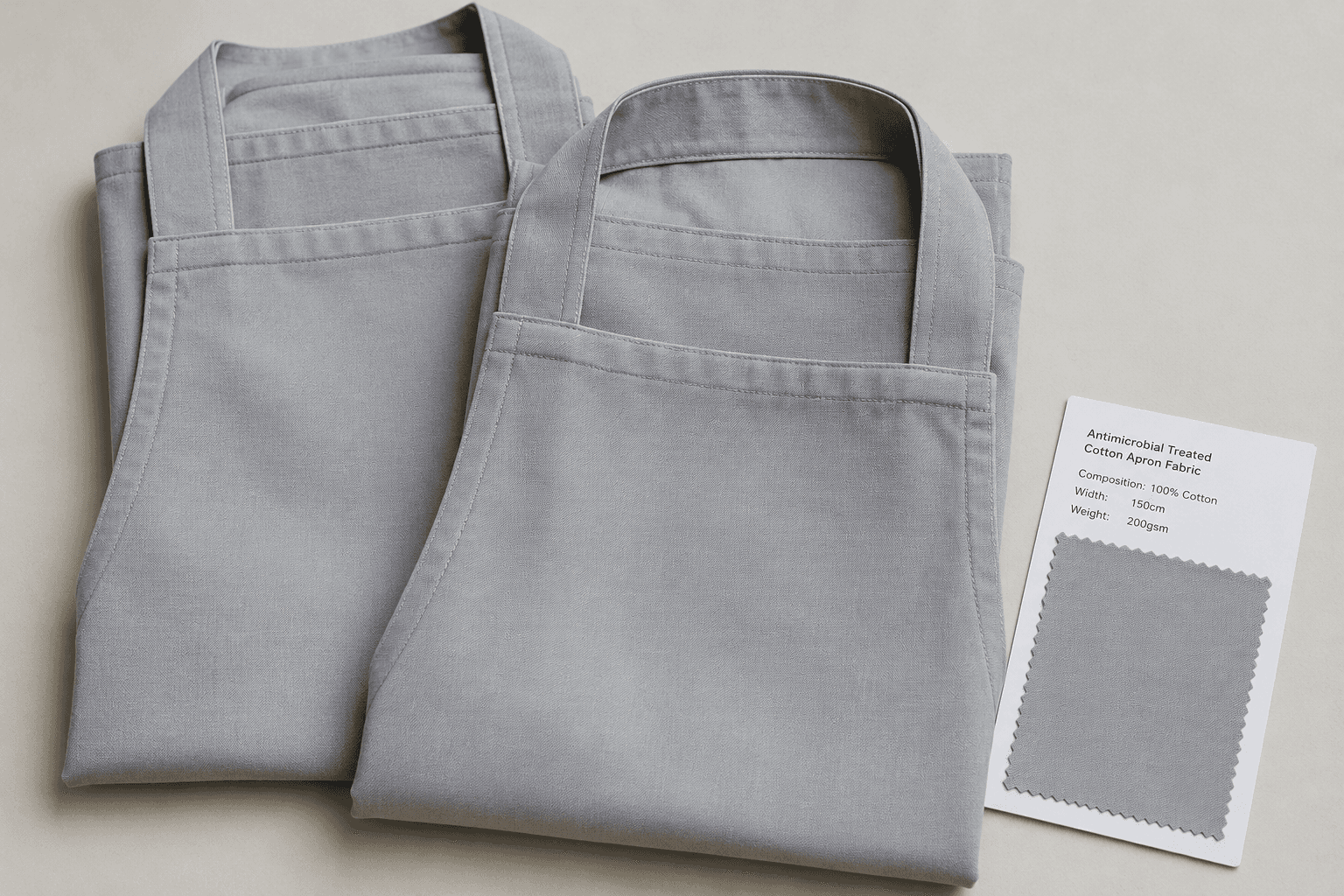
Antimicrobial apron fabric is requested more often in food service, coffee chains, healthcare-adjacent retail, cleaning services and hospitality programs. The reason is practical: aprons sit close to moisture, food residue, oils and repeated handling. A fabric that stays fresher between laundering can improve user acceptance and reduce odor complaints, especially in warm kitchens or high-turnover service environments.
From a factory sourcing view, an antimicrobial apron is not a single product category. It can mean a silver ion apron finish on polyester-cotton twill, a quaternary ammonium treatment on cotton canvas, an odor-control finish on recycled polyester, or a coated hygienic apron material for splash protection. Each option has different handfeel, wash durability, label claim limits, testing cost and MOQ.
The key is to select the treatment only where it creates value. For many custom aprons, better fabric weight, darker color, proper laundering instructions and stain-release finishing solve more problems than antimicrobial chemistry. For other programs, especially shared uniforms, food-prep back-of-house, pet grooming, spa, medical retail and long-shift hospitality, antimicrobial finishing can be justified if the buyer controls claims and verifies performance before bulk production.
- Antimicrobial finishes mainly control microbes on the fabric surface; they do not make an apron sterile or replace washing.
- Silver ion finishes usually add US$0.12-0.45/pc on common bib aprons, depending on dosage, fabric weight and wash target.
- Wash durability should be agreed before sampling, commonly 20, 30 or 50 home-laundry cycles for uniform aprons.
- Claims must be written carefully, because fabric protection claims are easier to support than human health claims.
- Finishing MOQs are normally higher than cut-and-sew MOQs, often 1,000-3,000 meters per color for treated woven fabrics.
- Antimicrobial apron fabric works best when combined with suitable base fabric, stain management and realistic care instructions.
What antimicrobial apron fabric actually means
In apron sourcing, antimicrobial apron fabric means the textile has been treated or engineered to inhibit the growth of certain microorganisms on the fabric surface. The most common commercial purpose is fabric protection: reducing odor, slowing microbial growth in damp conditions, and keeping the garment fresher during use. It does not mean the apron disinfects hands, food, worktops or the wearer.
This distinction matters because buyers often start with a broad request such as "antibacterial apron fabric" or "hygienic apron material". A supplier then has to translate that into a base fabric, finish chemistry, test standard, wash durability target and claim language. A 280 GSM cotton twill apron with antimicrobial treatment is a different commercial product from a 190 GSM PU-coated polyester apron that can be wiped clean. Both may support hygiene-related positioning, but they solve different workplace problems.
For most custom apron orders from China, the antimicrobial function is added during textile finishing before cutting and sewing. The fabric is dyed, treated by padding or coating, dried, cured, tested and then sent for garment production. This means the decision should be made before bulk fabric booking. Adding an antimicrobial finish after aprons are sewn is technically possible in some cases, but it is less controlled, less economical and rarely preferred for B2B uniform programs.
- Typical use cases include coffee shop aprons, chef aprons, butcher aprons, cleaning service aprons, beauty and spa aprons, pet grooming aprons and healthcare retail uniforms.
- Common base fabrics include 240-320 GSM poly-cotton twill, 280-400 GSM cotton canvas, 190-260 GSM polyester oxford, and 180-240 GSM recycled polyester blends.
- Common buyer goals are odor control, fresher wear between shifts, hygiene-related product positioning and better acceptance in shared uniform programs.
- Common misunderstandings include expecting the apron to sterilize surfaces, protect the user from disease, or eliminate normal laundering.
Main finish types used for an antimicrobial apron
The most familiar option is a silver ion apron finish. Silver-based treatments are widely used because they can be effective at low add-on levels, have a clear commercial story and are available from established chemical suppliers. In production, silver ion chemistry can be applied to polyester, cotton and blended fabrics, although wash durability depends heavily on the binder system and the fabric construction.
Quaternary ammonium compound finishes are another common route. They can provide antibacterial performance at a competitive cost, especially for cotton and poly-cotton aprons. The trade-off is that durability can be more sensitive to laundering chemistry, softeners and high-temperature washing. For buyers supplying commercial kitchens or laundries, this point should be checked early because industrial washing is harsher than home laundering.
Odor-control finishes are sometimes sold as antimicrobial, but the mechanism may differ. Some finishes inhibit odor-causing bacteria; others absorb or neutralize odor molecules. For an odor resistant apron, the buyer should ask whether the claim is antibacterial, anti-odor, freshness, or a combination. These are not the same in testing or compliance.
- Silver ion finishes are often selected for premium hospitality, healthcare-adjacent retail and branded uniform programs where buyers want a recognized antimicrobial story.
- Quaternary ammonium finishes are often considered for cost-sensitive cotton or poly-cotton aprons where the required wash target is moderate.
- Zinc-based or mineral-based systems may be used where a buyer wants an alternative to silver, but testing and supplier documentation should be reviewed carefully.
- Coated fabrics such as PU, TPU or PVC are usually chosen for wipe-clean and liquid resistance first; antimicrobial treatment can be added, but coating performance remains the main specification.
Where antimicrobial apron fabric helps in real apron programs
The strongest case is usually shared or long-wear uniforms. A barista wearing a bib apron for an eight-hour shift will generate heat and moisture around the chest, waist and pockets. A kitchen apron may collect food particles and oil mist. A grooming apron may be exposed to water, pet-care products and organic residue. In these environments, antimicrobial apron fabric can help reduce odor development on the textile between laundering cycles.
It is also useful when a brand wants a hygiene-supporting specification without moving to a plastic-coated look. For example, a 300 GSM poly-cotton twill with stain release and antimicrobial finish can still feel like a normal uniform apron, while a coated waterproof apron may feel too stiff or too industrial for front-of-house service. For restaurants, bakeries and coffee chains, the appearance and drape of the apron are often just as important as the hygiene message.
The finish is less valuable when the apron is single-user, washed daily, used only for light retail tasks, or replaced frequently due to visible staining. In those cases, a buyer may get better value from darker yarn-dyed stripes, stronger pocket reinforcement, colorfast reactive dyeing, or a fabric weight increase from 240 GSM to 280 GSM.
- Good fit: shared aprons in restaurants, rental uniform programs, long-shift hospitality and back-of-house food preparation.
- Good fit: odor-sensitive categories such as pet grooming, spa, salon, cleaning services and warm-climate outdoor service.
- Moderate fit: promotional aprons where the antimicrobial claim supports brand positioning but the apron is not used heavily.
- Weak fit: low-cost event aprons under US$2.00/pc where the finish cost may exceed the practical value.
- Weak fit: coated aprons that are wiped after each use, unless the buyer has a specific surface-protection claim to support.
Base fabric choices before adding an antibacterial apron fabric finish
The antimicrobial finish cannot compensate for the wrong base fabric. A 180 GSM plain-weave polyester apron may pass an antibacterial test, but it may still feel too thin for a chef apron and may wrinkle or cling under heat. A 360 GSM cotton canvas may look premium, but if it absorbs oil and dries slowly, odor complaints may still appear in kitchen use. The fabric construction, fiber blend and after-finish package need to work together.
For general hospitality aprons, our Zhejiang production experience is that 240-280 GSM poly-cotton twill is the most balanced starting point. A common construction is 65/35 polyester-cotton or 80/20 polyester-cotton, dyed to brand color, finished with stain release plus antimicrobial treatment. It offers better dimensional stability than pure cotton, lower price than heavy canvas, and easier care for uniform operators.
For premium cafe, bakery or retail aprons, 280-340 GSM cotton canvas or cotton-rich twill is common. The handfeel is better and the garment looks less synthetic, but shrinkage control and colorfastness need attention. For pure cotton, a buyer should define expected shrinkage after washing, normally within 3-5% for a controlled program, and confirm whether the antimicrobial finish remains effective after the same wash cycles.
- 220-260 GSM poly-cotton twill is suitable for light front-of-house aprons, promotional uniforms and warm environments.
- 260-320 GSM poly-cotton twill is suitable for chain restaurant aprons, chef bib aprons and repeated commercial use.
- 280-400 GSM cotton canvas is suitable for premium retail, craft, bakery and coffee aprons where structure and natural handfeel matter.
- 180-240 GSM polyester oxford is suitable for cleaning, utility or water-repellent aprons, especially when paired with PU or water-resistant finishing.
- 200-260 GSM recycled polyester blends can support sustainability briefs, but antimicrobial chemistry and recycled-content certification must be documented separately.
Testing, wash durability and claim control
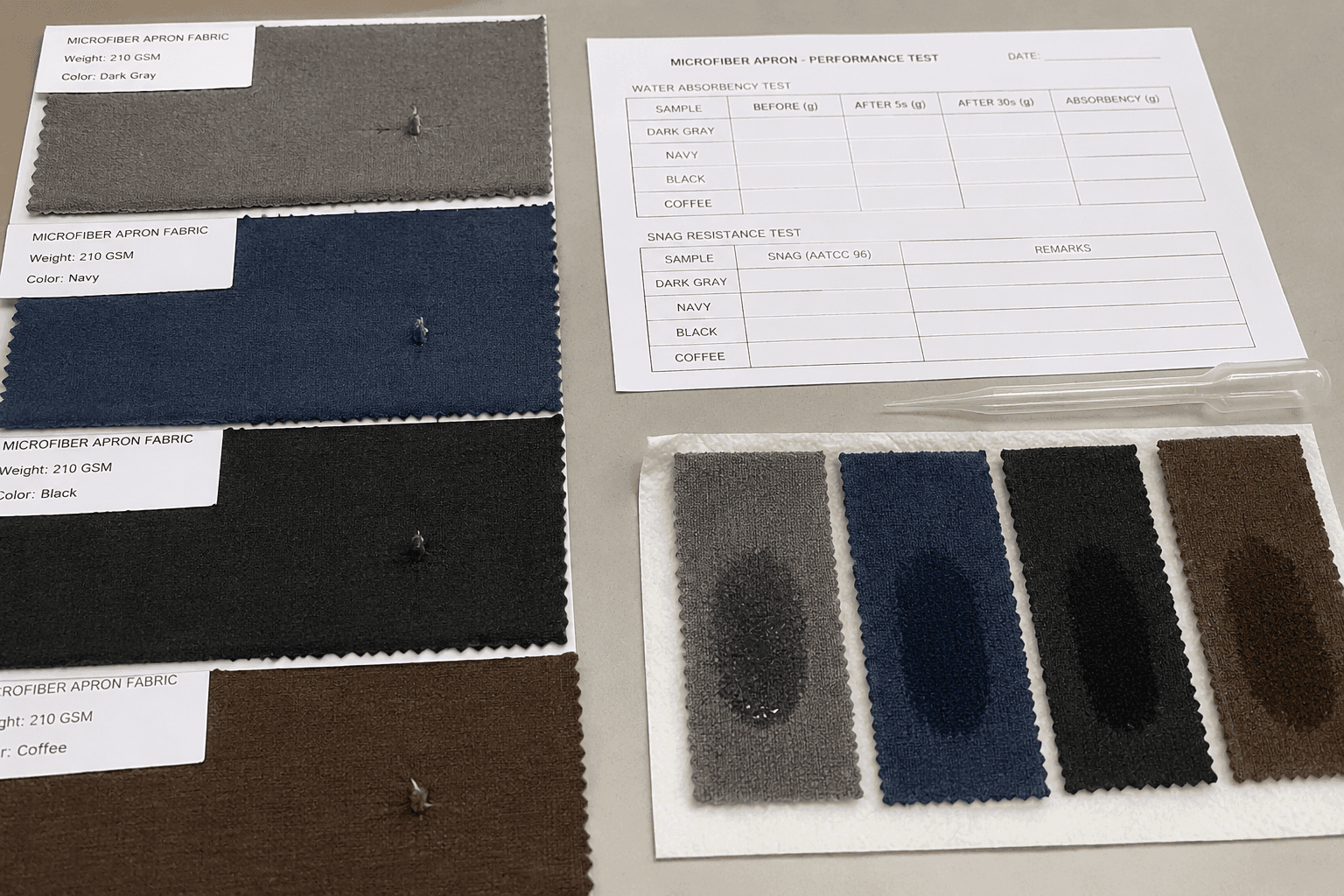
Testing should be agreed before salesman samples become approval samples. Common antibacterial test methods include AATCC 100, ISO 20743 and JIS L 1902. The correct method depends on the buyer's market, claim language and end customer expectations. A test result against one organism under one method does not automatically support every antimicrobial claim.
For aprons, wash durability is often the real commercial issue. A finish that performs before washing but fails after 10 washes is not suitable for a uniform program promising long-term freshness. Buyers commonly request performance after 20, 30 or 50 home-laundry cycles. Rental or industrial laundry programs may require separate testing because chlorine bleach, alkaline detergent, high drying temperature and mechanical action can reduce performance.
Claim wording should be conservative. Safer wording usually focuses on the fabric, for example: "treated to inhibit the growth of odor-causing bacteria on the fabric" or "antimicrobial treatment helps keep the apron fresher between washes." Riskier wording suggests protection of the wearer or food, such as "prevents infection," "kills germs on contact," or "keeps food safe." Those claims may trigger regulatory review and should not be printed on labels or packaging without legal confirmation.
- Ask which test method will be used, which microorganisms are included, and whether the report is for the exact fabric and finish combination.
- Define whether testing is required before washing, after 20 washes, after 30 washes or after 50 washes.
- Confirm the washing method, including temperature, detergent type, drying method and whether bleach is allowed.
- Keep fabric-protection claims separate from health, medical or food-safety claims.
- Request chemical safety documents such as SDS, restricted substance compliance and, where relevant, OEKO-TEX or bluesign-related documentation from the chemical supplier.
Cost, MOQ and lead time for antimicrobial apron fabric
For custom apron sourcing, antimicrobial finishing is usually priced as a fabric-level add-on, then converted into garment cost. On standard bib aprons using 0.55-0.85 meters of fabric per piece, a silver ion finish may add roughly US$0.12-0.45/pc. A lower-cost antibacterial finish may add US$0.06-0.25/pc. The range depends on finish brand, dosage, wash durability target, fabric absorption, test requirements and wastage.
MOQ is also important. A cut-and-sew factory may accept 500 custom aprons if greige or dyed stock fabric is available, but antimicrobial finishing normally needs a finishing lot. For woven fabrics, practical MOQ is often 1,000-3,000 meters per color and finish. For special branded chemistry, the MOQ may be higher because the chemical supplier or dyeing mill will not open a very small production bath economically.
Lead time increases because the fabric route becomes longer. A normal custom apron in stock fabric may ship in 15-25 days after sample approval. A dyed-to-order apron may need 30-45 days. Add antimicrobial finishing, lab dip approval, treatment trial and optional third-party testing, and the realistic schedule becomes 40-60 days for first production. Repeat orders can be faster, usually 30-45 days if the fabric, color and finish remain unchanged.
- Budget add-on for basic antibacterial finishing: about US$0.06-0.25/pc on many standard bib apron constructions.
- Budget add-on for silver ion finishing: about US$0.12-0.45/pc, with premium branded systems sometimes higher.
- Practical finishing MOQ: often 1,000-3,000 meters per color, equal to roughly 1,200-4,500 aprons depending on pattern consumption.
- Testing cost: third-party antibacterial testing may cost US$150-500 per fabric item per test condition, and more if multiple wash stages are required.
- First-order timing: allow 40-60 days after confirmed artwork, color, fabric and claim requirements.
Sourcing checklist for antimicrobial apron fabric approval
The cleanest purchasing process is to approve the antimicrobial specification at fabric stage, not after garment quotation. A buyer should send the target market, apron style, expected wash life, claim wording, target FOB price and any restricted substance requirements. The factory can then match the fabric and finish realistically instead of quoting a vague "antimicrobial apron" that later changes in cost.
Approval samples should include both garment appearance and fabric performance documents. The apron must still meet ordinary uniform requirements: stable color, clean sewing, pocket strength, bar-tack placement, shrinkage control, rub fastness and fit consistency. Antimicrobial performance is an additional function, not a replacement for normal apron engineering.
For repeat programs, keep one approved fabric swatch, one treated bulk cutting and one finished apron as control samples. Antimicrobial finishes are invisible, so production control relies on batch records, mill certificates, purchase records for chemistry and periodic testing. Without those controls, the buyer may not know whether a future reorder used the same treatment level.
- Define the end use: front-of-house, kitchen, cleaning, grooming, healthcare retail, promotional or rental uniform.
- Select the base fabric first, including GSM, fiber content, weave, color, shrinkage and stain or water resistance requirements.
- Choose the antimicrobial system and state whether silver ion, quaternary ammonium, odor control or another chemistry is preferred.
- Set the wash target and test method before bulk fabric is ordered.
- Approve claim wording for labels, packaging, online product pages and buyer specification sheets.
- Keep batch documents for dyeing, finishing, testing and garment production for each shipment.
When to choose antimicrobial apron fabric and when to skip it
Choose antimicrobial apron fabric when the apron is part of a durable uniform program, when odor complaints are likely, or when the buyer needs a hygiene-related product story that can be supported by documentation. It is most defensible when the added cost is small compared with the full landed cost of the uniform and when the apron is expected to stay in service for months rather than days.
Skip it when the brief is mainly about low price, short event use, daily hot washing, heavy visible staining or waterproof splash protection. In those cases, the finish may not solve the main problem. A better route may be a heavier twill, a coated fabric, a detachable towel loop, reinforced pockets, darker color, bleach-resistant polyester, or a more precise care label.
For professional buyers, the practical question is not whether an antimicrobial apron is "better" in a general sense. The question is whether the finish improves the specific apron program enough to justify MOQ, testing, documentation and cost. When the answer is yes, specify it early, test the exact fabric, control the wording and keep the claim tied to the textile surface. That is the difference between a useful hygienic apron material and an expensive feature that creates avoidable compliance risk.