For buyers sourcing airport lounge aprons, the brief is narrower than a general hospitality apron order. The garment must look composed under terminal lighting, recover after staff sit at reception counters or fold aprons into lockers, carry branding without looking promotional, and tolerate frequent laundering across multi-shift operations. The buying decision should focus on wrinkle recovery, shade continuity, pocket discipline, replacement planning and cost per wear, not only the lowest FOB price.
In factory terms, lounge apron programs sit between front-of-house hospitality and premium retail uniforms. Buyers often want a smoother hand than basic cafe aprons, but they still need production discipline for 1,000 to 20,000 pieces across airport sites. That means specifying 200-235 GSM or roughly 6.0-7.0 oz poly-cotton twill, shrinkage below 3 percent after five washes, AQL 2.5/4.0 inspection levels, and replenishment lead times before staff turnover creates urgent repeat orders.
This guide breaks down the sourcing choices behind airport lounge aprons: wrinkle-recovery fabric, discreet branding, clean construction, practical sizing, FOB cost drivers and replenishment rules for a high-turnover apron program where replacement stock must be available without rewriting the uniform specification every quarter.
- Wrinkle recovery matters more than fabric weight alone; 210-225 GSM 65/35 polyester-cotton twill usually performs better than cotton-rich cloth after locker storage and seated work.
- Discreet lounge branding is most reliable with tonal embroidery, woven side labels or matte heat transfers placed at the pocket edge, lower bib corner, waistband side or side seam.
- Most airport lounge bib aprons work at 68-72 cm wide and 72-78 cm long; waist aprons usually sit at 70-90 cm wide and 45-55 cm long.
- A realistic MOQ for custom airport lounge aprons is 300-500 pieces per colorway, with proto samples in 7-12 days and bulk production in 20-35 days after PP approval.
- Inspection should use AQL 2.5 for major defects and AQL 4.0 for minor defects, plus packed recovery, post-wash appearance, shade and logo placement checks.
- Replacement reserves should be 12-18 percent for stable teams and 20-30 percent for high-churn or multi-site launch programs.
Airport lounge aprons need stricter specs than restaurant aprons
Standard restaurant apron sourcing often prioritizes stain masking, broad role flexibility and low unit cost. Airport lounge aprons have a different operating profile. Staff are visible at reception counters, buffet stations, coffee bars and seating areas, often beside premium furniture, glass, stone or brushed metal finishes. A crease across the bib, twisted pocket or shiny logo is more visible in this environment than it would be in a kitchen or casual cafe.
The apron also has to handle mixed movement. Lounge staff may check eligibility, clear tables, replenish food, operate coffee machines and carry trays during the same shift. The garment is repeatedly folded, clipped, sat in, brushed against counters and washed. A fabric that looks refined on a hanger can fail after three days of use if it has poor recovery, seam torque or unstable trim. For this reason, 100 percent cotton canvas at 8 oz may look attractive during approval but become too wrinkled after locker storage and commercial washing.
Replacement frequency is another difference. Many airport lounges are operated by hospitality contractors with rotating labor pools, extended opening hours and seasonal passenger spikes. Buyers are not only purchasing a launch uniform; they are creating a replenishment system. If the launch order is 3,000 pieces and the annual replacement reserve is 20 percent, another 600 aprons may be required within the first year. Shade mismatch becomes a real risk if fabric lots, trims and logo threads are not controlled.
Branding restraint also matters. Large center-chest logos that work for coffee chains can look too promotional in a premium lounge. The apron should support the wider uniform system, not dominate it. A good lounge apron specification therefore combines appearance, wash durability, repeatable sourcing and operational cost control.
- Typical launch order: 500-5,000 pieces for one operator; 5,000-20,000 pieces for multi-airport rollout
- Common fabric target: 200-235 GSM, equal to roughly 6.0-7.0 oz depending on weave
- Main service risk: aprons arrive pressed but crease after 24 hours in lockers or cartons
- Recommended inspection baseline: AQL 2.5 major, AQL 4.0 minor, zero tolerance for critical defects
- Approval method: review washed, folded and recovered samples, not only fresh showroom samples
Wrinkle-recovery fabrics for airport lounge aprons
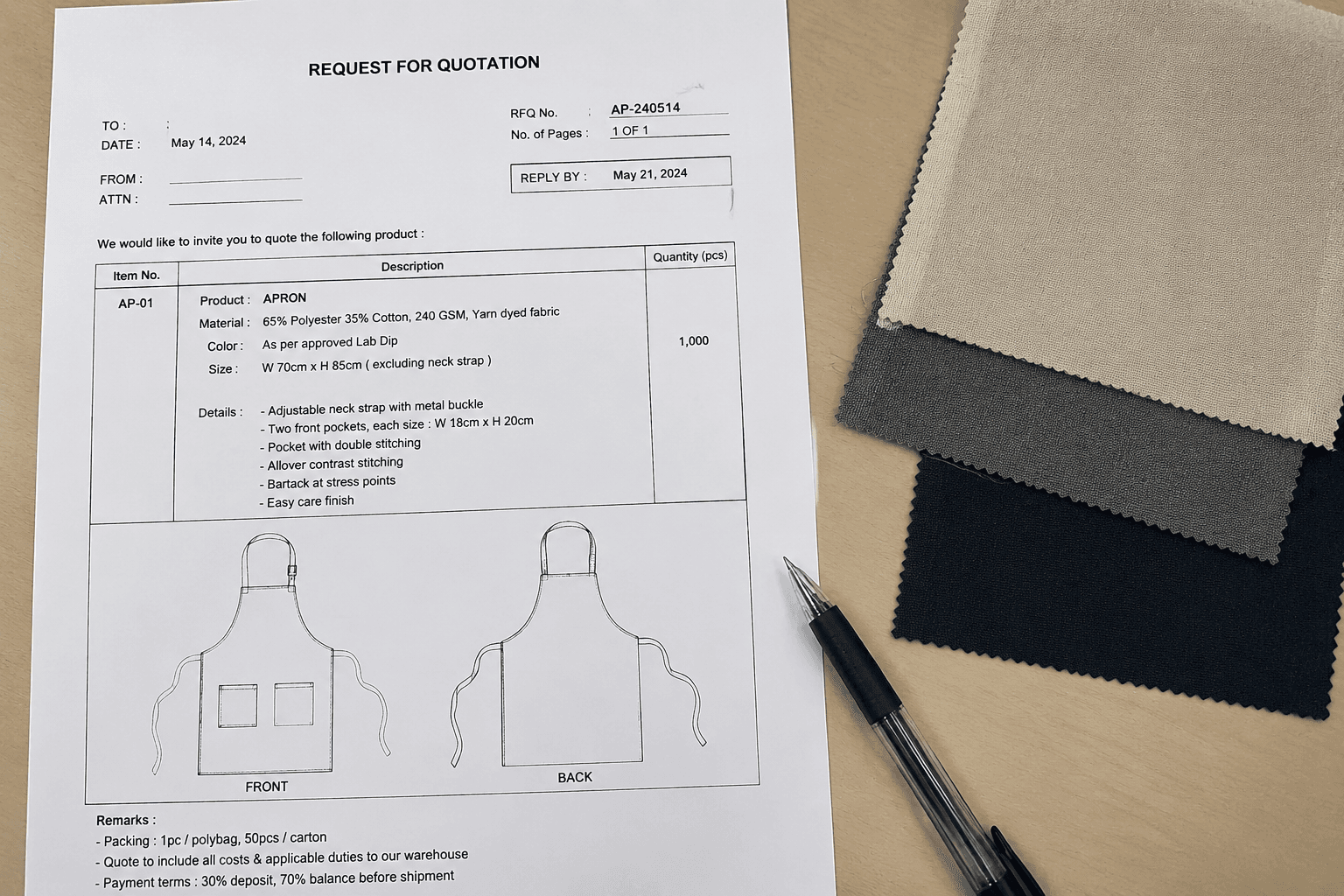
For airport lounge aprons, the safest fabric starting point is usually a 200-235 GSM polyester-cotton twill, fine twill or oxford. A 65/35 polyester-cotton blend at 210-225 GSM is the most practical mid-market solution because it gives better recovery than cotton-rich fabric while keeping a familiar hand feel. It also holds color better than many low-cost cotton drills after repeated laundering, especially in navy, charcoal, black, dark green and burgundy.
Below 180 GSM, bib aprons often collapse against the body and show fold lines quickly. They may be acceptable for promotional use but are weak for a premium lounge uniform expected to withstand daily wear. Above 245 GSM, the apron can become too stiff for front-of-house service unless the design is simplified and the operator accepts a heavier look. Heavier fabric can also increase drying time and laundry cost, which matters when aprons rotate through daily wash cycles.
Composition should be selected by role and climate. A 55/45 polyester-cotton blend gives a softer touch but creases more readily than 65/35. An 80/20 blend can produce a cleaner surface and faster recovery, although it may feel less breathable in warm terminals or poorly ventilated service zones. A 100 percent polyester woven can deliver strong wrinkle resistance, but buyers should avoid shiny finishes that make the apron look like a low-cost service garment.
Finishing claims need verification. Some mills promote anti-wrinkle finishes, but surface chemistry can weaken after repeated wash cycles. Buyers should ask whether recovery comes from fiber blend, weave structure or chemical finish. For long-term programs, blend and weave are more dependable than a temporary finish. Swatches should be checked after five wash cycles at the intended care temperature, then folded under light pressure for 24 hours before recovery is assessed.
- Budget commercial option: 190-205 GSM 65/35 poly-cotton twill for cost-sensitive rollouts
- Balanced lounge option: 210-225 GSM 65/35 fine twill with matte face and smooth hand
- Sharper premium option: 220-235 GSM 80/20 poly-cotton oxford or fine twill
- Shrinkage target: below 3 percent after five washes at the approved care setting
- Colorfastness target: grade 3-4 or above for washing and rubbing; grade 4 preferred for dark shades
Construction details that keep lounge aprons flat and clean
Fabric alone will not solve presentation problems if the apron construction creates stress lines. For lounge aprons, broad clean panels usually look better than heavily segmented designs. Each decorative seam can create fold memory after carton packing or locker storage. If color blocking is required, the join should sit away from the center bib, where wrinkles and puckering are most visible.
Strap design has a direct effect on how the apron sits during long shifts. Neck-loop styles are simple, familiar and lower in cost, but a narrow or poorly placed strap can pull the bib upward and create chest wrinkles. Cross-back aprons distribute weight better and often look smoother, especially for staff carrying pens, key cards or small devices. The tradeoff is grading: a cross-back design needs enough strap adjustment to fit different body shapes without twisting at the side seam.
Edge construction should be durable without becoming bulky. A 1 cm folded edge may be too light for frequent laundering, while a 2.5 cm fold on heavier twill can look stiff. For most 210-225 GSM fabrics, a 1.5-2.0 cm turned edge with lockstitch at 9-11 stitches per inch works well. Bar-tacks should be used at strap joins, pocket corners and stress points, but they should match the garment color unless the buyer intentionally wants contrast.
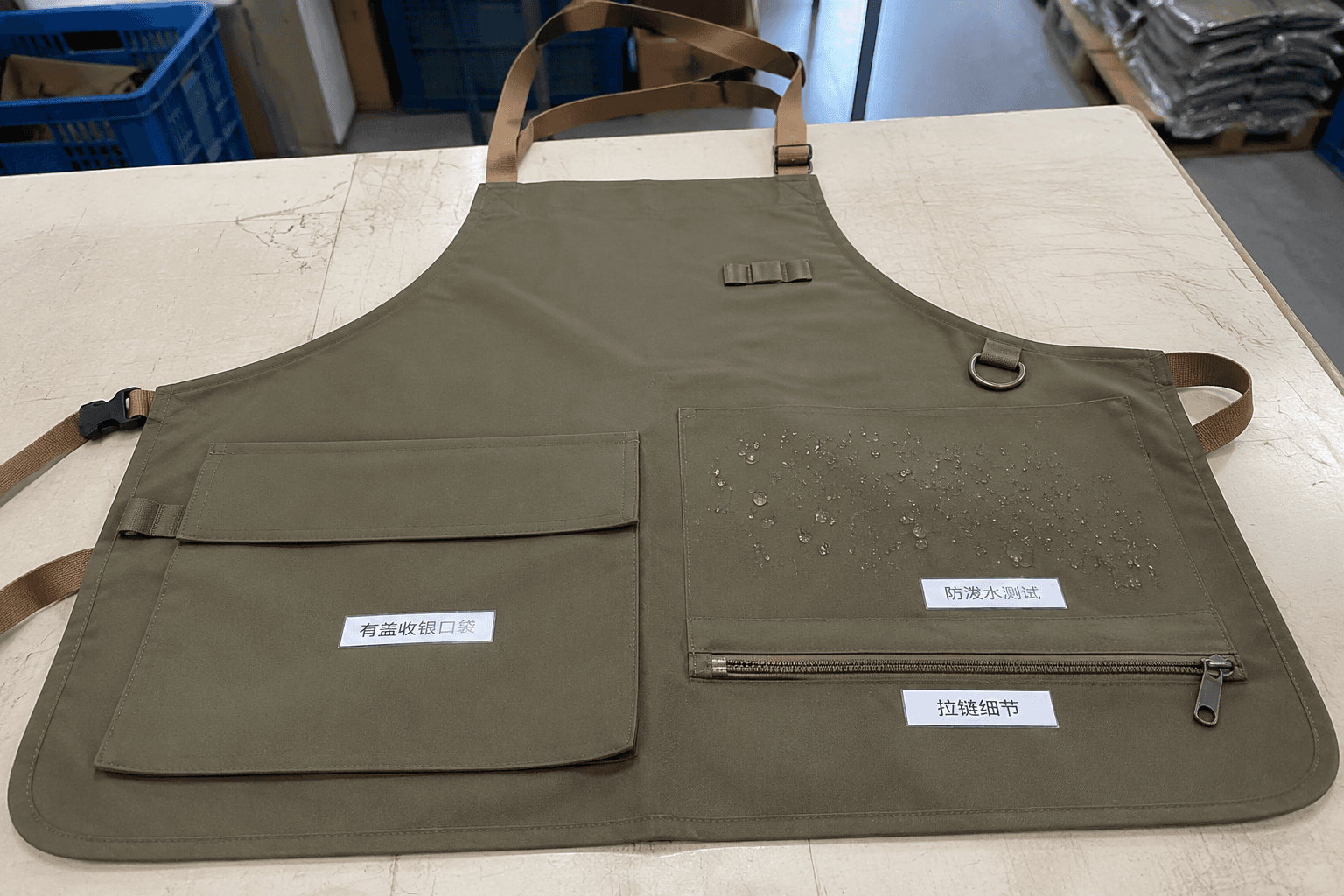
Pocket layout should be restrained. Lounge staff may need pens, order pads, gloves, key cards or a small handheld terminal, but large utility pockets push the apron toward workshop or kitchen wear. One divided lower pocket, two slim patch pockets or one discreet welt pocket is usually enough. If a radio loop is required, specify a narrow bartacked tab rather than a bulky attachment.
- Recommended strap width: 2.5-3.0 cm for neck loops and cross-back straps
- Typical bib dimensions: 68-72 cm wide and 72-78 cm long
- Preferred stitch density: 9-11 stitches per inch, adjusted by fabric thickness
- Pocket depth: 16-20 cm for pens, cards, gloves and small tools
- Hardware caution: metal adjusters add weight, mark counters and increase laundry abrasion
Discreet branding options for airport lounge aprons
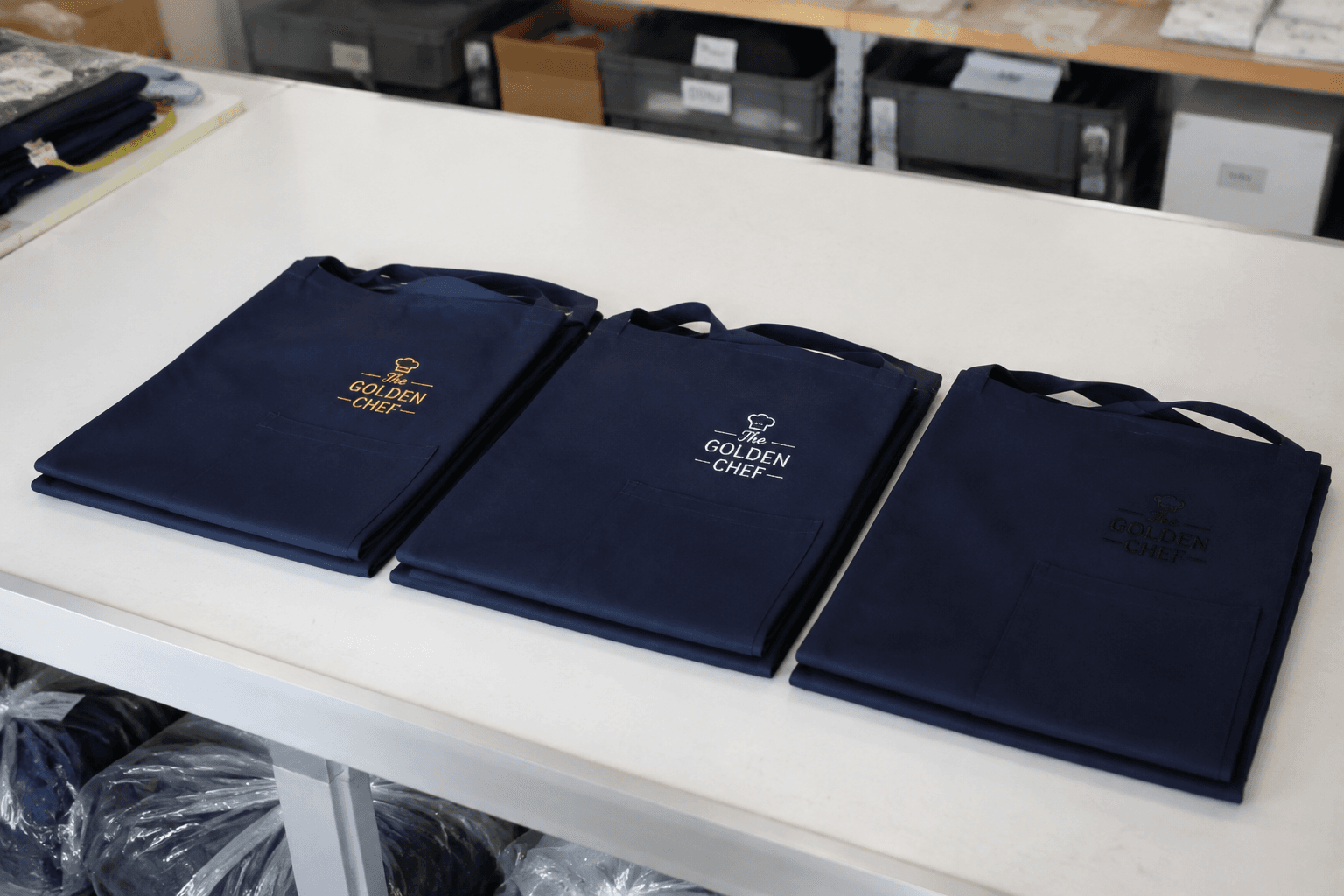
Branding for airport lounge aprons should be visible enough for uniform identity but quiet enough for the lounge environment. Oversized embroidery across the chest usually reads as promotional and can compete with shirts, blazers or name badges. Better options include tonal embroidery, a woven side label, a small matte heat transfer or a low-profile faux leather patch if the care process supports it.
Tonal embroidery is the most durable and widely accepted option. For lounge use, logo widths of 25-55 mm usually work best. Above 70 mm, the logo begins to dominate the apron and may distort the fabric if the stitch count is high. Thread should be matte or semi-matte, especially on black, charcoal and navy fabric. High-shine thread catches terminal lighting and can make a subtle logo appear louder than intended.
Woven labels are useful when the buyer wants very low visual impact. A label can sit at the side seam, waistband edge or pocket edge, keeping the apron clean from a distance. Heat transfer works for crisp marks and low-contrast designs, but buyers should require wash testing before approval. For commercial laundry exposure, test at least 20 wash cycles and check cracking, peeling, edge lift and color change.
Brand hierarchy should match staff function. Reception staff usually need the cleanest upper-body presentation, so branding can move to the lower bib corner or pocket line. Buffet and coffee service staff can carry a modest chest mark if the apron body is plain. For operators running multiple lounge tiers under one parent brand, use the same apron body and differentiate tiers through label color, embroidery thread or a small icon. This reduces SKU count and simplifies repeat ordering.
- Embroidery size target: 25-55 mm wide for discreet lounge branding
- Low-risk placements: lower bib corner, pocket edge, waistband side or side seam label
- Heat transfer validation: minimum 20 wash cycles before bulk approval
- Thread recommendation: matte or semi-matte tonal thread on dark fabrics
- SKU control: keep one base apron and vary only logo color, icon or label for lounge tiers
Sizing, pockets and care labels for high-turnover lounge teams
High staff turnover changes the uniform logic. Buyers may want tailored-looking aprons, but too many sizes create dead stock and slow replenishment. Most lounge programs work best with one-size or two-size grading. Aprons are more forgiving than shirts or jackets, so adjustable straps and stable body proportions are usually more valuable than four or five size splits.
For bib aprons, a body width of 68-72 cm and length of 72-78 cm covers most adult wearers when strap length is properly graded. For shorter staff or more formal reception roles, a slightly shorter 70-74 cm length may look cleaner. Waist aprons for barista, buffet or concierge service often perform well at 70-90 cm wide and 45-55 cm long. Longer waist aprons can look premium, but they must not restrict walking, bending or tray carrying.
Pocket requirements should be based on the actual role, not on generic hospitality templates. Reception staff may need a pen and key card. Buffet attendants may need gloves or a small order pad. Coffee staff may need a towel loop or divided pocket. Adding every possible feature into one apron increases cost, makes the garment busier and creates replenishment variation if trims change. A cleaner approach is to define one core apron and one role-specific variant only when the operation truly needs it.
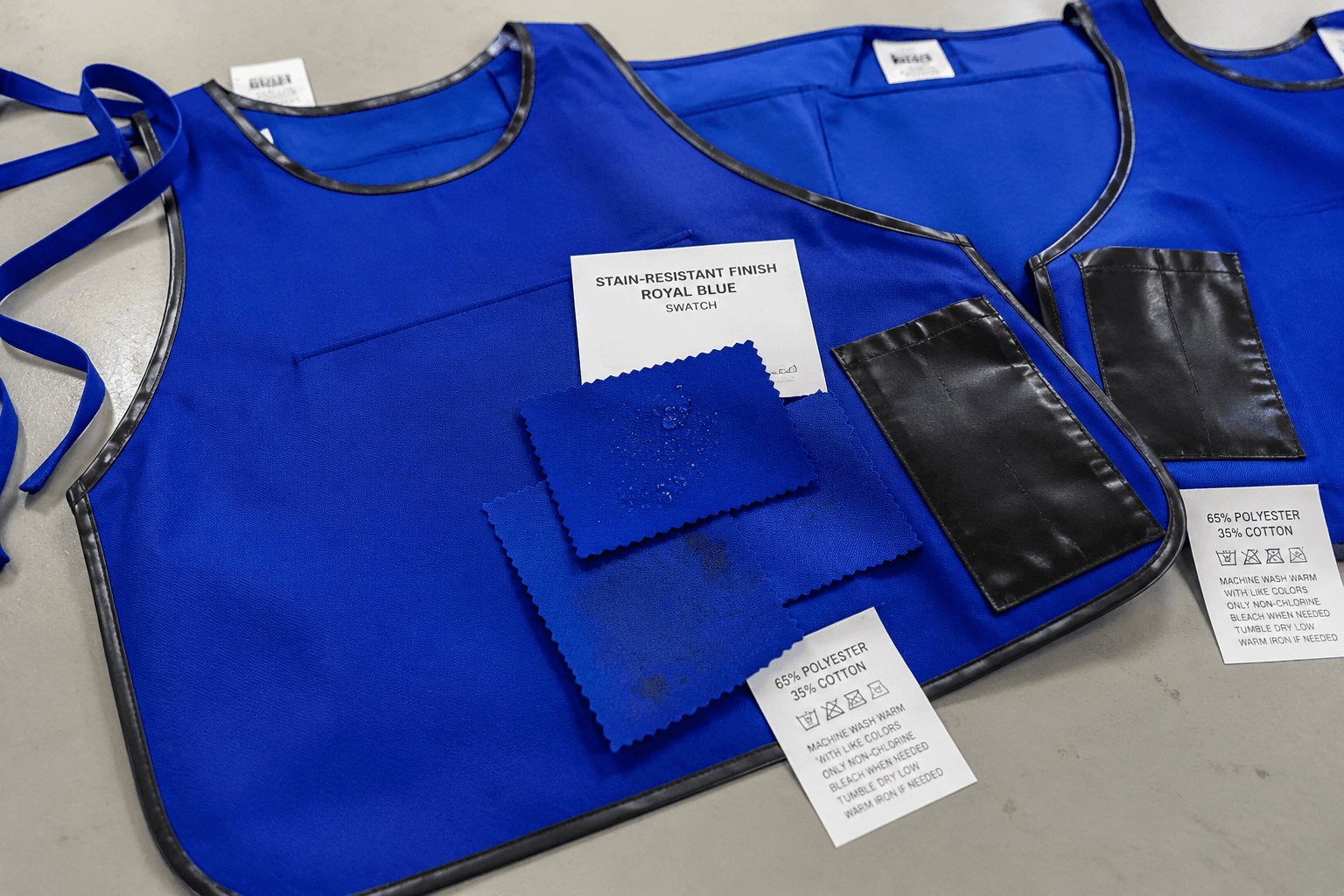
Care labels are a commercial control point. If the approved apron is tested at 40 degrees Celsius domestic wash but the operator sends it through hotter commercial laundering, shrinkage, fading and seam torque will be blamed on the product. The tech pack should state wash temperature, tumble conditions, ironing limits and whether chlorine bleach is prohibited. For repeat orders, the buyer should keep one sealed PP sample and one washed reference sample for shade, size and construction comparison.
- Bib apron target: 68-72 cm wide x 72-78 cm long
- Waist apron target: 70-90 cm wide x 45-55 cm long
- Size strategy: one size for simple programs; two sizes for larger multi-site rollouts
- Pocket strategy: one divided pocket or two slim lower pockets for most lounge roles
- Care label control: state wash temperature, drying method, ironing limit and bleach restriction
MOQ, FOB pricing and lead times for airport lounge aprons
A realistic sourcing plan for airport lounge aprons should include MOQ, sampling time, bulk lead time and replenishment cost before the first order is placed. For custom apron manufacturing in China, a normal MOQ is 300-500 pieces per color per style when using available fabric. Some factories can support 200 pieces, but usually with stock fabric, fewer trim choices and a higher unit price. At 1,000-3,000 pieces, costing becomes more stable and the buyer gains better control over labels, embroidery, carton sorting and site allocation.
Sampling timelines should be written into the project calendar. A proto sample usually takes 7-12 days after artwork, fabric and measurements are confirmed. A revised sample normally needs 5-7 days if comments are specific. A PP sample should be approved before bulk cutting, especially when logo placement, pocket alignment or strap grading is critical. Bulk production is commonly 20-35 days after PP approval and deposit for standard fabrics. Custom dyeing, special trims or site-by-site packing can add 7-15 days.
Indicative FOB pricing varies by cloth, construction and branding. A simple 190-205 GSM poly-cotton waist apron with one small embroidery may sit around $2.20-$3.20 per piece at 1,000 units. A 210-230 GSM bib apron with adjustable strap, divided pocket and tonal embroidery is more often $3.80-$6.20. A premium apron with custom-dyed fabric, metal adjusters, woven label, barcode polybag and carton sorting by airport site may run $5.50-$7.80 or higher depending on volume.
The lowest launch price is not always the lowest annual cost. If a cheaper fabric wrinkles quickly, fades after 10 washes or cannot be repeated in the same shade, the buyer may pay more in replacement, complaints and emergency freight. For lounge operators, the better metric is annual cost per active wearer. A $5.20 apron that lasts 80-100 wears can be more economical than a $3.40 apron that looks poor after 30-40 wears.
- Typical MOQ: 300-500 pieces per colorway per style
- Proto sample lead time: 7-12 days after complete tech pack and artwork
- Revised sample lead time: 5-7 days when comments are specific
- Bulk production lead time: 20-35 days after PP approval for standard fabrics
- Indicative FOB range: $2.20-$7.80 per piece depending on fabric, trims, branding and packing
QC and replenishment rules for repeat apron orders
Final approval for airport lounge aprons should reflect real use, not only flat-table inspection. A pressed sample can look acceptable while the same garment performs poorly after packing, sitting and washing. Before bulk approval, buyers should review a sample after five wash cycles, 24 hours of folded storage and one hanging recovery period. Dark solid fabrics should be checked under both white and warm lighting because pressure marks and shade variation can appear differently in airport interiors.
Measurement tolerances need to be practical but firm. Aprons are not tailored jackets, yet visible length variation across a team looks unprofessional. A tolerance of plus or minus 1 cm on key body dimensions is common. Strap length, pocket alignment and logo placement should be controlled closely because small errors are obvious when staff stand side by side. Embroidery placement should be measured from fixed points such as top bib edge, side seam or pocket edge, not estimated by eye.
Inspection should cover fabric shade, seam straightness, topstitch consistency, pocket symmetry, bar-tack strength, hardware finish and trim colorfastness. If the apron uses faux leather, contrast tape or dyed webbing, require crocking checks to reduce the risk of dye transfer onto light seating, shirts or counters. For bulk orders, AQL 2.5 major and AQL 4.0 minor is a reasonable baseline, with critical defects set at zero tolerance for sharp hardware, broken needles or severe contamination.
Replenishment should be planned with the first order. Stable lounge teams normally need 12-18 percent annual replacement stock. High-churn operations, new contract launches or multi-airport rollouts should plan 20-30 percent. If the buyer launches 3,000 pieces, that means 600-900 additional aprons may be needed within the year. Reserving greige fabric, keeping shade-band references and approving a repeat-order standard can prevent color mismatch and rushed air freight.
- Inspection baseline: AQL 2.5 major, AQL 4.0 minor, zero tolerance for critical defects
- Measurement tolerance: plus or minus 1 cm on main body dimensions
- Appearance test: five wash cycles, 24-hour folded storage and hanging recovery review
- Replenishment reserve: 12-18 percent for stable teams; 20-30 percent for high-churn programs
- Continuity control: retain sealed PP sample, washed sample and approved shade reference for repeats