For custom apron orders, branding is not only a design decision. It affects sewing sequence, fabric selection, wash performance, packing inspection, unit cost, and lead time. Buyers often compare an apron woven label with heat transfer because both can show a logo clearly, but they behave very differently once the apron is worn in a cafe, bakery, salon, workshop, or commercial kitchen.
From a factory point of view, the best choice depends on where the brand mark sits, how often the apron will be washed, whether the apron is cotton canvas, denim, TC twill, polyester, or coated fabric, and how strict the buyer is about color matching. A woven label apron normally gives a more textile-native finish and strong durability. A heat transfer apron can support bigger artwork, gradients, and clean front-panel placement, but it needs correct film, temperature, pressure, and fabric compatibility.
This article compares woven labels and heat transfer branding for bulk apron sourcing, using practical production numbers: MOQ, GSM range, label size, placement tolerance, wash cycles, cost impact, and sample lead time. The goal is to help sourcing managers decide the right apron branding label before sample approval, instead of discovering the trade-off after bulk production starts.
- An apron woven label is usually stronger for repeated washing and small brand marks on pockets, side seams, straps, or hems.
- Heat transfer is better when the apron needs a larger front logo, fine graphic detail, gradients, or a no-stitch branding surface.
- Woven labels add sewing handling time, while heat transfer adds pressing control risk and requires fabric-specific testing.
- For 500-3,000 pcs, woven labels often add about US$0.06-0.18/pc, while heat transfer commonly adds US$0.12-0.45/pc depending on size and film.
- Apron care label requirements should be decided together with the external branding method, especially for hospitality and workwear buyers.
- Bulk approval should include wash testing, rub testing, placement measurement, and packaging inspection for both branding options.
How an apron woven label works in bulk production
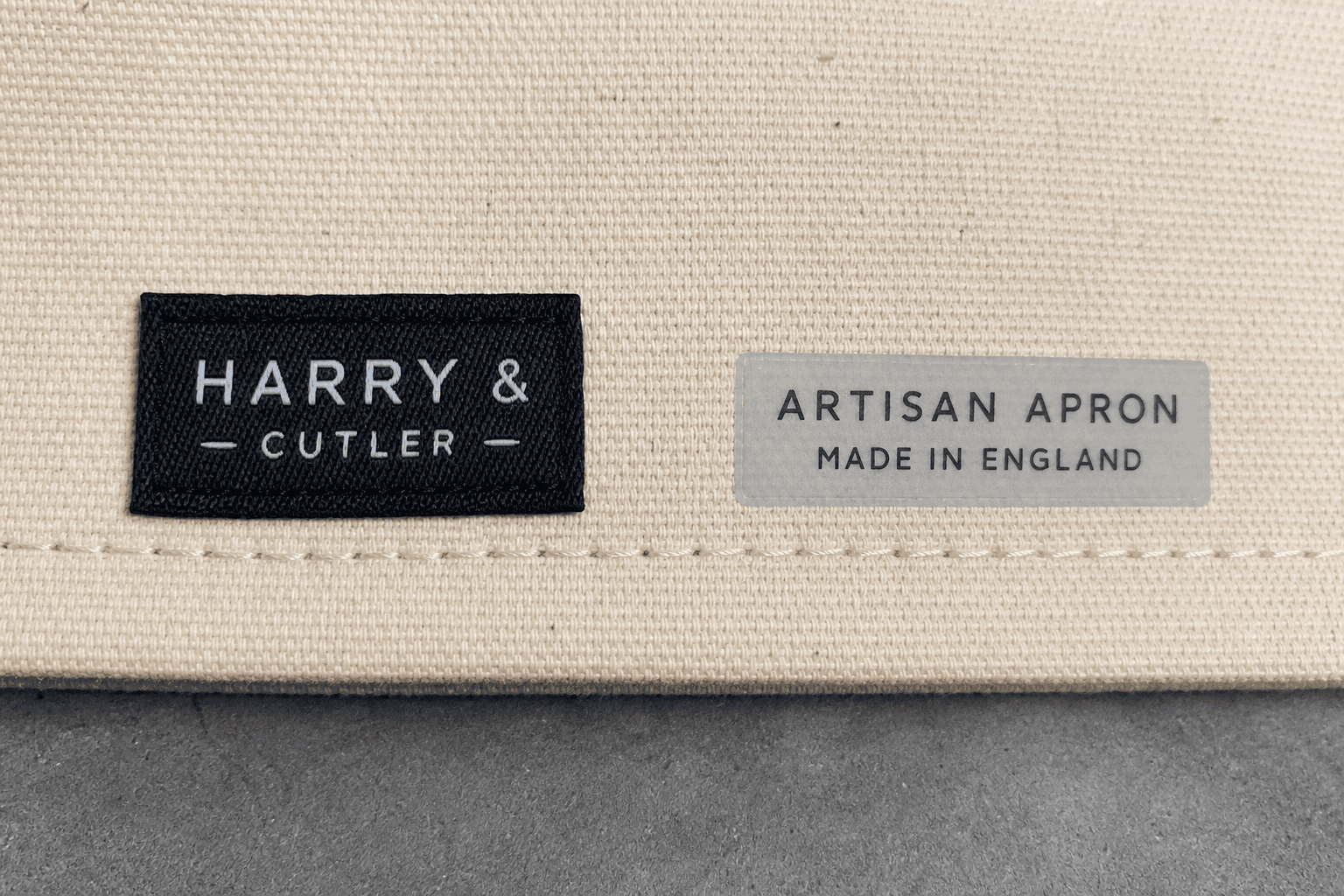
An apron woven label is made on a label loom using polyester yarns, then cut, folded, and sewn into the apron during the stitching process. For aprons, common label positions are the upper pocket edge, lower pocket side, bib side seam, waist tie seam, neck strap, or bottom hem. The most common label sizes we see for OEM apron orders are 20 x 50 mm, 25 x 60 mm, 30 x 70 mm, and 40 x 80 mm. For folded side labels, 15 x 50 mm and 20 x 60 mm are also common because only half the label is visible after folding.
A woven label apron is usually planned before the sewing line is arranged. If the label is caught into a pocket seam or hem, it must be supplied to the sewing operator at that step. If the buyer changes label position after the pre-production sample, the factory may need to revise the operation bulletin, sewing folder, or pocket template. This is not difficult, but it can add 1-2 days before bulk sewing, especially when the apron has multiple pockets or contrast bartacks.
For durability, woven labels are normally made from polyester yarn because it resists washing, abrasion, and color bleeding better than cotton yarn. Standard label density is suitable for simple logos and text above 1.2 mm line thickness. For small letters under 1 mm, a high-density damask woven label is better, but the artwork should still be simplified. Very small QR codes, fine serif fonts, and multi-color gradient logos usually do not reproduce cleanly on woven labels.
- Typical MOQ for a custom apron label is 500-1,000 pcs per design, although the practical cost is better from 2,000 pcs upward.
- Standard woven label sampling takes 5-7 days after artwork confirmation, and bulk label production usually takes 7-10 days.
- Normal color options are 2-6 yarn colors, with best results when the buyer provides Pantone TPX or TCX references.
- Sewing placement tolerance is normally +/-3 mm for pocket labels and +/-5 mm for side seam or hem labels on bulk aprons.
How heat transfer apron branding works
Heat transfer apron branding uses a printed or cut film applied to the apron fabric with heat, pressure, and dwell time. In apron production, the most common applications are center chest logos, lower front logos, large cafe brand graphics, staff role marks, and promotional artwork. Depending on the artwork, the factory may use PU transfer film, PET transfer, screen-printed transfer, digital transfer, reflective transfer, or silicone transfer. Each option has different hand feel, wash resistance, color depth, and minimum size rules.
A heat transfer apron is attractive when the brand needs a clean front surface without stitching. It can show a larger logo than a woven label and can reproduce more detail. For example, a 120 x 80 mm chest transfer is common for cafe and retail aprons, while a 250 x 180 mm front transfer may be used for promotional aprons. However, larger transfers can change fabric hand feel and breathability, especially on 180-240 GSM TC twill or polyester aprons. On heavier 10 oz or 12 oz cotton canvas, the transfer may sit well visually, but wash testing is still needed because the fabric texture can affect adhesion.
The heat press process is usually done after panel cutting and before final sewing, or after sewing if the placement allows a flat press surface. For bib aprons with pockets, pressing after sewing can be difficult because pocket seams, rivets, metal eyelets, or thick waist tie joins create uneven pressure. If the transfer crosses a seam, failure risk increases. A supplier should confirm whether the transfer will be pressed on a flat cut panel or on the completed apron.
- Common heat press settings range from 130-160 degrees Celsius, 8-15 seconds, and medium to high pressure, depending on film type.
- Small transfer MOQ can start from 100-300 pcs, but bulk pricing is usually more stable above 500 pcs per design.
- A simple one-color chest transfer may add about US$0.12-0.25/pc, while large multi-color digital transfers may add US$0.30-0.80/pc.
- Heat transfer sampling normally needs 3-5 days if film is available, or 7-10 days for custom printed transfers.
Apron woven label cost, MOQ, and lead-time impact
For sourcing managers, the apron woven label cost is often small compared with fabric and sewing, but it still needs to be calculated correctly. A basic 2-color woven label in a 25 x 60 mm size may cost around US$0.025-0.06/pc at 5,000 pcs, before sewing handling. At 500 pcs, the same label may be charged with a setup cost or higher unit rate. After adding sewing time and inspection, the finished apron cost impact is often around US$0.06-0.18/pc.
The cost changes with label size, yarn colors, density, fold type, edge finish, and whether the label is sewn on one side or two sides. A center-fold label sewn into a side seam is usually faster than a flat label stitched on all four sides. A flat patch label on a chest pocket may require more accurate positioning and an extra operation, increasing labor cost. If the apron has heavy 12 oz canvas, waxed canvas, or thick denim, needle choice and seam thickness also affect sewing speed.
Lead time is another reason to decide the custom apron label early. If the apron body fabric is ready but labels are still pending approval, the whole sewing line may wait. For a 2,000 pcs order, this can be manageable. For a 20,000 pcs program with carton delivery windows, delayed labels can affect shipment by several days. We usually recommend approving the woven label together with the size set sample or salesman sample, not after the bulk fabric is already dyed.
- For 500 pcs, woven label cost may be dominated by setup and sampling rather than the label unit price.
- For 3,000-10,000 pcs, woven labels usually become more economical and stable in color and supply.
- For repeat orders, keeping the same label artwork and size can remove new setup time and reduce price variance.
- For multi-SKU apron programs, one shared brand label can simplify production if each SKU does not need a different logo.
Durability in washing, abrasion, and daily apron use
Aprons are washed more aggressively than many promotional textile items. Cafe aprons may be washed 2-4 times per week. Kitchen aprons can see oil, detergent, hot water, and tumble drying. Workshop aprons may face abrasion from tools, counters, straps, and repeated tying. In this environment, a sewn woven label usually has a strong advantage because the logo is part of a separate woven tape and is mechanically attached to the garment.
A good polyester woven label can normally pass 30-50 domestic wash cycles without losing basic legibility. The weak point is not usually the label face, but the stitching or label edge. If the label is too stiff, it may curl. If it is placed at a high-abrasion point such as the lower front center of a work apron, the edge may fray earlier. For this reason, we prefer woven labels on pockets, side seams, upper bib edges, or strap areas where they are visible but not constantly rubbed against tables or tools.
Heat transfer durability depends more on the transfer type and fabric surface. A quality PU or screen transfer can pass 20-40 wash cycles on suitable fabric, but poor adhesion can show cracks, lifting edges, or fading after only a few washes. High-temperature washing, chlorine bleach, industrial laundry, and high tumble drying all increase risk. If the buyer is sourcing aprons for restaurants that use commercial laundry, heat transfer must be tested under the real care method, not only a mild home wash.
- For cotton canvas aprons at 260-360 GSM, woven labels are generally safer for long-term brand visibility.
- For polyester or TC twill aprons at 180-240 GSM, heat transfer can work well if the film is matched to the fiber blend.
- For denim aprons, woven labels look natural, while heat transfer needs testing because uneven twill texture can reduce contact.
- For coated, water-resistant, or waxed aprons, heat transfer may fail unless the coating is compatible with the adhesive layer.
- For industrial laundry, woven labels are usually the lower-risk apron branding label.
Design limitations: logo detail, color, and placement
The design question is not only which method looks better in a presentation file. It is which method can reproduce the buyer's logo consistently across bulk aprons. Woven labels are excellent for simple wordmarks, small icons, two-color brand marks, and classic workwear styling. They are not ideal for photographic artwork, gradients, very thin lines, or tiny compliance text. For a woven label, letter height should ideally be above 2 mm for clean reading, and line width should avoid extreme thin strokes.
Heat transfer gives more freedom for artwork. It can print multiple colors, smooth shapes, detailed illustrations, and larger front graphics. It also allows different staff names, event marks, or seasonal campaign graphics if the order is organized carefully. But this flexibility creates more approval points: artwork resolution, film edge, hand feel, color fastness, cracking, and exact placement. A 2 mm shift may not matter on a side woven label, but it can be very visible on a centered chest logo.
Placement also changes the wear experience. A woven label on a side seam or pocket edge feels small and integrated. A heat transfer on the chest is more visible from distance, which is useful for front-of-house staff uniforms. On the other hand, a large transfer on the lower front panel can make the apron feel less breathable and may show creasing when the wearer bends. For chef, barista, florist, and maker aprons, we usually suggest checking both the standing appearance and seated or working posture during sample review.
- Use a woven label when the logo is compact, textile-style, and expected to stay on the apron for the product life.
- Use heat transfer when the artwork is large, detailed, multi-color, or needs a flat print-like surface.
- Avoid placing heat transfer over pocket seams, rivets, eyelets, bartacks, or heavy folded hems.
- Avoid placing stiff woven labels where the neck or wrist may rub against the label edge during work.
- Confirm logo placement with measurements from fixed points, such as top bib edge, pocket edge, side seam, or center line.
Apron care label and compliance considerations
The apron care label is separate from the external brand label, but buyers should approve both at the same time. A care label normally includes fiber content, washing instruction, country of origin, size, RN number or importer information where required, and sometimes batch coding. In many bulk apron orders, the care label is sewn into the side seam, waist seam, or lower inside hem. For reversible aprons or cross-back aprons, placement needs more care because the label should not affect appearance or comfort.
A custom apron label used for branding should not replace the required care label unless it carries all required information and is accepted for the destination market. For example, a small apron woven label on the pocket may be suitable for logo branding, but it usually cannot carry full fiber content and washing symbols in readable form. A separate satin printed care label or soft woven care label is more practical. For US, EU, UK, Japan, and Australia shipments, buyers should provide compliance text or confirm that the supplier's template matches their market.
Branding method also affects care wording. If the apron has heat transfer, care instructions may need to include washing inside out, low tumble drying, no bleach, no ironing on print, or similar restrictions. If the apron has only woven labels, the care instruction can often follow the main fabric requirement. This matters because a buyer may choose a heat transfer for design reasons, then later discover that the required care restrictions are not suitable for a restaurant laundry program.
Quality control points for woven label apron orders
For a woven label apron, QC should check label artwork, yarn color, size, fold, edge finish, sewing position, stitch density, and label direction. Direction errors are more common than buyers expect, especially with folded side labels, neck strap labels, or aprons sewn in multiple colors. The pre-production sample should show exactly how the label is inserted and how it looks after pressing and packing. A loose label mock-up is not enough for approval.
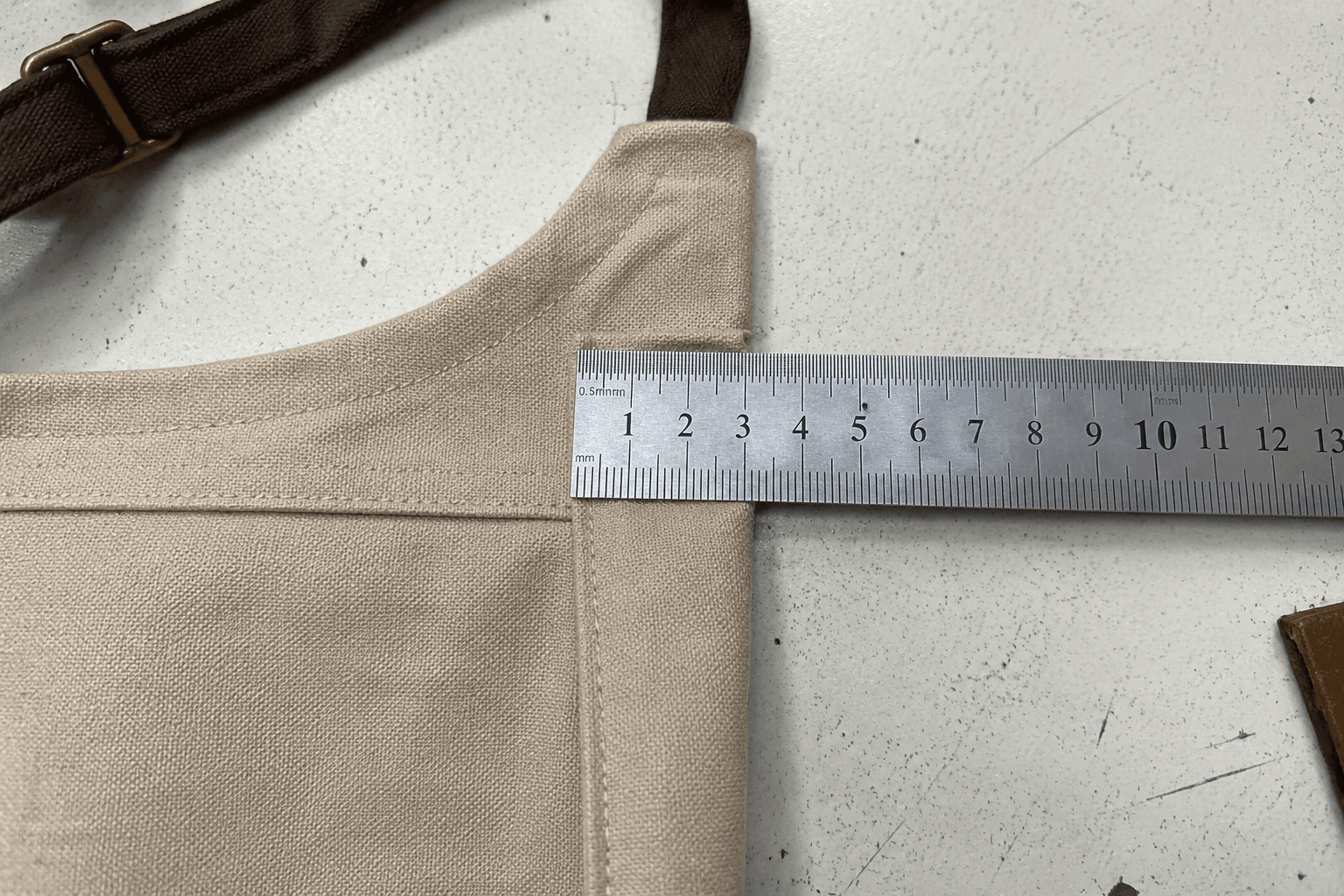
On the sewing line, the operator should use a placement guide when the label is visible on a pocket or chest area. For pocket labels, we commonly set tolerance at +/-3 mm from pocket edge and +/-3 mm from top edge. For side seam labels, +/-5 mm is more realistic because fabric handling varies during seam closing. Stitching should catch the label securely without covering important logo elements. For flat labels, the stitch line should be even and the corners should not curl.
Final inspection should include rubbing the label edge, checking that no labels are missing, and confirming carton-level SKU separation. This sounds basic, but mixed label versions are a real risk in OEM apron programs where the same apron body is produced for several restaurant chains or retail brands. If the order includes several brand labels in the same fabric color, the factory should separate labels by production line, bundle, and carton mark.
- Check label size after cutting, because heat cutting and folding can change visible dimensions by 1-2 mm.
- Check yarn color under D65 or buyer-specified light source when the brand color is strict.
- Check label direction before bulk sewing starts, especially for side-fold and end-fold labels.
- Check stitch tension on heavy canvas so the label does not pucker the pocket or bib panel.
- Check packed aprons after pressing because labels can curl if the fold memory is poor.
Quality control points for heat transfer apron orders
For heat transfer apron orders, the most important control is process consistency. The approved sample should record transfer type, press temperature, dwell time, pressure, peel method, and fabric composition. If the bulk fabric changes from 100% cotton to TC, or from 240 GSM twill to 320 GSM canvas, the approved transfer process may no longer be valid. Even the same logo can behave differently on brushed cotton, coarse canvas, smooth polyester, and denim.
Bulk QC should test adhesion before and after washing. A simple fingernail edge check is useful on the line, but it is not enough. We recommend at least one wash test before bulk pressing and another during production, especially for orders above 3,000 pcs. For restaurant and workwear aprons, a practical test is 5 wash cycles at the buyer's expected temperature, then checking cracking, lifting, color change, and hand feel. For higher-risk programs, 20 wash cycles gives a better view of real use.
Placement control is also stricter for heat transfer because front logos are highly visible. The factory should define the logo center point from the top bib edge and center line, or from the pocket line if the apron structure requires it. For a 100 x 60 mm chest logo, +/-3 mm may be acceptable. For a large 250 mm front graphic, even a slight tilt can look poor, so pressing fixtures or printed placement guides are useful.
- Confirm whether the transfer is hot peel, warm peel, or cold peel before bulk production.
- Check that the transfer film does not leave press marks or gloss boxes on dark cotton aprons.
- Check stretch and cracking if the apron fabric has elastic content or curved body movement.
- Check wash resistance under the same detergent and drying method expected in real use.
- Check that each apron is cooled and stacked properly so transfers do not stick or mark other panels.