For tool and hardware brands, a workshop apron is not a simple promotional textile item. It sits close to sharp edges, sawdust, oil, glue, hand tools, fasteners, and repeated abrasion from bench work. Buyers usually need a product that looks brand-right on the retail wall, but the factory must also build it so pockets do not tear, straps do not slip, and fabric does not collapse after three months of real use.
At Linwa Apron Manufacturing in Zhejiang, we see workshop apron programs from two directions: retail tool brands that want a packaged SKU, and industrial distributors that want a durable utility apron for workshops, woodworking classes, repair counters, maker spaces, and hardware store staff. The right specification depends on fabric weight, pocket load, reinforcement method, washing expectation, packaging format, and target landed cost.
This article explains the factory-side decisions behind a custom workshop apron order, including fabric GSM, denim and canvas options, MOQ ranges, sample timing, bulk lead time, and the trade-offs buyers should settle before confirming artwork and purchase orders.
- 10 oz to 16 oz cotton canvas is the most common fabric range for workshop apron orders, with 12 oz often balancing durability and sewing efficiency.
- Pocket reinforcement is usually more important than fabric weight when the apron carries screwdrivers, rulers, pliers, pencils, bits, or fasteners.
- Cross-back straps reduce neck pressure and are recommended for woodworking apron and utility apron designs worn for several hours.
- Realistic MOQ starts around 500-1,000 pcs per color for standard fabric, but custom dyed canvas or special hardware can raise MOQ to 2,000-3,000 pcs.
- Bulk lead time is normally 30-45 days after sample approval, fabric confirmation, and deposit, depending on pocket complexity and packaging.
- A heavy duty apron supplier should test pocket loading, rivet placement, seam strength, and colorfastness, not only check appearance.
What makes a workshop apron different from a kitchen apron
A kitchen apron is mainly designed for splash protection, basic coverage, and frequent laundering. A workshop apron must carry tools, resist rubbing against benches, tolerate dust and oil, and maintain pocket shape under load. The stress points are different. On a kitchen apron, the waist ties and bib top may be the main areas to watch. On a tool apron, the lower pockets, pen channels, hammer loops, rivet corners, waist strap attachment, and bottom hem receive far more strain.
This is why a workshop apron should not be sourced by copying a hospitality apron and adding extra pockets. The cutting pattern, fabric weight, stitch density, bartack position, and strap structure should be specified from the beginning. If a buyer asks for 14 oz canvas but keeps a single-needle pocket seam, the fabric looks strong but the pocket mouth may still fail. If a brand requests metal rivets everywhere, the apron can look rugged, but badly placed rivets can scratch workpieces, interfere with folding, or create pressure points.
For tool and hardware brands, the apron is also a brand object. It may be sold alongside measuring tapes, clamps, drill bits, sanding blocks, or safety accessories. The perceived value depends on hand feel, hardware quality, label placement, logo execution, and retail packaging. The factory therefore needs both production tolerance and merchandising requirements, not only a flat sketch.
- A workshop apron normally requires heavier fabric, stronger seams, and more pocket engineering than a standard hospitality apron.
- A tool apron should be tested with actual tools or equivalent weight, not only inspected flat on a table.
- A utility apron for retail staff may need lighter fabric and faster washing than a woodworking apron for bench use.
- A heavy duty apron supplier should confirm whether the product is for resale, staff uniform, promotional kit, or industrial use.
Workshop apron fabric choices: canvas, denim, twill, and waxed options
Fabric selection drives cost, sewing difficulty, finished weight, and user comfort. For most workshop apron programs, cotton canvas in the 10 oz to 16 oz range is the main option. In metric terms, this is roughly 340-540 GSM depending on yarn count and finishing. A 10 oz canvas is easier to wear and lower in cost, but may feel less substantial for premium tool brands. A 12 oz canvas is a practical middle point for many bulk orders. A 14 oz or 16 oz canvas looks and feels more rugged, but increases fabric cost, sewing time, needle wear, packing volume, and freight weight.
Denim is another common choice, especially for brands wanting a workwear look. A 10 oz to 13 oz denim workshop apron can be comfortable and visually strong. However, indigo denim requires careful colorfastness control. Dark denim may transfer color to light shirts, packaging, or benches if the washing and finishing process is not specified. For export orders, we normally recommend lab dip approval, rubbing colorfastness testing, and a clear statement on whether the garment is raw, rinsed, enzyme washed, or garment washed.
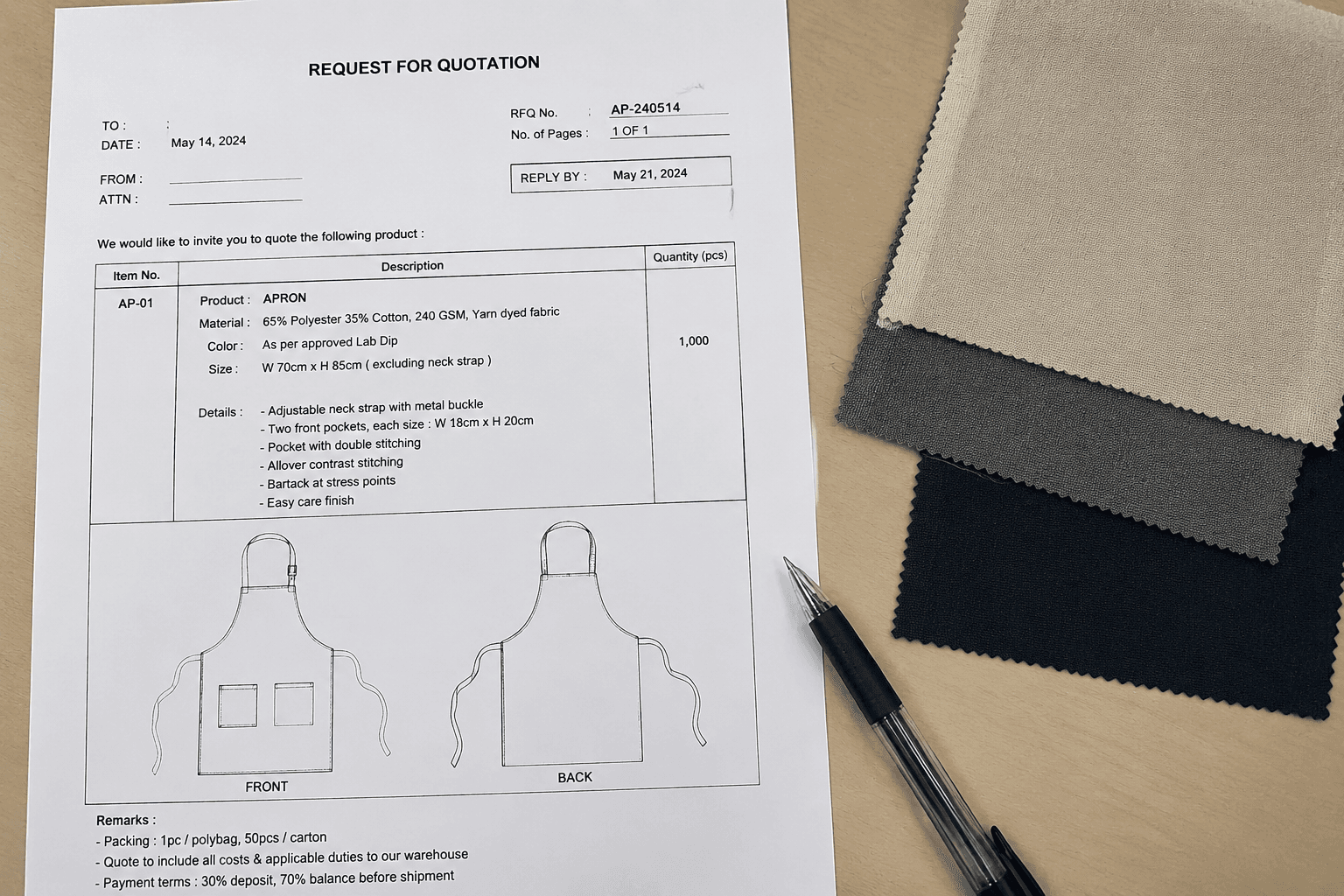
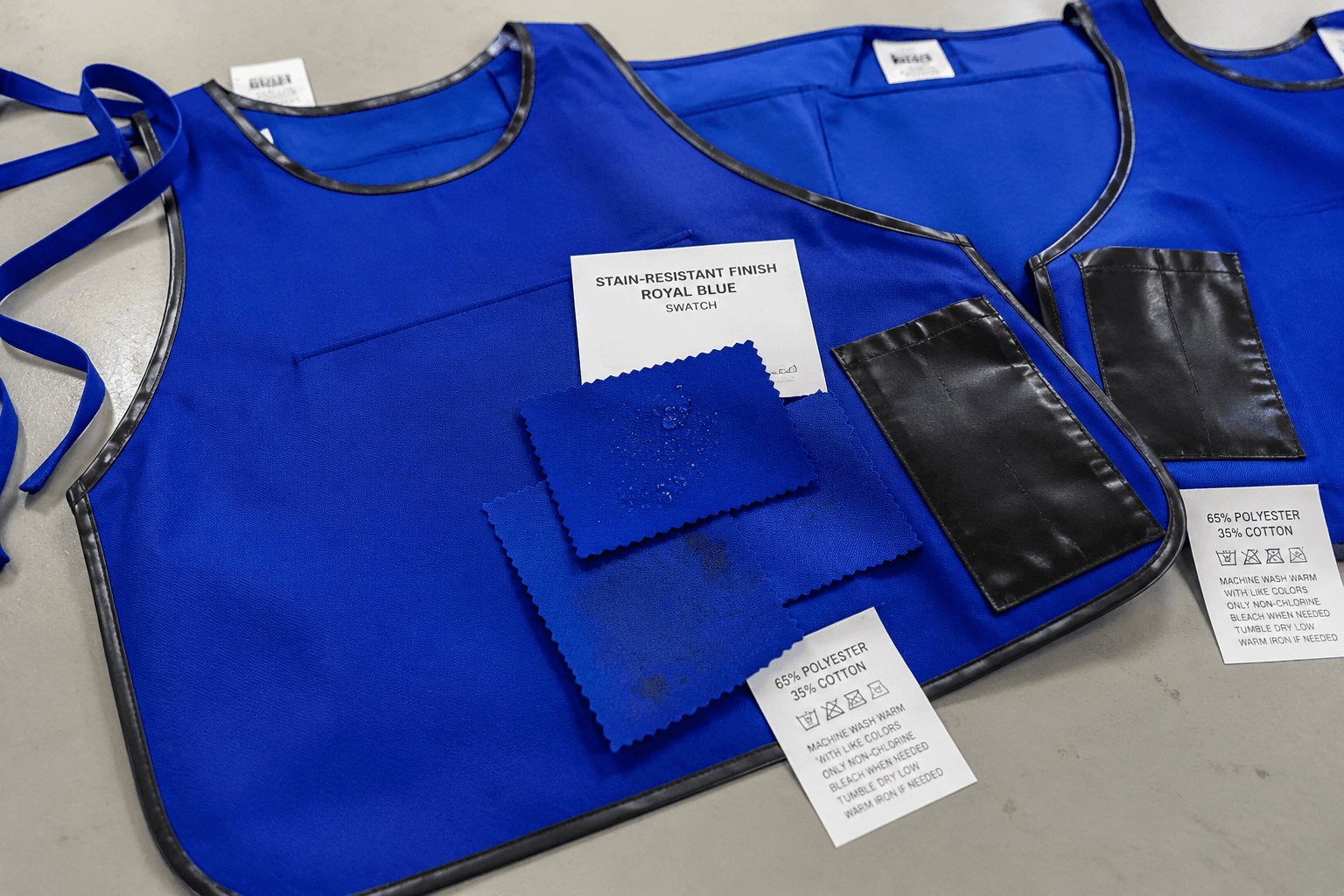
Twill, poly-cotton canvas, and blended fabrics can reduce cost and improve wrinkle recovery. For an industrial utility apron that needs frequent washing and faster drying, a 65/35 polyester-cotton twill at 240-280 GSM can make sense. But for tool and hardware retail, buyers often prefer cotton-rich fabrics because they feel more authentic and accept screen printing, embroidery, and leather patch trims well. Waxed canvas can be attractive for premium woodworking apron designs, but it raises unit cost, requires slower sewing, and may have import or care-label considerations depending on the wax formulation.
- 10 oz canvas, about 340 GSM, suits lighter utility apron programs where comfort and price matter.
- 12 oz canvas, about 400 GSM, is a balanced specification for many custom workshop apron SKUs.
- 14-16 oz canvas, about 470-540 GSM, gives a stronger hand feel but increases sewing and freight cost.
- 10-13 oz denim works well for workwear styling, but colorfastness must be checked before bulk shipment.
- Waxed canvas is suitable for premium positioning, but MOQ and unit price are usually higher than plain canvas.
Pocket layout for tool apron performance
Pocket design is the part of a tool apron that most often separates a good sample from a weak production item. Buyers may request many compartments because the drawing looks more useful, but each added pocket changes labor time, bulk thickness, and quality risk. A practical workshop apron usually needs a combination of large lower pockets, narrow pencil pockets, one or two ruler or utility knife channels, and optional side loops. Too many narrow pockets can become unusable after washing or shrinkage if tolerance is not controlled.
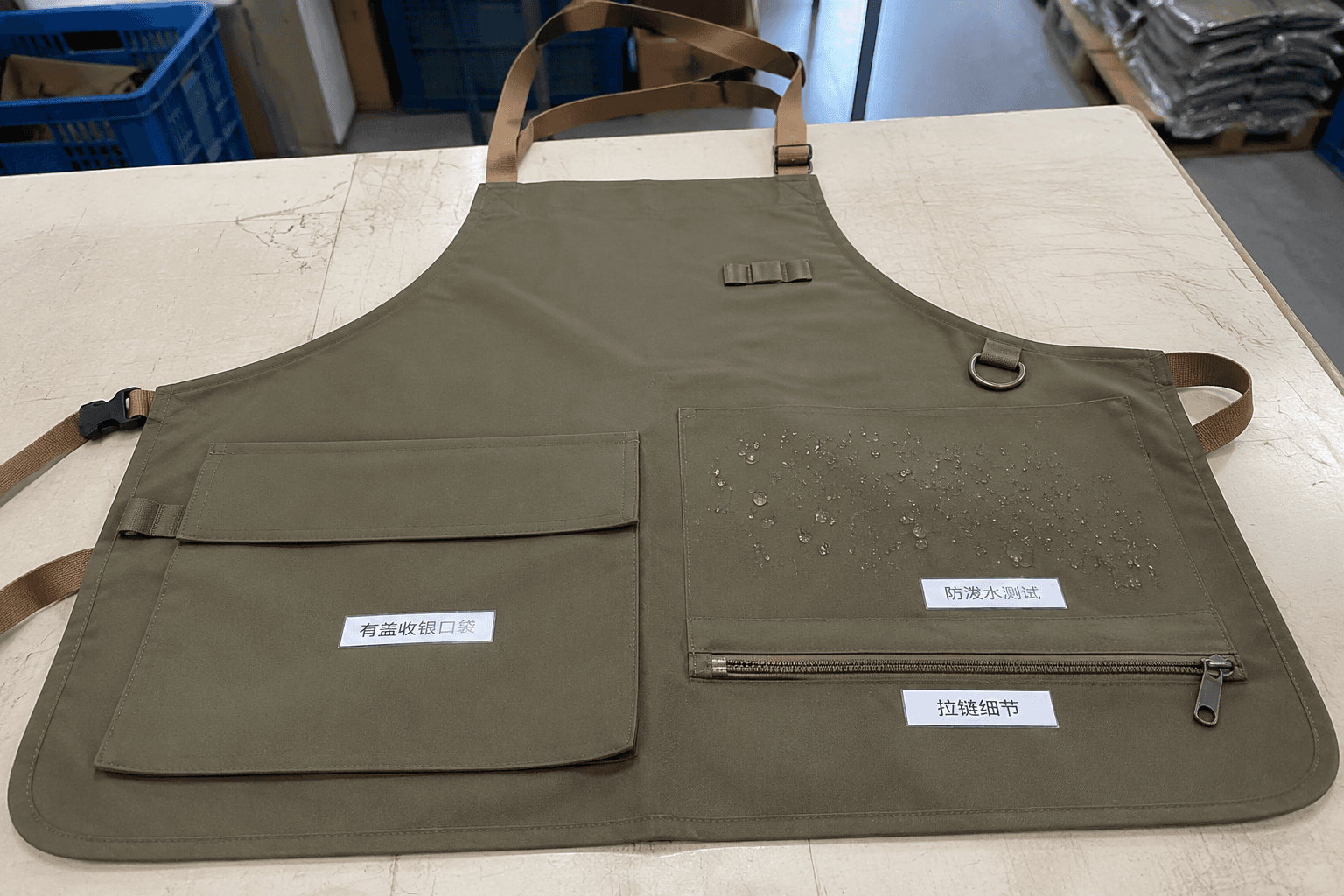
The first decision is what the pocket must carry. A carpenter pencil weighs little, but a steel ruler, screwdriver, pliers, or small box of fasteners creates downward pull at the pocket corners. For these load points, we usually recommend double-needle stitching plus bartacks at the top corners. Rivets can be added for appearance and reinforcement, but they should be positioned away from folding lines and areas that may contact delicate work surfaces. For heavier designs, a pocket panel made from double-layer canvas is often more reliable than simply using a heavier base fabric.
Pocket depth also needs discipline. A lower pocket depth of 17-20 cm works for many hand tools and prevents small items from falling out easily. Pencil pockets can be 2.5-3.5 cm wide depending on fabric thickness. A phone pocket should be specified by device size, but not every workshop apron should include one; many users prefer to keep phones away from dust and chips. If a buyer needs a phone pocket, adding a flap or upper chest position may protect it better than a low front pocket.
- Lower pocket openings should be reinforced with bartacks or rivets at the load points.
- Pocket depth should match actual tool length, not only visual proportion on a mockup.
- A double-layer pocket panel can improve durability without making the full apron too heavy.
- Narrow pencil slots need shrinkage allowance, especially on washed cotton canvas or denim.
- Large logos should not be placed where pocket folds and tool edges will quickly abrade the print.
Straps, hardware, and fit for long workshop use
Fit affects whether the end user actually wears the apron. Traditional neck-loop aprons are simple and cost-effective, but a heavy workshop apron with loaded pockets can pull on the neck after one or two hours. For serious woodworking apron and maker-space apron programs, cross-back straps are usually more comfortable because they distribute weight across the shoulders. The additional cost is not only strap length; it also includes hardware, extra sewing operations, and more time for adjustment during packing.
Common strap materials include self-fabric canvas, cotton webbing, polyester webbing, and leather. Self-fabric straps create a clean garment look, but thick canvas straps can be bulky and slower to sew. Cotton webbing has a natural appearance and good comfort, while polyester webbing offers better strength, color consistency, and lower shrinkage. For a retail tool apron, 25 mm or 38 mm webbing is common. A 25 mm strap is lighter and cheaper, while 38 mm feels more substantial and spreads pressure better.
Hardware should be selected according to use and target price. Nickel-plated or antique brass metal buckles give a stronger workshop look, but must pass basic rust resistance expectations. Plastic side-release buckles reduce weight and cost, but may not match a premium hardware brand image. If leather trims are used, buyers should confirm whether genuine leather, split leather, microfiber leather, or washable synthetic leather is acceptable. Genuine leather patches can look good on the shelf but may complicate wash care and increase color migration risk.
- A neck-loop strap is suitable for lower-cost utility apron orders or short-wear use.
- A cross-back strap is recommended for heavier workshop apron designs with loaded pockets.
- 25 mm webbing is economical, while 38 mm webbing gives better comfort and perceived strength.
- Metal hardware should be checked for plating quality, burrs, rust resistance, and color consistency.
- Leather trims should be confirmed early because they affect care labeling, MOQ, and import documentation.
Branding methods for workshop apron orders
Branding must be chosen around fabric texture, apron color, order quantity, and expected abrasion. Screen printing is cost-effective for bold logos and one to three colors. On 10 oz to 12 oz canvas, a clean screen print can work well if the artwork has enough line thickness. On rough 16 oz canvas or waxed fabric, fine details may break. For a tool and hardware brand, we usually recommend avoiding tiny text in lower pocket areas because tools and bench contact will wear the print faster.
Embroidery gives a durable, premium result but adds cost and can distort lighter fabrics if the stitch count is high. A 6,000-10,000 stitch logo is common for chest placement, while large embroidered graphics can become stiff and expensive. Woven labels are useful for side seams, pocket edges, or retail identity. Rubber patches and leather patches can increase perceived value, but they add MOQ, mold charge, or patch sampling time. For example, a custom rubber patch may require a mold fee of around USD 80-150 depending on size and color complexity.
Buyers should send vector artwork, Pantone references, logo size, and placement measurements before sampling. If exact brand color is critical, the factory should produce a strike-off or embroidery swatch before bulk production. A common mistake is approving logo position only from a flat digital mockup. The logo should be checked on an actual sample worn on a body form, because chest height, pocket flap angle, and strap crossing can change how the branding reads.
- Screen printing is usually the best value for bold logos on cotton canvas or twill.
- Embroidery is durable but should be controlled for stitch count, backing, and fabric puckering.
- Woven labels are stable for repeat orders and help retail products look finished.
- Leather and rubber patches improve shelf value but add sampling time and extra component MOQ.
- Logo placement should be approved on a physical sample, not only on a digital drawing.
MOQ, pricing, and lead time for a custom workshop apron
MOQ depends on fabric availability, color, trims, printing method, and packaging. For a workshop apron using stock black, khaki, navy, grey, or natural canvas, a practical MOQ is often 500-1,000 pcs per color. For custom dyed canvas, special denim wash, waxed fabric, custom webbing color, or custom hardware, MOQ can rise to 2,000-3,000 pcs because upstream mills and trim suppliers have minimum batch requirements. Buyers should separate sample MOQ from production MOQ; a factory can often make samples from available fabric, but that does not mean the same material is available for bulk at 500 pcs.
Price is built from fabric consumption, fabric cost per meter, cutting efficiency, sewing minutes, reinforcement operations, hardware, branding, inspection, packaging, and export handling. As a broad factory-side reference, a simple 10 oz canvas utility apron with basic pockets may be in the USD 3.20-5.00 range at 1,000 pcs, depending on fabric and logo. A 12 oz to 14 oz workshop apron with cross-back straps, reinforced pockets, metal hardware, and retail packaging may fall around USD 6.50-10.50. Waxed canvas, leather trims, garment washing, and complex pocket structures can push the price above USD 12.00 per piece.
Sampling usually takes 5-10 days after artwork and materials are confirmed. If custom dyed fabric, washed denim, molded rubber patches, or special hardware are involved, sample development may take 12-20 days. Bulk production is commonly 30-45 days after sample approval and deposit. During peak season, before major trade shows, or near Chinese New Year, buyers should add buffer time. For repeat orders with fabric reserved and approved trims, lead time can sometimes be shortened to 25-35 days, but only when the purchase order and packing details are stable.
- Stock fabric MOQ is commonly 500-1,000 pcs per color for practical custom apron production.
- Custom dyed fabric or special trims may require 2,000-3,000 pcs per color or component.
- Sample lead time is usually 5-10 days for standard materials and 12-20 days for custom components.
- Bulk lead time is usually 30-45 days after sample approval, deposit, and packaging confirmation.
- Retail packaging, hangtags, barcodes, and carton marks should be confirmed before bulk cutting starts.
Quality control points a heavy duty apron supplier should manage
Quality control for a workshop apron should go beyond appearance. The first control point is fabric. The factory should check fabric weight, width, shade, shrinkage, skew, and defects before cutting. For cotton canvas and denim, shrinkage after washing may be 3-8% if not pre-shrunk or controlled by finishing. If the buyer requires home laundering, shrinkage testing should be completed before final sizing. If the apron is wipe-clean only or waxed, the care label must state that clearly.
The second control point is reinforcement. Pocket openings should be checked for bartack length, stitch density, and thread tension. A practical bartack may be 8-12 mm depending on pocket size and fabric. Thread choice matters. For most heavy cotton canvas aprons, Tex 40 or Tex 60 polyester thread can provide good strength. Very thick thread may look rugged but can create sewing tension problems if the machine setting is not adjusted. Needles must match fabric and thread to avoid skipped stitches or fabric damage.
The third control point is functional inspection. A factory should test strap adjustment, buckle movement, pocket loading, rivet security, label attachment, print adhesion, and carton packing. For printed logos, rubbing and washing tests should be considered, especially on dark or heavily textured fabric. For metal hardware, edges should be smooth because a sharp buckle or rivet back can damage garments or hands. For retail orders, each piece should be folded consistently so the logo, label, or product front is visible in the polybag or belly band.
- Incoming fabric should be checked for GSM, shade, shrinkage, width, and visible defects before cutting.
- Pocket seams should be inspected under load, especially at top corners and divider lines.
- Strap hardware should move smoothly and should not have sharp edges or loose plating.
- Prints and patches should be tested for adhesion, rubbing resistance, and placement tolerance.
- Final inspection should include measurements, appearance, tool-pocket function, packing, barcode, and carton marks.
Specification checklist before placing a workshop apron order
A clear tech pack saves time and reduces cost surprises. Many delays happen because the buyer approves the overall look but leaves open questions about fabric finish, pocket dimensions, label type, strap length, or packaging. For a custom workshop apron, even small details matter. A 2 cm difference in pocket depth can affect tool retention. A change from neck strap to cross-back strap can alter the cutting marker and labor cost. A switch from screen print to embroidery can require new logo sizing and backing tests.
Before requesting a quotation, buyers should define the user, retail price target, order quantity by color, required testing, and packaging method. A tool apron for a premium woodworking brand may justify higher fabric weight, antique brass hardware, and a leather patch. A utility apron for hardware store staff may need lower weight, easier washing, and simple screen printing. A promotional kit apron bundled with tools may need compact folding, low unit cost, and strict carton dimensions.
The best results come when buyer and factory agree on the functional priority first. If comfort is the main priority, use moderate fabric weight and cross-back straps. If shelf impact is the main priority, focus on fabric hand feel, patch quality, and packaging. If durability is the main priority, spend budget on pocket construction, bartacks, thread, and reinforced panels before adding decorative hardware. This is the difference between an apron that only looks heavy duty and an apron that performs in a real workshop.
- Confirm apron size, bib height, waist width, total length, and measurement tolerance.
- Specify fabric type, GSM or ounce weight, color, finishing, shrinkage requirement, and care label.
- Define pocket quantity, pocket dimensions, reinforcement method, and expected tool load.
- Confirm strap structure, webbing width, buckle type, hardware finish, and adjustment range.
- Provide vector logo files, Pantone colors, branding method, placement, and approval process.
- Confirm MOQ, sample cost, bulk lead time, packaging format, barcode needs, carton size, and inspection standard.