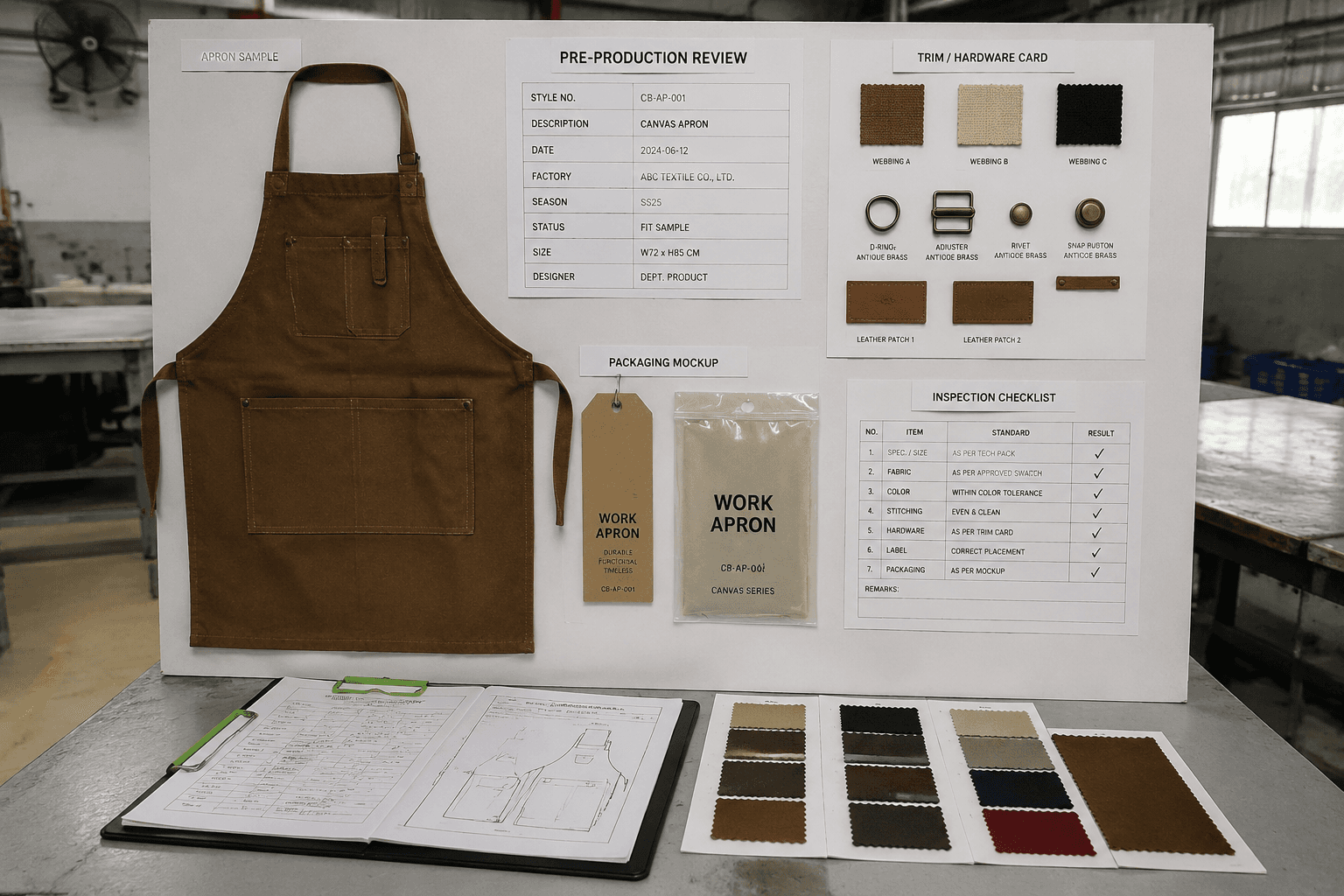
A national apron rollout looks simple on paper: approve the PPS, place the PO, receive cartons at the DC, and allocate stock to stores before opening day. In reality, most failures show up in first production, not in the approved sample. Bib length can drift by 8-12 mm across a size set, waist ties can vary by 10-15 mm if cutting control is loose, and embroidery on a 240 GSM cotton canvas apron can tunnel after three industrial wash cycles. For hospitality groups, retailers, foodservice chains, and licensed merchandisers, pilot run apron production is the most reliable way to verify whether the approved apron can survive real production, handling, laundering, and packing before a national launch fixes the inventory position.
For apron sourcing, a pilot is not a courtesy order and it is not a prettier sample. It is a controlled production exercise using one approved fabric lot, one trim set, one sewing line, one decoration setup, one wash method, and one packing SOP. That structure matters because a hand-finished sales sample does not tell procurement whether 210 GSM poly-cotton twill will hold shade, whether 12 oz denim will soften after wash without losing shape, or whether folded aprons will arrive with clean straps and readable carton marks across 200 stores.
The commercial logic is straightforward. A 150-piece pilot at $6.40/pc for a bib apron may look expensive next to a 3,000-piece bulk target of $4.35/pc, but the extra unit premium is small compared with a failed 6,000-piece rollout, replacement freight, or a two-week delay to store openings. Buyers are not paying for a discount on the pilot. They are paying for decision-grade data on fit, wash stability, decoration quality, packing accuracy, and factory repeatability.
When pilot planning is disciplined, it becomes a formal go/no-go gate. The buying team can confirm whether the apron spec, QC standard, and lead-time assumption are strong enough for scale. The factory gets a frozen production reference. Operations gets fewer surprises. That is the real value of pilot run apron production before a national rollout.
- Request pilot run apron production when specification risk is higher than unit-price risk, especially for new apron styles, new mills, new decoration methods, or first orders with a factory.
- Keep the pilot production-equivalent: same fabric GSM or oz weight, same trim codes, same thread count, same folding method, same carton pack-out, and same artwork placement as bulk.
- Approve against measurable standards, such as ±0.5 cm major point tolerance, shrinkage under 3%, AQL 2.5 major and 4.0 minor, and barcode scan accuracy at carton level.
- Use the pilot to validate both garment performance and logistics performance, including wash cycles, seam strength, label durability, carton drop condition, and DC-ready carton marking.
- Freeze the approved apron after the pilot passes, including fabric code, color standard, trim list, pattern revision, decoration file, and packing SOP before bulk cutting starts.
- Treat failed pilot findings as process data, not opinion, so the factory can correct pattern, cutting, sewing, decoration, or packing before scale-up.
When pilot run apron production is the right call before rollout
Not every apron order needs a pilot. A repeat waist apron in stock 210 GSM poly-cotton twill, with a proven screen print and unchanged carton format, can often move directly to bulk. A new national program is different. Risk rises quickly when the apron has multiple pockets, cross-back straps, metal hardware, contrast binding, size grading, or embroidery on heavier cloth. Each variable creates another place where bulk production can drift away from the approved sample.
For professional B2B buyers, the trigger for pilot run apron production should be operational exposure. If the rollout covers 50 to 500 locations, supports a fixed campaign date, or puts the apron in front of customers every day, the cost of a small test run is usually lower than the cost of failure. A mis-positioned chest pocket on 120 pilot units is manageable. The same defect on 8,000 aprons becomes a rework, write-off, or replacement problem.
Pilot runs are also justified when the apron is sourced from a new factory or when an existing factory changes a critical input. A switch from 65/35 poly-cotton twill to 100% cotton canvas, a new dyehouse, or a different embroidery subcontractor can alter shrinkage, color consistency, and sewing behavior. Buyers should not assume that a vendor with strong results on chef jackets or tote bags will automatically hold the same standards on aprons with long tie sets and visible top-stitching.
In practical terms, the pilot answers one sourcing question: can this exact apron specification be made repeatedly, packed correctly, and inspected to the agreed quality level within the promised lead time? If the answer is uncertain, the national rollout is not ready.
The best time to order a pilot is before the buyer locks the last commercial variable. That means before final store allocation, before DC booking, and before the bulk fabric is fully committed. If the pilot exposes a pattern issue or a trim mismatch, correction is still possible without a six-figure inventory problem. If the buyer waits until after bulk cutting starts, the corrective window shrinks to days instead of weeks.
For aprons with brand-facing visibility, the pilot also protects the marketing calendar. Hospitality groups often schedule apron launches around menu refreshes, seasonal promotions, or franchise openings. A 10-day delay in apron approval can force a logo rollout or store photo shoot to proceed with temporary uniforms. That weakens brand control and usually increases rush freight later.
The rule is simple: if the apron will be worn by staff in front of customers, photographed for brand use, or distributed across a large geography, a pilot is not optional. It is the lowest-cost way to prove that the approved concept is actually ready for scale.
- Run a pilot when the apron uses 220-300 GSM fabric with visible structure, because heavy twill and canvas show puckering, seam grin, and embroidery distortion more clearly than lighter cloth.
- Run a pilot when the MOQ for bulk is 1,000 pcs or higher, because a small pre-check is cheaper than discovering a defect after fabric has been fully cut.
- Run a pilot when the launch date has less than 21 buffer days between warehouse receipt and store issue, because there is little room for mass correction.
- Run a pilot when the apron will be issued across multiple wearer profiles, such as café staff, kitchen staff, and retail associates, because fit tolerance becomes more visible in daily use.
What a pilot-run apron lot must replicate to be meaningful
A pilot only works if it is built like bulk. If the final program calls for a 240 GSM cotton canvas bib apron with antique-brass eyelets, bartacked pocket corners, 2.5 cm herringbone ties, and a 6,000-stitch logo embroidery, the pilot must use those exact inputs or their approved production equivalents. A pilot made with substitute ties, stock labels, or a lighter fabric may pass on appearance while hiding the failures that appear later in mass production.
The first checkpoint is fabric behavior. Apron buyers should confirm actual fabric weight, width, finish, and shrinkage from the pilot lot, not just the lab report. A nominal 8 oz twill can arrive closer to 7.4 oz after finishing variance, which affects drape and opacity. A 10 oz canvas may look premium before wash but tighten enough after laundering to pull pocket openings out of shape. These are not cosmetic details; they affect wear life and brand consistency.
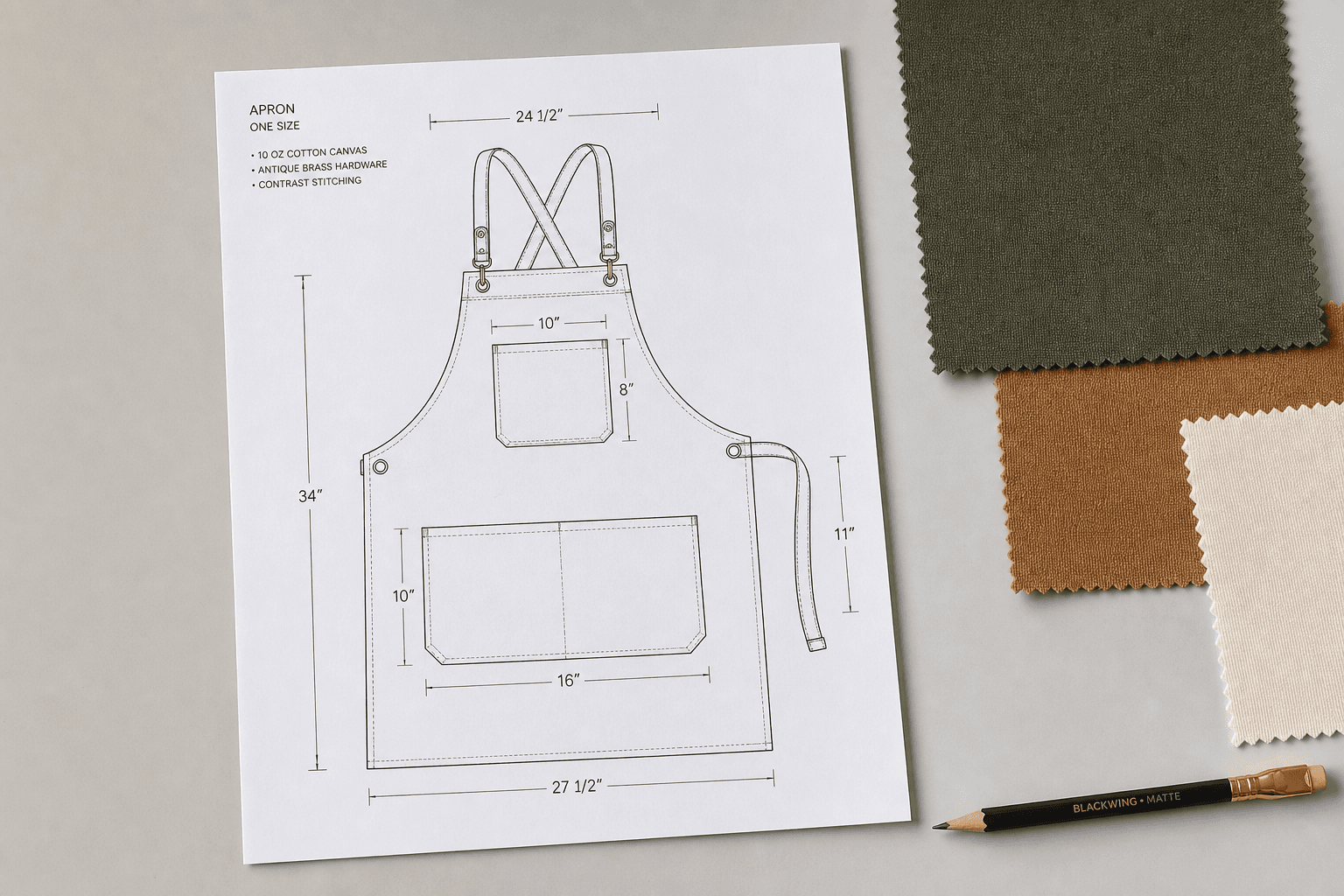
The second checkpoint is construction stability. Aprons have long visual lines, so even small deviations are easy to see. Buyers should measure bib width, bib length, total body length, pocket opening width, pocket depth, tie length, neck adjustment range, and symmetry from left to right. A tolerance that looks acceptable on paper can still fail in use. If the neck strap adjuster range is too short, taller wearers will pull the bib too high; if pocket depth is reduced by 1 cm, tablets or service pads may no longer sit securely.
The third checkpoint is finishing and packing. Many apron complaints begin at opening, not after wearing. If ties are folded inconsistently, if the neck loop is trapped under the body panel, or if barcodes are applied over seam bulk, the apron can arrive wrinkled, difficult to scan, or poor in presentation. A pilot should reproduce the final fold template, insert card, polybag gauge, carton count, carton dimensions, and shipping marks so the buyer can assess the item exactly as a DC or store team will receive it.
A meaningful pilot also preserves the same sewing route and line balance planned for bulk. If the factory samples one garment slowly in a sample room but plans to mass-produce it on a different line with higher operator speed, the buyer may not see the puckering, skipped bartacks, or thread tension issues that appear at scale. The pilot should therefore come from the actual production line whenever possible, not from a separate sample team.
For national programs, the pilot should also mirror packaging sequence. If stores will receive 25 pcs/carton and each carton must carry a specific SKU barcode, shade sticker, and destination label, those exact details should appear in the pilot. A bulk order can absorb a minor packing typo only if the pilot catches it first. Otherwise, the buyer ends up paying twice: once to produce the aprons and again to rework the cartons.
- Match the final fabric specification, such as 210 GSM poly-cotton twill, 240 GSM cotton canvas, or 12 oz denim, rather than using sample-room substitutes.
- Use the same trims planned for bulk, including adjusters, rivets, labels, thread ticket, and tie material, because trim changes can alter cost, function, and appearance.
- Replicate the production decoration method, whether flat embroidery, screen print, or heat transfer, at the same location and scale used on the PO.
- Pack the pilot to the same SOP, including 1 pc/polybag, 25 pcs/carton, barcode label position, and carton marks, so logistics issues appear early.
Pilot run apron production: set measurable pass-fail standards before sewing starts
The strongest pilot programs are defined before cutting begins. Buyers and factories should agree on pass-fail criteria inside the tech pack, PPS notes, and PO comments so the pilot is judged on numbers, not on a general feeling that the apron 'looks fine.' Once a national rollout is involved, vague approval language creates avoidable conflict between sourcing, QA, operations, and the factory.
For aprons, core tolerances should cover both appearance and function. A common starting point is ±0.5 cm on major points such as body width and body length, ±0.3 cm on pocket placement, and ±0.5 cm on tie length per side if the ties are highly visible in wear. Shrinkage limits should be written by fabric type and wash method. For example, a 65/35 poly-cotton twill apron may be held to under 2% residual shrinkage after three washes at 40°C, while a 100% cotton canvas apron may allow up to 3% if the buyer accepts the hand-feel and fit result.
QC standards should be equally concrete. For pilot lots, many buyers use AQL 2.5 for major defects and 4.0 for minor defects, with zero tolerance for critical defects such as broken ties, sharp hardware edges, wrong size labels, or unreadable carton marks. If the apron has a front logo, the buyer should define acceptable embroidery thread coverage, registration, backing visibility, and position from the top edge or pocket seam. If the logo is screen printed, set an adhesion or rub test expectation and a color reference.
The process should also assign responsibility for any deviation. If shrinkage fails, the issue may sit with fabric finish or wash test method. If bib alignment drifts, the source may be pattern grading, marker planning, or cutting control. If a barcode cannot scan through the polybag, the problem belongs to packing or label stock, not sewing. Clear ownership keeps pilot corrections fast and prevents the bulk timeline from slipping because every department debates the same issue.
For a clean approval process, the buyer should use a written pilot scorecard. That scorecard should separate garment defects, packing defects, and distribution defects, because a program can pass one area and fail another. An apron that looks acceptable on the sewing table still fails if the carton count is wrong by two pieces per box or if the outer label cannot be scanned by the warehouse. Each defect class needs a binary decision and an owner for correction.
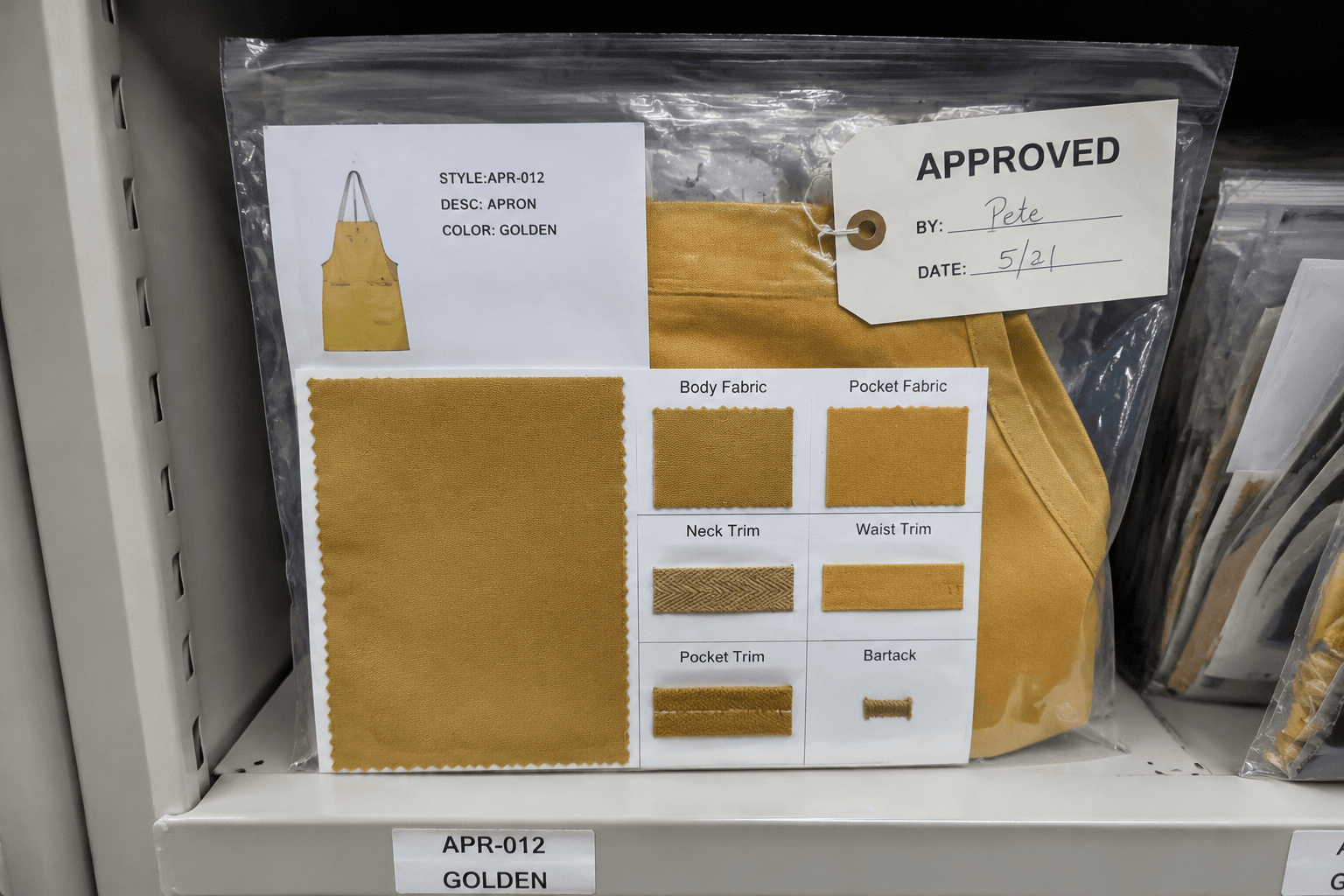
The ideal outcome is a pilot sign-off document that names the approved fabric code, color standard, trim list, pattern revision, thread color, logo file, wash process, pack method, and inspection level. If any of those items remain open, the order is not really approved. It is only partially de-risked, which is not enough for a national apron rollout.
- Write measurement tolerances into the apron spec, such as body length ±0.5 cm, pocket height ±0.3 cm, tie length ±0.5 cm.
- Set wash criteria by method, for example 3 wash cycles at 40°C, tumble low or line dry, shrinkage under 2-3% depending on fabric composition.
- Use formal QC thresholds, such as AQL 2.5 major, AQL 4.0 minor, 0 critical, so pilot acceptance is auditable.
- Define decoration standards, including logo position, stitch count, color match, and post-wash appearance, before pilot approval begins.
How many aprons to pilot, what it costs, and how many days to allow
Pilot volume should be large enough to expose production variation but small enough to limit financial exposure. For a simple waist apron with one pocket and stock twill, 60 to 100 pcs is often enough. For a bib apron with adjustable neck, contrast trims, multiple pockets, and embroidery, 120 to 250 pcs is more realistic. If the rollout includes multiple sizes or colorways, spread the pilot across the full assortment rather than concentrating all units into one SKU.
Costing should be discussed without pretending the pilot will match bulk pricing. Small runs carry higher cutting loss, setup time, and trim inefficiency. In current OEM sourcing, a straightforward 210 GSM poly-cotton waist apron might pilot at $3.80-$4.90/pc and then drop to $2.60-$3.40/pc at 3,000 pcs. A 240 GSM cotton canvas bib apron with metal hardware and embroidery might pilot at $6.20-$8.20/pc and then move to $4.20-$5.70/pc at 2,000-5,000 pcs. These ranges vary by trim, packing, and inspection requirement, but they are realistic enough for budgeting.
Lead time needs the same level of discipline. If fabric is greige or stock-dyed and trims are available, pilot production can often be completed in 12-18 days after PPS approval. If the buyer needs custom Pantone dyeing, branded woven labels, or special hardware plating, the schedule may move to 18-25 days. Bulk apron production usually follows in 25-40 days after final pilot sign-off, depending on order volume, line allocation, and material readiness. Buyers should also allow separate days for in-house inspection, third-party QC if required, and consolidation before shipment.
A useful budgeting rule is to compare the pilot premium against the cost of a single corrective event. If a 200-piece pilot costs an extra $500 to $800 versus theoretical bulk pricing, but it prevents a 5,000-piece rework or a two-week launch delay, the pilot pays for itself many times over. In most national apron programs, the cost of certainty is lower than the cost of correction.
Lead-time planning should also account for decision lag. A factory may finish the pilot in 15 days, but the buyer still needs 2-4 days for internal review, photos, wash-test checks, and sign-off. If a correction is required, add another 5-10 days for revision and resubmission. That is why a buyer should never schedule the pilot to end one day before shipment of the bulk order. The approval window needs breathing room.
If the national rollout depends on phased store openings, the pilot should be scheduled early enough to support the earliest wave and late enough to reflect the final fabric and trim commitments. That balance is what keeps a pilot from becoming a disconnected formality.
- Typical pilot MOQ: 60-250 pcs per style, depending on complexity and size spread.
- Typical pilot price: $3.80-$8.20/pc across common waist and bib apron constructions.
- Typical pilot lead time: 12-25 days after PPS and material confirmation.
- Typical bulk lead time: 25-40 days ex-factory, excluding booking, customs clearance, and final-mile distribution.
What to test during pilot-run apron production before national distribution
A pilot should test the apron in the same environment where it will be worn and handled. For hospitality aprons, that usually means wash testing for oil stains, sauce marks, bleach sensitivity, and repeated tie handling over several shifts. For retail or branded merchandise aprons, the focus may shift to presentation, print durability, and how the apron hangs on different body types during customer-facing wear. For utility or workshop aprons, pocket load and seam stress become more important than showroom appearance alone.
Fabric-specific testing matters. A 12 oz denim apron may hold shape well but can crock if indigo fixation is weak. A 240 GSM cotton canvas apron may feel substantial but lose 2.5-3.0% length after wash if preshrink control is limited. A 65/35 poly-cotton twill apron at 210 GSM may wash more cleanly but can show pilling or heat-press shine if process settings are off. The pilot is the stage where buyers compare these trade-offs against the actual end use instead of relying on sample-room assumptions.
Logistics testing should be part of the same exercise. Cartons should be checked for count accuracy, barcode readability, outer-box dimensions, gross weight, and compression condition after stacking. If the national rollout depends on DC scanning, a perfect apron with poor label placement is still a failed program. Likewise, if the apron will be sold through retail channels, folded dimensions, insert cards, and peg-ready or shelf-ready presentation should be reviewed from the packed pilot, not from a single hand-folded sample.
Finally, pilot review should include line repeatability. One good apron does not prove production control. Buyers should inspect units pulled from different times in the pilot lot to see whether top-stitching, logo placement, bartack quality, and strap symmetry remain stable across the run. Repeatability is what protects the national rollout.
If the apron will be issued to foodservice teams, the pilot should also assess stain release after real use. That means checking whether tomato-based sauces, fryer oil, and coffee marks release in the approved wash routine without excessive color loss. If the apron is branded merchandise, the same pilot should confirm that repeated folding, hanging, and shelf handling do not crush the logo or leave permanent fold lines in the front panel.
The goal is to test the apron as a working unit, not as a photograph. A strong pilot gives the buyer data on comfort, laundry life, visual consistency, and warehouse readiness at the same time. That combination is what turns a sample into a launch-ready product.
- Run wash checks at 3, 5, and 10 cycles when the apron will face repeated commercial laundering or heavy home laundering.
- Test pocket load using realistic items, such as order pads, tablets, bar tools, or hand tools, to see whether pocket seams distort or sag.
- Inspect packed cartons for count accuracy, scan rate, carton strength, and shipping-mark legibility before approving mass packing.
- Sample units from start, middle, and end of the pilot lot to confirm sewing and decoration consistency across the run.
How to approve, correct, or reject a pilot apron lot
A pilot should end with a documented decision: approve for bulk, approve with corrective action, or reject and remake. Anything less precise invites problems once the larger PO is placed. If fit is acceptable but embroidery edges lift after wash, the apron is not fully approved. If the sewing quality passes but the carton barcode is wrong for the buyer’s WMS, the pilot is not ready for national distribution. Approval must cover the full apron program, not just the garment on a hanger.
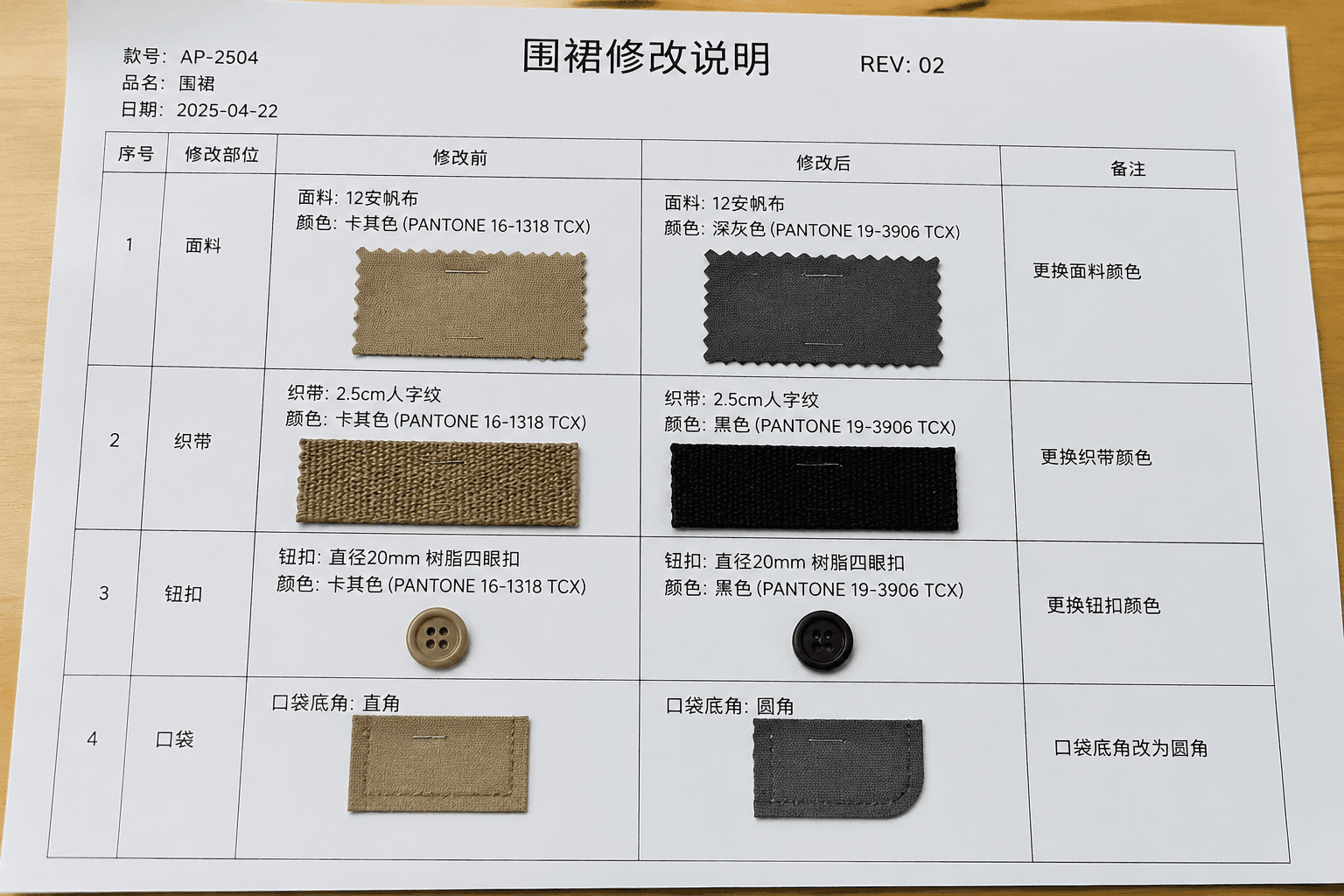
Most pilot failures are small but expensive at scale. Common examples include tie length variation of 10-15 mm, pocket opening width reduced by seam creep, logo placement drifting 5 mm lower than approved, or a trim substitution made because the original adjuster was unavailable. None of these may look catastrophic on a single unit. On 10,000 aprons, each becomes a repeatable defect, an operations complaint, or a brand inconsistency visible across stores.
When the pilot passes, the next step is to freeze every production reference. The buyer and factory should lock the fabric code, GSM or oz weight, approved shade, pattern revision, sewing construction, thread color, trim list, artwork file, fold method, carton pack-out, and inspection standard. A sealed pilot sample retained by both parties is useful for bulk comparison and future reorder consistency.
If the pilot does not pass, the correction should be targeted. Adjust the pattern if fit failed. Change wash finish if shrinkage exceeded spec. Reprogram embroidery if logo stability failed. Revise the fold SOP if presentation failed. The pilot is valuable precisely because it reveals where the fix belongs before the order becomes too large to correct efficiently.
The best closeout document is short but complete. It should state what was tested, which defects were found, which were accepted, which were corrected, and which remain open. That record protects both the buyer and the factory when bulk questions arise later, especially if the next order comes six months after the pilot and a different merchandiser has inherited the program.
For a national rollout, rejection is not a failure of the sourcing process. It is a success of risk control. A pilot that blocks a bad bulk order saves freight, protects launch dates, and prevents avoidable store-level complaints. In apron sourcing, that is the right outcome.
If the factory proposes a re-pilot after corrections, the buyer should insist on testing only the changed variables plus any affected adjacent process. That keeps the timeline efficient while still verifying that the fix truly works. Over-testing can be wasteful, but under-testing leaves the same risk in place.
Once approval is granted, the buyer should circulate the frozen reference to sourcing, QA, logistics, and the distribution team. A pilot that stays inside one inbox does not protect a rollout. A pilot that becomes the shared reference does.
- Approve only when the apron meets agreed standards for fit, wash result, decoration, packing, and QC level.
- Issue corrective action when the failure is isolated and fixable within 7-10 days without changing the approved commercial target.
- Reject and remake when defects affect function, brand appearance, or distribution readiness across the lot.
- Retain one approved pilot sample and one sealed packing sample as the bulk production reference.