For professional apron buyers, fabric is usually the largest hidden risk in cost, timing and claim handling. A 15 to 20 GSM shift on a 260 GSM twill, a usable-width drop from 150 cm to 147 cm, or residual shrinkage of 3.2 percent instead of an agreed 2.0 percent can change marker yield, panel balance and sewing output across the whole order. Those issues matter more in aprons than in many small accessories because the front body is large, highly visible and expected to stay straight after wash and daily wear.
That is why the choice between a nominated fabric mill for aprons and factory-managed sourcing should be made with operating data, not preference. Buyers need to compare fabric MOQ by color, meter consumption by style, lab-dip cycle days, weaving and dyeing days, incoming inspection rules, garment AQL, target FOB and who accepts remake liability if the cloth fails after cutting.
A nominated mill can be the right tool for a controlled 8 oz canvas, 240 to 300 GSM twill or 10 to 12 oz denim program that must stay consistent across replenishment orders or multiple production sites. Factory sourcing is usually safer for hospitality launches, café chains, promotions and lower-volume replenishment where shorter lead time, lower MOQ and single-party accountability matter more than direct control of the cloth source.
- Nominate the mill only when the apron fabric is a controlled commercial asset, usually in repeat programs with annual volume high enough to support 1,000 to 3,000 meters per color.
- Use factory sourcing when delivery certainty and claim ownership are the priority, especially for orders below about 2,000 aprons per color or projects shipping in 30 to 45 days.
- The real comparison is apron-level economics: fabric saving per piece, extra calendar days, surcharge risk by color and who pays if bulk fabric causes a remake.
- For most standard apron fabrics, the cost gap is often only $0.10 to $0.35 per piece, while one failed dip round or one fabric dispute can add 7 to 15 days and far more cost than the initial saving.
- Approval discipline matters more than source ownership. Bulk fabric should not be released to cutting until width, GSM, shade, shrinkage and sewn-sample performance have been signed off.
- If buyer nomination is used, write liability, testing, inspection and airfreight responsibility into the order before fabric is booked.
How a nominated fabric mill for aprons changes control and risk
When a buyer appoints a nominated fabric mill for aprons, the apron factory still owns patterning, markers, cutting, sewing, finishing and packing, but it no longer controls the upstream cloth source. That shifts risk from one integrated supplier relationship to a three-party structure involving buyer, mill and factory. The added control can be useful, but only if approvals, testing and liability are defined before bulk fabric moves.
In apron production, that shift is significant because the fabric affects both appearance and workability. A 65/35 poly-cotton bib apron in 210 GSM twill, a 280 GSM cotton canvas server apron and an 11 oz denim cross-back apron all react differently in spreading, cutting and sewing. If usable width falls by 3 cm, consumption can rise by about 2.5 to 4.5 percent depending on pattern efficiency. If residual shrinkage exceeds tolerance, pocket placement, finished length and side alignment can miss spec even when the sewing is otherwise correct.
The commercial upside of nomination is direct control over shade continuity, handfeel, certification and repeatability. The operational downside is lower flexibility when the nominated cloth is late, off-shade or unstable in sewing. Buyers should treat nomination as a risk-allocation model, not as a default sign of tighter sourcing discipline.
- Buyer controls the selected mill, fabric standard and any linked certification route.
- Factory loses the ability to switch quickly to an equivalent approved cloth if bulk fabric fails.
- Approval steps usually expand to lab dips, fabric testing, sewn sample review and two-stage incoming inspection.
- Claim responsibility becomes harder to settle when garment defects trace back to fabric behavior after cutting.
When a nominated fabric mill for aprons is commercially justified
Nomination makes sense when the apron fabric itself is a fixed asset in the buyer's supply chain. That usually means repeat business built around one approved fabric quality that must stay consistent over time, such as 8 oz cotton canvas for retail merchandising aprons, 280 to 300 GSM cotton twill for hospitality uniforms, or 10.5 to 12 oz denim for branded workwear collections. In those cases, the buyer is protecting continuity, not simply looking for a lower meter rate.
Volume is the first hard filter. A nominated mill is usually workable when annual demand reaches about 12,000 to 60,000 aprons using the same base cloth across two to four repeat shades. At that level, color lots of 1,500 to 3,000 meters become commercially reasonable, and the buyer can justify reserving greige, locking a finish and carrying approved standards from season to season. Below that level, custom color MOQ, surcharge and leftover inventory often erase the theoretical benefit.
The second filter is technical capability. If the buyer has a sourcing or quality team that can review yarn count, construction, weight tolerance, shrinkage, skew, seam behavior and shade variation, nomination can work well. Without that capability, the buyer often nominates a mill in name only and still relies on the apron factory to solve fabric problems once the cloth reaches the cutting floor. That is weak control with added delay.
- Annual apron demand can absorb at least 1,000 to 3,000 meters per color without excessive leftover stock.
- The same cloth must stay consistent across repeat orders, several apron styles or more than one manufacturing site.
- A buyer-specific traceability or compliance requirement is tied to one approved mill or one exact fabric construction.
- The buyer can manage lab dips, bulk approvals, claims and corrective action directly with the mill.
When factory sourcing is safer for apron MOQ, lead time and accountability
Factory sourcing is safer for many apron programs because it keeps commercial responsibility with one supplier and matches fabric selection to the factory's existing production methods. Most established apron factories already run approved mills for standard 200 to 220 GSM poly-cotton twill, 240 to 300 GSM cotton canvas and 8 to 12 oz denim. Those fabrics have known cutting yields, sewing settings and decoration compatibility, which reduces trial-and-error during production.
The time difference is usually material. With a factory-managed source holding recurring greige or standard shades, buyers can often complete fabric confirmation in 2 to 3 days, approve lab dips in 4 to 6 days and receive bulk cloth at the apron factory in about 18 to 25 days after dip approval. Under a buyer-nominated structure, the alignment stage alone can consume 4 to 8 days, especially if spec details, test methods or finish expectations are not already standardized. Add 20 to 30 days for weaving and dyeing, 2 to 4 days for inspection and 3 to 7 days for transfer, and total fabric timing frequently reaches 32 to 48 days from spec lock.
Factory sourcing also simplifies claims. If the aprons skew after wash, prints fail to bond, pockets pucker or strap areas distort because the cloth was outside usable tolerance, the buyer can hold one party responsible for root-cause analysis, remake and freight. In a nominated structure, the factory may reject liability by pointing to unstable cloth, while the mill may argue that sewing tension, curing temperature or post-sew finishing caused the defect. That split is expensive in calendar days and leverage.
- Factory-managed fabric usually cuts 7 to 12 days from the total apron sourcing calendar.
- One-party ownership reduces disputes over debit notes, remake cost and urgent freight charges.
- Orders under roughly 2,000 pieces per color are often too fragmented to justify mill nomination.
- For launch-sensitive apron orders, an on-time ship date is normally worth more than a fabric saving of $0.15 to $0.25 per piece.
The cost, MOQ and day-count math buyers should run first
The correct comparison is cost per finished apron, not fabric price per meter alone. A basic adult bib apron typically uses about 0.85 to 1.00 meters at 150 cm width, depending on pocket layout and hem allowance. A waist apron may use 0.45 to 0.65 meters, while a cross-back canvas or denim apron often uses 1.10 to 1.30 meters. On these styles, the practical mill-to-mill saving is often modest: about $0.12 to $0.28 per piece for standard twill or canvas and roughly $0.25 to $0.40 per piece for garment-washed denim. One failed dip round, one airfreight carton or one remake claim can eliminate that saving immediately.
MOQ discipline matters even more than nominal price. Custom-dyed twill or canvas commonly requires 1,000 to 3,000 meters per color, though some mills accept 600 to 800 meters with surcharge. Consider a 1,800-piece bib apron order using about 1,620 to 1,760 meters total. If the order is split across three shades, each color may fall below efficient lot size. The result is either a small-lot surcharge of around $0.08 to $0.20 per apron, a wait for lot consolidation, or excess inventory that sits in the buyer's stock room.
Lead time should be counted from specification lock to fabric receipt at the apron factory. A realistic schedule is 2 to 4 days for greige or yarn confirmation, 4 to 7 days for lab dips, 1 to 3 days for buyer comments, 20 to 30 days for weaving and dyeing, 2 to 4 days for mill inspection and packing, and 3 to 7 days for inland transfer. That is why custom fabric for aprons regularly lands in the 32 to 48 day range even before cutting starts. Buyers who compare only the quoted dyeing days are understating the real calendar.
- Bib aprons usually consume about 0.85 to 1.00 meters; waist aprons 0.45 to 0.65 meters; cross-back aprons 1.10 to 1.30 meters.
- Typical nominated-fabric timing is 32 to 48 days from spec lock to factory receipt, versus about 24 to 35 days under a responsive factory-managed source.
- Small-lot color surcharges often add $0.08 to $0.20 per apron when shade demand is fragmented.
- A quoted saving below $0.20 per apron rarely justifies an extra 7 to 14 days unless continuity requirements are strict.
Common failure points in buyer-nominated apron fabric programs
Most nominated-fabric problems appear at the handoff points, not in the initial quotation. The specification may look correct on paper, but the apron still fails because the cloth was approved as a hanger or swatch instead of as a sewn garment. A lab dip that seems acceptable under office light can shift visibly across a full bib panel beside black webbing, natural herringbone tape or a contrast printed logo. By the time that difference appears, each party has usually completed its own step and responsibility becomes blurred.
Aprons are exposed to several fabric-related risks that buyers sometimes underestimate. Large front panels make bow and skew easy to see. Patch pockets reveal shrinkage mismatch quickly. Dark navy, black and bottle green can crock onto pale webbing or ecru bartack thread. Water-repellent finishes may increase needle heat and skipped stitches at strap joins. Washed denim can show seam grin, panel mismatch or uneven abrasion if density and sewing tension were not validated together before bulk cutting. None of these are unusual edge cases; they are routine production risks in apron manufacturing.
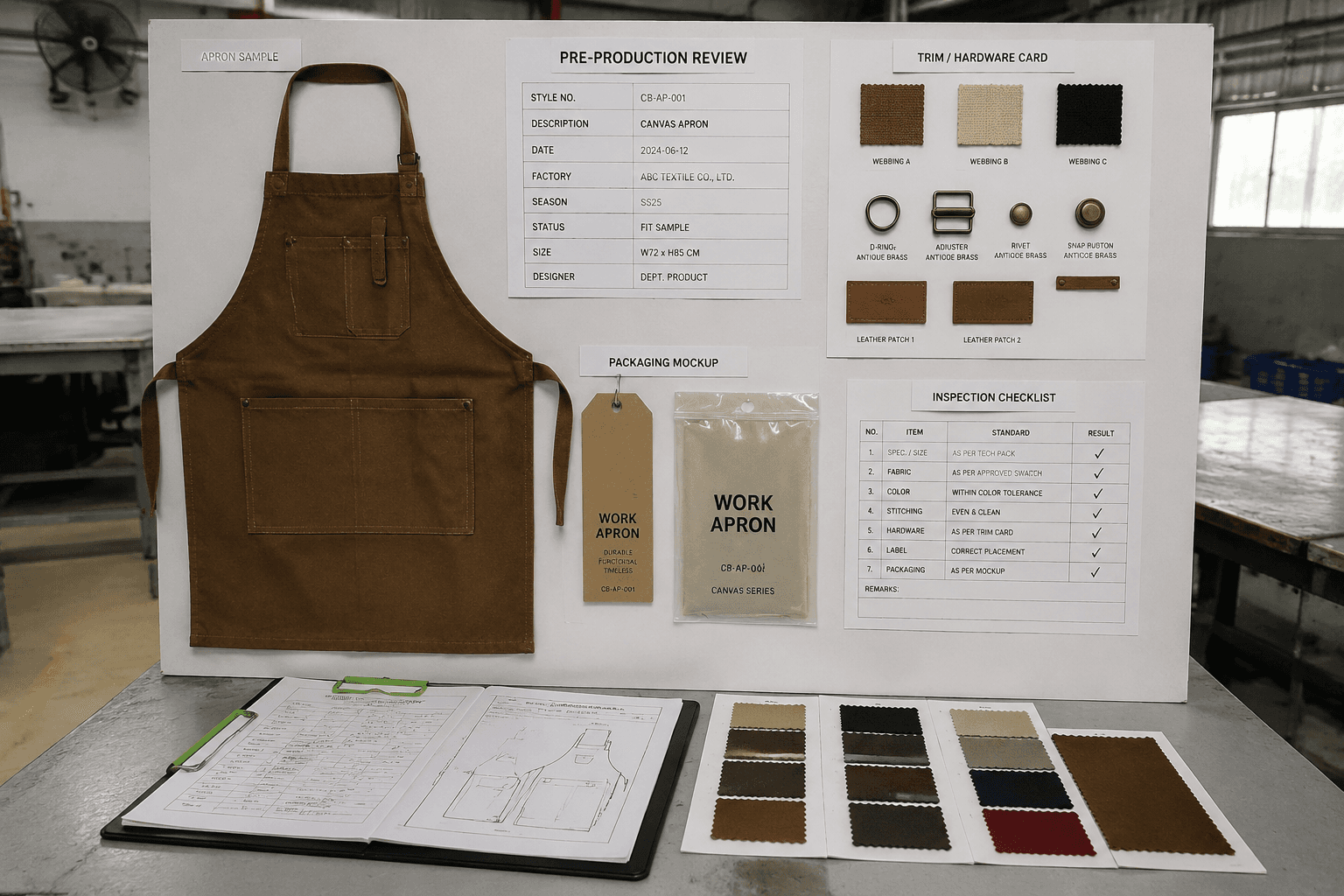
The best control point is a sewn pre-production apron made from actual bulk fabric or the closest production-equivalent lot. That sample should include the intended webbing, thread, pocket construction, branding method and wash route. Spending 3 to 5 extra days on that stage is usually cheaper than losing 15 to 20 days after cutting because a fabric issue surfaced too late.
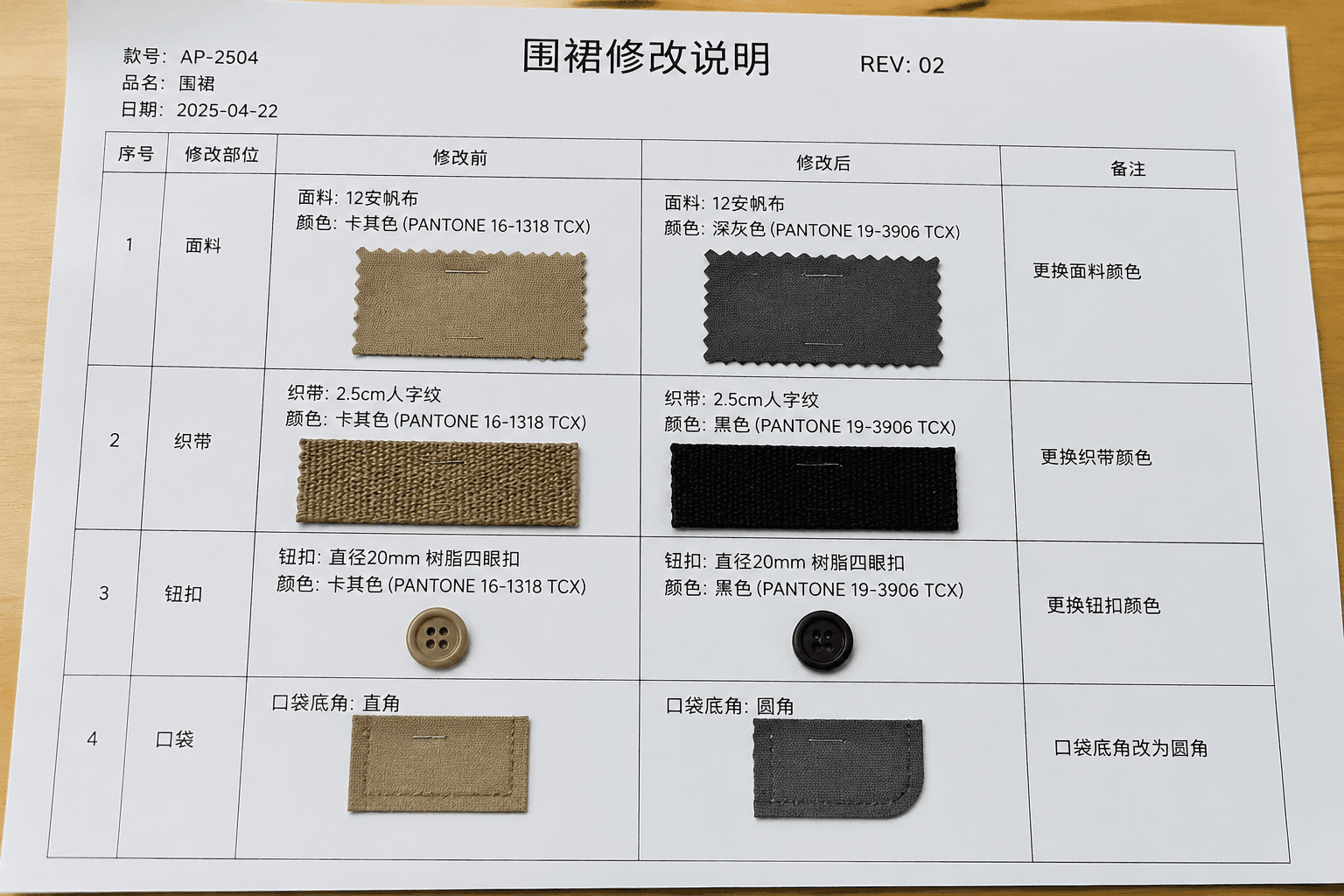
- Check shade under the agreed light source against body fabric, thread, webbing, labels and print colors together.
- Confirm shrinkage, skew and usable width before marker planning and pocket placement are frozen.
- Inspect bulk fabric for coating consistency, seam behavior and surface defects before cutting release.
- Approve one sewn pre-production apron from real production cloth whenever timing allows.
How to approve nominated apron fabric without opening claim gaps
If a buyer decides to use a nominated fabric mill for aprons, the process needs a written responsibility matrix before the fabric purchase order is issued. That matrix should state who approves lab dips, who signs off handfeel, who arranges testing, who accepts or rejects incoming fabric, who pays for replacement cloth and who covers airfreight if a delay threatens the ex-factory date. Without those answers in writing, the nominated model usually breaks down on the first exception.
The approval flow should also be sequential and time-bound. First, lock composition, construction, usable width, target GSM with tolerance, finish, shade standard and test method. Second, require lab-dip comments within 48 hours. Third, complete a sewn pre-production apron and issue comments within 72 hours. Fourth, release bulk only after sample approval. Fifth, inspect fabric at the mill and again when it reaches the apron factory. A common structure is a 4-point fabric inspection system plus garment AQL 2.5 for major defects and AQL 4.0 for minor defects, but the acceptable standard must be written into the PO and quality manual.
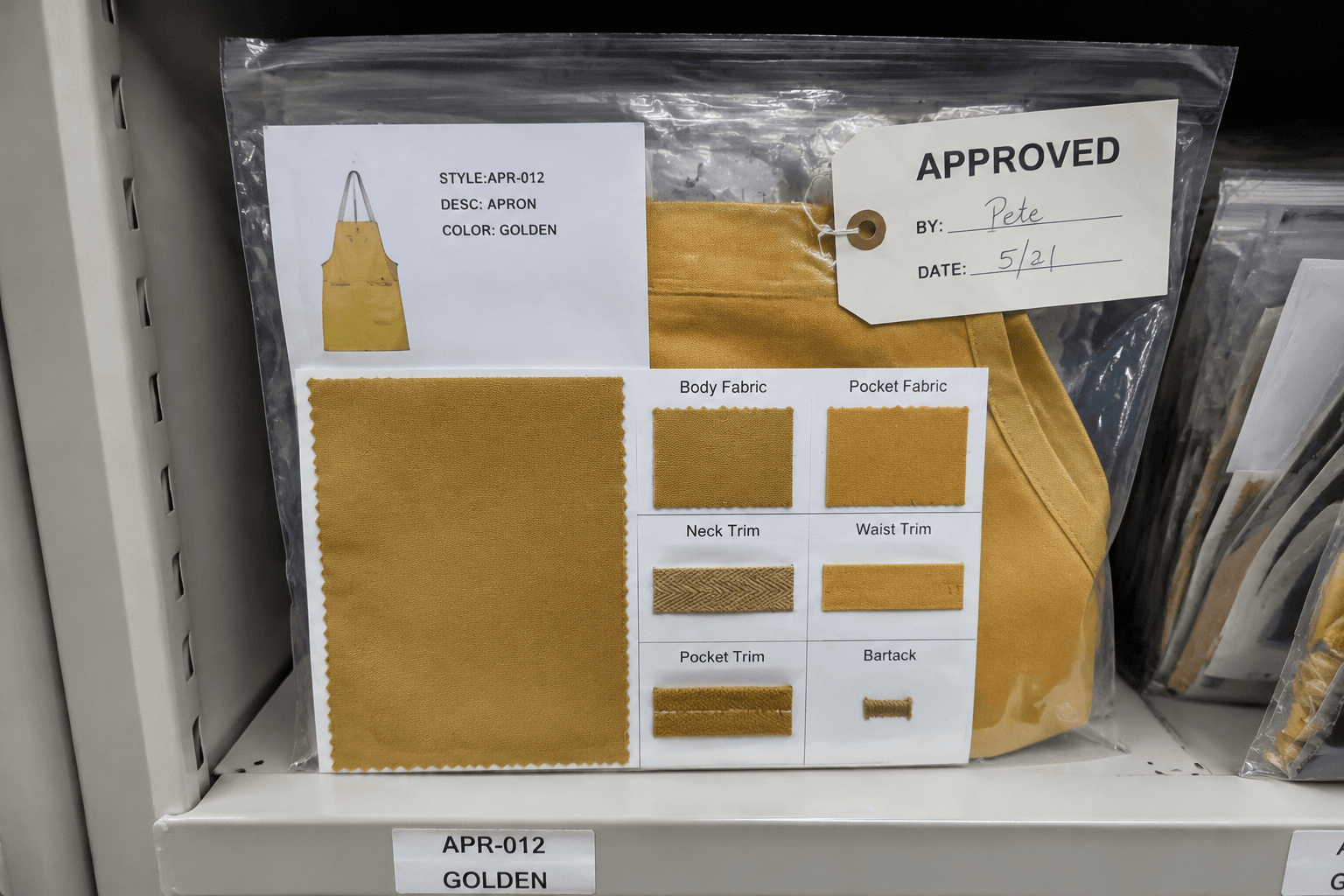
Repeat orders should be archived in production language, not just merchandising language. Keep one sealed hanger by color, one approved test report, one signed pre-production apron sample and one material card showing mill name, mill code, width, GSM, finish and approval date. When a reorder comes 6 to 12 months later, that record is what allows the team to judge whether the new lot is genuinely within tolerance rather than just visually close.
- Write measurable limits for GSM, usable width, shade variation, skew and residual shrinkage before booking bulk fabric.
- Set response windows such as 48 hours for lab dips and 72 hours for sewn-sample comments.
- Require both mill final inspection and factory incoming inspection before cutting is released.
- Archive approved apron fabric standards by color and supplier code to support stable replenishment.
A practical sourcing rule for professional apron buyers
The most reliable rule is simple: use a nominated fabric mill for aprons when fabric continuity is worth more than speed, and use factory sourcing when shipment certainty and single-party accountability matter more than direct mill control. The decision is rarely ideological. It depends on annual units per color, color fragmentation, fabric complexity, target FOB and the buyer's ability to manage one more approval interface without slowing the order.
A small launch order shows why. A 700-piece café bib apron project with an FOB target of $3.90 to $4.80 per piece is usually a poor candidate for nomination. The volume is too low to support custom color efficiently, and one failed dip round can affect the store opening date. By contrast, a 30,000-piece annual hospitality program using one 280 GSM canvas in three repeat shades may justify nomination because consistency across multiple deliveries is commercially more valuable than saving 7 to 10 days in sourcing.
Before choosing the model, buyers should force three numbers onto one worksheet: expected fabric saving per apron, added calendar days and who pays if fabric failure causes a remake. If the saving is small, the added days are high and liability is split, factory sourcing is usually safer. If the nominated mill is already proven, the annual volume supports the color MOQ and the buyer can enforce approvals directly, nomination can work well for long-running apron programs.
- Use nomination for stable, high-volume apron programs with repeat colors and locked fabric standards.
- Use factory sourcing for short lead-time, lower-volume or launch-sensitive apron orders.
- Evaluate the model by on-time shipment, finished-apron performance and clear claim ownership, not meter price alone.
- Do not separate fabric control from remake liability unless replacement terms and freight responsibility are written clearly.