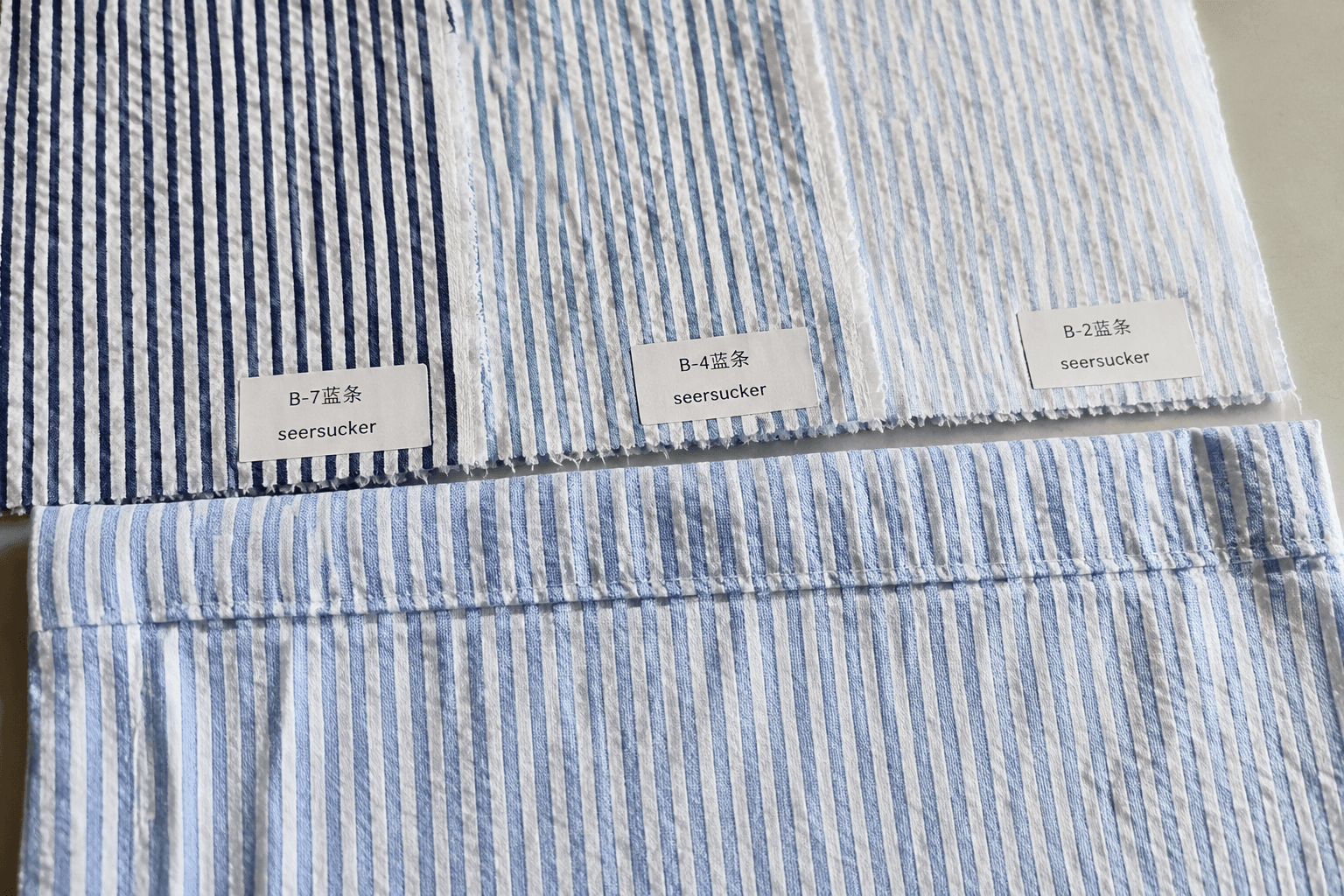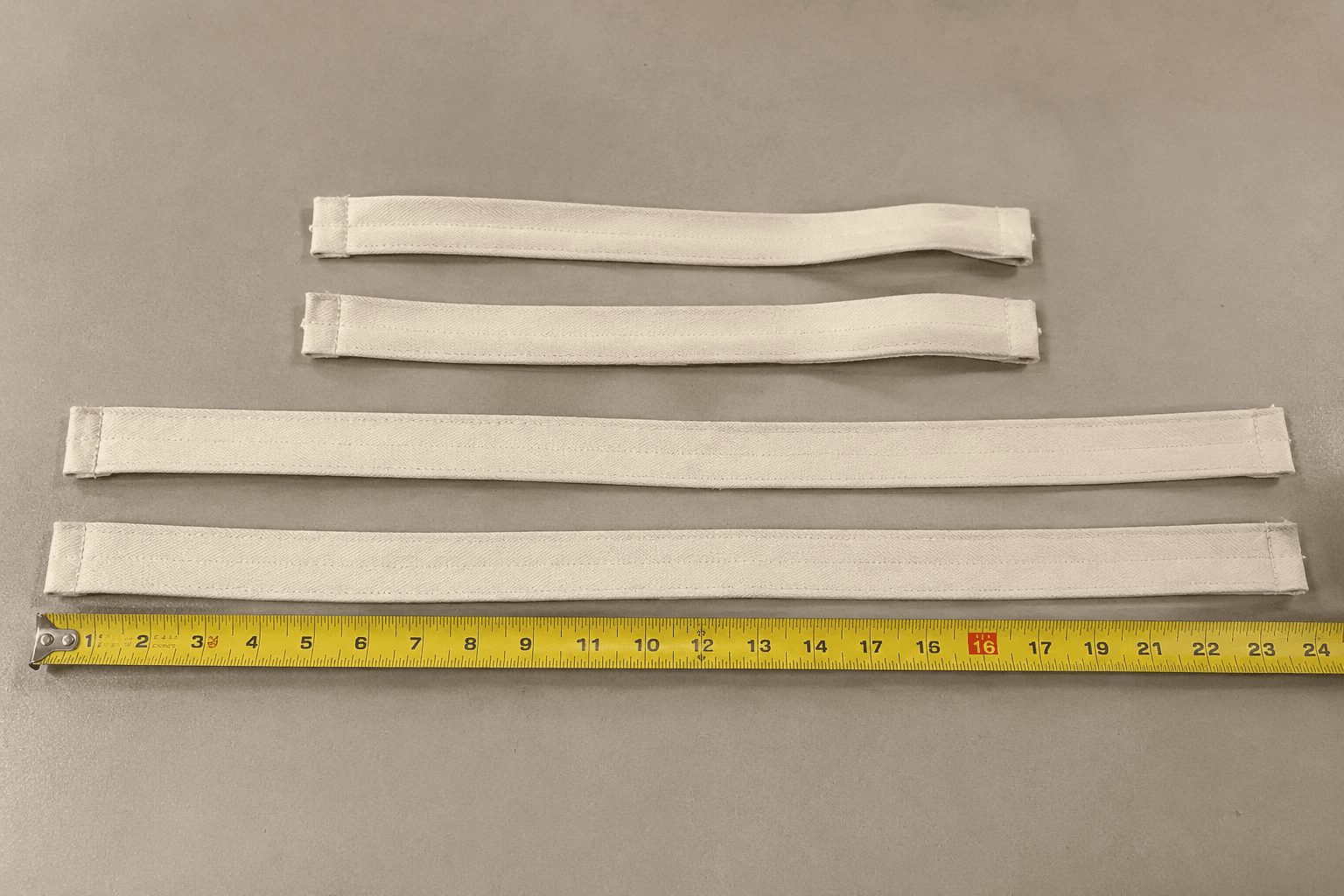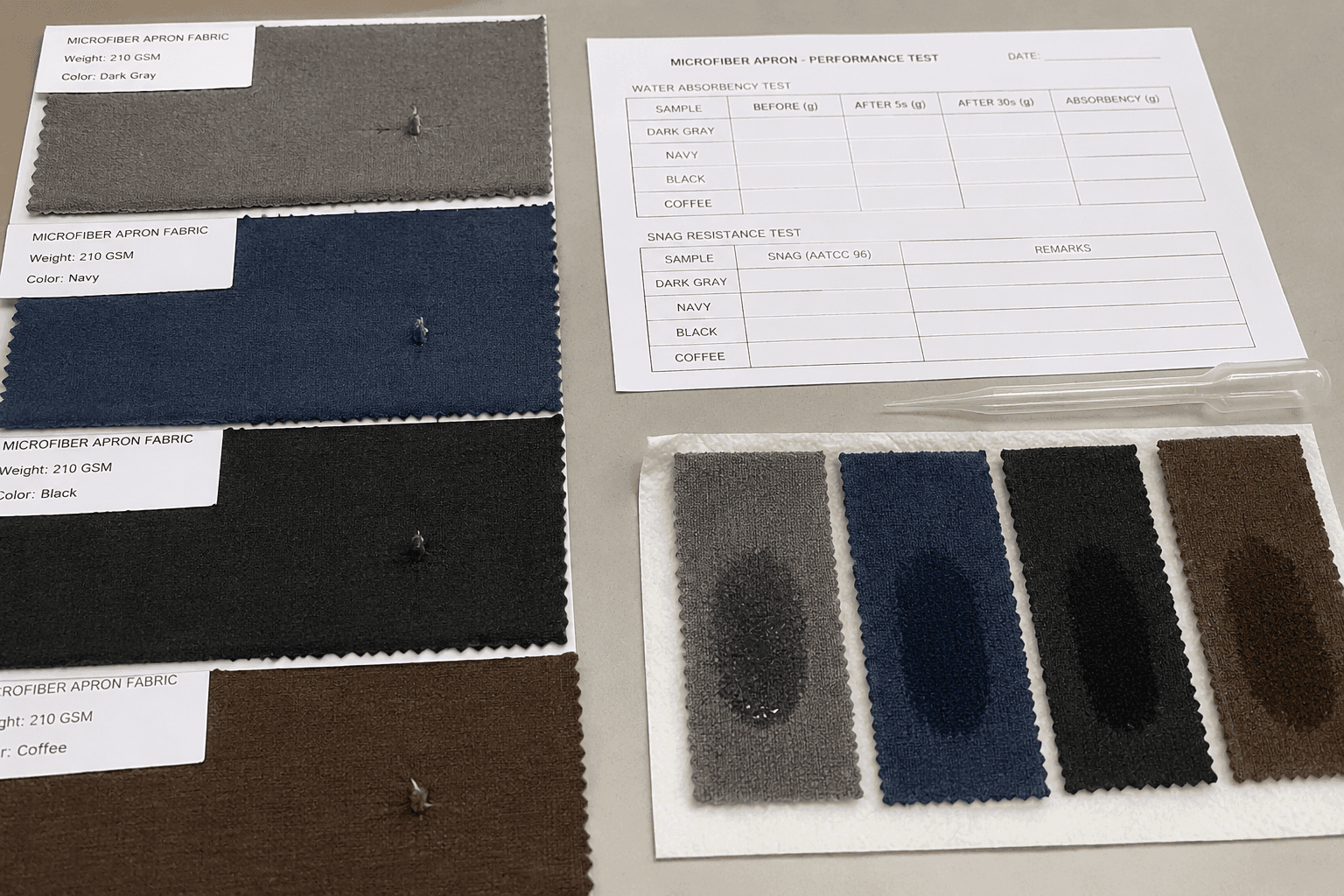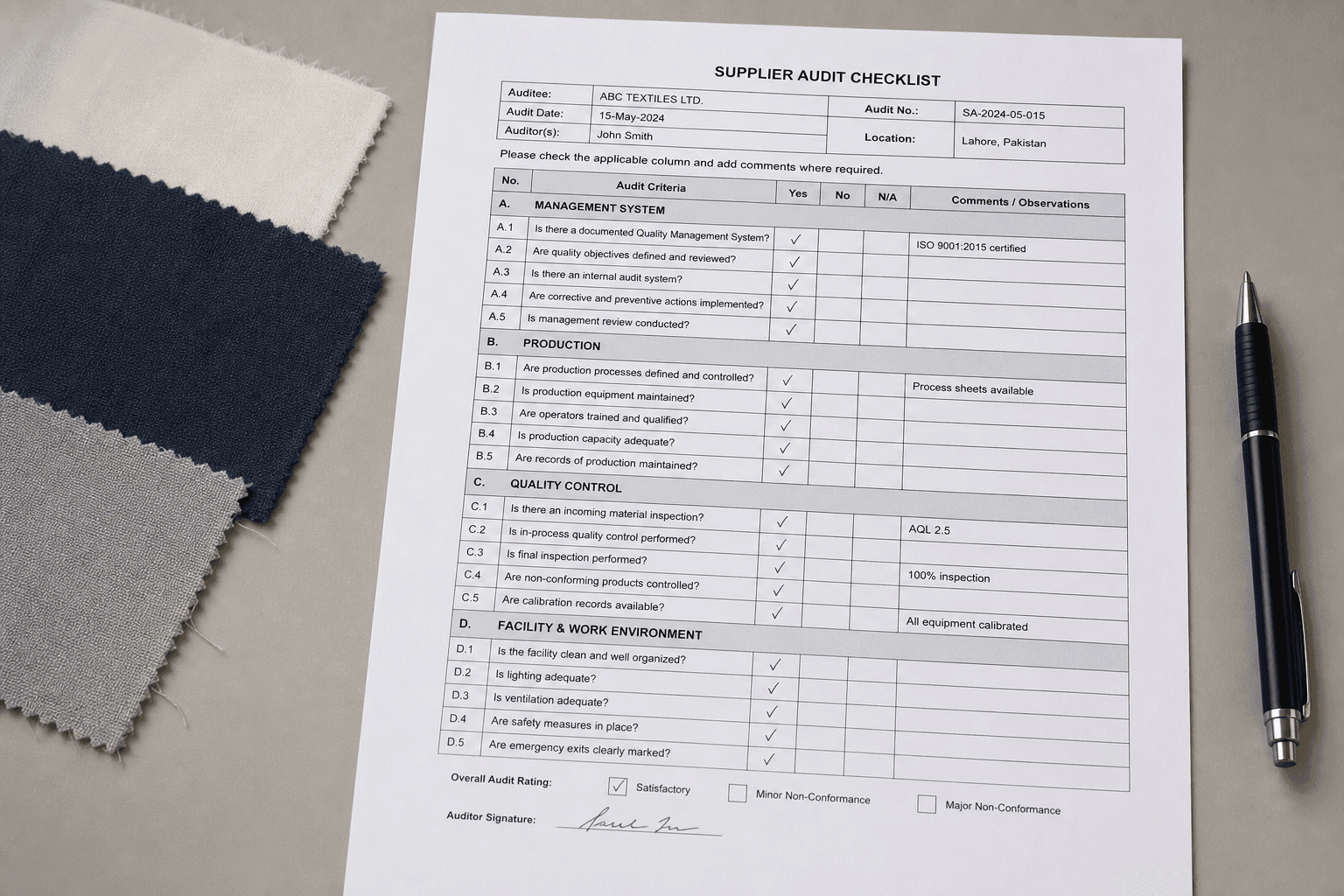
For professional apron buyers, natural color apron fabric is a technical specification before it is a visual concept. Unbleached or lightly processed cotton keeps more of the fiber's original tone, so shade drift, seed specks, yarn slubs and lot-to-lot variation remain visible in a way they do not on bleached or dyed cloth. On aprons, those issues are exposed because the product relies on large front panels, patch pockets and long straps with few seams to break up the surface.
That visibility is manageable only when the approval standard is written in production terms. A factory needs an agreed fabric weight such as 260 GSM or 7.7 oz canvas, a signed shade range rather than a single swatch, a written speck tolerance by size and placement, and a rule on whether body, pocket and strap pieces must come from the same lot. If those points are missing, disagreement usually starts after sewing, when rework is slower, wastage is higher and liability is harder to assign fairly.
For sourcing teams buying custom aprons from China or other Asian supply bases, the practical task is to convert an aesthetic idea into operating limits: acceptable shade band, clean logo zone, speck density, wash result, roll segregation, inspection method and repeat-order tolerance. When those items are defined before fabric booking, claims fall, lead times stay credible and natural color apron fabric becomes a repeatable apron category instead of a subjective one.
- Approve natural color apron fabric with a shade range and a finished-apron reference, not one small cut swatch
- Write seed-speck tolerance into the PO by size, quantity and placement, especially for bib fronts, pockets and chest logo areas
- For premium aprons, require body and pocket panels from the same roll batch or the same approved shade family
- Expect different commercial conditions: stock ecru apron programs can ship in 25-35 days, while custom natural-fabric programs usually need 45-60 days
- Use incoming roll grading, first-lot review and final AQL 2.5 major / 4.0 minor inspection to prevent avoidable claims
What buyers are actually purchasing when they specify natural color apron fabric
In apron sourcing, natural-color fabric usually means cotton canvas, cotton twill or a cotton-linen blend supplied in ecru, undyed, lightly scoured or minimally finished form rather than bleached white or piece-dyed cloth. For professional aprons, the commercial weight range is usually 210-340 GSM, or about 6.2-10.0 oz. Most hospitality and retail bib aprons sit in the middle at 260-300 GSM or 7.7-8.9 oz, because that weight gives enough body for pockets and embroidery without feeling as stiff as heavy tool aprons.
The important sourcing point is that the base shade comes from the fiber mix and finishing route, not from strong bleaching or dye correction. One lot may read pale cream, another warm oatmeal, another light flax. All three may be commercially normal. Problems start when a buyer expects the visual consistency of reactive-dyed twill from an undyed base. Aprons make that mismatch obvious because the front panel is broad and uninterrupted. A pocket cut from a darker roll can read wrong at a glance even if the cloth looked close on the inspection table.
This is why experienced buyers treat natural color apron fabric as a separate approval category. The question is not whether undyed cloth is suitable for aprons; it is. The real question is whether the buyer has converted visual preference into measurable operating rules that a mill, cutting room and QC team can apply the same way every day.
- Common undyed apron fabric range: 210-340 GSM or 6.2-10.0 oz
- Commercial sweet spot for bib aprons: 260-300 GSM
- Typical stock-fabric MOQ for basic aprons: 500-1,000 pcs per colorway/style
- Custom weaving usually starts around 2,000-3,000 meters; special blends may require 5,000 meters
How to approve shade bands for natural color apron fabric before bulk cutting
The weakest approval method is one signed swatch treated as an exact color target. That works poorly for undyed apron cloth because mills cannot force every lot back to one absolute point without adding bleaching or color correction that changes the original concept. A stronger method is a shade band: either 3-5 submitted swatches or one larger hanger showing the lightest acceptable point, the preferred middle and the darkest acceptable point. That gives the apron factory a usable decision range instead of an argument.
For production, the buyer also needs to define where variation matters. Many programs accept carton-to-carton movement as long as each individual apron is internally consistent. More demanding programs allow slight strap-to-body variation but reject visible pocket-to-body mismatch at 1 meter under D65 light. Those rules have a direct cost. On an order of 3,000 bib aprons, roll segregation, shade sorting and one-lot bundling typically add 2-4 working days and around $0.08-$0.22 per piece, depending on pocket count, strap construction and whether printing or embroidery is included.
Repeat orders need their own language. Even when the pattern, mill and sewing factory stay constant, a new cotton crop or weaving batch can move the base shade. Buyers who need continuity should keep a signed bulk swatch from the approved shipment and compare the next lot side by side with the new submission. The wording should still stay range-based. A PO phrase such as 'must match previous shipment exactly' is commercially weak for natural fabric because the material itself does not support laboratory-level shade repeatability.
- Approve with 3-5 shade swatches or one hanger with light, mid and dark limits
- State viewing conditions: D65 light, face side up, visual check at 1 meter
- Define the garment rule, for example no visible pocket-to-body mismatch above grey scale 4
- If cartons must stay lot-separated, print that requirement on the PO and packing marks
Seed specks, slubs and clean-face rules on undyed apron fabrics
Seed specks are one of the main causes of preventable claims on undyed apron orders. In unbleached cotton canvas, small tan, brown or dark specks are often normal remnants from the raw fiber because the fabric has not gone through full bleaching. They are not defects by default. They become defects when they exceed the agreed tolerance. For aprons, that distinction must be written into the PO, sample comments and final QC checklist, otherwise every visual check becomes subjective.
The most practical standard combines size, quantity and placement. A buyer may accept pinpoint specks and occasional marks up to 1.0 mm on lower front areas, but reject any speck above 1.0 mm in the bib center, chest logo area or top pocket edge. A premium retail apron program often limits the visible bib area to no more than 2-3 specks above 1.0 mm per garment, while a promotional or utility apron may accept a higher count. Cleaner-face fabric costs more because the mill may need better cotton selection, tighter cleaning and more selective inspection. In practice, that usually adds $0.10-$0.35 per yard, or roughly $0.06-$0.28 per apron depending on pattern yield.
Slubs need the same level of definition. Some buyers want visible natural texture, but then reject the apron once the slub crosses the center chest or sits under embroidery. If slub is acceptable, specify whether normal yarn irregularity is allowed and whether thick places are prohibited on the front bib, upper pocket line or waist ties. For decorated aprons, define a clean-face logo zone before cutting so the factory does not place print or embroidery on visibly specked or slubby sections.
- General commercial rule: allow pinpoint to 1.0 mm specks in non-key areas, reject larger marks in key visual zones
- Premium bib apron standard: max 2-3 visible specks above 1.0 mm on the main bib face
- Define a clean logo zone for embroidery or print before marker planning
- Cleaner-face ecru canvas can add 3-7 days to fabric booking and inspection
Why apron panel matching matters more than on most sewn products
Aprons are simple products, but they are unforgiving in visual inspection. A shirt spreads variation across sleeves, collar and side seams. A bib apron places most visual weight on one large flat surface. Once a patch pocket is topstitched onto that body panel, even a moderate cream-to-oatmeal shift becomes easy to see. On natural goods, the eye catches that difference quickly in daylight, store lighting and restaurant front-of-house environments.
Certain constructions increase the risk. Multi-pocket utility aprons create more matching points. Contrast topstitching outlines the pocket edge and makes shade difference more obvious. Cross-back straps introduce long narrow parts that may be cut from a different lay than the body panel. Garment washing adds another variable because separate lots can soften, shrink or surface-fade differently after wash. A small pre-sewing difference can look larger after one enzyme wash or one home-laundry cycle.
The factory response has to be operational, not verbal. For premium programs, body and pocket pieces should be cut from the same roll batch or at least the same approved shade family. Left and right strap sets should stay paired from cutting through sewing. On orders above 5,000 pcs, that segregation usually adds 1-3 working days for roll marking, bundling and first-cut verification. Buyers who want tight panel matching should build that time into the production calendar instead of disputing it after sewing starts.
- Best practice for premium bib aprons: cut body and front pocket from the same roll batch
- Keep left and right strap sets bundled together through sewing and packing
- Run a full garment wash test on at least 3 sample aprons, not only on loose fabric
- Orders above 5,000 pcs usually need 1-3 extra days for segregation control
MOQ, price and lead-time realities for natural-color apron programs
Undyed fabric is not automatically the cheapest apron option. It is cost-efficient when the buyer uses stock ecru canvas, standard sewing construction and a normal face-quality expectation. In that case, a simple waist apron or entry bib apron in 220-260 GSM natural canvas commonly lands around $1.60-$2.60 per piece FOB China at volumes of 2,000-5,000 pcs, depending on size, pocket count and print count. A heavier 280-320 GSM bib apron with metal adjusters, bartack reinforcement, cleaner face control and tighter shade sorting more often lands at $3.80-$6.20 per piece FOB.
The savings narrow quickly when the buyer wants a very specific oatmeal tone, low speck count, garment wash, lot-separated packing and close repeat-order continuity. In that case, money saved by skipping dyeing is offset by stricter mill selection, more cutting discipline, added in-line review and higher front-panel rejection risk. Extra handling usually adds $0.10-$0.45 per piece. If the cloth must be custom woven to a target width, blend or handle, MOQ often shifts from finished-garment minimums of 500-1,000 pcs to fabric minimums of 2,000-3,000 meters, and special cotton-linen blends may need 5,000 meters or more.
Lead time follows the same logic. A stock-fabric apron program can often move from sample confirmation to shipment in 25-35 days, with a counter sample in 5-7 days. A custom natural-color program usually needs 7-10 days for fabric review and approval, 20-30 days for weaving and finishing, and a total ex-factory lead time of 45-60 days. If trims are custom plated, neck hardware is color-matched, labels are woven in a natural palette or wash testing needs a second sample round, add 5-10 days.
- Stock natural apron fabric route: sample 5-7 days, bulk 25-35 days, MOQ often 500-1,000 pcs
- Custom fabric route: approval 7-10 days, fabric lead time 20-30 days, total bulk 45-60 days
- Entry natural canvas apron: about $1.60-$2.60/pc FOB
- Premium structured bib apron: about $3.80-$6.20/pc FOB
- Shade sorting, wash control or cleaner-face requirements can add $0.10-$0.45/pc
Approval pack and inspection sequence that prevent disputes on natural-color aprons
The strongest approval pack for natural aprons is both visual and written. It should include a signed shade standard, an approved full-size apron, a wash result, decoration approval on the actual base cloth and a QC note defining specks, slubs and acceptable internal variation. A purchase order that says only 'natural cotton canvas apron' leaves too much room for interpretation once bulk fabric is booked and cutting has started.
Decoration approval matters because thread coverage, print opacity and edge sharpness all read differently on an ecru base than on white fabric. Black, charcoal and dark navy usually perform reliably; muted green, burgundy and medium blue can look duller unless tested on the actual cloth. For chest branding, the factory should submit strike-off or embroidery approval on the same natural color apron fabric and at the same finished wash condition planned for bulk production.
Inspection should combine incoming fabric control with finished-garment audit. A common final audit level for aprons is AQL 2.5 major / 4.0 minor, but natural goods need more than an end-of-line check. The factory should grade incoming rolls by shade family, review the first cutting lay and hold a first-lot review of 50-100 pcs before releasing full sewing. That sequence catches panel mismatch, excessive specking and decoration placement issues before the full order is exposed.
- Signed shade hanger with light, mid and dark acceptable points
- Approved full-size apron showing fabric weight, pocket placement and strap material
- Speck and slub note defining size, quantity and forbidden zones
- Wash approval after 1 sample wash; for retail programs add a 3-cycle home-laundry check
- Final audit target such as AQL 2.5 major / 4.0 minor plus front-panel visual criteria
- Packing instruction stating whether cartons may mix shade lots or must stay lot-separated
What buyers should write into the PO for repeatable natural apron production
Most disputes on natural aprons begin because the buyer approved a look but did not write a production rule. A usable PO for this category should convert that look into measurable terms: fabric composition, finished weight, acceptable shade range, seed-speck limit, panel-matching rule, wash standard, decoration placement and carton handling. When those terms are clear, the factory can cost the job correctly and decide early whether stock fabric is realistic or custom weaving is required.
A practical PO for a mid-range bib apron might read: 100% cotton canvas, 280 GSM plus or minus 5%; shade to approved 3-point hanger; body and patch pocket from same shade family; no specks above 1.0 mm in chest logo zone or upper bib center; carton may not mix roll lots; pre-production sample approval required; final inspection to AQL 2.5/4.0. That language is not complicated, but it prevents the common problem where buyer, mill and sewing factory are each using a different internal standard.
For repeat business, buyers should also document what level of shipment-to-shipment variation is acceptable. A natural-fabric apron program can be commercially consistent without being identical. If the buyer accepts moderate lot movement provided each apron matches internally, the sourcing base is wider and pricing is usually sharper. If the buyer needs close continuity across multiple seasons, then the supply plan should reflect tighter mill control, higher review frequency and slightly longer booking time.
- Specify weight clearly, for example 280 GSM +/-5% or 8.3 oz +/-0.3 oz
- State speck rule by size, count and placement, not with the word 'clean' alone
- Define whether body, pocket and straps must be cut from the same roll batch or only the same shade family
- Write carton rule explicitly: mixed lots allowed or lot-separated packing required
- Add repeat-order language describing acceptable shipment-to-shipment variation