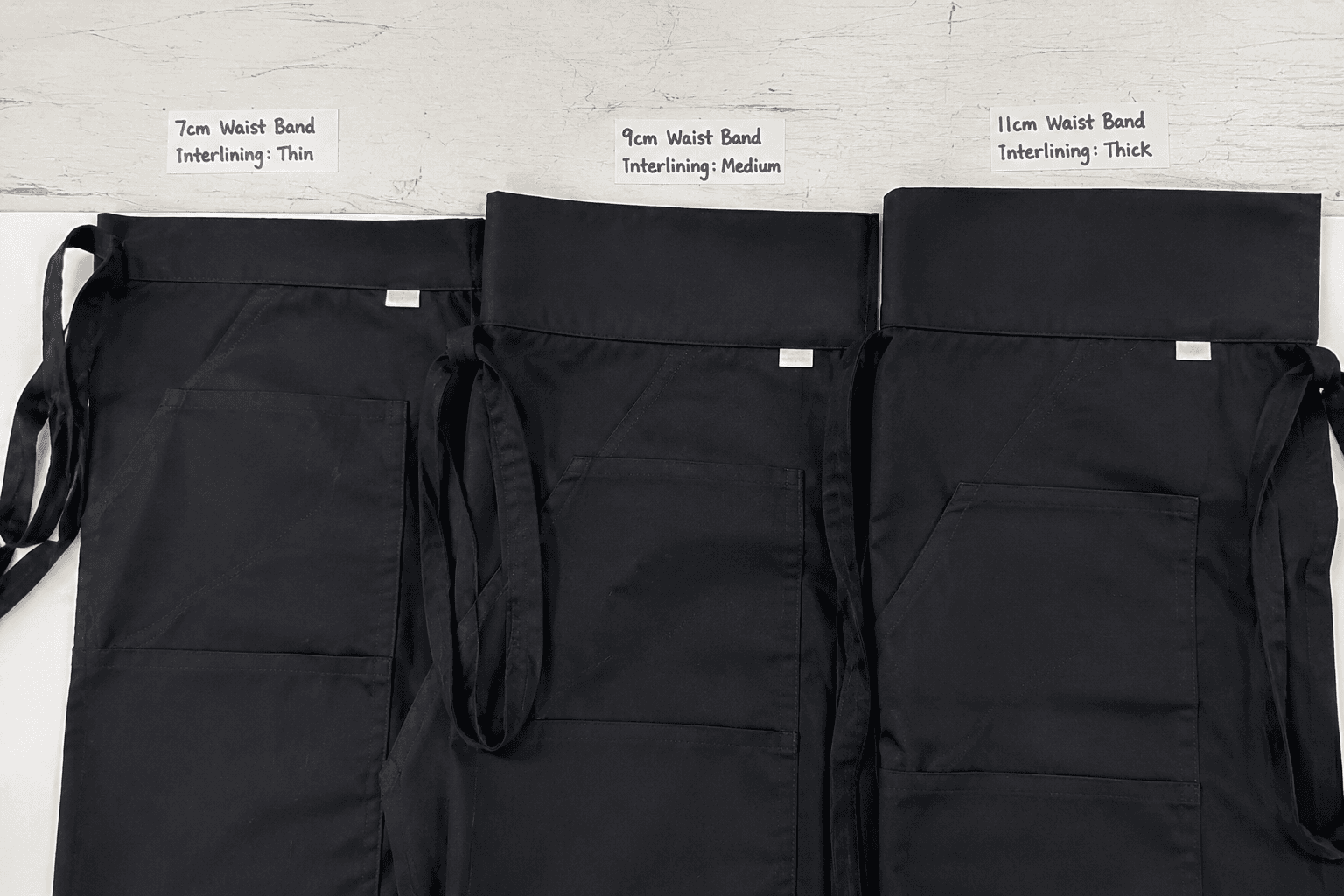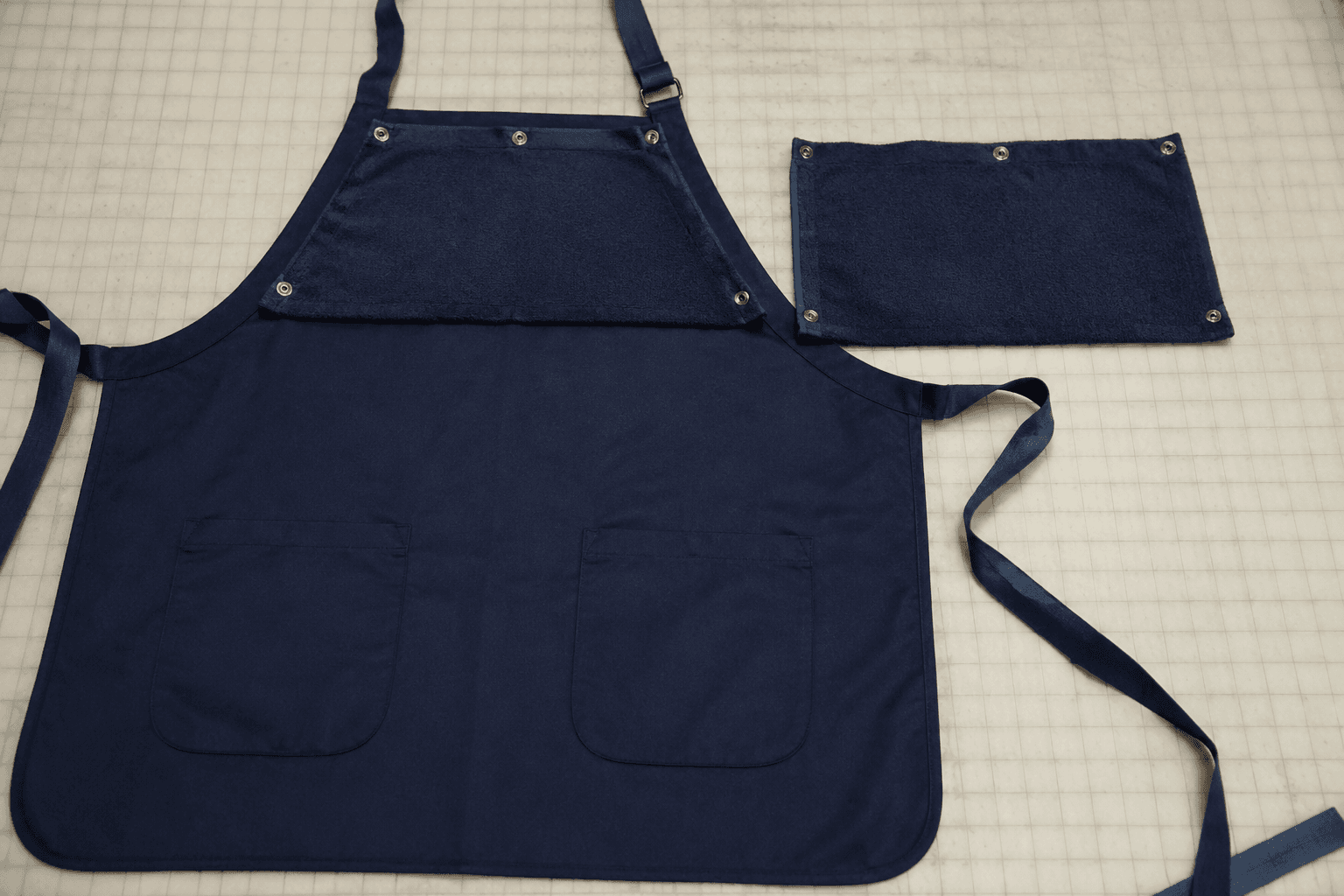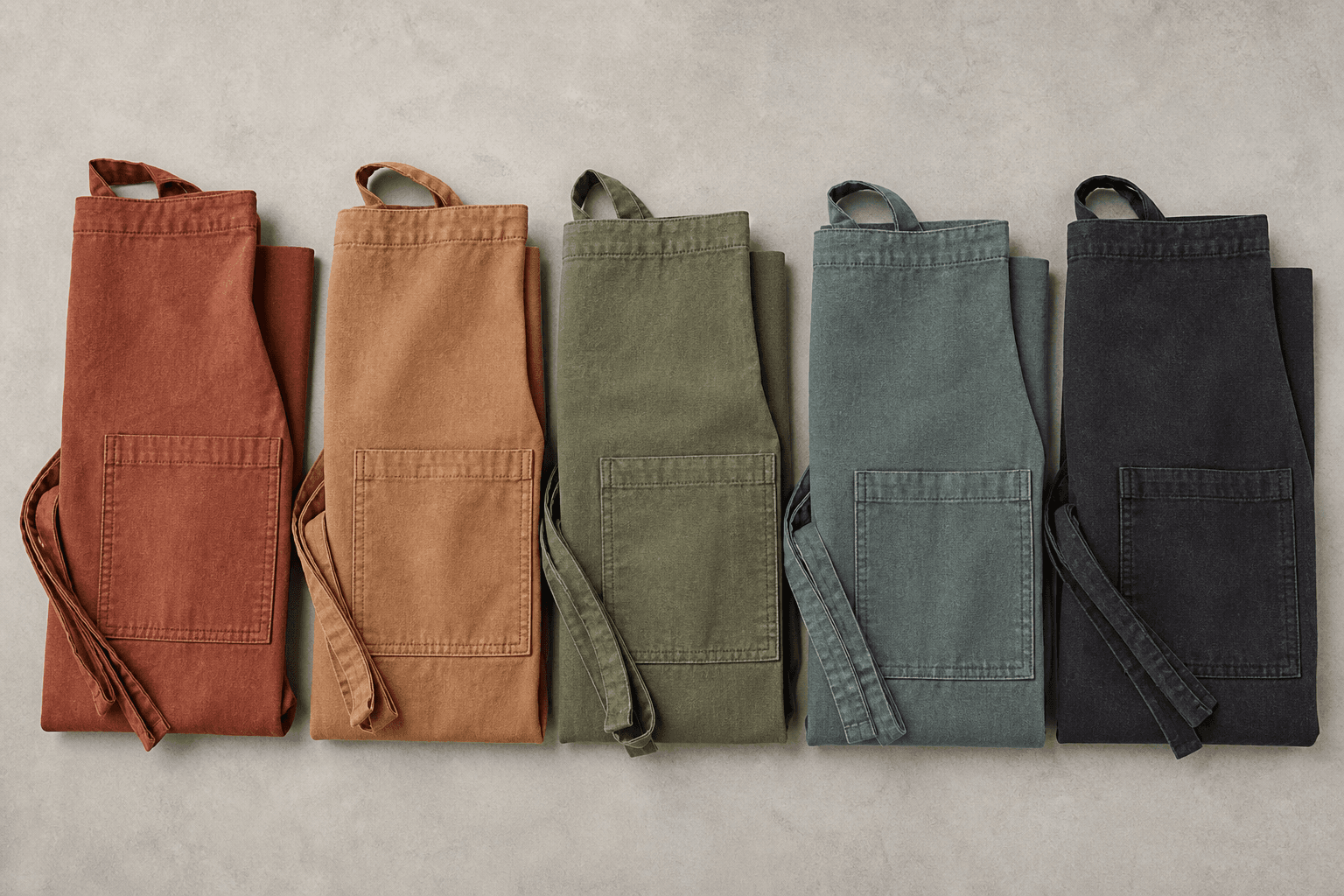
For hospitality buyers, logo placement on an apron affects both brand presentation and daily wear performance. Many premium operators now choose under pocket branding aprons instead of chest embroidery or visible pocket-face prints because the mark appears only during service movement. That approach fits fine dining, boutique hotels, wine-led concepts, chef counters, and premium café groups that want a branded apron without turning the uniform into front-of-house advertising.
Hidden logo placement on aprons has to be engineered early. On a development sample, a visible reveal of 10 mm can drop to 7 mm after the pocket fold is adjusted, or to 6 mm after wash shrinkage on cotton canvas. When an apron program runs from 500 pcs to 8,000 pcs, that small shift becomes a repeatability problem across bulk sewing, pressing, packing, and reorders.
For sourcing managers and product developers, the issue is not style alone. The decision comes down to which branding method keeps the pocket usable, holds up through 30 to 50 commercial wash cycles, stays within target cost, and can be reproduced with stable quality on bib aprons, waist aprons, and utility bar aprons. The sections below stay focused on apron-specific decisions, with realistic numbers for fabric, tolerance, lead time, price, and inspection.
- Under pocket branding aprons should be developed from the first sample with the pocket pattern, fold depth, and target visible logo height fixed together.
- A woven seam label is usually the safest option for hospitality aprons that need repeat orders, frequent laundering, and low defect risk.
- Under-pocket print is generally most cost-efficient from about 1,000 pcs upward, but dark twill and canvas aprons need crocking, adhesion, and placement checks.
- Embroidery delivers a premium result on aprons above 240 GSM, but tension, backing, and pocket comfort must be controlled carefully.
- Typical branding adders range from $0.08 to $0.45 per piece; base apron MOQ is commonly 300 to 500 pcs per style per color.
- Bulk approval should include a wash-tested sample, a written reveal tolerance such as ±2 mm, and inspection under AQL 2.5 major / 4.0 minor.
- Commercial-laundry apron programs should avoid decorative trims that warp, crack, harden, or discolor under heat and chemical exposure.
Why under pocket branding aprons suit premium hospitality uniforms
The main advantage of under pocket branding aprons is control. The apron keeps a clean front view when staff stand at reception, take orders, pour wine, or work an open pass, yet the brand still appears during natural movements such as reaching into a pocket or lifting a service cloth. For upscale operators, that restrained visibility usually fits the room better than a centered chest logo or a high-contrast front print.
This placement also gives the logo some protection from daily abrasion. On busy hospitality aprons, exposed branding rubs against counters, trays, POS stations, folded storage stacks, and repeated hand contact. A logo placed under the pocket edge is not fully shielded, but it usually wears more evenly than a decoration on the apron face. On dark server aprons worn 5 shifts per week, that can help the mark stay presentable across a 4 to 6 month uniform rotation.
From a sourcing perspective, the best applications are bib aprons and waist aprons with lower patch pockets or divided front pockets. Buyers commonly use 200 to 280 GSM poly-cotton twill, 8 oz to 12 oz cotton canvas, or washed slub blends for this detail. Those fabrics are heavy enough to support the pocket structure while still practical for restaurant and hotel laundering.
- Best-fit channels include fine dining, boutique hotels, wine bars, chef counters, premium cafés, and cocktail-led restaurant groups.
- Most workable apron bodies use one large lower patch pocket, two divided lower pockets, or a utility pocket with a stable top fold.
- Refined color combinations include black-on-charcoal, stone-on-sand, navy-on-indigo, and tobacco-on-olive.
- The detail is especially useful when the apron already has visible hardware, contrast bartacks, or a minimalist front design that should remain uncluttered.
Pocket construction specs that make under pocket branding aprons repeatable
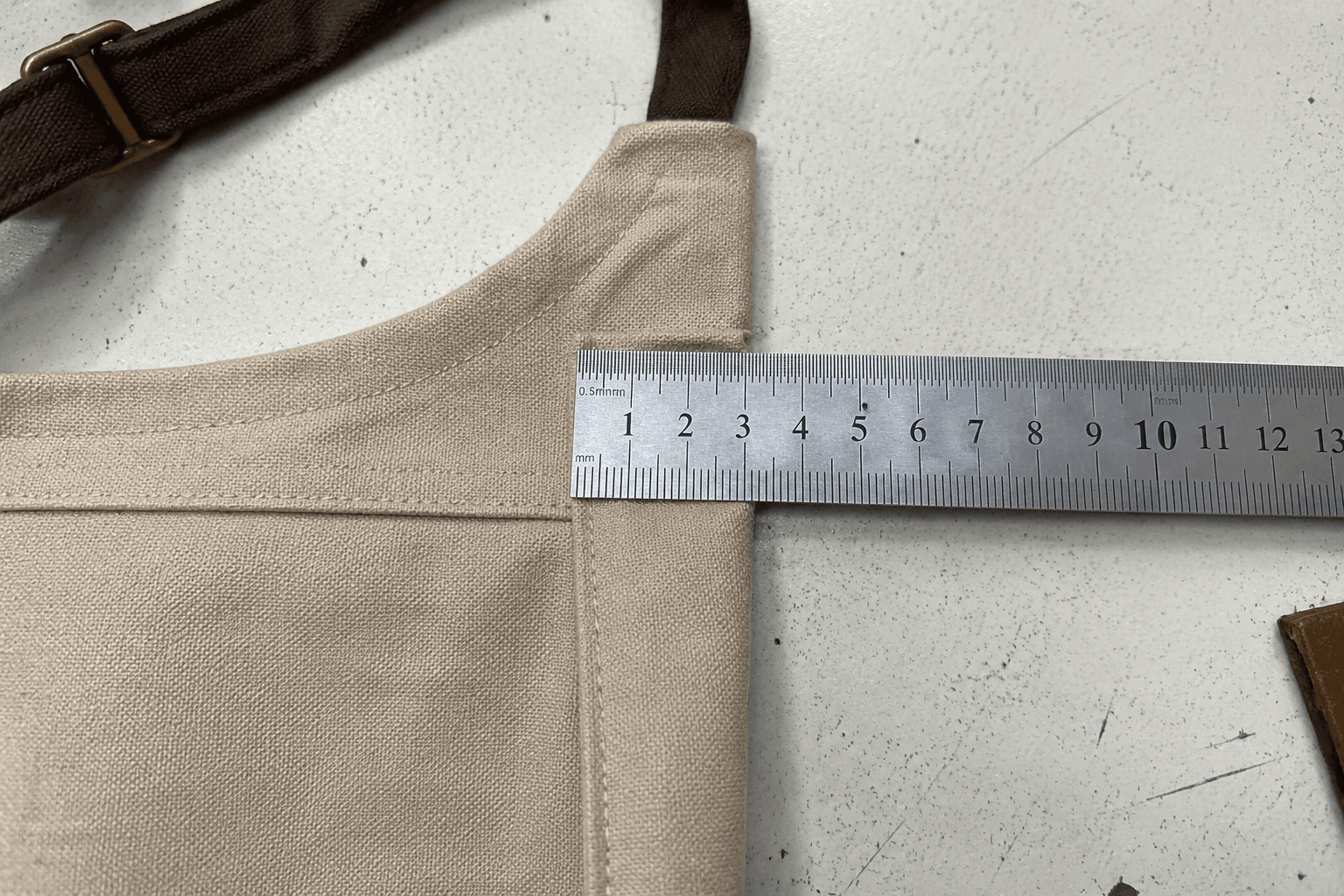
The pocket build determines whether hidden branding on an apron looks deliberate or accidental. The most stable method is a woven label inserted into the upper pocket seam with a finished reveal of 8 to 15 mm. The second method places a print or embroidery on the apron body before the pocket is sewn down, leaving part of the mark covered by the pocket edge. A third approach uses a flap pocket on a bartender or utility apron, with the logo revealed below the flap line. Each route changes sewing flow, cost, and defect exposure.
Pocket dimensions and logo scale have to be approved together. A standard lower patch pocket on a bib apron is often 18 to 20 cm wide by 20 to 22 cm high, with a top fold of 25 to 30 mm and a seam allowance of 10 mm. If the required visible logo height is 10 mm, the factory must calculate the fold, stitch line, and expected fabric movement before making the pre-production sample. If those measurements are guessed late, the reveal can drift enough to make the branding look inconsistent carton to carton.
Physical sample review is more important than flat artwork approval. Buyers should insert real service items into the apron pocket, check whether the hand catches on backing or seam bulk, and measure the reveal after sewing and after wash. On subtle branding, even a shift of 2 to 3 mm is easy to see, especially on clean-front hospitality styles where the under-pocket logo is one of the few visible details.
- Woven seam label: lowest-risk method for repeat apron orders; practical from about 300 pcs if trim MOQ works.
- Under-pocket print: efficient for larger apron volumes, usually from 1,000 pcs upward when printing is done before pocket attachment.
- Under-pocket embroidery: premium look, but higher labor time and greater risk of pocket-edge distortion on lighter fabrics.
- Flap-pocket branding: useful for bartender aprons and utility waists, but adds pattern pieces, sewing minutes, and more inspection points.
- Target reveal: most hospitality buyers stay within 8 mm to 12 mm for a discreet result that still reads at close range.
Fabric weight, wash cycles, and branding durability on professional aprons
Apron fabric weight affects both appearance and durability of hidden branding. On 180 to 210 GSM poly-cotton twill, embroidery can pucker the pocket edge unless the stitch count is kept low and backing is chosen carefully. On 240 to 280 GSM twill, woven labels and compact embroidery generally behave better. On 260 to 320 GSM cotton canvas, the structure supports premium branding well, but shrinkage control becomes more important because the apron body can move after washing and alter the visible reveal.
Wash environment matters just as much as GSM. An apron washed in-house at 40°C with line drying faces a different risk profile from one sent to a commercial laundry using stronger chemistry, hotter finishing, and tunnel drying. Woven labels usually hold up well if the yarns are colorfast and the edges are sealed properly. Prints need closer scrutiny. A low-cost pigment print may save $0.03 to $0.06 per piece versus a better transfer, but on dark aprons it may crack or fade faster after 20 to 30 washes.
The right test sequence is simple but often skipped. Buyers should review the hidden branding on a fresh sample, then again after 5 wash cycles and ideally after 20 wash cycles if the program is expected to run through commercial laundering. That catches reveal loss, label fray, embroidery abrasion, backing exposure, and pocket curling before bulk production starts. For professional aprons, hidden branding should be approved as part of the full construction, not as an isolated decoration detail.
- For embroidered aprons, fabrics above 240 GSM are usually safer unless the logo is very small and low stitch count.
- Common woven label widths for aprons are 10 mm, 15 mm, 20 mm, and 25 mm; smaller labels often look cleaner on fine-dining uniform styles.
- Uncontrolled cotton canvas shrinkage of 3% to 5% can change the visible logo reveal by more than 3 mm.
- Aprons entering industrial laundry should avoid faux leather, brittle transfer films, and trims that harden under repeated heat.
- A practical durability benchmark is no serious fray, peel, or distortion after 30 wash cycles for standard hospitality use.
Cost, MOQ, and lead-time benchmarks for hidden-logo apron sourcing
Buyers should quote hidden branding as an engineered apron feature, not as a casual add-on. At 1,000 pcs, a standard bib apron in 240 GSM poly-cotton twill commonly runs about $2.20 to $3.60 per piece ex-factory, depending on size, neck adjustment, strap material, and pocket count. A heavier 10 oz cotton canvas bib apron with metal hardware or cross-back straps typically lands around $4.10 to $6.90 per piece. The under-pocket branding cost sits on top of the base apron price.
For the branding itself, a woven label inserted into the pocket seam usually adds $0.08 to $0.16 per piece at 1,000 pcs. A one-color under-pocket print typically adds $0.10 to $0.20 per piece if the print is applied before pocket sewing and the placement jig is stable. Embroidery normally adds $0.20 to $0.45 per piece, depending on stitch count, thread colors, trimming, backing, and machine time. On a buyer margin model, those few cents matter, especially when the same apron is rolled out across several hundred staff.
MOQ and timing should be fixed before the sample is signed off. Many OEM apron factories accept a base MOQ of 300 to 500 pcs per style per color, but custom woven labels may require 1,000 to 3,000 pcs per design. A revised development sample for an existing apron body usually takes 7 to 10 days; a new pattern with hidden branding often needs 10 to 14 days. Bulk production usually runs 25 to 35 days after deposit, fabric confirmation, trim approval, and PP sample sign-off. Washed canvas, custom dye lots, or multi-country trim sourcing can push the apron lead time to 45 to 60 days.
- Ask for separate quote lines for the base apron, branding adder, sample charge, and repeat-order price.
- Confirm whether label MOQ applies by logo design, by colorway, or by size of the trim.
- Budget extra time for washed canvas aprons, custom-dyed straps, or imported metal hardware.
- Do not change from label to embroidery after PP approval unless the delivery calendar can absorb another sample round.
- If the apron program is seasonal, reserve label stock early so a repeat order does not wait on trim replenishment.
AQL checkpoints for under pocket branding aprons in bulk production
Small hidden branding requires tighter discipline than a large visible mark because every millimeter is noticeable. The main bulk risks on under pocket branding aprons are uneven reveal height, skewed label insertion, pocket placement drift, thread shade variation, print misregistration, pressing shine at the pocket edge, and embroidery backing that reduces pocket usability. A subtle logo can look premium on one sample and off-standard on the next carton if the factory does not control those variables.
A practical QC standard for hospitality aprons should define the measurable points in advance. Many buyers set visible logo height tolerance at ±2 mm, pocket alignment at ±3 mm, and topstitch straightness with no obvious waviness at normal inspection distance of roughly 60 cm. Woven labels should be checked for fray resistance and pull security. Printed logos should be checked for placement, adhesion, and color rub. Embroidered logos should be checked for backside neatness so pens, thermometers, towels, and bar tools do not catch inside the pocket.
Bulk inspection should run against a formal acceptance plan, not visual preference. For professional apron orders, AQL 2.5 for major defects and AQL 4.0 for minor defects is a workable standard. A missing logo reveal, upside-down label, severe placement error, or backing that partially closes the pocket should normally be classified as major. Light pressing shine, minor thread ends, or slight shade variation that does not affect brand appearance may be treated as minor if the apron remains fully usable and visually consistent.
- Write the reveal tolerance into the apron spec sheet before PP approval, for example 10 mm finished reveal ±2 mm.
- Include front-view photos of the approved branded pocket, not only artwork and dimensions.
- Check pocket function with real service items such as order pads, pens, bar spoons, and folded towels.
- Request at least one wash-tested reference apron if the program will be laundered frequently.
- Use sealed approval samples so factory floor, QC, and third-party inspectors work to the same standard.
Factory brief and sampling steps for repeat apron reorders
The fastest way to lose control of hidden branding is to brief it loosely. Buyers should give the factory a full apron specification that covers fabric composition, target weight in GSM or oz, finished dimensions, pocket construction, branding method, finished visible reveal, logo colors, laundry environment, and packing method. That level of detail reduces the common development problem where the base apron is approved first and the hidden logo is forced into the pattern afterward.
If the apron is part of a wider hospitality range, the brief should explain how each SKU relates to the others. A server bib apron may need a 10 mm tone-on-tone woven label, while a bartender waist apron in the same program may allow a slightly larger 15 mm reveal under a flap pocket. When a supplier understands the collection logic early, it can standardize trim choices, reduce sample loops, and keep the brand language consistent across bib, waist, cross-back, and utility aprons.
For most professional programs, a sensible sampling path is one development sample, one revised sample if needed, one PP sample, and one wash-tested reference sample before bulk. Buyers should also confirm reserve trim quantities for reorders, because custom labels often become the critical-path item even when apron sewing capacity is available. In private-label apron sourcing, the hidden mark should always be treated as a construction feature with measurable controls, not as a last-minute decorative request.
- Send vector logo artwork and specify the exact visible portion required after sewing and after washing.
- State whether branding sits under the pocket edge, inside the opening, or under a separate flap.
- Define the laundry route clearly: home wash, in-house hospitality wash, or industrial laundry.
- Approve pocket dimensions and reveal height on the same sample, not in separate stages.
- Confirm spare trim stock if the apron is likely to repeat within the next 6 to 12 months.