Buyers sourcing aprons for ultrasonic cleaning work usually focus first on day-one splash repellency. In production, the more expensive failure appears later: after 15-40 shifts around alkaline detergents, surfactants, anti-rust additives, and bath temperatures of 45-70°C, some aprons harden at fold lines, curl at the hem, or turn brittle across the lower bib. Operators then loosen the neck strap, roll the bottom edge, or stop wearing the apron before the barrier layer has visibly leaked.
For professional apron buying, the right specification is not simply PVC versus PU. It is the combination of base fabric denier, finished GSM, coating thickness, strap construction, seam count, edge finish, target replacement cycle, and post-shift drying conditions. A 240 GSM apron that stays flexible for 90 days often delivers a lower cost per wear than a 340 GSM apron rejected by operators after 20 shifts.
The fastest way to improve sample accuracy is to send the factory a usable process brief: chemical family, pH range, working concentration, bath temperature, splash frequency per shift, wipe-down practice, and target service life such as 60, 90, or 180 days. That allows an OEM supplier to quote two or three realistic apron builds instead of sending generic waterproof samples that do not match the actual ultrasonic cleaning line.
- PU-coated polyester, PVC-coated polyester, and TPU-laminated polyester are the main commercial materials for aprons for ultrasonic cleaning work; untreated cotton is rarely suitable at active tank stations.
- Flex retention must be tested separately from initial splash resistance. A fabric can bead diluted cleaner on day one and still harden after 10-20 wet-dry cycles.
- Typical MOQ is 500 pcs per color for stock-supported coated fabrics and 1,000-3,000 pcs for custom lamination, embossed finish, or special color matching.
- Normal development timing is 7-12 days for standard sewn samples, 12-18 days for welded or custom-trim development, and 25-45 days for bulk production depending on construction.
- Working ex-factory prices for OEM bib aprons usually range from US$2.20 to US$6.80 per pc, with many industrial programs landing between US$3.10 and US$5.20 at 1,000 pcs.
- AQL should be fixed before production. AQL 2.5 for major defects and 4.0 for minor defects is a practical baseline for most custom apron orders.
Why <em>aprons for ultrasonic cleaning work</em> fail from stiffening before they leak
At most ultrasonic cleaning stations, apron exposure is repeated splash rather than full immersion. Fine mist hits the chest, larger droplets collect on the lower front panel, and the waist area gets frequent contact when operators lean over the tank lip to load baskets or inspect parts. After the water phase evaporates, detergent solids and additive residue remain at fold lines, hems, strap joints, and stitch paths. That residue buildup is what often turns an apron rigid long before liquid penetration is visible.
In day-to-day use, comfort failure usually comes before barrier failure. When an apron becomes board-like after 20-35 working days, operators tie it looser, wear it lower on the chest, or leave it hanging beside the machine. From a B2B sourcing view, that is still a failed apron program because wearer compliance drops before the planned replacement cycle is reached. A buyer expecting 90 days of use but getting 25 days of real wear has not bought a cheaper apron, only a faster replacement problem.
A better approval method is to evaluate aprons for ultrasonic cleaning work under repeated exposure instead of checking only an unused sample. A practical pre-production screen is 10, 15, or 20 splash-and-dry cycles using the buyer's actual diluted solution, followed by 50 manual bends at the same fold line. The review point is not just leakage. It should check for hardening, whitening, cracking, edge curl, seam distortion, and strap stiffness. That produces far more useful sourcing data than a clean showroom sample.
- Highest splash load usually appears on the lower front 25-40 cm of the apron.
- Chest center, hem fold, and waist tie junctions are common early stiffening points.
- Drying near heaters or process air above 50°C accelerates coating hardening and edge curl.
- If operators reject the apron after 3-4 weeks, the apron program has failed even without a visible leak.
Material benchmarks for <em>aprons for ultrasonic cleaning work</em>: GSM, coating build, and ex-factory price
For active tank-side use, the commercial shortlist is narrow: PVC-coated polyester, PU-coated polyester, TPU-laminated polyester, and in limited cases neoprene or rubberized constructions. Cotton or poly-cotton with a water-repellent finish may suit low-splash support roles, but not primary apron use at open ultrasonic tanks. Those fabrics absorb splash, stain quickly, and become uncomfortable once chemical residue dries into the yarn structure.
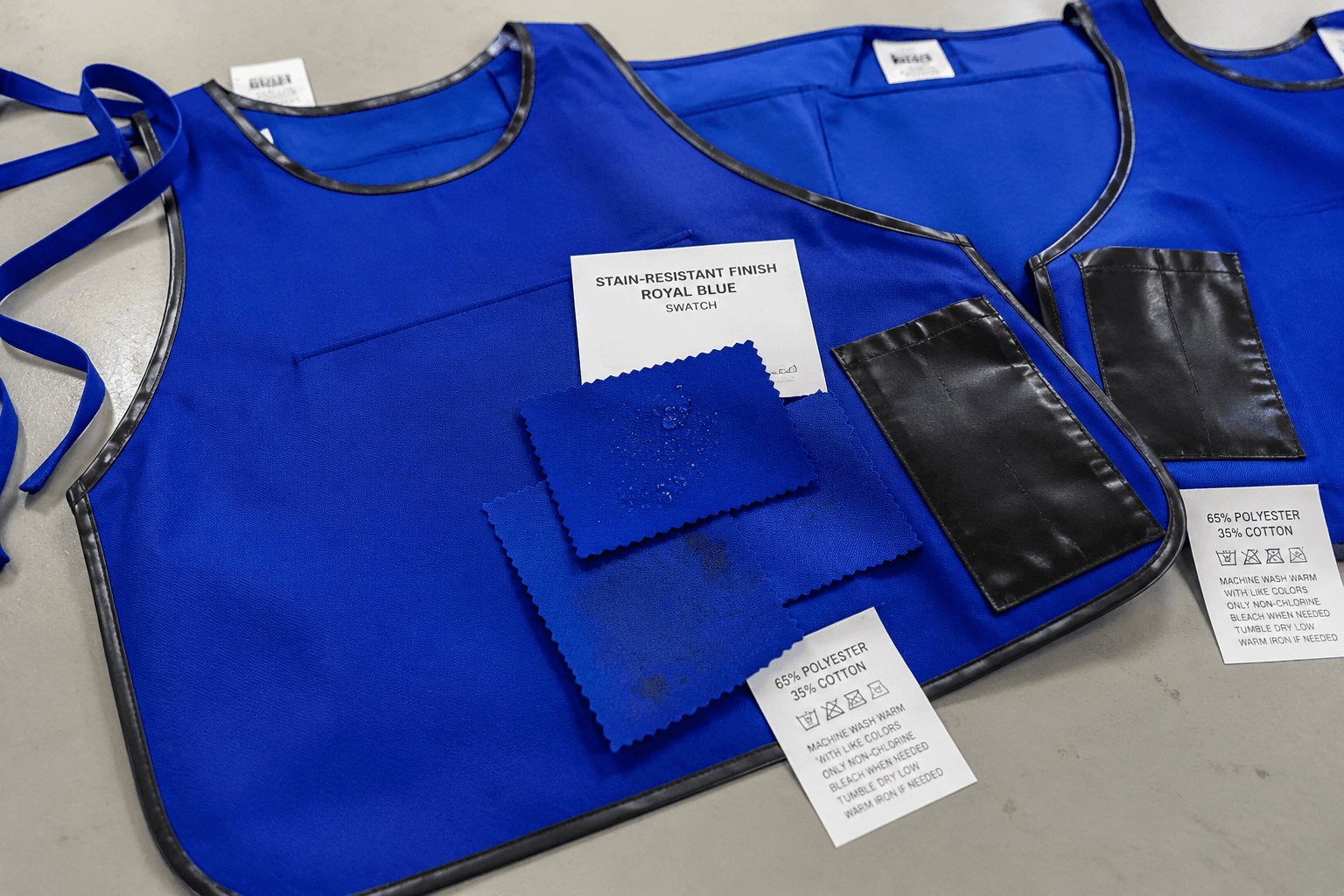
PVC-coated polyester remains the volume option because it is widely available and usually the lowest-cost coated build. A common OEM specification is 300D or 420D polyester with total finished weight of 230-320 GSM and PVC coating thickness around 0.12-0.22 mm. At 1,000 pcs, a standard sewn bib apron in this build often lands at US$2.20-US$3.80 ex-factory, depending on cut size, logo method, packaging, and strap configuration. The trade-off is flex retention: lower-grade PVC formulations can stiffen in cooler storage or after frequent fold-and-dry cycles.
PU-coated polyester usually gives a softer hand and better drape. Common finished weights are 180-280 GSM, with many wearable industrial builds clustering around 210-250 GSM. At 1,000 pcs, pricing commonly sits at US$2.80-US$4.80 per pc. For detergent-based ultrasonic lines, PU is often easier for operators to wear through a full shift, but buyers should confirm whether the exact coating formula also tolerates brief alcohol wipe-downs or adjacent handling with light solvents.
TPU-laminated polyester is often selected when the buyer prioritizes flexibility retention and cleaner long-term handling. Typical apron weights are 200-300 GSM, and ex-factory prices often start around US$4.20 and run to US$6.20 per pc. MOQ is usually higher because the lamination mill may require 1,000-3,000 meters per color or finish. For longer-life programs targeting 90-180 days, that extra material cost can still make financial sense if replacement frequency and operator rejection both drop. Neoprene and heavier rubberized builds usually start above 350 GSM and can exceed 500 GSM. They provide a stronger barrier, but in many general ultrasonic detergent lines they are unnecessarily hot, heavy, and expensive.
- PVC-coated polyester, 230-320 GSM: lowest cost, stable supply, suitable for many detergent-based lines.
- PU-coated polyester, 180-280 GSM: softer hand, better drape, often better all-shift wear acceptance.
- TPU-laminated polyester, 200-300 GSM: stronger flex retention, higher price, and higher fabric MOQ.
- Neoprene or rubberized builds, 350-500+ GSM: strong barrier, but heavier and warmer for long shifts.
- Untreated cotton or poly-cotton: not recommended for primary splash zones around active tanks.
Match apron construction to chemistry, temperature, and replacement cycle
A common buying mistake is to ask for the strongest chemical-resistant apron without describing the process. Many ultrasonic lines run diluted alkaline cleaners at pH 9-12, neutral detergents, surfactant blends, anti-foam additives, and occasional IPA wipe-down in a nearby station. Those conditions do not always justify a heavy rubberized apron. Over-specifying can add US$1.00-US$2.50 per pc, reduce wearer comfort, and still leave failure points if the straps, binding, or seams are poorly chosen.
A more accurate method is to zone apron use by exposure level. Operators standing directly at the tank edge may need a bib apron 72 x 110 cm or 80 x 120 cm with full chest coverage and wipe-clean straps. Staff loading baskets at a side bench, moving racks, or packing cleaned components may only need a lighter coated apron in the 180-220 GSM range. This split-spec approach keeps apron cost aligned with actual splash intensity instead of forcing one heavy construction onto every role in the room.
For sourcing discussions, the buyer should provide five core data points: chemical family, working concentration, operating temperature, splash frequency, and target replacement cycle. A brief such as 'alkaline detergent, pH 11-12, 3%-5% concentration, 55-60°C bath, 20-30 splash events per shift, target life 90 days' is specific enough for an OEM apron factory to recommend a realistic build. That is more useful than asking for a generic chemical apron and then sorting through samples that are not designed for the actual line conditions.
- State whether exposure is alkaline detergent, acidic cleaner, surfactant blend, alcohol wipe-down, or mixed process.
- Give the working temperature; chemistry at 65°C ages coatings faster than the same formula at 25°C.
- Set a replacement target such as 60, 90, or 180 days instead of asking for a 'durable' apron.
- Separate direct tank operators from low-splash support roles before fixing one final specification.
- If solvent contact is brief and infrequent, note that clearly so the apron is not overbuilt.
Seams, straps, and edge finishing that decide apron life in wet cleaning rooms
In OEM apron production, panel fabric gets most of the attention, but trim failures drive a large share of field complaints. If the main body is chemical-resistant while the edge binding is absorbent tape, residue collects there and creates a stiff, dirty border. Wearers often read that as an overall apron failure even when the front panel is still performing. The same problem appears when neck webbing absorbs liquid and dries hard against the collar line.
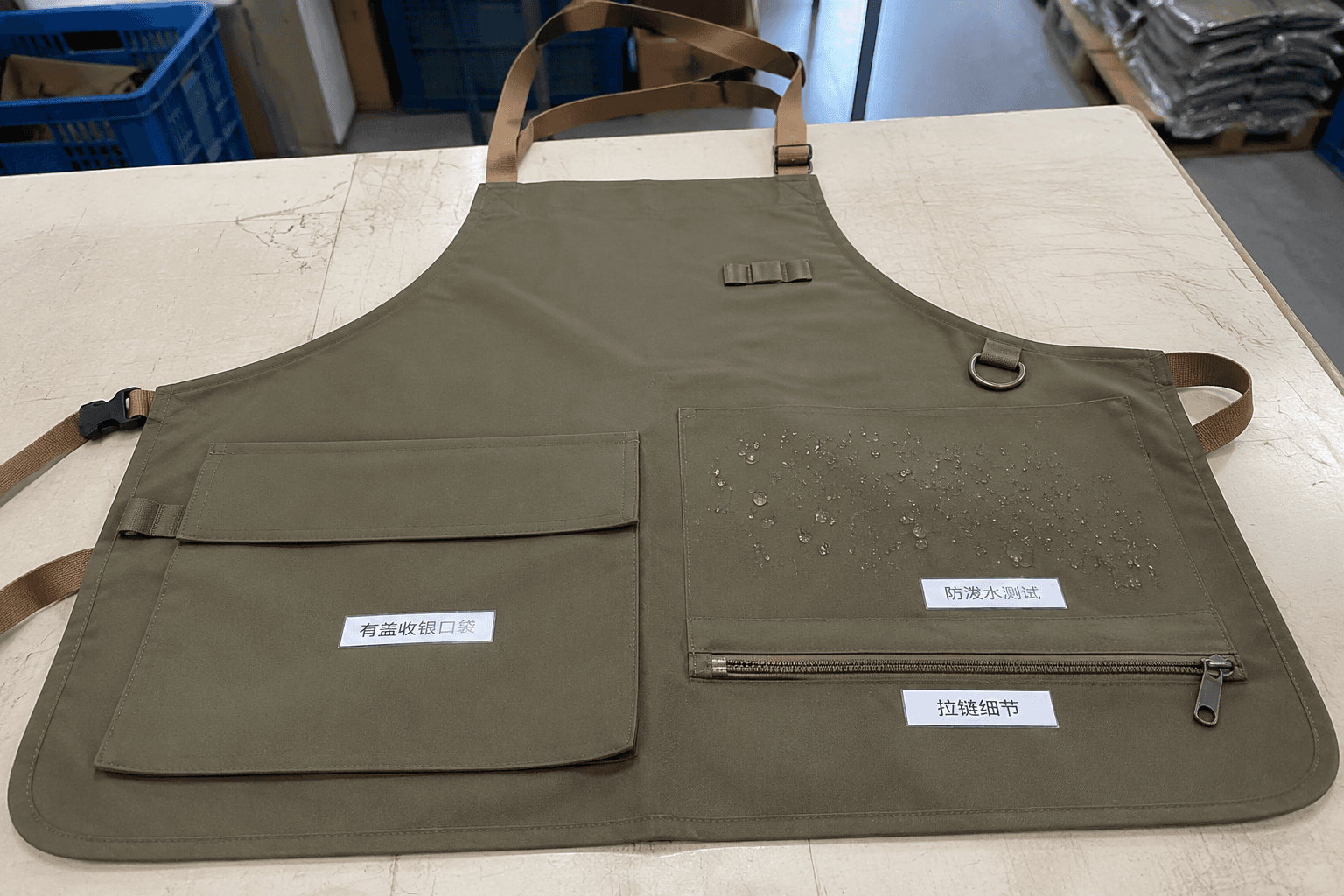
For most professional ultrasonic cleaning programs, a plain bib apron without front pockets is the safest starting point. Pockets trap splash, hold residue, and add seam lines exactly where repeated wetting is highest. Unless the operator must carry tags or small tools, deleting the pocket usually improves wipe-down speed and extends usable wear life. This is a simple design choice, but it often has more impact on maintenance than increasing fabric weight by 30 or 40 GSM.
Seam design also matters. A standard sewn lockstitch construction is acceptable for moderate splash use if the seam allowance is turned away from direct exposure and stitch density is consistent. For tougher environments, partial welding or fully welded front seams can reduce residue retention and simplify cleaning. That upgrade usually adds about US$0.40-US$1.20 per pc and may push MOQ upward because welded production is less flexible than basic sewing. Hardware should stay simple as well. Metal adjusters and sliders can corrode in humid cleaning rooms, especially where alkaline mist is present across long shifts. Acetal buckles, coated straps, or self-fabric tie systems are easier to source consistently and easier to repeat across future orders.
- Delete open front pockets unless the process genuinely requires them.
- Use low-absorbency bindings and straps that wipe clean with the main panel.
- Keep seam lines out of direct high-splash zones where possible.
- Choose acetal or self-fabric adjustment parts instead of exposed metal hardware.
- Confirm strap width at 2.0-2.5 cm; narrower straps reduce wearing comfort and compliance.
MOQ, lead time, AQL, and approval tests for repeat apron orders
For coated-fabric apron programs, the commercial benchmarks are predictable if the buyer sets the project clearly. With stock-supported fabric, MOQ is commonly 500 pcs per color and style. If the buyer requests custom coating color, embossed surface, TPU lamination, private-mold buckle, or welded seam development, MOQ typically rises to 1,000-3,000 pcs. In most cases, the limiting factor is the fabric mill minimum rather than the sewing line capacity.
Sample lead time is usually 7-12 days for a sewn apron using stock fabric and standard trims. New developments with custom print placement, woven labels, non-standard strap sets, or welding trials usually take 12-18 days. After PP sample approval and deposit, bulk production commonly runs 25-40 days for sewn styles. If the order includes welded seams, custom retail packing, third-party inspection booking, or peak-season fabric reservation, a 35-45 day schedule is more realistic than a generic 20-day promise.
Quality terms should be locked before the purchase order is issued. A practical baseline is AQL 2.5 for major defects and AQL 4.0 for minor defects. Major defects usually include wrong material, coating delamination, broken straps, seam opening, major size variance outside agreed tolerance such as ±1.5 cm, or obvious logo misplacement. Minor defects include small surface marks, slight stitch irregularity, and limited print shade variation within the approved standard. Testing should reflect the cleaning line instead of relying on broad supplier claims. A useful factory screen includes 10-20 exposure cycles with the actual diluted chemistry, room-temperature drying, hand-flex checks, visual review for whitening or cracking, strap wipe-clean assessment, and spot seam-strength checks. For repeat orders, it is worth retaining one approved bulk sample from each lot so the next production run can be checked against a physical standard.
- MOQ: 500 pcs for stock fabric; 1,000-3,000 pcs for custom laminated or custom-colored materials.
- Sample lead time: 7-12 days standard; 12-18 days for welded or custom-trim development.
- Bulk production: 25-40 days sewn; 35-45 days with welding, inspections, or custom packing.
- AQL baseline: 2.5 major and 4.0 minor for most OEM apron orders.
- Main price band: US$3.10-US$5.20 per pc for many professional coated-fabric apron programs at 1,000 pcs.
RFQ checklist for sourcing <em>aprons for ultrasonic cleaning work</em> without wasted sample rounds
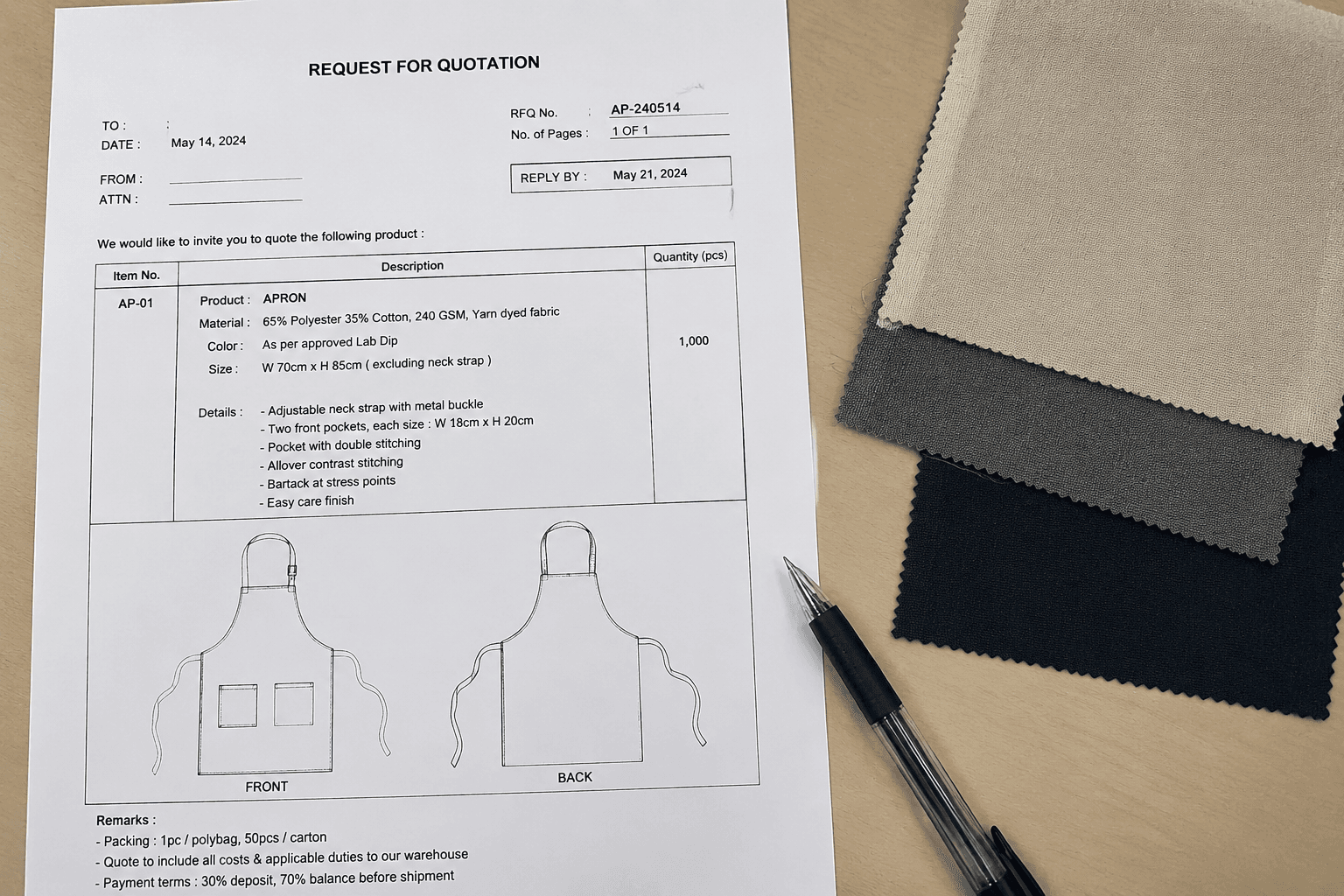
The most effective RFQ for an apron factory is a short technical brief tied to one process, one exposure level, and one commercial target. That structure reduces unnecessary sample rounds, makes supplier quotations easier to compare, and helps the factory recommend the right material instead of defaulting to a generic waterproof apron. Buyers who send only a photo and a request for 'chemical resistant' usually receive samples that vary too widely in weight, drape, and service life to compare properly.
For many buyers, the best first-round request is two alternatives: one comfort-focused and one cost-focused. A practical comparison would be a 220-250 GSM PU-coated polyester apron versus a 280-320 GSM PVC-coated polyester apron in the same dimensions, with the same strap width, same neck adjustment method, and no pocket. That allows a direct comparison of drape, wipeability, stiffness after drying, and estimated replacement cost without changing multiple variables at once.
The best sourcing result is not the heaviest panel or the lowest quoted price. It is the apron construction that delivers stable splash performance, acceptable flexibility after repeated drying, consistent bulk quality, and a replenishment lead time the buyer can actually plan around. For B2B buyers, that is what turns a one-off trial into a repeatable industrial apron program rather than a series of corrective purchases.
- Specify base fabric, coating type, total GSM, color, and whether the surface is matte, gloss, or embossed.
- Provide cut size targets such as 72 x 110 cm or 80 x 120 cm, plus tolerance requirements.
- State strap material, strap width, attachment method, and whether neck adjustment is required.
- Confirm pocket requirement as yes or no; for active tank-side use, no is usually the better default.
- Set a target ex-factory range early, such as US$3.50-US$4.20 per pc, to avoid mismatched sampling.
- Define inspection standard, packaging method, carton quantity, and shipping marks before PP approval.
- Request one retained bulk approval sample for future repeat-order comparison.