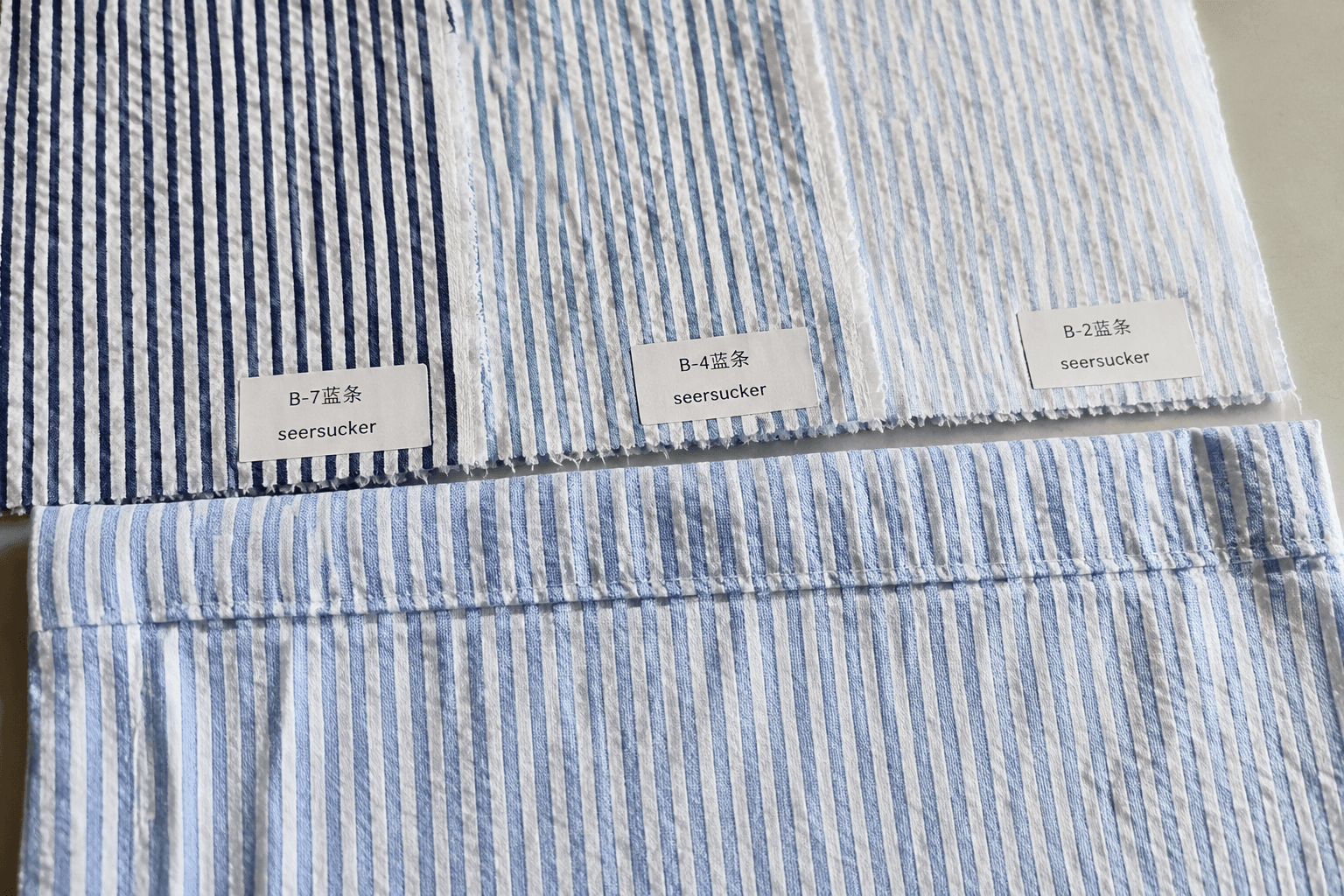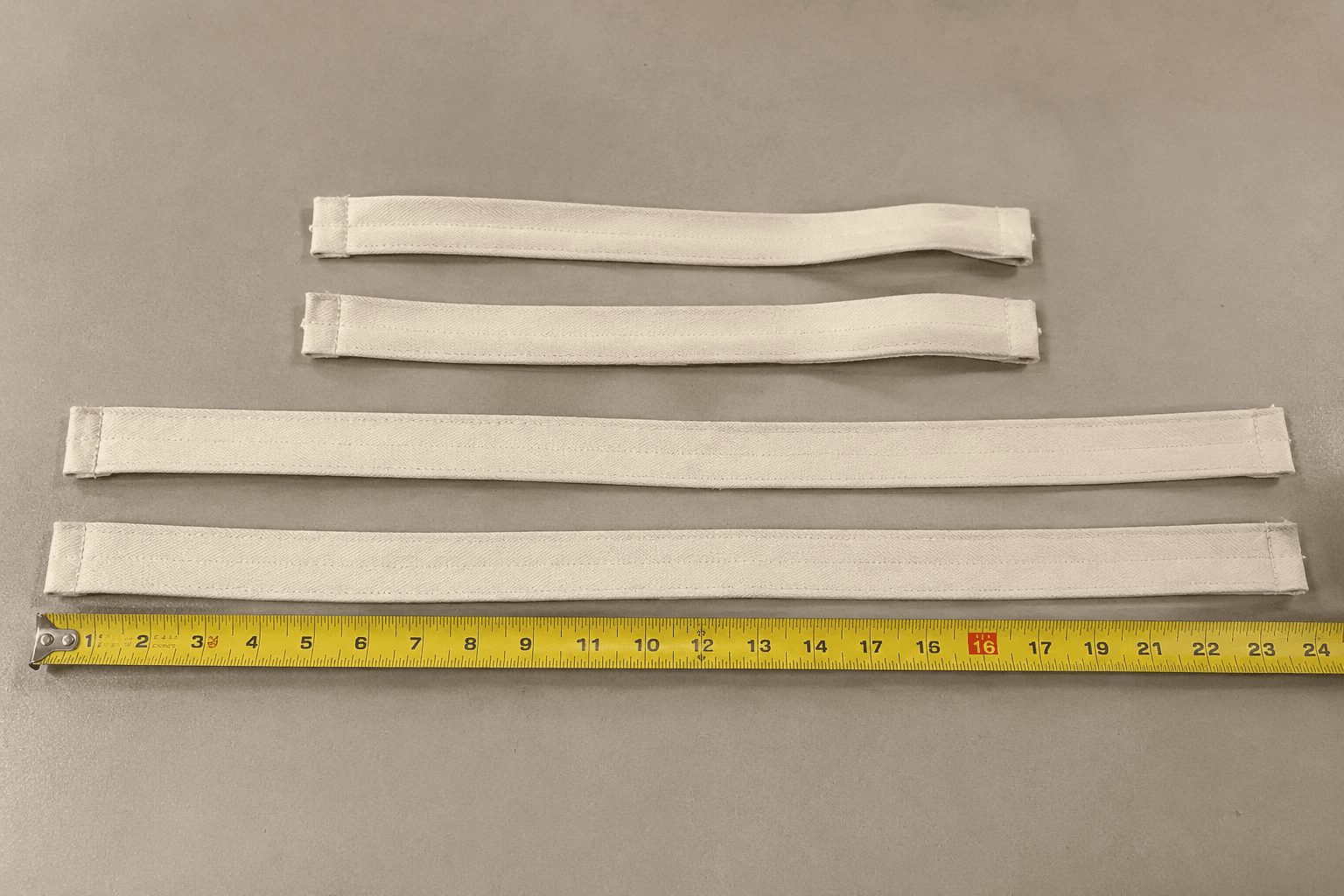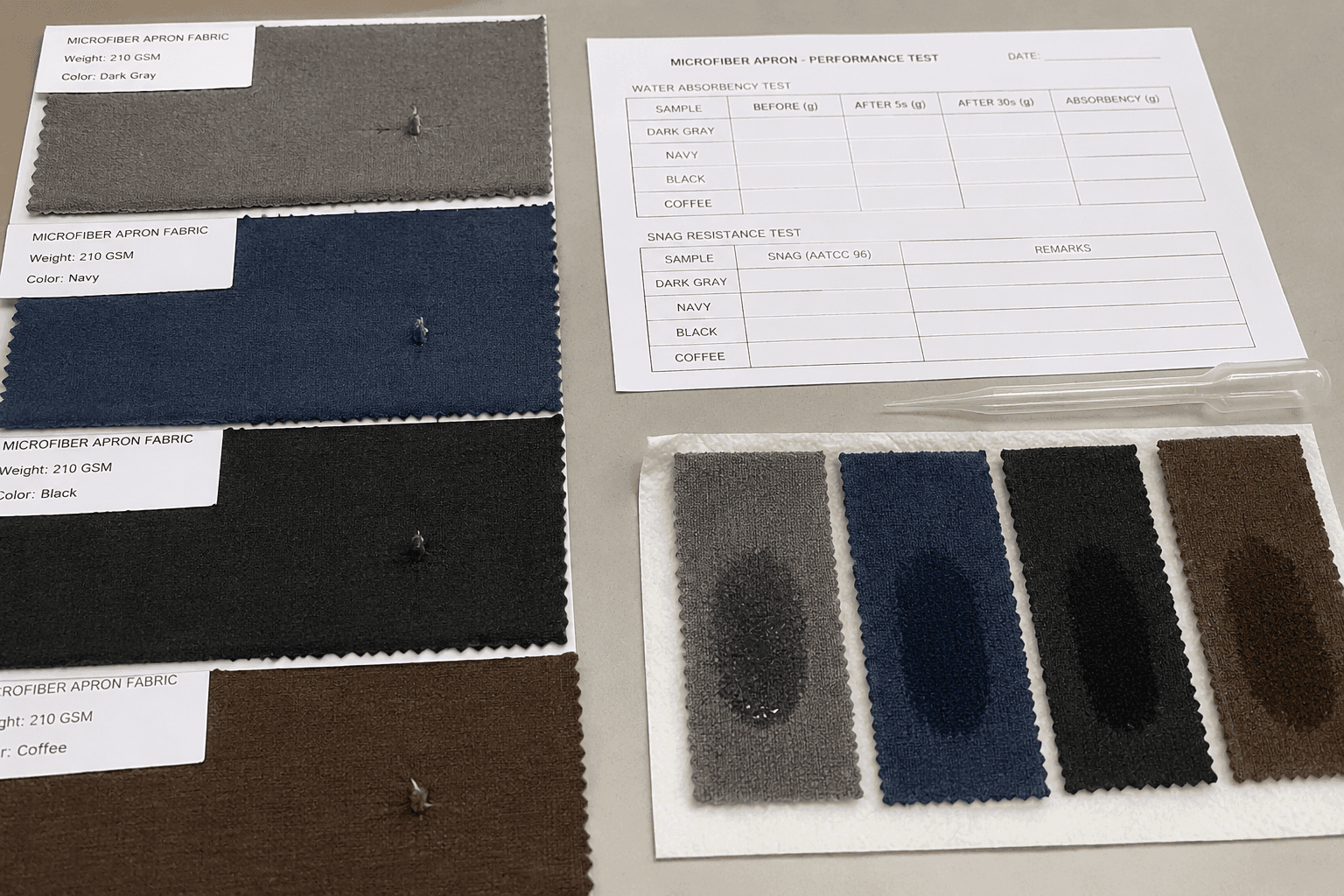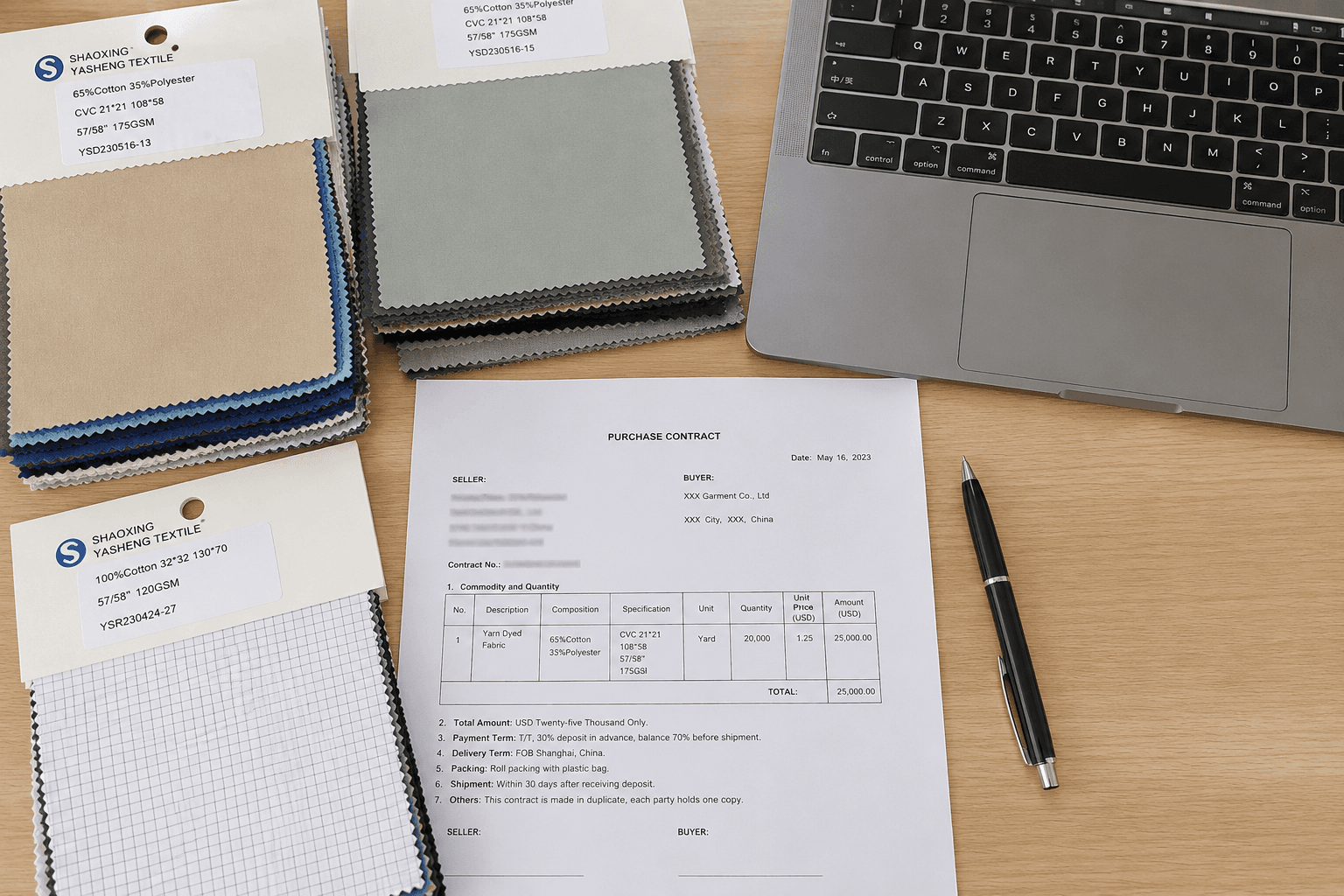
For hospitality groups, café chains, cookware brands and private-label home goods programs, tencel cotton apron fabric fills a defined sourcing gap between rigid 8-10 oz cotton canvas and lower-cost 65/35 poly-cotton twill. It works best in bib, waist and cross-back aprons that need a softer silhouette, smoother hand and more apparel-like presentation during 4-10 hour indoor shifts.
The buying decision needs to stay technical. A Tencel-cotton apron can look premium in a sales sample, yet bulk performance depends on finished GSM, weave density, seam allowance, stitch density, pocket load, pressing behavior and wash response. Compared with firm canvas, lyocell-rich blends usually improve drape and moisture dispersion, but they also increase the risk of seam slippage, needle marking and edge growth if the construction is too open or the sewing settings are too aggressive.
For professional apron buyers, the safest method is to develop fabric, pattern and seam package together. When the tech pack fixes blend tolerance, finished weight, wash method, shrinkage target, reinforcement points, inspection standard and approval sequence during sampling, tencel cotton apron fabric can support a premium apron line without predictable bulk claims.
- 190-230 GSM, or about 5.6-6.8 oz, is the safest range for most bib and waist aprons in tencel cotton apron fabric.
- For front-of-house apron programs, blends of 55/45, 60/40 or 70/30 lyocell-to-cotton usually give the best balance of drape, appearance and sewing control.
- Stress seams normally need 1.0-1.2 cm seam allowances, with bartacks or stay reinforcement at pocket corners, tie bases and bib upper corners.
- Moisture spread is usually better than dense cotton twill in warm indoor service, especially on single-layer aprons worn for 4-8 hour shifts.
- Seam slippage risk rises sharply below about 200 GSM, especially on open twill or plain weaves with soft finishing.
- Typical dyed-fabric MOQ is 500-1000 meters per color; custom apron MOQ is usually 300-800 pcs per style-color.
- Bulk lead time for a custom program is commonly 45-65 days from color approval, versus roughly 25-35 days for a stock-fabric cotton reorder.
- Compared with standard cotton twill aprons, fabric often costs US$3.20-5.80 per meter, while FOB garment cost usually rises by US$0.40-1.20 per piece.
Where <em>tencel cotton apron fabric</em> fits in B2B apron programs
In apron sourcing, tencel cotton apron fabric is not a low-cost substitute for commodity twill and not a replacement for heavy-duty canvas. It is specified for premium bib aprons, waist aprons and cross-back styles sold into café service, bakery retail, floral retail, cookware merchandising and showroom staffing, where the apron needs to read closer to apparel than to utility workwear.
Its value is visible at retail and on staff. A well-finished 60/40 or 55/45 lyocell-cotton twill at 200-220 GSM usually hangs closer to the body, folds more cleanly in packaging and shows less surface hairiness than many standard cotton twills. In black, charcoal, tobacco or olive, that cleaner face can support apron retail prices around US$24.99-59.99 without moving into luxury pricing.
The trade-off is lower tolerance for abrasion and strain. A soft 205 GSM twill used on a front-of-house bib apron can perform well for order taking, bar service and retail demonstration, but it is a poor match for butcher aprons, heavy tool pockets, rough prep counters, bleach-heavy wash routines or industrial laundry. If the work cycle is harsh, a tighter 270-340 GSM cotton twill or canvas is usually the lower-risk sourcing decision.
- Best-fit channels are coffee chains, boutique bakeries, cookware brands, floral retail, showroom uniforms and premium private-label retail.
- Most used blends are 55/45, 60/40 and 70/30 lyocell-to-cotton.
- The most stable apron weight band is 190-230 GSM, equal to about 5.6-6.8 oz.
- Typical fabric surcharge over basic cotton twill is US$1.20-2.80 per meter, depending on blend, finish and color depth.
Moisture handling in <em>tencel cotton apron fabric</em> during 4-10 hour shifts
For aprons, moisture handling matters more than broad marketing claims about breathability. In espresso bars, bakery counters and open kitchens, heat builds behind the bib panel, waistband, ties and layered pockets. A lyocell-cotton construction usually spreads moisture faster across the fabric surface than dense cotton twill, which helps evaporation and reduces the sticky feel wearers often report after 4-6 hours on shift.
That advantage depends on apron engineering, not on fiber content alone. A 210 GSM bib apron with double chest pockets, a large lower pouch and wide turned hems can still feel warm because stacked layers trap heat. By contrast, a single-layer bib apron with moderate pocketing, clean side seams and lighter reinforcement often feels drier over the same working cycle.
Buyers should assess comfort in the actual use environment. For front-of-house aprons in moderate indoor heat, the comfort gain is usually measurable over 4-8 hour shifts. In greasy production kitchens, outdoor catering or 10-hour high-heat use, the moisture benefit often narrows while durability demands rise, so the fabric should be approved only if the apron role is primarily presentation-led rather than heavy-duty.
- For café and retail aprons, 190-220 GSM usually balances comfort, opacity and sewing stability.
- A single-layer bib normally wears cooler than a bib with lining, fusible backing or oversized chest pockets.
- Above about 240 GSM, the moisture and drape advantage over standard twill usually drops.
- Wear trials should run for at least 5 working days and include laundering after day 2 or 3 to capture post-wash feel.
Drape, silhouette and pattern choices that justify the apron premium
Drape is the commercial reason most buyers move into this fabric category. In apron terms, better drape means the bib folds naturally at the waist, the skirt drops straighter from the hip and the garment looks less stiff in product photography, VM displays and on-floor wear. That softer fall is especially useful for private-label aprons positioned as giftable retail or premium uniform capsules.
Better drape also changes pattern rules. Self-fabric ties can look cleaner than webbing, but ties cut too narrow often twist after washing. Large patch pockets can sag once they carry a handheld POS, thermometer or order pad. Narrow rolled hems frequently ripple on fluid cloth, while a 2.0-3.0 cm hem gives a straighter edge and a cleaner bottom line on most bib and waist aprons.
The strongest apron developments in this category avoid overbuilding the entire garment. They keep the body soft while reinforcing the pocket mouth, bib top edge, strap insertion and side tie base with selective support. That approach preserves the drape buyers are paying for while controlling the points most likely to distort during wear, steaming and repeat laundering.
- Cross-back, pinafore and longer Japanese-style aprons benefit more from drape than rigid chef-bib shapes.
- Pocket openings perform better with stay tape, double turn-under construction or bartacks at both corners.
- Hem depth of 2.0-3.0 cm is usually cleaner than a narrow rolled hem on fluid apron fabrics.
- Steam finishing time can rise by 10-20% versus standard cotton twill because edge shaping is less rigid.
Seam slippage risk in <em>tencel cotton apron fabric</em>: the main pre-bulk control point
The main technical risk in tencel cotton apron fabric is seam slippage. This is yarn movement away from the seam line under tension, creating a visible gap even when the sewing thread has not broken. On aprons, it usually appears first at pocket top corners, side openings, tie attachments, bib upper corners and any area pulled repeatedly while the wearer ties, adjusts or loads the garment.
Risk rises when buyers approve a soft-hand twill or plain weave with open construction, low cover factor or overly light weight. A 195 GSM soft twill can photograph well and pass a first fitting, then show seam opening after wash if seam allowance is only 0.6-0.8 cm or stitch density is so tight that the needle line weakens the cloth. The same softness that creates premium drape can reduce seam holding power if the weave is not compact enough for apron use.
This is a development-stage issue, not something final inspection can solve. Seam slippage should be checked in both warp and weft before bulk fabric booking, then rechecked after wash if the apron will be garment washed, enzyme softened or sold as pre-laundered. If results are marginal, the buyer should widen seam allowances, reduce pocket size, simplify high-load details or move up to a tighter construction before PP sample approval.
- Use 1.0-1.2 cm seam allowances in stress areas instead of minimal fashion seams.
- Target roughly 8-10 SPI; overly dense stitching can increase needle damage on soft constructions.
- Load-test pockets with realistic weights of 300-500 g, such as a POS device, thermometer or notepad.
- Check seam appearance after 3 wash cycles if the apron is garment washed or pre-softened.
- Set final inspection at AQL 2.5 major / 4.0 minor, with explicit checks for seam grin, pocket distortion and tie attachment security.
How to write a bulk-ready spec for Tencel-cotton aprons
Many apron tech packs still define the material too loosely, using phrases such as “soft Tencel blend” or “lyocell cotton twill” without measurable controls. For repeatable bulk production, the spec needs to define blend ratio, composition tolerance, finished GSM, usable width, weave, dye method, wash route, shrinkage target and seam-performance expectations. Without those details, the mill, factory and buyer may all approve different versions of the same apron.
A workable apron spec might read: 60% lyocell / 40% cotton twill, finished weight 210 GSM ±5%, usable width 148 cm, reactive dyed, pre-shrunk, colorfastness to washing minimum grade 4, shrinkage within 3% warp and 5% weft after one 30°C home-laundry cycle, with seam appearance approved on a sewn sample before and after wash. That level of precision lets the mill quote the correct base cloth and allows the sewing factory to set seam allowances, SPI and reinforcement before the pre-production sample.
This is also where buyers should separate fiber branding from apron performance. A branded fiber name may help merchandising, but the sourcing decision should still be based on drape, moisture handling, wash response, seam stability, shade consistency and hand feel after pressing. If an equivalent lyocell-cotton cloth meets the apron brief at a lower landed cost, it should be evaluated against the same technical standard.
- Specify composition as 60/40 ±3% or another agreed tolerance, not just a nominal blend.
- Lock finished weight at 200-220 GSM ±5% for most premium bib and waist aprons.
- Define usable width, commonly 145-150 cm, to protect marker efficiency and garment costing.
- Set shrinkage limits, usually within 3-5%, based on the final care method.
- Approve both a pre-production sample and a wash-tested sample before bulk cutting.
MOQ, lead time and cost benchmarks for custom apron sourcing
Cost planning for Tencel-cotton aprons should include both fabric price and handling cost. The fabric itself is more expensive than commodity twill, but the larger difference often comes from slower cutting, more careful pressing, tighter pocket-setting control and extra inspection around seam appearance. Soft constructions simply require more discipline on the sewing line than firm canvas.
For dyed fabric sourced in major China textile clusters, MOQ is commonly 500-1000 meters per color for apron-suitable qualities, though stock-supported bases can reduce this for repeat shades. On the garment side, OEM MOQ is usually 300-800 pcs per style-color for standard bib or waist aprons. If the buyer adds custom hardware, embroidery, printed neck labels, gift boxes, barcode stickers or individual retail packs, the practical MOQ often rises because trim minimums start to control the order.
Lead time should be planned conservatively. A stock-fabric cotton apron reorder may ship in 25-35 days after final approval. A custom tencel cotton apron fabric program usually needs 5-7 days for lab dips, 7-12 days for weaving and finishing, 7-10 days for sample sewing and revision, then 25-35 days for bulk production. In peak season, the full approval-to-ship window typically lands at 45-65 days, and retail packing can add another 3-5 days.
- Indicative fabric price is often US$3.20-5.80 per meter for apron-suitable qualities.
- Indicative FOB garment cost usually rises by US$0.40-1.20 per piece versus standard cotton twill.
- New-style apron sampling generally takes 7-14 days after fabric confirmation.
- Dyed-fabric MOQ is often 500-1000 m per color; finished apron MOQ is usually 300-800 pcs per style-color.
- Pre-production approval should include a wash-tested sample, measurement sheet, trim card and packing standard.
When B2B buyers should approve this fabric for aprons—and when they should not
This fabric is a strong choice when the apron must combine comfort, drape and premium presentation in front-of-house use. That includes café chains, boutique bakeries, floral shops, cookware brands, lifestyle retailers and hospitality capsule collections where the apron supports brand image as much as function. In these channels, a cost premium of roughly US$0.40-1.20 per piece is often acceptable because the apron feels better in hand, hangs better on body and looks stronger on shelf.
It is the wrong choice when the brief centers on hard abrasion, heavily loaded pockets, rough prep surfaces, chlorine-heavy care or industrial laundry. In those cases, many complaints are not factory defects but application mismatches: the buyer selected a soft, fashion-led apron fabric for a work cycle that actually required a firmer 8-10 oz twill or canvas. Construction changes can reduce risk, but they will not turn a fluid blend into a heavy-duty utility apron material.
The best sourcing outcome comes from matching the cloth to the exact apron job. If the goal is a premium front-of-house or retail apron, use a tighter Tencel-cotton construction, keep styling clean, reinforce stress points and require wearer trials of at least 5-7 working days plus one wash cycle before approval. If the goal is maximum service life at the lowest replacement cost, a firmer twill or canvas with a softer finish is usually the better commercial decision.
- Approve for front-of-house service, gifting, branded retail and premium uniform capsules.
- Use caution for butcher aprons, heavy utility styles, high pocket-load programs and industrial-laundry accounts.
- Keep designs simple; fewer panels, fewer oversized pockets and fewer decorative seams usually improve bulk stability.
- Require wearer trials of 5-7 days plus at least 1 wash cycle before final bulk approval.