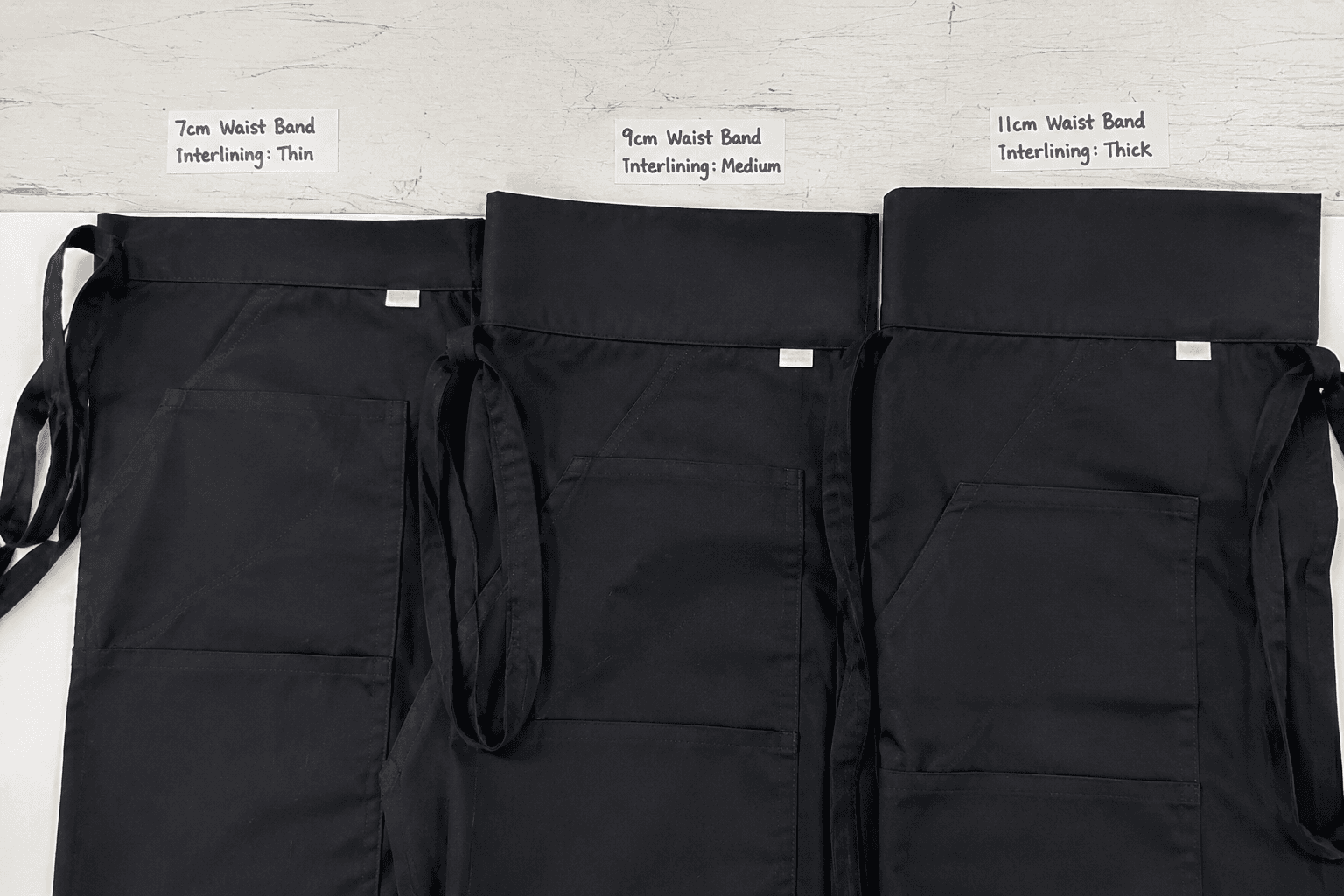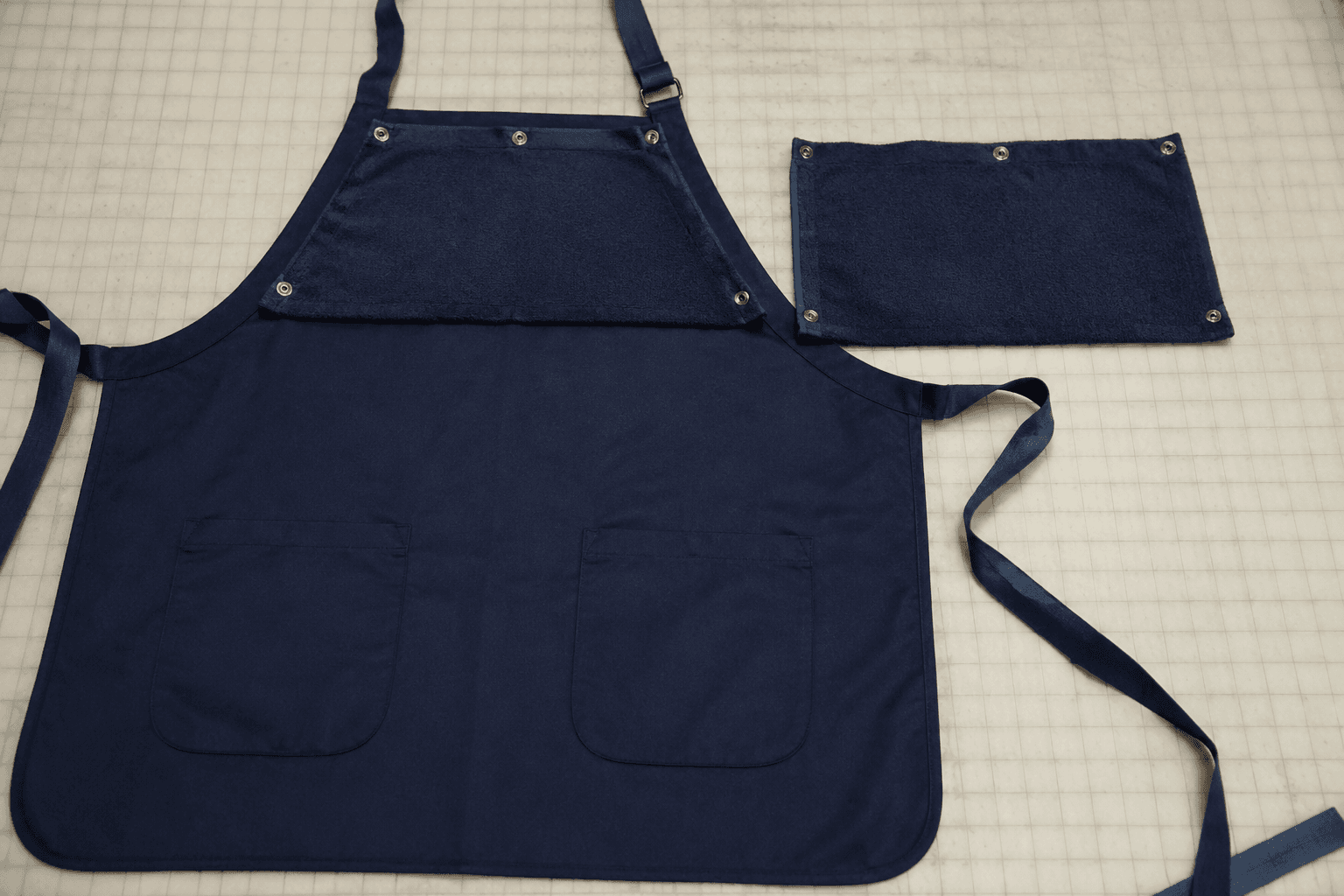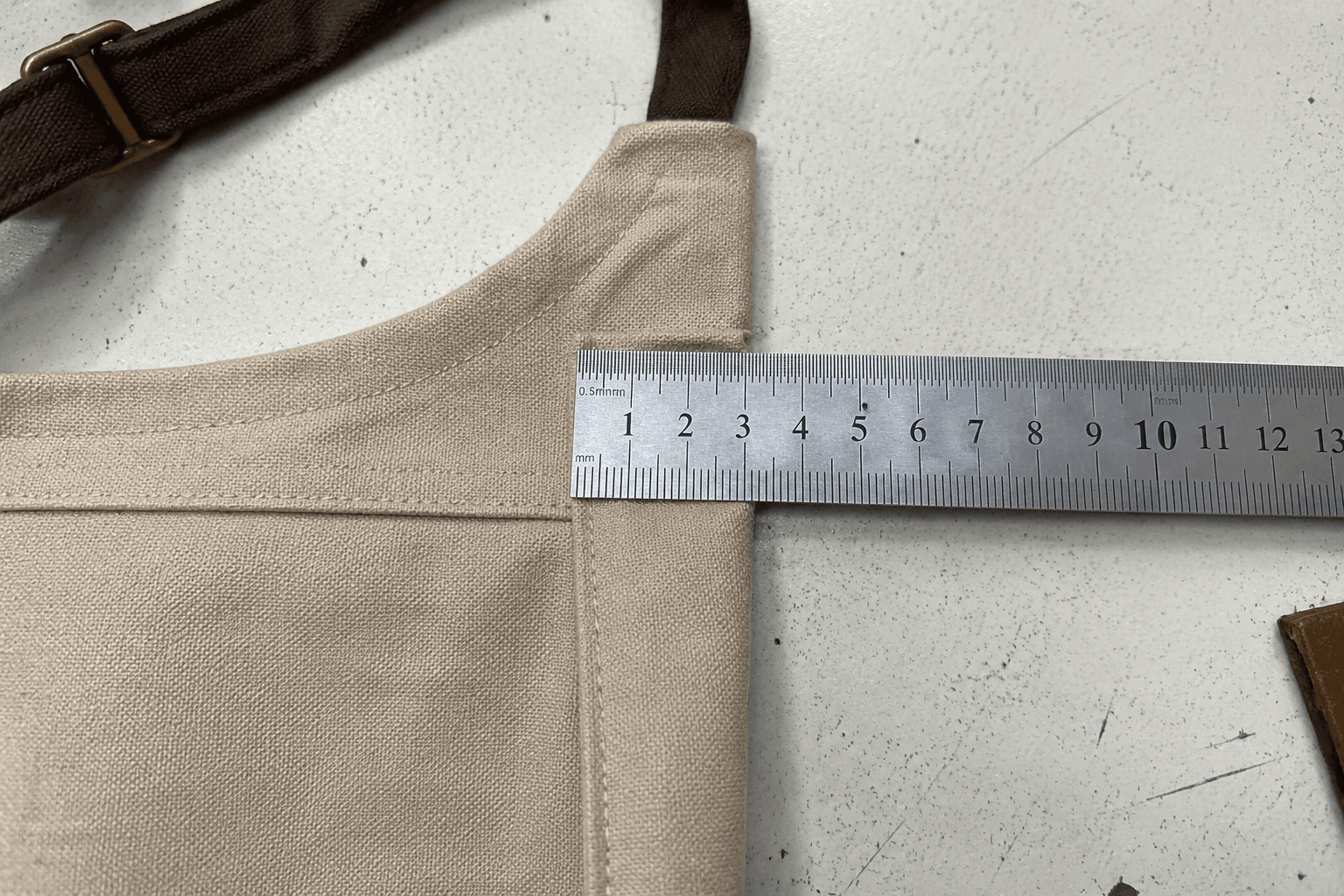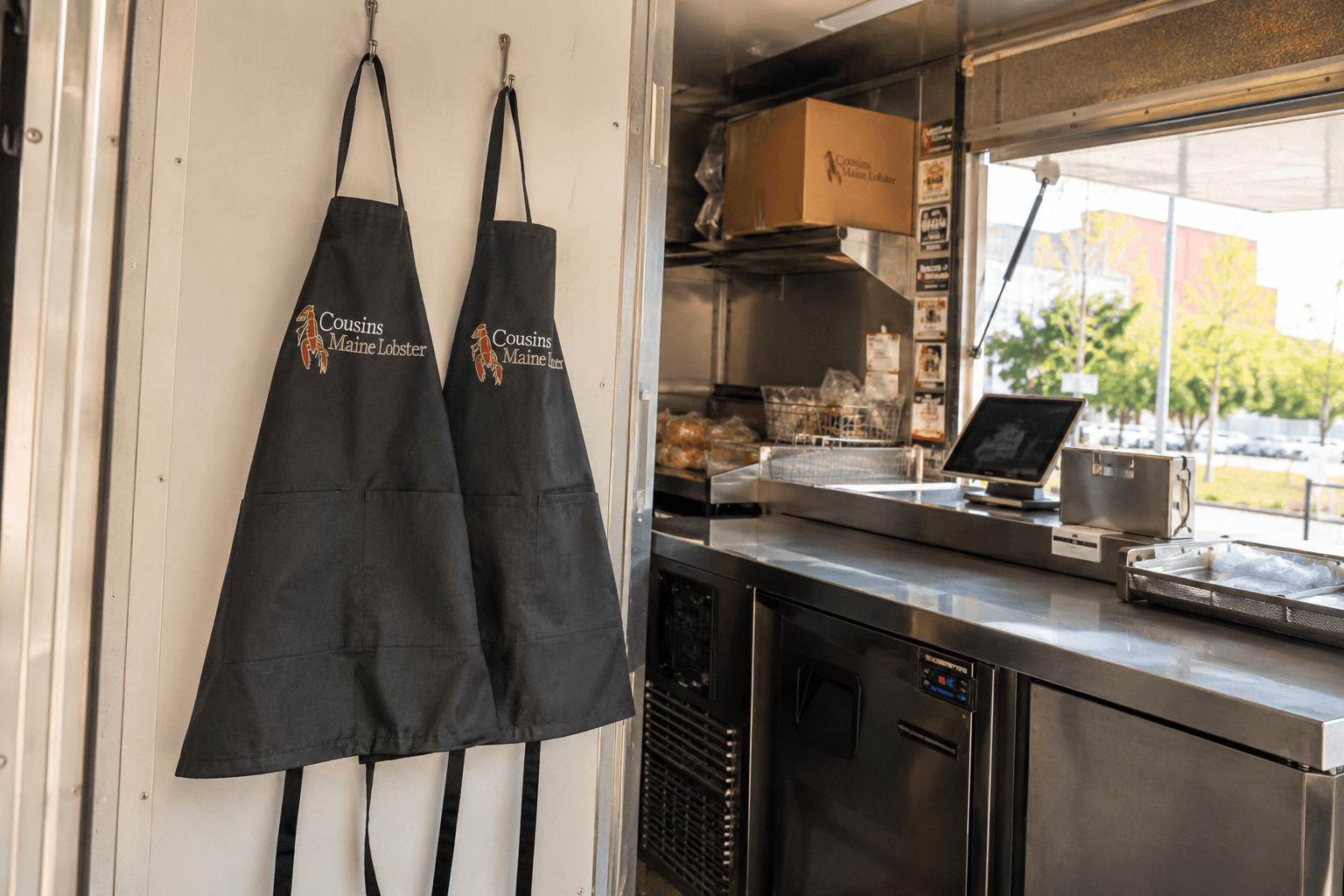
For uniform buyers, split leg apron manufacturing is a pattern and process decision with direct sourcing consequences. The front opening changes marker layout, sewing sequence, pressing control, and final inspection criteria. On a single salesman sample, the cost difference may look minor. On a 3,000 to 10,000 piece apron order, the same change affects labor minutes, fabric yield, defect risk, and delivery reliability.
A standard closed-front apron hangs from one stable front panel. A split-leg apron creates two free front drops that must match in length, stay flat after pressing, and remain balanced after washing. If the left and right drops differ by more than 0.5 to 0.7 cm at final inspection, many import buyers will reject the piece as a major visual defect under AQL 2.5, even when seam strength is acceptable. That is why split styles need tighter grain control, clearer hem specs, and a defined reinforcement method.
In most apron programs, the split itself is not the largest cost driver. The larger price movement usually comes from fabric GSM or oz weight, pocket complexity, wash treatment, trim count, branding, and pack-out method. At 5,000 pieces, a basic 235 to 245 GSM 65/35 polycotton twill split waist apron may cost only $0.20 to $0.40 more than a comparable closed-front version. A 10 oz to 12 oz canvas bib apron with bound split edges, multiple utility pockets, woven label, and retail folding can add $0.80 to $1.50 per piece. Buyers who freeze those details before the PP sample stage get cleaner quotes and fewer cost revisions.
- Split leg apron manufacturing usually adds 0.3 to 0.9 SMV, or about 7% to 18% sewing time, compared with a similar closed-front apron.
- For stable bulk production, 220 to 280 GSM twill and 8 oz to 10 oz canvas are the most workable ranges because they balance drape, opacity, and edge control.
- A 0.7 to 1.0 cm double-turned hem is usually the lowest-risk and lowest-cost finish for split openings; binding and decorative topstitching add labor and defect exposure.
- The split top should be reinforced with a bartack, box stitch, triangle stitch, or concealed patch; weak reinforcement often causes failures within the first 10 to 20 wear days.
- MOQ often stays near other custom apron programs, but a new split style commonly adds 7 to 14 calendar days to development and 2 to 5 days to bulk planning.
- Price comparisons are only valid when split and non-split aprons use the same fabric, pockets, trims, branding, packaging, and inspection standard.
Why split leg apron manufacturing changes labor cost, marker yield, and QC tolerance
Many buyers treat the split opening as a simple style line. In factory costing, it affects cutting, sewing, pressing, and final inspection at the same time. The cutting room handles a more complex front shape, operators sew two visible opening edges instead of one stable front body, and QC must check split depth, left-right balance, edge flatness, and reinforcement security on every unit.
For a basic waist apron in 240 GSM 65/35 polycotton twill, a closed-front style may run at 4.1 to 4.4 SMV. A centered split with two 0.8 cm double-turned hems and one bartack at the split top often raises that to 4.5 to 5.2 SMV. In factories costing labor at $0.045 to $0.065 per SMV, that adds about $0.02 to $0.06 per piece in sewing cost before trims, packing, or wash charges. At 8,000 pieces, the extra labor alone can move the quote by $160 to $480.
Fabric yield also changes. A simple mirrored split may reduce marker efficiency by only 1.5% to 2.5%, but overlap fronts, deep curved openings, or stripe-matching requirements can push the loss to 3% to 5%. Since fabric commonly represents 45% to 60% of apron FOB, this matters more than the added sewing line on its own. Final inspection also becomes stricter. Most export apron programs use AQL 2.5 for major defects and AQL 4.0 for minor defects. On split styles, visible imbalance, twisting, or a split top not centered to tolerance is often booked as a major visual defect because it affects presentation on both hanger and wearer.
- Typical added labor for a standard split apron is 0.3 to 0.9 SMV per piece.
- Common production tolerance for split depth is plus or minus 0.5 cm.
- Visible left-right front drop difference should usually stay within 0.5 to 0.7 cm.
- New split styles often need 2 to 5 extra planning days for wear testing, pressing trials, and added QC checkpoints.
Pattern engineering in split leg apron manufacturing: split depth, symmetry, and wearer movement
A workable split-leg apron pattern is not made by cutting a slit into a standard apron front. The split depth has to match the finished apron length, target job function, and fabric behavior. Service staff need enough opening for walking, squatting, stair use, and pivoting, but the split cannot rise so high that the front swings open excessively during standing tasks or table service.
For adult apron programs, a practical split depth is usually 22 to 36 cm measured upward from the finished hem. The correct range depends on finished body length. On a 70 to 75 cm waist apron, a 24 to 28 cm split often gives moderate mobility without excessive exposure. On an 88 to 95 cm bib apron, that same depth may feel too short, and 30 to 34 cm is more common. Many factories start development at roughly 32% to 38% of finished body length, then adjust after proto fitting and PP sample review.
Symmetrical construction is usually the lowest-risk option for commercial production. Some buyers request overlap fronts or underlap panels so the apron looks closed when the wearer stands still. That can improve coverage, but it adds pattern pieces, handling time, and a higher chance that one side hangs differently from the other after wash or pressing. For most hospitality, salon, and retail uniform programs, a centered mirrored split with one reinforced top point gives the best balance of mobility, appearance, and line efficiency.
- A centered mirrored split is usually the easiest style to cut, sew, press, and inspect at scale.
- Overlap or underlap fronts can add about 3% to 8% labor on the same apron block.
- Wear testing should involve at least two users with different heights or stride lengths before PP approval.
- For striped or checked aprons, split alignment should be approved before marker release because center-front mismatch is highly visible.
Fabric weights that keep split aprons stable in bulk production
Fabric choice determines whether split edges hang cleanly or distort after sewing and laundering. For split aprons, the main sourcing issue is not softness alone; it is edge stability under repeated use. Very light cloth can curl, torque, or show excessive opening. Very rigid heavy cloth can stand away from the body and make the split look wider than intended. The safest commercial range sits in the middle.
For high-volume foodservice and retail aprons, 220 to 245 GSM polycotton twill is a dependable baseline. It holds shape, controls shrinkage better than many all-cotton fabrics, and runs efficiently on standard single-needle and overlock equipment. In quantities of 3,000 to 5,000 pieces, a basic split waist apron in this range may land around $2.20 to $3.80 per piece FOB depending on pocket count, print or embroidery, tie construction, and packing method. For more premium salon, workshop, or lifestyle retail aprons, 260 to 320 GSM cotton twill or 8 oz to 10 oz canvas gives stronger coverage and a more substantial hand, but sewing, pressing, and hem control become more demanding.
Wash requirements need to be fixed before price approval. Enzyme wash, garment wash, and stone wash can increase edge torque at the split if the cloth is not preshrunk and cut accurately on grain. Buyers should ask for actual lot test data, not only a generic fabric card. Warp and weft shrinkage below 3% is generally manageable for split balance. Once shrinkage rises above 4%, the risk of uneven front hang and left-right length variation becomes materially higher, especially on longer bib aprons.
- 220 to 280 GSM is the safest general range for frequent-use split aprons in hospitality and retail.
- 8 oz to 10 oz canvas gives better body for premium aprons but usually adds sewing and pressing cost versus 235 GSM twill.
- Yarn-dyed stripes, checks, coated finishes, and brushed surfaces need tighter cutting control and usually lower marker efficiency.
- Before bulk approval, buyers should request GSM tolerance, shrinkage, colorfastness, and seam-slippage data where relevant.
Hem finishing options in split leg apron manufacturing and their unit-cost effect
In many apron quotes, the hidden cost variable is the split-edge finish rather than the split itself. A split creates two extra visible vertical edges and one concentrated stress point at the split top. Each finishing method changes machine time, trim consumption, operator skill requirement, and rework probability. If the buyer specifies the split but leaves the edge finish open, the quote often changes after sample confirmation.
For most apron programs, a 0.7 to 1.0 cm double-turned hem is the most economical and stable option. It protects the edge, runs on standard equipment, and adds no extra trim. On 210 to 280 GSM twill, it usually gives the best balance of appearance and line speed. Bound edges are useful when the brand wants contrast detail or when the fabric frays aggressively, but they require tape, more handling, and tighter control at the split endpoint where puckering is common. On 10 oz to 12 oz canvas, binding may improve showroom appearance, yet it often adds $0.12 to $0.30 per piece in trim and labor versus a standard turned hem.
Hem width must also match fabric weight. A narrow fold on heavy canvas can rope and spring outward after pressing. A wide fold on lighter twill can stiffen the opening and reduce movement. Decorative twin-needle topstitching is another common cost leak. It can look premium on a sample, but on 5,000 pieces it raises thread use, alignment pressure, and rework when stitching drifts near the split top. Buyers should ask suppliers to quote hem finish as a separate price delta so the extra cost stays visible.
- A standard double-turned hem is usually the lowest-cost finish for split aprons.
- Binding or contrast tape adds trim cost, slower sewing speed, and higher puckering risk.
- A bartack placed about 0.5 to 1.0 cm above the split top helps prevent seam failure during bending and stepping.
- Fabrics above 300 GSM often need wider seam allowance and a revised pressing sequence to keep split edges flat.
Reinforcement, pocket position, and service-life risk on working aprons
The split area is a stress point, so durability depends more on reinforcement than on appearance. In daily service use, the top of the split absorbs repeated force from walking, kneeling, turning, and pocket loading. An apron can pass final visual inspection and still fail after 10 to 20 wear days if the split ends with only a weak backstitch and no structural reinforcement. This is one of the most common failure points on low-cost development samples.
A practical construction uses at least one reinforcement method: bartack, triangle stitch, short box stitch, or concealed backing patch. On 180 to 220 GSM twill, a compact bartack is often enough without creating excess bulk. On 280 to 350 GSM canvas, a box stitch or hidden patch usually distributes stress better. Some buyers ask for rivets for a workwear look, but on aprons they can scratch tables or counters, chip in commercial washing, and create complaints in foodservice settings. In most B2B apron programs, stitched reinforcement is the safer commercial choice.
Pocket placement should be reviewed together with the split path. If a lower patch pocket sits too close to the opening, the pocket load can pull the front panel inward and distort the split during wear. A clear tech pack should therefore show finished body length, split depth, reinforcement type, distance from split top to nearest pocket edge, and stitch specification. Without those details, sample-to-bulk consistency becomes difficult, and defect judgment during final inspection becomes subjective.
- Keep major pocket attachment lines at least 2 to 3 cm away from the split path where the design allows.
- Rivets typically add about $0.04 to $0.10 each before setting labor and added inspection.
- Bartack density should match fabric strength because overly dense bartacks can cut softer yarns after repeated laundering.
- A 5 to 10 day wearer trial often reveals split-top stress failures that office sample review misses.
MOQ, sample rounds, and lead-time planning for commercial split apron orders
Split aprons do not always require a higher MOQ, but they do require more disciplined development. If the supplier already stocks the fabric and standard webbing or self-fabric ties, MOQ can stay close to ordinary custom apron programs. A simple twill split waist apron often starts at 300 to 500 pieces per color. Washed canvas bib aprons with custom labels, extra pockets, and branded retail packaging more often start at 800 to 1,000 pieces per color because trim setup and development cost are higher.
Sampling should be treated as movement approval rather than visual approval only. A proto that looks clean on a mannequin can still feel restrictive during stepping, kneeling, or tray service. For a new split pattern, many reliable factories recommend one proto sample, one revised fit sample, and one PP sample before bulk cutting. Compared with a proven closed-front apron block, that usually adds 7 to 14 calendar days to development and 2 to 5 days to production planning.
Bulk lead time depends more on fabric and trim complexity than on the split alone. A straightforward split apron in stocked 235 to 245 GSM twill can usually ship in 20 to 30 days after fabric confirmation, PP approval, and deposit. A 10 oz to 12 oz canvas bib apron with custom dyeing, wash effect, branded labels, and retail fold packing may need 35 to 50 days. Barcode stickers, ratio packs, carton drop-test approval, or final audit booking can add another 3 to 5 days. Late changes to split depth, hem finish, or pocket position after PP approval usually affect both delivery and cost.
- Common MOQ is 300 to 500 pieces per color for basic twill split aprons.
- More complex canvas programs often start at 800 to 1,000 pieces per color.
- A new split style usually needs one to two more sample rounds than a standard closed-front apron.
- Realistic bulk lead time is 20 to 30 days for simple styles and 35 to 50 days for washed or trim-heavy styles.
How B2B buyers should compare split aprons with closed-front options
The practical sourcing question is not whether a split apron costs more; in most cases it does. The better question is whether the mobility gain justifies the extra complexity for the target job. For reception, cashier, or host-stand roles, the functional return may be limited. For servers, baristas, florists, salon teams, and retail associates who move continuously, the improvement in stride and kneeling range is often worth a modest premium.
A fair comparison requires the split and non-split apron to use the same fabric, same pocket layout, same branding, same packaging, and the same inspection standard. Only then can the buyer isolate the actual price premium of the split construction. In many China apron quotes, that premium on a medium-complexity style is around 5% to 12%. When the gap is much larger, the real driver is usually elsewhere: heavier cloth, garment wash, lower order volume, bound edges, added embroidery, or retailer-specific packing requirements.
Before approving the final quote, buyers should lock five technical points: split depth, hem finish, fabric GSM or oz weight, reinforcement method, and pocket position. Those items control most of the cost and quality risk in split leg apron manufacturing. Once they are fixed, the supplier can quote more accurately, set realistic lead times, and hold consistent QC standards from cutting through final packing.
- Compare split and non-split aprons only when fabric, trims, branding, and packing are identical.
- Expect roughly a 5% to 12% price increase for a moderate split design in commercial volume.
- Ask suppliers to show separate cost deltas for fabric upgrade, hem finish, reinforcement, branding, and packaging.
- Freeze technical specifications before price approval to reduce quote revision, rework, and bulk inconsistency.