A spa apron is a quiet product, but it carries a high workload. It must look calm and clean in front of guests, feel light during long treatment shifts, tolerate lotion and oil contact, and return from laundry without twisting, shrinking, or looking tired after a few weeks. For sourcing managers, the challenge is usually not finding an apron pattern; it is balancing softness, opacity, recovery, and easy care at a bulk price that works across multiple spa locations.
In our Zhejiang apron factory, we normally see spa and wellness buyers request three main types: a lightweight front-of-house wellness apron, a practical massage therapist apron for treatment work, and a slightly more structured therapist uniform apron for hotel spa chains. These products may look similar in a catalogue, but the fabric handfeel, strap system, pocket placement, and wash performance should be specified differently.
This guide explains the main sourcing decisions behind a custom spa apron order, including fabric GSM, construction choices, trims, MOQ, sampling time, and bulk production lead time. The goal is to help buyers write clearer tech packs and avoid common problems such as apron neck pull, oil staining, poor drape, uneven color between batches, and shrinkage after industrial washing.
- A spa apron should normally use 160-240 GSM fabric for comfort, unless heavy stain exposure requires a denser construction.
- A massage therapist apron needs soft drape, stable straps, and pocket positions that do not interfere with bending or side movement.
- Easy-care performance depends on fiber blend, pre-shrinking, colorfastness, and seam construction, not fabric name alone.
- For custom wellness uniforms, a realistic MOQ is usually 300-500 pcs per color for dyed fabric and 1000 pcs or more for custom woven or printed fabric.
- Sampling normally takes 7-12 days after artwork and fabric confirmation, while bulk production is commonly 25-40 days depending on dyeing and trim complexity.
- The lowest unit price can become expensive if the apron pills, shrinks, or loses shape after 10-15 wash cycles.
Spa apron use cases are different from cafe or kitchen aprons
A spa apron is not a kitchen apron with a softer color. In food service, the buyer may prioritize heat resistance, heavy soil coverage, and strong pocket capacity. In spa and massage environments, the product is judged more by comfort, quiet appearance, skin feel, and how it behaves during close guest contact. The wearer may lean over a treatment table, carry small bottles, fold towels, clean surfaces, or move between wet and dry rooms. A stiff bib, rough neck tape, or badly placed pocket is noticed quickly.
For a massage therapist apron, the most important movement zones are the neck, shoulder, waist, and hip. If the bib is too high, it can rub against the collarbone. If the waist tie is too narrow, it can curl after washing and feel sharp during a full shift. If the pocket is placed too low, it may hit the treatment table when the therapist bends. These are small pattern details, but they decide whether the apron is used daily or left in storage.
We recommend that buyers separate spa apron requirements by department before asking for price. Reception, nail care, facial treatment, massage therapy, housekeeping support, and wet spa areas may need different fabrics or pocket layouts. One universal apron can reduce SKU management, but it may compromise comfort for the treatment team or durability for cleaning staff.
- Reception and retail counters usually need a neat wellness apron in 160-200 GSM fabric with minimal pocket bulk.
- Massage and facial treatment teams usually need a soft apron with good side movement and oil-resistant dark or mid-tone colors.
- Nail and beauty service teams often need stronger stain management, with 200-240 GSM twill or treated polyester-cotton.
- Wet spa or sauna support staff may require faster drying fabric and rust-resistant trims instead of cotton-rich constructions.
Choosing spa apron fabric by GSM, fiber, and handfeel
Fabric selection drives most of the final cost and performance. For spa orders, buyers often ask for cotton because it sounds premium and breathable. Cotton can be suitable, especially for boutique spas that want a natural soft apron, but 100% cotton also wrinkles more, dries slower, and may shrink 3-5% if not pre-shrunk. For multi-location operators, polyester-cotton or rayon-blend fabrics often give a more stable result at a controlled cost.
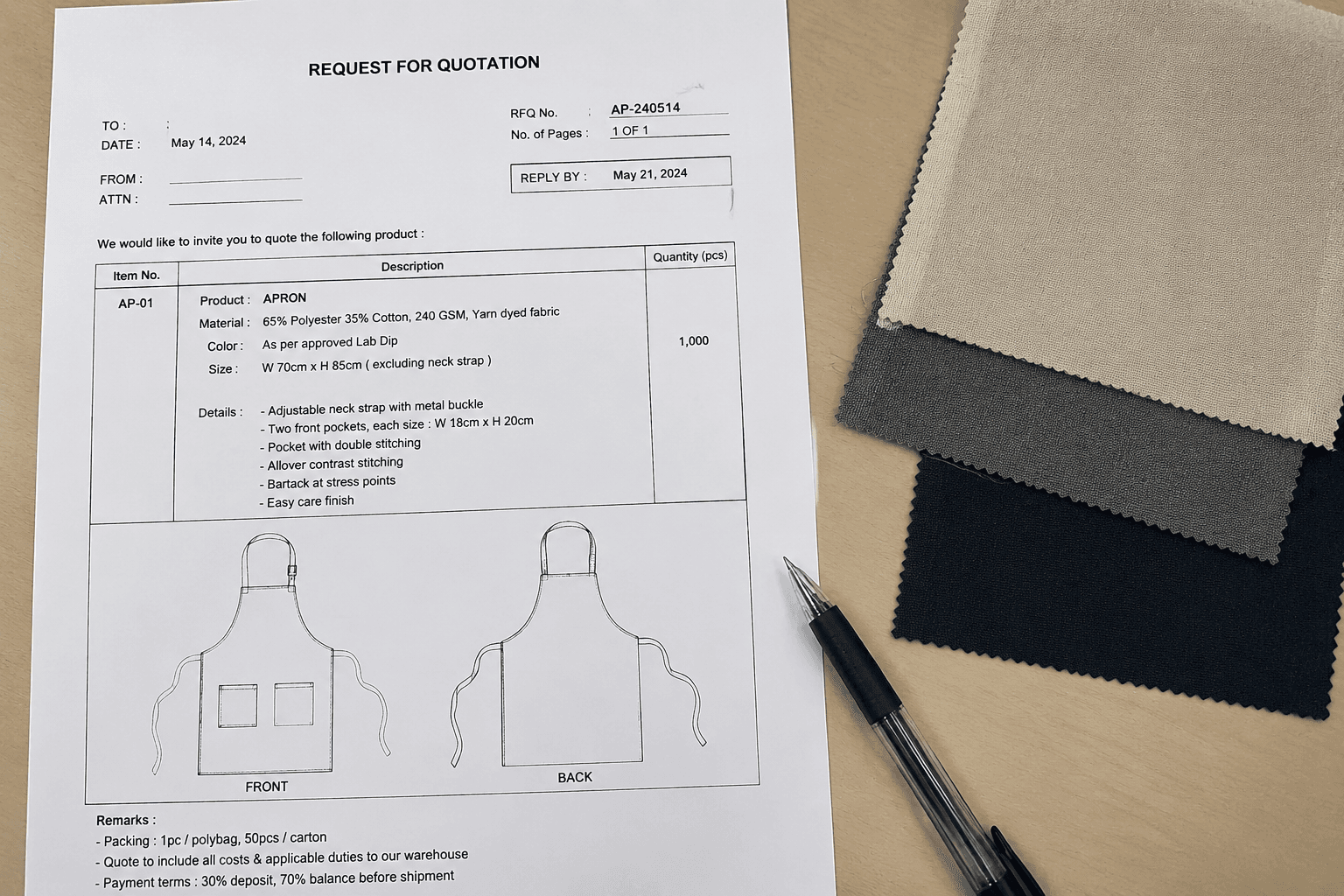
A common specification for a custom spa apron is 65/35 polyester-cotton twill at 190-220 GSM. This gives enough opacity for light colors, better crease recovery than 100% cotton, and acceptable durability for commercial laundering. For a softer wellness apron, a 180-210 GSM cotton-rayon or cotton-modal blend can provide a smoother handfeel, but the buyer should expect higher fabric cost and more careful washing instructions. For high-traffic treatment rooms, a 220-240 GSM compact twill is safer, although it will feel warmer.
The key is to test fabric by touch and by wash, not only by composition. Two fabrics with the same GSM can drape very differently because of yarn count, weave density, finishing, and softener. In sampling, we normally prepare one target fabric and one cost-saving alternative. The buyer can then compare handfeel, opacity, color depth, and wash recovery before confirming bulk production.
- 160-180 GSM plain weave is light and comfortable, but it may be too transparent in white, ivory, or pale grey.
- 190-220 GSM poly-cotton twill is a practical middle range for most therapist uniform apron programs.
- 220-240 GSM twill gives better structure and stain tolerance, but it may feel heavier during long massage shifts.
- Cotton-rayon or cotton-modal blends improve softness, but require tighter control of shrinkage and pilling.
- Recycled polyester blends are possible, but MOQ may rise to 500-1000 pcs per color depending on fabric availability.
Spa apron patterns should reduce neck pressure and improve movement
Apron comfort is partly fabric, but pattern engineering matters just as much. A standard bib apron often places weight on the neck. This is acceptable for short service periods, but for massage therapists working 6-8 hour shifts, neck pressure becomes a real complaint. A cross-back strap, split neck strap, or wider adjustable neck tape can improve comfort. However, cross-back styles take more sewing time and require clearer size grading, so the unit price usually increases by USD 0.25-0.60 per piece depending on strap material and hardware.
For a massage therapist apron, the bib width should protect the upper garment without restricting shoulder motion. Many buyers choose a bib width of 24-27 cm at the top and 60-70 cm at the lower body for adult unisex sizing. Total length often falls between 70 and 85 cm, depending on whether the apron is intended to cover tunic tops only or extend toward the upper thigh. For petite teams or Asia-specific sizing, we often reduce total length by 3-5 cm and adjust tie length to prevent loose hanging ends.
Waist ties should be tested after washing. A 1.5 cm tie may look neat in product photos, but it can curl, twist, and feel uncomfortable. For spa uniforms, 2.0-2.5 cm finished tie width is more stable. If the fabric is very soft, adding light interlining inside the neck strap or using self-fabric straps with reinforced bartacks can prevent early deformation.
- Use cross-back straps when the wearer carries tools in pockets or works full treatment shifts.
- Use adjustable neck straps when one apron size must fit mixed-height teams across several locations.
- Keep waist ties at 85-100 cm per side for standard adult sizing, or confirm exact tie method with the buyer.
- Place bartacks at stress points including neck strap ends, waist tie joins, and pocket corners.
- Avoid oversized bibs on soft fabrics because the apron may collapse and look untidy after laundering.
Pocket design for a massage therapist apron
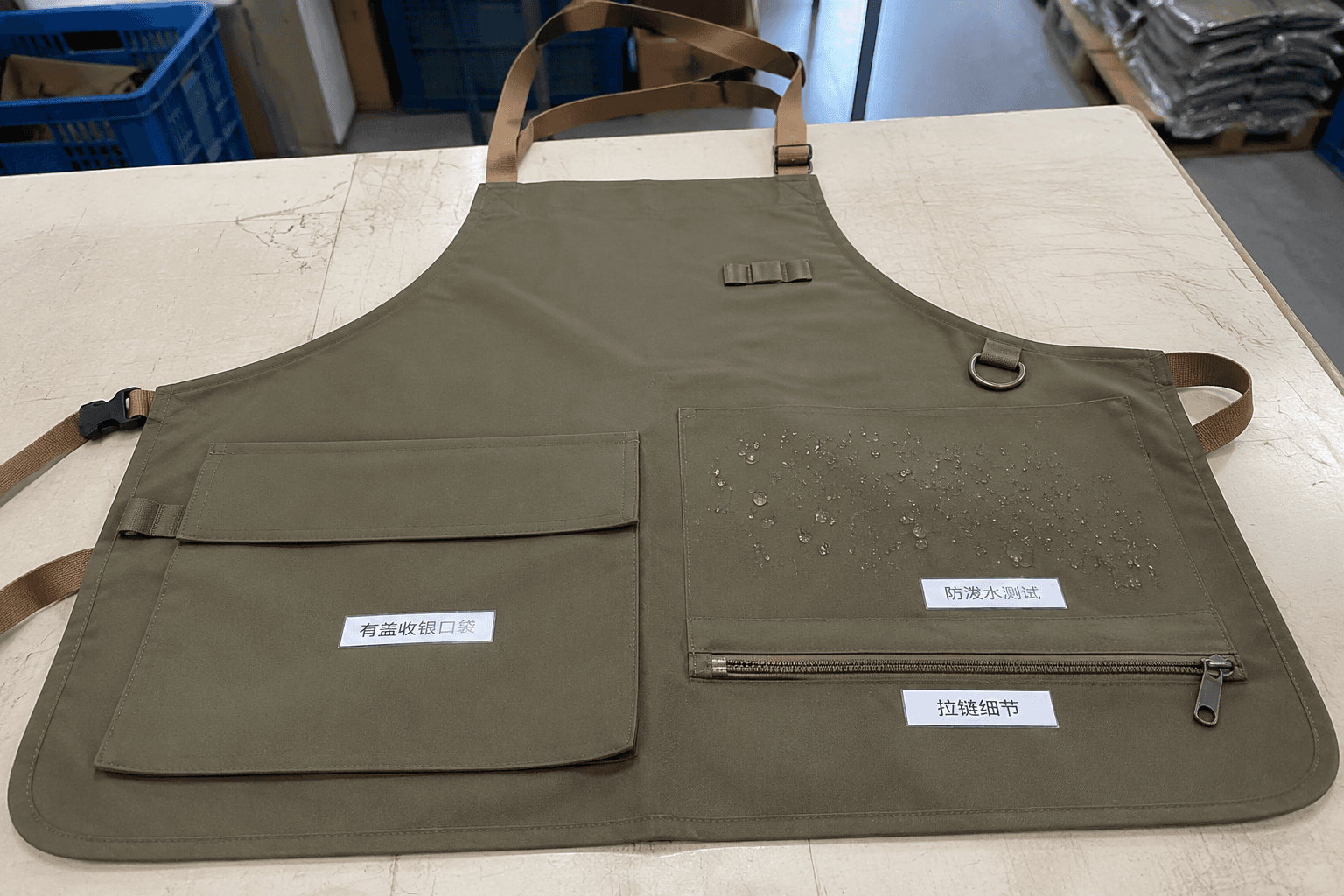
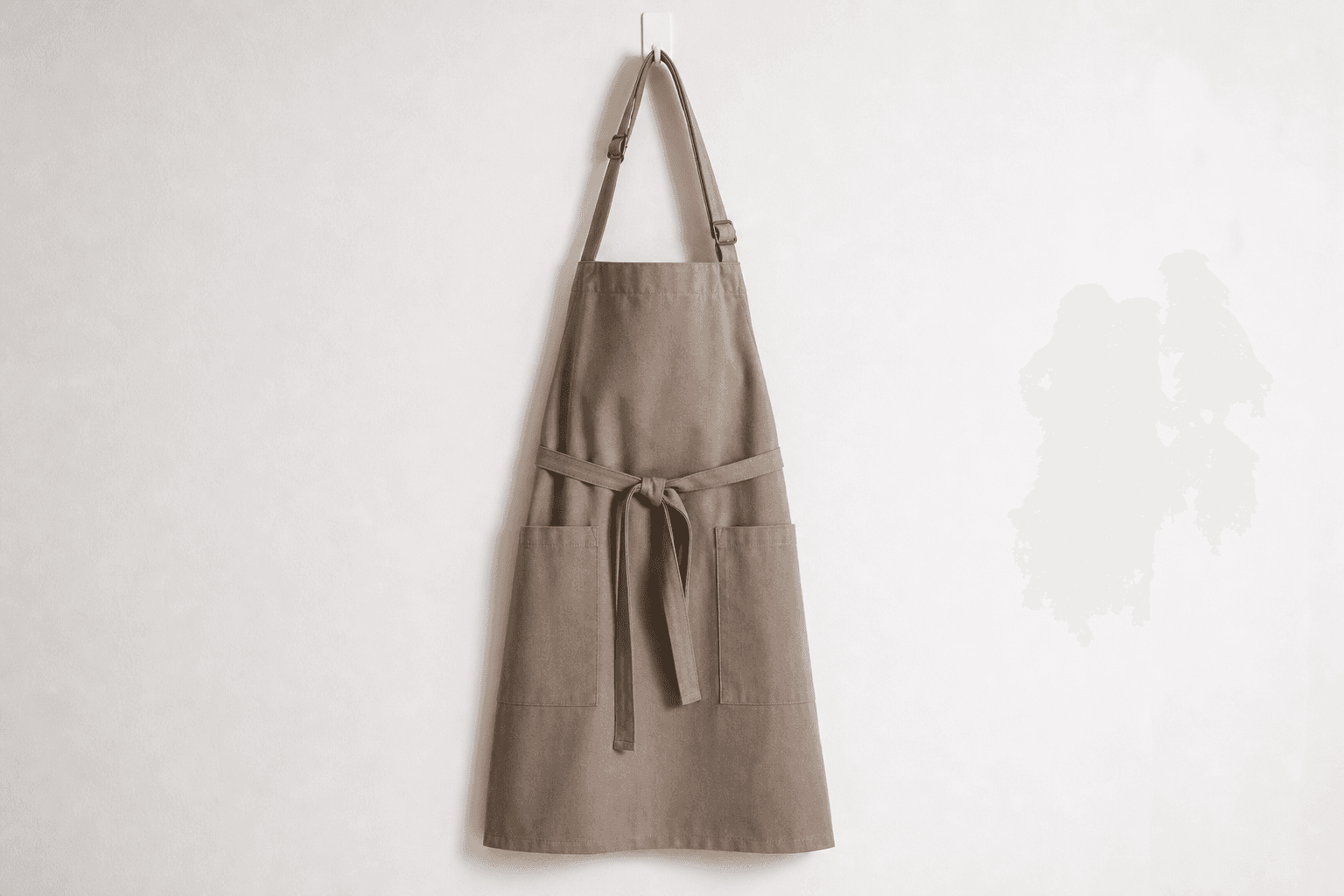
Pocket design should follow actual work behavior. A spa therapist may need to carry a room key, small notepad, pen, balm tube, disposable mask, treatment card, or small bottle. Large cargo pockets can look useful, but they may create bulk and swing against the table. For most massage therapist apron orders, two lower patch pockets or one divided kangaroo pocket is enough. Pocket depth of 15-18 cm works for small tools without trapping the hand.
For front-of-house wellness apron styles, pockets should be cleaner and flatter. A hidden inner pocket or narrow pen pocket can be more professional than large visible compartments. If the spa uses tablets or POS devices, the pocket must be tested with the actual device. A pocket that fits an 8-inch tablet on paper may pull the apron forward and create neck pressure in use.
We suggest avoiding metal rivets for treatment-room aprons. They can scratch equipment, become noisy, and may not match the calm visual standard of the spa. Reinforced stitching and bartacks are usually enough. If a brand wants a premium detail, matte resin buttons, tonal embroidery, or a small woven label are usually better choices than shiny hardware.
- Lower patch pockets should usually be 14-16 cm wide and 15-18 cm deep for treatment tools.
- Pocket openings should be slightly angled only if the pattern is tested, because too much angle can drop small items.
- Pen slots should be 2.5-3.0 cm wide after sewing, not only before seam allowance.
- Tablet pockets require stronger fabric and wider straps because loaded weight changes apron balance.
- Tonal pocket stitching gives a cleaner therapist uniform apron look than high-contrast thread.
Easy-care performance starts before sewing
Easy care is often written as a simple label request, but the factory must translate it into fabric finishing, color choice, seam construction, and packing method. For spa apron programs, the most common complaints are wrinkling, oil marks, shrinkage, color fading, and seam puckering. These issues are easier to prevent at fabric approval stage than to correct after bulk goods are sewn.
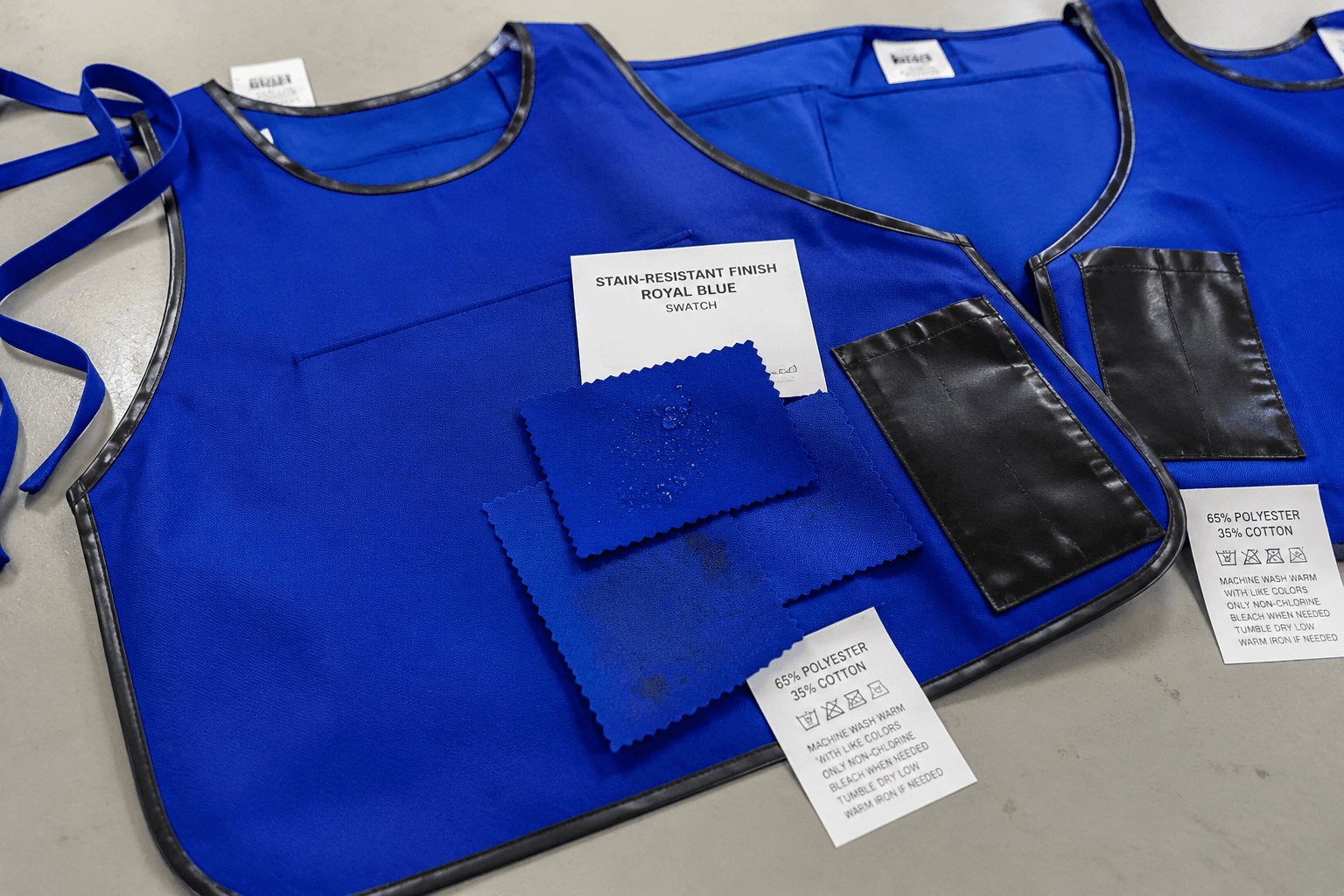
For light colors such as white, cream, sand, sage, and pale blue, opacity and stain recovery must be checked carefully. Massage oils can leave shadows on cotton-rich fabric, especially if the laundry process uses low temperature and mild detergent. A mid-tone color often performs better in real spa operation. Charcoal, warm grey, taupe, olive, muted teal, and soft navy hide treatment stains better than pure white while still looking calm. If the brand requires white or ivory, we recommend testing after at least 5 wash cycles with oil exposure before bulk confirmation.
Pre-shrinking is important. For 100% cotton spa aprons, we normally target residual shrinkage within 3% after washing, but this depends on fabric and finishing. For poly-cotton, shrinkage can often be controlled within 2-3%. Seam puckering should be checked after wash because a beautiful sample can become uneven if the thread tension, needle size, and fabric shrinkage are not aligned.
- Request wash test data for dimensional change after 3-5 cycles before confirming large orders.
- Use polyester sewing thread for better wash durability and lower color bleeding risk.
- Specify colorfastness to washing at grade 3-4 or above for most commercial spa uniform programs.
- Use darker binding or hidden reinforcement where lotion and oil contact is frequent.
- Avoid heavy starch finishing because it improves showroom appearance but reduces the soft apron feeling after delivery.
Branding options that suit a wellness apron
Branding on a wellness apron should be durable and restrained. Spa buyers usually prefer tonal embroidery, small woven labels, heat transfer logos, or low-contrast screen printing. The right method depends on fabric texture, logo detail, order quantity, and laundering conditions. Embroidery is strong and premium, but dense embroidery on lightweight fabric can cause puckering. Heat transfer can reproduce fine logo details, but it must be tested for wash resistance and surface feel.
For a therapist uniform apron, we often recommend embroidery only when the fabric is at least 190 GSM and the logo is not too large. A left chest logo around 6-8 cm wide or a lower pocket logo around 5-7 cm wide is usually safe. If the logo is bigger than 10 cm on a soft apron, the embroidered area may become stiff and pull the bib out of shape. For very soft fabrics, a woven label at the side seam or pocket edge is often cleaner.
Color matching also needs realistic tolerance. Fabric dyeing, embroidery thread, woven labels, and printed logos all use different materials, so an exact match across all components is not always possible. Buyers should approve a physical lab dip or thread card instead of relying only on Pantone codes on screen. For multi-year spa uniform programs, it is useful to keep approved fabric swatches and trim records at both buyer and factory sides.
- Embroidery is suitable for simple logos, 190 GSM or heavier fabric, and premium hotel spa uniforms.
- Heat transfer is suitable for detailed logos, but bulk approval should include wash and handfeel testing.
- Woven labels are cost-efficient for MOQ 500 pcs and above, with typical label lead time of 7-12 days.
- Screen printing works for flat areas, but heavy ink can reduce softness and may crack under harsh washing.
- Tonal branding usually fits spa environments better than bright contrast logos.
MOQ, price ranges, and lead times for custom spa apron orders
MOQ depends mainly on fabric availability, dyeing requirements, and branding method. If the buyer selects stock fabric and a simple logo, a factory may accept 100-300 pcs per style, although the unit price will be higher because cutting, printing, and sewing setup costs are spread across fewer pieces. For dyed-to-order fabric, 300-500 pcs per color is more realistic. For custom woven fabric, yarn-dyed stripes, recycled certified fabric, or special finishing, MOQ can increase to 1000-3000 pcs.
As a practical reference, a simple poly-cotton spa apron in 190-220 GSM with one pocket and basic embroidery may fall around USD 2.80-4.80 per piece FOB China at 500-1000 pcs, depending on fabric, logo size, and packing. A cross-back massage therapist apron with better fabric, reinforced pockets, and woven label may range from USD 4.20-7.50 per piece. Very soft cotton-modal blends, special washing, garment dyeing, or certified recycled materials can push the price higher.
Sampling usually takes 7-12 days after fabric, measurements, logo file, and trim details are confirmed. If lab dips are required, add 5-10 days. Bulk production is commonly 25-40 days after sample approval and deposit, but peak seasons before major hotel openings or holiday retail launches should be planned earlier. For repeat orders using approved fabric and pattern, production can often be shortened by 5-7 days if fabric is available.
- Stock fabric with simple logo can sometimes start from 100-300 pcs, with higher unit cost.
- Dyed-to-order spa apron fabric usually requires 300-500 pcs per color.
- Custom fabric weaving or special eco-certified material often requires 1000 pcs or more.
- Normal sample time is 7-12 days after all artwork and measurement details are complete.
- Normal bulk lead time is 25-40 days after approval, deposit, and final material confirmation.
- Air shipment may be used for urgent opening orders, but it can add USD 0.50-1.50 per apron depending on weight and destination.
Quality control points before shipping a spa apron order
Final inspection should reflect how the apron will be used, not only how it looks on a table. For spa aprons, we check measurement tolerance, strap strength, pocket symmetry, logo position, shade consistency, fabric defects, needle marks, loose threads, and packing cleanliness. Measurement tolerance is usually plus or minus 1 cm for main body dimensions and plus or minus 0.5 cm for pocket placement, but buyers with strict uniform programs should state their tolerance in the tech pack.
Color shade control is important when a spa chain orders by location or in repeat batches. Even a small shade difference between aprons can be visible at reception. For dyed fabric, we recommend approving bulk fabric cutting only after shade band review. For repeat orders, the buyer should expect some tolerance unless the fabric is reserved from the same dye lot. If exact uniformity is critical, order enough quantity in one batch for all locations plus spare stock.
Packing also affects presentation. A soft apron can arrive badly creased if it is folded too tightly or compressed for too long. Individual polybags are common for hygiene and distribution, but some spa buyers prefer paper bands or bulk packing to reduce plastic use. For B2B distribution, clear size and color labels on master cartons reduce warehouse sorting errors. A typical carton may hold 50-100 pcs depending on apron weight and fold method.
- Check strap pull strength at neck and waist joins, especially on cross-back styles.
- Measure body length, width, pocket position, tie length, and bib width against the approved sample.
- Inspect oil mark visibility and wash recovery before approving pale colors for treatment rooms.
- Confirm logo position tolerance, usually within 0.5-1.0 cm depending on branding method.
- Use carton labels with style number, color, quantity, gross weight, net weight, and destination details.