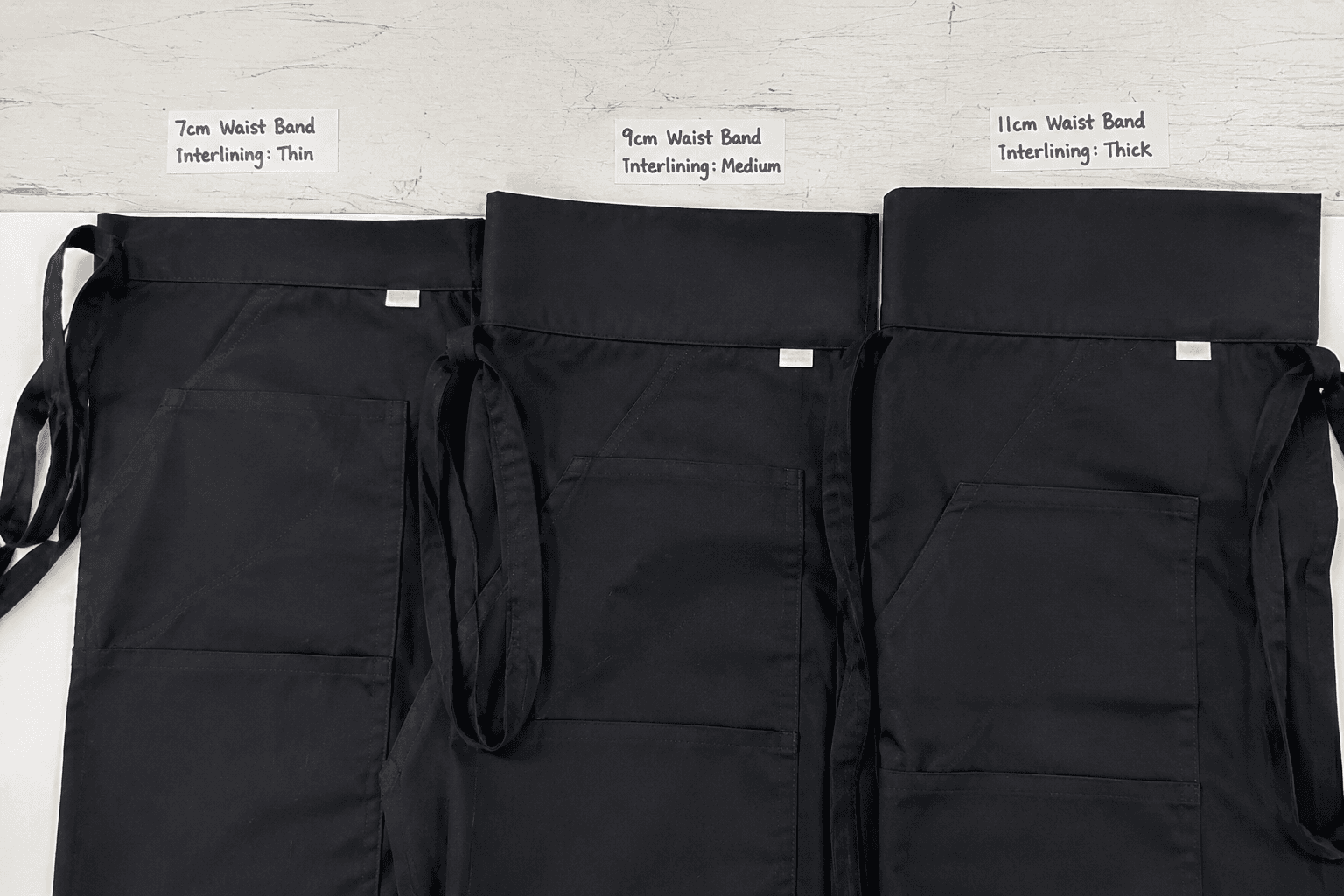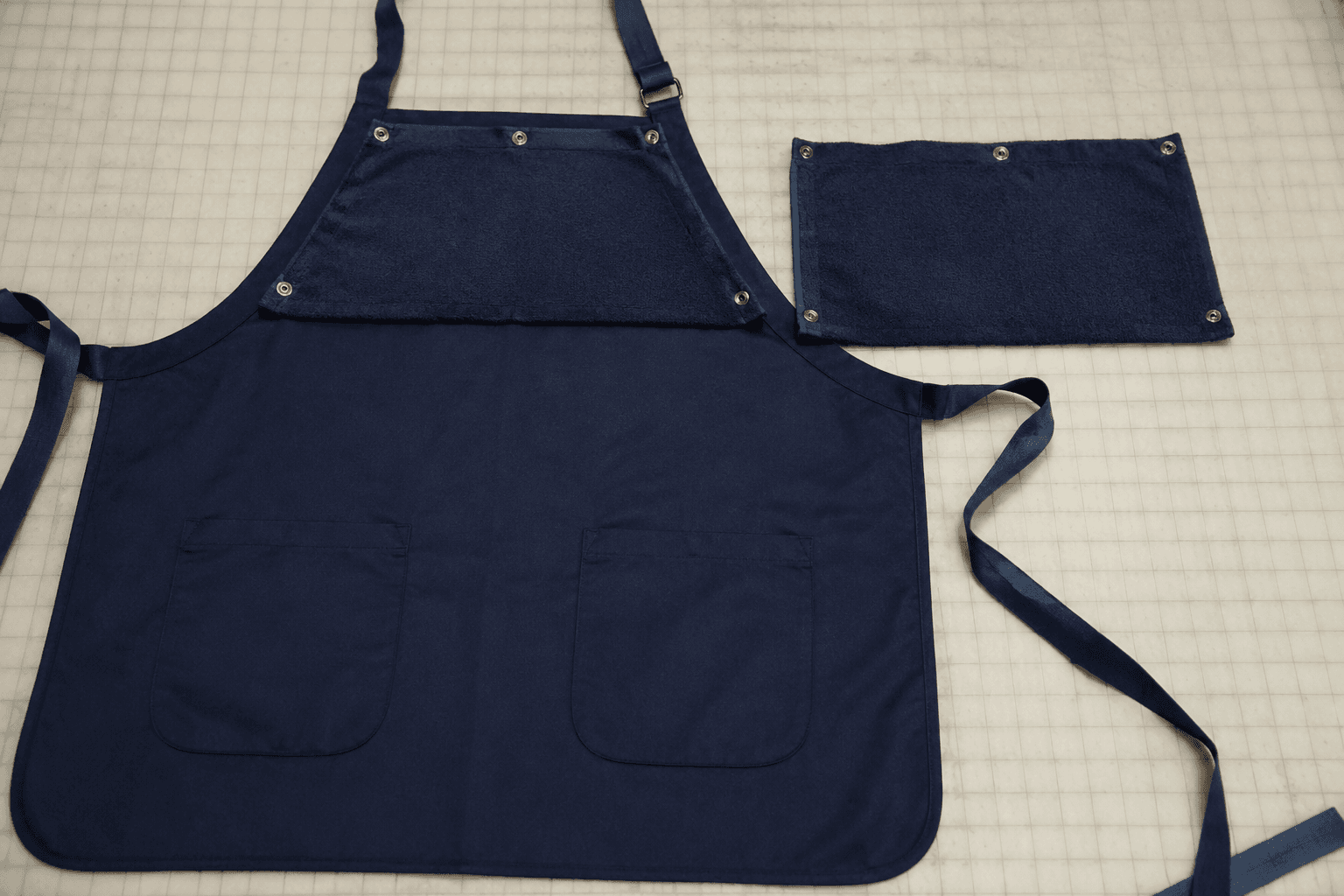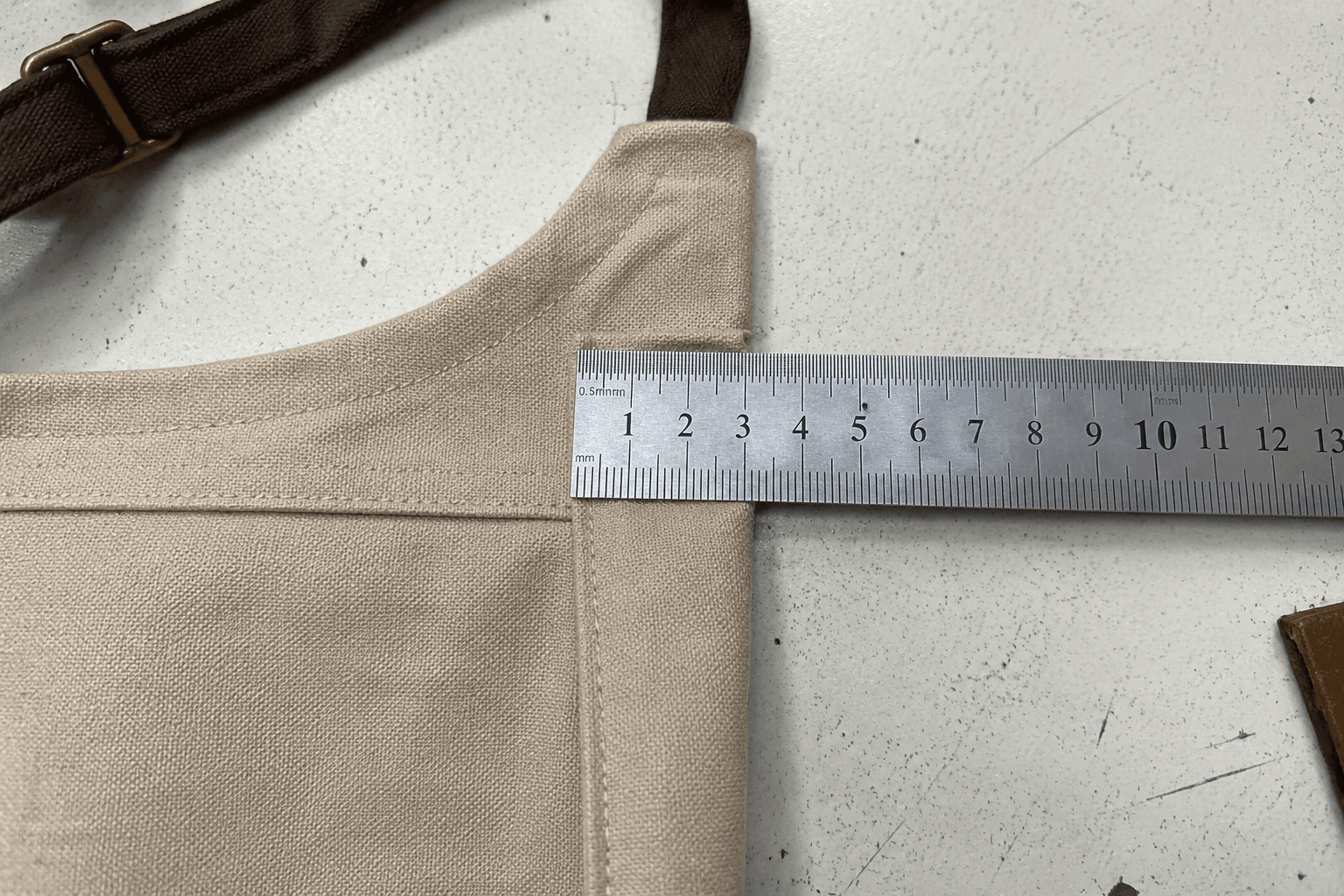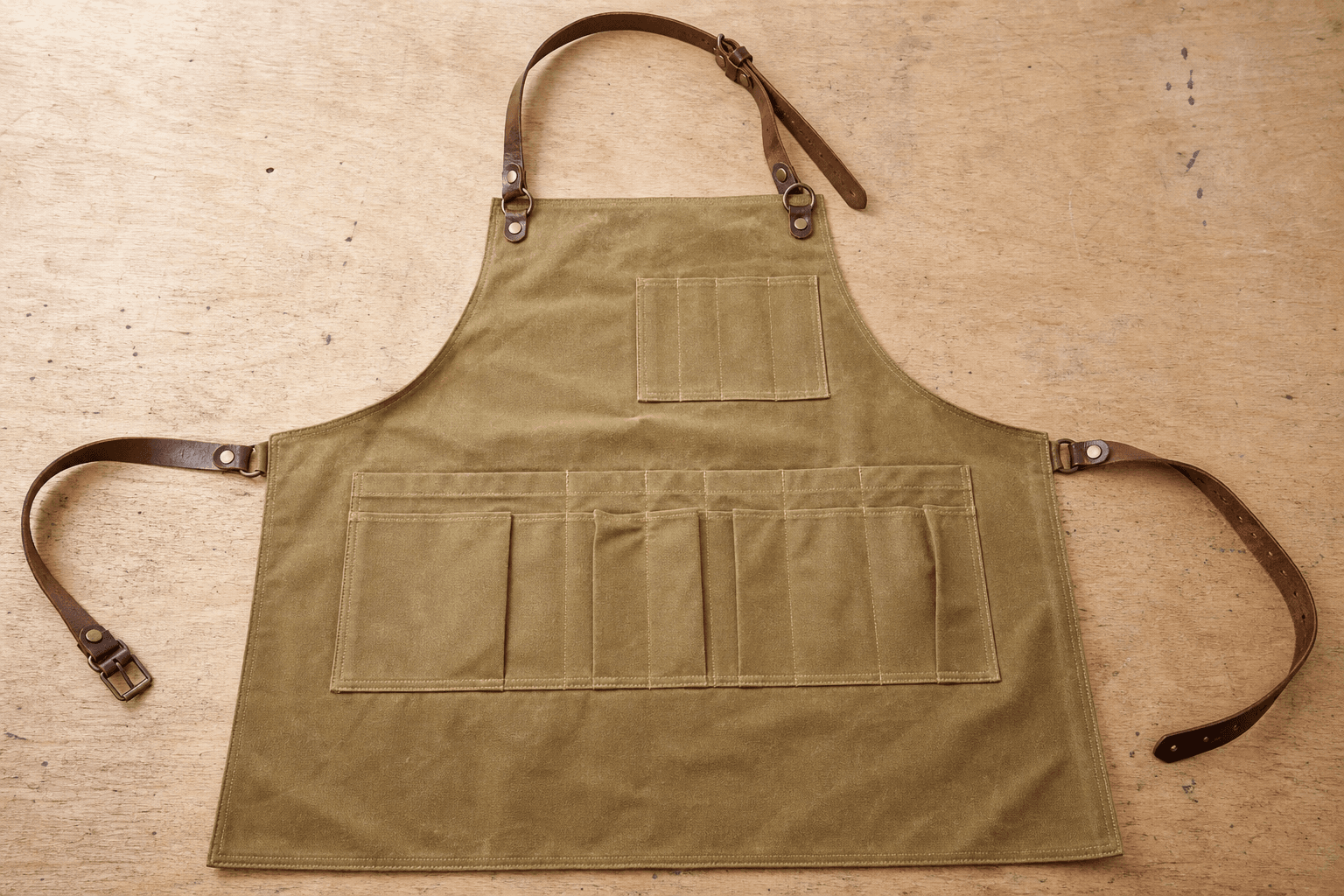
In apron sourcing, FOB cost is only the starting point. Once a buyer issues 5,000, 12,000, or 25,000 aprons across multiple sites, the real question becomes operational control: who received each apron, when it entered service, how long it lasted, and why it was replaced. Serialized apron patches turn an apron from a generic uniform item into a traceable asset with usable replacement history.
This matters most in professional apron programs with frequent washing, staff turnover, and site-level stock movement. Bib aprons, waist aprons, cross-back aprons, and utility aprons often fail through a mix of stain damage, seam stress, collection loss, and over-issue rather than one obvious material defect. Without serialization, buyers rely on store estimates. With serialization, they can compare actual life by site, job role, fabric weight, and construction.
For OEM production, serialization must be fixed before PP sample approval. The code format, patch material, placement, character height, serial file owner, and inspection method should all sit in the BOM and trim approval pack. If buyers add those details after bulk trim booking, remakes, mixed serial blocks, and packing errors can easily cost 3-7 extra days; if numbering logic changes after labels are produced, disruption often reaches 10-15 days.
The commercial upside is measurable. A well-run serial patch program helps procurement teams separate fabric failure from misuse, forecast maintenance orders with more accuracy, and avoid carrying excess safety stock. In China apron sourcing, the strongest results come when the serialization method matches real program scale, expected wash count, MOQ, and target FOB range instead of being treated as a late branding request.
- Lock serialized apron patches into the BOM, serial logic, and placement before PP approval; late changes usually add 3-7 days, and full trim remakes can add 10-15 days.
- Typical add-on cost is $0.04-$0.10/pc for satin or printed serial labels, $0.08-$0.18/pc for woven serialized patches, and $0.20-$0.35/pc for TPU variable-number badges.
- For most 3,000-10,000 piece apron orders, serialization affects trim control, carton allocation, and final inspection more than sewing speed; when planned early, total lead-time impact is usually 3-7 days.
- A usable buyer log should record serial number, wearer or employee ID, site code, issue date, wash or repair events if tracked, replacement date, and replacement reason.
- Replacement planning based on serial history is usually more accurate than site estimates once annual replenishment exceeds 15%-20% of issued apron volume.
Why serialized apron patches matter once apron programs pass 3,000 pieces
The larger the rollout, the weaker informal tracking becomes. In a 4,500-piece café launch across 30 sites or a 22,000-piece program spanning franchise kitchens, bakeries, and commissaries, losses usually come from small control failures: staff turnover, mixed locker issue, laundry mix-ups, unrecorded replacements, and local over-ordering. A standard logo patch cannot identify which apron was issued to which wearer or how long it lasted. Serialized apron patches can.
This is especially relevant for aprons with daily wear and regular washing. A 200-240 GSM polycotton waist apron in quick-service food retail may cycle through heavy stain exposure and frequent handover. A 300-360 GSM canvas bib apron in a bakery or open kitchen may last longer but still suffer from seam stress, bleach exposure, or poor return discipline. When one region replaces 18% of issued aprons in six months and another replaces 7%, a serial record shows whether the problem is fabric life, misuse, theft, or stock control.
For centralized buyers, serialized control also improves replenishment planning. One approved apron specification can be produced in bulk, while serial blocks are allocated by country, DC, franchise group, or launch wave. That gives a practical audit trail without the cost and system burden of RFID, which is usually hard to justify on apron programs with FOB values around $1.90-$4.80 per piece.
- Programs above 3,000 aprons per style usually see clearer savings because manual issue logs become inconsistent.
- Visible serial patches are usually more practical than RFID for low-FOB apron programs.
- Each serial should connect to issue date, wearer ID, site code, and replacement reason in the buyer database.
- Site-by-site history helps separate genuine product failure from over-issue, theft, or weak collection discipline.
Selecting serialized apron patches by fabric weight, wash target, MOQ, and trim cost
Patch selection should follow apron use conditions rather than visual preference. In apron OEM production, the main options are woven patches, printed twill patches, satin serial labels, coated polyester labels, and TPU variable-number badges. The right choice depends on apron body weight, wash target, serial readability, placement, and allowed trim cost.
For heavier aprons in the 280-420 GSM range, especially cotton canvas bib aprons, a woven patch around 25 x 50 mm or 30 x 60 mm works when the buyer wants both brand presentation and serial control. For lighter 180-240 GSM polycotton bib aprons and waist aprons, satin or coated labels are usually the better value because they create clearer contrast for 6-10 character codes and add less edge bulk. TPU can work for wipe-clean service aprons or premium retail presentation, but it needs heat-bond testing on actual fabric and normally carries the highest trim MOQ.
Cost differences are material but manageable. On a 5,000-piece order, a standard woven logo patch may add $0.05-$0.12 per apron. A woven serialized version usually adds $0.08-$0.18 because the trim supplier must manage sequence control, sorting, and inspection. Printed or satin serial labels typically land at $0.04-$0.10, while TPU variable-number badges usually sit at $0.20-$0.35 depending on mold cost, color count, and packing method. In most factories, practical MOQ is 1,000-3,000 pieces per design for serialized trims, though simple printed labels may start at 500 pieces with a higher unit rate.
- Woven patch: best for 280-420 GSM canvas aprons where brand appearance matters and code length stays moderate.
- Printed twill patch: useful when buyers want a front-facing logo patch with clearer numbering than woven detail allows.
- Satin or coated label: lowest-cost option for 180-240 GSM polycotton aprons and clear serial contrast.
- TPU badge: premium look and wipe-clean surface, but higher MOQ, higher cost, and stricter adhesion testing.
- Direct printed label: best when data clarity matters more than decorative trim effect.
Code structure for serialized apron patches: keep the apron code short and the buyer data deep
A common mistake is forcing too much information onto the patch itself. Buyers sometimes ask the visible code to include country, season, style, color, size, PO number, factory code, and wearer assignment. On an apron, that usually produces small characters, slower approvals, and more manual reading errors. A better system uses a short visible serial on the apron and stores the rest in the buyer database.
For most apron programs, an 8-12 character visible code is enough. A simple format such as two letters for region, two digits for year, and a 4-6 digit running number stays readable after repeated washing and daily use. Codes such as EU24-018563 or US25-004128 are long enough for control but still practical for issue, return, laundry check, and spot audit. If staff must read the number manually, character height should usually stay at 2.5-3.0 mm minimum.
The patch should identify the apron, not permanently identify the wearer. Employee assignment belongs in the buyer issue log because staff turnover changes faster than stock identity. If an apron is reassigned after 90 days or 180 days, the serial remains fixed while the wearer record changes. That keeps replacement history intact without relabeling inventory. It also makes repeat-order continuity far easier, because the numbering logic stays stable across launch and replenishment production.
- Keep the visible code to 8-12 characters so it remains readable on folded, stained, or heavily washed aprons.
- Store wearer name, employee ID, site, issue date, and replacement date in the buyer system rather than on the patch.
- Use one fixed serial structure across launch orders and repeat orders.
- If multiple warehouses issue the same style, reserve serial blocks by warehouse or region before production starts.
Production control for serialized apron patches: sequence management, sewing discipline, and AQL standards
Most serialization failures happen after trim production, not during cutting. The recurring problems are out-of-sequence trim bundles, duplicate numbers used across lines, correct patches sewn onto the wrong style, and correct garments packed into the wrong destination cartons. For that reason, serialized patches should be treated as a controlled process inside the apron BOM, QC plan, and packing SOP rather than as decorative trim.
A workable OEM process is straightforward. First, approve artwork and serial logic. Second, confirm font, character height, and placement. Third, issue the buyer serial file before trim production begins. Fourth, inspect the trim sequence on receipt. Fifth, assign serial bundles by block to the sewing floor. Sixth, reconcile applied ranges during finishing and final packing. On orders above 5,000 pieces, a serial control sheet with in-line verification is advisable. On orders above 20,000 pieces, it is safer to split production into controlled blocks such as 000001-005000, 005001-010000, and 010001-015000 than to let one full range move freely across many lines.
Lead-time impact is usually manageable if decisions are fixed early. A standard custom apron order often runs 25-35 days after PP sample approval, depending on fabric readiness, dyeing, and order size. Serialized trims typically add 3-7 days for trim production, counting, sorting, and reconciliation. If buyers change code logic after trim output, replacement labels and rechecking often add 10-15 days. For inspection, most buyers align the serialization check with AQL 2.5 major and AQL 4.0 minor, while treating missing, duplicated, or incorrect serials as major defects because they break the tracking system.
- Common failure: the trim supplier packs internal serial bundles in the wrong order.
- Common failure: sewing is correct but finished aprons are packed into the wrong site cartons.
- Common failure: logo artwork is approved before sequence logic and character size are finalized.
- Best practice: use one placement point and one sewing operation for every lot.
- Best practice: require carton-level serial range reporting on first launch orders and first repeat orders.
Placement and durability standards for serialized apron patches in daily wash environments
Patch placement should match how the apron is issued, checked, and worn. If supervisors need to confirm the serial at issue and return, a semi-visible position such as the upper bib edge, top pocket panel, or side seam near the waist is usually the most efficient. If the buyer wants a cleaner front appearance, the serial can sit on an internal facing or behind a pocket edge, but that slows issue checks, laundry audits, and replacement verification.
Durability targets should reflect real apron life rather than abstract wash claims. A light café apron in 200-220 GSM polycotton may be replaced in 4-8 months under daily use. A 320-360 GSM canvas bib apron for retail, food prep, or workshop use may stay in service for 12-18 months. If the buyer expects 30, 50, or 75 wash cycles, the patch system should be tested before bulk approval for print abrasion, edge fray, shrink mismatch, color bleed, seam distortion, and contrast loss. High-contrast black-on-white or white-on-black serials almost always stay readable longer than tonal logo treatments.
Human readability still matters. QR codes or compact barcodes can support internal systems, but they should not replace readable numbering on aprons used in kitchens, bakery counters, and service areas. Staff often check garments under poor lighting and with flour, oil, syrup, or detergent marks on the surface. In those conditions, a simple visible code outperforms decorative effects such as metallic yarn, dense texture, or embossed TPU detail that reduces legibility.
- Semi-visible placement speeds issue, return, and replacement checks.
- Internal placement protects front presentation but increases handling time during audits.
- For industrial laundering, test readability after at least 10-20 wash cycles before bulk sign-off, then confirm the full target life separately.
- Avoid serial character heights below 2.5 mm when staff must read the code manually.
- Match patch edge finish to apron body weight so 180-220 GSM fabrics do not pucker around the trim.
Using serial history to forecast apron replacement and control reorder volume
The real return on serialization appears after issue, not at shipment. Once every apron has a unique ID, buyers can measure replacement by location, role, fabric weight, trim type, days in service, and reason code. That changes sourcing decisions from anecdotal to evidence-based. If one bakery replaces aprons after 60 days while similar sites average 150 days, the buyer can check bleach exposure, laundry practice, collection discipline, or over-issue before blaming the fabric.
Serial history also improves specification comparison. A 240 GSM polycotton bib apron may average 140-180 days in use, while a 320 GSM cotton canvas version with bartacked pocket corners and stronger strap joins may average 220-300 days in the same chain. Even if the heavier apron costs $0.55 more FOB, the lower replacement rate may make it the better annual buy. The same analysis can be applied to strap construction, rivet use, bartack count, patch type, and wash-care instruction.
For replenishment planning, serialized history separates launch volume from maintenance volume. Many buyers hold excess safety stock because site requests are inconsistent and local managers tend to overstate replacement need. After 6-12 months of serial-based records, reorder ratios usually stabilize. Instead of asking each store what it thinks it needs, procurement can build repeat orders around measured apron life, seasonal staffing peaks, actual loss, and confirmed retirement reasons.
- Track replacement reason codes such as stain, seam break, missing garment, hardware damage, wash damage, and policy loss.
- Review life by fabric weight, for example 220 GSM polycotton versus 320 GSM canvas.
- Check trend data every 90 days so sourcing changes can be made before annual budgeting.
- Use serial history to decide whether to change fabric, reinforcement, care instruction, issue policy, or reorder quantity.
Commercial terms to settle before quoting apron orders with serialized apron patches
Serialization becomes expensive when commercial rules stay vague. Problems usually start when the buyer wants premium visible patches, low MOQ, individualized numbering, and short lead time without deciding who owns the sequence or how repeat orders should continue it. In apron sourcing, those points should be fixed before bulk quotation, not after sample comments.
Sample review and bulk execution should be separated clearly. A development sample can use a mock serial for visual approval, but bulk needs the exact numbering structure, placement tolerance, font size, and sequence ownership. The factory must know whether the serial file comes from the buyer, trim supplier, or sewing factory. Repeat orders also need a rule: continue the original sequence, start a new year-based block, or reserve ranges by warehouse. Without that rule, buyers create duplicate risk and break the replacement record.
Costing works best when serialization sits inside the BOM from the start. As a practical benchmark, a 3,000-piece bib apron order in 240 GSM polycotton may FOB at about $2.10-$3.40 depending on blend, pocket count, and strap construction. A 300-360 GSM canvas apron may run $3.20-$4.80 FOB. Adding serialized trims usually raises cost by $0.04-$0.18 for label or woven systems, with an additional admin charge only if carton-level allocation, serial reconciliation, or buyer-format reporting is required.
- Confirm MOQ by serialized patch design, not only by apron style.
- Confirm who generates, verifies, and stores the serial sequence file.
- Confirm whether repeat orders continue the original numbering logic or start a new block.
- Confirm whether final reports need carton-level, site-level, or warehouse-level serial allocation.
- Confirm lead-time separately for trim production, sewing, final inspection, and reconciliation reporting.