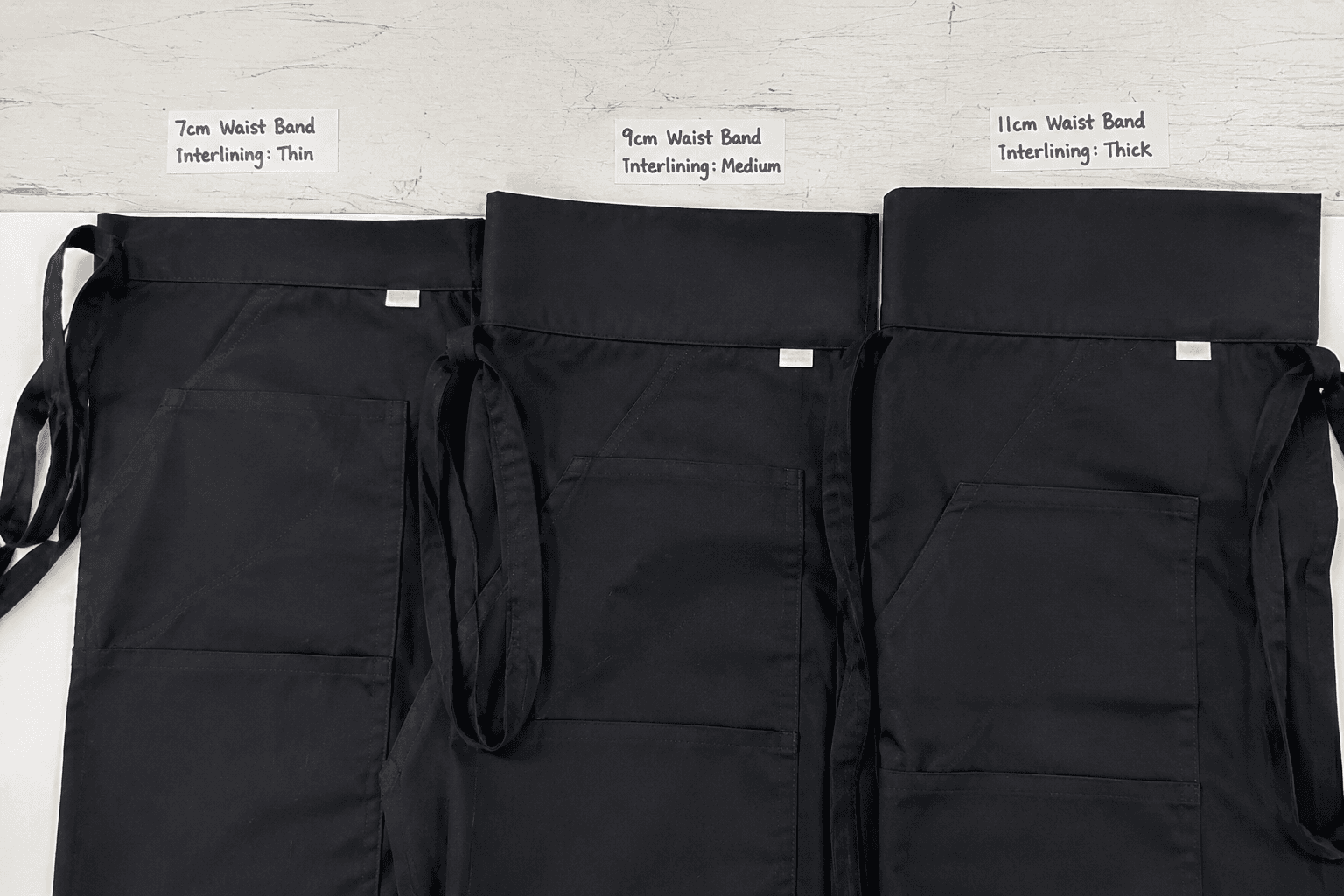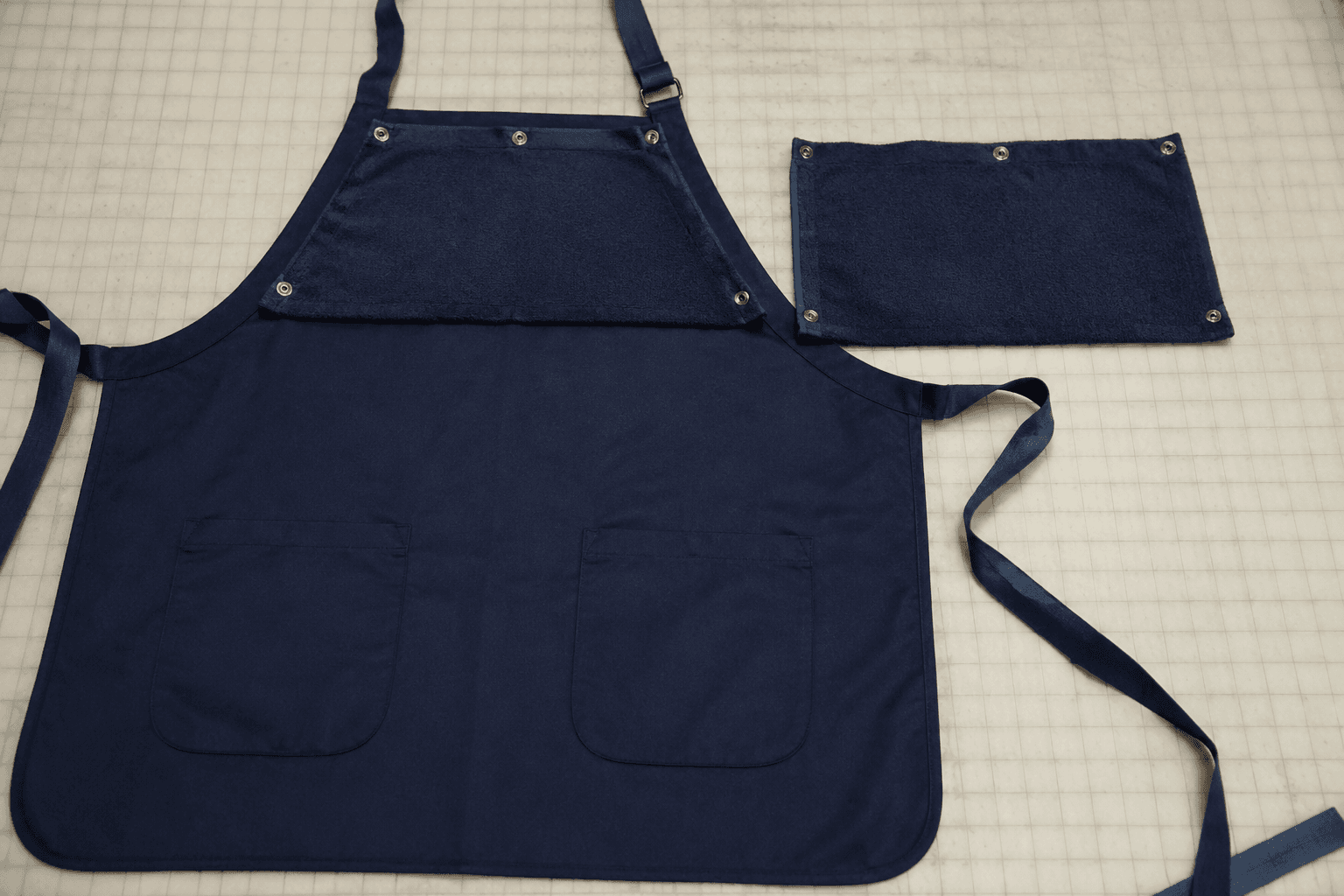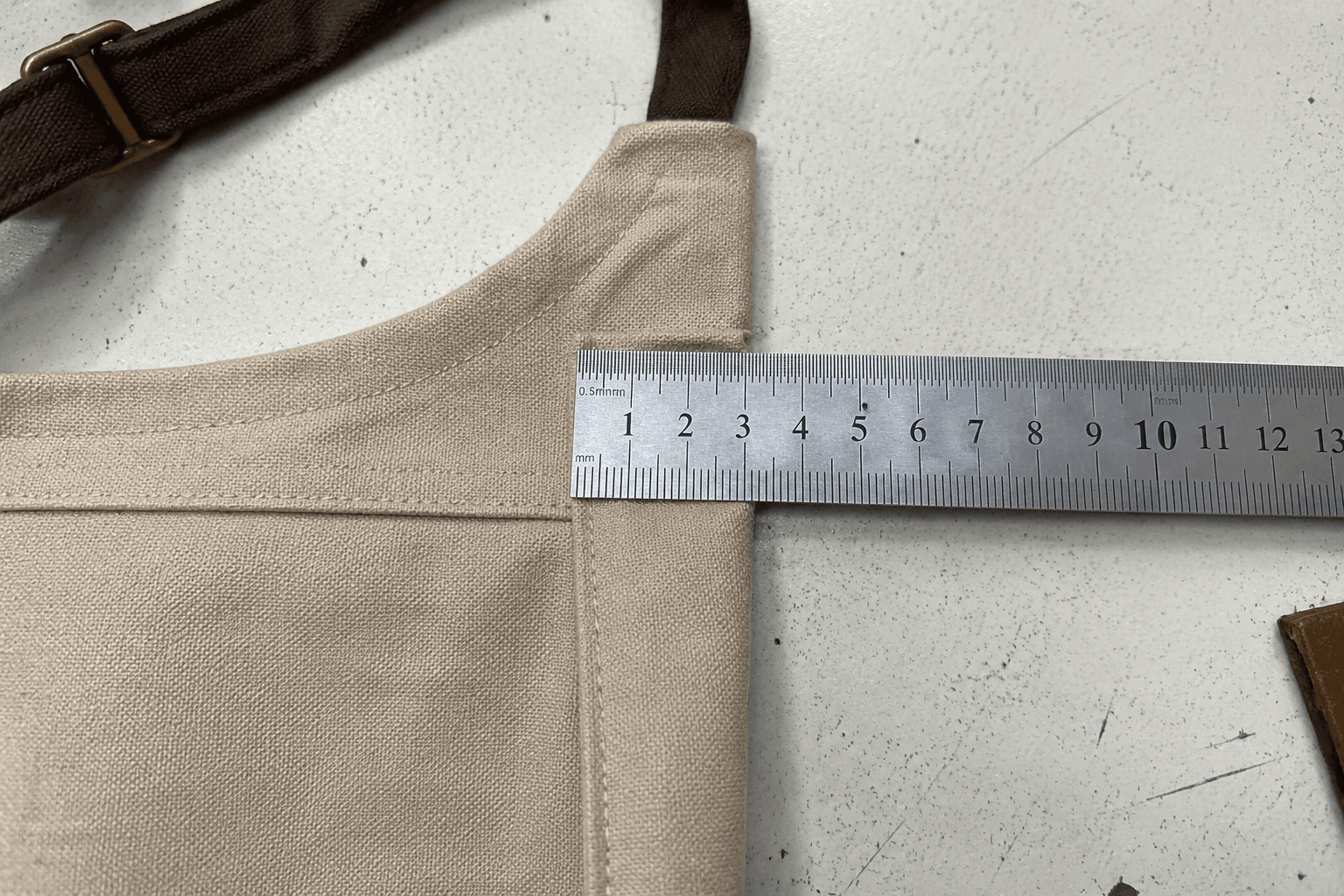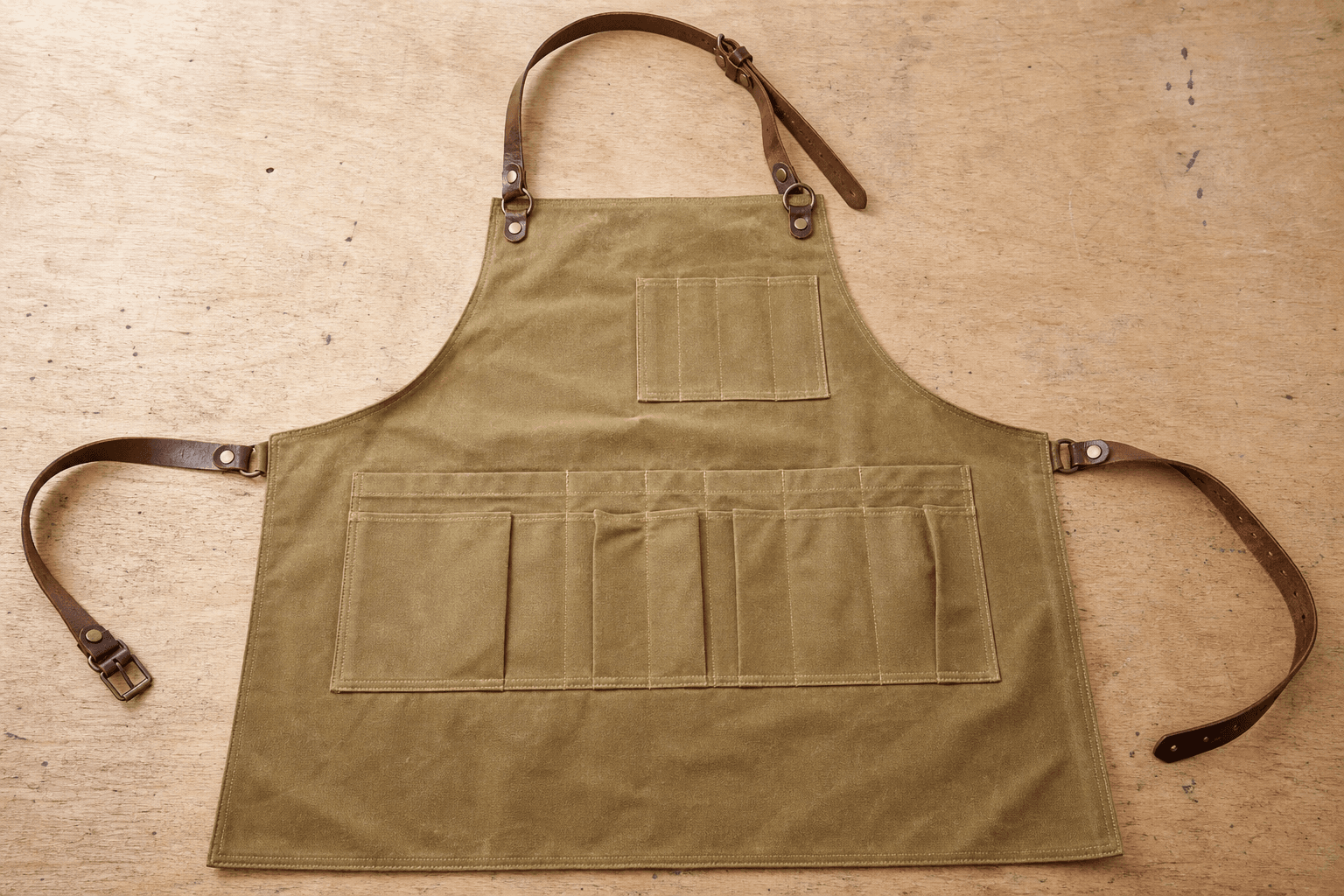
For premium apron programs, branding does not always belong on the chest panel, patch pocket, or neck label. Many professional buyers now specify hidden branding on apron straps or inside top facings to keep the apron front clean while adding a controlled private label signature. The detail is most relevant for hospitality bib aprons, specialty food retail aprons, chef-led merchandise, and premium gift programs where a visible logo can feel too promotional for daily wear.
From a factory standpoint, reverse-side print on apron straps and facings is a construction decision, not a last-minute graphic add-on. Fabric composition, GSM, strap width, fold allowance, print coverage, curing temperature, and wash expectation all affect whether the detail survives bulk production. A logo that looks sharp on one development sample can fail at scale if the finished strap drops below 20 mm, the weave is too open, or the artwork lands too close to a bartack or fold edge.
For sourcing managers, the issue is repeatability across 1,000 to 10,000 units. On OEM apron programs, that means quoting against hard numbers: 200-320 GSM body fabrics, 25 mm to 38 mm finished straps, 1,000 pcs MOQ per colorway, $0.08-$0.35 added cost per piece, 7-10 days for strike-off approval, and 30-45 days for bulk after PPS sign-off. Compared with woven labels, jacquard straps, or logo hardware, hidden branding on apron straps is often the cleaner and lower-risk choice when the specification is locked early.
- Hidden branding on apron straps should be written into the apron tech pack before sample development, not added after PP or PPS approval.
- The most stable bases for reverse-side strap or facing prints are tightly woven cotton canvas, cotton drill, and polyester-cotton twill in the 200-320 GSM range.
- For most OEM apron orders, the added bulk cost is usually $0.08-$0.15/pc for a one-color repeat and $0.18-$0.35/pc for a two-color or higher-coverage layout, with practical MOQ starting at 1,000 pcs per colorway.
- Inside top facings and 25 mm, 30 mm, or 38 mm waist ties usually hold reverse prints more consistently than neck straps below 20 mm finished width.
- QC should cover crocking, wash appearance, registration, fold-line distortion, and stitch interference on the finished apron construction, using clear defect classes such as AQL 2.5 major and AQL 4.0 minor.
- The strongest commercial return is on mid-premium and premium private label aprons with FOBs around $4.50-$14.00, where subtle trim upgrades support margin without cluttering the apron front.
Why <em>hidden branding on apron straps</em> fits premium apron private label programs
Visible branding often creates a conflict on professional aprons. Restaurant groups usually want a neutral bib front for staff presentation, while specialty food retailers and chef-merchandise brands often want a cleaner product image for shelf display and e-commerce photography. In that context, hidden branding on apron straps solves a specific sourcing problem: it adds brand identity without taking working space away from the apron face.
The detail performs best on bib aprons with long waist ties, inside neck straps, top facings, or reinforced chest-edge facings. Branding appears during tying, hanging, folding, or close handling rather than from a distance. That limited visibility is the commercial point. It gives the buyer a premium signature while keeping the outside appropriate for cafés, bakeries, open kitchens, deli counters, and retail food environments.
The feature makes financial sense once the apron sits above commodity level. On low-cost promotional aprons below about $2.80 FOB, buyers usually prioritize fabric cost, sewing speed, and packing efficiency. On aprons in the $4.50-$14.00 FOB band, hidden trim details are easier to justify because they lift perceived value without the cost of custom hardware, jacquard tape, or multiple visible trims.
Factories should treat this as part of apron engineering. A 72 cm self-fabric tie cut from 240 GSM cotton canvas behaves very differently from a 30 mm cotton herringbone tape or a 32 mm polyester-cotton webbing strap. Ink spread, edge definition, shrinkage, and fold visibility all change with the substrate, so material and placement should be approved together rather than separately.
- Best-fit categories include hospitality bib aprons, specialty food retail aprons, chef merchandise aprons, and premium gift aprons.
- Typical hidden placements are the reverse of waist ties, inside neck straps, inside top facings, and underside of pocket binding.
- The feature is usually commercially viable on apron programs above $4.50 FOB and rarely efficient on entry orders under $2.80-$3.00 FOB.
Best apron fabrics, strap widths, and facing builds for reverse-side print
Not every apron strap is suitable for reverse-side branding. The most reliable results come from tightly woven materials with a smooth enough surface for sharp logo edges and enough body to hold shape after repeated knotting and laundering. In bulk apron production, stable options include 7 oz cotton drill at about 240 GSM, 8 oz cotton canvas at roughly 270 GSM, 65/35 polyester-cotton twill at 200-240 GSM, and 10 oz canvas near 340 GSM when the apron concept supports a firmer hand.
Loose or hairy surfaces create avoidable risk. On low-density canvas, peached cotton, slub weaves, or visibly open constructions, small logos tend to feather and dark ink deposits print unevenly along yarn texture. The problem becomes more obvious on narrow straps because the usable print lane is already limited. If the artwork includes fine lines, micro text, or a repeat under 12 mm, woven tape or herringbone strap is usually safer than a self-fabric tie cut from the apron body cloth.
Construction matters as much as fabric choice. Self-fabric straps reduce trim count and keep color matching simple, but they lose printable area once the strip is folded, turned, and topstitched. A strap panel cut at 80 mm may finish at only 30 mm, with 6-10 mm per side consumed by turning and seam build. By contrast, separate webbing or herringbone tape gives more consistent finished widths and better repeat control at 25 mm, 30 mm, and 38 mm.
Inside facings are often the easier hidden branding zone because the printable area is flatter and wider. A top facing cut at 90-120 mm can leave 40-60 mm of visible inside area after construction, which gives more room for a centered one-color repeat. For buyers building a stronger private label story, a reverse-printed waist tie combined with a matching inside facing creates a coordinated branded interior without changing the apron exterior.
- Recommended finished strap widths are 25 mm, 30 mm, and 38 mm; widths below 20 mm reduce readability and lower QC yield.
- A safe logo height on apron straps is usually 6-12 mm; text below 4 mm often breaks down after pressing or laundering.
- For inside facings, a visible branding lane of 40-60 mm gives better repeat clarity than a narrow neck strap.
- When using self-fabric ties, keep a 6-10 mm print-safe margin away from folded edges, bartacks, box stitches, and adjustable hardware.
Print methods, MOQ, cost, and lead time for <em>hidden branding on apron straps</em>
For most OEM apron programs, screen printing remains the standard process for hidden strap branding. On cotton canvas, cotton drill, and polyester-cotton twill, a one-color repeating logo gives the best balance of opacity, wash hold, and production speed. Heat transfer can produce sharper detail for smaller runs or tighter artwork, but it adds hand feel and is more vulnerable to cracking on waist ties that are knotted every day. Pigment printing can work on natural-fiber apron components, but buyers should review crocking results carefully before approving it for hospitality use.
The cost impact is driven more by handling steps and color splits than by artwork complexity alone. A one-color repeat on a standard 25 mm or 30 mm strap usually adds about $0.08-$0.15 per apron at 3,000-5,000 pcs per colorway. A two-color repeat, heavier coverage, or separate handling for contrast ties usually pushes the added cost to $0.18-$0.35 per piece. On orders below 1,000 pcs per colorway, setup cost becomes more visible, and many factories either add a surcharge of $80-$150 per colorway or limit the method to simpler artwork.
MOQ should be discussed by style, strap color, and artwork combination, not only by total order quantity. A buyer may place 4,800 aprons in total, but if that volume is split across four body colors and three hidden print versions, each print run becomes less efficient. In practice, most suppliers quote this feature cleanly at 1,000 pcs per colorway, while 500 pcs is possible only with higher unit cost, fewer artwork changes, and tighter planning.
Lead time impact is moderate when the hidden print is approved before bulk material booking. A realistic schedule is 3-5 days for artwork review, 7-10 days for strike-off approval, 10-14 days for revised sample submission if needed, and 30-45 days for bulk after PPS approval. If the order uses custom-dyed webbing, holiday-season capacity, or multiple strap colors, total production commonly extends to 45-60 days.
- Typical added bulk cost is $0.08-$0.15/pc for a one-color repeat and $0.18-$0.35/pc for more complex strap programs.
- Practical MOQ is 1,000 pcs per colorway; runs around 500 pcs usually carry surcharges or process limits.
- Standard timing is 7-10 days for strike-off approval, 10-14 days for sample revision, and 30-45 days for bulk after PPS sign-off.
- Custom webbing, multiple strap shades, or peak-season bookings can stretch total lead time to 45-60 days.
QC standards and bulk failure points on printed apron straps and facings
The main risk with hidden apron branding is not total failure but inconsistency across the order. A development sample is often printed slowly and handled lightly. Bulk apron straps are cut, folded, stitched, pressed, knotted, packed, and sometimes garment-washed. That production sequence can create off-center repeats, shadow marks on fold lines, cracking at high-flex zones, print loss near tie ends, or distortion where bartacks and box stitches compress the substrate.
Testing should match actual apron use. Reverse-side waist ties rub against hands, shirts, and work surfaces. Neck straps flex at the back neck. Inside facings are exposed during folding, hanging, and laundering. For professional apron programs, buyers should ask for dry crocking, wet crocking, wash appearance, and edge-retention checks on the finished strap or facing construction, not only on flat fabric swatches. A practical benchmark is review after 5 home-laundry cycles at 40°C, or after 3 commercial wash cycles for aprons intended for rental, open kitchen, or heavy back-of-house use.
Inspection language also needs to be precise. Many suppliers work with AQL 2.5 for major defects and AQL 4.0 for minor defects, but hidden branding requires its own defect definitions. A slight repeat shift may be acceptable on the inside of a waist tie, while heavy ink transfer, missing print at the tie end, or visible cracking after wash should be classified as major. Without that distinction, QC teams either over-reject harmless minor issues or under-classify failures that affect resale quality.
Placement visibility should be reviewed on the worn apron, not only on a table. A full-length print on a 95 cm tie gives more flashes of branding when ties hang loose, while a 20-25 cm printed zone near the ends appears mainly during tying or close handling. The intended function—authentication, wearer experience, or unboxing reveal—should be decided before PPS approval because each purpose changes acceptable placement and tolerance.
- Set registration tolerance at about ±2-3 mm on straps and ±3-5 mm on inside facings.
- Use clear defect classes such as AQL 2.5 major and AQL 4.0 minor for hidden print variation.
- Test crocking and wash performance on the finished strap or facing construction, not just yardage or flat strike-offs.
- Approve whether branding should appear in natural hang, tied position, or handling only.
How to write a tech pack spec for inside facings and hidden apron strap branding
Many production delays begin with a vague instruction such as 'print logo inside strap.' That is not enough for a factory to quote, sample, or inspect accurately. A usable apron specification should state the strap material, finished width, base color, artwork repeat length, print direction, print-safe margins, one-side or all-over coverage, expected wash performance, and packing orientation. If those details are missing, suppliers make different assumptions and the quote spread can widen by $0.10-$0.25 per piece.
The cleanest approach is to write the hidden branding directly into the apron tech pack. Show a flat sketch with the start and end point of the printed zone, maximum logo width in millimeters, spacing between repeats, and stop distance before folds, bartacks, rivets, sliders, or box stitches. For inside facings, specify whether the facing is self-fabric, contrast fabric, or separate lining cloth, and whether the print is centered or placed on wearer-left or wearer-right only.
It also helps to define the commercial purpose of the branding. If the hidden print mainly serves as authentication, a tonal one-color repeat is usually enough. If the apron is sold as a premium retail item and the buyer wants a stronger reveal during unboxing or close-up merchandising, higher contrast and a wider print lane matter more. That commercial brief helps the supplier choose the right process instead of overbuilding the trim.
For repeat programs, buyers should keep one approved standard with a physical strap sample, signed color reference, and construction note. Hidden trim details are easy to miss in reorder communication, especially when production moves between merchandisers, factories, or seasons. A clear archived standard prevents drift in print density, placement, and hand feel from order to order.
- Specify finished strap width, repeat length, printable zone, and distance from folds in millimeters.
- Provide artwork in AI or vector PDF to protect repeat accuracy on narrow apron trims.
- State whether the print is one-color, two-color, tonal, or high-contrast because opacity and wash targets change by method.
- Add the hidden branding checkpoint to PP sample and PPS approval so it does not become a late trim revision.
When hidden strap branding is a better sourcing choice than visible apron logos
This feature is not universal. It earns its cost when the apron needs a cleaner front, a more premium hand, or tighter control over branding hierarchy. Hospitality buyers often want the apron to support venue identity without distracting from service. Specialty retail buyers may want a private label cue that does not compete with food stains, large pockets, contrast topstitching, towel loops, cross-back structures, or hardware already present on the garment.
The price logic is straightforward. If the apron already uses better base fabric, reinforced stress points, antique brass hardware, washed finish, or heavier stitch detailing, reverse-side branding helps justify the step-up from a standard OEM apron to a more deliberate private label product. If the apron is a basic giveaway item, the same detail rarely changes buying behavior enough to offset extra trim handling, extra inspection time, and added sampling rounds.
Hidden branding can also reduce visible trim crowding. A woven side flag, chest embroidery, logo rivet, and printed neck label can make a compact bib apron look overworked. Moving one brand element to the inside facing or reverse strap often improves design balance while keeping the apron suitable for restaurant groups, food halls, cafés, and multi-brand retail shelves. For B2B buyers, the benefit is not novelty; it is cleaner brand control on the apron itself.
- Use hidden branding when the apron front must stay clean for uniform service, minimal retail presentation, or gift positioning.
- Choose it when the apron already carries visible design elements such as patch pockets, contrast stitching, cross-back straps, or metal hardware.
- Expect the best ROI on mid-premium and premium apron lines, not low-cost promotional orders.