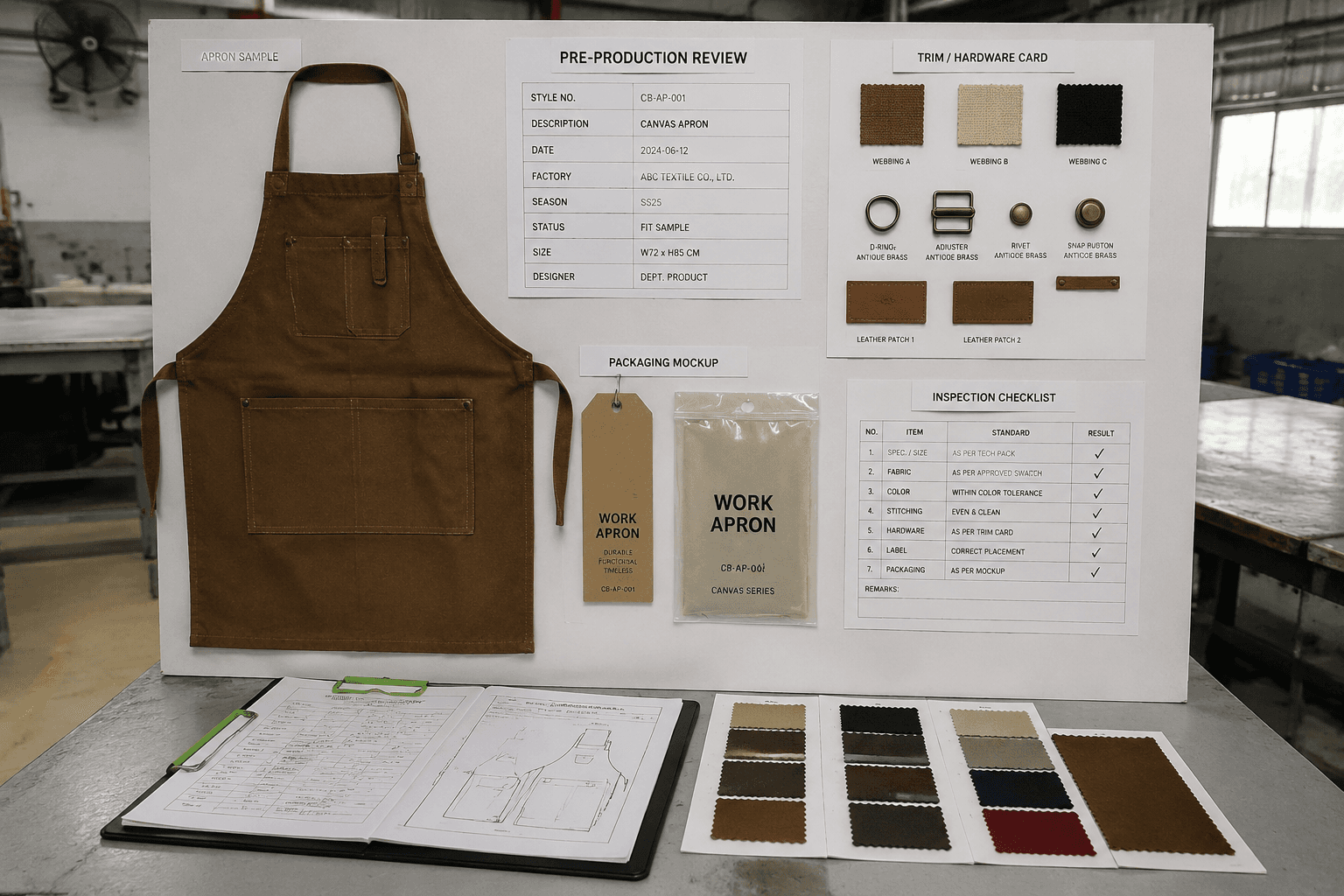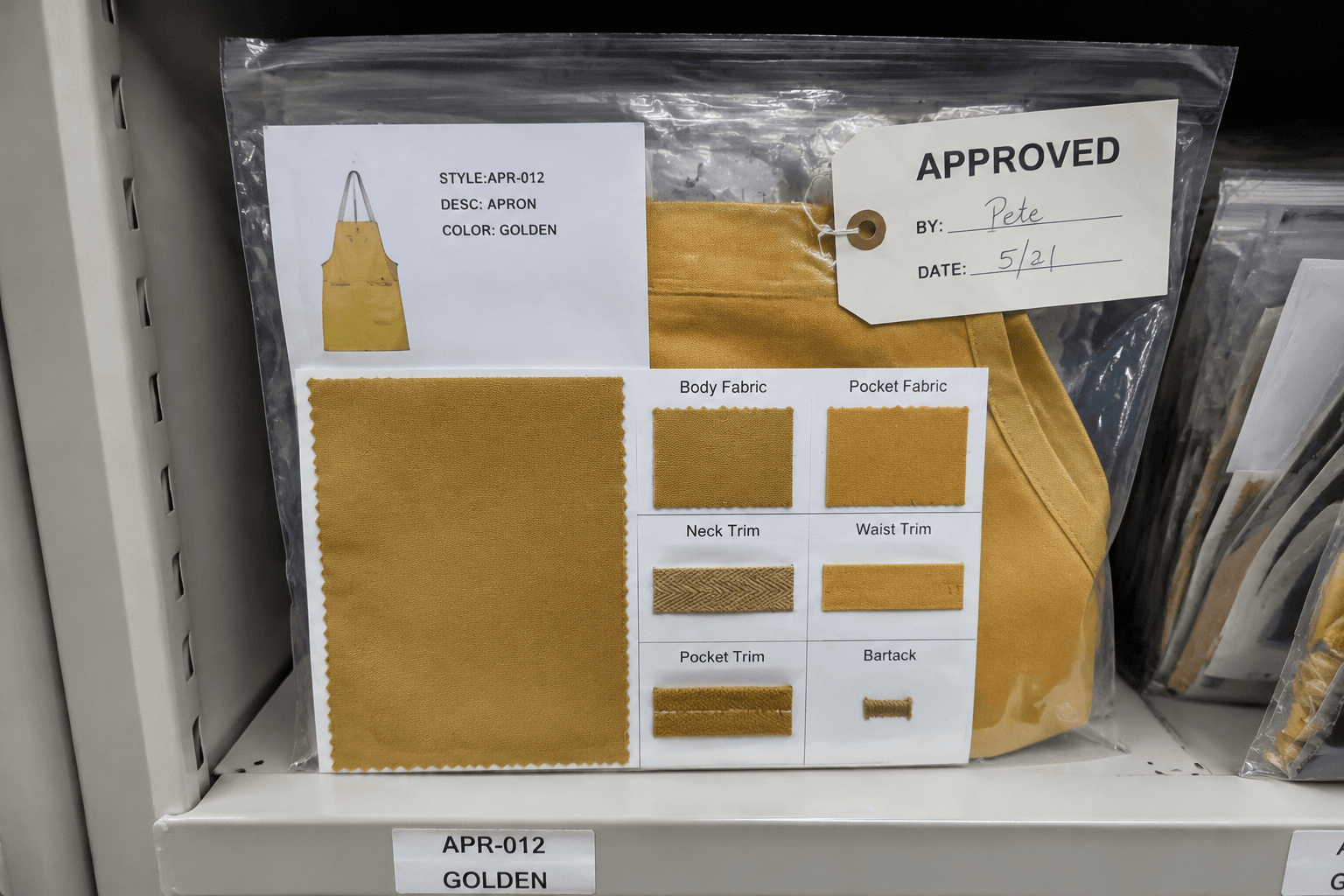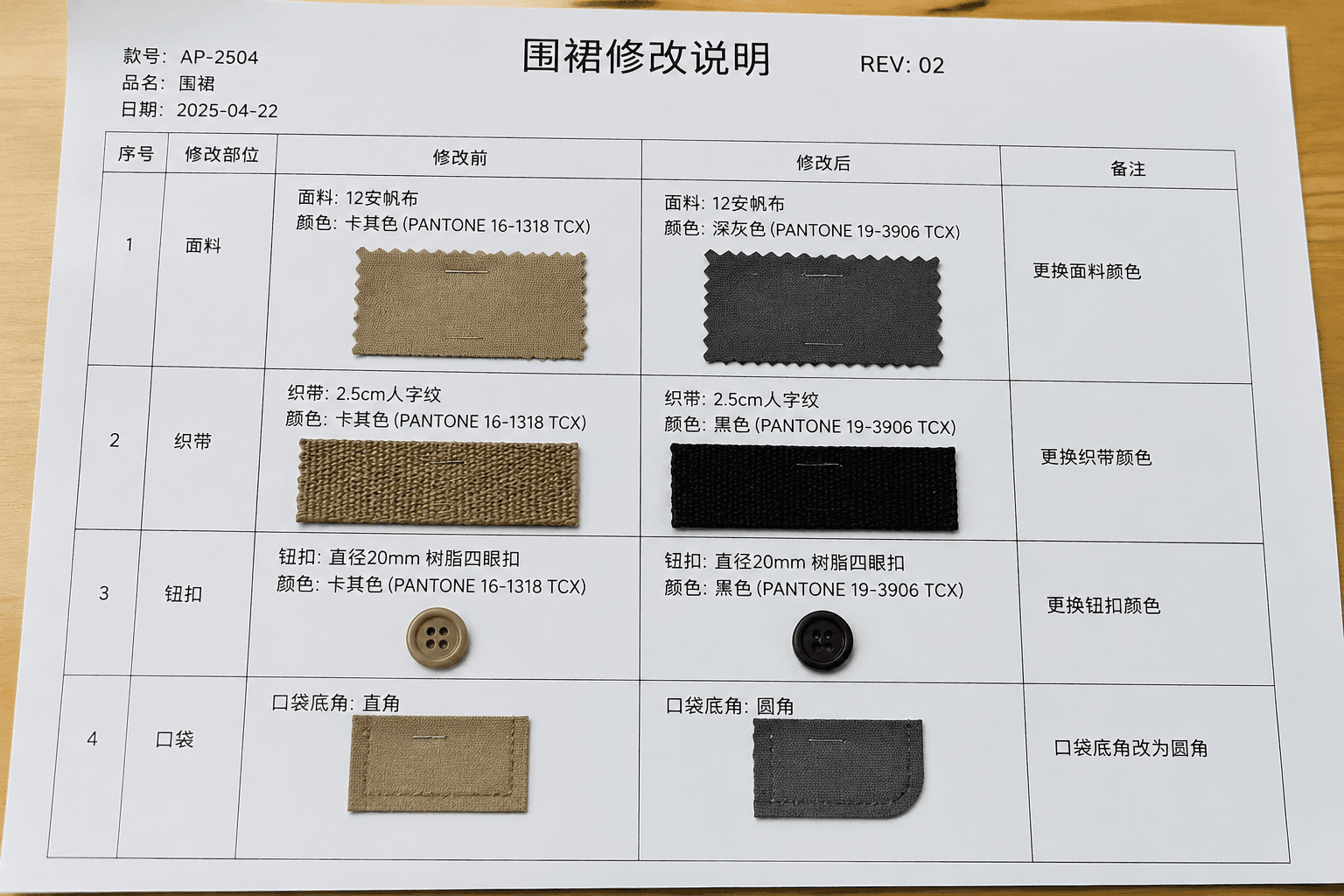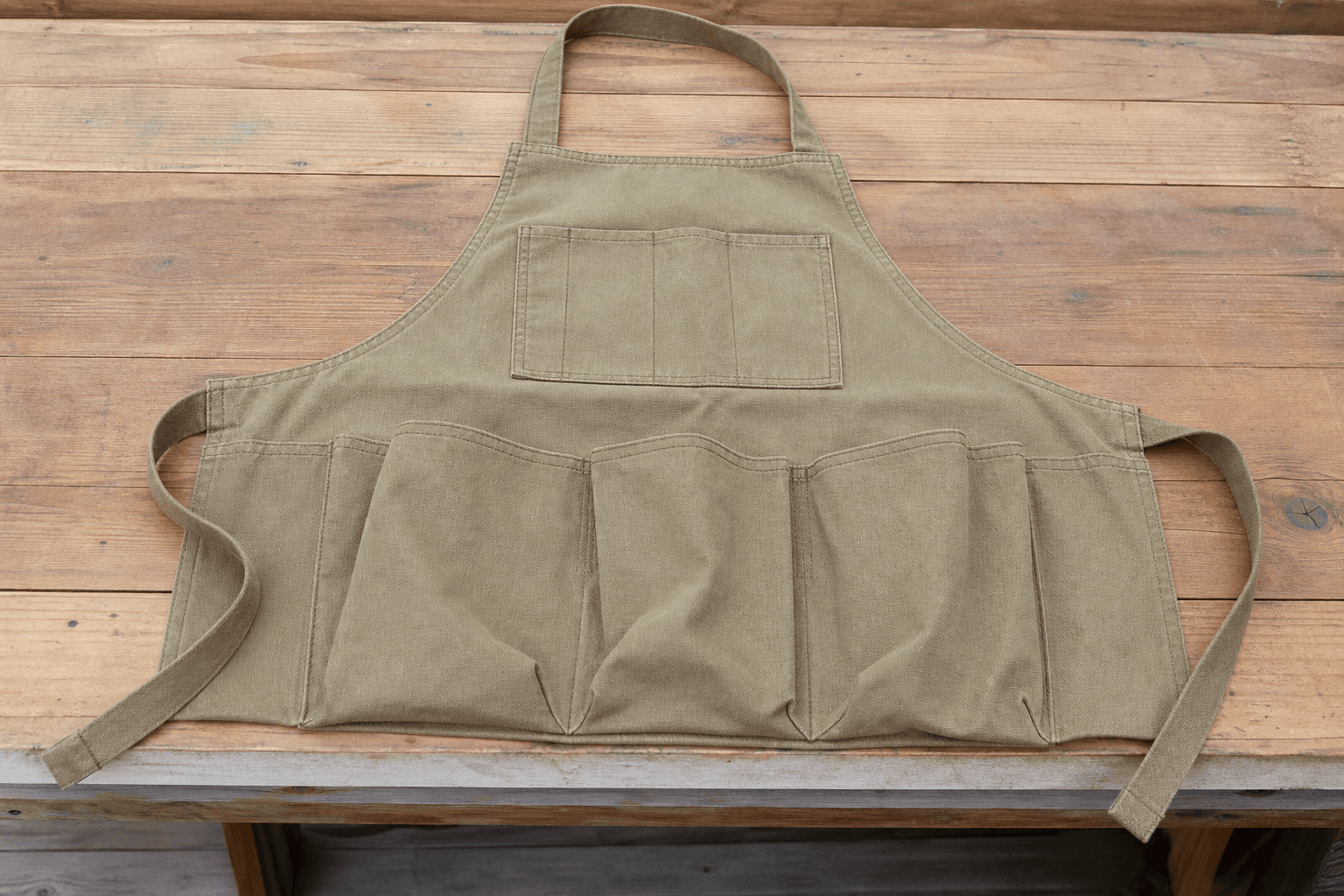
Many apron sourcing teams still treat packaging as a last-stage task. That may work for horeca replenishment packed in plain export polybags. It usually fails for retail. A shelf-facing apron is not only a sewn product; it is a retail unit with a fixed front view, barcode scan zone, fold profile, assortment logic, and carton label standard. For that reason, retail ready apron packaging planning should start during development, ideally before pre-production approval and always before printed packaging components are ordered.
For a custom apron factory, packaging decisions change production engineering in measurable ways. A 260 GSM poly-cotton bib apron folded to 25 x 32 cm with a 350 GSM chipboard insert and paper belly band runs through finishing very differently from the same apron packed flat in a 1.5 mil OPP bag. Fold style can shift handling time by 12 to 45 seconds per piece. Barcode placement determines whether the code scans through the bag without glare, trapped air, or wrinkling. Carton assortment determines whether black, natural, and navy aprons can be packed in line or must be sorted to ratio after pressing and final thread cleaning.
The commercial impact is usually manageable when the retail pack is defined early and expensive when it changes late. A plain barcode-applied polybag may add $0.02 to $0.05 per apron. A board fold with insert, size sticker, and belly band commonly adds $0.11 to $0.26 per piece, plus 7 to 14 calendar days for printed components. The sourcing objective is simple: engineer the apron and its retail pack together so sewing, finishing, QA, and carton packing all follow one approved standard.
- Approve barcode symbology, sticker size, adhesive grade, scan orientation, and exact pack placement before PP sign-off.
- Lock fold dimensions, strap-tucking rules, and front-view orientation early; even a 2 cm change in fold width can reduce carton count or increase finishing labor.
- Freeze carton assortment ratios before ordering bags, boards, inserts, and outer cartons; mixed ratio packing often adds 10% to 25% more packing labor than solid-color packing.
- Retail apron shipments are commonly rejected for barcode scan failure, wrong carton marks, mixed assortment, fold inconsistency, missing size stickers, or poor front presentation.
- Custom printed packaging components usually need 7 to 14 calendar days and often carry MOQs of 1,000 to 3,000 pieces per artwork.
- Corrective relabeling, repressing, and resorting after bulk sewing typically costs $0.06 to $0.38 per piece and delays shipment by 3 to 8 working days.
Why retail ready apron packaging planning must be fixed before bulk cutting
Late packaging decisions create predictable rework in apron programs because an approved garment does not automatically match an approved retail presentation. A 72 x 86 cm adult bib apron in 8 oz cotton canvas can be flat-folded, board-folded, hanger-packed, or sleeve-packed. Each option changes pack footprint, visible logo area, unit thickness, and master carton efficiency. If the buyer approves only the sewing specification and postpones the retail pack method, the final fold may cover the chest embroidery, hide the kangaroo pocket, or create a unit depth that no longer fits the planned carton quantity.
This is why retail ready apron packaging planning has to be reviewed with apron dimensions, fabric weight, pocket bulk, strap construction, rivets, buckles, and trim. A plain export fold might allow 48 pieces per master carton at 58 x 40 x 34 cm. The same apron in a board fold with belly band may drop to 36 pieces in the same outer size, or require a larger carton such as 60 x 42 x 36 cm to avoid compression marks. That change affects carton cube, pallet count, and warehouse slotting. If the buyer also requires a ratio such as 12 black, 12 natural, and 12 navy per carton, finishing cannot simply pack by color as units come off line; it must sort to fixed assortment.
For repeat apron SKUs, freezing the pack method by the pre-production meeting can save 1 to 2 working days in final packing. For a new private-label launch, it prevents a bigger issue: finished aprons accumulating in bins while barcode labels, insert dimensions, or fold instructions are still under discussion. Once bulk cutting has started, any packaging revision that changes fold size, insert size, or visible front orientation becomes materially more expensive to absorb.
- Approve one complete PP set covering apron spec, retail fold, barcode location, insert artwork, and carton assortment together.
- For orders above 5,000 pieces, require one fully packed PP sample and one trial master carton before bulk packing starts.
- Plain stock boards or unprinted bands often need 5 to 7 calendar days; custom printed paper components usually need 10 to 14 calendar days after artwork approval.
- If packaging changes after sewing starts, relabeling, repressing, and resorting usually add $0.06 to $0.38 per piece.
Barcode control in retail ready apron packaging planning for DC scan compliance
Barcode execution is one of the highest-risk points in apron retail programs because the receiving team tests it immediately at the distribution center. Buyers often provide the barcode number but omit the operating details the factory needs: symbology, sticker size, quiet zone, orientation, human-readable digits, substrate, adhesive grade, and exact location on the packed apron. A code that looks correct on an artwork PDF can fail after it is applied across a fold edge, placed on glossy OPP, or distorted by trapped air under the bag.
For aprons, common label sizes are 40 x 25 mm, 50 x 30 mm, and 60 x 40 mm. UPC-A is typical for the US market, while EAN-13 is standard for many EU and export programs. Entry-level retail packs often place the barcode directly on a clear 1.5 to 2.0 mil OPP bag, adding around $0.01 to $0.03 per piece in label and labor cost. More developed private-label programs place the barcode on a paper belly band or insert card to create a flatter scan surface. That usually improves scan consistency, but it also demands tighter fold control so the code lands in the same position on every packed apron.
Adhesive choice matters. Low-tack labels can lift from OPP during humid loading conditions above 30 degrees C. Over-aggressive adhesive can tear paper bands during in-line correction. A practical approval method is to test the final sticker on the actual bulk packaging material and scan 20 to 30 packed aprons pulled from different operators and line positions. Some retailers require ISO/IEC 15416 verification or a minimum ANSI grade C; even when they do not, an origin scan trial is cheaper than destination relabeling, where handling cost is usually several times higher.
- Confirm symbology, sticker size, contrast, adhesive type, and placement photo before ordering labels.
- Keep barcode labels away from vent holes, flap seals, fold ridges, pocket bulk, and metal hardware pressure points.
- If bib aprons are hanger-packed, test scan performance both flat and hanging vertically under store lighting.
- Manual label application usually adds about 1 finishing day per 8,000 to 12,000 pieces unless semi-automatic applicators are used.
Fold standards for aprons by fabric weight, hardware, and front presentation
There is no universal retail fold for aprons because construction varies too much by fabric and trim. A 180 to 220 GSM poly-cotton waist apron can hold a compact fold with limited spring-back. A 10 oz to 12 oz washed cotton canvas bib apron with antique brass grommets, D-rings, cross-back straps, or riveted patch pockets behaves differently. If the fold compresses hardware into the center panel, the retail unit becomes uneven, the front face bulges, and the apron can show pressure marks after transit or warehouse stacking.
For professional buyers, fold standards should be written as measurable engineering rules, not general merchandising comments. Adult bib aprons commonly finish in retail folds such as 24 x 30 cm, 25 x 32 cm, or 28 x 35 cm depending on fabric weight and presentation style. Once fold width on a full-size bib apron drops below about 22 cm, operator consistency usually falls unless a folding board or acrylic guide is used. On orders above 3,000 pieces, a simple folding template often reduces visual variation enough to prevent repeated QA comments during final inspection.
A complete apron fold standard should define more than width and height. It should specify where the neck strap sits, whether waist ties are wrapped or hidden, whether the front pocket faces outward, whether the chest logo remains centered, and whether the insert sits under or over the top panel. For fabrics above 300 GSM, or for aprons with metal hardware, buyers should expect that a larger fold, support board, or both will be needed to keep the retail face flat. In practice, one approved physical sample with measured tolerances is more effective than pages of general notes.
- Adult bib apron fold tolerance is commonly set at plus or minus 1 cm on both width and height.
- Aprons above 300 GSM or above 10 oz usually need a larger fold, support board, or both for shape control.
- Cross-back aprons need written strap-routing rules; otherwise packed presentation varies widely carton to carton.
- If hardware sits on the retail face, request a pressure test after 5 to 7 days in a closed master carton.
Carton assortment planning for apron color-size ratios and shelf flow
Retail buyers rarely accept random bulk packing because DC systems and store replenishment plans depend on predictable carton logic. In multi-color or multi-size apron programs, the assortment ratio should be fixed before finishing starts and before retail packaging materials are ordered. Otherwise a factory may pack all black units first, then discover that each carton must contain a repeating ratio such as 6 black, 4 navy, and 2 natural, or a mixed size set such as 8 M/L and 4 XL. At that point, cartons have to be reopened, relabeled, and re-sorted.
Assortment planning becomes more difficult when apron variants have different pack thickness. A plain 210 GSM twill bib apron and a 340 GSM canvas bib apron with faux leather tabs may share the same flat dimensions but not the same carton efficiency. If the buyer wants both inside one shelf-ready display shipper, the factory has to confirm whether 24 pieces still fit without deforming the front retail face. This matters even more when the outer carton doubles as a tray-ready shipper, because presentation damage is visible immediately at store level and often turns into a claim.
The labor effect is usually clear. Moving from solid-color cartons to ratio-packed cartons typically increases sorting and finishing labor by 10% to 25%. On a 12,000-piece apron order, that can add 1 to 2 working days at packing depending on SKU complexity, color spread, and workstation layout. That extra time is manageable when it is planned and expensive when it appears three days before vessel cutoff.
- Common apron master carton counts are 24, 36, 48, and 60 pieces depending on fold depth, board use, and fabric bulk.
- Typical retail assortment structures are solid color, mixed color, mixed size, or mixed color-size ratio.
- Clarify overage tolerance early; strict 0% overage rules slow balance packing and increase the risk of broken ratios.
- If display shippers are required, confirm whether printed outer cartons replace separate carton labels or still need retailer compliance labels.
Cost, MOQ, and lead-time math for shelf-ready apron packaging
Retail packaging does not usually make an apron program commercially unworkable by itself; poor timing does. A standard apron packed one piece per plain polybag with barcode and carton mark stays close to normal export cost. A shelf-ready retail unit may add a chipboard insert, belly band, size sticker, hanger hole, extra folding labor, and stricter carton marking. Each item looks small in isolation, but together they add seconds, MOQs, and approval steps.
As a working benchmark, direct barcode-on-polybag packing usually adds $0.02 to $0.05 per apron. A folded retail pack with custom insert and belly band usually adds $0.11 to $0.26 per piece. A more structured board fold with hanger support and multiple stickers can reach $0.24 to $0.42 per piece depending on order size, manual content, and origin labor rate. Printed paper components are often commercially efficient from 3,000 to 5,000 pieces per SKU or artwork. Below 1,500 pieces, digital printing or generic stock materials are often more economical than offset runs with normal setup waste.
Lead time should always be quoted in two parts: garment production and packaging preparation. A standard custom apron order commonly needs 30 to 45 calendar days after PP approval, depending on greige availability, dyeing, washing, and trim complexity. Printed retail components usually require another 7 to 14 calendar days after artwork sign-off. If a barcode number, legal text, or bilingual warning changes after printing, replacement components can cost another 5 to 10 days. Buyers should build a 3 to 5 day buffer before vessel cutoff whenever more than one custom packaging component is involved.
- Ask suppliers to separate sewing lead time from packaging-material lead time on every quote.
- Printed paper bands, insert cards, and size labels often carry MOQs of 1,000 to 3,000 pieces per artwork.
- For orders under 1,500 pieces per SKU, compare digital print packaging against generic stock materials with applied stickers.
- Review packed cost per piece and carton cube, not only sewing FOB, because retail packaging changes freight efficiency.
What the apron tech pack and PP approval set must include
Many retail packing failures start with documents that are too general. It is common to see a detailed apron specification sheet paired with a weak note such as '1 pc in polybag with barcode.' That is not enough for a retail apron program. The factory needs a dedicated packaging page with measurable standards, reference images, SKU logic, and carton instructions that match the retailer's receiving process.
At minimum, the packaging page should show finished fold size, front and back packed view, barcode position, size-sticker location, insert orientation, carton quantity, assortment ratio, shipping mark, and country-of-origin label requirement if applicable. If the apron has long waist ties, cross-back straps, buckles, detachable accessories, or hanging loops, the document should also show exactly how those parts are secured inside the pack. This prevents loose ties from shifting under the bag, distorting the front face, or covering the barcode area.
The PP approval set should include one complete physical retail unit made with the actual apron, actual fold, actual bag gauge, and actual paper components whenever possible. It should also include one trial master carton with final quantity or at least a density test using equivalent bulk material. In production, one physical packed standard removes more interpretation errors than several email rounds. QA can then inspect against that approved sample using a defined checklist and an AQL plan, commonly AQL 2.5 for major defects and AQL 4.0 for minor defects at final random inspection.
- Include pack front image, back image, sticker map, carton mark artwork, and assortment table in the approved pack spec.
- State fold tolerance clearly, for example plus or minus 1 cm, and define the exact measuring points.
- List every label separately: care label, size sticker, barcode sticker, carton label, and retailer compliance mark.
- Use a final inspection checklist covering scan test, assortment count, fold consistency, carton marking, and packed-carton condition.