For buyers sourcing aprons for restaurant groups, hotels, bakeries, cafés, salons, retail teams, and workshop uniforms, removable apron straps are not a styling extra. They directly affect laundry throughput, repair speed, spare-part planning, and the real service life of the apron body. They also change factory construction details such as reinforcement tabs, hardware sourcing, sewing time, inspection points, and packing format.
The decision is not simply snap versus button versus hook. A 190 to 210 GSM poly-cotton bib apron built for 30 to 50 wash cycles needs a different attachment build from a 10 oz to 12 oz canvas apron expected to survive 80 to 150 commercial laundry cycles. When the system is underbuilt, the first failure is often fabric tear-out at the tab, buttonhole distortion, or corrosion at the hardware rather than breakage of the strap itself.
In OEM apron manufacturing, snap, button, and hook systems can all work if the buyer specifies measurable standards before sampling: fabric GSM or oz, strap width, hardware size, pull tolerance, corrosion resistance, wash-cycle target, spare-part packing, and final inspection at agreed AQL levels. The practical goal is to choose the lowest total-cost detachable system that still matches the buyer’s laundering and repair model.
- Snap removable apron straps are usually the most efficient choice for hospitality aprons in the 210 to 260 GSM range because they are fast to remove, fast to reattach, and easy for laundry teams to process.
- Button systems usually add the least FOB cost, often $0.05 to $0.15 per apron, but they are slower in laundries handling 300 to 1,000 aprons per week and should not carry the highest-tension point on heavy aprons.
- Hook-based removable apron straps suit cross-back and modular apron programs, especially on 280 to 340 GSM canvas, but buyers should verify base metal, plating, edge finishing, and corrosion performance after repeated 60°C washing and tumble drying.
- A repairable apron program often supports an added FOB of $0.20 to $0.70 per piece when spare strap sets cost $0.35 to $1.20 and a full apron body costs $3.20 to $7.80 FOB.
- Approve detachable systems against clear standards: fabric weight, strap width, hardware size, target wash cycles, pull-force requirement, corrosion result, packing method, and inspection at AQL 2.5 major and AQL 4.0 minor.
Why removable apron straps lower replacement cost in bulk apron programs
In many apron programs, the strap assembly wears out before the apron body. Neck straps absorb oils and repeated bending. Waist ties catch on counters and chairs. Cross-back straps are twisted every time staff dress and undress. If these components are fixed permanently, one damaged strap can retire an otherwise usable bib or waist apron. Removable apron straps separate the highest-wear component from the higher-value body panel, which is why they are relevant to B2B apron buyers managing chain-wide replacement budgets.
The cost case is easy to quantify. A standard 210 to 240 GSM poly-cotton bib apron often lands at $3.20 to $4.20 FOB at 3,000 to 10,000 pcs. A 240 to 260 GSM twill bib apron with reinforced pockets often lands at $3.90 to $5.30 FOB. A 10 oz to 12 oz canvas apron with heavier trims and utility pockets often reaches $5.80 to $7.80 FOB. By comparison, a replacement neck strap or cross-back strap set typically costs $0.35 to $1.20 FOB, depending on material and hardware. On an annual program of 20,000 aprons, cutting full-body replacement by 5% to 8% can protect several thousand dollars before freight and local distribution are added.
The operating advantage matters as much as the unit economics. Buyers can stock bodies and replacement straps separately, issue spare parts by site, and avoid waiting 30 to 45 days for a full replenishment shipment. The trade-off is that detachable systems add hardware purchasing, extra sewing operations, more QC checkpoints, and tighter packing requirements. That means the technical package for the apron must be more precise than for a fixed-strap style.
- Typical added FOB for detachable hardware on a 190 to 210 GSM apron is $0.12 to $0.28 per piece.
- On 280 to 340 GSM canvas aprons with reinforced tabs and metal hardware, added FOB is usually $0.38 to $1.10 per piece.
- Common MOQ for custom aprons is 500 to 1,000 pcs per color, while separate spare strap sets often require 1,000 to 2,000 sets.
- Stock trims usually support a 25 to 35 day production lead time; custom-logo hardware or accessory packing often adds 5 to 10 days.
Snap removable apron straps for 210 to 260 GSM hospitality aprons
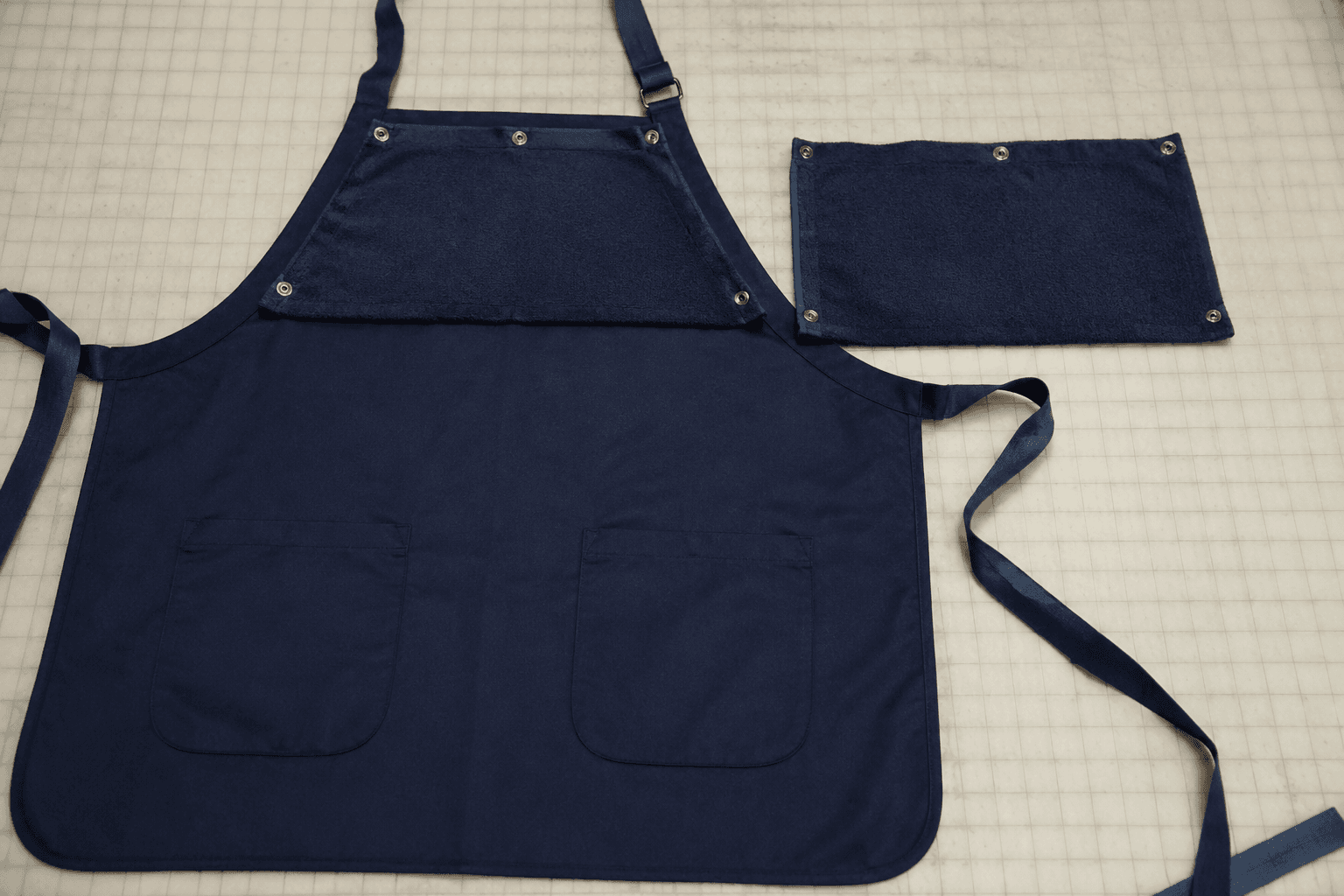
For most food-service and hotel apron programs, snap systems are the most practical balance of speed, cost, and durability. They let laundry or store teams detach straps quickly, reduce handling time during wash sorting, and reattach the finished apron without tools. On standard bib aprons, flat snap tabs also stack better in return packing than bulky hook hardware, which helps when aprons are processed in larger weekly volumes.
Snap performance depends less on the cap itself than on the tab construction behind it. On a 210 to 230 GSM twill apron with limited pocket load, a 12.5 mm or 15 mm snap on a doubled fabric tab is often adequate. On a 260 GSM twill or a light 10 oz canvas apron carrying a check pad, towel, or handheld device, the snap should normally sit on a reinforced tab with backing fabric or webbing plus bartacks or multi-row lockstitch. In bulk claims, the most common failure is fabric tear-out around the snap rather than failure of the metal part.
Snap systems also simplify SKU planning. A buyer can standardize one apron body across several sites and hold 3% to 5% spare strap sets against the order volume. If the brand wants seasonal color changes, only the strap SKU changes while the main apron body remains stable. For wash programs using 60°C cleaning, stronger detergents, and tumble drying, brass or stainless snaps usually hold up better than low-cost plated steel options.
- Common apron snap sizes are 12.5 mm, 15 mm, and 17 mm, selected by tab thickness and apron weight.
- Stock snap systems usually add $0.08 to $0.22 per apron; custom-finish or logo-cap snaps can add another $0.15 to $0.35.
- A practical approval standard is 100 to 200 open-close cycles, 20 to 50 washes for light-duty aprons, and 50 to 100 washes for standard hospitality use.
- Loose, missing, or non-closing snaps should be classified as major defects under AQL 2.5 because the apron cannot stay in service.
Button systems for lower-cost removable apron straps on lighter programs
Buttons remain useful when the buyer needs a removable function at the lowest hardware cost. They are common on neck adjustment tabs, side tabs, and short connector sections on lighter bib aprons. For cost-sensitive programs targeting FOB below roughly $3.50 to $4.00, buttons can preserve a repairable apron design without the price increase that comes with heavier metal hardware.
The price advantage is straightforward. Standard plastic, resin, or melamine-look buttons usually add around $0.05 to $0.12 per apron in bulk production. Metal tack buttons or branded buttons may raise that to $0.10 to $0.25. Repair is also easy: a damaged button can often be replaced by a local tailor or in-house uniform team without waiting for imported matching snaps or hooks. That is useful for regional restaurant groups or retail chains operating many smaller branches.
The limits are equally clear. Buttons are slower than snaps when a laundry is handling 300 to 1,000 aprons per week. Buttonholes also require disciplined stitching density and reinforcement, especially after repeated hot washing. On 280 to 320 GSM canvas, a narrow tab can distort or fray if the button is taking angled load rather than straight tension. In practice, button systems work best on lighter aprons and moderate wash volumes, not on the highest-stress point of a heavy utility apron.
- Buttons work best on stable attachment points rather than the highest-tension load point.
- A two-position neck tab usually performs better than one button carrying the full pull of the strap.
- Typical neck-tab button sizes are 18L to 24L; larger sizes often add look rather than real strength.
- During inspection, check button security, buttonhole fraying, tab distortion, and attachment symmetry.
Hook systems for cross-back removable apron straps and modular apron SKUs
Hook systems are widely used on cross-back aprons because they make strap replacement simple and support flexible sizing without changing the apron body. Common formats include swivel hooks, trigger hooks, G-hooks, and clip-style connectors paired with D-rings, rectangular rings, or bartacked webbing loops. For barista aprons, workshop aprons, floral aprons, barber aprons, and retail craft aprons, they are often the best route to a modular product range.
The commercial advantage is SKU efficiency. A buyer can stock one apron body in black, tan, navy, or olive and pair it with two or three strap lengths instead of carrying more finished sizes. That matters most when the body fabric is expensive, such as 10 oz to 12 oz canvas, waxed-look cotton, or heavier twill with multiple pockets. The body remains the main inventory unit while strap kits become lower-cost replenishment items.
The main risk is hardware inconsistency. Low-grade hooks may open under twist, abrade webbing, scratch furniture or counters, and corrode after repeated wet handling. Heavier hook hardware can also tangle more during commercial laundry than flat snap tabs. Buyers should therefore approve the exact metal, finish, wire gauge, and edge condition, then test the final bulk hardware after washing and drying rather than relying on showroom samples.
- Typical hook-system cost addition is $0.20 to $0.70 per apron, depending on hook size, finish, and matching rings.
- Cross-back systems usually perform better with 25 mm or 32 mm webbing because wider straps resist twisting.
- For hot-wash programs, stainless or higher-grade coated hardware often outperforms low-cost plated steel, but may add $0.12 to $0.30 per apron.
- If the apron is used front-of-house, test whether loose metal hardware creates noise against rings during wear.
Match apron hardware to wash process, cycle target, and fabric weight
The right attachment system should be chosen from the laundry process backward. An apron washed in-house at 40°C and line dried can accept hardware that would fail in a contract laundry using 60°C washing, chemical dosing, mechanical extraction, and tumble drying. Two buyers may order the same apron silhouette but need different detachable hardware because their laundering conditions are not the same.
Fabric weight is the next filter. Light 180 to 210 GSM poly-cotton aprons with low pocket load usually work with simple buttons or light snap systems. Midweight 210 to 260 GSM twill aprons are often the best range for standard snap programs because they balance durability with reasonable FOB cost. Heavier 280 to 340 GSM canvas aprons, especially those with chest pockets, towel loops, or tool compartments, usually need wider straps, stronger tab backing, and either reinforced snaps or hook systems. Matching hardware to apron weight is basic sourcing discipline, yet many sampling mistakes begin here.
Detachable straps create the most value when the body and strap age at different speeds. In many uniform programs, the apron body can stay in service for 12 to 24 months while the strap assembly needs replacement after 6 to 12 months. That replacement logic only works when the buyer defines realistic cycle targets from the start. A workable standard is 30 to 50 washes for light-duty aprons, 60 to 80 washes for standard hospitality aprons, and 100 to 150 cycles for heavy-duty commercial laundry programs.
- Define wash temperature, detergent strength, bleach exposure, dryer method, and target cycle count before hardware approval.
- Check colorfastness of body fabric and straps separately when the materials differ, such as cotton canvas with polyester webbing.
- For commercial laundry users, plan spare strap volume at about 3% to 8% of the apron order quantity.
- If straps ship detached, require packing that prevents hardware snagging, rust transfer, or abrasion on the apron body.
Cost, MOQ, lead time, and AQL rules before bulk apron approval
The best sourcing decision is the one that reduces annual ownership cost, not simply the first quoted FOB. Saving $0.15 to $0.20 per apron by reducing reinforcement or using lower-grade hardware can disappear quickly if strap-related failures rise by only 3% to 4% in use. On a 10,000-piece apron order, that failure rate can erase the initial savings through replacements, complaint handling, and local repair labor. Buyers should compare detachable systems against the full 12-month operating cost of the apron program.
MOQ and production planning need early agreement. Many apron factories can produce a standard custom apron at 500 to 1,000 pcs per color, but detachable programs with custom-logo snaps, special hook finishes, or separately packed spare straps often need 1,000 to 2,000 pcs or sets for stable pricing. With stock trims, production after PPS approval is often 25 to 35 days. If the order includes custom hardware, branded accessory bags, or an extra wash-test round, lead time commonly moves to 35 to 45 days.
Inspection rules should be written before bulk starts. Missing hardware, broken attachment points, loose snaps, failed buttonholes, or hooks that do not close properly should be treated as major defects and controlled at AQL 2.5. Minor issues such as slight finish-shade variation can usually sit under AQL 4.0. If the buyer wants stronger control, pull testing, wash verification, and open-close cycling should be included in the written purchase specification rather than discussed informally.
- 190 to 210 GSM poly-cotton usually suits buttons or light snap systems.
- 210 to 260 GSM twill is often the best value range for standard snap systems with reinforced tabs.
- 280 to 340 GSM canvas usually requires wider straps, stronger backing, and more durable hardware.
- An extra prototype round for strap testing often costs only $50 to $180 per style, far less than a bulk quality claim.
Specification checklist for OEM orders using removable apron straps
Most detachable-strap failures begin with incomplete specifications rather than poor factory capability. A sample may look correct, but key details are left open: snap size, button material, hook metal, reinforcement layer, tab dimensions, strap width, thread ticket, packing format, or target wash count. The apron ships in good visual condition, then fails early in service because the stress points were never defined clearly.
A complete tech pack for removable apron straps should state the apron style, fabric composition, GSM or oz weight, strap material, strap width, hardware type, hardware finish, reinforcement method, wash process, expected service life, and spare-part model. If straps are sold as separate after-sales items, the buyer should also define barcode format, inner-pack quantity, labeling, and carton marking. Industrial or commercial laundry use must be disclosed before sample approval because it changes hardware choice and test expectations.
For many B2B apron buyers, the safest development path is to sample two attachment systems on the same apron body and compare them under wash and wear conditions. That small development cost usually produces a better sourcing decision than approving the cheapest hardware on the first quote. In apron sourcing, detachable straps work best when they are specified as an engineering feature tied to laundering, repair, and replacement economics.
- Specify hardware material, finish, size, color, and whether logo branding is required.
- Approve tab dimensions, backing fabric, webbing reinforcement, bartack length, and thread type before bulk cutting.
- Define the replacement model: no spare straps, spare straps in the master carton, or a separate spare-part SKU.
- Request wash simulation and wear testing on final bulk fabric and final hardware, not substitute sample materials.
- Confirm packing that prevents hardware abrasion, rust transfer, and snagging during transit.
- Set acceptance rules for pull performance, corrosion result, ease of reattachment, and visual consistency.