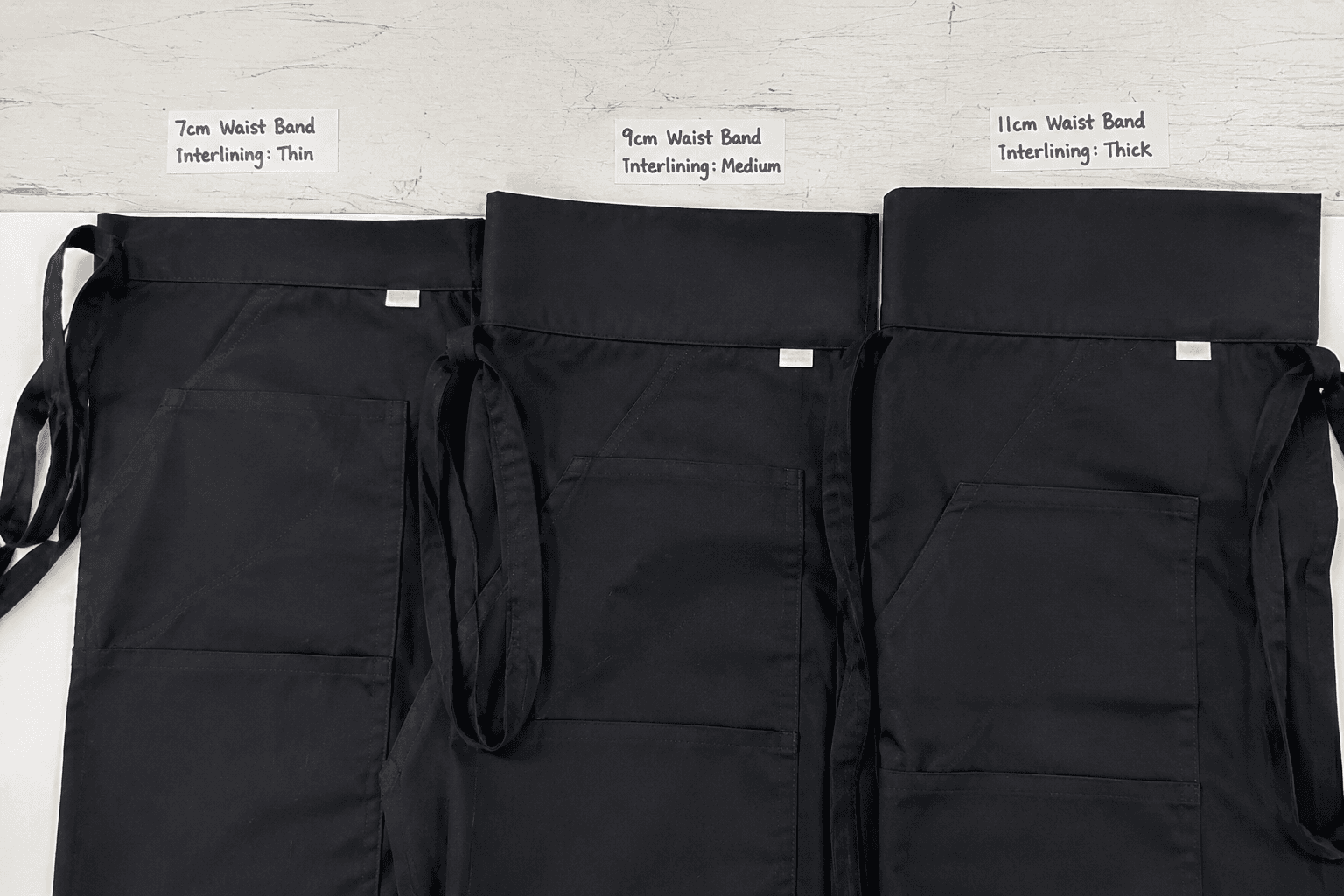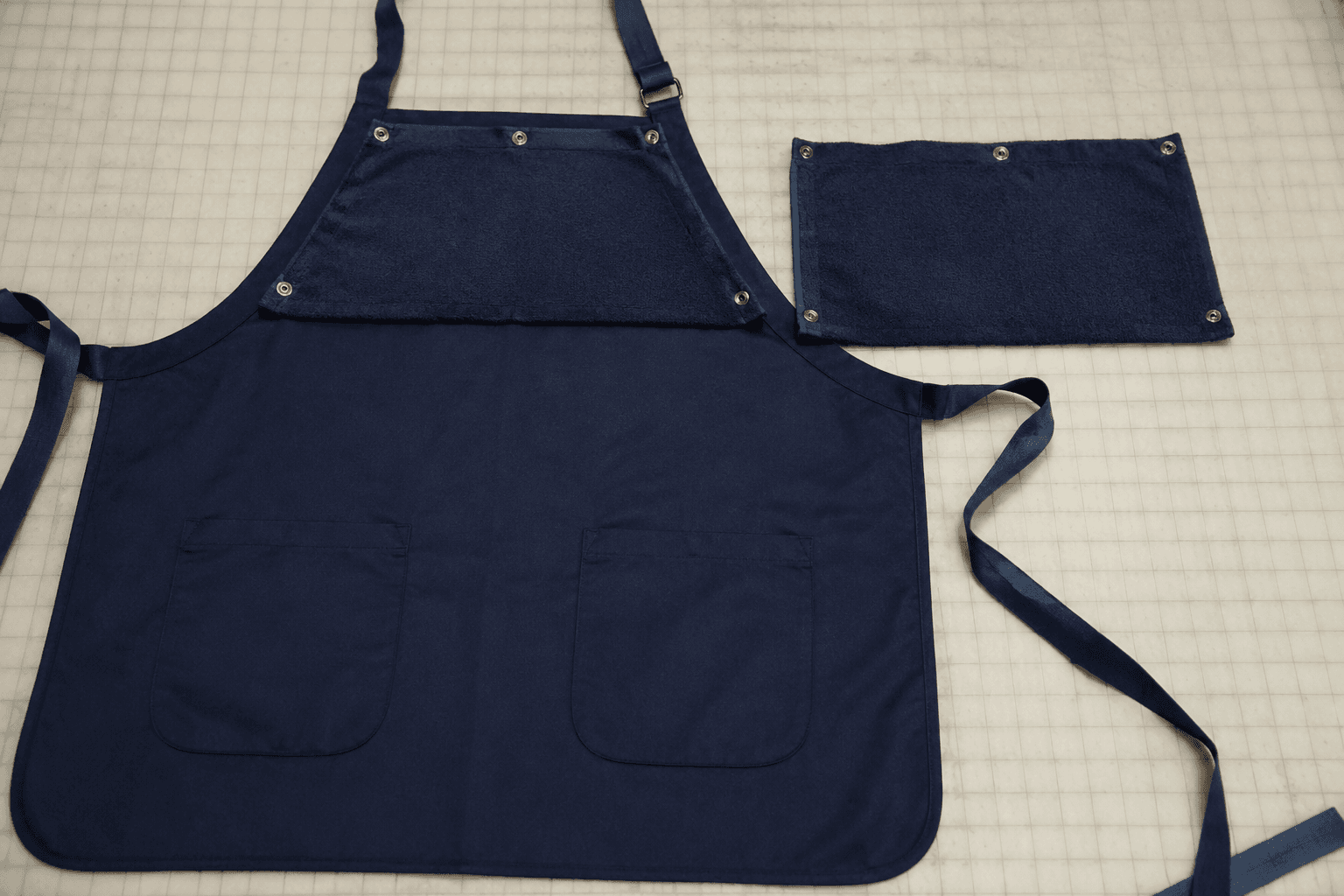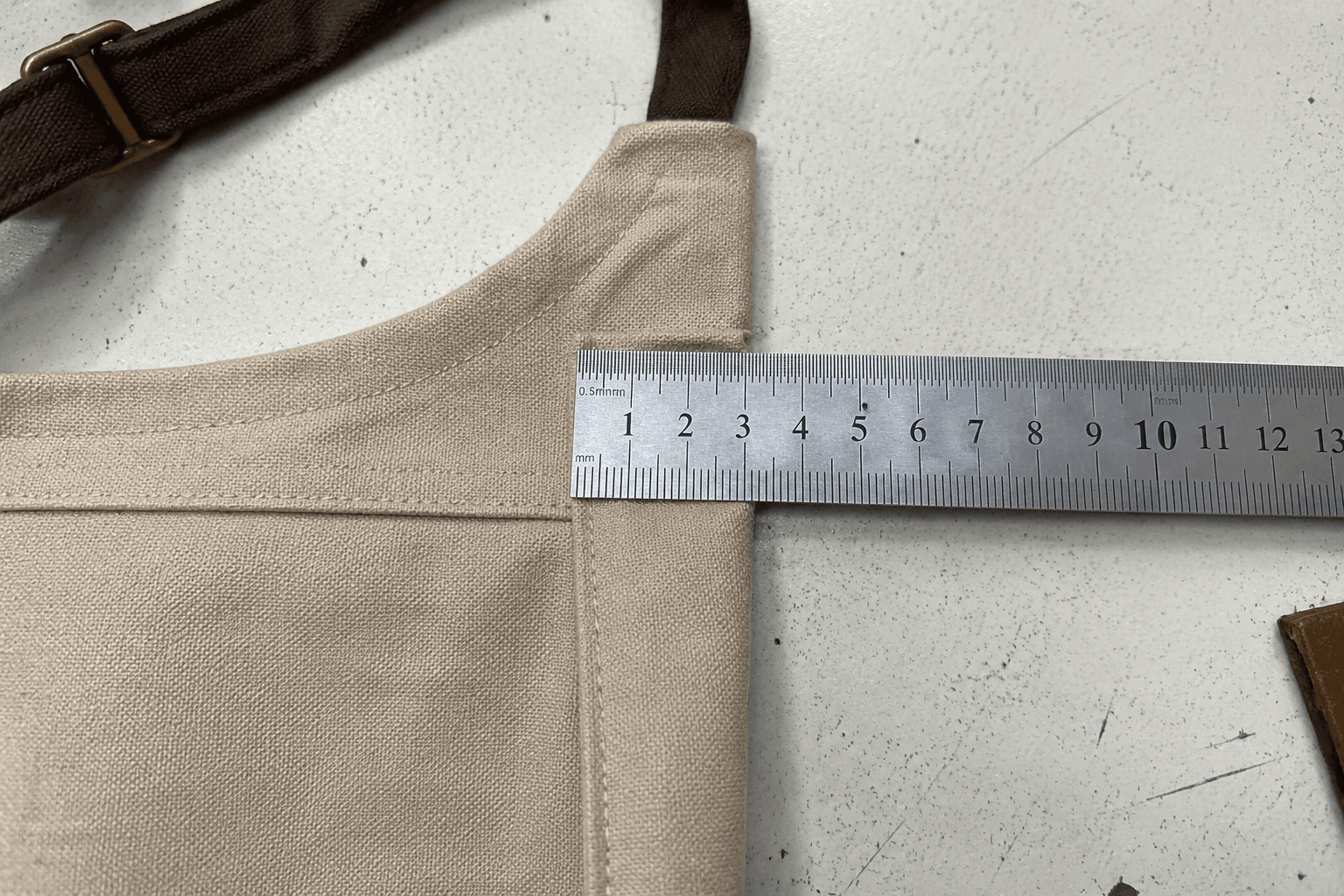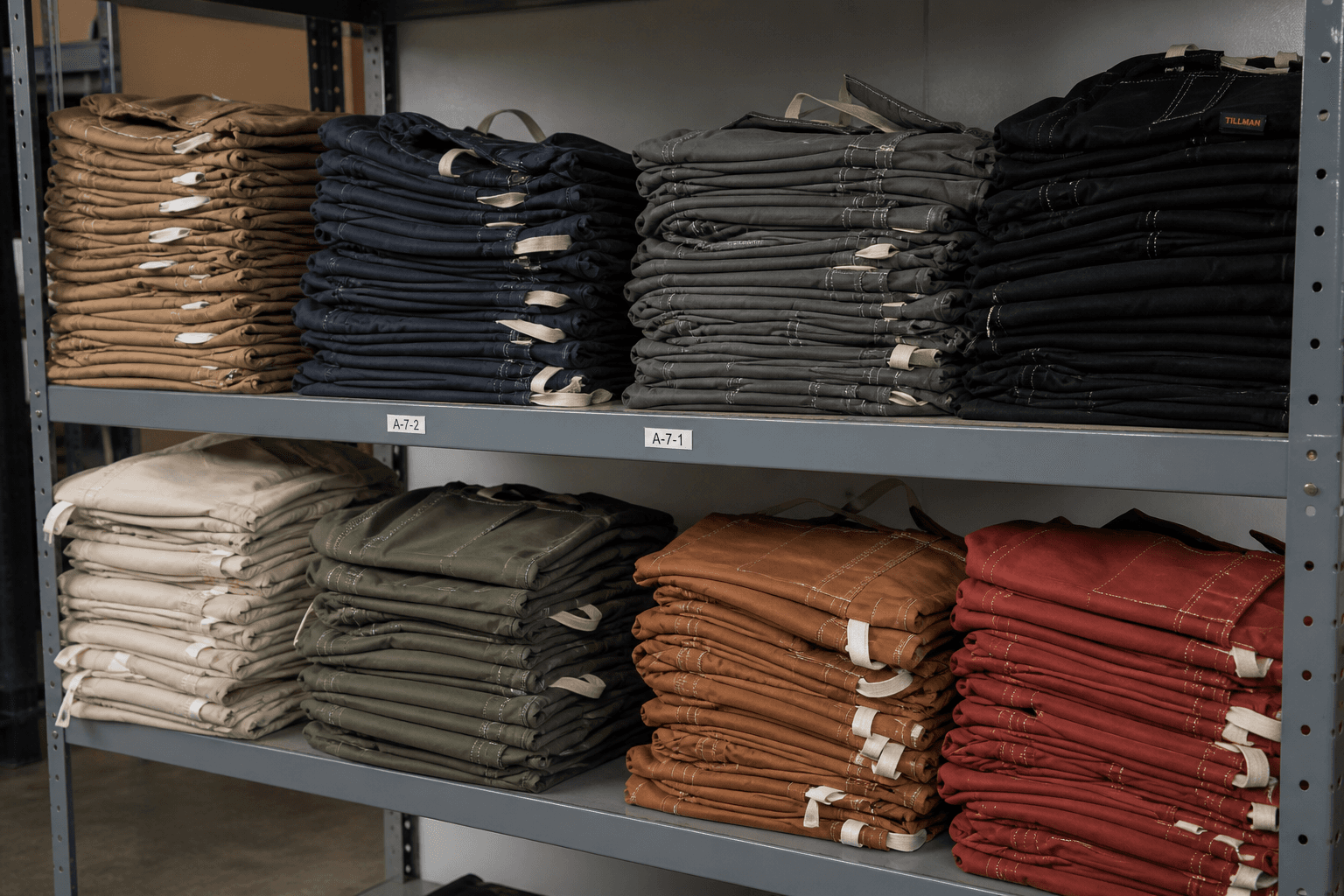
For hospitality groups, foodservice operators, event contractors and retail chains, the apron is often the most visible part of the front-of-house uniform. That is why reflective logo transfers on aprons appeal to buyers running evening cafés, patio service, curbside pickup, food trucks and venue teams working around headlights, camera flash and uneven exterior lighting. The real sourcing issue is not initial brightness; it is whether the logo stays attached, readable and commercially acceptable across the actual wash and replacement cycle.
Performance depends on the apron body as much as the transfer film. Fabric blend, GSM, weave stability, shrinkage, resin or water-repellent finish, artwork detail, press temperature, dwell time and pressure all affect adhesion. A reflective transfer that performs acceptably on a 245 GSM 65/35 poly-cotton twill bib apron may fail early on a 310 GSM wax-finished cotton canvas apron because the surface is less stable and the fabric moves differently in wash.
For professional B2B buyers, the decision is practical. Reflective branding improves low-light recognition, but it also adds cost, can stiffen the front panel if oversized and usually has a shorter visual life than embroidery in high-temperature laundry. Buyers should approve reflective logo transfers on aprons only after matching the transfer to the exact apron fabric, wash method, order volume and planned replacement period.
- 200-260 GSM 65/35 or 80/20 poly-cotton twill is usually the lowest-risk apron base for reflective transfers.
- A small chest transfer normally adds US$0.18-0.55 per apron; larger artwork, premium film or two placements usually raises the surcharge to US$0.60-0.85.
- A realistic approval target is 25-40 home washes at 30-40°C or 15-25 industrial washes at 60-75°C, depending on film grade, drying method and fabric finish.
- Sampling should use the actual production apron fabric and include wash checkpoints at 10, 20 and 30 cycles before bulk confirmation.
- Bulk inspection should be defined in writing at AQL 2.5 major / 4.0 minor, with clear limits for edge lift, cracking, placement tolerance, reflectivity loss and scorching.
Where reflective logo transfers on aprons create measurable sourcing value
Reflective decoration on aprons is useful when buyers need quick staff identification in low-light service conditions, not certified high-visibility protection. The strongest use cases are evening coffee chains, outdoor dining groups, food trucks, curbside pickup teams, event staffing agencies and garden retail crews working after dusk. In these operations, the bib panel stays visible while staff take orders, carry trays, hand off bags or greet customers, so a reflective chest mark can improve recognition without changing the apron pattern.
The value is highest on bib aprons because the upper front panel remains exposed during normal work. Waist aprons are less effective because counters, POS stations and tables often block the logo. For most OEM programs, the most practical placement is left chest or center chest above the pocket line, usually at 6 x 8 cm, 8 x 8 cm or 8 x 10 cm. That keeps the artwork in the 48-80 cm² range, large enough to return light but small enough to avoid excessive stiffness.
Buyers also need to separate recognition from compliance. Reflective logo transfers on aprons can support brand visibility in hospitality and retail, but they do not replace certified high-visibility garments with regulated tape coverage. If the apron is part of a service uniform, reflective branding can be commercially useful. If the job requires compliant visibility protection, the apron should remain secondary to the certified outerwear.
- Best-fit sectors: evening cafés, outdoor catering, curbside pickup, food trucks, event staffing and garden retail.
- Best apron format: bib aprons with a flat upper-front press area.
- Most efficient logo size: 48-80 cm²; areas above 150 cm² usually reduce comfort.
- Use reflective logos for recognition, not as a substitute for certified hi-vis PPE.
Fabric specifications that support durable reflective logo transfers on aprons
For apron sourcing, fabric construction is the main durability variable. The safest base is a smooth, stable twill in the 200-260 GSM range, especially 65/35 or 80/20 poly-cotton. These fabrics normally shrink less than pure cotton canvas, present a flatter surface to the adhesive and behave more consistently under heat press. In factory practice, a 240-250 GSM poly-cotton bib apron almost always gives more predictable transfer adhesion than a 300-320 GSM slub canvas apron, even if the heavier cloth feels stronger by hand.
Pure cotton aprons can still be used, but the risk rises on waxed finishes, brushed surfaces, enzyme washes, water-repellent coatings and irregular weaves. Those finishes limit clean adhesive contact, so the logo may pass incoming inspection yet start lifting at the edges after repeated laundry. If the apron fabric includes PU coating, acrylic coating or fluorocarbon treatment, buyers should test the exact bulk fabric lot rather than rely on a previous sample from another production run.
Shrinkage should be treated as a decoration control point, not only a fabric issue. Reflective films do not shrink at the same rate as the apron shell. As a practical approval rule, the fabric should stay at 3 percent shrinkage or below after the agreed wash method. Once shrinkage moves above that level, the transfer perimeter is placed under more stress during laundering and tumble drying, which increases the chance of cracking or edge separation.
- Preferred fabric: 200-260 GSM pre-shrunk poly-cotton twill.
- Lower-risk blends: 65/35 and 80/20 poly-cotton.
- Higher-risk surfaces: waxed cotton, brushed canvas, slub weave, heavy garment wash and water-repellent finish.
- Recommended shrinkage limit: ≤3% after the agreed wash test.
Transfer film, press settings and wash targets for reflective logo transfers on aprons
Not all reflective transfer films behave the same on aprons. For most uniform programs, factories use standard reflective PU film, softer premium reflective PU film or a stiffer microprismatic construction. Standard and premium PU are usually the best fit for aprons because they balance reflectivity, flexibility and price. Microprismatic film can deliver stronger light return, but on aprons it often feels too rigid for everyday service use and usually costs more than most hospitality buyers want to absorb.
Press settings must match both the film adhesive and the apron fabric finish. A common production window is 145-160°C for 10-18 seconds at medium pressure, but the approved setting has to be locked against the actual film supplier specification. Under-pressing is one of the most common reasons for early wash failure. Over-pressing can scorch dark fabric, flatten twill texture and reduce face quality on the reflective surface. Where a factory uses two or more pressing stations, buyers should require the approved recipe to be recorded and checked at each station before bulk starts.
On a stable 245 GSM poly-cotton bib apron with one chest logo below 80 cm², an entry-grade reflective transfer will often remain commercially acceptable for 25-35 home washes at 30-40°C. A better-grade film may hold for 35-50 home washes. Under industrial laundry at 60-75°C with alkaline detergent and tumble drying, many reflective chest logos decline after 15-25 cycles. Buyers should approve the wash target in writing, because phrases such as wash durable or long lasting are not measurable sourcing standards.
- Typical press window: 145-160°C for 10-18 seconds at medium pressure.
- Home-laundry target: 25-40 washes at 30-40°C.
- Industrial-laundry target: 15-25 washes at 60-75°C.
- Typical surcharge: US$0.18-0.35 entry grade, US$0.35-0.55 mid grade, US$0.60-0.85 for larger or two-position applications.
Artwork and placement rules that reduce failure on apron transfers
Most reflective transfer failures begin in the artwork, not on the pressing line. Fine lines, distressed effects, sharp inside corners and tiny counters in letters create small cut elements that lift earlier in washing. For apron production, a workable rule is 1.0-1.2 mm minimum line thickness, 1.2 mm minimum gap spacing and 5-6 mm minimum capital letter height for chest logos. These limits matter even more on textured cotton aprons because the pressing surface is less even than on twill.
Placement needs the same discipline as artwork simplification. On bib aprons, the upper chest panel is usually the flattest and most stable press zone. Buyers should keep reflective logos away from pocket mouths, bartacks, strap folds, rivets, darts and heavy seam buildup that interrupts pressure. A practical factory rule is to keep the transfer at least 2.5-3.0 cm from major seams and at least 1.5 cm from pocket edges. If the logo must align with a pocket top or center line, the exact measurement should appear on the tech pack, not be left to visual judgment at sewing inspection.
Oversized reflective graphics are rarely efficient on aprons. A large front panel graphic at 20 x 25 cm covers 500 cm², increases stiffness, traps heat against the wearer and creates a much larger failure zone during abrasion against counters and tray edges. For most service uniforms, a small reflective chest mark combined with embroidery, woven branding or standard print elsewhere gives a better balance of comfort, durability and unit cost.
- Minimum line thickness: 1.0-1.2 mm.
- Minimum gap spacing: 1.2 mm.
- Minimum text height: 5-6 mm capital height.
- Placement clearance: 2.5-3.0 cm from seams and 1.5 cm from pocket edges.
MOQ, sampling steps and lead times for bulk apron programs
Reflective decoration should be costed at the start of apron development, not added after the style is already approved. In OEM apron manufacturing, sewing MOQs often start at 300-500 pieces per style or color, but reflective logo programs usually become more efficient from 500 pieces upward. Below that point, setup time, separate film preparation and closer press control push the cost per piece higher. The surcharge also rises when a buyer splits a small run across several apron colors, placements or logo versions.
A disciplined sample path reduces claims later. The normal sequence is artwork review, reflective strike-off on actual production fabric, sewn sample approval and wash verification. Artwork review confirms that the design is cuttable and durable. The strike-off checks light return and adhesion on the real apron shell, not on a substitute cloth. The sewn sample confirms logo position relative to pockets, neck straps and seam lines. Wash verification should then be completed at 10, 20 and 30 cycles using the intended home or industrial method before the buyer signs off bulk production.
Lead times need to be quoted against the full process, not only sewing days. Artwork cleanup usually takes 2-4 days. Sample sewing and pressing normally take 5-7 days. Wash verification adds another 5-10 days. If the reflective film is imported or specially sourced, inbound material can add 5-12 days. After final approval, bulk production for 1,000-3,000 aprons in standard twill with one reflective chest logo commonly runs 25-35 days. Custom-dyed fabric, multiple placements, metal trims or imported accessories can extend that to 35-50 days.
- Typical sewing MOQ: 300-500 pcs per style or color.
- More efficient reflective MOQ: 500 pcs+.
- Sample development including wash checks: 12-21 days.
- Bulk production after approval: 25-35 days standard, 35-50 days for more customized programs.
QC standards, AQL and replacement-cycle planning for reflective apron logos
Buyers should approve reflective logos with measurable quality standards rather than appearance alone. A chest logo can look clean at packing and still fail early if press temperature drifted, pressure varied by station or the bulk fabric finish changed from the sample lot. For apron programs, a practical inspection standard is AQL 2.5 major / 4.0 minor, with checkpoints for placement, adhesion, cracking, edge lift, reflectivity consistency and fabric damage. For one chest logo, placement tolerance is commonly ±5 mm, though some retail programs tighten this if the logo must align to a pocket line or center front.
Failure criteria should be written before production begins. A workable specification may define failure as corner lift above 3 mm, cracking over 10 percent of logo area after the agreed wash test, visible scorching, or distortion that makes the logo unreadable at 1 meter. Dry peel checks are useful for in-line process monitoring, but they do not replace wash verification because aprons face repeated moisture, detergent exposure, folding and abrasion in actual service.
Replacement planning should be tied to the laundering profile. If a café chain expects each apron to stay in service for 4-6 months with home washing once or twice per week, reflective chest branding can be cost-effective. If a hotel laundry, commissary or institutional kitchen processes the apron 3-5 times per week at around 70°C, reflective life will be shorter and embroidery may offer lower total replacement cost. Packing also matters: pressed logos should cool fully before folding and carton loading, or pressure marks can develop during transit.
- Suggested bulk standard: AQL 2.5 major / 4.0 minor.
- Placement tolerance: ±5 mm for a chest logo.
- Example failure threshold: edge lift over 3 mm or cracking over 10% of logo area.
- Typical replacement horizon: 4-6 months in moderate home-wash use; shorter in frequent industrial laundry.
When reflective transfer is the right choice versus embroidery or print
For B2B apron buyers, decoration method should be chosen by wash method, visibility need and replacement schedule. Embroidery usually provides the longest perceived life for a small chest logo, especially where aprons go through frequent industrial laundry, but embroidery does not return light. Standard print is usually the lowest-cost option for larger graphics, often around US$0.10-0.25 per position at scale, but it adds no low-light visibility. Reflective transfer sits between the two: it costs more than basic print, sometimes less than embroidery for simple logos, and adds a useful recognition function in dark service environments.
The strongest case for reflective logo transfers on aprons is a service program with moderate laundering demand. A coffee chain, patio dining operator or event contractor washing aprons at 30-40°C can often justify the extra US$0.18-0.55 per piece for a small chest logo. A hotel laundry, central kitchen or commissary washing repeatedly at 60-75°C should be more cautious, because embroidery often holds appearance longer and reduces replacement claims. In these heavy-wash programs, a mixed branding strategy is often safer: embroidery for the main mark, with a smaller reflective accent only where low-light recognition still matters.
The most reliable buying framework is to divide apron programs into three groups. First, image-led service use with moderate washing, where reflective transfer is commercially sound. Second, high-wash uniform use, where embroidery or a mixed method is lower risk. Third, regulated visibility settings, where the apron should never carry the visibility requirement on its own. That keeps the sourcing decision focused on apron performance and total ownership cost rather than decoration trend.
- Choose reflective transfer when low-light staff recognition matters and wash demand is moderate.
- Choose embroidery when aprons face frequent high-temperature industrial laundering.
- Choose standard print when lowest unit cost matters more than reflectivity.
- Use a mixed method when the buyer wants both longer wear life and a limited reflective feature.