Event campaigns usually give buyers less time than normal retail programs. A trade show, catering launch, barista competition or distributor meeting may need 500 to 10,000 aprons delivered within a fixed calendar window, with no room for late artwork approvals or repeated sampling. For this type of order, the promotional apron must be designed around speed, brand visibility and predictable production control.
From the factory side, fast turnaround is possible when the apron construction is kept practical: available fabric, standard tape colors, simple pocket shapes, and a logo process that matches the event schedule. The biggest delays usually do not come from sewing; they come from unclear artwork files, fabric color matching, special accessories, individual packing instructions or late changes after the pre-production sample.
This article explains how sourcing managers can specify a branded apron, event apron, custom logo apron or corporate apron gift with fewer production risks. The focus is not on the cheapest possible apron, but on a balanced product that can be manufactured consistently in bulk, pass basic inspection, and arrive before the event date.
- A promotional apron for events should use stock or repeat-order fabric when the deadline is under 30 days.
- Logo method affects both cost and lead time, with screen print often faster than embroidery for 1,000-5,000 pcs.
- Simple bib apron constructions reduce sewing variation and keep bulk inspection easier.
- Event packing should be confirmed before production because individual polybags, inserts and carton marks add handling days.
- Buyers should reserve 3-5 working days for artwork checking, strike-off approval and final sample confirmation.
Why promotional apron orders are different from retail apron programs
A retail apron program is usually built around seasonality, repeat replenishment and shelf presentation. A promotional apron order is different because the delivery date is fixed by an external event. If 2,000 aprons are needed for a hotel supplier expo on 18 June, receiving the goods on 20 June has little value, even if the sewing quality is acceptable. The sourcing plan must therefore start from the event date and work backward through freight, packing, production, logo approval and material booking.
For a standard cotton or poly-cotton bib apron, a realistic fast schedule from a Zhejiang factory is often 18-25 days after artwork and sample approval for 500-3,000 pcs, assuming fabric is available and the logo is not complex. For 5,000-10,000 pcs, 25-35 days is more comfortable because cutting, printing, sewing, trimming, packing and inspection need more line capacity. Air shipment can reduce transit time, but it often adds USD 0.80-2.50 per piece depending on weight and destination, so product weight and carton volume matter.
Buyers should treat event aprons as operational products, not only as advertising surfaces. Staff need to wear them for several hours, sometimes while serving food, demonstrating equipment or handling samples. Neck comfort, pocket position, tie length and fabric hand feel all affect whether the apron supports the event or becomes a distraction.
- A 200-240 GSM poly-cotton apron is usually faster to source than a special dyed 12 oz canvas apron.
- A one-color chest print can often be approved and produced faster than a 6-color placement print.
- A standard bib apron pattern is lower risk than a newly developed cross-back apron for short lead times.
- A fixed event date should be shared with the factory before quotation, not after order placement.
Choosing a promotional apron fabric for fast turnaround
Fabric selection is the first real trade-off. The buyer may want a premium hand feel, but the event schedule may require stock greige fabric, existing dyed colors or repeat-order rolls. For a promotional apron, common choices include 190-220 GSM polyester, 200-240 GSM poly-cotton twill, 240-280 GSM cotton twill, and 8-10 oz cotton canvas. Each option has a different balance of cost, logo performance, shrinkage and availability.
Polyester is often the lowest cost and dries quickly, but it can look less natural and may reflect light under exhibition hall lighting. Poly-cotton twill is a practical middle option for corporate events because it holds color well, controls shrinkage better than pure cotton, and accepts screen printing cleanly. Cotton twill and canvas give a more substantial appearance, but dyed cotton may need extra time for lab dips or stock matching, and heavier fabric increases freight cost.
For short lead times, we normally advise buyers to choose from available black, navy, white, natural, dark green, red or charcoal fabric when possible. Custom Pantone dyeing can be done, but it may add 7-12 days for lab dip and 10-18 days for bulk dyeing depending on mill schedule and quantity. For an event apron with a two-week production window, custom dyeing is usually not the best first choice.
- 190-220 GSM polyester is suitable for low-cost giveaways, short use cycles and large event quantities.
- 200-240 GSM poly-cotton twill is suitable for staff uniforms, distributor events and corporate apron gift programs.
- 240-280 GSM cotton twill is suitable when the buyer wants a more natural look and moderate durability.
- 8-10 oz canvas is suitable for premium brand events, but it needs more sewing control and higher freight allowance.
- 12 oz canvas or denim can look strong, but it is rarely the fastest option unless the fabric is already in stock.
Logo method: screen print, heat transfer or embroidery
The logo process is often the largest variable in a custom logo apron order. A buyer may send a full-color logo and ask for the same result on black cotton twill, natural canvas and red polyester. In production, these are three different technical situations. Ink coverage, fabric absorption, base coating, wash expectation and artwork detail all influence the correct method.
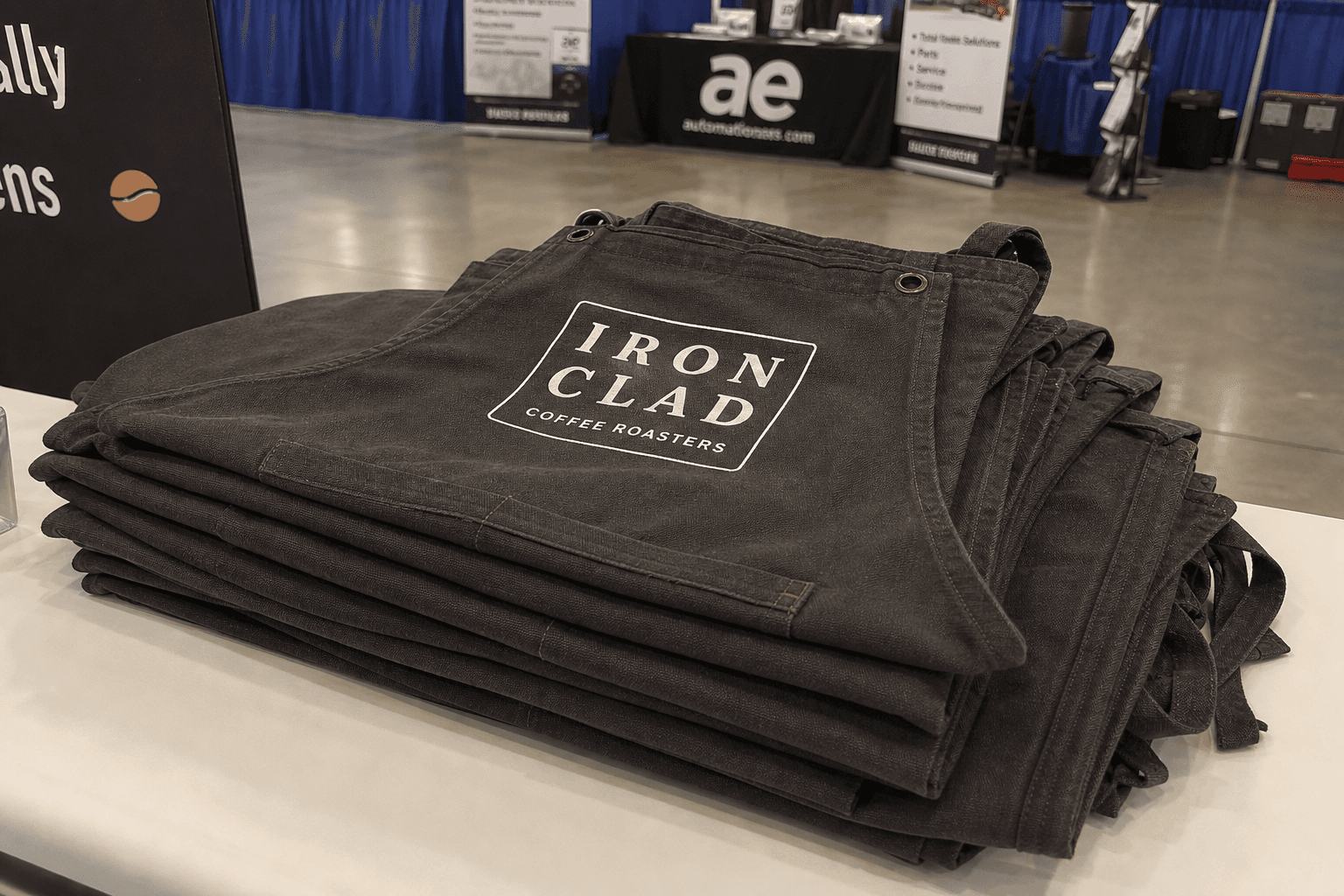
Screen printing is usually the fastest and most economical method for 1-3 spot colors. For 1,000 pcs with a one-color chest logo around 18 x 10 cm, screen print cost may be around USD 0.12-0.35 per piece depending on ink type and fabric. Setup charges may apply for screens, often USD 20-50 per color. For event aprons that are mainly used for 1-5 days, screen printing is normally sufficient if the artwork is clean and the print position is controlled.
Heat transfer is useful for gradients, small text and full-color logos, especially when the order quantity is lower, such as 300-800 pcs. It can give sharp results, but the hand feel may be more noticeable on lightweight fabric. Embroidery gives a premium look for a branded apron, but it adds stitch-time and can distort lightweight bib panels if the backing and hooping are not managed. A logo with 8,000-12,000 stitches may add USD 0.35-0.90 per piece and more production days compared with a simple print.
- Use screen print for one-color or two-color event logos where cost and speed are the priority.
- Use heat transfer when the artwork includes gradients, photo details or many small color changes.
- Use embroidery for executive gifts, hospitality staff or premium corporate apron gift sets.
- Avoid very small text below 4-5 mm height on coarse canvas because readability will drop.
- Confirm logo size on an actual apron panel, not only on a digital mock-up.
Promotional apron construction that keeps production moving
The fastest apron construction is usually a standard bib apron with neck strap, waist ties and one or two front pockets. This is not because factories cannot make more complex designs, but because standard construction has stable sewing minutes, known material consumption and predictable quality points. For event orders, reducing complexity protects the deadline.
A common adult bib apron size is 70 x 80 cm or 72 x 86 cm, with 90-100 cm waist ties and a 55-60 cm neck strap. For Western markets, longer ties may be needed so the apron can be tied at the front. For hospitality teams, an adjustable neck strap with metal buckle or plastic slider improves fit, but it adds accessory sourcing and sewing steps. If the deadline is tight, a fixed neck strap may be safer unless the buyer already uses a repeat style.
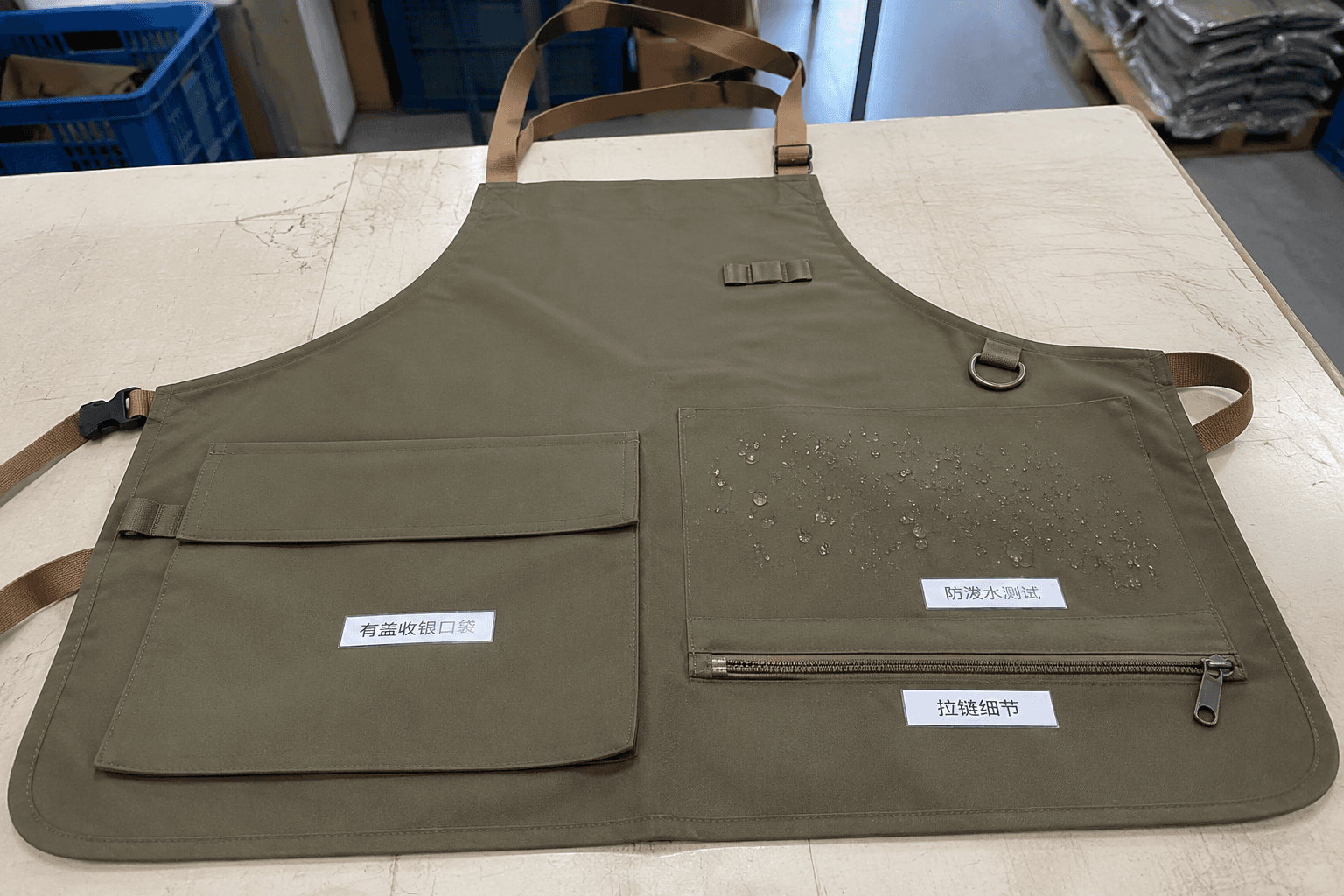
Pockets should match the actual event use. A large kangaroo pocket is useful for pens, order pads or tasting cards, but it can interfere with a lower logo placement. Two divided pockets look more organized for service staff. A chest pocket is possible, but if the main logo is printed on the upper bib, the pocket and logo may compete for space. These details should be settled before artwork is finalized.
- A standard bib apron normally has the lowest sewing risk for 1,000-10,000 pcs event orders.
- A waist apron is faster and cheaper, but it gives less visible branding area than a bib apron.
- A cross-back apron improves comfort for long wear, but it increases tape consumption and fitting checks.
- Metal eyelets, rivets and leather patches add perceived value, but they also add sourcing and inspection points.
- Pocket placement should be confirmed together with logo placement to avoid visual crowding.
Cost structure for a branded apron event order
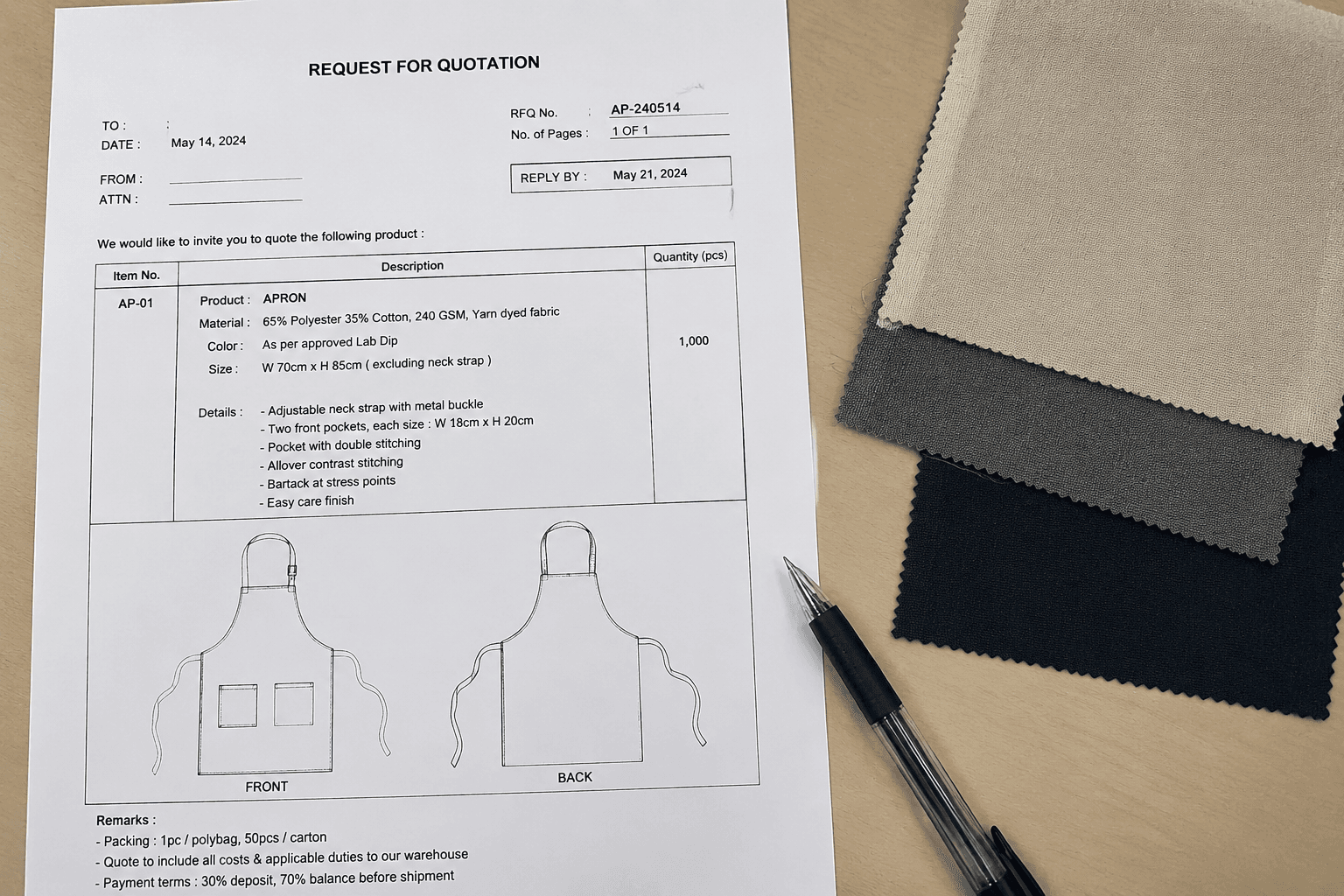
A branded apron quotation is built from fabric, trims, cutting, logo process, sewing, trimming, packing, wastage, inland transport and margin. When buyers compare quotes, they should check whether the same assumptions are included. One supplier may quote with 200 GSM polyester and bulk packing, while another quotes 240 GSM poly-cotton with individual polybags and carton labels. The price difference may not be a supplier margin issue; it may be a specification difference.
As a practical reference, a simple 200 GSM polyester promotional apron with one-color print may quote around USD 1.20-1.80 per piece at 3,000 pcs FOB China, depending on size and packing. A 240 GSM poly-cotton bib apron with one front pocket and one-color print may sit around USD 1.80-2.80 per piece. A 10 oz cotton canvas apron with embroidery, adjustable neck strap and divided pocket may be USD 3.20-5.50 per piece. These are not fixed market prices, but they show how fabric weight and logo method move the unit cost.
MOQ also depends on material and logo process. For stock fabric colors, 300-500 pcs can often be workable for a custom logo apron, although unit price will be higher. For custom dyed fabric, MOQ may be 1,000-2,000 pcs per color because the dyeing mill has minimum vat requirements. For special webbing, custom buckles or brand-specific packing, the MOQ can be driven by the trim supplier rather than the apron sewing line.
- Ask whether the quoted GSM is finished fabric weight or nominal supplier description.
- Confirm whether logo setup charges are included or listed separately.
- Check if the price includes individual polybags, hangtags, inserts or only bulk packing.
- Clarify whether the quotation is EXW, FOB Ningbo, FOB Shanghai or another trade term.
- Reserve 1-3% extra quantity for event staff changes, damaged cartons or last-minute additions.
Approval timeline for a custom logo apron
Fast turnaround depends on disciplined approvals. A factory can cut and sew quickly, but only after the buyer freezes the artwork, fabric, logo size, packing and carton marks. For a custom logo apron, the minimum approval path should include artwork check, material confirmation, logo strike-off and pre-production sample. If the order repeats an existing style, this can be compressed. If the style is new, skipping these steps creates risk at bulk inspection.
A typical timeline for 1,000-3,000 pcs may look like this: 1 day for quotation and specification review, 1-2 days for artwork adjustment, 2-4 days for logo strike-off, 2-3 days for sample sewing, 1 day for buyer approval, 10-15 days for bulk production, 1-2 days for final inspection and packing closure. This gives a total of around 18-28 days before export pickup. If the buyer requires courier delivery of a physical sample before approval, add 3-5 days for international courier time.
Digital mock-ups are useful for confirming position and scale, but they cannot replace a real logo strike-off when color, opacity and fabric texture matter. On black or dark fabric, white ink may need an underbase. On natural cotton canvas, the fabric shade can make a printed brand color look warmer. On polyester, heat transfer may look sharper than screen print for small details. These issues are best solved before bulk production starts.
- Day 1-2: confirm technical sheet, apron size, fabric choice and estimated quantity.
- Day 2-4: check AI, PDF or vector artwork and confirm logo dimensions in centimeters.
- Day 4-7: approve logo strike-off or embroidery sample photo with measurement reference.
- Day 7-10: approve pre-production sample, including pocket, ties, label and packing.
- Day 10 onward: start bulk cutting only after written approval to avoid mixed instructions.
Packing, freight and event delivery control
Packing is often treated as a final detail, but for event aprons it can affect both labor time and delivery performance. Bulk packing, such as 50 pcs per inner bag and 100 pcs per carton, is the fastest and lowest cost. Individual polybags add handling time but help event teams distribute aprons cleanly. A folded apron with a printed insert card can support a corporate apron gift program, but inserts need artwork approval, printing time and packing line control.
Carton planning should be discussed before shipment booking. A lightweight polyester apron may pack 100-150 pcs per carton, while a heavy canvas apron may only fit 40-60 pcs depending on carton size and folded thickness. If the aprons are shipped by air, volumetric weight can be more important than gross weight. A large carton with loose folding may increase freight cost even when the apron itself is inexpensive.
For fixed-date events, the buyer should decide early between sea, rail, truck-air combination or full air shipment. To the US or Europe, normal sea freight may take 25-40 days port to port, plus origin and destination handling. Air freight may take 5-10 days after goods are ready, but customs clearance and local delivery still need buffer time. For urgent orders, factories can sometimes split shipment: 10-20% by air for the opening event, with the balance by sea for later use.
- Use bulk packing when the event team will distribute aprons from a back office or warehouse.
- Use individual polybags when aprons are handed directly to staff, guests or franchise partners.
- Use size or department stickers only when the apron program includes multiple wearer groups.
- Print carton marks with event name, PO number, color and quantity to reduce receiving errors.
- Keep at least 3-5 days of arrival buffer before the event setup date, not only before the event opening date.
Quality checks before shipping a promotional apron order
Even for a short-use event apron, quality control should not be ignored. The inspection focus should match the product purpose: visible logo quality, correct color, clean stitching, usable ties, pocket function, packing count and carton labeling. A promotional apron may not require the same wash performance as a retail workwear apron, but it must look consistent when 200 staff stand together at a booth or service counter.
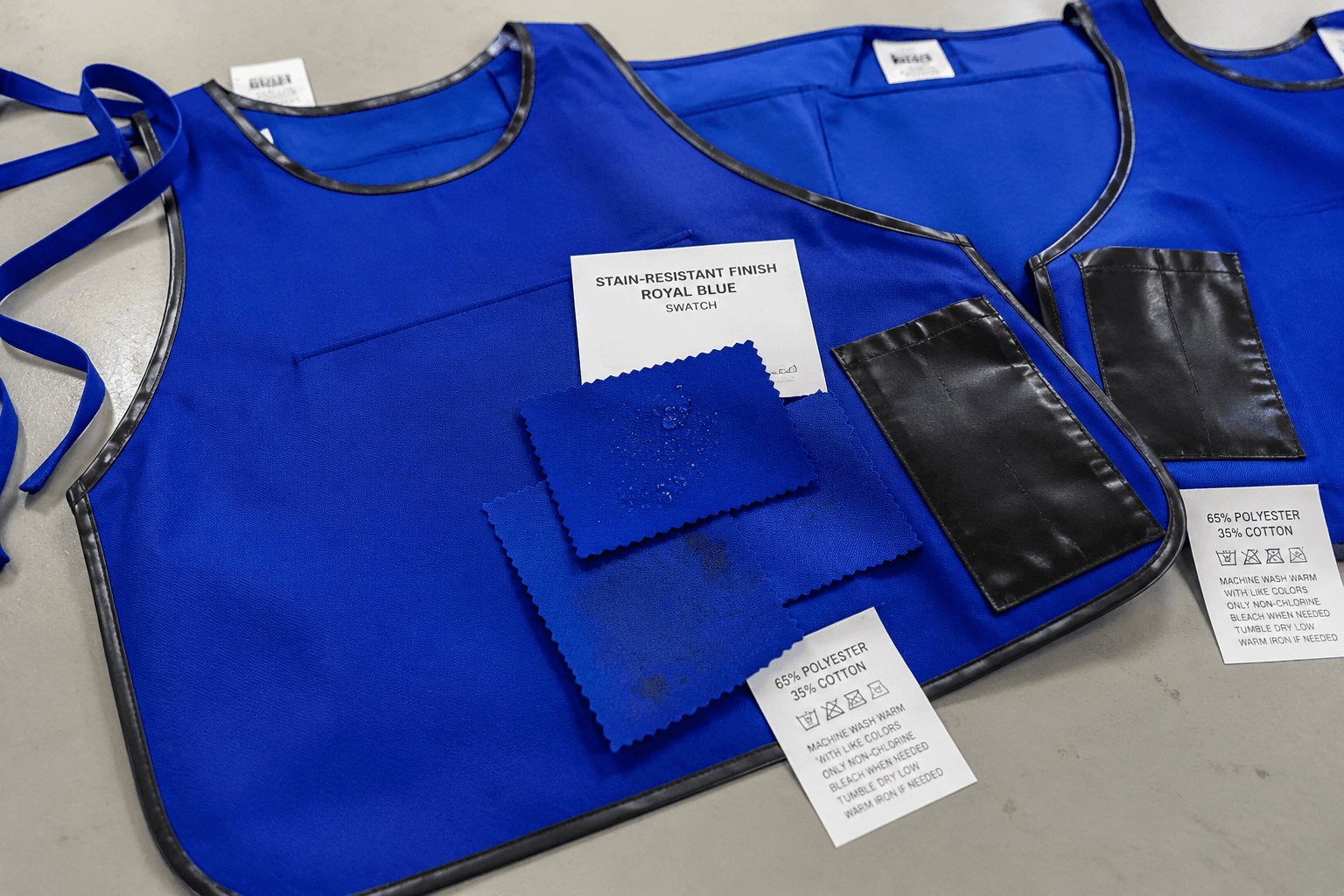
For dimensions, a practical tolerance is often +/-1 cm on main body width and length, and +/-2 cm on tie length, unless the buyer specifies tighter requirements. Logo placement tolerance is usually +/-0.5-1 cm depending on method and apron size. Color approval should be based on a physical fabric swatch or Pantone reference with agreed tolerance, because photos under factory lighting can mislead buyers. For print, the inspector should check cracking, smudging, pinholes, wrong position and inconsistent opacity.
The final inspection should happen after bulk packing but before shipment release. For event orders, rework time is limited, so in-line inspection during sewing and printing is also useful. A factory can check the first 20-50 pcs from each logo process and sewing line before continuing. This catches issues such as upside-down pocket panels, wrong neck strap length or logo shifted too low on the bib. The earlier the issue is found, the less calendar time is lost.
- Check logo color, size and position against the approved strike-off and pre-production sample.
- Measure apron body, neck strap, waist ties and pocket opening against the technical sheet.
- Inspect stitching at stress points, especially tie attachments and pocket corners.
- Confirm packing quantity per polybag, inner bag and export carton before carton sealing.
- Photograph carton marks and random packed units before shipment pickup.